
key takeaway
Expanded CalFresh time limits under H.R. 1 put millions of Californians at risk of losing food assistance, with impacts extending to children, families, and local economies.
All Californians deserve a fair chance at securing basic needs and the opportunity to thrive. However, deep cuts introduced through H.R. 1 have already taken effect, rendering many Californians ineligible for vital programs, like CalFresh — federally known as the Supplemental Nutrition Assistance Program (SNAP).
Specifically, on June 1, harsh CalFresh time limits were officially expanded to include several populations of adult participants, like veterans and people experiencing homelessness, who were previously exempted. Time limits, which restrict food assistance to three months unless participants can prove they are complying with certain work reporting requirements, have been shown to be a punitive and ineffective policy that pushes people off of vital programs. Since counties are on the front lines of administering CalFresh and implementing these requirements, the fiscal and administrative impact on counties, and therefore regional economies, is particularly important to understand.
Why Are the Newly Expanded Time Limits Harmful to All Californians?
Research shows that when parents or caregivers lose or receive reduced SNAP food assistance benefits, the effects extend to their entire family, directly impacting their children. Families whose SNAP benefits are reduced or terminated face a greater risk of food insecurity, poor health outcomes, and poverty. This suggests that expanding SNAP time limits could affect not only adults who lose benefits, but also their children and other household members who depend on those benefits to meet their basic needs.
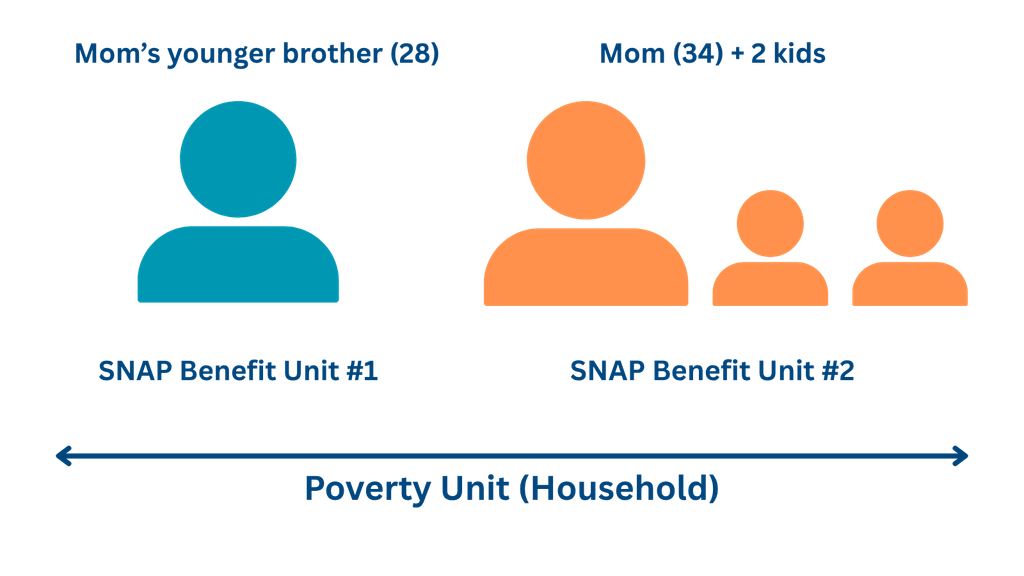
New data from the Stanford Center on Poverty and Inequality estimate that over three million people live in households — referred to in the data as poverty units — with someone who is at-risk of losing their CalFresh because they are subject to expanded time limits. SNAP benefit units include people in the same household who purchase and prepare food together, while poverty units capture people who live together and share household resources and expenses. SNAP benefit units may only capture some household members that together make up a whole poverty unit, meaning the loss of benefits for someone in a SNAP unit can also negatively impact the broader poverty unit. The data include children, older adults, Californians with disabilities, and others who, while not at risk themselves, could face adverse consequences if someone in their household loses their share of CalFresh benefits due to harsh time limits.
An Example Demonstrating the Relationship Between a Poverty Unit and a SNAP Benefit Unit
A low-income single mother and her two children share an apartment with her adult brother. Since they share the cost of household resources like rent and utilities they are considered a poverty unit. However, they pay for their food and prepare meals separately, so they are considered two separate SNAP units and receive their benefits independently. If the adult sibling loses CalFresh due to the expanded time limits, he may have to reallocate some of his monthly budget toward food. This may make the brother unable to afford his share of rent, jeopardizing the entire household’s stability.
How Do the Impacts of Time Limits Vary Across the State?
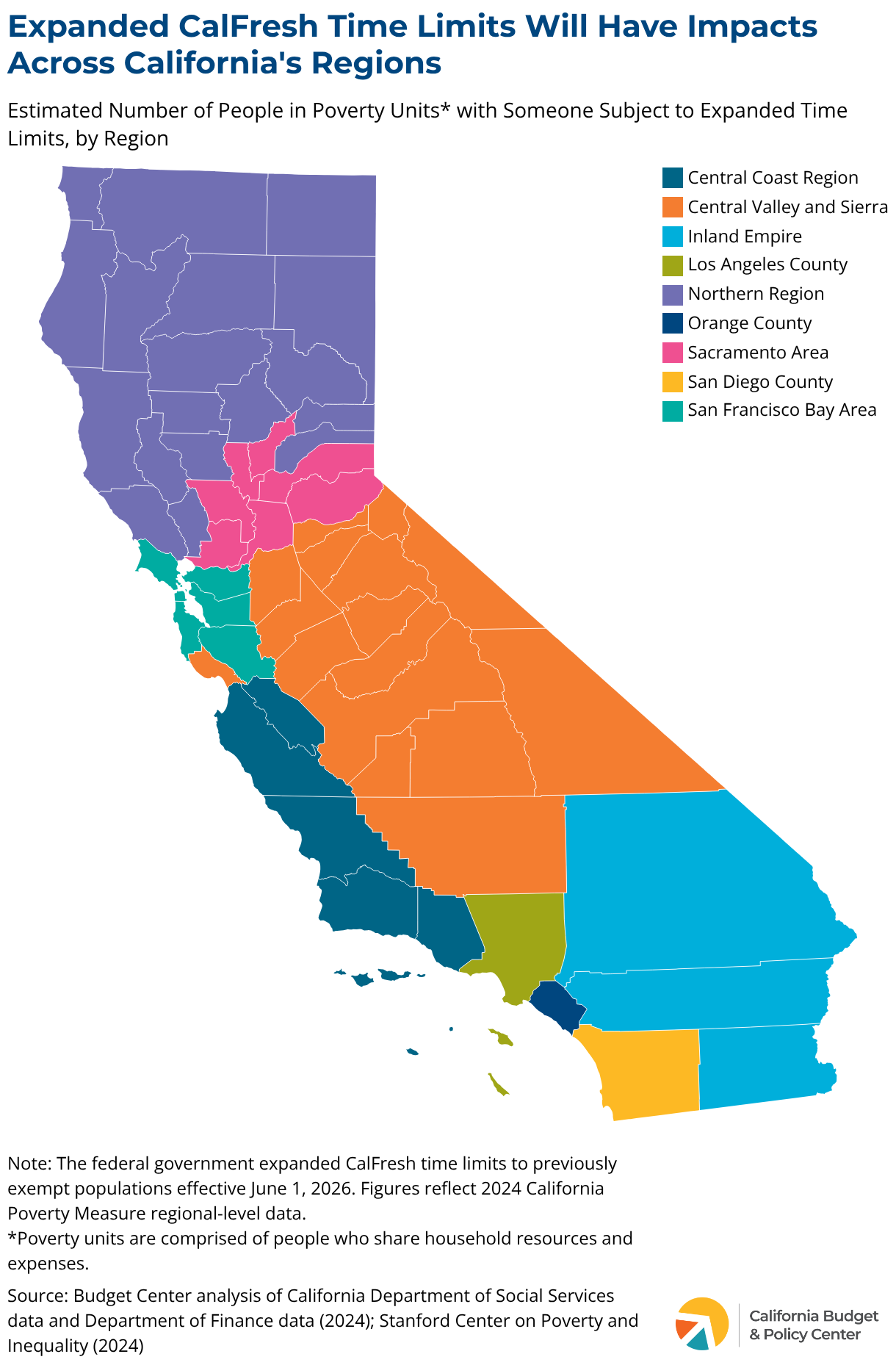
CalFresh is one of many programs that help fight poverty across the state. The Public Policy Institute of California estimates that CalFresh kept 850,000 people out of poverty in 2024. As people lose food assistance because of expanded time limits, poverty across the state is likely to increase, though the effects may vary by region given different population compositions and economic realities. The map below displays the estimated number of people in households with time-limited adults, including those newly subject to the policy. The regions estimated to be most impacted by expanded time limits include Los Angeles County, the Central Valley and Sierra region, the San Francisco Bay Area, and the Inland Empire.
Los Angeles County
Los Angeles County is the most populous county in the nation, with over 9 million residents from a variety of ethnic, professional, and geographic backgrounds. This diversity also means there are extremes on both ends of the spectrum when it comes to incomes and cost of living. These stark inequities are reflected in the region’s high share of unhoused Californians and higher than average poverty rates, which consequently make programs like CalFresh vital for 1.6 million Californians in the county.
Los Angeles County is estimated to have the highest number of people impacted by expanded time limits, with over 900,000 people living in households with someone now at-risk of losing their CalFresh benefits due to this expanded policy. This will likely tighten household budgets that are already strained by affordability pressures and force people to turn to community supports to secure food. The county is providing relief via food banks, but many are already overburdened. The Los Angeles Regional Food Bank reports experiencing unprecedented demand from those facing the realities of food assistance policy changes, and requires more support to meet the needs of all Los Angeles residents.
Central Valley and Sierra Region
The Central Valley and Sierra region is a core piece of the state and country’s economic success, producing about one-fourth of the food consumed in the United States. As the state’s farming hub, many of the counties in this region — like Fresno, Tulare, and Kern — are home to the largest number of workers in the agricultural sector. This makes CalFresh especially important since it provides economic returns directly to farmers. Research shows that when CalFresh participation declines, the economic activity generated by the program also suffers, directly reducing revenue for farmers like those in this region.
The program is also crucial for the 1 in 5 Central Valley and Sierra residents who rely on CalFresh benefits. Multiple counties in this region were granted a temporary waiver that exempts people in those counties from the CalFresh time limits. These waivers are given to counties with unemployment rates greater than 10%, underscoring the difficulty participants in these counties could face in securing stable employment that allows them to meet all the paperwork requirements to maintain CalFresh. Plus, many agricultural workers in the region have short-term employment contracts, so finding job opportunities that adhere to the three-month time limit may be especially difficult. All these factors could make it harder for the 477,000 Californians in this region estimated to be impacted, either directly or indirectly, by expanded time limits.
San Francisco Bay Area
While the San Francisco Bay Area region spans many diverse economies, it has historically been the center of technological innovation, particularly in areas like Silicon Valley. Even though this sector continues to rapidly grow and incomes are the highest in the state, for many in the region, a full-time job does not guarantee an economically secure life. This makes programs like CalFresh particularly important for fighting poverty and freeing up households’ dollars to put towards the rising cost of living. However, time limits under H.R.1 will make it harder for over 300,000 Bay Area residents who could be affected by the policy to escape or avoid poverty.
San Francisco County has utilized both philanthropy and local government resources in the past to help mitigate some of the harm of lapsed food assistance. Grocery gift cards were provided to households to help cover a portion of their grocery bills during last year’s government shutdown, but this type of solution may only work on a short-term basis.
Inland Empire
The Inland Empire is a fast-growing region that has attracted people looking for a more affordable cost of living. It has also seen a large spike in workforce growth, becoming a warehousing and transportation hub for the state. Despite this growth, wage disparities, lack of educational opportunities, and job insecurity remain key challenges among workers. The lack of job stability coupled with rising housing costs is likely to make it even harder for the 460,000 residents estimated to be impacted by expanded time limits to retain their CalFresh benefits or backfill lost assistance.
In response to other harmful food assistance policies, San Bernardino County, located within this region, has taken steps to proactively support local agencies to protect residents’ food benefits. The county invested in local resources to support CalFresh recipients with enrollment and benefit renewals. While these efforts help to mitigate harm, they are only sustainable in the short term, even though residents of the Inland Empire may face long-term adverse impacts. Many counties are doing their best to mitigate the negative impacts of H.R. 1, but administrative cost shifts and increased need require support from the state to address the projected harm.
How Can the State Address the Disparate Impact of H.R. 1 Across Regions?
The regional breakdown above demonstrates the very different economic realities for Californians who are at risk of losing food benefits due to expanded time limits. Regardless of these differences, all regions are grappling with a broader affordability crisis which is making it harder to afford basic necessities.
Because counties and localities are on the front lines of administering CalFresh and other benefits, it’s imperative the state supports California’s counties. Counties anticipate needing to spend between $6 and $9.5 billion annually to implement changes to Medi-Cal and CalFresh. In order to support Californians across the state in the near term as these changes take effect, policymakers should:
- Continue to provide counties with adequate funding to adhere to new administrative burdens and keep people enrolled in CalFresh.
- Continue to provide augmented funding to food banks as need rises.
- Provide supplemental nutrition benefits to bridge the gap in food assistance for families who are pushed off CalFresh.
Longer-term solutions that provide sufficient food assistance to all Californians in need and address the impacts of expanded time limits alongside other H.R. 1 policies will require ongoing investment in the coming years. To do so, the state should raise sustainable and ongoing revenue by ensuring corporations pay their fair share so local communities have the resources needed to protect Californians at risk of losing their CalFresh benefits due to expanded time limits and the broader adverse impact on others who live in their households.
Monica Saucedo contributed to this publication.