Table of Contents
- Why We Focus on the State Budget
- Key Takeaways
- Key Facts About California’s State Budget
- State Budget Terms That Every Budget Advocate Should Know
- The Constitutional Framework
- What Do the Governor and the Legislature Do?
- What Happens When?
- How Can Californians Participate in the State Budget Process?
- Advocacy Opportunities During Each Phase of the State Budget Process
- State Budget Resources
Why We Focus on the State Budget
Every year, California’s governor and Legislature adopt a state budget that provides a framework and funding for vital public services and systems — from child care and health care to housing and the safety net to colleges and TK-12 schools (transitional kindergarten through 12th grade).
But the state budget is about more than dollars and cents.
The budget expresses our values as well as our priorities for Californians and as a state. At its best, the budget should reflect our collective efforts to expand economic opportunities, promote well-being, and improve the lives of Californians who are denied the chance to share in our state’s wealth and who deserve the dignity and support to lead thriving lives.
State budget choices have an impact on all Californians. These decisions affect the quality of our schools and health care, the cost of a college education, families’ access to affordable child care and housing, the availability of services and financial support to help older adults age in place, and so much more.
Because the state budget touches so many services and our everyday lives, it is critical for Californians to understand and participate in the annual budget process to ensure that state leaders are making the strategic choices needed to allow every Californian — from different races, backgrounds, and places — to thrive and share in our state’s economic and social life.
This report sheds light on the state budget and the budget process with the goal of giving Californians the tools they need to effectively engage decision makers and advocate for fair and just policy choices.
Key Takeaways
The Bottom Line
- The state spending plan is about more than dollars and cents.
- Crafting the budget provides an opportunity for Californians to express our values and priorities as a state.
- The state Constitution establishes the rules of the budget process.
- Among other things, these rules allow lawmakers to approve spending with a simple majority vote, but require a two-thirds vote to increase taxes. Voters periodically revise the budget process by approving constitutional amendments.
- The governor has the lead role in the budget process.
- Proposing a state budget for the upcoming fiscal year gives the governor the first word in each year’s budget deliberations.
- The May Revision gives the governor another opportunity to set the budget and policy agenda for the state.
- Veto power generally gives the governor the last word.
- The Legislature reviews and revises the governor’s proposals.
- Lawmakers can alter the governor’s proposals and advance their own initiatives as they craft their version of the budget prior to negotiating an agreement with the governor.
- Budget decisions are made throughout the year.
- The public has various opportunities for input during the budget process.
- This includes writing letters highlighting their budget priorities, providing public comment at legislative hearings, and meeting with officials from the governor’s administration as well as with legislators and members of their staff.
- In short, Californians have ample opportunity to stay engaged and involved in the budget process year-round.
Key Facts About California’s State Budget
The State Budget = State Funds + Federal Funds
Three Kinds of State Funds
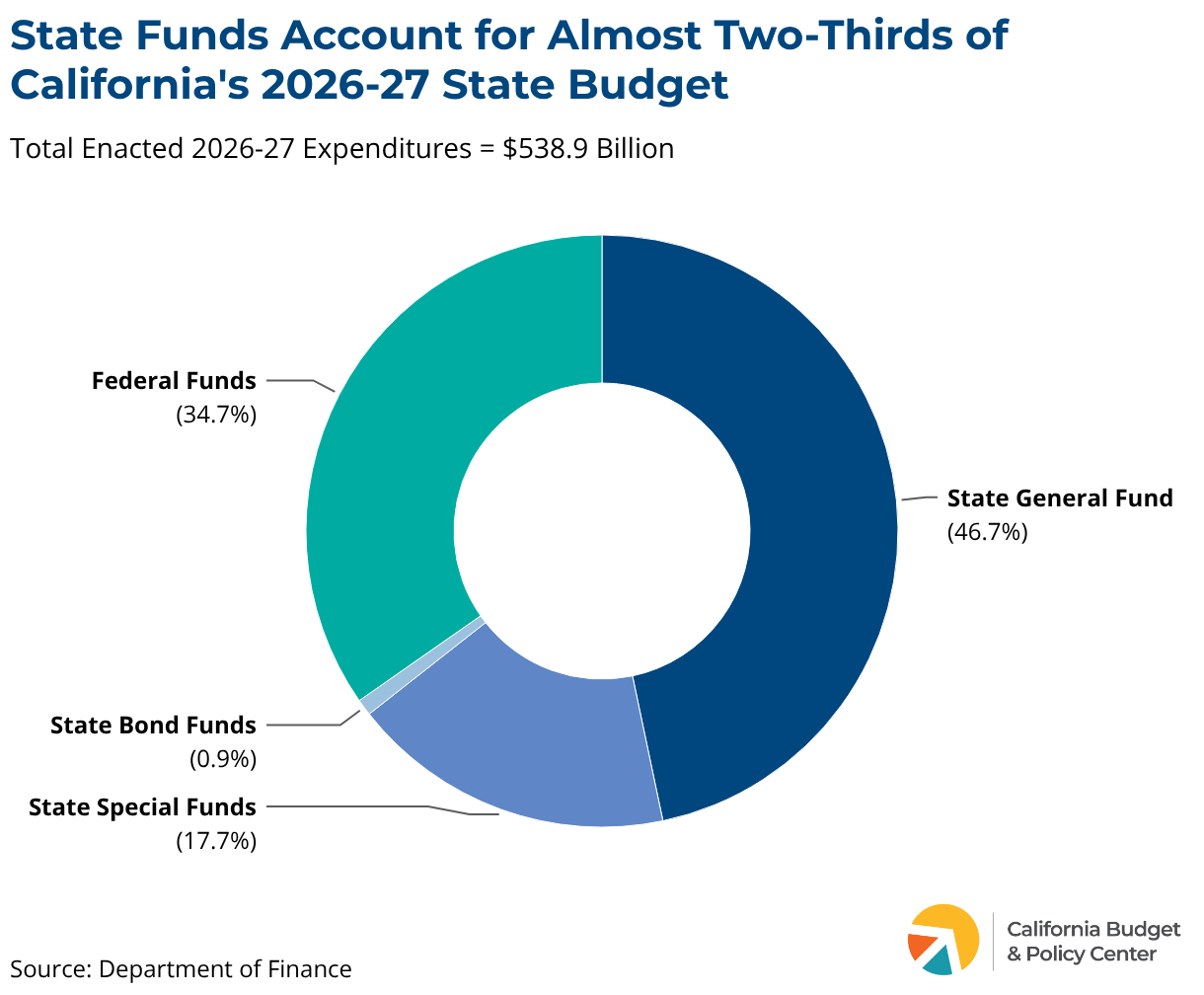
Three kinds of state funds account for almost two-thirds ($351.7 billion, or 65.3%) of California’s $538.9 billion budget for 2026-27, the fiscal year that began on July 1, 2026. Specifically:
- General Fund — The state General Fund accounts for revenues that are not designated for a specific purpose. Most state support for education, health and human services, and state prisons comes from the General Fund.
- Special Funds — Over 500 state special funds account for taxes, fees, and licenses that are designated for a specific purpose.
- Bond Funds — State bond funds account for the receipt and disbursement of general obligation (GO) bond proceeds.
Federal funds comprise the rest ($187.2 billion, or 34.7%) of the state’s 2026-27 budget.
Most State General Fund and Special Fund Revenue Comes from Three Sources
California’s “big three” taxes
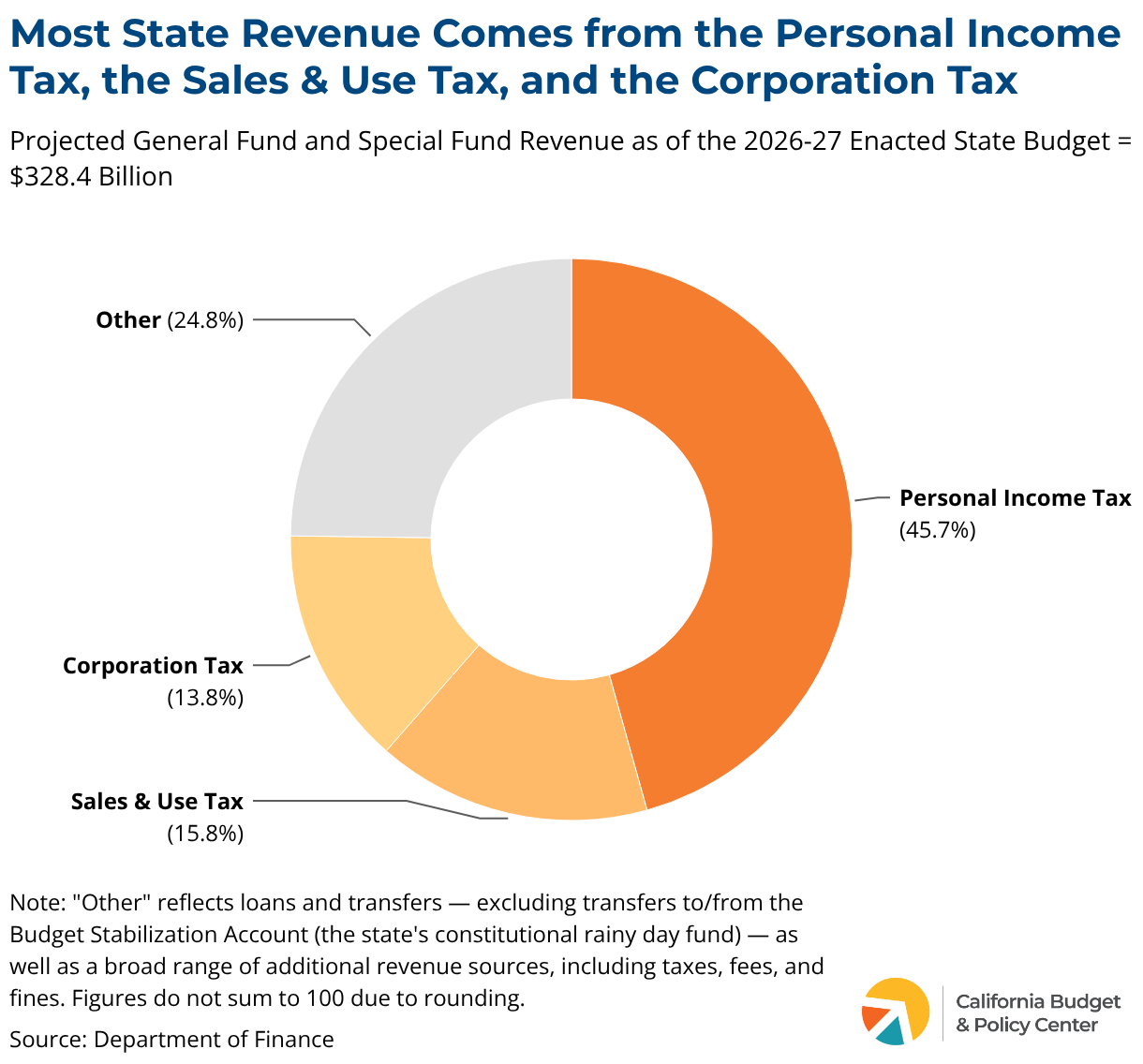
Most state revenue comes from California’s “Big Three” taxes. In 2026-27, General Fund and special fund revenue combined is estimated to total $328.4 billion, with more than three-quarters ($247.0 billion, or 75.3%) expected to come from the Big Three. California’s Big Three taxes are the:
- Personal income tax — This is a tax on the income of California residents as well as the income of nonresidents derived from California sources. It is California’s largest source of revenue.
- Sales & use tax — This is a tax on the purchase of tangible goods in California (the sales tax) or on the use of tangible goods in California that were purchased elsewhere (the use tax). Services are excluded from the sales and use tax, as are other items exempted by law, including groceries and medications. The sales and use tax is California’s second-largest source of revenue.
- Corporation tax — This is a tax imposed on corporations that do business in or derive income from California, with the exception of insurance companies, which instead pay the insurance tax. The corporation tax is California’s third-largest source of revenue.
Other state revenue is estimated to make up nearly one-quarter ($81.4 billion) of total projected General Fund and special fund revenue in 2026-27. This other revenue comes from a broad range of sources, including taxes, fees, and fines.
State Funds Primarily Support Health and Human Services or Education
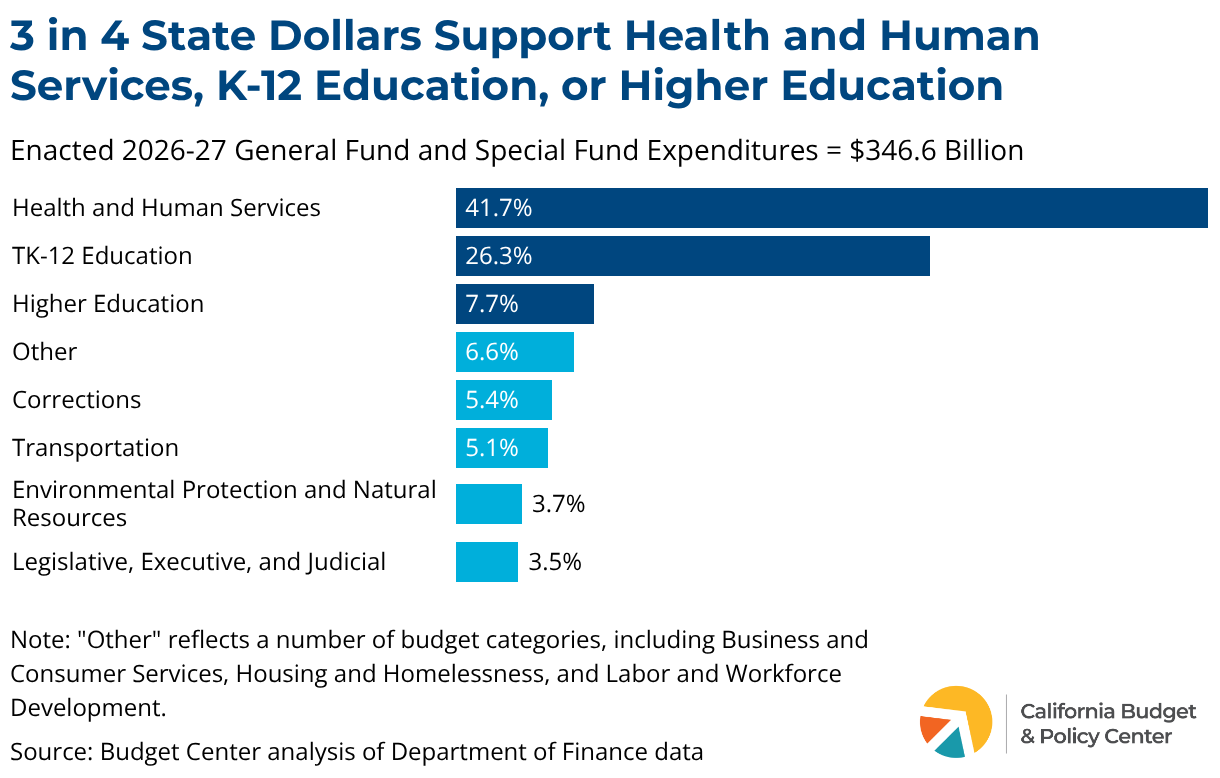
Under the enacted 2026-27 state budget:
- 3 in 4 General Fund and special fund dollars support three categories of spending:
- Health and human services (41.7%),
- TK-12 education (26.3%), and
- Higher education (7.7%).
- More than 5% of General Fund and special fund dollars go to corrections, primarily the state prison system.
- The balance of these dollars supports other essential services (such as transportation and environmental protection) and institutions (such as the state’s court system).
Federal Funds Primarily Support Health and Human Services
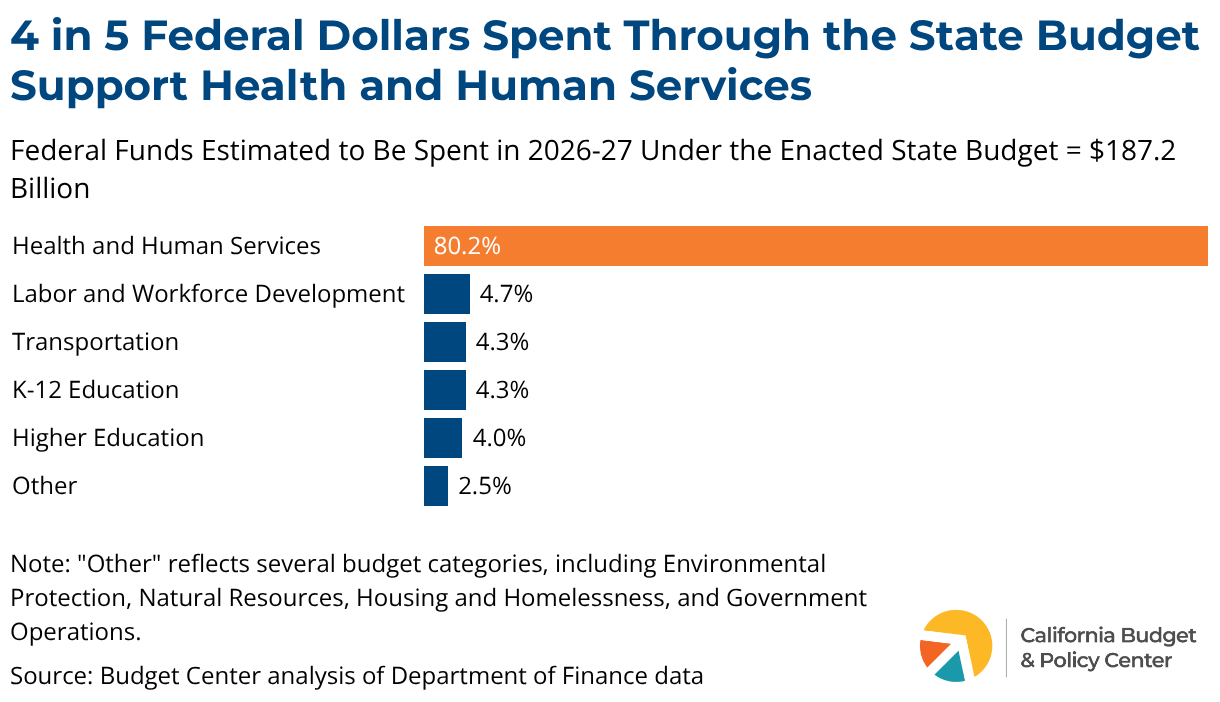
Under the enacted 2026-27 state budget:
- Four-fifths of federal dollars (80.2%) support health and human services programs.
- The balance of federal dollars supports other essential services, including labor and workforce development, K-12 education, higher education, and transportation.
The State Budget Is Part of a Package of Bills
The state budget never stands alone. Instead, it moves as part of a package of legislation that typically includes two to three dozen bills, and sometimes many more — particularly in years when there is a budget shortfall and state leaders need to make multiple changes to balance the budget. In 2026, Governor Newsom signed more than 40 budget-related bills.
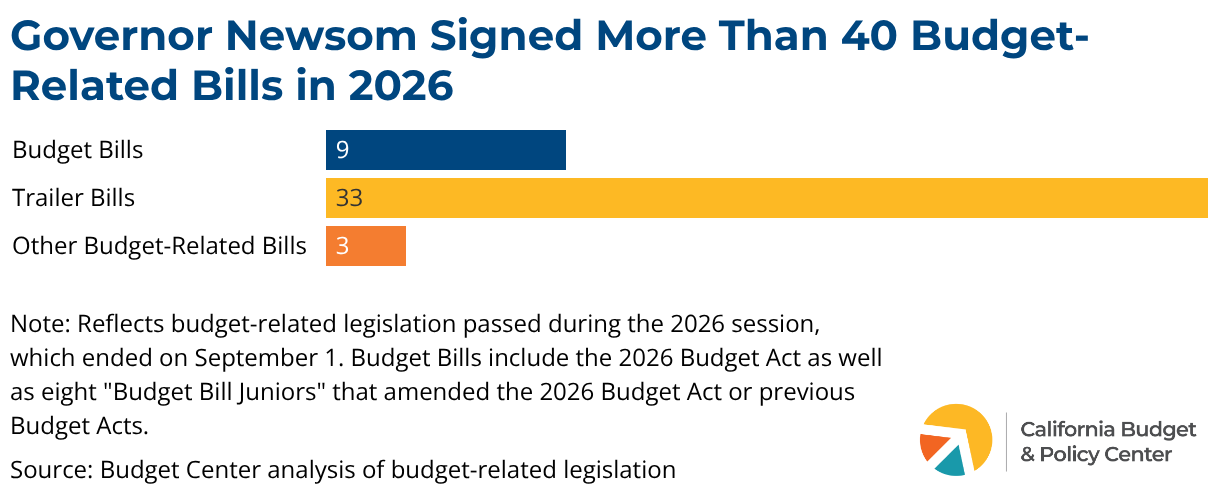
four kinds of budget-related bills
The budget package consists of two types of budget bills along with trailer bills and other budget-related legislation.
- Budget Act — The state budget is formally known as the Budget Act. The Budget Act is the initial budget bill passed by the Legislature and signed into law by the governor. In general, budget bills:
- Provide authority to spend money (“appropriations”) across an array of public services and systems for a single year.
- Move through the Legislature’s budget committees on their own timeline.
- Budget Bill Juniors — This is the informal term for any budget bill that amends the Budget Act, such as by increasing or reducing authorized expenditures. There is no limit on the number of Budget Bill Juniors that may be included in a budget package. This means state leaders can revise the Budget Act as many times as they wish by passing additional budget bills.
- Trailer bills — The state budget package also includes trailer bills. Trailer bills generally make changes to state law related to the Budget Act and, like budget bills, move through the Legislature’s budget committees. In addition, trailer bills:
- Must contain at least one appropriation and be listed in the Budget Act — a requirement that directly links trailer bills to the state budget.
- Are organized by major policy areas in the budget. For example, health-related changes would be included in a “health” trailer bill, housing-related changes would be included in a “housing” trailer bill, etc.
- Other budget-related bills — Other bills may be included in the budget package from time to time. These are bills that move independently of the Budget Act (and therefore are not trailer bills) but are still considered part of the state budget framework. This could include, for example, legislation to increase taxes or to place constitutional amendments before the voters as well as bills passed in a special session of the Legislature. This other budget-related legislation can move either through the Legislature’s policy committees or through budget committees.
State Budget Terms That Every Budget Advocate Should Know
Understanding budget lingo is crucial to effectively navigating California’s state budget process. This section highlights 10 key definitions drawn from the Budget Center’s glossary of state budget terms, which includes almost 100 budget-related words and phrases.
- Assembly Budget Committee and Senate Budget & Fiscal Review Committee
- Budget Act
- Budget Bill Jr.
- Department of Finance (DOF)
- Governor’s Budget Summary
- Governor’s Proposed Budget
- Legislative Analyst’s Office (LAO)
- Line-Item Veto
- May Revision
- Trailer Bill
The Constitutional Framework
The State Constitution Establishes the Rules of the Budget Process
The governor and legislators craft the state’s annual spending plan according to rules outlined in the state Constitution.
California voters periodically revise these rules by approving constitutional amendments that appear on the statewide ballot.
- Proposals to amend the state Constitution can be placed on the ballot through a citizens’ initiative or by the Legislature.
- A constitutional amendment takes effect if approved by a simple majority of voters.
Three Key Budget Deadlines
Two in the State Constitution (January 10 and June 15), One in State Law (May 14)
Prop. 25: Simple Majority Vote for Budget Bills and Trailer Bills
The budget package generally may be passed by a simple majority vote of each house of the Legislature.
- Prop. 25 of 2010 allows lawmakers to pass, by a simple majority vote, budget bills as well as trailer bills that may take effect as soon as the governor signs them.
- Under the rules of Prop. 25, trailer bills must (1) be listed in the Budget Act and (2) contain an appropriation of any amount.
- Even with Prop. 25, some types of trailer bills that could be included in a budget package will require a supermajority — generally two-thirds — vote of each house. This includes, for example, bills that would raise taxes or amend a state law that was approved by voters via a ballot initiative. However, most trailer bills in the budget package will need only a simple majority vote to pass.
Prop. 25: Penalties for a Late Budget
Lawmakers face penalties if they fail to pass the budget bill on or before June 15.
- Prop. 25 requires lawmakers to permanently forfeit both their pay and their reimbursement for travel and living expenses for each day after June 15 that the budget bill is not passed and sent to the governor.
- These penalties do not apply to budget-related bills, which do not have to be passed on or before June 15.
Prop. 26: Supermajority Vote for Tax Increases
Any tax increase requires a two-thirds vote of each house of the Legislature.
- Under the state Constitution, “any change in state statute which results in any taxpayer paying a higher tax” requires a two-thirds vote of each house.
- This standard was imposed by Prop. 26 of 2010. This measure expanded the definition of a tax increase and thus the scope of the two-thirds vote requirement, which was originally imposed by Prop. 13 of 1978.
- Prior to Prop. 26, only bills changing state taxes “for the purpose of increasing revenues” required a two-thirds vote. Bills that increased some taxes but reduced others by an equal or larger amount could be passed by a simple majority vote of each house.
Prop. 26: Supermajority Vote for Tax Increases
Prop. 26 of 2010 also expanded the definition of a tax to include some fees.
- Prior to Prop. 26, lawmakers could create or increase fees by a simple majority vote. These majority-vote fees included regulatory fees intended to address health, environmental, or other problems caused by various products, such as alcohol, oil, or hazardous materials.
- Prop. 26 reclassified regulatory and certain other fees as taxes. As a result, a two-thirds vote of each house of the Legislature is now required for many charges that previously were considered fees and could be passed by a simple majority vote.
Additional Supermajority Vote Requirements
The state Constitution requires a two-thirds vote of each house of the Legislature in order to:
- Appropriate money from the General Fund, except for appropriations that are for public schools or that are included in budget bills or in trailer bills.
- Pass bills that take effect immediately (urgency statutes), except for budget bills and trailer bills.
- Place constitutional amendments or general obligation bond measures before the voters.
- Override the governor’s veto of a bill or an item of appropriation.
Prop. 54: A Bill Must Be Published for At Least 72 Hours Before the Legislature Can Act on It
Prop. 54 of 2016 requires bills to be distributed to legislators and published on the Internet, in their final form, at least 72 hours before being passed by the Legislature.
This rule applies to all bills, including the budget bill and other legislation included in the budget package.
This mandatory review period can be waived for a bill if:
- The governor declares an emergency in response to a disaster or extreme peril, and
- Two-thirds of legislators in the house considering the bill vote to waive the review period.
Prop. 98: A Funding Guarantee for TK-12 Schools and Community Colleges
Prop. 98 of 1988 guarantees a minimum annual level of funding for TK-14 education.
- The amount of the guarantee is calculated each year based on one of three tests that apply under varying fiscal and economic conditions. Two of these tests include adjustments for changes in statewide TK-12 attendance. Prop. 98 funding comes from the state General Fund and local property tax revenues.
- The Legislature can suspend the guarantee for a single year by a two-thirds vote of each house and provide less funding. Following a suspension, the state must increase Prop. 98 funding over time to the level that it would have reached absent the suspension.
- While the Legislature can provide more funding than Prop. 98 requires, the guarantee has generally served as a maximum funding level.
Prop. 2: Saving for a Rainy Day, Paying Down Debt
Prop. 2 of 2014 revised the rules that apply to the Budget Stabilization Account (BSA) — the state’s constitutional rainy day fund — and also established a new requirement to pay down state budgetary debt.
- The state is required to set aside 1.5% of General Fund revenues each year, plus additional dollars in years when tax revenues from capital gains are particularly strong.
- Until 2029-30, half of the revenues go into the BSA and the other half must be used to pay down state budgetary debt, which includes unfunded pension liabilities. Starting in 2030-31, the entire annual transfer goes into the BSA.
- State policymakers may suspend or reduce the BSA deposit and withdraw funds from the reserve, but only under limited circumstances that qualify as a “budget emergency.”
Prop. 2: A Budget Reserve for TK-14 Education
Prop. 2 of 2014 also created a state budget reserve for TK-12 schools and community colleges called the Public School System Stabilization Account (PSSSA).
- Deposits come from state capital gains tax revenues in years when those revenues are particularly strong.
- However, various conditions must be met before these dollars could be transferred to the PSSSA. For example, transfers may occur only in so-called “Test 1” years under Prop. 98, which have been relatively rare.
Prop. 55: Potential New Funding for Medi-Cal From a Tax on the Wealthiest Californians
Prop. 55 of 2016 extends, through 2030, personal income tax rate increases on very high-income Californians and establishes a formula to boost funding for Medi-Cal, which provides health care services to Californians with low incomes.
- Starting in 2018-19, General Fund revenues — including those raised by Prop. 55 — must first be used to fund (1) the annual Prop. 98 guarantee for K-12 schools and community colleges and (2) the cost of other services that were authorized as of January 1, 2016, as adjusted for population changes, federal mandates, and other factors.
- If any Prop. 55 revenues remain after meeting these required expenditures, Medi-Cal would receive 50% of this excess, up to a maximum of $2 billion in any fiscal year.
- Prop. 55 has not yet resulted in any additional funding for Medi-Cal.
Prop. 4: State Appropriations Limit (SAL) — A Cap on Spending
Appropriations are subject to a limit established by Prop. 4 of 1979, as modified by later initiatives. This spending cap is known as the Gann Limit.
- The SAL limits the amount of state tax proceeds that can be appropriated each year. This limit is adjusted annually for changes in population and per capita personal income.
- Some appropriations from tax proceeds do not count toward the limit, including debt service and spending that is needed to comply with court or federal mandates.
- Revenues that exceed the SAL over a two-year period are divided equally between Prop. 98 spending and taxpayer rebates. The state last exceeded the SAL in 2020-21 (but did not do so in the prior year).
State Mandates: Pay for Them or Suspend Them
The state must pay for or suspend mandates that it imposes on local governments.
- Prop. 4 of 1979 requires the state to reimburse local governments for costs related to a new program or a higher level of service that is mandated by the state.
- Prop. 1A of 2004 expanded the definition of a mandate to include the transfer of
financial responsibility from the state to local governments. - Prop. 1A also requires the state to suspend a mandate in any year in which local
governments’ costs are not fully reimbursed.
What Do the Governor and the Legislature Do?
The governor and state legislators play key roles in the state budget process.
The Governor’s Role
California has long had an executive-centered budget process that gives significant authority and power to the governor and the Department of Finance (DOF), which leads the development of the governor’s budget proposals. The governor:
- Approves, modifies, or rejects spending proposals prepared by state departments and agencies through an internal process coordinated by the DOF.
- Proposes a spending plan for the state each January, which is introduced as the budget bill in the Legislature.
- Updates and revises the proposed budget each May (the “May Revision”).
- Signs or vetoes the bills included in the budget package.
- Can veto all or part of individual appropriations (line items), but cannot increase any appropriations above the level approved by the Legislature.
The Legislature’s Role
Legislators also play a key role in the budget process by reviewing, revising, and adding to the governor’s proposals, with help from the Legislative Analyst’s Office, commonly known as the LAO. The Legislature:
- Approves, modifies, or rejects the governor’s budget proposals.
- Can add new spending or make other changes that substantially revise the governor’s proposals.
- Needs a simple majority vote of each house to pass budget bills and most trailer bills.
- Needs a two-thirds vote to pass certain other bills that may be part of the budget package, including bills that increase taxes or that propose constitutional amendments.
- Needs a two-thirds vote of each house to override the governor’s veto of a bill or an appropriation.
What Is the Role of the Legislature’s Budget Subcommittees in the State Budget Process?
The work of the Assembly Budget Committee and the Senate Budget and Fiscal Review Committee largely happens through subcommittees. Each subcommittee — seven in the Assembly and five in the Senate — focuses on a specific policy area or set of policy areas, like health, housing, or education.
Budget subcommittees have a number of roles in the state budget process. For example, they:
- Hold dozens of hearings from February to May to review the governor’s proposals, which they can approve, modify, or reject.
- Meet with policy advocates to understand their priorities and gather intel on what’s happening in a specific policy space.
- Evaluate budget requests (or “asks”) submitted by advocates and legislators and decide which to include in their own budget plans that they work on throughout the spring.
- Finalize the Assembly and Senate versions of the budget, which are later combined into a unified legislative budget plan that is typically unveiled in late May or early June.
What Happens When?
The state budget process is cyclical, with no clear stop and start dates. State leaders develop and revise the budget during three distinct periods: July to December, January to mid-May, and mid-May to June. The following sections highlight major budget-related events and activities during each of these periods.
July to December
Work on the state budget during July to December is focused on two areas: 1) revising the June budget package (that is, the budget-related bills signed into law by the governor early in the summer), and 2) preparing for the next state fiscal year.
January to Mid-May
The release of the governor’s proposed budget is the signature event of this period. The Legislature convenes dozens of public hearings to review the governor’s plan.
Mid-May to June
The unveiling of the governor’s revised budget (the May Revision) kicks off this period, which also includes the release of the joint Assembly-Senate budget plan and the announcement of a three-way budget deal between the governor and legislative leaders.
How Can Californians Participate in the State Budget Process?
Californians can inform and influence budget choices by engaging with legislators and their staff as well as with executive branch officials.
Building Relationships Is Key to Effective Advocacy
Building relationships with policymakers and staffers in the Legislature and in the governor’s administration is the foundation of effective budget advocacy.
The Capitol runs on relationships: Who you know is critical to advancing your budget priorities, so it’s important to lay the groundwork for influence by building familiarity and trust with key players in the process by reaching out and scheduling a time to meet in person or virtually. Autumn can be the best time to reach out because workloads tend to be lighter, but it’s never too late to start.
Because turnover can be high in the Legislature and in the governor’s administration, it’s important to pay constant attention to relationship-building. There are always new faces to become acquainted with, so the work of relationship-building never ends.
Californians Have Many Ways to Make Their Voices Heard
With relationships as a foundation, there are a range of tactics that advocates can use to ensure that their voices are heard in the state budget process. For example, you can:
Submit “budget letters” to policymakers outlining your budget priorities.
- The public’s role includes writing letters that highlight your budget priorities and providing them to legislators and the governor’s administration.
- Budget letters and other comments should be submitted to the Assembly Budget Committee and the Senate Budget and Fiscal Review Committee using the dedicated email addresses shown at the top of each committee’s home page.
- While it’s acceptable to send information directly to budget committee consultants’ work emails, advocates should use this option prudently given the high volume of emails that committee consultants receive.
- However, advocates should never send “spam” emails directly to budget committee consultants. These are email templates that hundreds or thousands of people can use to send the same message to policymakers and staff. Those kinds of emails should go to the dedicated budget committee email addresses instead.
Schedule meetings with key policymakers and staff in the Legislature and in the governor’s administration.
- Building relationships is crucial to effective advocacy, so it’s important to lay the groundwork for influence by reaching out and scheduling times to meet with key legislators and their staff — particularly on the budget committees and in leadership positions — as well as with key contacts in the governor’s administration.
Provide public comments and — if invited — testify as part of a panel at budget subcommittee hearings.
- You can share your views during public comment periods at budget subcommittee hearings.
- Committee chairs set time limits for each public comment. Sometimes the limit is 1 minute, but it’s often shorter and may only include enough time for you to deliver a “me too” comment — name, organization, and position on the issue.
- In addition, when invited by committee staff, you can provide testimony at a budget subcommittee hearing, which provides more time to share expertise on an issue as well as personal stories, which can be very impactful.
Participate in “lobby days” at the Capitol, joining forces with a broad range of advocates.
- Lobby days can be impactful — these events bring together hundreds or even thousands of advocates who join forces to focus media and policymakers’ attention on key policy issues, including those affecting health, child care, economic security, and housing.
Advocacy Opportunities During Each Phase of the State Budget Process
Californians can press for their budget priorities throughout the year. This section outlines what you can do during each phase of the state budget process: July to December, January to mid-May, and mid-May to June.
Advocacy Opportunities: July to December
quick take: quietest period of the state budget process
Much happens behind the scenes from July to December, particularly in the governor’s administration, but advocates still have opportunities to make their voices heard
Watch for budget developments in August that affect the issues you work on and be prepared to weigh in on any new proposals.
Schedule introductory meetings with staffers in the Legislature and in the governor’s administration who will be helpful to know for your advocacy.
- For the Legislature, check the Assembly and Senate websites to see which budget committee consultants focus on your issues and get their email addresses.
- For the governor’s administration, start with organizational charts that show who works in the Governor’s Office (the governor’s “inner circle” of advisers) and in key positions in the state departments and agencies. For contacts in the Department of Finance, see this chart of responsibilities.
Share your budget priorities with:
- Key contacts in the Governor’s Office and in state departments, asking for your priorities to be included in the governor’s January 10 budget proposal.
- Budget committee consultants as well as staff who work for legislative leadership (Assembly Speaker and the Senate President pro Tem).
Advocacy Opportunities: January to Mid-May
quick take: heart of the budget process
January to mid-May is the period with the most consistent and transparent opportunities for public engagement.
Write letters outlining your priorities, including weighing in on the governor’s January proposed budget. Deliver budget letters to the Assembly and Senate budget committee members and staff, legislative leadership, and the Governor’s Office.
Meet with contacts in the Governor’s Office and state departments to discuss the January proposed budget’s approach to education funding and policy and share your ideas for how to improve the governor’s proposals in the May Revision.
Look for opportunities to meet with key contacts in the Legislature to share your priorities and perspectives, including key staff and the chairs of the budget subcommittees.
Draw attention to your issues by:
- Taking advantage of public comment periods during budget hearings,
- Focusing on storytelling (including highlighting real-world impacts of policy actions/inaction), and
- Organizing public actions to raise awareness and garner local and statewide media coverage.
Advocacy Opportunities: Mid-May to June
quick take: fastest-moving period of the budget process
The quick pace during the mid-May to June period can make advocacy challenging as policymakers make major decisions in a short period of time.
Share your views on the May Revision (the governor’s revised budget) during the public comment periods at budget subcommittee hearings.
Urge key legislative staff and members to include your budget priorities in the joint Assembly-Senate budget plan — assuming your idea hasn’t already been embraced by either house or by the governor.
If the Legislature adopts your idea but the governor’s position is questionable or negative, look for ways to move the governor to yes. This could include bringing grassroots pressure to bear, publishing op-eds in key media outlets, and garnering favorable media attention for your cause.
State Budget Resources
- Department of Finance: The governor’s budget proposals and related documents.
- Legislative Analyst’s Office: Budget and policy analyses, budget recommendations, and historical budget data.
- Legislative Counsel: Bills and bill analyses, a free bill-tracking service, the state codes, and the state Constitution.
- State Assembly and Senate: Committee agendas and other publications, floor session and committee schedules, the annual legislative calendar, and live and archived video streaming of legislative proceedings.