
key takeaway
Expanding the California Young Child Tax Credit would strengthen affordability for families with low incomes, promote racial equity, and reach immigrant families left out of federal tax credits, as federal cuts in the 2025 megabill, H.R. 1, deepen economic hardship for millions across the state.
Around 7 million Californians consistently struggle to make ends meet due to factors like unaffordable housing costs and rising food costs, which are straining already tight household budgets. These intense affordability pressures will increase as the debilitating federal cuts to food assistance and health care from H.R. 1 — the harmful Republican megabill — begin to materialize, likely driving up already high rates of poverty and food insecurity.
At a time when the federal government is making it harder for families to meet their basic needs, California leaders should do more to use the tools they have to address affordability challenges. Specifically, policymakers should seize the opportunity to expand California’s Young Child Tax Credit (YCTC) to all low-income families with dependent children, providing a much-needed boost to their incomes.
The Young Child Tax Credit Benefits Families Across the State
Refundable state tax credits are proven tools that help families better afford everyday expenses, like food, rent, and other necessities. Collectively, refundable state tax credits have put billions of dollars back into the pockets of families and individuals with low incomes, and have been linked to long term benefits for children’s well-being. California’s YCTC is a fully refundable state credit established in 2019 that directly boosts the incomes of families with earnings of $32,900 or less and at least one child between the ages of 0 and 5.
WHAT IS A REFUNDABLE INCOME TAX CREDIT?
A refundable income tax credit is a type of credit that benefits families and individuals with very low incomes. The credit provides the same value regardless of how much tax filers owe in personal income taxes. For example, a family that qualifies for a $500 refundable credit and owes $200 in taxes will get the full $500 credit, with $200 covering their taxes and $300 as a cash refund. If the family owes no tax, they will get the full $500 as a cash refund.
The impact of the YCTC is sweeping, with roughly 400,000 families across the state benefiting from the credit each year. Most of these families receive the maximum credit, which in tax year 2025 is $1,189 — enough to cover the cost of six months of utilities for a family living in Los Angeles County. Families with the lowest incomes, including those without any earnings, receive the maximum credit — a contrast from federal refundable tax credits as well as other state tax benefits. The YCTC also helps to promote racial equity, with the majority of families eligible for YCTC being communities of color.
State Leaders Should Expand the YCTC to More Families with Low Incomes
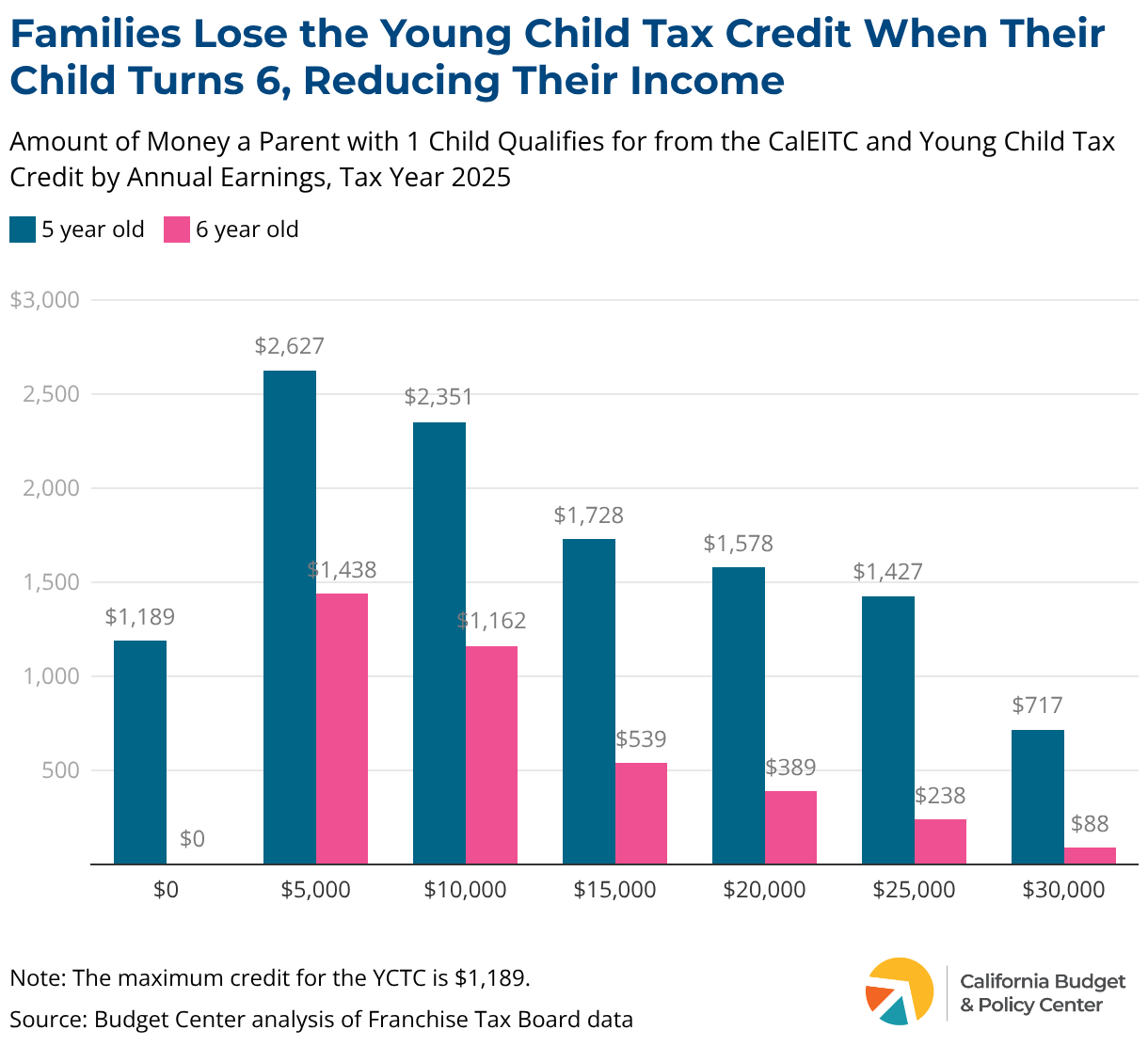
Expanding the YCTC to reach all low-income families with dependent children — not just those ages 0 to 5 — would help more families meet basic needs in the face of mounting affordability challenges that will worsen as federal cuts take effect. Currently, because the YCTC is limited to families with young children, about 60% of families with low incomes are excluded from the credit. However, all low-income families with dependent children are feeling increased pressures from the rising cost of living and would benefit from the meaningful income boost this credit provides.
Extending the YCTC to low-income families with dependent children ages 6 to 18 would also prevent the sudden loss in income families face when their youngest child turns 6 and they lose access to the credit. For most families this means a loss of $1,189 — an amount that could cover almost 2 months’ worth of groceries for a family living in Los Angeles County.
Although most families who lose the YCTC still qualify for California’s Earned Income Tax Credit — the CalEITC — this credit alone does not provide families with adequate support. For example, a parent with one child making $15,000 per year would qualify for $1,728 in combined YCTC and CalEITC benefits when their child is age 5. However, when their child turns 6, they would only be eligible for the CalEITC, which would provide just $539 — an almost 70% decrease in benefits. Losing the YCTC is especially difficult for families with no earnings from work — who are most in need of income support — because it is the only refundable tax credit these families are eligible for.

Expanding the YCTC Will Benefit Immigrant Families Targeted by Federal Cuts to the Child Tax Credit
Expanding the YCTC to all low-income families with dependent children is also a key way state leaders can support immigrant families who are facing compounding federal threats to their safety, access to food assistance, and health care. Unlike federal refundable tax credits, California’s credits are inclusive of immigrants, recognizing that all people who pay taxes deserve to benefit from tax credits. Over 35,000 families who file taxes with Individual Tax Identification Numbers (ITINs) benefit from the YCTC each year. ITINs are issued by the Internal Revenue Service to individuals who do not have Social Security Numbers to use to file their personal income taxes.
In contrast, federal tax credits largely leave behind immigrant families who have ITINs. The federal Earned Income Tax Credit (EITC) is not available to any adult or child with an ITIN and since 2017, the federal Child Tax Credit (CTC) has excluded children with ITINs. H.R. 1 makes the federal CTC even more exclusionary by requiring at least one parent to have a Social Security Number (SSN) valid for work in order to be eligible for the credit starting in tax year 2025.
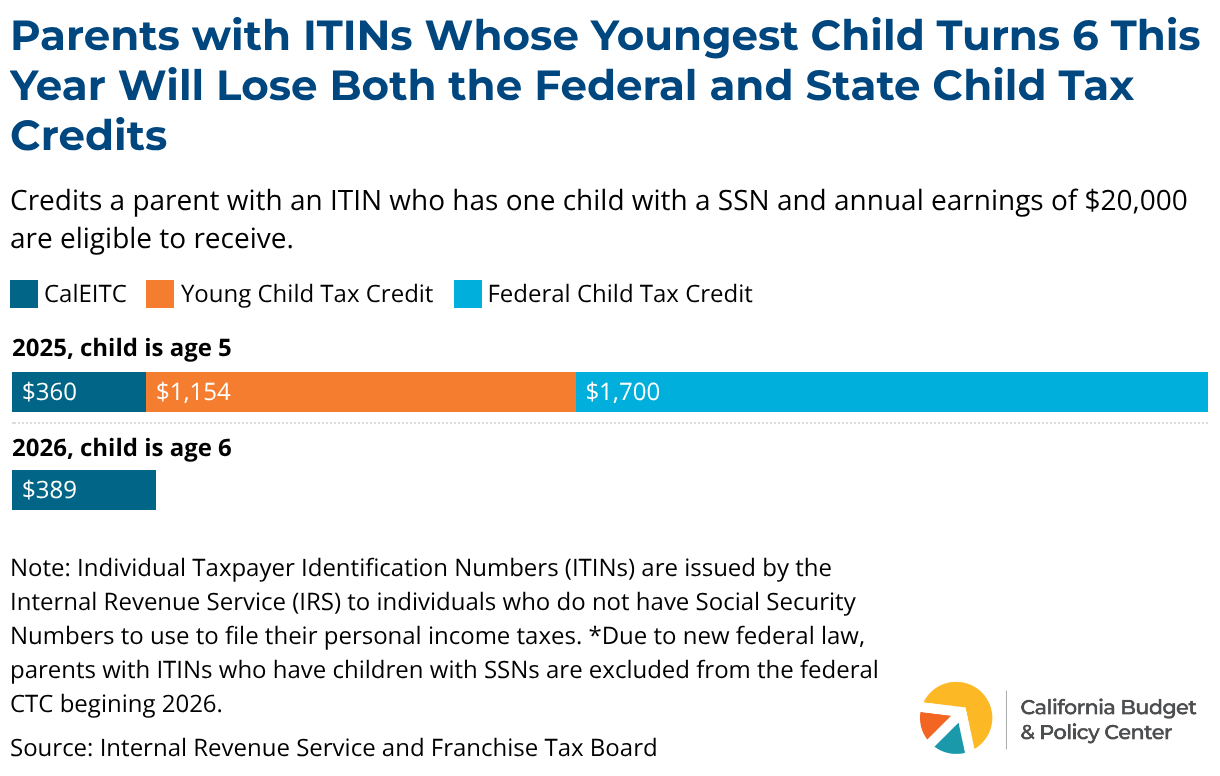
This means that parents with ITINs whose youngest child turns 6 this year will lose both the federal CTC and YCTC. For a single parent with one child and annual earnings of $20,000, the loss of both these credits is equivalent to a reduction of almost $3,000 in income — money that could have gone toward necessities like child care, groceries, or rent. This cut comes amidst harmful federal actions that are creating increased economic uncertainty for immigrant families, potentially leaving parents with less money to support their families. Expanding the YCTC can help to alleviate some of the acute stress placed on immigrant household budgets by offering more families the opportunity to claim the credit, putting money directly back in their pockets.
State Leaders Have the Ability and Responsibility to Invest in Families
California’s budget should reflect the state’s collective values and invest in families, not abandon communities already struggling to afford basic needs and bearing the brunt of recent federal cuts. At a time when profitable corporations and the wealthy are receiving trillions of dollars in federal tax breaks funded by the very cuts to the Child Tax Credit, health care, and food assistance that will harm millions of Californians, state leaders have the ability and responsibility to chart a different course for the Golden State.
California currently spends billions of dollars each year on tax breaks for profitable corporations and the wealthy. Closing wasteful, inequitable tax breaks — like the water’s edge election — and making the state’s tax system more progressive could free up billions of dollars that could better protect Californians from federal harm and meaningfully invest in California families, including by expanding the YCTC.
Support for this report was provided by Crankstart