
Women in California continue to face economic barriers that undermine equitable access to economic stability and well-being. In 2024, 18.4% of California women lived in poverty, reflecting persistent inequities in pay, caregiving demands and the cost of child care, and inadequate political representation. Racial poverty gaps for women of color also persist in large part due to the intersectionality of racism and sexism they have historically endured, with Black and Latina Californians experiencing poverty rates that are approximately 10 percentage points higher than rates for white women, according to new Census data.
When women thrive, their families and communities prosper. However, women still struggle to afford basic needs, and systemic racism and gender inequities have meant that despite decades of progress in job opportunities and earnings, women still face barriers to equity.
Recent federal and state cuts to life-saving programs will lead to an even greater rise in poverty and further entrench gender inequities unless policymakers take bold action to reverse course. The harmful Republican megabill, H.R. 1, drastically cuts funding for health care, food assistance, and other basic supports for millions of women across the United States, using that cost savings to pay for tax cuts for wealthy individuals and corporations. Given that women make up the majority of recipients of food assistance and women — especially women of color — already face health disparities, these cuts will make it harder for women in California to make ends meet. The 2025-26 California state budget also includes significant cuts to health care access that will likely worsen existing inequities women face.
Confronting the harm to California’s communities requires bolder action from state leaders. With 7 million Californians living in poverty — even before these extraordinary budget cuts fully take effect — state leaders should do everything possible to support investments that help California women afford essential needs, including health care, food, child care, and housing. These investments are possible if leaders raise significant, ongoing revenue, particularly from the corporations and wealthy individuals that are overwhelmingly benefiting from recent massive federal tax cuts.

H.R. 1 and the Federal Budget
H.R. 1, the harmful Republican mega bill passed in July 2025, will deeply harm Californians by cutting funding for essential programs like health care, food assistance, and education.
See how California leaders can respond and protect vital supports.
Poverty Rates for Women in 2024 Signal Further Challenges Ahead
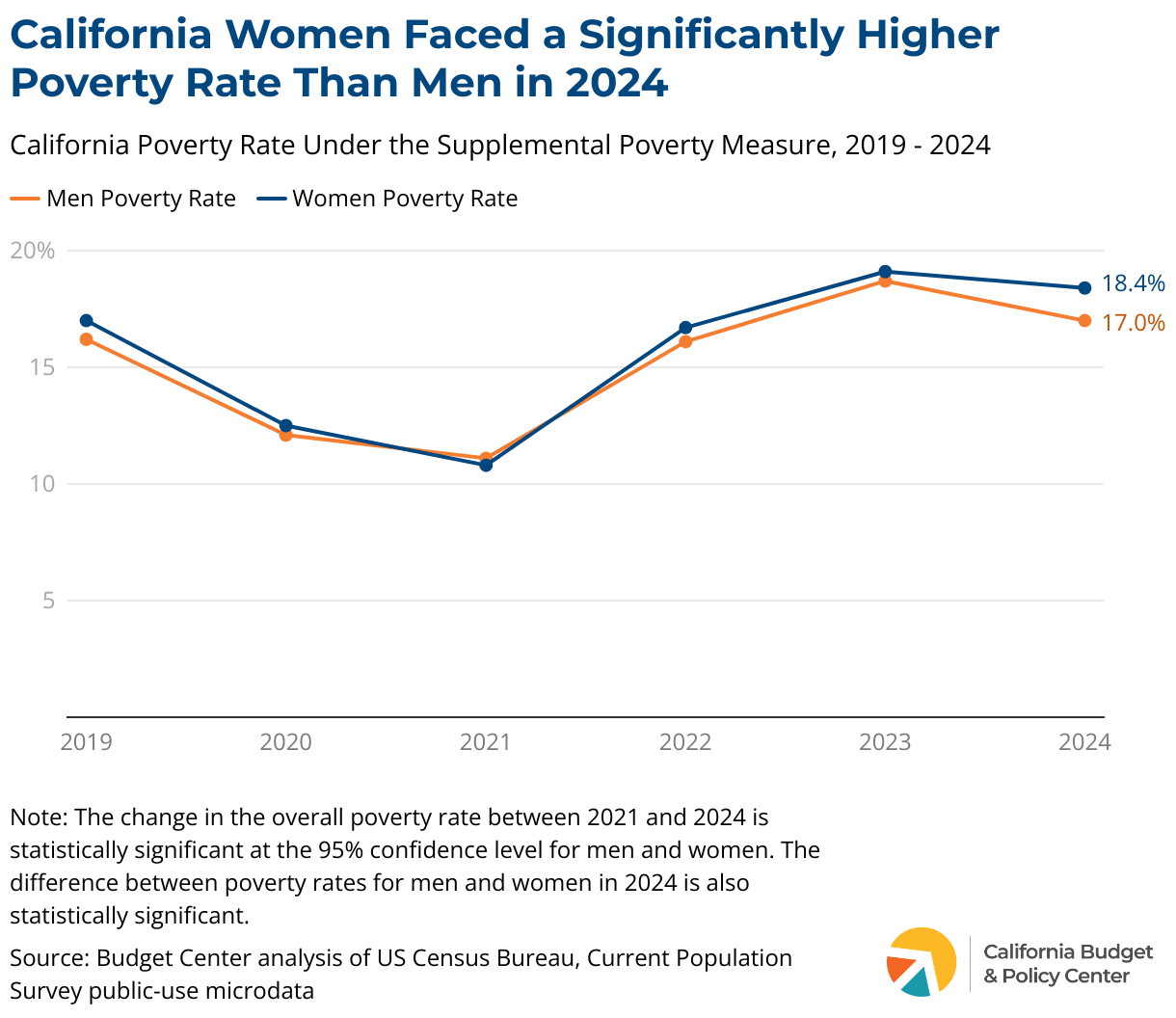
Using new US Census data, the Supplemental Poverty Measure — a more comprehensive reflection of economic well-being than the Official Poverty Measure — shows that the poverty rate for women in California remains high and is now significantly higher than the rate for men. Although the poverty rates for California’s men and women have followed a nearly identical trend since 2019, the poverty rate for women in 2024 (18.4%) was significantly higher than the rate for men (17.0%).
Poverty rates for both men and women hit significant lows in 2021, which reflected the success of pandemic-era policies like the expanded federal Child Tax Credit in reducing poverty. However, the gap in poverty rates in 2024 between men and women is a warning sign for women. H.R. 1 slashed funding for SNAP (CalFresh food assistance in California) and Medicaid (Medi-Cal in California) and severely reduced access to preventive care, primary care, and reproductive and sexual health care, all of which will especially harm women. Given the higher poverty rates women experienced in 2024, the cuts to proven poverty-reducing programs will fall hardest on women and risk pushing more into poverty.
Poverty for Older Women and the Rise in Poverty for Adult Women Are Both Alarmingly High
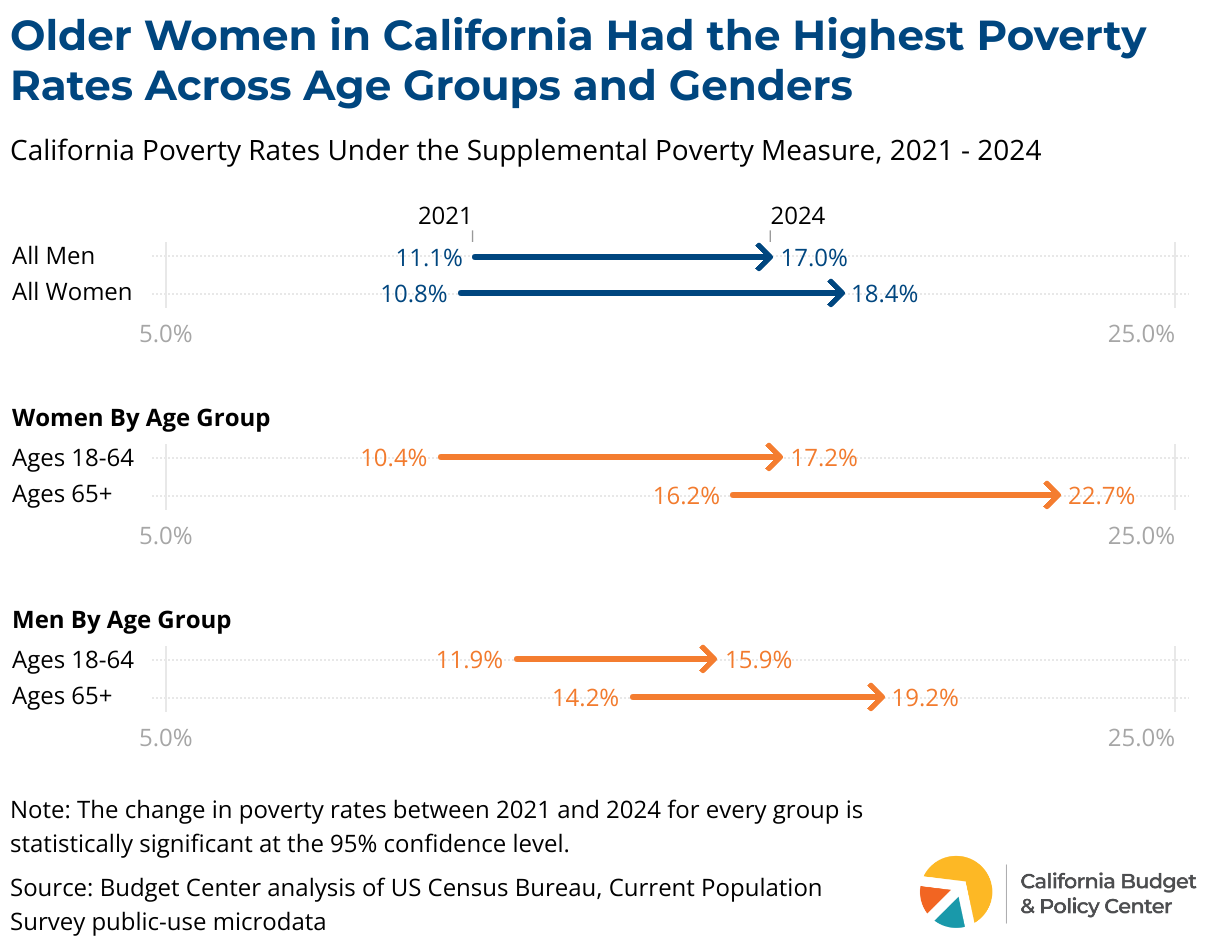
Older women faced a staggeringly high poverty rate in 2024. Women ages 65 and up had a poverty rate of 22.7% in 2024, over 5 percentage points higher than the overall poverty rate for women. Older adults are subject to higher out-of-pocket medical expenses, which contribute to their higher poverty rates and will only worsen with the policies from the federal and state budgets. Both H.R. 1 and the state budget include harmful policies and cuts to health care programs that will make accessing health care for older adults even more expensive. Additionally, new work requirements are more likely to harm older women who had left the workforce to care for children or family members. Together, these cuts and policies will further push older women into poverty.
Adult women had the largest increase in poverty since 2021. While older women are more likely to be in poverty, the percentage of adult women in poverty increased the most across all age groups and genders from 10.4% in 2021 to 17.2% in 2024. This is consistent with the trend for all adults statewide, and is a worrying signal for adult women. Adult women are more likely to be paid low wages, are paid about $10,000 less on average than men, and spend a higher percentage of their earnings on rent, all of which contribute to adult women facing large increases in poverty over time.
H.R. 1 — the harmful Republican megabill — does not address these inequities adult women face. Instead, it reverses progress that had been made in granting more adults access to affordable health insurance. H.R. 1 contains multiple provisions that will result in adults losing their health care. Administrative burdens like work requirements and increased eligibility checks for adults as well as new copayments on certain Medi-Cal services for low-income adults will likely result in millions of Californian adults — who are already the age group most likely to lack health insurance — losing coverage and pushing more adults and especially adult women into poverty.
Racial Inequities Persist, Especially for Women of Color
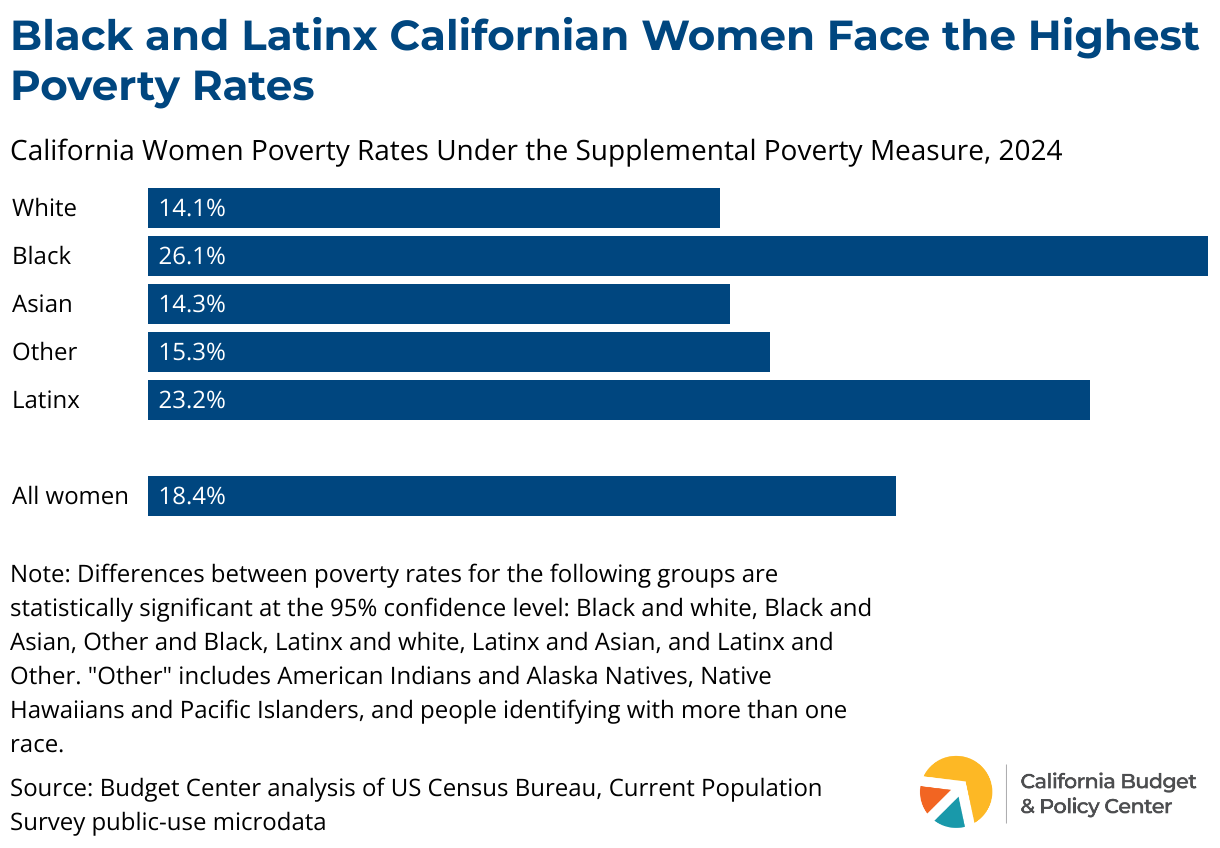
While poverty increased across all racial and ethnic groups in California from 2021 to 2024, poverty rates remain the highest for Black and Latinx Californians, especially Black and Latinx women. Over one in four Black women (26.1%) were in poverty in 2024 and 23.2% of Latinx women were in poverty, both of which are significantly higher than the 14.1% of white women. These disparities are evidence of generations of systemic racism, as well as racial discrimination in housing, access to banking, education, and taxation that have all contributed to a racial wealth gap evident in this poverty data.
Black women specifically — who face the highest poverty rates in the state — have endured centuries of exploitation, racism, sexism, and systemic injustices. In 2024, over half of Black women experienced racism or discrimination at work. Additionally, women of color face disparities in health outcomes and are more than twice as likely as white women to face homelessness.
H.R. 1 will disproportionately harm Californians of color and immigrants, which will only deepen inequities that women of color face. Federal cuts to Medicaid would take health coverage away from millions of Californians of color, forcing families to delay or forgo care, take on medical debt, and face greater risks of falling into poverty. More than one in three Californians — nearly 15 million people — rely on Medi-Cal, the state’s Medicaid program, for health coverage. Latinx Californians represent more than half of Medi-Cal enrollees and Black Californians make up nearly 7% of enrollees.
At the same time, monthly premium costs for Covered California, the state’s health insurance marketplace for people who do not qualify for Medi-Cal, are projected to rise by an average of 66% due to the expiration of enhanced premium tax credits, with even steeper increases for communities of color.
Federal actions also permanently gut the federal estate tax, allowing wealthy families to pass up to $30 million to their heirs tax-free, perpetuating wealth inequality and the racial wealth gap.
Without strong state policy interventions, recent federal actions will deepen racial and ethnic disparities especially for women of color, leaving Californians of color with fewer resources to stay healthy, build wealth, and achieve economic security. Protecting Medi-Cal and advancing more equitable tax policies are critical to ensuring all Californians can share in the state’s prosperity.

Women Renters in California Experience High Poverty Rates
Housing is the single largest cost in most family budgets, and high housing costs are pushing more people, especially those already facing systemic barriers, into deeper hardship. California renters are particularly likely to experience poverty due to unaffordable housing costs, which threaten their economic and housing stability.
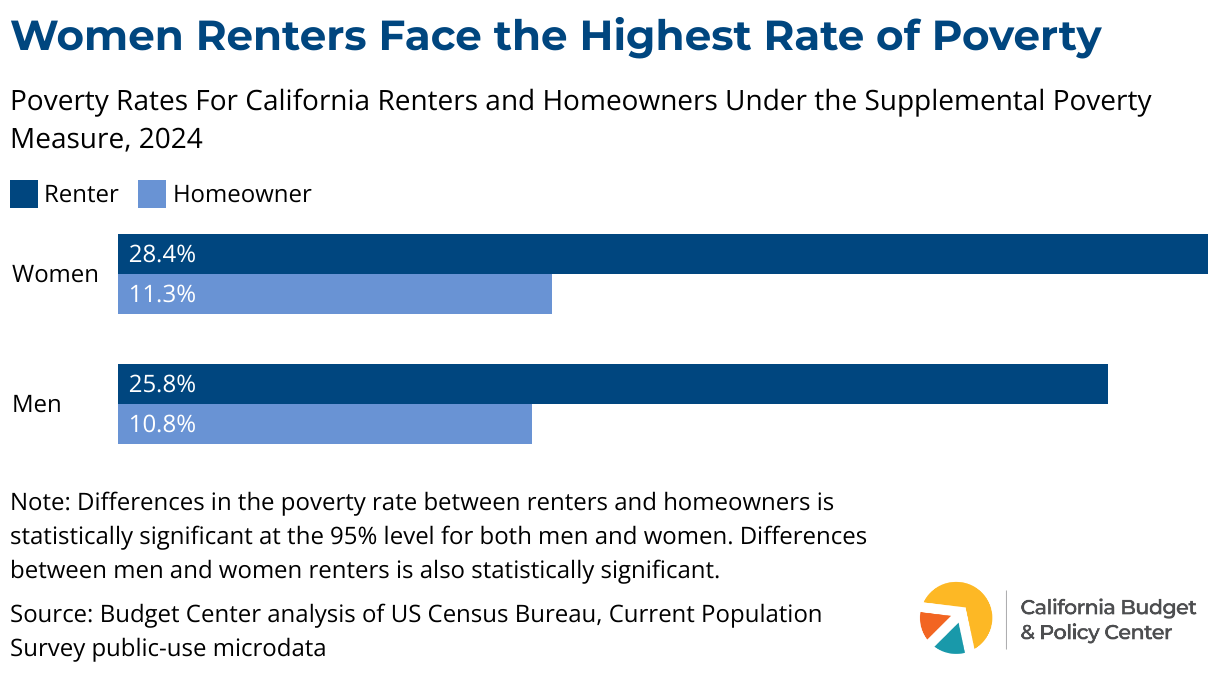
Over one-quarter (28.1%) of women renters were in poverty in 2024, which is significantly higher than the rate for women homeowners at 11.3%. Renters are most affected by the housing affordability crisis in California, with over half of renters paying over 30% of their income towards housing.
While renters consistently face a higher poverty rate than homeowners, this is especially the case for women renters. The percentage of women renters in poverty is significantly higher than the percentage of men. Women are consistently more likely than men to face unaffordable housing costs. Women have long faced historical racism and sexism in the housing market that when combined with gender inequities like lower pay, less accumulated wealth, and a higher likelihood to be caring for children continue to keep women renters in poverty.
Renters — and especially women renters — need support. However, future federal policy choices may exacerbate poverty among renters. Proposals from the Trump administration and the House for the upcoming federal fiscal year included cuts to rental assistance and affordable housing funds. Meanwhile, the Senate proposed level funding for Housing Choice Vouchers — the main federal rental assistance program — which is still not sufficient to fully fund voucher renewals for current participants, and could result in an estimated 14,400 households, encompassing 31,600 people, losing housing vouchers in California. Additionally, neither the House nor Senate has proposed sufficient funding for fully transitioning Emergency Housing Voucher recipients into the Housing Choice Voucher program, which currently serves over 15,000 people in California.
The lack of federal and state investments in affordable housing and rental assistance, combined with the enacted federal cuts to health and food assistance, will mean more women will face impossible choices between having enough food, accessing needed medical care, and paying rent.
State Leaders Have the Tools to Help California Women Living in Poverty
Women in California face continued disparities across all aspects of their lives, and the poverty rates for women in the state have remained high. Recent federal and state budget decisions strip away crucial safety net programs for women and will further entrench existing inequalities. In order to meaningfully reduce poverty amongst women in California, state policymakers must raise revenue to fund programs that are proven to reduce poverty. This starts with making sure that corporations and wealthy individuals pay their fair share in taxes, especially given the massive federal tax cuts they will be getting from H.R. 1 which are being financed by gutting the very safety net programs that help lift women out of poverty. State policymakers should begin by:
- Ending California’s most costly corporate tax break — the water’s edge loophole — which allows corporations to avoid around $3 billion in California taxes each year and deprives the state of needed resources to address the most pressing concerns facing Californians.
- Preventing profitable corporations from completely wiping out their tax bills by placing reasonable limits on their tax credits and deductions, ensuring they contribute to state services just like all Californians.
- Instituting a graduated corporate tax rate to ensure California’s most profitable corporations pay their fair share to support services all Californians need.
Poverty is a policy choice. State policymakers have the tools to ensure that all California women have the resources needed to thrive.