
Read this publication in Spanish.
key takeaway
Eviction filings in California are at a six-year high, yet most renters face the process alone and without legal support. State programs fall far short of the need — and without sustained investment and a statewide commitment to legal defense, more Californians will lose their homes and face homelessness.
All Californians deserve a safe place to call home and that requires robust renter protections and access to legal defense, regardless of their income or background. Eviction legal defense, along with education, mediation, or early intervention are proven tools to prevent homelessness, housing instability, and protect families from future hardship. Yet as eviction filings continue to rise — and millions of Californians with low incomes face high housing costs alongside threats to their health care coverage and food assistance — there is drastically more that state leaders can do to ensure Californians can remain in their homes.
This brief builds on A Civil Injustice: The State of Eviction in California by SAJE and Housing Now!, and examines key trends on formal evictions in California, explains state programs and funding for eviction defense, and outlines policy recommendations state leaders can implement to keep renters housed, promote housing stability, and prevent homelessness.
To learn more about the California eviction process see The Pipeline, an interactive learning tool. Follow a tenant through California’s eviction system to see how procedural barriers push families out of their homes before they ever see a judge.
About This Report
This report was co-authored by Kyle Nelson, director of research and policy at Strategic Actions for a Just Economy (SAJE), and Francisco Dueñas, executive director at Housing Now!.

Strategic Actions for a Just Economy (SAJE) is a Los Angeles–based community organizing and advocacy organization that works to advance economic justice in low-income communities of color. SAJE partners with tenants, workers, and community members to build power, fight displacement, and promote policies that expand access to affordable housing, good jobs, and healthy neighborhoods. Through grassroots organizing, policy advocacy, and leadership development, SAJE plays a key role in shaping local and state efforts to protect renters and strengthen housing stability.

Housing Now! is a statewide advocacy coalition focused on advancing policies and investments to address California’s housing affordability and homelessness crises. The coalition brings together housing, health, labor, and community-based organizations to push for increased state funding, stronger renter protections, and long-term solutions that expand access to affordable homes. Housing NOW! plays a key role in shaping state budget and policy priorities, with a focus on ensuring resources reach communities most impacted by housing instability.
1. Evictions Are Rising Across California, Even with Tenant Protections in Place
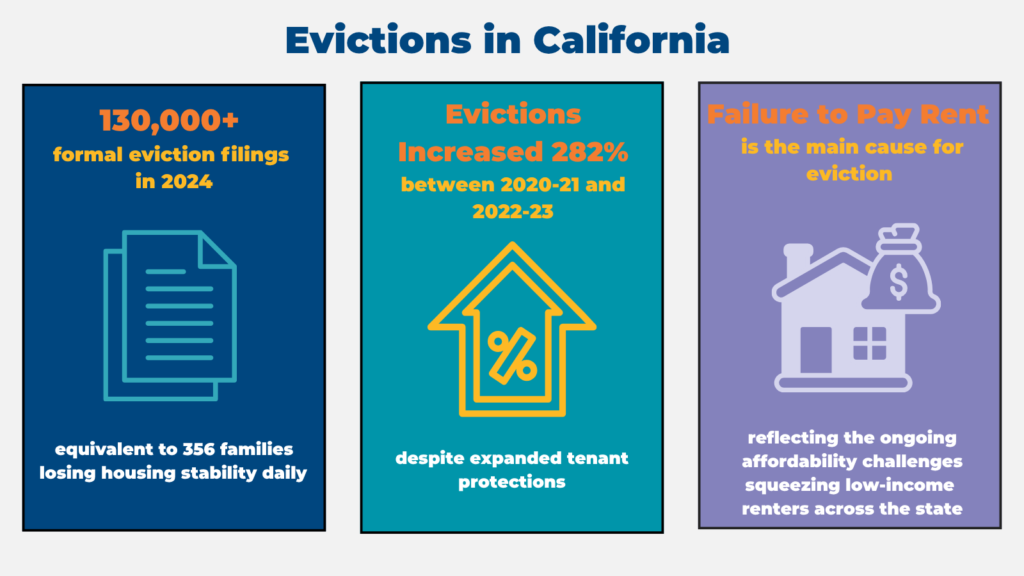
Over 130,000 formal eviction cases were filed in California in 2024, and filings over the past two years are the highest they have been in six years — surpassing pre-pandemic levels despite state and local tenant protections.
Behind each eviction filing is a family or individual at risk of losing their home and their financial stability, employment, and community ties. The ramifications fall hardest on Californians with low incomes and women of color, particularly Black women, who face eviction at disproportionate rates due to the ongoing legacy of racist housing policies and discriminatory practices that have long limited communities of color from stable, affordable housing and economic security.
According to the SAJE report, formal eviction filings in California spiked 282% between FY 2020–21 and FY 2022–23, and filings in FY 2022–23 and FY 2023–24 are the highest in six years — exceeding pre-Tenant Protection Act (TPA) levels despite these new state protections. TPA required landlords to have “just cause” to evict a tenant and a statewide rent cap that applied to most residential landlords. While these safeguards and protections are important in protecting renters and their cost of housing, they unfortunately do little for tenants facing a formal eviction. The TPA left room for loopholes for landlords to increase housing costs through other arbitrary fees and still allow for significant rent increases that can cause financial hardship and lead to evictions.
Failure to pay rent remains the most common reason for formal eviction, reflecting the affordability challenges squeezing renters with low incomes across the state. But formal filings tell only part of the story, many more Californians are displaced informally, without a court record, meaning the true scale of displacement is likely far greater than data show.
2. Many Renters Face Eviction Alone — and California Lacks the Data to Fully Understand the Scope
When California renters face a formal eviction, they face it alone. Unlike defendants in the criminal legal system, California renters have no guaranteed right to legal representation as their cases go through the civil legal system. This is despite evidence showing that preventative and legal interventions are a cost-effective way to keep people in their homes.
California lacks a comprehensive statewide system to track evictions. And the data that is available leaves out informal evictions. The available data come directly from each of California’s 58 counties, all of which have their own approach to documenting outcomes and making that information publicly available, if they do at all.
Research from SAJE highlights significant gaps in eviction outcome data (or consistent data), particularly from large counties like Los Angeles, Riverside, Sacramento, San Diego, and San Francisco. This is concerning as they contain cities with large tenant populations, expensive housing markets, and the highest numbers of eviction filings.
These gaps mean California lacks a full understanding of eviction outcomes and displacement. As a result, the true scale and impacts of eviction — especially informal evictions — is likely far greater than current data suggests.
3. Nearly Half of Californians Lose Their Eviction Case Before Stepping Into a Court Room
Among available eviction records, over 46% of cases end in default judgment, meaning tenants lost before they ever made it to court. Default judgments occur when a tenant fails to file a formal response to their landlord’s eviction lawsuit within the mandated timeframe or fails to appear in court. Nearly all of these defaults (96%) happened at this earliest stage as a tenant failed to answer the eviction filing — before a hearing was ever scheduled. This often happens because of the lack of accessible legal support, complex and hard-to-navigate processes, inability to take time off work or transportation difficulties, or fear of the legal system.
Until 2024, tenants had just five days to respond; that window has since been extended to ten days, which may reduce default rates over time, though the full impact remains to be seen. It is also rare for an eviction case to make it to trial, as roughly 85% of eviction outcomes occur before trial, even though jury trials are typically more favorable to tenants.
4. California’s Eviction Legal Defense Programs Work, But Can’t Keep Up With the Need
California funds eviction legal defense through a small set of state programs, but investments fall far short of the scale of need. There is no statewide, dedicated funding source solely for eviction legal defense or judicial-related homelessness prevention. Instead, a small set of state programs fund this work alongside other types of civil cases.
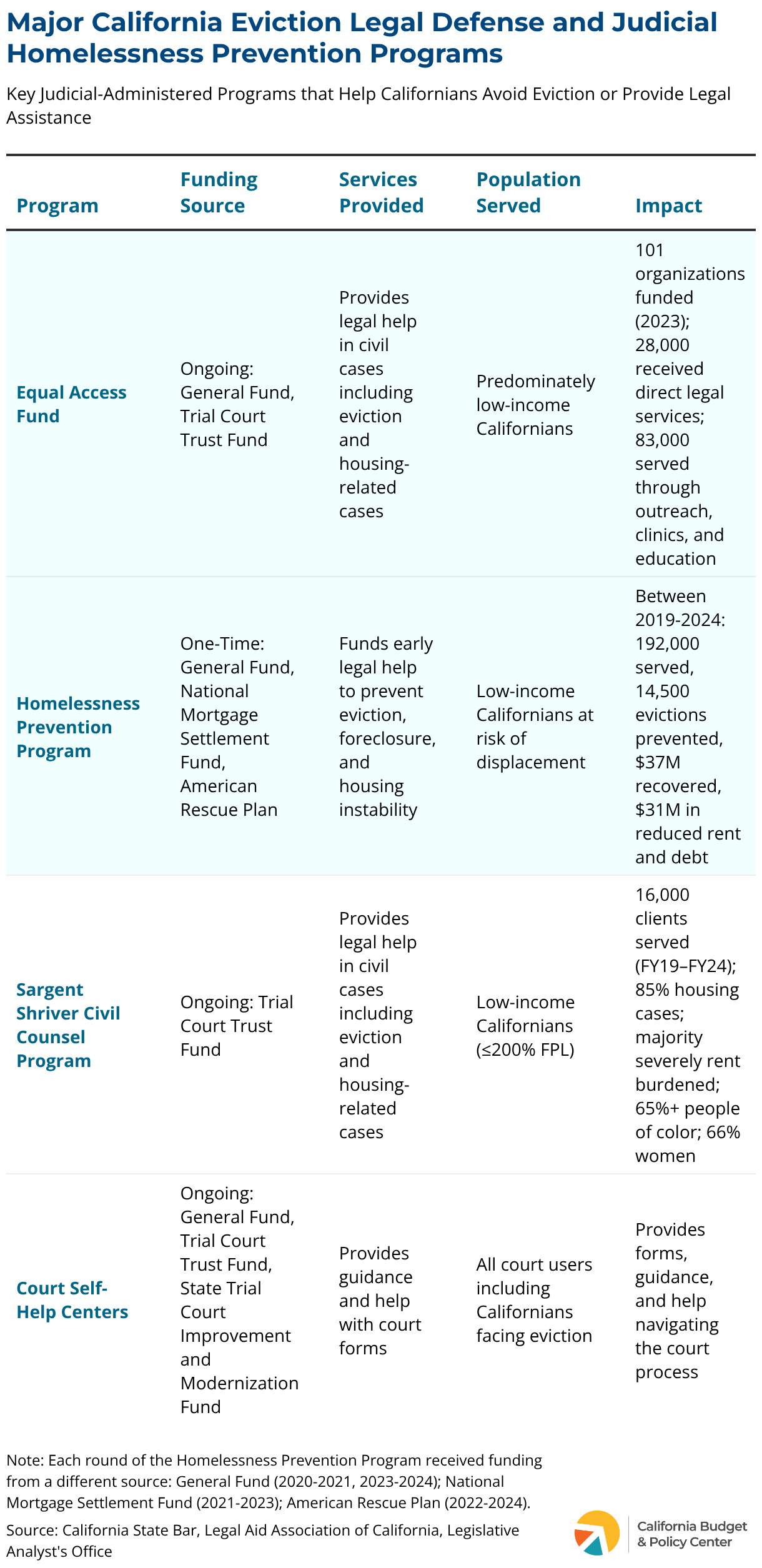
The core state programs for legal eviction prevention and defense are:
- Equal Access Fund Program (EAF)
- Homelessness Prevention Program (HP)
- Sargent Shriver Civil Counsel program (Shriver program)
- Court Self-Help Centers
5. California’s Eviction Defense System Remains Fragmented and Faces Funding Threats
Key state programs have shown results, but fall short of what Californians need. The state’s eviction defense system is fragmented, limited in scope, and unequal across regions — and since the 2023-24 state budget, there has been no state funding specifically for eviction legal defense.
Legal aid organizations that provide eviction prevention or legal defense among other services rely on a patchwork of local funds, federal funds, or one-time grants that vary in availability and scope. Right-to-counsel programs only exist in two major jurisdictions, but even those are limited by income eligibility caps, geographic restrictions, and short response windows that tenants may miss.
The patchwork of eviction legal defense providers is also only part of the picture. Non-judicial homelessness prevention programs, such as the Homeless Housing Assistance and Prevention (HHAP) program which can fund rental assistance and other prevention efforts, are delivered through equally underfunded and diverse providers. The result is a homelessness prevention system that leaves many California renters without support when facing eviction.
Simultaneously, federal funding for legal aid organizations remains uncertain. Federal funding for the Legal Services Corporation (LSC) — the nation’s largest civil legal aid funder — was proposed to be fully eliminated in the 2026 federal budget. In California, that would have meant $55.7 million annually lost in LSC funding, which supports services for over 165,000 Californians statewide, nearly half (48%) of whom had housing-related cases.
Alongside other federal proposals, California was at risk of losing $187 million in total legal services funding. While the final federal budget included a smaller reduction, funding remains uncertain as it must be reappropriated annually. Plus, threats from H.R.1 (2025) and other federal actions will increase hardship for Californians, making it very difficult to afford rent and other basic needs. These pressures come at the same time state and federal homelessness funding is also declining, compounding housing insecurity and further straining already limited legal and housing support systems.
Looking Ahead, Policymakers Can Take Action to Protect Renters from Evictions
California has yet to make a statewide commitment to legally support renters facing eviction. Policymakers have the tools to change that — starting with the following steps:
Establish a statewide right to counsel for low-to-moderate income tenants facing eviction and augment funding for eviction legal defense. Current state investments in eviction legal defense are insufficient relative to the scale of the need. Guaranteeing full legal representation for all tenants facing eviction proceedings, paired with robust outreach, education, and resources, is far more cost-effective than addressing the downstream consequences of homelessness. The Roadmap Home estimated the cost to provide full representation to a family facing formal eviction is $3,500. Research also demonstrates every $1 invested in legal aid yields at least $7 in economic return, reducing the strain on courts, health systems, and social safety net programs.
Strengthen and make permanent the Tenant Protection Act (TPA). The TPA has reduced unjust evictions where it applies, but it needs to be stronger and broader. State leaders should make the TPA permanent, lower the annual allowable rent increase cap, remove exemptions to cover more renters, increase relocation assistance requirements, and eliminate “substantial remodel” and demolition as allowable no-fault eviction justifications. Extending these protections could cover an additional 1.65 million renters.
Mandate statewide eviction data collection and public reporting. California cannot solve a problem it refuses to measure nor adequately account for the resources needed. The state should require all 58 counties to collect and publicly report consistent eviction outcome data, including case outcomes, demographic information, and representation rates.
Establish a statewide redemption law. Following the lead of 21 other states, California should allow tenants facing eviction for nonpayment to redeem their tenancy — and remain in their home — by paying the rent owed, even after an eviction action has been filed.
Direct resources for rental assistance. Directing resources for rental assistance, including emergency and shallow rental subsidies, housing vouchers, and rapid-rehousing efforts to ensure people can remain in their homes during times of financial crisis.
Conclusion
Keeping California renters in their homes through meaningful tenant protections, robust legal support, and equity-centered policies is one of the most effective tools available to state policymakers to protect renters from evictions — particularly as federal cuts through H.R. 1 and other rollbacks threaten to deepen already severe affordability challenges. Sustained state investments in eviction legal defense, stronger renter protections, and consistent statewide data are not only essential for keeping Californians housed — they are critical to prevent homelessness and advance housing stability.
Strengthening California’s revenue base by ensuring the most profitable corporations and wealthiest Californians pay their fair share could generate the resources needed to protect communities. By doing so state leaders would have the resources to protect communities from federal harm and fund the tenant protections, rental assistance, and legal supports that keep renters stably housed.
Salena Copeland and Lorin Kline with the Legal Aid Association of California contributed to this publication.