
key takeaway
Seven in 10 Californians struggle with health care costs, even with insurance. State leaders must raise ongoing revenue and strengthen policies to reduce premiums, out-of-pocket costs, and barriers to care so all Californians can afford the health care they need.
Affordable health care helps Californians get the care they need while keeping up with rent, groceries, and other basic needs. But health care is not affordable for everyone. Even Californians who have health coverage struggle with premiums and medical bills that can lead them to delay treatment, take on debt, or cut back on essentials. In fact, research from the California Health Care Foundation finds that seven in 10 Californians are struggling with the cost of health care.
Recent federal and state policy choices are adding to these pressures. H.R. 1, which President Trump signed into law in summer 2025, sharply cut federal health care funding and imposed new barriers to coverage and care. In addition, President Trump and the Republican majority in Congress allowed enhanced federal premium tax credits to expire, significantly raising costs for Covered California enrollees. State leaders also adopted harmful cuts and new costs affecting certain Medi-Cal enrollees. These state and federal policy choices are putting affordable care further out of reach for communities already facing economic hardship and discrimination.
The five facts below explore affordability challenges facing Native Hawaiian and Pacific Islander Californians, transgender and gender expansive people, certain immigrants, seniors and people with disabilities, and Covered California enrollees. Together, these challenges highlight the need for state leaders to raise new, ongoing revenue to support access to affordable care. This publication also identifies policy changes to reverse harmful cuts, reduce premiums and out-of-pocket costs, and minimize barriers so more Californians can afford the care they need.
The companion publication, Health Coverage Is Out of Reach for Many Californians, examines barriers to getting and keeping coverage. Together, these publications underscore that coverage must be both accessible and affordable to protect Californians’ health and financial security.
1. Health Affordability Challenges Are Largest for Native Hawaiian and Pacific Islander Californians
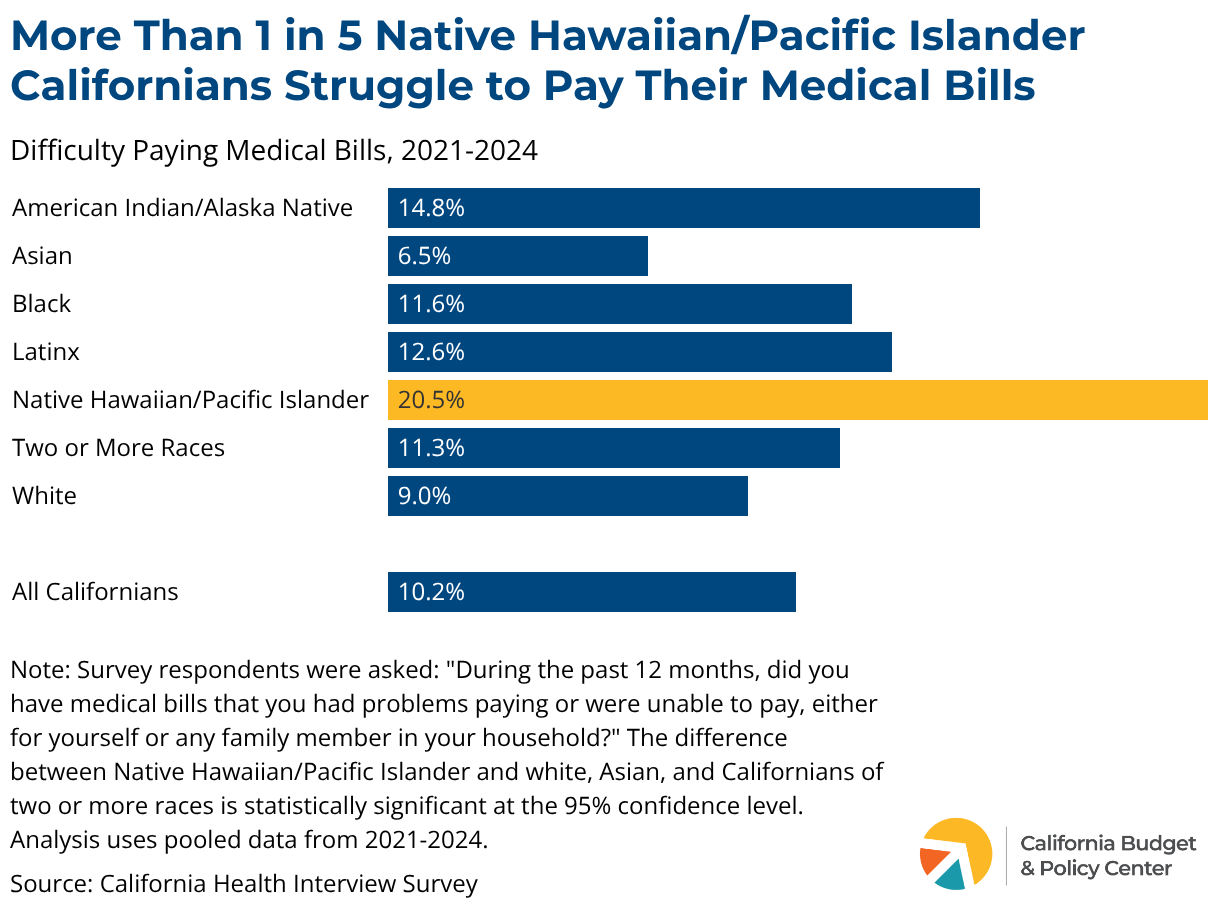
The rising cost of health care impacts all Californians, but significant racial disparities mean some Californians bear the brunt of affordability challenges. While around 10% of all Californians have had difficulty paying medical bills, this rises to over 20% — or more than 1 in 5 — for Native Hawaiian and Pacific Islanders.1While this analysis displays Native Americans as a racial/ethnic group, the data does not specify Tribal citizenship, which reflects the political relationship between Tribal nations and the federal government. Programs that serve Tribes and Tribal citizens based on their membership in the Tribe are not based on race or ethnicity, but on the political relationship between Tribes and the United States. This analysis should be interpreted with that context and the known data limitations for Native Americans.
Research from AAPI Data shows that Native Hawaiian and Pacific Islanders are less likely to enroll in Medi-Cal, which provides free and low-cost care to millions of Californians. Native Hawaiian and Pacific Islanders also face structural barriers to accessing affordable health care, including challenges navigating Medi-Cal enrollment, higher rates of poverty, racism in health care, and limited availability of culturally and linguistically appropriate care. These challenges and disparities highlight the enduring impacts of racism in health coverage and access to affordable health care, which will not be resolved without state action.
2. Federal Attacks on Transgender Californians Will Worsen Existing Health Disparities
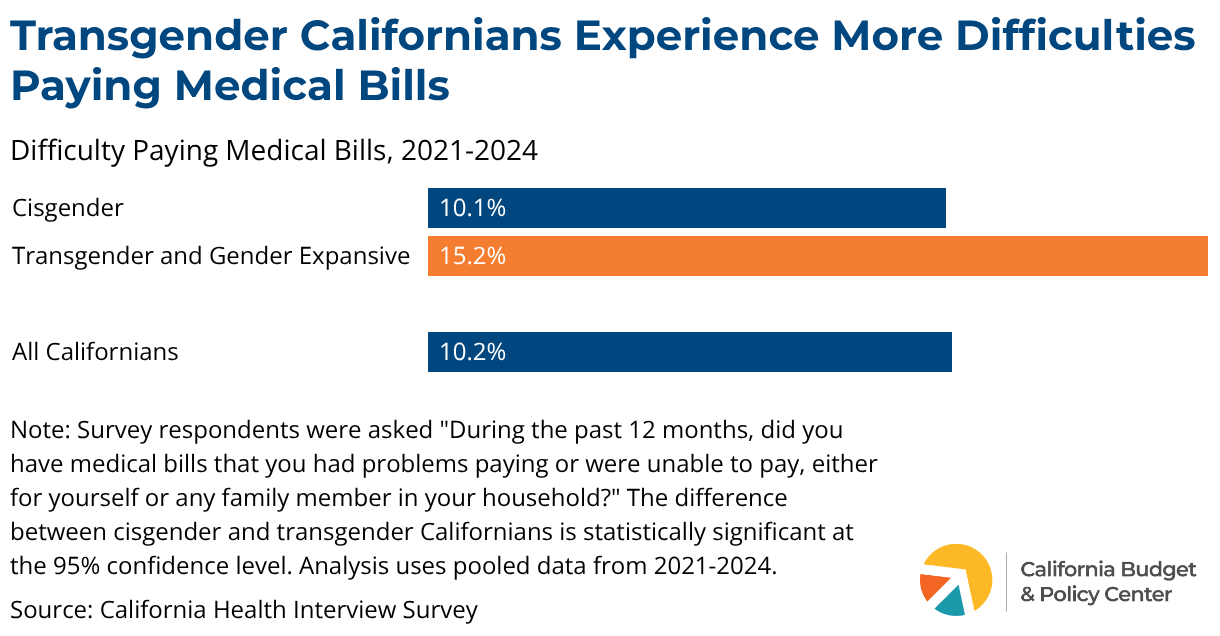
The Trump administration has continuously attacked the ability of transgender and gender expansive people to access health care that meets their needs, worsening affordability challenges. Health care is much harder to afford for transgender and gender expansive Californians compared to cisgender Californians. In fact, over 15% of transgender and gender expansive Californians have had difficulty paying for medical bills.
Most recently, the Trump administration prohibited the use of federal Medicaid funding for gender-affirming care for youth. Gender-affirming care is health care for transgender and gender expansive individuals that helps them access treatments aligning with their gender identity, including mental health care, medical care, and social services. Out-of-pocket costs for gender-affirming care can range from $72 to $3,792 per year. Federal restrictions on funding for this care will lead to higher health costs for a population that already faces significant challenges affording health care. Without state action, transgender and gender expansive Californians will be unable to afford the health care they need to survive.
3. Medi-Cal Premiums Will Make Health Care More Unaffordable for Undocumented Adults and Certain Other Immigrants
H.R. 1, recent state budget choices, and federal attacks on immigrant communities are all threatening the safety and livelihoods of immigrant Californians. An enrollment freeze for undocumented Californians in Medi-Cal, the elimination of federal Medicaid eligibility for immigrants with humanitarian status, and the elimination of dental benefits for certain groups of immigrants are among some of the many harmful attacks on immigrants’ access to health care.
On top of those cuts, the 2025 state budget created a monthly Medi-Cal premium that applies only to certain groups of immigrants, including undocumented adults and others who do not qualify for federally funded Medicaid coverage. This new state premium is set to go into effect on July 1, 2027.
California’s incoming governor is required to set the new monthly Medi-Cal premium between $30 and $50. A premium of any size would increase health care costs for immigrants who are already struggling to afford medical bills. But a monthly premium of $50 would put people in the impossible position of choosing between getting the health care they need to survive and the bundle of groceries shown below. No one should have to choose between food and critical health care, a choice that certain immigrant Californians will have to make once monthly Medi-Cal premiums go into effect.
4. For Many Seniors and People with Disabilities, Medi-Cal Only Helps After Health Care Costs Add Up
Many seniors and people with disabilities qualify for Medi-Cal but have incomes above the limit for no-cost coverage. For these Californians, Medi-Cal only starts paying for their care after they reach a certain amount of out-of-pocket health care expenses each month. This is called a share of cost and works somewhat like a monthly deductible. A snapshot from January 2026 shows that about 141,000 seniors and people with disabilities were subject to this requirement.
People’s share of cost is equal to their monthly income minus $600. For example:
- Monthly income of $1,000: The state subtracts $600 and the remainder ($400) is the Medi-Cal share of cost. In other words, this individual would have to spend at least $400 on health care before Medi-Cal would begin paying for any additional health care expenses during the same month.
- Monthly income of $1,600: The state subtracts $600 and the remainder ($1,000) is the Medi-Cal share of cost. In other words, this individual would have to spend at least $1,000 on health care before Medi-Cal would begin paying for any additional health care expenses in the same month.
In either case, only $600 is left to help meet living expenses like rent, food, and utilities. This $600 standard has not been updated since 1989, even though California’s cost of living has increased substantially since the late 1980s.
In every year from 2019 through 2026, more than 9 in 10 seniors and people with disabilities who had a share of cost did not spend enough on health care to receive state support for their expenses. For these Californians, being enrolled in Medi-Cal does not mean Medi-Cal is helping pay for their care. Someone can spend hundreds of dollars out of pocket on health care and still receive no help from Medi-Cal if they fall short of their full share of cost. Even if an individual reaches their full share of cost — causing Medi-Cal coverage to “kick in” — Medi-Cal does not reimburse the money they already spent getting there. Then, when a new month begins, the requirement resets and they must start over.
5. Rising Premiums Have Made Coverage and Care Harder to Afford for Covered California Enrollees
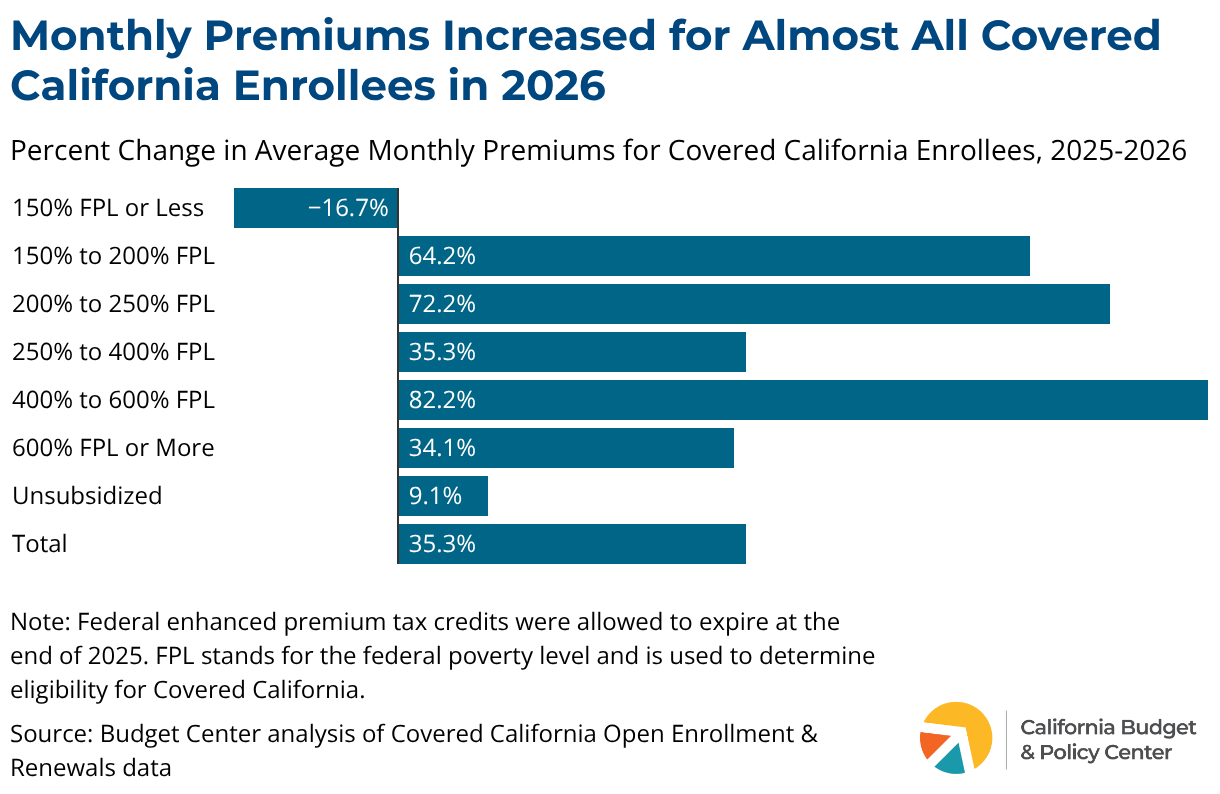
Californians who buy coverage through Covered California — the state’s health insurance marketplace established through the Affordable Care Act (ACA) — are also struggling to afford health care. After President Trump and the Republican-controlled Congress allowed enhanced premium tax credits to expire at the end of 2025, many enrollees with low to moderate incomes faced higher premiums. For those earning 150%–200% of the federal poverty level (about $23,500–$31,300 a year for an individual), average monthly premiums after financial help rose from $67 in 2025 to $110 in 2026, a 64% increase. These increases leave less room in household budgets for care and other basic needs.
To manage higher premiums, many people kept insurance by switching to Bronze plans, which generally cost less each month but require people to pay more when they need care. In 2026, 119,200 people who actively renewed their Covered California health insurance switched to Bronze from plans that paid a larger share of their care costs. Lower premiums can help people maintain coverage, but higher out-of-pocket costs can make that coverage harder to use. Among surveyed people who switched from Silver to Bronze or minimum coverage, more than one-third expected to delay or skip urgent care because of cost.
While some people switched plans, others let their Covered California coverage lapse. Black and Latinx enrollees left at higher rates, according to a recent Covered California report. The effects of disenrollment can extend to people who keep their coverage. For example, as younger adults were more likely to drop their coverage, fewer generally healthier people remained to share the cost of care, potentially driving premiums higher for people enrolled. People who leave Covered California may find health insurance elsewhere, but many go without coverage. Among those who responded to Covered California’s survey after ending coverage, the share of people who reported no longer having health insurance doubled from 2025 to 2026.
As health care costs rise, Californians are feeling the harmful consequences. Yuri from Marina shares the significant impacts she is enduring due to the cost of her health care, even with her health insurance coverage: “I got a bill for $2,500 [for] every single day I went into the hospital…$12,500… I ended up paying $500 per day for that service… That means that I’m not going to be able to send my kids to whatever thing it is they need or pay my rent, pay my car payments.”
This story was gathered by Health Access as part of their work conducting town halls to understand and illustrate the real-life impacts of health care affordability challenges.
California Should Raise Revenue and Strengthen Policies to Make Care Affordable
These five facts show how health care costs strain Californians’ budgets and deepen existing inequities. State leaders can respond by investing in affordable care and changing policies that leave people with costs they cannot afford.
New ongoing state revenue is essential to this response. Raising revenue from wealthy individuals and profitable corporations who will benefit the most from newly expanded federal tax breaks would help California replace lost federal funding, reverse harmful state cuts, and sustain investments in coverage and care. The next governor and Legislature should prioritize revenue solutions to protect access to affordable care without shifting more costs onto households already struggling to meet basic needs.
Alongside raising revenue, state leaders should:
- Prevent new Medi-Cal premiums from taking effect. Certain groups of immigrants who receive health care through Medi-Cal will begin paying monthly premiums in July 2027 due to a recent state policy change. These premiums will make health coverage much harder to afford for some of the state’s most vulnerable residents. Current law requires the next governor to set the monthly premium between $30 and $50. Instead, state policymakers should reverse course and fully eliminate the premium. If that is not possible, they should set premiums at the lowest possible level to minimize their burden.
- Support the Office of Health Care Affordability’s work to address the underlying cost of care and protect people from medical debt. State policymakers should build on the Office of Health Care Affordability’s efforts to slow spending growth, curb excessive prices, and address harmful consolidation. They should also strengthen access to financial assistance and protections from medical debt.
- Provide funding to ensure transgender youth can access gender-affirming care. The 2026-27 state budget included $10 million for gender-affirming care for youth to help address federal funding gaps. However, the federal government has since cut off Medicaid funding for gender-affirming care for youth, widening the funding gap. State policymakers should approve additional funding for gender-affirming care for youth to ensure that there are no gaps in services for transgender and gender expansive children.
- Ensure there is a Medi-Cal payment pathway for gender-affirming care. California has policies in place to cover gender-affirming care for Medi-Cal recipients even as federal restrictions on federal funding for this care take effect. However, there is currently no pathway for providers to get reimbursed for gender-affirming care through the Department of Health Care Services (DHCS). As a result, some providers have been unwilling to provide care because they are uncertain whether they will be reimbursed. State leaders should create a payment pathway to ensure providers get reimbursed for gender-affirming care, to help ensure patients have access to the care they need.
- Eliminate the Medi-Cal asset limits for seniors and people with disabilities. The individual limit is scheduled to fall from $130,000 to $21,000 on July 1, 2027. This means that seniors and people with disabilities will be forced to spend down most of their savings to qualify for health coverage, leaving very little in the bank in case of emergencies. State policymakers should prevent the scheduled reduction in asset limits and fully eliminate the asset test for affected Medi-Cal programs. Seniors and people with disabilities should be able to retain savings for emergencies and basic needs without jeopardizing their health coverage.
- Reduce Medi-Cal share of cost so seniors and people with disabilities can afford care. Policymakers should update the outdated $600 monthly income standard and reduce the amount seniors and people with disabilities must meet before Medi-Cal pays for their care. Coverage should help people obtain needed services while preserving enough income for basic living expenses.
- Help to reduce premiums and out-of-pocket costs for Californians who buy their health insurance through Covered California. State leaders should expand affordability assistance so people can keep coverage that meets their needs. State assistance should address both monthly premiums and the costs of using care, with attention to communities experiencing greater financial barriers.
- Minimize the impact of H.R. 1’s new Medi-Cal cost sharing requirements on adults with incomes above 100% of the federal poverty level. State policymakers should set required charges at the lowest amount permitted under federal law and preserve care without cost sharing wherever allowed. California should use all available flexibility to protect adults with low incomes from new out-of-pocket costs that could cause them to delay or forgo needed care.