key takeaway
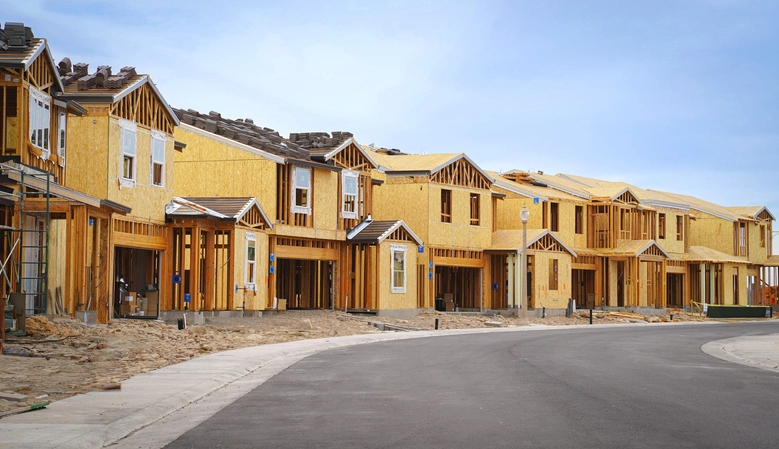
Proposition 37 on the November 2026 ballot would establish a “middle-class” homebuyer downpayment assistance program, funded with up to $25 billion in revenue bonds. This assistance could only be used to purchase newly built homes or newly created housing units converted from nonresidential buildings, where the buyer is the first purchaser. The program is intended to be self-sustaining because participating homebuyers — not the state — would ultimately repay the bonds through their mortgage payments.
table of contents
- What Would Prop. 37 Do?
- How Would Income Eligibility for Prop. 37’s Downpayment Assistance Vary Across California Counties?
- How Is Prop. 37 Different from California’s Existing Downpayment Assistance Programs?
- Would Prop. 37 Reach “Middle-Class” Californians Facing the Greatest Barriers to Homeownership?
- Could Prop. 37 Encourage Sprawl and Harm the Environment?
- What Other Homeownership Costs Could Come with Prop. 37’s New-Construction Requirement?
- Who Supports and Opposes Prop. 37?
Supporting homeownership is an important strategy for promoting economic security and wealth building. However, it is unclear whether Prop. 37 would meaningfully help “middle class” Californians who face the greatest barriers to homeownership to afford a home.
As Prop. 37 would be financed through revenue bonds — which do not require voter approval — the program proposed by this initiative could have been enacted legislatively or a comparable program could have been established by the California Finance Housing Agency. Prop. 37 is a citizens’ initiative spearheaded by former California Senate Majority Leader and Assembly Speaker Bob Hertzberg.
What Would Prop. 37 Do?
The Middle Class Homeownership and Family Home Construction Act of 2026 would direct the California Housing Finance Agency (CalHFA) to establish a middle-class homebuyer downpayment assistance program, funded with up to $25 billion in revenue bonds. The new program would:
- Provide up to 17% of the purchase price toward the down payment, which could only be used to purchase new homes or newly created housing units converted from nonresidential buildings, where the buyer is the first purchaser.
- Require the buyer to put down at least 3% of the purchase price toward the down payment. Combined with the 17% state downpayment assistance, this would reach 20% of the home’s purchase price and eliminates the need for private mortgage insurance. A conventional first mortgage would cover the remaining amount.
- Require the downpayment assistance to be provided as a loan, not a grant, which recipients are likely to pay back monthly as a fixed-rate second mortgage. This would be in addition to the homebuyer’s monthly payments on their conventional first mortgage.
- Allow applicants to have incomes up to 200% of the Area Median Income (AMI), which varies by region.
- Cap the maximum home purchase price at roughly $1 million to $1.5 million, depending on the county and other factors. This is equivalent to a $170,000-$255,000 downpayment assistance cap per home.
- Not require applicants to be first-time or first-generation home buyers, nor would recipients owe the state any equity gained in their home. These are requirements of comparable state downpayment assistance programs the state currently operates.
- Allow home builders to become “qualified builders,” and have their developments automatically qualify for the program if they meet specified labor and enforcement standards.
How Would Income Eligibility for Prop. 37’s Downpayment Assistance Vary Across California Counties?
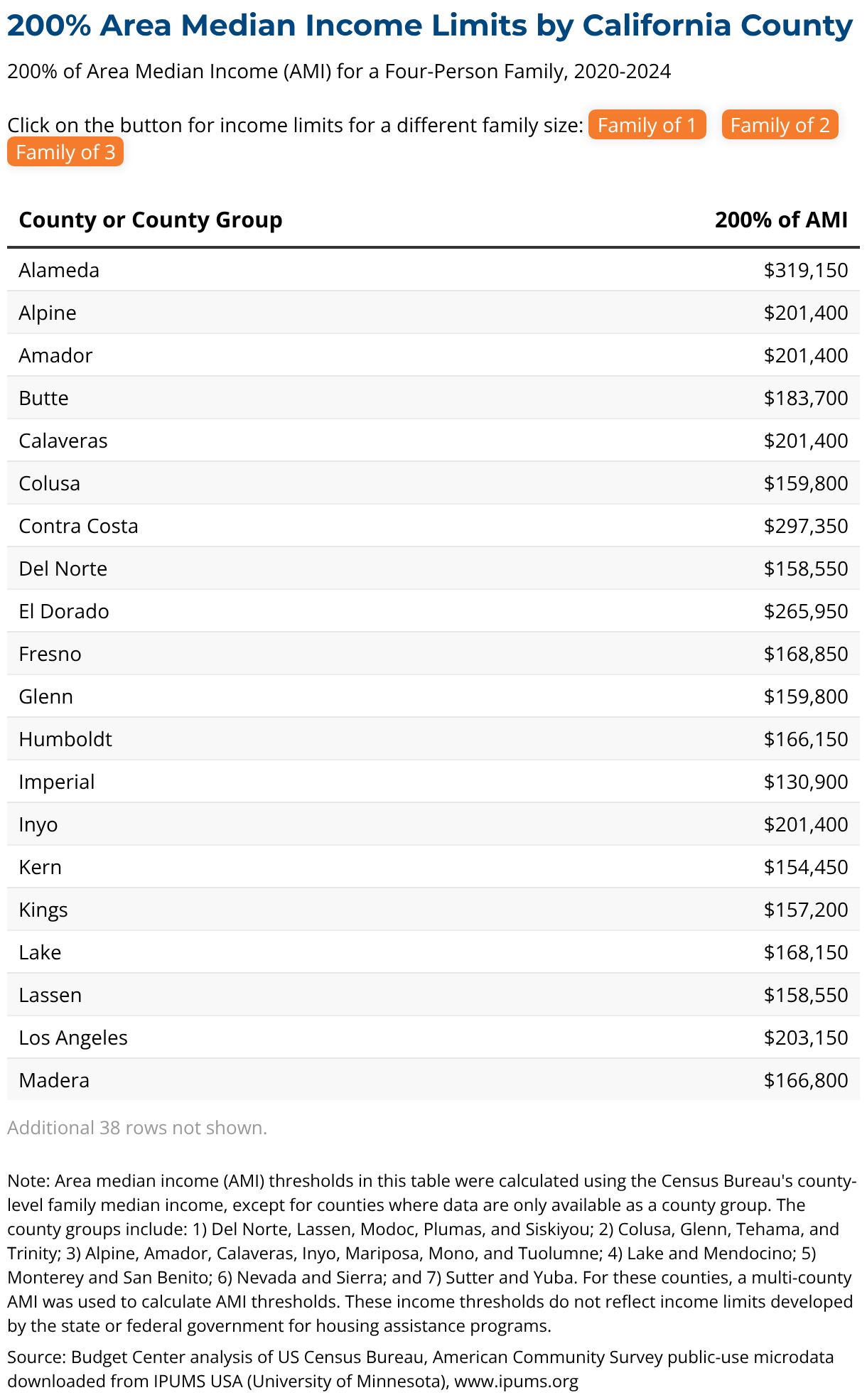
Prop. 37 would make a broad group of Californians eligible for downpayment assistance by allowing family incomes not exceeding 200% of Area Median Income (AMI) to qualify, a threshold that extends well beyond established downpayment assistance programs.
AMI represents the midpoint of family incomes in a specific area, adjusted for household size. In other words, half of households in an area have incomes that exceed 100% AMI and half have incomes below that level, so 200% AMI is roughly double what a typical family makes in the area. The limit is tied to local incomes, so whether a family income would qualify for Prop. 37’s downpayment assistance would vary significantly across California.
For example, a Budget Center analysis of Census Bureau data shows that a family of four earning up to $166,800 annually in Madera County or up to $375,800 annually in Santa Clara County could each qualify for assistance. However, the final dollar amounts would be set by CalHFA if Prop. 37 is approved by voters.
How Is Prop. 37 Different from California’s Existing Downpayment Assistance Programs?
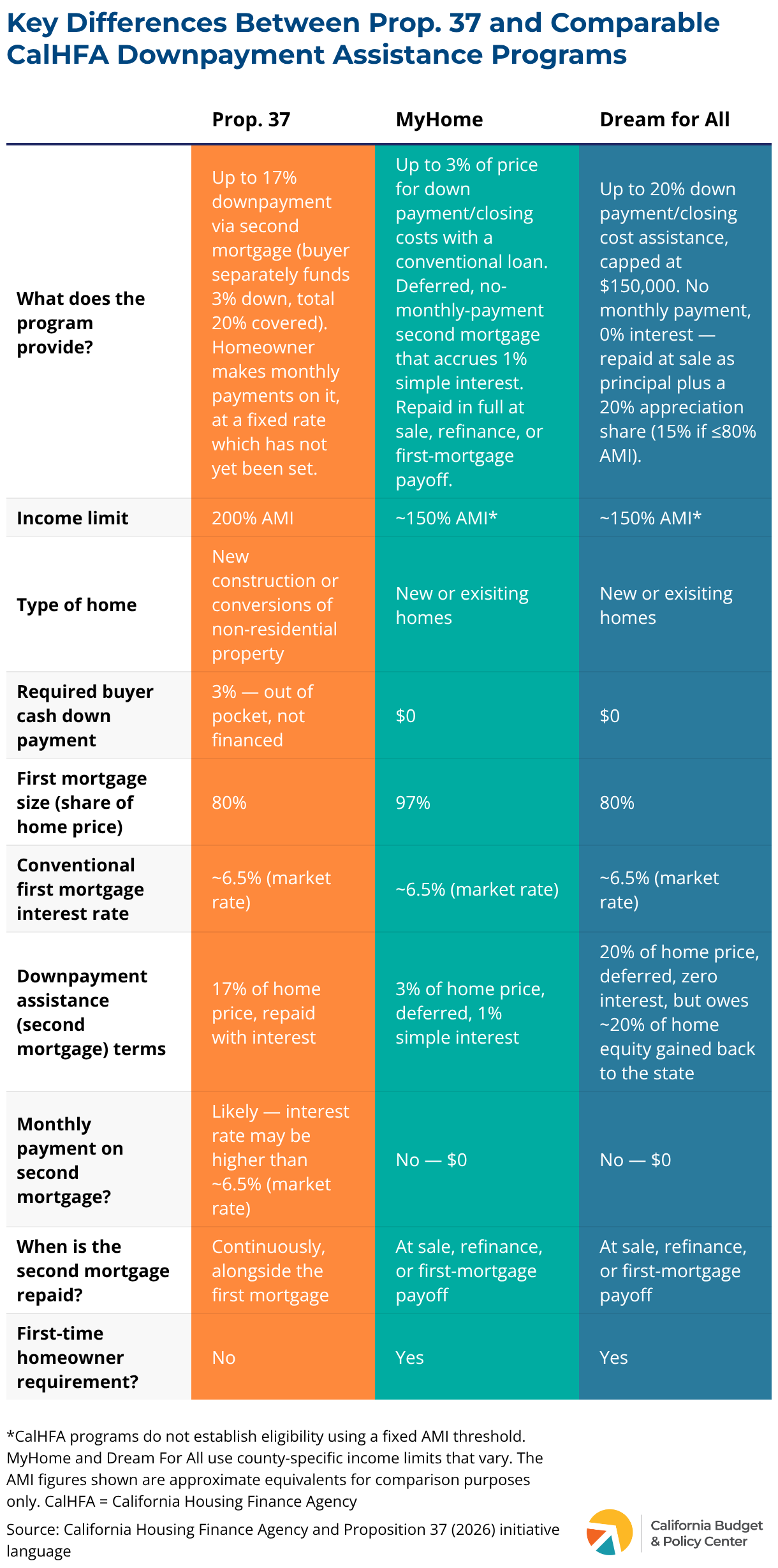
California operates several statewide homeownership programs through CalHFA, but Prop. 37 would take a different approach that could hit family budgets harder, as participants are likely to pay back the downpayment assistance monthly as a fixed-rate second mortgage.
For example, CalHFA’s MyHome Assistance Program and the Dream for All Shared Appreciation Loan program both provide downpayment assistance through deferred “silent second” loans (also known as silent second mortgages). MyHome charges 1% simple interest on the assistance; Dream for All accrues no interest, but requires a 15% or 20% share of the home’s appreciation to go to the state. Under both programs, nothing is due on these silent second mortgages until the homeowner sells, refinances, or pays off the first mortgage. This ensures that the downpayment assistance doesn’t compete with the first mortgage, groceries, utility bills, or other basic needs in a family’s monthly budget.
Prop. 37’s approach is likely to require monthly payments. This is because CalHFA would issue up to $25 billion in revenue bonds, and by law those bonds must be repaid from the proceeds of the program itself — meaning the principal and interest of the second mortgages CalHFA issues. The second mortgages would need to generate steady, ongoing revenue to pay the debt from the revenue bonds. Language in the measure also states “a borrower may request a temporary hardship deferral of monthly interest payments on its middle-class homeownership loan,” further alluding to its intended structure.

Curious About Other Ballot Propositions?
Browse our collection of resources covering California’s statewide ballot measures to help you understand what’s at stake for California this November.
Under Prop. 37, the second mortgage payment could also likely carry higher interest rates above conventional first mortgage rates. Although the measure states the intent to provide below-market downpayment assistance financing, it doesn’t guarantee it. The interest rate on the second mortgages would ultimately depend on the terms under which the bonds are issued and market conditions at the time of implementation, which are largely outside CalHFA’s control.
Revenue bonds that finance second mortgages are inherently riskier for investors because if a homeowner defaults, the first mortgage gets repaid before the second, leaving the bond investors more exposed to loss. Investors may therefore require a higher return to compensate for that additional risk, which could increase the interest rate on the second mortgage. This means Prop. 37’s second mortgage rate could land above the roughly 6.5% conventional first-mortgage rates buyers already face today. CalHFA wouldn’t set the actual rate or terms on the second mortgage until implementation, so the interest rate cannot be known before voters decide on Prop. 37.
Ultimately, while Prop. 37 could help get homebuyers to a 20% downpayment to avoid private mortgage insurance, the monthly repayment costs for the second mortgage could erode much of the benefit the downpayment assistance was meant to provide.
Would Prop. 37 Reach “Middle-Class” Californians Facing the Greatest Barriers to Homeownership?
Prop. 37 would make a broad range of households eligible for downpayment assistance, but income eligibility alone does not determine who can realistically purchase a home. Racial and ethnic disparities in income, wealth, credit access, and housing affordability mean that not all eligible families across California may be positioned to benefit from the program as proposed.
Prop. 37 would require the buyer to put down at least 3% of the purchase price, which would still be unattainable for many Californians. For example:
- A house that costs $500,000 would require a 3% down payment of $15,000.
- A house that costs $700,000 would require a 3% down payment of $21,000.
These upfront costs could be out of reach for many families, with the result that Prop. 37’s assistance could largely benefit families with incomes toward the higher end of the eligibility range. According to the Public Policy Institute of California, the median amount in Californians’ checking and savings accounts was just over $18,000 in 2025 dollars. This means that a 3% down payment could still almost or entirely clear out most or all of what an average family has in checkings and savings.
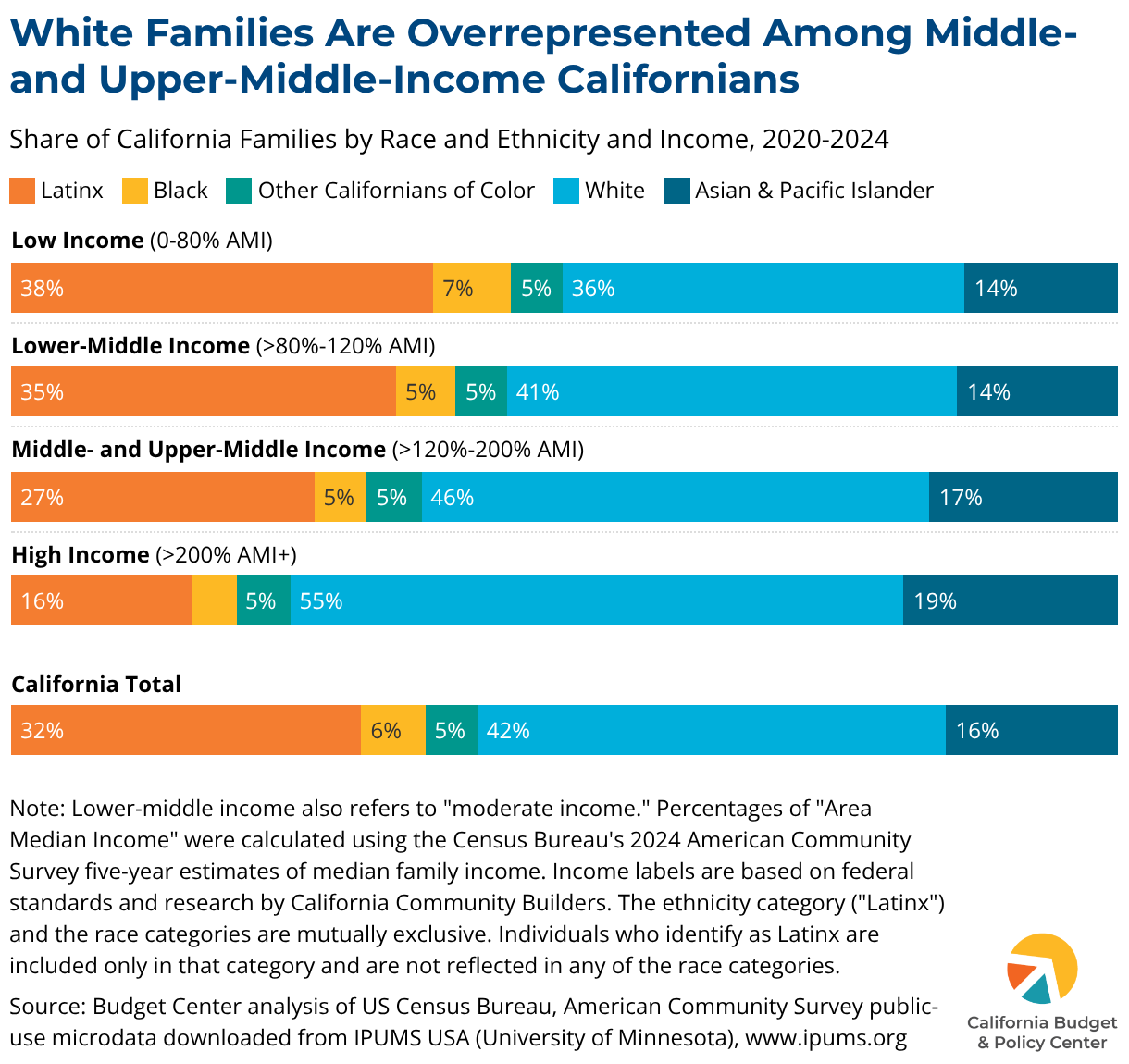
Prop. 37 could also reinforce economic, racial, and ethnic inequities in homeownership. The measure is intended to help “middle class” Californians, roughly defined as those with incomes between 80% to 200% AMI. White families are overrepresented among middle- and upper-middle-income Californians (46%), compared to their share of all California families (42%).
In contrast, Black and Latinx families are underrepresented in this “middle class” income range. This means that white families could disproportionately benefit from this program — even though white households already make up the largest share of homeowners in the state, while Black and Latinx renter households face disproportionately high housing costs.
Prop. 37 does not require applicants to be first-time or first-generation home buyers, further exacerbating equity concerns. Black and brown communities have been historically excluded from building wealth and accumulating assets, making the barrier to entering the housing market even more pronounced. Families of color face occupational segregation that pushes them into lower-paying jobs. They are also less likely to inherit generational wealth, and are more likely to be renters. These factors make it substantially more difficult to save for a down payment, even at similar income levels. Additionally, data limitations often mask significant disparities in homeownership access across racial and ethnic groups, especially among Asian American, Native Hawaiian, and Pacific Islander Californians.
Could Prop. 37 Encourage Sprawl and Harm the Environment?
By restricting downpayment assistance to newly built homes or newly created housing units converted from nonresidential buildings, Prop. 37 could push more “middle-class” housing onto land that’s not well suited for housing. Much of the land in California best suited for housing has already been developed, leaving remaining areas that are often far from job centers, prone to wildfire,environmentally sensitive, or important for agriculture.
While existing state down payment assistance programs are not immune to these concerns because they can also be used to purchase new homes, Prop. 37 goes further by limiting assistance exclusively to newly constructed homes. As a result, Prop. 37 could further direct “middle-class” housing demand toward suburban and exurban areas. This is a critical deviation from infill development — building on denser, already developed land — which has been the focus of state affordable housing and environmental efforts.
This pattern of building housing on the periphery of cities is known as urban sprawl and carries various environmental and equity considerations. Development in more suburban and inland areas can push Californians further from job centers, increasing their commute times and making it difficult to travel without a car. It may also encourage development in areas on the outskirts of cities that may cause new homes to infringe upon natural habitats and important agricultural lands, especially in areas like the Central Valley. Sprawl can also lead to divestment from urban areas, which are often composed of communities of color, and concentrate investment in higher-income, suburban neighborhoods, further exacerbating racial and income inequality across the state.
What Other Homeownership Costs Could Come with Prop. 37’s New-Construction Requirement?
Prop. 37’s new construction requirement could steer homebuyers toward housing with higher out-of-pocket costs on top of their monthly mortgage payments. Unlike existing state down payment assistance programs, which can be used to purchase both new and existing homes, Prop. 37 would limit assistance to newly constructed homes. New construction homes are more likely to come with homeowners association (HOA) dues, Mello-Roos assessments, and home insurance challenges.
HOA fees are far more common in new homes as nearly 70% of newly built homes listed for sale nationally in 2024 were subject to HOA dues, compared with about 38% of existing homes. In California, more than a third of residents live in an HOA — including about 65% of all California homeowners. The average monthly fee is $280, and fees can rise up to 20% annually without a homeowner vote under current state law.
New construction in undeveloped areas of California also often comes with Mello-Roos special tax assessments, which fund infrastructure like roads, schools, and utilities in newly developed areas and are layered on top of regular property taxes — typically adding another monthly fee to new-build homes for years.
California’s home insurance market also compounds the problem. Some state insurers have stopped providing coverage in many of the wildfire-prone areas where new homes are being built which has statewide ramifications. California’s state-run insurer of last resort, known as the FAIR Plan, is likely to be overburdened to the extent that more insurers drop coverage across the state.
While home insurance challenges are not unique to Prop. 37, they remain acute in the wildland-urban interface — where almost 45% of the houses built in California have been located over the last 30 years. Though these areas tend to have less expensive real estate, they are also particularly susceptible to wildfires. That exposure could mean higher premiums, more difficulty securing a loan, or dependence on the FAIR Plan, driving additional costs on top of the repayments of Prop. 37.
Altogether, these compounding factors could undercut the affordability gains the measure is purported to provide for Californians. As a result, the benefits of Prop. 37 may skew toward eligible families with greater financial resources who were already better positioned to cover the costs of homeownership.
Who Supports and Opposes Prop. 37?
There have been some official supporters of the initiative, but no official opponents as of mid-summer 2026. Former California Senate Majority Leader and Assembly Speaker Robert Hertzberg is the primary sponsor and a supporter of this proposition. Hertzberg has stated the main goal of the measure is to allow working families and their children to build wealth and remain in California.
Various carpentry-focused unions and realty organizations — like the California Association of Realtors and the Northern California Carpenters Regional Council — have also expressed support for the measure. Gubernatorial candidate Xavier Becerra has also expressed support for this measure.
The California Budget & Policy Center is a nonpartisan research and analysis nonprofit and does not endorse or oppose ballot measures. This analysis reflects the institutional position of the Budget Center, developed and reviewed by our policy leadership team.