key takeaway
Prop. 42 would prohibit new taxes on the ownership of certain assets as well as taxes that apply retroactively. The primary intent of the measure is to invalidate Prop. 40 — the one-time billionaire tax measure also appearing on the November ballot — if it receives more votes, and it would also create new barriers to raising progressive state revenue in the future to adequately meet the needs of Californians.
What Would Prop. 42 Do?
Prop. 42 would amend the state Constitution to prohibit taxes on the ownership of certain assets and on certain retroactive taxes.
Prohibition on New Taxes on Assets
Prop. 42 would prohibit the imposition of any new state tax — enacted on or after January 1, 2026 — on the ownership of financial assets (such as bank accounts, stocks, bonds, or mutual funds), retirement accounts, interests in businesses, intellectual property, and other personal property (such as vehicles, jewelry, artwork, and other movable, physical property).
Prohibition on Retroactive Taxes
Prop. 42 would prohibit the imposition of new retroactive taxes, specifically any tax that is based on “conduct, activities, or a status” that preceded the effective date of the tax. The measure also explicitly prohibits taxes based on someone’s residency status prior to the tax going into effect. An exception would be made for retroactive taxes in cases where the revenues would be used to respond to a governor-declared emergency and the tax does not apply retroactively for more than one year before the effective date.
What Would Prop. 42 Mean for Californians and the State Budget?
The primary intent of Prop. 42 is to invalidate Prop. 40, which would create a one-time tax on the wealth of billionaires. The tax would apply retroactively to billionaires who were California residents on January 1, 2026 and would apply to financial assets like stocks and bonds and other types of assets that would put it in direct conflict with Prop. 42’s prohibition of such taxes — though Prop. 40 would exclude retirement accounts, which is a key focus of Prop. 42. If both measures were to pass and Prop. 42 received more votes, Prop. 40 would likely be invalidated.
But the measure would also have more far-reaching consequences by making it harder for state leaders to raise revenues from wealthy households to effectively meet the needs of Californians and to quickly adapt to changing circumstances.
This would come at a time when California is facing challenges on multiple fronts — the consequences of the steep federal cuts to health care and food assistance enacted in H.R. 1, the sustained high poverty rate, the ongoing housing affordability and homelessness crises, and rising costs of maintaining current services due to inflation and an aging population. Addressing these issues and ensuring California communities can thrive will require the state to substantially raise ongoing revenues.
While Prop. 42 would reduce the options state policymakers have to increase revenues, California voters may still be able to amend the state Constitution in the future to allow a new tax on assets or one that applied retroactively. However, legal challenges are possible and there is no absolute certainty on how courts would rule.
Impacts of Prohibition on Taxing Assets
Currently, the ownership of assets is generally not taxed in California, with the exception of local property taxes on real estate — already subject to strict constitutional limits under Prop. 13 (1978) — and some types of personal property including boats, planes, and business equipment, as well as state vehicle license fees.
While the state does not currently tax the ownership of financial assets, business interests, or other intangible assets, it is not constitutionally barred from doing so. Prop. 42 would enshrine this prohibition in the state Constitution, which would prevent state leaders from creating wealth-based taxes in the future. This would limit the options policymakers have to raise progressive revenue to maintain and improve state services that support Californians in staying healthy, housed, and economically secure.
While most Californians hold assets in some form, such as checking or savings accounts, some types of assets are far more likely to be held by wealthy households. For example, about two-thirds of Californians in the top 25% of the wealth distribution hold stocks, bonds, or mutual funds, compared to only 9% of Californians in the bottom 25%, according to an analysis by the Public Policy Institute of California.
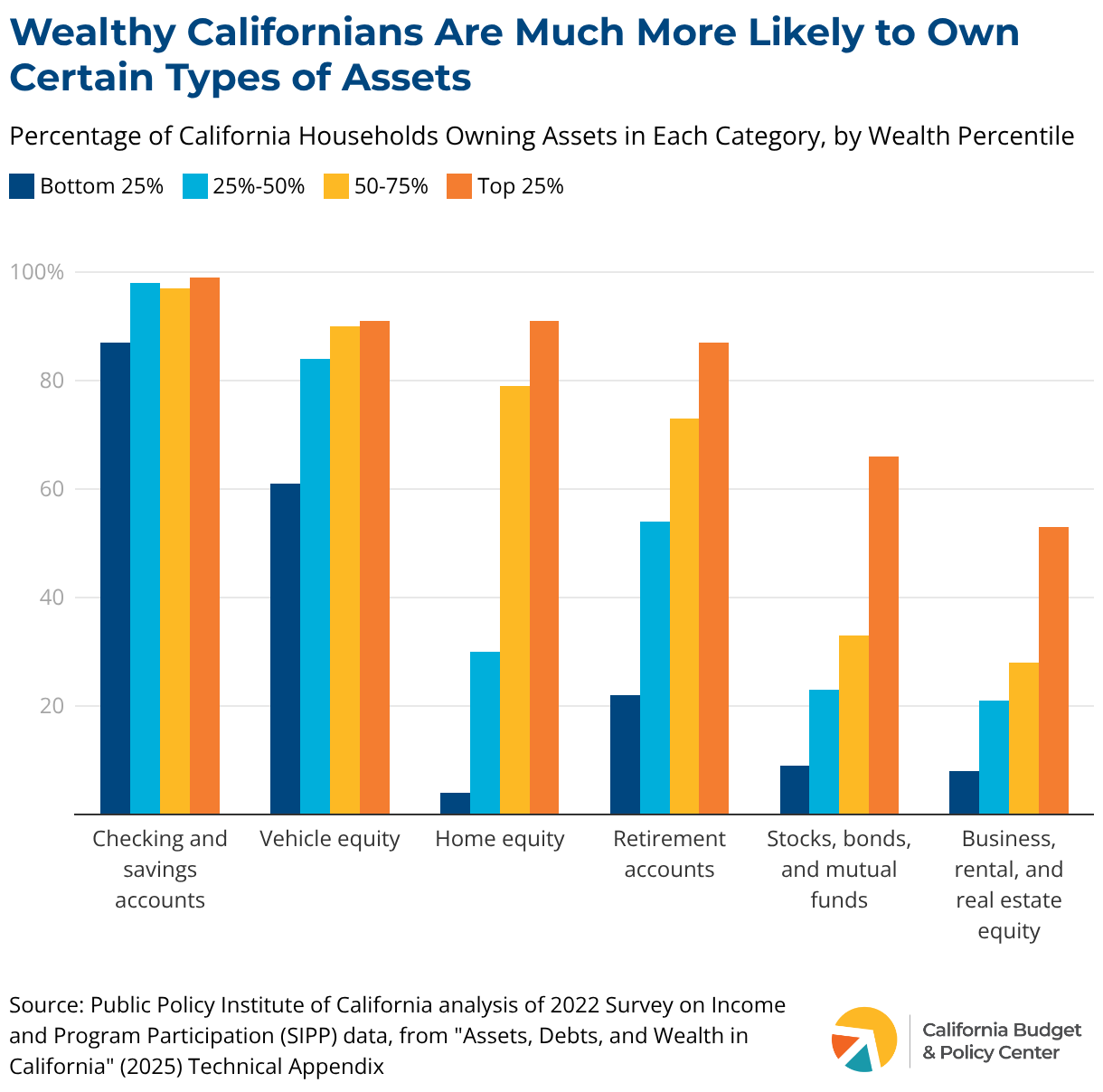
Current federal and state tax policies allow some large wealth increases to never be taxed. California — like the federal government — only taxes the income people receive when they sell their assets, but does not tax the growth in value of assets they hold onto. This growth is known as an unrealized capital gain, and for very wealthy households, unrealized capital gains make up a large share of their total wealth. Some wealthy people may even be able to avoid paying income taxes entirely in some years by not taking a salary, not selling any stocks or other assets, and simply borrowing against their wealth to pay their bills.
Additionally, if someone holds onto assets until their death, their heirs do not have to pay any tax on the gain due to a provision in both federal and state law known as “stepped-up basis,” estimated to cost California around $5 billion each year.
For these reasons, broadly prohibiting state leaders from enacting any new taxes on assets would narrow the options available to ensure that the wealthiest Californians pay their fair share to support the services that benefit residents across the state.
Impacts of Prohibition on Retroactive Taxes
Many federal and state tax law changes have modest retroactivity periods, such as looking back to the beginning of a tax year. This has the benefit of reducing taxpayers’ ability to engage in activities to avoid or evade the tax before it goes into effect, which would reduce the revenue potential. Looking back to the start of the current tax year can also more immediately raise revenues when there are urgent needs.
Broadly prohibiting retroactive taxation would hamstring the ability of state leaders to enact effective and timely tax policy changes that raise revenues needed to meet the needs of Californians.
Who Supports and Opposes Prop. 42?
The top contributor to the Prop. 41 campaign is a group called “Building a Better California,” which is largely funded by Google cofounder Sergey Brin and other billionaires. This group is also opposing Prop. 40 and supporting Prop. 41. The measure is also endorsed by the California Republican Party, the California Chamber of Commerce, the California Taxpayers Association, the California Professional Firefighters, and the State Building & Construction Trades Council of California.
There is no official opposition campaign for Prop. 41, but prominent opponents include the Service Employees International Union – United Health Workers West (SEIU-UHW) — the main proponent of the Prop. 40 billionaire tax measure — as well as other labor groups including the California Federation of Teachers and the California Federation of Labor Unions. The California Democratic Party and the League of Women Voters are also opposed.

Curious About Other Ballot Propositions?
Browse our collection of resources covering California’s statewide ballot measures to help you understand what’s at stake for California this November.