
key takeaway
California’s poverty rate remained among the highest in the nation in 2025, with nearly 7 million Californians lacking enough resources to afford basic necessities like food and housing. Poverty has returned to and exceeded pre-pandemic levels, while recent federal and state policy changes threaten to increase economic hardship further.
The latest poverty data show Californians continued to face widespread economic hardship last year, even before major federal cuts to vital programs took effect, underscoring the need for bold state action to prevent poverty from rising further.
In 2025, California’s poverty rate remained essentially unchanged since 2024, at 17.3%, second only to Louisiana. The state’s poverty rate has returned to, and exceeded, pre-pandemic levels, erasing the historic poverty reduction seen in 2021 following significant, but temporary, investments in the child tax credit, food assistance, and other key antipoverty public programs. New data show that nearly 7 million Californians — more than the populations of Los Angeles, San Diego, and San Jose combined — did not have enough resources to afford basic necessities like food and housing. These estimates are based on the Supplemental Poverty Measure, which provides a comprehensive picture of families’ economic well-being, by accounting for both the cost of basic needs and resources from public supports.
The persistently high poverty level is especially concerning as California enters a new and more challenging policy environment. In 2025, the first year of the second Trump administration, Congress enacted far-reaching legislation, namely H.R. 1, the “One Big Beautiful Bill”, which made historic cuts to the Supplemental Nutrition Assistance Program (SNAP) and Medicaid — CalFresh and Medi-Cal in California — amid other federal actions that threatened families’ economic security, including the longest federal government shutdown in US history. These cuts affect programs that are central to California’s safety net and have long played an important role in reducing poverty. CalFresh alone helps lift hundreds of thousands of Californians out of poverty each year.
The full effects of many recent federal policy changes are not yet reflected in the 2025 poverty rate. As cuts to food assistance, health coverage, and other public supports take effect over the coming years, California is likely to see poverty and economic hardship rise further. Understanding where poverty stood before these changes provides an important baseline for assessing their effects in the years ahead. This report examines how poverty in California has changed over time and how experiences differ across age and racial and ethnic groups.
Nearly 7 million Californians lived in poverty in 2025, according to new US Census data based on the Supplemental Poverty Measure — a more comprehensive reflection of economic well-being than the Official Poverty Measure. California’s overall poverty rate declined slightly to 17.3% in 2025, down from 17.7% in 2024, though the change was not statistically significant. The child poverty rate declined to 16.6%, which was also not statistically different from the 2024 rate. The unchanged poverty rates remain above pre-pandemic levels and far above the historic lows of 2021, when expanded public supports helped millions of families make ends meet.
California’s high poverty rate — and the steep declines achieved when public supports were expanded in 2021 — underscore the critical role public supports play in helping families meet basic needs and the importance of ensuring eligible families can access them. In 2025, increased attacks and misinformation targeting immigrant and mixed-status families and the federal government shutdown disrupted access to key programs, including CalFresh, and created confusion around eligibility for many Californians. While the 2025 data cannot isolate the effect of the decline in CalFresh program participation we’re already seeing, it underscores how fragile economic security is for millions of California families and how elevated the state’s poverty rate remains above the historically low 2021 levels.
Poverty Increased Across All Age Groups, with Child Poverty Now More than Double 2021 Levels
Poverty rose significantly across all age groups from 2021 to 2025, though rates vary among children, adults, and older adults. Notably:
- Child poverty more than doubled since 2021, reflecting a weakened safety net and costs associated with raising children. Child poverty has risen since 2021 from 7.5% to more than double that in 2025 at 16.6%. The end of pandemic-era safety net programs has directly contributed to this trend. For example, the expanded federal child tax credit (CTC) reduced child poverty by 4.3% in 2021. In 2024, the CTC kept just 1.8% of children out of poverty, a marked reduction from 2021. Costs associated with raising children (such as child care) also contribute to relatively higher poverty rates. Data from the RAPID Survey Project show that from November 2022 to July 2025, 56% of California families with children under age 6, on average, reported difficulty affording one or more basic needs. Without state action, recent federal attacks on programs that support families with children threaten to exacerbate child poverty.
- At 21.5%, poverty remains highest for older adults in California. This trend is largely due to higher out-of-pocket medical expenses for older adults. Chronic health conditions become more common with age, and managing these conditions often requires ongoing care, medications, and other health services that can add to out-of-pocket expenses. Recent state actions — such as reducing Medi-Cal asset limits — specifically puts older adults at risk for higher health-related expenses, further compounding the high poverty level among older adults.
- Poverty rates for adults 18-64 are significantly higher in 2025, as compared with 2021. Specifically, poverty for Californians ages 18 to 64 rose from 11.1% in 2021 to 16.3% in 2024. Many of the policies in H.R. 1, such as harsher CalFresh time limit rules and increased administrative hurdles to maintain Medi-Cal, will specifically target this age range. As a result, thousands of adults in California could lose access to food assistance and health care, likely resulting in increased poverty levels.
Black and Latinx Californians Continue to Face Economic Barriers, Resulting in Relatively High Poverty Levels
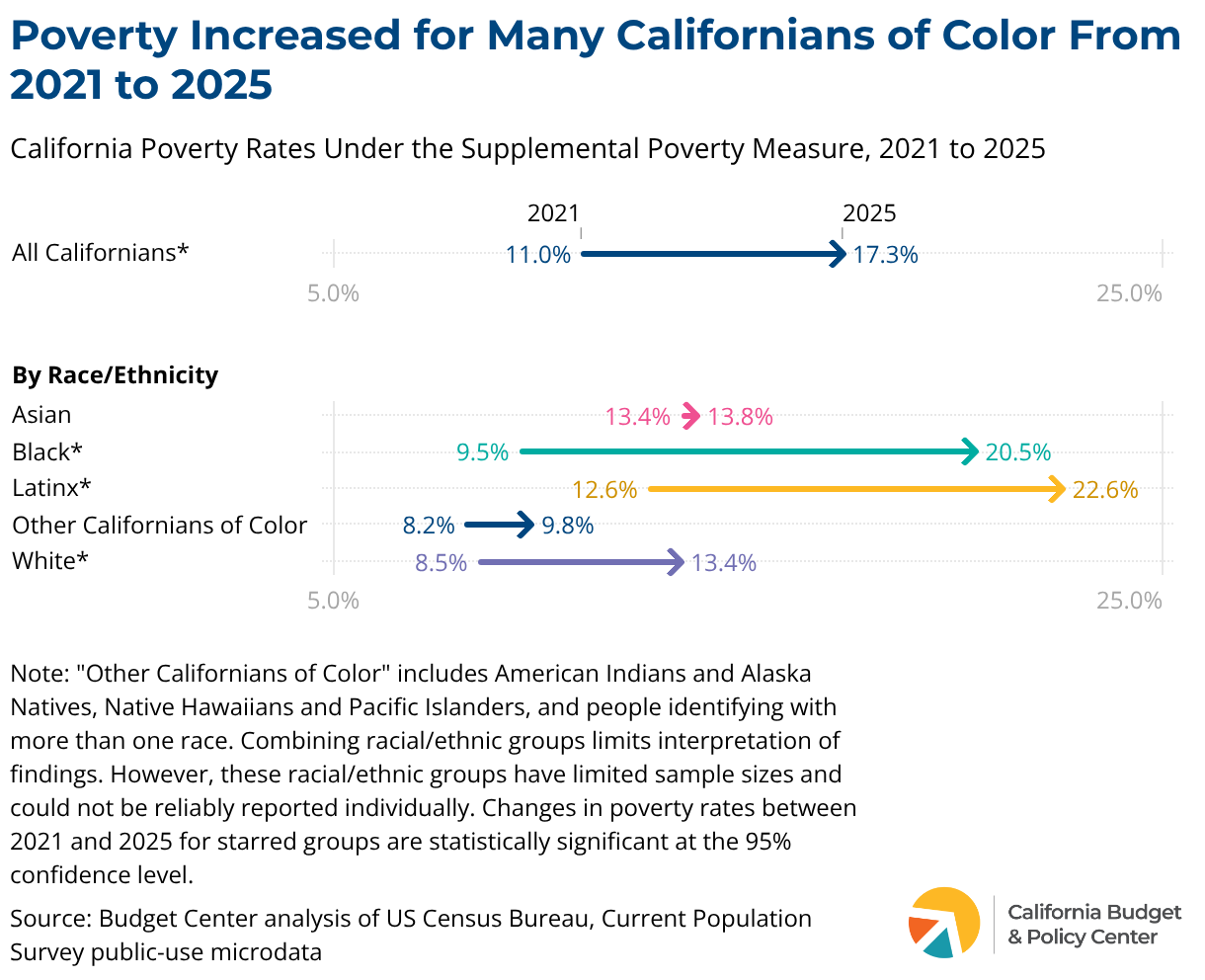
Poverty increased for many Californians of color from 2021 to 2025.1While this analysis displays Native Americans as a racial/ethnic group, the data does not specify Tribal citizenship, which reflects the political relationship between Tribal nations and the federal government. This analysis should be interpreted with that context and the known data limitations for Native Americans. These increases were most pronounced for Black and Latinx Californians, further widening racial disparities in the state. For Black Californians, poverty rates have more than doubled in the last four years, rising from 9.5% in 2021 to 20.5% in 2025. Latinx Californians saw an increase almost as large, from 12.6% in 2021 to 22.6% in 2025. Such racial and ethnic disparities in poverty reflect generations of systemic racism that continues to persist. Racial discrimination in housing, access to banking, education, and taxation have all contributed to the racial income and wealth inequalities reflected in today’s poverty estimates.
Recent federal and state actions will disproportionately harm Californians of color and immigrants and are likely to push more Black and Latinx Californians into poverty in future years. Federal cuts to Medicaid and CalFresh, as well as state policy choices to freeze Medi-Cal enrollment for undocumented Californians and eliminate dental benefits for certain groups of immigrants, will take health coverage away from millions of Californians, force families to delay or forgo care, experience food insecurity, and face greater risks of falling into poverty. Latinx Californians represent more than half of Medi-Cal enrollees and CalFresh participants, While Black Californians make up approximately 7% of Medi-Cal and 9% of CalFresh enrollees.
Without strong state policy interventions, the recent federal and state policy changes will widen racial and ethnic disparities, leaving Californians of color with fewer resources to stay healthy, build wealth, and achieve economic security. Protecting Medi-Cal, food assistance, and other supports while advancing more equitable tax policies is critical to ensuring all Californians can share in the state’s prosperity.
2025 Previews Hardship Ahead for Californians Unless the State Takes Bold Action to Address Poverty
The quick rise of California’s poverty rate to pre-pandemic levels shows that poverty is a policy choice. After the end of historic temporary investments in 2021, millions of Californians still struggle to afford basic needs. The new Census data show particularly high poverty rates among older adults and deep racial disparities that leave Black and Latinx Californians more likely to experience poverty.
The 2025 data preview the greater hardship ahead for California families if state leaders do not take bold action soon. Federal cuts to food assistance, health care, and other public supports that help lift millions out of poverty each year are likely to push poverty even higher and widen existing disparities as they begin taking effect. California has commonsense options to raise additional ongoing revenue to mitigate the harm of these cuts and make the investments necessary to reduce poverty in the long run. For example, state leaders could build on recent efforts to make corporate taxes fairer and redirect some of the billions of dollars California loses each year on tax breaks for profitable corporations to families and individuals struggling to meet basic needs. California has seen how quickly poverty can fall when families have the resources they need, and state leaders have the tools to continue building on hard-won progress.
Alissa Anderson, Hannah Orbach-Mandel, Kayla Kitson, Leslie Ortiz, Laura Pryor, Nishi Nair, Monica Saucedo, and Omar Morales contributed to this report.