SACRAMENTO, CA — Following Governor Newsom’s 2025-26 budget proposal released this morning, the California Budget & Policy Center (Budget Center), a nonpartisan research and analysis nonprofit, weighed in with the following statement from its executive director, Chris Hoene. “The California state budget is a statement of our collective values. The 2025-26 budget proposal makes strides … Continued
Budget Center policy experts explore what the budget proposal means for California’s communities, economy, and overall progress.
Watch the recording
About this event
Following Governor Newsom’s proposed 2025-26 budget, the Budget Center team will provide an overview of significant proposals and answer your questions about our state’s fiscal future.
This year promises big changes as California faces potential federal budget and policy threats, a changing state budget landscape, and the effects of recent ballot measures.
Our policy experts will explore what this proposal means for Californians, focusing on:
Governor Newsom’s overall approach to the state budget, including key policy shifts and their potential impact.
How the proposal addresses economic and racial disparities in our communities.
Missed opportunities: We’ll highlight what’s missing and share actionable steps policymakers can take to help Californians combat the high cost of living.
Join us as we kick off a new budget season and dive into the tools, policies, and investments that can help shape a budget focused on equity and thriving communities for all.
Conrad N. Hilton Foundation, James Irvine Foundation
About the California Budget & Policy Center
The California Budget & Policy Center (Budget Center) is a nonpartisan research and analysis nonprofit advancing public policies that expand opportunities and promote well-being for all Californians.
There was a problem processing your signup. Please try again. Or contact us
Please check your email to confirm your signup.
Every year, California’s governor and Legislature make budget decisions that shape funding for education, health care, housing, child care, transportation, climate programs, and many other public services. These decisions affect millions of Californians and reflect the state’s priorities and values.
This downloadable guide explains how the California state budget process works — from the governor’s January budget proposal through the May Revision, legislative negotiations, and final budget adoption. Whether you’re new to state budgeting or looking for a helpful reference, this resource provides an overview of the annual budget cycle and the opportunities for public participation throughout the year.
This guide includes:
An overview of California’s annual state budget process
The roles of the governor, Legislature, and other key budget institutions
Important constitutional deadlines and budget milestones
A visual timeline of the state budget cycle
Opportunities for Californians to participate in budget decisions
Want to Better Understand the State Budget?
The Budget Center’s essential resources for understanding and navigating the California state budget — all in one place.
Explore tools, videos, and expert insights designed to strengthen your advocacy and guide informed decision-making.
There was a problem processing your signup. Please try again. Or contact us
Please check your email to confirm your signup.
Join Dollars and Democracy for expert-led California budget training and advocacy insights to make an impact in 2025.
Watch the recording
About this event
As California navigates a shifting budget landscape, a hostile federal administration, and the impact of recent ballot measures, 2025 promises pivotal decisions. Join us for Dollars and Democracy, our premier state budget training, followed by an in-depth conversation with expert advocates and budget insiders to help you engage effectively and amplify your cause in Sacramento.
Whether new to advocacy or a seasoned veteran, this training offers valuable insights. Our Budget Director, Scott Graves, will guide you through California’s budget process, highlighting key deadlines and the essential roles of the governor, the Legislature, and advocates in driving community investments.
Next, a discussion panel of budget and election experts will share practical advocacy tools and insights on what to expect in 2025.
Don’t miss this opportunity to equip yourself and your community for the year ahead. Register now to secure your spot and prepare to make an impact on the California budget!
Budget Trainer
Dollars and Democracy training, approx. 25 minutes
Scott Graves, Budget Director, California Budget & Policy Center
Discussion Panel
Looking ahead and what to expect in 2025, approx. 35 minutes
Alissa Anderson, Policy Director, California Budget & Policy Center
Mary Ignatius, Executive Director, Parent Voices
Elisa Wynne, Staff Director, Senate Committee on Budget and Fiscal Review
Thank you to our event sponsors
Conrad N. Hilton Foundation, James Irvine Foundation
About the California Budget & Policy Center
The California Budget & Policy Center (Budget Center) is a nonpartisan research and analysis nonprofit advancing public policies that expand opportunities and promote well-being for all Californians.
In late June, Governor Newsom and state leaders reached a deal on the 2024-25 California state budget. Confronted with a substantial shortfall, state leaders negotiated a budget package that presents a mixed bag for California families. Policymakers managed to protect many essential programs, but some financial maneuvers and the continued resistance to significantly raise revenues to help all Californians thrive may hinder progress in future years.
The June budget package rejects many harmful cuts to critical programs initially proposed by Governor Newsom in January and May. State leaders protected many essential programs that Californians rely on, including by drawing on the state’s reserves and delaying some program expansions. However, the budget also relies heavily on borrowing from future budgets, commits a higher percentage of future revenue growth to schools, and only temporarily increases revenues. These decisions could compromise the state’s ability to sustain core programs and stall much-needed investments in the coming years if revenue conditions do not improve.
This analysis highlights key components of the June budget package and examines how it protects — or misses opportunities to enhance — services that aim to improve the well-being of Californians with low incomes, Californians of color, women, immigrants, and others historically excluded from sharing in the state’s wealth.
How did state leaders close the budget shortfall?
State leaders closed a roughly $47 billion General Fund shortfall across the three-year “budget window” (fiscal years 2022-23 through 2024-25) using a broad array of budget tools. The “solutions” in the 2024-25 budget package include:
$16 billion in spending reductions.
$13.6 billion from a combination of additional revenue (which is mostly temporary) and internal borrowing from state special funds.
$6 billion in fund shifts, which transfer certain costs from the General Fund to other state funds.
Nearly $6 billion in withdrawals from two reserves: the Budget Stabilization Account (also known as the rainy day fund) and the Safety Net Reserve.
$3.1 billion in funding delays and pauses. This includes delaying, for two years, an expansion of food assistance to undocumented Californians as well as postponing, for six months, a wage increase for people who provide services to Californians with intellectual and developmental disabilities.
$2.1 billion in deferrals, which postpone certain payments to later years. This includes shifting one month of state employee payroll costs from June 2025 (the last month of the 2024-25 fiscal year) to July 2025 (the first month of the 2025-26 fiscal year).
What happened to Prop. 98? Was school funding protected?
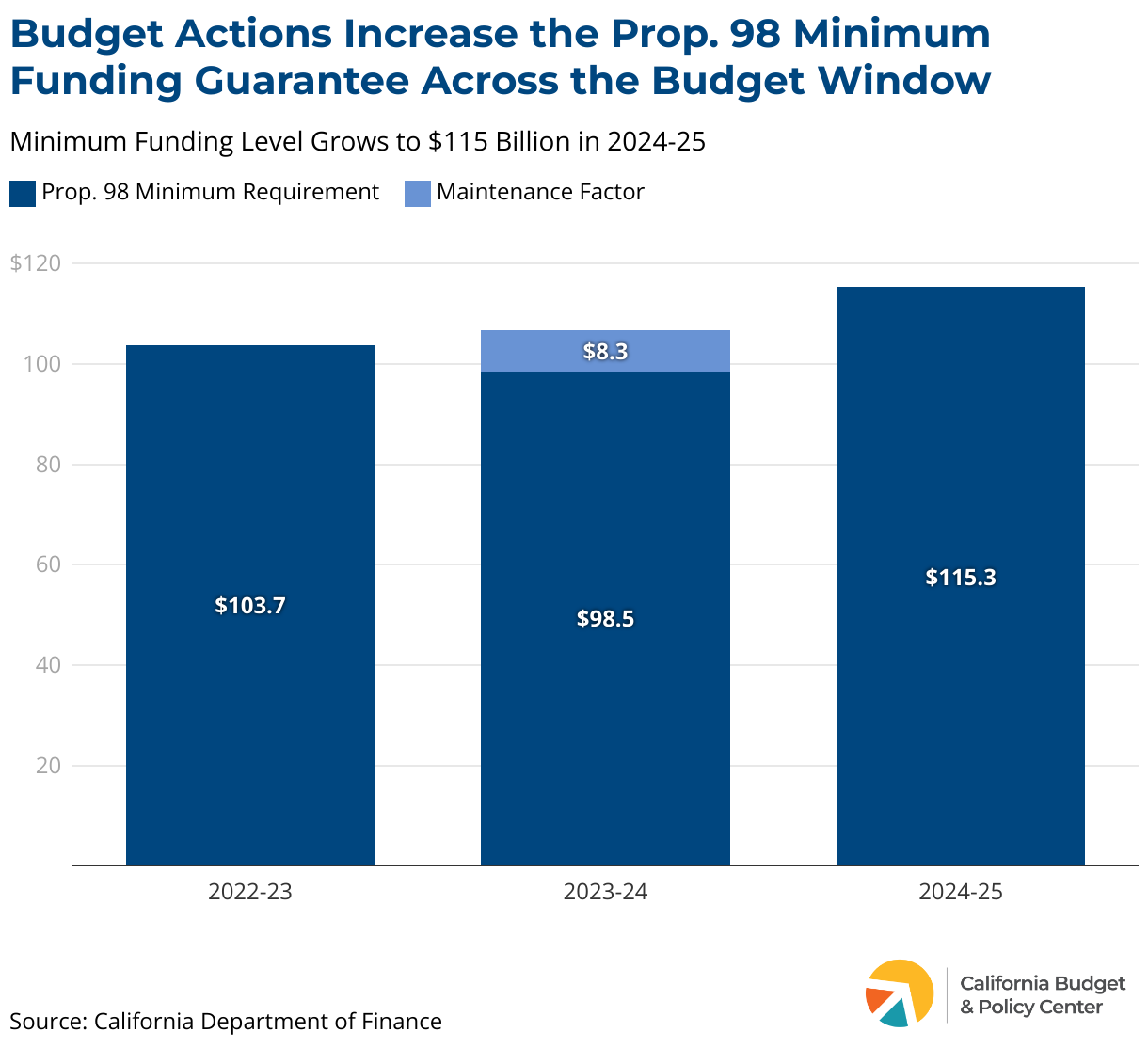
The budget agreement protects funding for Transitional Kindergarten, K-12 schools, and community colleges (TK-14 education) despite revenue challenges. Estimates of the Proposition 98 minimum funding guarantee for TK-14 education are updated to reflect two major budget actions: 1) the adoption of a proposal to “accrue” some funding from 2022-23 to future years and 2) the suspension of the Prop. 98 guarantee in 2023-24. These actions increase the Prop. 98 minimum funding levels across the 2022-23 to 2024-25 “budget window” and also ensure funding growth beyond the three-year window.
Key details that further explain the Prop. 98-related budget actions are outlined below.
The enacted budget adopts a plan to accrue $6.2 billion in TK-14 spending to future years.
A drop in income tax collections in the 2022 tax year led to a reduction in the Proposition 98 minimum funding guarantee. This revenue drop only became clear in late 2023, after the 2022-23 fiscal year ended. As a result, the Prop. 98 disbursement amount exceeded the revised minimum funding guarantee for 2022-23. The budget agreement sets the 2022-23 minimum guarantee base at that higher level ($103.7 billion), which is $6.2 billion higher than what the formulas require under the revised revenue estimates. To account for these budgetary costs over the Prop. 98 guarantee in 2022-23, the enacted budget requires annual payments to be made in later fiscal years. These payments of $544 million annually over 10 years will begin in 2026-27 and will be paid for with non-Prop. 98 General Fund dollars.
The enacted budget suspends the Prop. 98 minimum funding guarantee.
The decision to set the Prop. 98 base at a higher level in 2022-23 increases the 2023-24 minimum guarantee to $106.8 billion. (Prop. 98 formulas in this case require the prior-year funding level to be one of the main components of the calculation in the subsequent year.) However, available state revenues are insufficient to meet this requirement in 2023-24. As a result, state leaders decided to suspend the Prop. 98 guarantee and set the funding level at $98.5 billion in 2023-24. Suspending the guarantee is allowed under the state Constitution for this particular purpose — this is the third time the guarantee has been suspended since Prop. 98 was passed in 1988.
The Prop. 98 suspension creates a funding gap called “maintenance factor.”
Constitutional provisions require that the Prop. 98 guarantee be restored to the level it would have reached absent the suspension. This happens over time by accelerating growth in the minimum guarantee depending on General Fund revenue growth. Furthermore, the maintenance factor amount is adjusted annually to reflect changes in student enrollment and the cost of living. Under current estimates, the 2023-24 suspension creates a maintenance factor amount of $8.3 billion.
Overall, decisions on the minimum guarantee push large spending obligations to future budget years that add pressure to the non-Prop. 98 side of the budget. First, while the Prop. 98 suspension provides relief in 2023-24, TK-14 education will get a higher percentage of future revenue growth than normal until the maintenance factor is paid. In other words, a larger portion of General Fund revenue growth will go toward the maintenance factor obligation, leaving less funding for the non-Prop. 98 side of the budget.
Second, shifting $6.2 billion in TK-14 education spending to the non-Prop. 98 side of the budget starting in 2026-27 will reduce funding available for other critical needs, such as food security, child care, housing, and other programs that help families make ends meet.
What revenue solutions does the budget include?
One of the budget solutions is a temporary increase in state revenues, which helps to avoid more harmful service cuts, but will also lead to decreased revenues in later years.
Specifically, for tax years 2024 through 2026, the budget agreement 1) limits the tax credits businesses can use to $5 million and 2) suspends tax deductions for prior-year losses (“net operating losses” or NOLs) for businesses with at least $1 million in profits. These provisions are estimated to increase revenues by $5.95 billion in 2024-25, $5.5 billion in 2025-26, and $3.4 billion in 2026-27.
However, the budget agreement also includes provisions to allow businesses impacted by these limitations to fully recoup the lost tax benefits in later years, reducing state revenues for several years beginning in 2027-28 by as much as a few billion dollars in some years. Notably, businesses subject to tax credit limitations will be allowed to receive the credits above the $5 million annual limit as a refund — spread across five years — after the limitation period ends. In other words, if the excess credits claimed in future years exceed a business’ tax bill, it can receive the difference in cash. Historically, business tax credits have generally not been refundable.
Additionally, if the governor’s administration determines that the budget can be balanced in 2025-26 and/or 2026-27 without the additional revenue from the temporary business credit limitation and NOL suspension, policymakers can specify in the Budget Act that these provisions do not apply for that year.
Finally, the budget contains some smaller, ongoing tax policy changes impacting businesses and investors. These changes will increase revenues by a few hundred million dollars ongoing, including eliminating tax subsidies that specifically benefit oil and gas companies.
state budget terms defined
What’s the difference between a trailer bill and policy bill? A deficit and an operating deficit? And what exactly is a “Budget Bill Jr.?” Our Glossary of State Budget Terms answers that and more.
How did California’s Rainy Day Fund and other reserves help cover the shortfall?
California has several reserve accounts that set aside funds intended to be used when economic conditions worsen and state revenues decline. These include:
The Budget Stabilization Account (BSA), commonly referred to as the Rainy Day Fund. This is the state’s largest reserve and its funds may be used for any purpose.
The Public School System Stabilization Account (PSSSA), which is also known as the Prop. 98 reserve. Funds withdrawn from this account must be used to support K-12 schools and community colleges.
The Safety Net Reserve Fund. Funds withdrawn from this account are intended to maintain existing CalWORKs and Medi-Cal benefits and services during an economic downturn.
State Budget Reserves Explained
See our report, California’s State Budget Reserves Explained, to learn more about the savings accounts policymakers can use to support Californians in times of budget shortfalls.
The budget agreement rejects many harmful cuts to critical services in part by drawing on state reserves. However, the budget takes an imbalanced approach, taking around half the funds in the BSA, but draining all funds from the Safety Net Reserve, leaving no dedicated funds to help support CalWORKs and Medi-Cal in future years.
Specifically, the budget agreement withdraws $4.9 billion from the BSA in 2024-25, and assumes an additional BSA withdrawal of $7.1 billion in 2025-26, which would leave about $10.5 billion available for future years. In contrast, the budget withdraws all $900 million from the Safety Net Reserve in 2024-25. The budget also takes all $8.4 billion from the PSSSA in 2023-24, but makes a $1.1 billion discretionary deposit to that account in 2024-25.
As required by the state Constitution, the governor signed a proclamation on June 26 declaring a budget emergency in order to allow the withdrawal of funds from the BSA. The governor did not need to declare a budget emergency to withdraw funds from the PSSSA or the Safety Net Reserve.
The budget includes a big cut to “state operations” spending — what does this mean and is the cut achievable?
The budget agreement adopted the governor’s plan to permanently reduce “state operations” spending by around $3 billion starting in 2024-25. This funding supports the basic activities of state government. Savings are to be achieved through two actions implemented by the Department of Finance (DOF) in collaboration with state departments:
Reducing state operations spending tied to vacant positions, for General Fund savings of $762.5 million in 2024-25.
In addition, the governor is required to propose the permanent elimination of vacant positions as part of his 2025-26 state budget, which will be released in January 2025. The budget agreement exempts several state entities from this reduction, including the Legislature, the judicial branch, the California State University, and the University of California, and the UC College of the Law, San Francisco.
Cutting state operations spending by up to an additional 7.95%, for General Fund savings of $2.2 billion in 2024-25.
This reduction is to be applied on top of the cut to funding for vacant positions, with savings expected to be achieved through operational efficiencies and other cost-reduction measures. The budget agreement exempts the Legislature from this cut.
These reductions would equal roughly 10% of total General Fund state operations spending. However, it’s questionable whether $1 of every $10 in state operations costs could be permanently eliminated through efficiencies and other measures without eroding state services. Moreover, in some departments, most state operations spending supports employee salaries and benefits — which cannot be unilaterally cut to generate state savings. As a result, some departments may have relatively little state operations funding available to cut to help meet the $3 billion statewide reduction target.
Furthermore, the governor’s administration reported in budget hearings that 24-hour operations would be exempt from the reductions. This includes, for example, the state prison system, which is overseen by the California Department of Corrections and Rehabilitation (CDCR). The budget agreement assumes that CDCR will account for nearly $400 million of the $3 billion in state operations reductions. CDCR could easily achieve these savings by closing state prisons. However, the governor refuses to plan for more prison closures, and it’s uncertain whether CDCR will be able to cut roughly $400 million from its operating budget without downsizing the state prison system.
Overall, it’s highly unlikely that the projected $3 billion in statewide savings will fully materialize, according to the Legislative Analyst’s Office. Unrealized savings would need to be addressed during the 2025-26 budget process and would “add to any fiscal challenges” the state is facing that year. In the meantime, DOF will update the Legislature in October and again in January on any progress made toward reducing state operations spending as envisioned in the budget agreement.
What changes were proposed to the MCO tax, and how does it help support Medi-Cal services for Californians?
Managed Care Organizations (MCOs), also known as health insurance plans, are responsible for managing health care services as a way to manage cost, utilization, and quality. States, with federal approval, can impose a tax on MCOs to reduce — or offset — state Medicaid spending and draw down additional federal funds. The MCO tax is a charge based on enrollment in Medi-Cal managed care plans and private health insurance plans.
In 2023, California renewed its MCO tax with federal approval, effective from April 1, 2023 to December 31, 2026. State leaders planned to use the roughly $19.4 billion in tax revenue to offset General Fund spending on Medi-Cal and support provider rate increases to improve access to health care services. Currently, many Californians face difficulties accessing Medi-Cal health care services because local providers oftentimes do not accept Medi-Cal patients.
This year, state leaders proposed amendments to increase the tax, generating a net fiscal benefit of $24.3 billion total, given the budget shortfall. These amendments require federal approval.
The 2024-25 budget agreement outlines a plan to use revenue from the MCO tax to support the Medi-Cal program as well as rate increases for health providers, with some investments delayed to 2026. Budget allocations include:
$6.9 billion in 2024-25, $6.6 billion in 2025-26, and $5.0 billion in 2026-27 to help maintain existing services in the Medi-Cal program; and
$133 million in 2024-25, $728 million in 2025-26, and $1.2 billion in 2026-27 for new targeted Medi-Cal provider rate increases and investments.
However, the MCO tax spending plan would be overturned if voters approve a ballot initiative this November that would make the tax permanent and require the state to use these dollars solely for certain provider rate increases.
What was the overall impact of the budget on critical programs and services?
The budget agreement rejects many harmful cuts to critical programs proposed by Governor Newsom in January and May. However, despite growing needs, the agreement includes considerable cuts to housing and safety net programs and makes no significant ongoing investments in critical programs and services.
The budget agreement maintains funding for the CalFresh Minimum Benefit Pilot and the Work Incentive Nutritional Supplement (WINS) programs, which were at risk of being eliminated. Both of these programs are important in addressing food insecurity. The budget also includes a small increase of 0.3% to the California Work Opportunity and Responsibility to Kids (CalWORKs) cash grants and protects the recent increase to the Supplemental Security Income/State Supplementary Payment (SSI/SSP) programs.
Missed Opportunities
The budget agreement includes cuts to various CalWORKs services, including the Expanded Subsidized Employment and Home Visiting programs. While the cuts are tailored to match recent utilization levels, the cuts may limit the reach these programs could have. The budget agreement also drains the Safety Net Reserve, which leaves CalWORKs vulnerable to more cuts in the event of an economic downturn. While the agreement preserves the California Food Assistance Program (CFAP) expansion to older undocumented adults, a population experiencing high rates of food insecurity, it delays the start date to 2027.
The budget agreement allocates $1 billion for local flexible funding to address homelessness with additional requirements. It also adjusts previous allocations for various homelessness programs that serve vulnerable diverse populations including families involved with the child welfare system, individuals involved in Adult Protective Services, and unhoused individuals who are likely eligible for disability benefits. Separately, the budget agreement maintains over $1 billion for critical affordable housing programs including an additional $500 million for state Low Income Housing Tax Credits, $315 million for the Multifamily Housing Program, and $260 million for the Regional Early Action Program (REAP) 2.0.
Missed Opportunities
The budget agreement cuts roughly $1.1 billion from various critical affordable housing, homeownership, and homelessness programs, for which there is no slated future funding. Over half of California renters continue to pay unaffordable housing costs, the instability of which is a primary driver of homelessness. California cannot afford to continue piecemealing needed funding for affordable housing and homelessness through one-time funding allocations. Ongoing resources are needed for localities, service providers, and developers to effectively implement short- and long-term solutions to these challenges.
While the budget agreement temporarily pauses the promised 200,000 subsidized child care slot expansion at approximately 118,000 slots, it does solidify a plan for rolling out the remaining slots by 2027-28. Additionally, the budget agreement funds the approximately 11,000 general child care spaces awarded in March 2024. Lastly, the budget agreement includes trailer bill language to advance the creation of an alternative rate methodology for child care providers by the July 1, 2025 federal deadline, as well as language to ensure that provider rates do not revert back to the 2018 regional market rate if the deadline is missed.
Missed Opportunities
Due to various administrative and contextual challenges, the amount of funding for new child care slots can exceed the number of slots that actually materialize, leaving dollars unspent. The joint legislative budget agreement proposed creating a reversion account to ensure that unspent child care dollars remain within child care programming. In contrast, the budget agreement with the governor does not include this reversion account. Therefore, any unspent child care dollars will be reverted back to the General Fund.
The budget agreement preserves the expansion of Medi-Cal eligibility to undocumented adults ages 26 to 49 as well as In-Home Supportive Services (IHSS) for undocumented Californians. The IHSS program helps people with low incomes who are over the age of 65, blind, and/or disabled live with dignity in their own homes. In May, the governor proposed eliminating IHSS for all undocumented Californians, a harmful and xenophobic proposal that could have pushed many immigrant families deeper into poverty.
Missed Opportunities
The budget agreement does not provide funding to reform the Medi-Cal Share of Cost program, which would alleviate financial burdens for many older adults and people with disabilities. Under the current program, many Californians must choose between paying for their health care, rent, food, or other basic needs. This reform was passed in the 2022 Budget Act but was subject to future appropriation.
The budget agreement provides key funding for survivors of domestic violence, among other crimes. Specifically, it includes $103 million in one-time state funding to fill a gap in federal Victims of Crime Act funds that provide critical services to survivors. The budget agreement also preserves funding for the Flexible Assistance for Survivors program, which provides grants to community-based organizations to provide flexible assistance such as relocation or care costs to survivors of crime. In May, the governor proposed removing all funding for this program, which would have eliminated crucial support for survivors.
What changes to the 2024-25 budget package might happen in August?
Budget decisions happen throughout the year, not just from January to June. In August, for example, the governor and legislative leaders will revisit the 2024-25 budget package and make changes by passing additional trailer bills and, potentially, amending the 2024 Budget Act.
In fact, the Legislature is expected to soon consider proposals that aim to smooth budget volatility by requiring the state to set aside more revenue in the future. State leaders have indicated that this plan includes two components:
Require a portion of a projected budget surplus to be placed in a “temporary holding account” to be allocated in future years if anticipated revenues are actually realized; and
Ask voters to 1) amend the state Constitution to increase the maximum size of the Budget Stabilization Account (“rainy day fund”) — which is currently capped at 10% of General Fund tax proceeds — and 2) exclude deposits to state reserve funds from the state spending limit created by Proposition 4 in 1979 (the “Gann Limit”).
These proposals involve trade-offs. Expanding reserves would provide more budget resilience during revenue downturns and help policymakers avoid making harmful cuts. But some critical needs of Californians may remain unmet if additional resources must be saved instead of being immediately invested in California’s communities.
What more should state leaders do next year and beyond to create an equitable California?
For every Californian — from different races, backgrounds, and places — to thrive and share in the state’s economic and social life, strategic policy choices must be made. To a large extent, these choices are made through the state budget process. State leaders should set funding and policy priorities that help all Californians share in the wealth that they help create while also ensuring that the state’s tax dollars are invested in the areas of greatest need.
To achieve these goals — and move toward a more equitable California — bold approaches are needed across a broad range of public services and systems. For example, state leaders should:
Raise revenues to boost tax fairness and invest in our communities.
The temporary tax revenue in the 2024-25 budget package helps to prevent many harmful spending cuts in the short term. But state leaders missed an opportunity to raise revenues on an ongoing basis by ensuring that profitable corporations and wealthy Californians are adequately contributing taxes to support critical public services. For example, policymakers can enact permanent tax policy changes to 1) address corporations’ use of tax havens to avoid state taxes and 2) impose reasonable limitations on business tax credits to prevent businesses from essentially zeroing out their tax bills.
Provide ongoing, at-scale resources to increase affordable housing and solve homelessness.
More Californians are experiencing homelessness than ever before. Recent state investments have been crucial in supporting these individuals and in promoting housing stability. However, policymakers can go further by creating sustainable systems to serve all Californians struggling to stay in their homes. Specifically, state leaders should prioritize at-scale, sustained funding and policy interventions that promote affordable and supportive housing, protect renters, and direct resources to rental assistance and homelessness services.
Close more state prisons to free up resources for critical services.
In recent years, state leaders have taken steps to downsize California’s costly and sprawling prison system, but progress has stalled. Spending on state corrections remains high — over $14 billion per year — and the prison system operates with roughly 15,000 empty beds. While the budget agreement deactivates selected prison housing units — lowering state costs by around $80 million per year — closing prisons would generate substantially more ongoing savings. California can safely close up to five additional prisons for state savings of roughly $1 billion per year. These resources could be used for reentry assistance and other services to promote rehabilitation, reduce poverty, and strengthen families and communities — particularly Black and Latinx communities, which have been disproportionately impacted by generations of discrimination at the hands of the criminal justice system.
As featured in the Los Angeles Times: California’s leaders are negotiating a serious budget shortfall. They must balance the budget, fund essential services that keep the state and its infrastructure running and protect the well-being of Californians through investments in education, health care, child care and more.
SACRAMENTO, CA — In response to the California State Assembly and Senate leaders announcing a joint legislative budget plan on May 29, the California Budget & Policy Center (Budget Center), a nonpartisan research and analysis nonprofit, weighed in with an X thread and the following statement from Executive Director Chris Hoene: “Overall, the Legislature’s plan … Continued
This website uses cookies to analyze site traffic and to allow users to complete forms on the site. The California Budget & Policy Center does not share, trade, sell, or otherwise disclose personal information. By using our website you agree to our Privacy Policy.