
key takeaway
California’s failure to expand publicly funded child care leaves 1.8 million eligible children without access, worsening affordability, racial inequities, and affordability challenges for families statewide.
California’s state leaders acknowledge that child care is a key driver of unaffordability and is critical for children’s healthy development and a strong state economy. Among these state leaders is Governor Gavin Newsom, who made a promise of expanding affordable child care to more than 200,000 children, stating that this expansion “will help reinvigorate our essential care economy and invest in the health and well-being of families across the state.” Despite this promise, the state has indefinitely paused funding for this expansion, which was set to add around 129,800 new subsidized child care spaces for California families. However, the demand for publicly funded child care continues to far exceed the supply, leaving hundreds of thousands of families to continue to face unaffordable costs. The pause on expanding child care spaces only exacerbates this challenge. In light of this policy context, the proceeding narrative explains: a) Why publicly funded child care is critical; b) The gap between the number of children eligible for child care programs and the number enrolled; and c) Implications for underfunding California’s child care programs.

1. Without access to publicly funded spaces, child care is unaffordable for hundreds of thousands of California families.
Publicly funded child care (i.e., subsidized child care) provides low- or no-cost care for families with low incomes and/or families who meet need-based qualifications. When eligible families cannot access publicly funded child care, they are met with unsustainable costs that negatively impact their economic security. As shown in the chart below, a single mother with a school-age child and an infant will spend 63% of her income on child care without access to a state subsidy. Accessing publicly funded child care likely eliminates all child care costs, thus allowing her to focus her resources on housing, food, and other basic necessities. Specifically, in 2024:
- A typical single mother in California with children had an annual income of $47,062. After paying for child care for her infant and school-age child, she was only left with $17,609 from her annual income.
- If she had access to a subsidy for both her children, her child care costs would have been covered, saving her $29,453 annually for basic necessities for her family.
- Additionally, a typical single father in California would spend 43% of his income on child care for his school-age child and infant, far exceeding federal affordability guidelines of 7%.
2. Underfunding child care programs negatively impacts children of color.
Historic and systemic racism has created racial inequities throughout California, in which families of color face structural barriers in their path toward economic mobility. For example, harmful “welfare” stereotypes in the 1980s and 1990s perpetuated a myth that families of color were not “deserving” of assistance, prompting ineffective policies that prioritize work over well-being. Moreover, persistent income inequality reflects racial disparities in unemployment and access to wealth, impacting economic opportunities for Californians of color. The state’s current child care policies continue to uphold this harmful legacy.
The chart below shows that children of color — particularly Black, American Indian/Alaskan Native, and Latinx children — are disproportionately eligible for publicly funded child care. Therefore, when demand for child care outpaces supply, relatively more children of color are unenrolled, forcing their families to either pay unsustainably high costs for child care, quit their jobs, or find other solutions that inevitably strain family resources. Failing to expand access to publicly funded child care only exacerbates existing racial inequities embedded in our current state policies and landscape.
3. Overall, while the unmet need has improved over the past three years, only 16% of eligible children are enrolled in child care programs.
In other words, only 1 in 6 children eligible for child care actually receive care through programs administered by the California Department of Social Services. While this number has improved from the unmet need percentages of 14% in 2023 and 11% in 2022, programs remain severely underfunded. As a result, approximately 1.8 million children eligible for care are not enrolled, likely leaving tens of thousands of families on long waiting lists, unable to access affordable care and forced to choose between going to work and caring for their child. This challenge has been highlighted by parents and caregivers across the state, as shown in the parent quotation below from the California Assembly Blue Ribbon Commission on Early Childhood Education –- Parent Voices’ Parent Recommendations Report.
“And a lot of parents [quit their job] because I think they’re at their end. And they’re like, ‘I thought I could figure out child care without the subsidy with all this.’ Because I was gonna go back to work. But then they realized it cost so much money. That they would actually go into debt with their job. And that’s where I was at.”
4. Enrollment increases have been slower for infants/toddlers and school-age children.
When looking at the unmet need by age group for 2024 compared with 2022, the strongest growth in enrollment has occurred for preschool-age children (ages 3 to 5). While there have been increases for infants/toddlers (ages 0-2) and school-age children (ages 6-12) over time, they have trailed the rate of preschool-age growth. These trends reflect recent research from the Public Policy Institute of California, showing that infant care is harder to find. In a survey of child care navigators, only 31% of respondents said families were able to find affordable infant care, compared to 77% for preschoolers.
5. Rural and agricultural counties have relatively higher levels of unmet need for publicly funded child care.
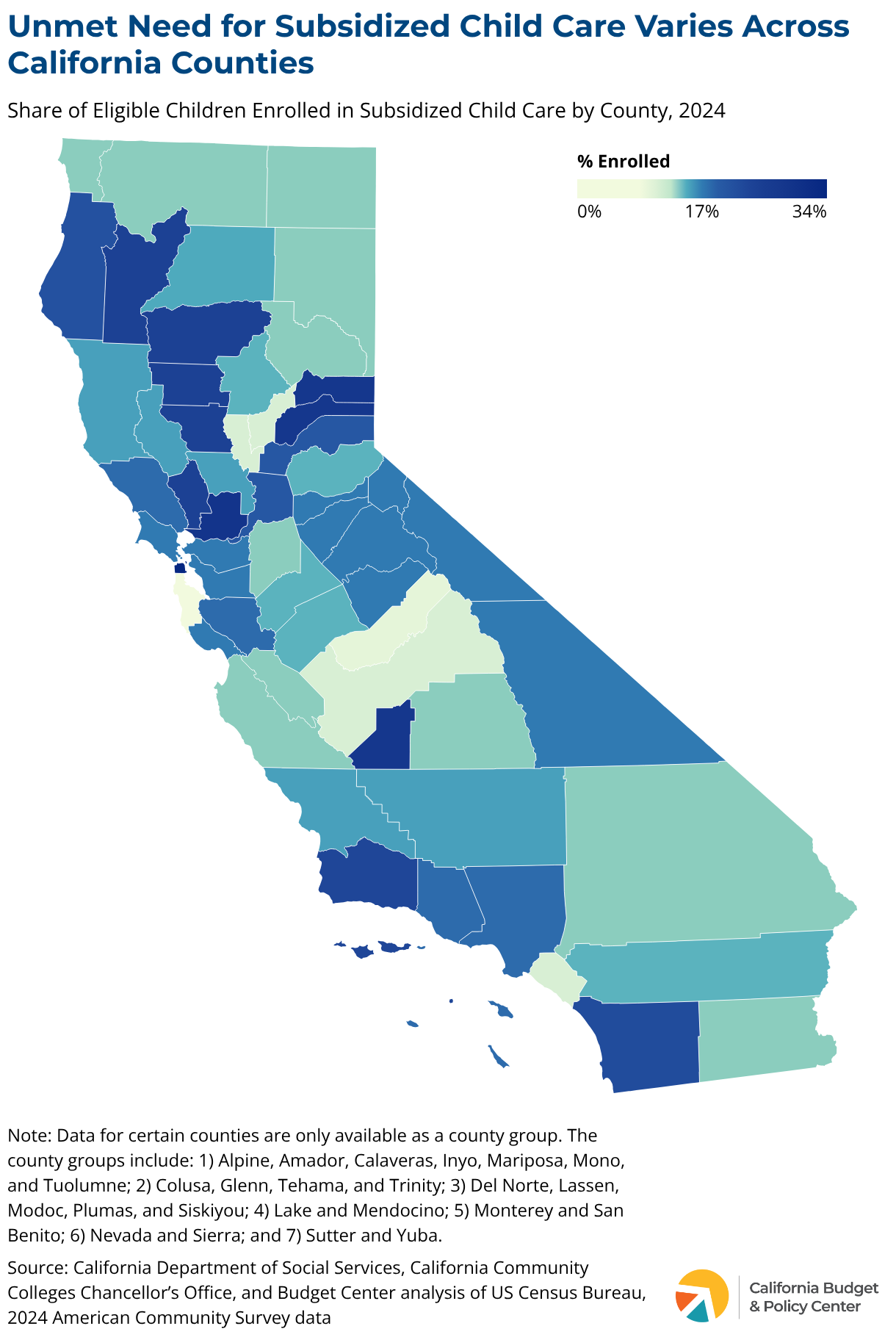
Unmet need varies widely across counties in California, with San Francisco having 34% of eligible children enrolled while Madera County has only 10% — one of the lowest in the state. One clear trend is that rural counties have relatively fewer children enrolled as a percentage of eligible children. This is particularly acute for counties in the Far North (as shown in the county map). Moreover, counties with an agricultural focus also have a relatively higher unmet need. Previous research in rural Monterey County identifies specific barriers that families working in the agricultural sector face when accessing child care, underscoring this regional trend. This is further supported by parent testimony from the Assembly Select Committee on Child Care Costs, in which a father from the Central Valley stated:
“To be able to go to work and leave my son in good care, it was hard to find a provider. We looked and we didn’t have many options. In particular, for a night shift. Because for packers we can work night hours, and it’s really hard for us to find a person to watch my son.”
Implications for Programs, Families, and Children
The unmet need for child care remains alarmingly high. With the Newsom administration walking back plans for expanding the number of subsidized child care spaces, families and children will continue to face unnecessary challenges with meeting basic needs. Key implications include:
- Families will continue to languish on the waiting list. While the state does not have a centralized eligibility list to confirm the exact number of families on local waiting lists, with nearly 1.8 million eligible children in California not enrolled, there are most likely thousands and thousands of families waiting to access a subsidy. With the state suspending progress on expanding publicly funded child care, families on this “no hope list” are not going to see relief.
- California’s affordability challenges will remain unaddressed, threatening to increase the state’s poverty rate. California has the highest poverty rate in the nation (tied with Louisiana), with the percentage of people in poverty dramatically increasing since the expiration of pandemic-era policies in 2021. In particular, the child poverty rate has experienced an alarming increase from a historic low of 7.5% in 2021 to 18.6% in 2024. Failing to expand publicly funded child care will only contribute to (instead of reversing) this harmful trend.
- Harmful federal cuts to health care and food assistance will only make child care more unaffordable. The harmful Republican megabill (H.R. 1) that passed during summer 2025 will take health care and food assistance away from millions of Californians. These cuts will tighten families’ budgets thus increasing the urgency for expanding the number of subsidized child care spaces. For families with young children, the negative impacts of H.R. 1 will run even deeper without access to affordable child care.
Given these implications for California families — and the positive effects of child care on the state’s economy — state leaders should fulfill their promise to expand publicly funded child care. Doing so would help to combat California’s affordability challenges and impending harms from the Republican megabill, H.R. 1. Fully funding the promised child care spaces would move thousands of families off waiting lists, putting California on a stronger path to address affordability challenges and longstanding inequities.
Kristin Schumacher is a former analyst at the California Budget & Policy Center and now serves as a consultant on various research projects for the organization.