Skip to content

As part of the Policy Perspective Speakers Series, the Budget Center hosted a budget briefing webinar to discuss the new state budget proposal released by Governor Jerry Brown on January 10. The webinar featured this presentation from Budget Center staff, based on our “first look” analysis of the Governor’s proposal.

Stay in the know.

Join our email list!

Executive Summary

On January 10, Governor Jerry Brown released a proposed 2017-18 budget that reflects both deep uncertainty about looming federal actions and a tempered economic and fiscal outlook for the state. The Governor forecasts revenues that are $5.8 billion lower — over a three-year period — than previously projected and proposes taking steps to address a $1.6 billion projected shortfall for 2017-18. (This gap would be even larger but for the Administration’s assumption that some state General Fund costs will decrease in 2017-18. For example, the Governor proposes to change how the state and counties share the cost of the In-Home Supportive Services (IHSS) program, with the result that the state would save roughly $600 million in 2017-18, while counties’ costs, in the aggregate, would increase by a like amount.) The Governor’s proposal assumes current federal policies and funding levels, even as the Affordable Care Act and other federal programs face the prospect of cuts with President-elect Trump taking office.

As part of addressing the deficit that his Administration foresees, the Governor proposes to rescind several one-year spending commitments that had been part of the 2016-17 budget agreement, including $400 million for affordable housing programs and $300 million for renovation of state office buildings. The Governor also proposes to “pause” a multiyear plan for reinvesting the state’s child care system.

The Governor’s proposal calls for continued funding of the California Earned Income Tax Credit (CalEITC) and also reflects the state’s increased minimum wage. However, this restrained budget proposal contains no additional investments in the welfare-to-work system (CalWORKs) or in basic income support for low-income seniors and people with disabilities (SSI/SSP). In addition, the Governor’s budget does not include proposals to address California’s affordable housing crisis.

The Governor’s proposal continues modest increases in funding for the California State University and University of California, but also reduces certain student aid programs. Lower revenue projections also mean slower growth in the Proposition 98 minimum guarantee for K-14 education spending.

The Governor’s proposal includes setting aside $2.3 billion as constitutionally required by Prop. 2 (2014), with half deposited in the state’s rainy day fund and half used to pay down state debts. Under the Governor’s proposal, state reserves would total $9.5 billion by the end of 2017-18.

With the near-term state budget facing many uncertainties, it is critical that California’s Congressional delegation and state lawmakers seek to protect the Affordable Care Act and the social safety net, and that state lawmakers ensure that California is well positioned to invest over the long term in education, child care, affordable housing, and other public services that help Californians advance economically.

The following sections summarize key provisions of the Governor’s proposed 2017-18 budget. Please check the Budget Center’s website (calbudgetcenter.org) for our latest commentary and analysis.

Download full report (PDF) or use the links below to browse individual sections:

Administration Expects Economic Growth to Continue, but Notes Several Risks
Governor Projects a Budget Shortfall Partly Due to a Lower Revenue Forecast
Governor’s Proposal Emphasizes the Importance of Reserves
Governor Proposes No Changes to the CalEITC
Lower Revenue Estimates Slow Growth in the Minimum Funding Level for Schools and Community Colleges
Administration Continues Modest Funding Increases for CSU and UC and Reduces Student Aid Programs
Governor’s Proposal “Pauses” Modest Reinvestments in Early Care and Education Programs
Proposed Budget Highlights Impact of Proposition 57, Which Provides New Tools for Reducing Incarceration
Proposed Budget Emphasizes the Uncertainty Over the Fate of the Federal Affordable Care Act
Governor’s Proposal Shifts Additional Costs for In-Home Supportive Services to Counties
Governor’s Proposal Does Not Make Any New Investments in CalWORKs
Governor Does Not Provide a State Cost-of-Living Increase for SSI/SSP Grants in 2017-18
Changes to State Retirement Systems Reflected in the Governor’s Budget Proposal
Governor Again Proposes 10-Year Transportation Funding and Reform Package
Administration Acknowledges Housing Crisis, but Proposes No New Funding to Address the Problem
Governor Makes $2.2 Billion Allocation Plan for Cap-and-Trade Revenues Dependent on Legislative Action Affirming Program

Administration Expects Economic Growth to Continue, but Notes Several Risks

The US economy is now in its seventh year of expansion since the Great Recession ended, and California’s economy has grown at a healthy clip in recent years, with the state’s job growth outpacing that of the nation. The Governor’s proposed budget assumes that economic growth will continue at a moderate pace over the next few years given that gains have slowed recently as the expansion has matured and the job market has neared full recovery from the recession. However, the Administration highlights several “risks to consider” that could weaken gains going forward. These include the possibility that the national economy could fall into another recession; that federal policy changes could disrupt the economy; and that California’s ongoing housing crisis could limit economic growth. While it is important to keep these potential risks in mind, it is worth noting that a recession in the next few years is not inevitable. The Administration states that “it would be a historical anomaly for there not to be a recession before 2020” given that the current economic expansion has lasted longer than the typical expansion. However, the Legislative Analyst’s Office (LAO) and other experts have pointed out that this fact does not in and of itself mean that another recession is likely soon because expansions “do not die of old age.”

Back to Top

Governor Projects a Budget Shortfall Partly Due to a Lower Revenue Forecast

The Governor’s proposed budget projects that California will face a budget shortfall of $1.6 billion in 2017-18, absent action by policymakers to address this gap. The projected deficit reflects two key factors: lower General Fund revenue projections and a shortfall in the Medi-Cal budget for the current fiscal year (2016-17). According to the Administration, state revenues have fallen short of expectations in most months since the 2016-17 budget was enacted. As a result, the Governor now projects that General Fund revenues (before transfers) over the three-year “budget window,” from 2015-16 to 2017-18, will be $5.8 billion lower than the projections included in the 2016-17 budget agreement. Specifically, the Governor expects personal income tax (PIT) revenues during this three-year period to be $2.1 billion lower, sales and use tax (SUT) revenues to be $1.9 billion lower, and corporation tax (CT) revenues to be $1.7 billion lower than expected when the budget for the current fiscal year was signed into law.

By comparison, the LAO forecast, published in November 2016, expected modestly lower revenues in 2015-16 and 2016-17 relative to projections in the 2016-17 budget agreement, but followed by “healthy revenue growth” in 2017-18. One of the major differences between these forecasts is that the LAO assumes higher growth in wages and salaries and capital gains than does the Administration, which contributes to higher PIT revenues, particularly in 2017-18. The LAO’s November forecast projected that the three largest revenue sources (PIT, SUT, and CT) would increase by 5.4 percent between 2016-17 and 2017-18, driven by a nearly 7 percent increase in PIT revenues, which comprise around 70 percent of General Fund revenues.

To address the projected budget shortfall and rebuild the state’s discretionary reserve, the Governor proposes to:

  • Rescind certain one-year spending commitments included in the 2016-17 budget. These include:
  • $400 million set aside for affordable housing programs. These dollars were to be provided only if lawmakers modified the local review process for certain housing developments, as proposed by the Governor. The Legislature did not adopt the Governor’s proposal.
  • $300 million that was intended to begin the process of renovating or replacing certain state office buildings.
  • $45 million for the Housing and Disability Advocacy Program. The purpose of this program, established in the 2016-17 budget, was to help people who are homeless or at risk of homelessness and who have a disability to access appropriate benefits.
  • Delaying a multiyear plan adopted in 2016 to reinvest in the state’s child care and development system, including by updating provider payment rates and further boosting the number of full-day state preschool slots.
  • Beginning the phase out of the Middle Class Scholarship program by not providing grants to any new students.

In addition, the Governor assumes a lower Proposition 98 minimum guarantee in 2015-16 and 2016-17, which reduces K-14 education spending over the two years by about $886 million.

The Administration notes that it is possible that the revenue forecast will improve by the time the Governor releases his revised 2017-18 budget in May, just after California’s final personal income tax receipts come in, in which case the state could possibly avoid making some or all of these cuts. Indeed, the revenue picture will likely remain “murky” until at least April, according to recent LAO publications. The LAO points out that lower-than-expected PIT revenue collections late in 2016 may reflect changes in taxpayers’ behavior in anticipation of potential federal tax changes. Specifically, the LAO suspects that some personal income tax filers with high incomes are deferring capital gains to calendar year 2017 in order to delay tax payments with the hope that they will owe less in taxes if federal policymakers lower tax rates beginning this year.

Under Prop. 2 (2014), which made changes to California’s constitutional rainy day fund — the Budget Stabilization Account (BSA) — the Governor has the authority to declare a “budget emergency” under certain conditions, allowing the state to suspend or reduce annual transfers into the BSA or withdraw funds from the BSA. A “budget emergency” is defined as resulting from either a disaster or extreme peril, as defined in the state Constitution, or from insufficient resources to maintain General Fund expenditures at the highest level of spending in the three most recent fiscal years, adjusted for state population growth and the change in the cost of living. (For a fuller discussion of Prop. 2, see following section.) The Governor’s proposed budget does not indicate whether the projected budget shortfall would constitute a budget emergency as defined under Prop. 2. Were the Governor to declare a budget emergency, it would allow the state to suspend or reduce the deposit into the BSA and/or withdraw reserve funds, freeing up revenue to help close the projected shortfall.

Back to Top

Governor’s Proposal Emphasizes the Importance of Reserves

California voters approved Prop. 2 in November 2014, amending the California Constitution to revise the rules for the state’s Budget Stabilization Account (BSA), commonly referred to as the rainy day fund. Prop. 2 requires an annual set-aside equal to 1.5 percent of estimated General Fund revenues. An additional set-aside is required when capital gains revenues in a given year exceed 8 percent of General Fund tax revenues. For 15 years — from 2015-16 to 2029-30 — half of these funds will be deposited into the rainy day fund, and the other half will be used to reduce certain state liabilities (also known as “budgetary debt”).

The Governor’s proposed 2017-18 budget projects that the BSA will total $6.7 billion by the end of the current fiscal year (2016-17). Based on the Governor’s revenue projections for 2017-18, Prop. 2 would constitutionally require the state to deposit an additional $1.2 billion in the BSA (as well as use $1.2 billion to repay budgetary debt), bringing the BSA total to $7.9 billion by the end of fiscal year 2017-18.

The BSA is not California’s only reserve fund. Each year, the state deposits additional funds into a discretionary reserve called the “Special Fund for Economic Uncertainties.” For 2017-18, the Governor projects $1.6 billion for this fund. Including this fund, the Governor’s proposal would build state reserves to a total of $9.5 billion in 2017-18.

Back to Top

Governor Proposes No Changes to the CalEITC

The California Earned Income Tax Credit (CalEITC) is a refundable state tax credit designed to boost the incomes of low-earning workers and their families and help them afford basic expenses. The credit was established by the 2015-16 budget agreement and became available to claim in the 2015 tax year. In its first year, the CalEITC provided an average credit of slightly more than $500 to over 385,000 households.

The Governor’s proposed budget makes no changes to the CalEITC. Unlike state EITCs in other states, the CalEITC is not automatically provided each year like a typical tax expenditure. Instead, California policymakers must specify in each year’s state budget how large a credit to provide. Specifically, they must set the state credit at a particular percentage of the federal EITC, referred to as the “adjustment factor.” The 2015-16 budget and 2016-17 budget set the state EITC adjustment factor at 85 percent, and the Governor proposes to maintain the adjustment factor at this percentage in the 2017-18 budget. Additionally, the Governor projects that the CalEITC will reduce state General Fund revenues by $240 million in 2016-17 and by $264 million in 2017-18, slightly more than the $200 million cost of the credit in 2015-16. When the CalEITC was first proposed, the Governor projected that it would reach 825,000 households at a cost — in terms of lower revenues — of $380 million annually. However, because claims in the credit’s first year were considerably lower than expected, the projected cost of the credit is also lower.

Raising awareness of the CalEITC could help boost the number of low-earning workers benefiting from the new tax credit. The 2016-17 budget agreement included $2 million to provide grants to community-based organizations and other entities to expand education and outreach efforts in order to increase CalEITC claims. It does not appear that the Governor’s proposed 2017-18 budget includes any funding to maintain these efforts beyond the current year.

Back to Top

Lower Revenue Estimates Slow Growth in the Minimum Funding Level for Schools and Community Colleges

Approved by voters in 1988, Prop. 98 constitutionally guarantees a minimum level of funding for K-12 schools, community colleges, and the state preschool program. The Governor’s proposed budget assumes a 2017-18 Prop. 98 funding level of $73.5 billion for K-14 education, $2.1 billion above the revised 2016-17 minimum funding level. The Prop. 98 guarantee tends to reflect changes in state General Fund revenues, and estimates of 2015-16 and 2016-17 General Fund revenue in the proposed budget are lower than those in the 2016-17 budget agreement. As a result, the Governor’s proposed 2017-18 budget reflects decreases in prior-year Prop. 98 funding levels compared to those assumed in the 2016-17 budget agreement. The Governor’s proposed budget assumes a 2016-17 Prop. 98 funding level of $71.4 billion, $506 million less than the level assumed in the 2016-17 budget agreement, and a $68.7 billion 2015-16 Prop. 98 funding level, $380 million below the level assumed in the 2016-17 budget agreement.

California’s school districts, charter schools, and county offices of education (COEs) provide instruction to approximately 6.2 million students in grades kindergarten through 12. The Governor’s proposed budget increases funding for the state’s K-12 education funding formula — the Local Control Funding Formula (LCFF) — and pays off outstanding obligations to school districts. Voter approval of Prop. 51 in November 2016 authorized $7 billion in state general obligation (GO) bonds for K-12 school facilities. However, the Governor’s proposed budget notes shortcomings in the State Facilities Program and suggests that until measures are in place to verify that state GO bond funds “are appropriately used,” the Administration will not support the expenditure of Prop. 51 dollars. The Governor also proposes to engage stakeholders in discussions during the spring budget process to respond to recommendations made to improve the current special education finance system.

Additionally, the Governor’s proposed budget:

  • Increases funding by $744.4 million in 2017-18 to continue implementation of the LCFF. The LCFF provides school districts, charter schools, and COEs a base grant per student, adjusted to reflect the number of students at various grade levels, as well as additional grants for the costs of educating English learners, students from low-income families, and foster youth. The Governor’s proposal to increase LCFF funding may reduce the amount of time it takes to fully implement the LCFF, which depends on funding sufficient for all districts to reach a target base grant (all COEs reached their LCFF funding targets in 2014-15). According to the Administration, the proposed 2017-18 LCFF funding level “maintains formula implementation at the current-year level of 96 percent.” In addition, the Governor’s proposed budget defers $859.1 million in 2016-17 LCFF funding to 2017-18 due to a reduction in 2016-17 Prop. 98 funding compared to the 2016-17 budget agreement.
  • Provides $287.3 million in one-time funding to reduce mandate debt the state owes to schools. Mandate debt reflects the cost of state-mandated services that school districts, charter schools, and COEs provided in prior years, but for which they have not yet been reimbursed.
  • Provides $200 million for the Career Technical Education Incentive Grant Program. The proposed spending plan reflects the final installment of a three-year program that began with the 2015 Budget Act.
  • Provides cost-of-living-adjustments (COLAs) for non-LCFF programs. The Governor’s proposed budget funds a 1.48 percent COLA ($58.1 million) for several categorical programs that remain outside of the LCFF, including special education, child nutrition, and American Indian Education Centers.

California’s community colleges (CCCs) help prepare approximately 2.4 million full-time students to transfer to four-year institutions as well as obtain training and skills for immediate employment. The Governor’s proposed budget provides CCCs with $150 million in one-time funding for grants to develop and implement “guided pathways” programs, an institution-wide approach to support student success. Participating CCCs can use guided pathway grants for activities such as targeted advising and support services and designing “academic roadmaps and transfer pathways that explicitly detail the courses students must take to complete a credential or degree on time.”

Back to Top

Administration Continues Modest Funding Increases for CSU and UC and Reduces Student Aid Programs

The Governor’s proposed budget includes modest increases in General Fund spending for the California State University (CSU) and the University of California (UC), with the expectation that CSU and UC implement new practices that reduce the cost of instruction and expand access to higher education for California students. At the same time, the Governor’s budget proposal notes that the UC Office of the President will propose a 2.5 percent tuition increase to the UC Board of Regents later in January and that the CSU Chancellor’s Office will propose a 5 percent tuition increase to the CSU Board of Trustees in March. The Governor’s proposal notes that these tuition increases would increase the 2017-18 Cal Grant costs for UC and CSU students by $17.7 million and $24.9 million respectively. However, the Governor’s proposed budget does not include funding to pay for these increased costs and states “any tuition increases must be viewed in the context of reducing the overall cost structure at UC and improving the graduation rates at the CSU.”

Specifically, the Governor’s proposed budget:

  • Increases funding for CSU by $161.2 million in 2017-18.
  • Increases funding for UC by $131.2 million in 2017-18. The Governor’s proposal represents a 4 percent increase in funding consistent with the existing agreement between the Administration and the UC President. The Governor’s proposed budget also includes a one-time increase of $169 million in Prop. 2 funds to help pay down unfunded liabilities of the UC Retirement Plan, which reflects the final installment of $436 million provided over a three-year period.
  • Phases out the Middle Class Scholarship Program (MCSP). The Governor’s proposal would provide $74 million to the MCSP in 2017-18, but would only renew scholarships for the approximately 37,000 students who received them in the 2016-17 academic year.
  • Reduces funding for the Cal Grant Program by $76.9 million. The Governor’s proposal would decrease Cal Grants by $24.5 million in 2017-18 and $52.4 million in 2016-17 “to reflect estimated costs.”

Back to Top

Governor’s Proposal “Pauses” Modest Reinvestments in Early Care and Education Programs

California’s child care and development system is composed of a variety of programs that allow parents with low and moderate incomes to find jobs and remain employed while caring for and preparing children for school. State policymakers dramatically cut support for these programs during and after the Great Recession, and overall funding in the current fiscal year remains nearly 20 percent below pre-recession levels, after adjusting for inflation, even with reinvestments made in recent years. Despite tremendous unmet need, the state currently provides about 70,000 fewer slots than in 2007-08.

The 2016-17 budget agreement called for implementation of a multiyear plan to reinvest in the state’s child care and development system, including by updating provider payment rates in order to keep pace with the state’s rising minimum wage and further boosting the number of full-day state preschool slots. Yet due to the projected decrease in revenue, the Governor’s proposed 2017-18 budget now “pauses” these proposed reinvestments until the 2018-19 fiscal year.

Back to Top

Proposed Budget Highlights Impact of Proposition 57, Which Provides New Tools for Reducing Incarceration

Currently, more than 129,200 people who have been convicted of a felony offense are serving their sentences at the state level. Most of these individuals — just over 114,000 — are housed in state prisons designed to hold slightly more than 85,000 people. This level of overcrowding is equal to 134 percent of the prison system’s “design capacity,” which is below the prison population cap — 137.5 percent of design capacity — established by federal court order. In addition, California houses roughly 15,200 individuals in facilities that are not subject to the court-ordered population cap, including fire camps, in-state “contract beds,” out-of-state prisons, and community-based facilities that provide rehabilitative services.

The total number of people incarcerated by the state has declined by more than one-quarter since peaking at 173,600 in 2007. This substantial reduction resulted largely from a series of policy changes adopted by state policymakers and the voters in the wake of the 2009 federal court order requiring the state to reduce overcrowding in state prisons.

California voters added a new reform this past November by approving Prop. 57, which gives state officials new policy tools to address ongoing overcrowding in state prisons. Prop. 57 requires parole consideration hearings for state prisoners who have been convicted of a nonviolent felony and have completed the full term for their primary offense. The measure also gives the California Department of Corrections and Rehabilitation (CDCR) — which is part of the Governor’s administration — broad new authority to award sentencing credits to reduce the amount of time that people spend in prison. Prop. 57 requires the CDCR to adopt regulations implementing both of these provisions. In addition, Prop. 57 requires juvenile court judges to decide whether a youth should be tried in adult court.

The CDCR is currently drafting regulations that will implement the new parole process and outline how the Administration will use its new authority to award sentencing credits. With respect to the new parole process, the Governor’s budget summary does not indicate how the new regulations will define a “nonviolent felony offense.” With respect to credits, the summary states that the “current credit-earning structure is convoluted” and suggests that the new regulations will aim to increase the amount of credits earned and “provide more equality in the credit structure.”

The CDCR’s new regulations are expected to be in place by October 1, 2017. The Governor estimates that in 2017-18, Prop. 57 will reduce the number of incarcerated adults by nearly 2,000 below the level that was otherwise projected (130,118). This annual drop in the inmate population is projected to grow to about 9,500 by 2020-21. According to the Administration, the combination of Prop. 57 and other population-reduction measures already in place would allow the CDCR to end the use of out-of-state prison facilities by 2020. Moreover, Prop. 57 would result in estimated net state savings of $22.4 million in 2017-18, rising to about $140 million by 2020-21.

Back to Top

Proposed Budget Emphasizes the Uncertainty Over the Fate of the Federal Affordable Care Act

The Governor’s proposed budget highlights the uncertainty surrounding the federal Affordable Care Act (ACA), also known as Obamacare. Under the umbrella of the ACA, state policymakers expanded Californians’ access to health care coverage, cutting the state’s uninsured rate in half. President-elect Trump campaigned on repealing the ACA, and Republicans in Congress have begun the process of dismantling the law. However, it is unclear how much of the ACA will ultimately be repealed, when any such repeal would actually take effect, and what the Republicans’ replacement for the ACA — if any — would look like.

California would lose well over $20 billion in federal funding each year if Republicans succeed in repealing two key components of the ACA:

  • The Medicaid expansion. California and 30 other states expanded eligibility for Medicaid health care coverage to low-income adults under age 65 who previously were excluded from the program. (Medicaid is called Medi-Cal in California.) Slightly more than 4 million Californians are expected to be enrolled in Medi-Cal in 2017-18 as a result of this expansion. Moreover, California is projected to receive more than $17 billion in federal funding in the upcoming fiscal year to support health care services for this population, according to the Governor’s budget summary.
  • Federal subsidies for private coverage purchased through online health insurance marketplaces, such as Covered California. Nearly 1.4 million Californians who earn too much to qualify for Medi-Cal but lack access to affordable job-based insurance get their coverage through Covered California. Nearly 9 in 10 of these individuals — 1.2 million — receive federal subsidies to reduce the cost of their coverage, with these subsidies totaling roughly $5 billion per year.

The Governor’s budget summary points out that “a complete repeal of the Affordable Care Act, without a companion replacement program, would not only affect millions of Californians’ health benefits, but would also disrupt the private insurance market.”

In addition, the Governor’s budget proposal:

  • Projects total Medi-Cal enrollment of 14.3 million in 2017-18. This is up from 7.9 million in 2012-13, an increase that is due primarily to California’s full implementation of federal health care reform.
  • Projects total Medi-Cal spending of $102.6 billion in 2017-18, which is comprised primarily of federal dollars. Federal support for Medi-Cal is projected to be $66.8 billion in 2017-18, roughly two-thirds of total funding for the program. State General Fund support for Medi-Cal is projected to be $19.1 billion in the upcoming fiscal year, with other non-federal funds providing the remaining $16.7 billion.
  • Identifies a $1.8 billion General Fund shortfall in the Medi-Cal budget for the current fiscal year (2016-17). According to the Governor’s budget summary, this significant gap is primarily due to “a one-time retroactive payment of drug rebates to the federal government and miscalculation of costs” related to the Coordinated Care Initiative, which coordinates health care and other services for certain seniors and people with disabilities.
  • Uses certain tobacco tax revenues raised by Prop. 56 to fund “increased General Fund health care costs in the Medi-Cal program.” Approved by voters this past November, Prop. 56 increases the state’s excise tax on cigarettes by $2 per pack starting on April 1. The measure also boosts the tax on other tobacco products by an equivalent amount and — for the first time — applies the state excise tax to electronic cigarettes that contain nicotine. Prop. 56 requires that the vast majority of revenues raised by the measure go to Medi-Cal. The Administration projects that Prop. 56 will generate $1.7 billion between April 1, 2017, and June 30, 2018, with $1.2 billion of this amount allocated to Medi-Cal. The Governor does not propose to use any of these new revenues to support payment increases for doctors and others who provide health care services to Medi-Cal enrollees.
  • Assumes that Congress will reauthorize the Children’s Health Insurance Program (CHIP) in 2017, but that the federal share of CHIP funding will be reduced. In California, federal and state funding for CHIP is used primarily to support health care services for certain children enrolled in Medi-Cal. (These children previously would have been enrolled in the Healthy Families Program, which was eliminated in 2013.) Since late 2015, the federal government has paid 88 percent of CHIP costs in California, with the state covering the remaining 12 percent. Previously, the federal share was set at 65 percent. With CHIP currently authorized only through September 2017, the Governor assumes that Congress will reauthorize the program this year, but revert to the prior sharing ratio (65/35) effective October 1, 2017. This change would increase the state’s General Fund costs for CHIP by $536.1 million, according to Administration estimates.

Back to Top

Governor’s Proposal Shifts Additional Costs for In-Home Supportive Services to Counties

Under the Coordinated Care Initiative (CCI), California integrates health care and other services — including In-Home Supportive Services (IHSS) — for certain seniors and people with disabilities. The Administration indicates that because the CCI is not cost-effective, it will be discontinued in 2017-18, pursuant to current law. One key outcome of discontinuing the CCI is that the counties’ share of the non-federal costs for IHSS would go up (and the state’s share would go down). This is because the current funding formula — which is tied to the CCI and significantly limits counties’ share of IHSS cost increases — would end. In its place, the state would reestablish — effective July 1, 2017 — the prior funding formula, which requires counties to pay 35 percent of the non-federal portion of IHSS costs, with the state paying the other 65 percent. The Administration anticipates that counties would lack sufficient funding to cover their increased share of IHSS costs in 2017-18, likely creating a “financial hardship and cash-flow problems.” As a result, the Governor proposes to “work with counties to mitigate, to the extent possible,” the financial impact of increasing counties’ share of costs for IHSS.

Back to Top

Governor’s Proposal Does Not Make Any New Investments in CalWORKs

The California Work Opportunity and Responsibility to Kids (CalWORKs) Program provides modest cash assistance for nearly 1 million low-income children while helping parents overcome barriers to employment and find jobs. State policymakers made a historic advance last year when they repealed the punitive Maximum Family Grant (MFG) or “family cap” rule, which only served to drive families with children deeper into poverty. The Governor’s proposed budget does not make any additional investments in CalWORKs, although this would be necessary to restore cuts made to the program during and after the Great Recession. Currently, CalWORKs grants fail to lift most families out of “deep poverty,” which is defined as having an income that is below half of the federal poverty line ($10,080 for a family of three in 2016). With the minimum wage increase scheduled for January 1, 2018, CalWORKs spending is expected to decrease by $5.3 million General Fund as more families earn an income that is above the eligibility limit but far below the level needed to make ends meet.

Back to Top

Governor Does Not Provide a State Cost-of-Living Increase for SSI/SSP Grants in 2017-18

Supplemental Security Income/State Supplementary Payment (SSI/SSP) grants help well over 1 million low-income seniors and people with disabilities to pay for housing, food, and other basic necessities. Grants are funded with both federal (SSI) and state (SSP) dollars. State policymakers made deep cuts to the SSP portion of these grants in order to help close budget shortfalls that emerged following the onset of the Great Recession in 2007. SSP grants for couples and for individuals were reduced to federal minimums in 2009 and 2011, respectively, and the annual state COLA for SSI/SSP grants was eliminated beginning in 2010-11, after being suspended for several years. However, California took a step toward reinvesting in SSI/SSP during the current fiscal year (2016-17). Effective January 1, 2017, the state increased the SSP portion of the grant by 2.76 percent. This raised the monthly SSP grant to $160.72 for individuals (an increase of $4.32) and to $407.14 for couples (an increase of $10.94).

The Governor does not propose to provide a new state COLA for SSI/SSP grants during 2017-18. However, the Administration projects that the federal government will provide a 2.6 percent COLA to the SSI portion of the grant effective January 1, 2018. As a result of the federal SSI COLA:

  • The maximum monthly SSI/SSP grant for individuals would rise from the current level of $895.72 to $915.72 on January 1, 2018. The projected 2018 grant level equals 5 percent of the current federal poverty guideline for an individual ($990 per month).
  • The maximum monthly SSI/SSP grant for couples would increase from the current level of $1,510.14 to $1,539.14 on January 1, 2018. The projected 2018 grant level equals 3 percent of the current poverty guideline for a couple ($1,335 per month).

Back to Top

Changes to State Retirement Systems Reflected in the Governor’s Budget Proposal

The Governor’s proposed 2017-18 budget incorporates contributions to three state-run retirement systems: the California Public Employees’ Retirement System (CalPERS), the California State Teachers’ Retirement System (CalSTRS), and the Secure Choice Retirement Savings Program that was authorized in 2016.

CalPERS and CalSTRS, like many retirement systems, are not funded at levels that will keep up with future benefits, resulting in the state needing to make higher annual contributions in order to pay down unfunded liabilities. Both systems are evaluating long-term investment assumptions, including the “discount rate” that is used to estimate the level of contributions from the state and employers. The Governor’s proposed 2017-18 budget includes $5.3 billion ($2.8 billion General Fund) for state contributions to CalPERS for state pension costs, and $672 million General Fund for CSU retirement costs. A recent CalPERS Board decision to reduce the discount rate from 7.5 percent to 7.0 percent over the next three years (that is, to adjust downward slightly its expected rate of return on the CalPERS investment portfolio) is reflected in these estimates, resulting in additional state contributions of $172 million ($105 million General Fund) in 2017-18.

The Governor’s proposed 2017-18 budget assumes that CalSTRS will also lower its discount rate, along with changes in other investment assumptions, requiring $153 million in additional state contributions from the General Fund. State contributions to CalSTRS are expected to total $2.8 billion from the General Fund in 2017-18.

In 2016, Senate Bill 1234 created the California Secure Choice Retirement Savings Program, a state-administered retirement savings program for private-sector employees in California who are not provided with retirement savings plans at their workplace. Approximately 6.8 million private-sector workers in California do not have access to a retirement savings plan. Secure Choice provides these workers with a low-cost option for investing in their retirement security. The proposed 2017-18 budget includes a $15 million loan from the General Fund for startup and administrative costs to implement the program, which would be repaid in future years with administrative fees.

Back to Top

Governor Again Proposes a 10-Year Transportation Funding and Reform Package

California’s expansive transportation infrastructure includes 50,000 lane-miles of state and federal highways, 304,000 miles of locally owned roads, Amtrak intercity rail services, and numerous local transit systems, all of which are intended to facilitate the efficient movement of people and goods across the state. The state’s largest category of deferred maintenance is for its existing transportation facilities.

The Governor’s proposed 2017-18 budget includes a 10-year, $43 billion transportation funding and reform package that would provide $1.8 billion in fiscal year 2017-18. The package was first introduced in 2015 and includes a mix of new revenues, additional investments of “cap and trade” auction proceeds, accelerated loan repayments, and efficiencies in the California Department of Transportation (Caltrans).

The Governor’s 10-year plan would be funded through a series of new revenue sources and redirected savings from efficiencies, including:

  • $2.1 billion from a new $65 fee on all vehicles, including hybrids and electrics.
  • $1.1 billion from the state gasoline excise tax, which would be set at the 2013-14 rate of 21.5 cents, with the broader gasoline tax adjusted annually for inflation.
  • $425 million from an 11-cent increase in the diesel excise tax, adjusted annually for inflation.
  • $500 million in additional cap-and-trade proceeds.
  • $100 million from cost-savings reforms in Caltrans.

It is likely that the new or increased revenue sources would require a two-thirds vote in each house of the Legislature.

These revenues, split evenly between state and local governments, would be used for investments in repairing and maintaining existing infrastructure, particularly state highways, local roads, and public transit.

Back to Top

Administration Acknowledges Housing Crisis, but Proposes No New Funding to Address the Problem

The Governor’s proposed budget includes numerous references to California’s housing crisis and its implications for families and individuals as well as employers and the economy. The Governor notes that California’s lack of affordable housing means that many people have less income to spend on taxable goods, which weakens sales and use tax revenues — a key revenue source for the state budget. In addition, high and rising housing costs make it harder for employers to attract skilled workers in certain areas of the state, and if businesses cannot relocate to lower-cost areas, the state’s job growth could stall. In fact, the Governor identified the state’s housing crisis as a key threat to the state’s economy over the next few years.

Although the Administration views the housing crisis as one of the major challenges facing California, the proposed budget includes no new funding to address the problem. Instead, the Governor eliminates $400 million set aside for affordable housing programs in the 2016-17 budget agreement. These dollars were to be allocated only if lawmakers modified the local review process for certain housing developments, as proposed by the Governor last year. The Legislature did not adopt the Governor’s so-called “by-right” proposal, and so these funds will not be available for affordable housing. The Governor also eliminates $45 million for the Housing and Disability Advocacy Program, established in the 2016-17 budget agreement. The purpose of this program was to help people who are homeless or at risk of homelessness and who have a disability to access appropriate benefits.

Budget documents state that the Administration is “committed to working with the Legislature on the development of a legislative package to further address the state’s housing shortage and affordability pressures.” However, the Governor makes clear that he is not willing to provide resources through the state budget to finance any solutions, as he states that this legislative package “should not rely on the General Fund.” Instead of proposing concrete solutions, the Governor outlines several principles for housing policy, which include reducing local barriers that prevent, slow down, or drive up the cost of housing developments.

Back to Top

Governor Makes $2.2 Billion Allocation Plan for Cap-and-Trade Revenues Dependent on Legislative Action Affirming Program

Established by the California Global Warming Solutions Acts of 2006 (Assembly Bill 32), California’s “cap and trade” program sets a statewide limit on the emission of greenhouse gases (GHGs) and authorizes the Air Resources Board to auction off emission allowances. Proceeds from these auctions are invested in activities that seek to reduce GHG emissions.

Since cap-and-trade auctions began in 2012, the state has allocated more than $3 billion in proceeds from them. However, the revenues from individual auctions have varied widely over the past the year, a predicament that the Administration attributes in part to “perceived legal uncertainty” about the program beyond 2020.

The Governor’s budget proposal calls on the Legislature to confirm, by a two-thirds vote in both the State Senate and the Assembly, the Air Resources Board’s authority to administer the cap-and-trade program beyond 2020. Contingent on this legislative action, the Governor proposes a $2.2 billion Cap and Trade Expenditure Plan for 2017-18, with the dollars allocated to high-speed rail and other transit investments, affordable housing, pollution-reduction projects, and other activities aimed to promote sustainability and energy efficiency.

Back to Top

Stay in the know.

Join our email list!

Endnotes are available in the PDF version of this Fact Sheet.

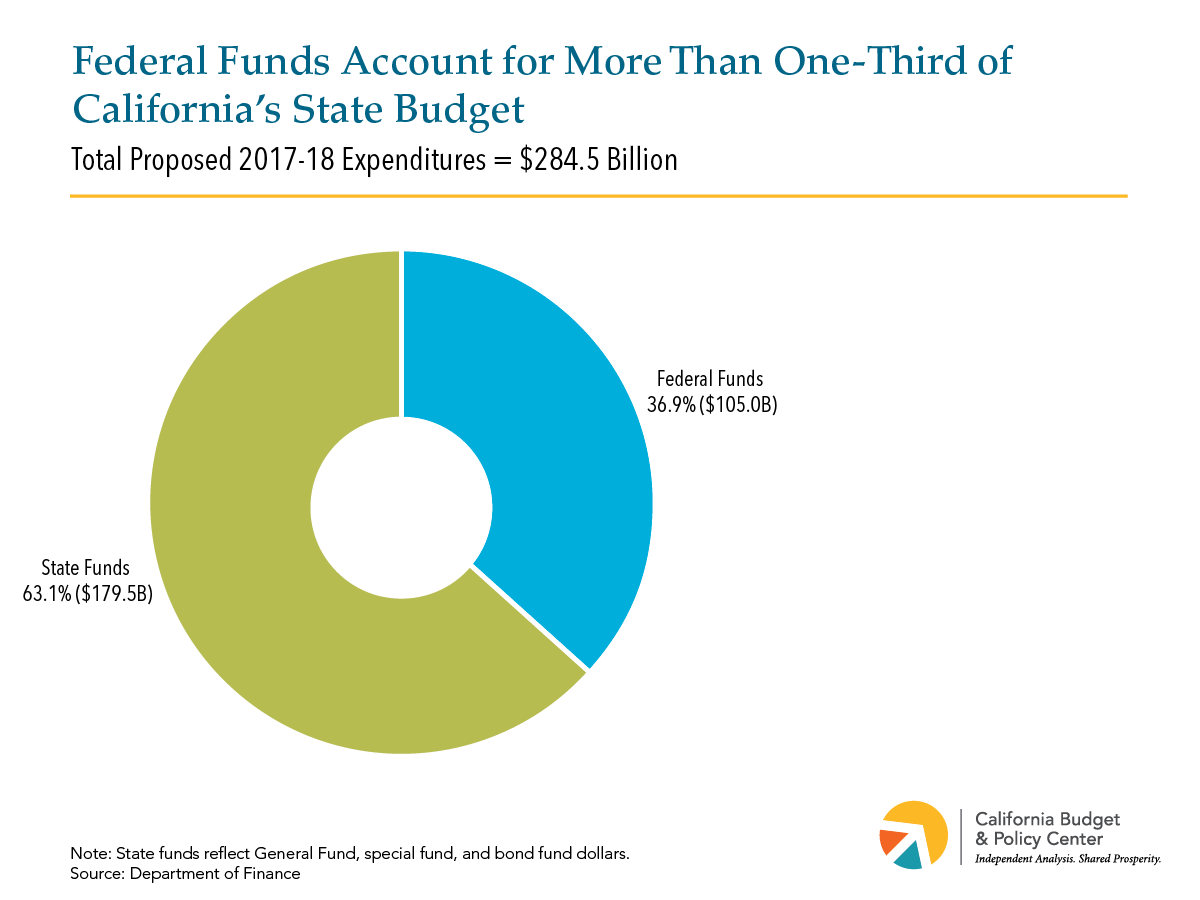
Federal dollars support a wide array of public services and systems that touch the lives of all Californians — from Social Security and health care to highway construction and public schools. A large share, but less than a majority, of this federal funding flows through California’s state budget. The current state budget includes nearly $96 billion in federal funds for 2016-17, the fiscal year that began last July 1. This is more than one-third (36 percent) of the total state budget, which also includes more than $170 billion in state funds for the current fiscal year.

fig-1-state-federal-funds_-2016-17-enacted-federal-focus-01

More than 7 in 10 federal dollars that flow through California’s state budget — $69.3 billion in 2016-17 — support health and human services (HHS) for children, seniors, and many other Californians (see chart). Most of these federal dollars, roughly $58 billion, go to Medi-Cal (California’s Medicaid program), which provides health care services to more than 13 million Californians with low incomes. The second-largest share of federal funding for HHS programs — $7.7 billion — goes to the state Department of Social Services. These funds support child welfare services, foster care, the CalWORKs welfare-to-work program, and other services that assist low-income and vulnerable Californians.

fig-2-spending-by-agency-01

The remaining federal funds that flow through the state budget — an estimated $26.6 billion in 2016-17 — support a broad range of public services and systems. This includes $7.6 billion for K-12 education; $6.6 billion for labor and workforce development programs, primarily for unemployment insurance benefits for jobless Californians; $5.0 billion for higher education (the California State University and the University of California); $4.9 billion for transportation, primarily to improve state and local transportation infrastructure; and $2.5 billion for additional public services and systems, including environmental protection, the state court system, and state corrections.

The outcome of the November 2016 national election portends major cuts to federal funding for key public services. For example, Republicans have vowed to repeal the Affordable Care Act (ACA), which would include rolling back the recent expansion of Medicaid coverage to low-income parents and childless adults. This change alone would reduce annual federal funding for Medi-Cal by more than $15 billion. Other services are also at risk, including some that are funded with federal dollars that flow directly to Californians outside of the state budget — such as federal food assistance provided through the state’s CalFresh program and federal Supplemental Security Income (SSI) payments for low-income seniors and people with disabilities. Republicans are likely to succeed in scaling back federal support in a number of policy areas. If so, state policymakers will face difficult choices about how to fill the resulting funding gaps in order to prevent the erosion of public services and systems that promote economic security and opportunity for millions of Californians.

Stay in the know.

Join our email list!

Budget Center Director of Research Scott Graves provided his overview of the state budget process with “Dollars and Democracy: An Introduction to the State Budget Process” at our Policy Perspectives Speaker Series event in Sacramento, “The State Budget Process and Key Issues to Watch for in 2017.”

Stay in the know.

Join our email list!

Endnotes are available in the PDF version of this Fact Sheet.

In recent years, California has made a series of criminal justice reforms aimed at reducing the number of people involved with state and county correctional systems, promoting rehabilitation, preventing crime, and spending limited tax dollars more wisely. For example, through the 2011 public safety “realignment,” California policymakers transferred responsibility and funding for many adults convicted of “lower-level” felonies from the state prison and parole systems to the counties. Since 2007, these criminal justice reforms have helped to reduce the number of state prisoners by more than one-quarter and the number of state parolees by nearly two-thirds. In contrast, the statewide county jail population has fluctuated since 2007. However, as of late 2015, county jails held only slightly more people than they did in September 2011 — the month before the state-to-county realignment took effect.

Despite these significant reforms, spending on incarceration and crime-related activities at the county and state levels remains high. As of 2014-15, California’s state and county governments spent $20.7 billion on incarceration and responding to crime, according to a Budget Center analysis of state data. Specifically:

  • Nearly three-quarters (73%) of this spending — $15.1 billion — was for incarceration of adults and juveniles at the state and county levels. At the state level, spending on incarceration ($10.8 billion) reflects state operations and related capital outlay for the California Department of Corrections and Rehabilitation (CDCR). At the county level, spending on incarceration ($4.3 billion) includes adult and juvenile detention, jail facilities, and related capital outlay.
  • More than one-quarter (27%) of this spending — $5.6 billion — was for activities associated with responding to crime. At the state level, this spending ($1.4 billion) includes support for trial courts as reflected in the state budget along with related capital outlay. At the county level, this spending ($4.3 billion) reflects support for district attorney prosecution; probation; public defenders; certain trial court activities (expenditures not reflected in the state category); juvenile wards of the court; grand juries; and related capital outlay. County-level expenditures in this category exclude the cost of policing that is provided by county sheriff’s departments.
state-and-county-spending-incarceration-responding-crime-exceeded-20-billion-2014-15

Significantly reducing state and county spending on incarceration and responding to crime will require continued implementation of recent reforms and going beyond recent changes in criminal justice policy. For instance, Proposition 47 (2014), which reduced penalties for several nonviolent drug and property crimes, allows individuals who are serving felony sentences for Prop. 47-related crimes to petition the court for resentencing to a misdemeanor based on this new classification, possibly resulting in early release. State and local officials should ensure that everyone in prison or jail who qualifies for resentencing under Prop. 47 has a chance to petition the court, which would likely lead to further reductions in state and county incarceration levels.

Policy changes that go beyond recent reforms could include simplifying the state’s complex Penal Code in order to shorten prison sentences, providing state officials with new policy options for further reducing incarceration, and increasing the use of alternatives to incarceration at the county level, particularly for youth. Decreasing the costs of incarceration and responding to crime at both the state and county levels would free up revenues that could then be redirected to public services and systems that can help more Californians achieve economic opportunity and security and promote broadly shared prosperity.

This analysis is the first part of a multiphase effort to analyze state and county spending on incarceration and responding to crime. Future phases of this work will examine trends in spending over time and provide county-by-county information.

For more information about the methodology used to calculate the expenditures reported in this Fact Sheet, see the Technical Appendix.

Stay in the know.

Join our email list!

For participants in the Women’s Policy Institute, a program of the Women’s Foundation of California, Kristin Schumacher discusses the importance of increasing access to affordable, high-quality child care and preschool.

Stay in the know.

Join our email list!

Endnotes are available in the PDF version of this Issue Brief

Proposition 30, approved by voters in 2012, provided critical revenues to California at a time when the state faced daunting budgetary challenges. Prop. 30’s tax rate increases are scheduled to fully expire at the end of 2018. Prop. 55, which will appear on the November 8, 2016 statewide ballot, would extend for 12 years the Prop. 30 tax rate increases that affect very-high-income Californians. Revenues generated by Prop. 55 – a projected $4 billion to $9 billion per year from 2019 through 2030 – would go to K-12 public schools, community colleges, health care for low-income Californians, the state’s rainy day fund, state debt payments, and other state services. This Issue Brief provides an overview of Prop. 55 and the policy issues it raises. The California Budget & Policy Center neither supports nor opposes Prop. 55.

What Would Proposition 55 Do?

Prop. 55, “The California Children’s Education and Health Care Protection Act of 2016,” would amend the California Constitution to (1) extend Prop. 30’s personal income tax provisions for 12 years beyond their scheduled expiration at the end of 2018 and (2) create a formula to provide additional funding for Medi-Cal from the revenues raised by the measure. Moreover, existing provisions of the state Constitution would require Prop. 55 revenues to go to K-12 public schools, community colleges, the state’s rainy day fund, and state debt payments. Specifically, Prop. 55 would:

  • Extend Prop. 30’s personal income tax rate increases on very-high-income Californians. Prop. 55 would extend – from 2019 through 2030 – personal income tax rates enacted by Prop. 30. Extending these rates would raise between $4 billion and $9 billion each year (in today’s dollars), according to the Legislative Analyst’s Office (LAO). Prop. 55 would allow Prop. 30’s one-quarter cent increase in the state sales tax rate to expire at the end of 2016 as scheduled.
  • Create a new constitutional formula to increase funding for Medi-Cal, which provides health care services to Californians with low incomes. For each fiscal year from 2018-19 through 2030-31, the Governor’s Department of Finance would be required to estimate the amount of General Fund revenues – including those raised by Prop. 55 – that are needed to:
    • Meet the annual Prop. 98 minimum funding guarantee for K-12 schools and community colleges.
    • Fund the cost of services that were authorized as of January 1, 2016 (excluding Prop. 98 spending), as adjusted for population changes, statutory cost-of-living increases, federal mandates, and other factors.

If any Prop. 55 revenues are estimated to remain after meeting these combined expenditures, Medi-Cal would receive 50 percent of the excess, up to a maximum of $2 billion in any fiscal year. Revenues allocated to Medi-Cal under this provision would have to add to – rather than replace – existing General Fund support for the program.

  • Increase funding for K-12 schools and community colleges as compared to current law. The vast majority of funding for California’s K-12 schools and community colleges is provided by the Prop. 98 minimum funding guarantee. This guarantee is based on varying economic and fiscal conditions, including state General Fund revenue collections. Other things being equal, General Fund revenues from 2018-19 to 2030-31 would be higher if voters approve Prop. 55 than if the measure is rejected. This is because Prop. 55 would extend income tax rate increases that otherwise would expire at the end of 2018 under the provisions of Prop. 30. By increasing General Fund revenues relative to current law – which assumes the expiration of Prop. 30’s income tax rates – Prop. 55 would boost the amount of Prop. 98 funding that K-12 schools and community colleges would otherwise be expected to receive during the period that Prop. 55 is in effect. About half of the revenue raised by Prop. 55 would go to K-14 education, according to the LAO.
  • Increase deposits into the state’s rainy day fund and repayments of state budgetary debt as compared to current law. Under Prop. 2, which voters approved in 2014, California is required to set aside a certain share of General Fund revenues each year in order to build the state’s rainy day fund (the Budget Stabilization Account) and pay down state budgetary debts, including unfunded state pension liabilities. Because Prop. 55 would increase General Fund revenues relative to current law – as explained above – the measure would result in larger debt payments and bigger deposits into the rainy day fund compared to what would be expected if voters rejected Prop 55. The LAO estimates that Prop. 55 would provide an additional $60 million to approximately $1.5 billion each year for Prop. 2 purposes.
  • Allow state policymakers to use any remaining revenues raised by Prop. 55 for any budget priorities. Prop. 55 revenues that remain after (1) meeting the constitutional spending obligations described above and (2) helping to maintain state services that were in place as of January 1, 2016 could be used for any public systems and services funded through the state budget. For example, these excess Prop. 55 revenues could be used to raise the number of subsidized child care slots, increase cash assistance for low-income seniors and people with disabilities, and boost state support for the California State University (CSU) and the University of California (UC).

Whose Taxes Would Proposition 55 Affect?

As noted above, Prop. 55 would extend the personal income tax rate increases of Prop. 30, but not the sales tax rate increase. Prop. 30’s income tax rate increases are aimed specifically at the highest-income households. Of the total dollar increase in income taxes brought about by Prop. 30, the top 1 percent of households pay 98.6 percent, and the next 4 percent of households pay the remaining 1.4 percent, according to the Institute on Taxation and Economic Policy (Figure 1). Prop. 55’s income tax rate increases could be expected to have a similar effect.

prop-55-fig-1

Compared to those of Prop. 30, Prop. 55’s overall tax-rate changes would be even more progressive. This is because Prop. 55 would not extend Prop. 30’s quarter-cent sales tax increase, which has a disproportionate impact on households with lower incomes. Prop. 55 follows the equity principle of taxation, by which taxes are levied fairly, based on the ability to pay.

Currently, California’s lowest-income families pay the largest share of their incomes in state and local taxes, while the wealthiest, who substantially benefit from public investments and have the greatest ability to contribute, pay much smaller portions of their incomes in state and local taxes. In other words, California’s tax system as a whole is regressive, even with Prop. 30’s income tax increases on the wealthiest households. If voters reject Prop. 55, California’s tax system would become even more regressive because the highest-income households would contribute a smaller share of their income in taxes than if Prop. 55 were approved (Figure 2).

prop-55-fig-2

Furthermore, the top 1 percent of California households – those who would be most affected by Prop. 55’s tax rate increases – have seen their average income more than double since the late 1980s, after adjusting for inflation (Figure 3). In contrast, average inflation-adjusted incomes for the bottom 80 percent of California households have declined.

prop-55-fig-3

What Would Rejection of Proposition 55 Mean for Public Services?

If California voters do not approve Prop. 55, the personal income tax rate increases on very-high-income Californians enacted by Prop. 30 will expire at the end of 2018. The expiration of Prop. 30’s income tax rates would:

  • Result in a significant loss of General Fund revenues. Fiscal year 2018-19 would lose half a year of higher personal income tax revenues and 2019-20 would lose a full year of higher revenues – a projected $4.5 billion in 2018-19 and $7.7 billion in 2019-20, with annual revenue losses continuing thereafter (Figure 4).
  • Create a multi-billion dollar budget deficit that would likely result in cuts to state services. With the expiration of Prop. 30’s income tax rates, the loss of billions of dollars in General Fund revenues would lead to annual multi-billion dollar state budget deficits. Under such a scenario, state policymakers would likely need to reduce spending for critical services in order to help to help balance the budget.
  • Reduce the Prop. 98 funding guarantee for schools and community colleges. Changes in annual General Fund revenues tend to affect the Prop. 98 guarantee. If Prop. 30’s income tax rates are allowed to expire, the projected decline in annual General Fund revenue growth would reduce Prop. 98 funding for K-14 education compared to the funding that would be required if Prop. 30’s tax rates were extended. Specifically, the Prop. 98 funding level could fall by roughly $2 billion in 2018-19 and by roughly $4 billion in 2019-20 if voters reject Prop. 55.
  • Restrict the state’s ability to boost investments in a broad range of critical services and systems. These include:
    • The state’s child care and development system, which continues to provide tens of thousands fewer subsidized “slots” than in 2007-08, the year the Great Recession began.
    • The state’s higher education system – the CSU and UC – for which direct state General Fund support per student is down substantially since the early 2000s, after adjusting for inflation.
    • The CalWORKs welfare-to-work program, which provides a level of support that leaves families, including 1 million children, unable to afford even low-cost housing.
    • SSI/SSP cash assistance for seniors and people with disabilities, which leaves individuals living below the poverty line and struggling to afford housing, food, and other necessities.
  • Result in smaller deposits into the state’s rainy day fund and lower debt payments, leaving the state less prepared for the next economic downturn. Building up reserves and paying down budgetary debt gives state policymakers additional options – beyond spending cuts – for balancing the budget and maintaining services during an economic downturn. However, the expiration of Prop. 30’s income tax rates would reduce the amount of revenues that are available for deposit into the Budget Stabilization Account and to pay down budgetary debt. As a result, critical services would likely face larger cuts if a recession significantly reduced state revenues.

In summary, allowing Prop. 30’s income tax rate increases on very-high-income Californians to expire would eliminate billions of dollars from California’s revenue system. This would leave the state with less funding to invest in schools, community colleges, and other vital public services and systems as well as reduce the state’s ability to pay down debts and save for a rainy day.

prop-55-fig-4

Policy Issues Raised by Proposition 55

Prop. 55 raises key policy issues, including whether to add a new funding formula for Medi-Cal to the state Constitution and whether to use temporary revenues to support ongoing services.

Adding a New Funding Formula for Medi-Cal to the State Constitution Reflects “Ballot-Box Budgeting”

By creating a new constitutional spending requirement for Medi-Cal, Prop. 55 is an example of what is commonly called “ballot-box budgeting.” On the one hand, critics of ballot-box budgeting argue that the initiative process limits voters to an up-or-down choice in isolation from other potential uses of funds. They argue that earmarking the proceeds from a certain revenue source constrains the ability of the Governor and lawmakers to use the same source for other spending priorities, to make programmatic changes, or to modify spending in response to economic, budget, and demographic shifts.

On the other hand, proponents of initiative-based spending argue that the two-thirds vote requirement for legislative approval of tax increases makes it difficult, if not impossible, to raise revenues through the legislative process to support public services and systems. As a result, they maintain that it is appropriate to offer voters the ability to raise taxes to fund specific state budget priorities.

Proposition 55 Provides Temporary Funds for Ongoing Spending

Prop. 55 extends Prop. 30’s personal income tax rate increases through 2030, but does not make those higher rates permanent. In other words, the revenues raised by Prop. 55 would eventually disappear. Given the temporary nature of these revenues, relying on them to fund permanent, ongoing services – such as K-14 education and Medi-Cal – would mean that state policymakers (and possibly the voters) would again face the question of whether to extend these tax rates, make them permanent, or find a different source of funding. If such efforts failed, state budget shortfalls would likely emerge, meaning that state policymakers would face the prospect of reducing spending on vital public services and systems.

What Do Proponents Argue?

Proponents of Prop. 55, including the California State PTA, the California Teachers Association, and State Superintendent of Public Instruction Tom Torlakson, argue that the measure will prevent “billions in budget cuts without raising taxes by ensuring the wealthiest Californians continue to pay their share.” They state that money from the measure “goes to local schools” with strict accountability requirements that “ensure funds designated for education go to classrooms,” and further that the measure “expands health care access for children.”

What Do Opponents Argue?

Opponents of Prop. 55, including the Howard Jarvis Taxpayers Association, the National Federation of Independent Business/California, and retired Superior Court Judge Quentin L. Kopp, argue that voters supported Prop. 30’s tax rate increases only “because we were promised they’d be temporary.” They assert that funding for schools and other requirements is adequate, and state that “we can’t trust the politicians and special interests.”

Conclusion

Prop. 55 would extend – from 2019 to 2030 – the personal income tax rate increases on very-high-income Californians that voters approved by passing Prop. 30 in 2012. Prop. 55 would not extend Prop. 30’s quarter-cent increase in the state sales tax rate, which would be allowed to expire at the end of 2016 as scheduled. Prop. 55 is projected to generate between $4 billion and $9 billion per year, a range that brackets the roughly $7 billion to $8 billion per year that Prop. 30 has raised to date. Prop. 55’s revenues would be used to meet various constitutional spending obligations, such as for K-14 education and for Medi-Cal, as well as to help maintain services that were in place as of January 1, 2016. After meeting these spending requirements, any Prop. 55 revenues that remained could be used for any budget priorities, including boosting working families’ access to subsidized child care, making higher education more affordable, and improving safety-net services for low-income families with children.

With Prop. 55, voters have a choice to maintain a level of funding that has allowed California to begin reinvesting in its schools and other public services after years of disinvestment during and following the Great Recession. Rejecting Prop. 55, and thus allowing Prop. 30’s income tax rate increases to expire at the end of 2018, would result in reduced state revenues, less funding for schools and community colleges, smaller deposits to the state’s rainy day fund, less repayment of budgetary debt, and – quite possibly –  cuts to vital public services and systems. Moreover, California’s state and local tax system would become even more regressive because the wealthiest households – primarily the top 1 percent – would receive a substantial tax cut and thereby contribute less toward strengthening services that can promote economic security and opportunity for all Californians.

Stay in the know.

Join our email list!

Approved by California voters in 2014, Proposition 47 reclassified several nonviolent drug and property crimes from felonies to misdemeanors, with the result that state prison is generally no longer a sentencing option for these offenses. Instead, individuals convicted of a Prop. 47 offense serve their sentence in county jail and/or receive local probation. As a result, the reforms initiated by Prop. 47 are intertwined with local criminal justice funding and policy decisions.

Against this backdrop, the California Budget & Policy Center collaborated with Californians for Safety and Justice to create a guide to help local advocates promote criminal justice reforms through their own county’s budget process. In addition to explaining the basics of county budgeting, this guide provides a framework for investigating the impacts of Prop. 47 on county budgets. This framework highlights how recent criminal justice reforms — such as Prop. 47 — have affected county jails and probation departments and includes a series of questions that advocates can pose to county officials to help evaluate the impact of Prop. 47 at the local level.

Read the guide.

Stay in the know.

Join our email list!