May 2025 | By the California Budget & Policy Center
Watch to learn more
California’s state budget affects every Californian, but where do those dollars go? In this short explainer video, we break down how California’s budget is funded and where the money goes, from health care and education to public infrastructure, safety net programs, and environmental protection.
Want to Better Understand the State Budget?
The Budget Center’s essential resources for understanding and navigating the California state budget — all in one place.
Explore tools, videos, and expert insights designed to strengthen your advocacy and guide informed decision-making.
There was a problem processing your signup. Please try again. Or contact us
Please check your email to confirm your signup.
Each year, California’s 58 counties develop their budgets, which are influenced by state-mandated responsibilities as well as funding decisions made by the governor and Legislature. However, these budgets also reflect the unique priorities and needs of residents and county leaders, balancing state requirements with community-driven goals
This infographic illustrates the key steps in the county budget process, how it interacts with the state budget process, as well as the respective roles of the Board of Supervisors and the County Manager.
There was a problem processing your signup. Please try again. Or contact us
Please check your email to confirm your signup.
California’s Constitution establishes several statewide offices that oversee the functions, policies, and programs of state government. While the Governor is the most prominent and powerful statewide official, several other constitutional officers have significant authority and responsibilities that affect the day-to-day lives of Californians, including the Attorney General, the Controller, and the Insurance Commissioner. In addition, the Constitution establishes the Board of Equalization, the only elected tax board in the United States.
Elections for all of these executive branch offices are held every four years, during non-presidential election years. Term limits apply: Individuals may only be elected to two four-year terms for any office. However, a person may hold a position for more than eight years if they are appointed to fill a vacancy and then elected to two four-year terms.
This glossary identifies current constitutional officeholders in the executive branch and highlights the roles and responsibilities of each office.
Acts as representative for the People of California in civil and criminal matters that come before trial, appellate, and supreme courts in California and at the federal level.
Ensures that laws are enforced fairly and impartially.
Coordinates statewide law enforcement efforts, assists local and federal law enforcement agencies, and provides legal counsel to state officers as well as to state departments, boards, and commissions.
Elected in 2018, reelected to final four-year term in 2022.
Statewide (Ex Officio):Malia M. Cohen, California State Controller
Elected to a four-year term in 2022.
Role in a nutshell:
Oversees California’s property tax system, the Alcoholic Beverage Tax, and the Insurance Tax.
Key duties:
Oversees and aids in the assessment practices of California’s 58 county assessors, promoting a uniform property tax system across the state.
Directly assesses certain public utilities and properties — such as property used by telephone companies or by gas and electric companies — and allocates the assessed values among the counties where the properties are located.
Holds hearings and decides on taxpayer appeals related to the tax programs that the Board constitutionally oversees.
Manages the Private Railroad Car Tax — the only property tax administered and collected by the state.
Responsible for tracking and protecting California’s public funds.
Key duties:
Audits state expenditures, monitors the fiscal condition of state and local governments, and administers payroll systems for state government and California State University employees.
Safeguards lost and forgotten property turned over to the state — such as bank accounts and insurance benefits — until claimed by the rightful owners.
Chairs the Franchise Tax Board and sits on numerous boards and commissions, including the California Public Employees’ Retirement System (CalPERS) and the California State Teachers’ Retirement System (CalSTRS).
Serves as one of five members of the California State Board of Equalization in an “ex officio” capacity.
Elected in 2018, reelected to final four-year term in 2022.
Role in a nutshell:
Oversees the executive branch — except for independent entities like the University of California Board of Regents as well as offices and departments overseen by other constitutional officers.
Key duties:
Executes the laws of the state.
Fills numerous positions throughout the executive branch as well as judicial vacancies and newly created judgeships.
Submits a proposed state budget by January 10 of each year and a revised budget by May 14 of each year.
Reviews bills passed by the Legislature and may 1) sign or veto any bill and 2) reduce or eliminate any item of appropriation.
Serves as commander-in-chief of the state militia and as California’s official communicator to other states and to the federal government.
Elected in 2018, reelected to final four-year term in 2022.
Role in a nutshell:
Governor-in-waiting — automatically becomes governor if a vacancy occurs.
Key duties:
Serves as acting governor when the governor leaves California.
Serves as president of the state Senate and casts tie-breaking votes.
Serves on several boards and commissions, including the boards that oversee the California Community Colleges, the California State University, and the University of California.
Appointed by Gov. Gavin Newsom to fill a vacancy in December 2020.
Elected to a full four-year term in 2022.
Role in a nutshell:
California’s chief elections officer.
Key duties:
Administers election laws, including testing voting equipment, publishing a voter information guide, compiling election returns, and certifying election results.
Maintains key databases, including of registered voters and lobbyists, campaign contributions, domestic partners, advance health care directives, and local, state, and federal elected officials.
Keeps the complete record of the official acts of the legislative and executive branches, including laws passed by the Legislature.
Provides several business-related services, including approving articles of incorporation for new California corporations and qualifying out-of-state and international corporations to do business in California.
Leads the operational aspects of the public school system, including teacher licensing.
Serves on numerous boards and commissions, including the University of California Board of Regents, the California State University Board of Trustees, and the California Commission on Teacher Credentialing.
Elected in 2018, reelected to final four-year term in 2022.
Role in a nutshell:
California’s banker, investor, and lead asset manager.
Key duties:
Safely invests tax dollars on behalf of the state and local governments through the Pooled Money Investment Account to manage the state’s cash flow and strengthen the financial security of local governments.
Sells state bonds, including voter-approved general obligation bonds.
Chairs or serves on several boards, commissions, and authorities, including state pension boards and the California Housing Finance Agency.
Chairs dozens of bond finance committees.
Want to Better Understand the State Budget?
The Budget Center’s essential resources for understanding and navigating the California state budget — all in one place.
Explore tools, videos, and expert insights designed to strengthen your advocacy and guide informed decision-making.
There was a problem processing your signup. Please try again. Or contact us
Please check your email to confirm your signup.
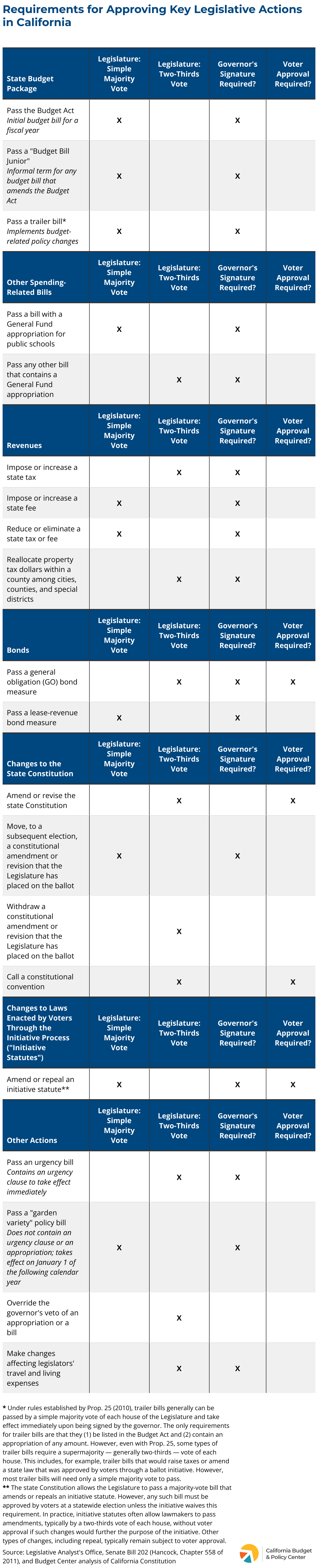
California’s Constitution establishes rules for a wide range of legislative actions, from passing the state budget to increasing taxes to placing constitutional amendments on the ballot.
Some actions need only a simple majority vote of each house of the Legislature — 41 votes in the 80-member Assembly and 21 votes in the 40-member state Senate.
Other actions require a two-thirds vote of each house of the Legislature — 54 votes in the Assembly and 27 votes in the Senate.
Most legislative actions require the governor’s signature, and some need voter approval.
This table summarizes the requirements for approving key legislative actions in California.
Want to Better Understand the State Budget?
The Budget Center’s essential resources for understanding and navigating the California state budget — all in one place.
Explore tools, videos, and expert insights designed to strengthen your advocacy and guide informed decision-making.
There was a problem processing your signup. Please try again. Or contact us
Please check your email to confirm your signup.
Watch to learn more
Explore the year-long process of creating and revising California’s state budget — a process that shapes policies impacting every Californian. This video simplifies each key step, from initial proposals by state agencies to the governor’s budget release, legislative reviews, and final negotiations.
Gain the insights you need to stay informed and empowered about California’s financial decisions.
Want to Better Understand the State Budget?
The Budget Center’s essential resources for understanding and navigating the California state budget — all in one place.
Explore tools, videos, and expert insights designed to strengthen your advocacy and guide informed decision-making.
There was a problem processing your signup. Please try again. Or contact us
Please check your email to confirm your signup.
Watch to learn more
Proposition 98, passed in 1988, is a cornerstone of California school funding, guaranteeing minimum funding levels for K-12 education funding and community college funding. But how does it work? And what does it mean for public schools and the state budget?
In this explainer video, we break it all down, including the funding sources, calculations, and its impact on education funding in California. Learn how this law ensures a steady financial base for schools while adapting to the state’s fiscal conditions.
Want to Better Understand the State Budget?
The Budget Center’s essential resources for understanding and navigating the California state budget — all in one place.
Explore tools, videos, and expert insights designed to strengthen your advocacy and guide informed decision-making.
The legislative process — also known as the policy bill process — provides a key pathway through the state Legislature for Californians who want to change state law.
Each year, members of the state Assembly and Senate collectively introduce thousands of bills that move, partially or all the way, through the legislative process. These bills propose changes to one or more of California’s nearly 30 state codes — changes that take effect only if a bill is passed by both houses and signed by the governor.
Proposals to amend the state Constitution also move through the legislative process. While Assembly and Senate constitutional amendments do not require the governor’s signature, they do need voter approval in order to take effect.
The legislative process operates according to rules outlined in the state Constitution, in state law, and in two-house agreements (“joint rules”) adopted by the Assembly and Senate at the outset of each two-year legislative session.
Written and unwritten rules that are unique to each house as well as to various committees within each house — and that can change from year to year — also shape the legislative process with opportunities for public involvement.
It is important to highlight that the state budget process provides a separate pathway through the Legislature for changing state law (through budget-related “trailer bills”). Compared to the legislative process, the state budget process has distinct rules, deadlines, and — in some cases — decision-makers. Advocates typically use both the state budget process and the legislative process to advance their policy goals. However, the remainder of this guide focuses exclusively on the legislative process.
Opportunities for Public Engagement in the Legislative Process
The public has many opportunities to engage with state policymakers during the legislative process. For example, members of the public can:
Suggest bill ideas to members of the Legislature.
Build/renew relationships with lawmakers and their staff in order to develop familiarity and trust — which is critical to securing bill authors and advancing legislation.
Meet with lawmakers and their staff as well as with members of the governor’s administration to make the case for legislation and address any concerns.
Write letters to committees and individual legislators sharing opinions about bills that have been introduced.
Attend legislative committee hearings to share opinions about bills during public comment periods.
Urge the governor to sign or veto legislation.
Policy Committees
Assembly and Senate policy committees consider the policy implications of a bill. Each house’s leadership assigns bills to policy committees based on subject matter and other factors. Bills may be reviewed by a single policy committee in each house or by multiple policy committees.
The state Senate has more than 20 standing policy committees, and the Assembly has over 30. Examples include the Assembly Education Committee and the Senate Revenue and Taxation Committee. Bills that are approved at this stage — potentially with amendments — go to the appropriations committee for further review.
Want to Better Understand the State Budget?
The Budget Center’s essential resources for understanding and navigating the California state budget — all in one place.
Explore tools, videos, and expert insights designed to strengthen your advocacy and guide informed decision-making.
Appropriations committees estimate the cost of bills. If the cost meets or exceeds certain thresholds, the bill generally is placed on the committee’s suspense file, which is essentially a “holding pen” for bills that will receive additional scrutiny. The dollar thresholds are relatively low in both houses. In the Senate, the threshold ranges from $50,000 to $150,000, depending on which state fund the money would come from. The threshold in the Assembly is $150,000 regardless of the fund.
Twice per year, appropriations committees convene hearings where they rapidly announce the fate of the hundreds of bills on their suspense files. Bills voted off the suspense file — often with amendments — advance to the Assembly or Senate floor, while bills that are held “on suspense” in the appropriations committee are dead for the year.
Bills can be held on suspense for any number of reasons, including concerns about their cost. However, committee chairs typically do not publicly explain why some bills advance to the floor while others are held.
Floor Votes: Simple Majority or Supermajority
Once a bill clears the final committee in its “house of origin,” it is scheduled for a debate and vote on the house floor. Most bills require only a simple majority vote to advance off the floor — 41 votes in the 80-member Assembly and 21 votes in the 40-member Senate.
However, a two-thirds (supermajority) vote of each house is required if the bill:
Would create a new tax or increase an existing tax.
Contains an “urgency” clause that allows it to take effect immediately rather than on January 1 (the typical date).
Proposes to amend the state Constitution — a change that ultimately must be approved by a majority of voters in a statewide election.
Rinse and Repeat: Process Moves to the Second House
If a bill passes the first house, it moves to the second house, where it repeats the process — policy committee(s), appropriations committee, floor vote. Bills are typically amended again at this stage. If approved with amendments, the bill goes back to the first house for a “concurrence” vote. Bills passed on concurrence go to the governor for final consideration.
Learn the Lingo
Understanding budget-related terms is essential for navigating the state budget and legislative process and effectively engaging with decision-makers to advocate for just policy solutions for Californians.
Thumbs Up or Thumbs Down: Approved Bills Go to the Governor
Once a bill receives final legislative approval it goes to the governor, who can:
Sign the bill into law.
Allow the bill to become law without a signature.
Veto — reject — the bill. The Legislature can override a veto with a two-thirds vote of each house. However, veto overrides are extremely rare.
Bills passed by a simple majority vote typically take effect on January 1 of the next calendar year. Urgency statutes, tax increases, and certain other bills take effect as soon as they become law.
Committee agendas and other publications, floor session and committee schedules, the annual legislative calendar, and live and archived video streaming of legislative proceedings.
Kristina Bas Hamilton, Changemaker: An Insider’s Guide to Getting Sh*t Done at the California Capitol (October 2023).
There was a problem processing your signup. Please try again. Or contact us
Please check your email to confirm your signup.
Watch to learn more about trailer bills in California
Trailer bills play a crucial role in California’s budget process by making the legal changes needed to implement policies in the Budget Act. This video explains how trailer bills work, their journey through budget committees, and the voting rules they must follow. You’ll explore how these bills impact vital areas like health, housing, and education to expand your knowledge of California’s legislative process.
Want to Better Understand the State Budget?
The Budget Center’s essential resources for understanding and navigating the California state budget — all in one place.
Explore tools, videos, and expert insights designed to strengthen your advocacy and guide informed decision-making.
There was a problem processing your signup. Please try again. Or contact us
Please check your email to confirm your signup.
This website uses cookies to analyze site traffic and to allow users to complete forms on the site. The California Budget & Policy Center does not share, trade, sell, or otherwise disclose personal information. By using our website you agree to our Privacy Policy.