Skip to content

Spending on K-12 schools is one of the most critical public investments we make. California voters’ approval of Proposition 30 in November 2012 has provided more dollars for the state to support schools and helped the state gain on the rest of the US in K-12 spending per student.

  • In 2012-13, the gap between California’s spending per student and the rest of the US had grown to its widest point. The drop in state revenue due to the Great Recession led to dramatic cuts to state spending on K-12 schools. As a result, the gap between California spending per K-12 student and the rest of the US grew to more than $2,600, the widest in at least 45 years, even after adjusting for inflation.
  • California’s spending per K-12 student has increased relative to the rest of the US since voters passed Prop. 30. California spent an estimated $2,000 more per K-12 student in 2015-16 than in 2012-13, inflation-adjusted. Largely as a result, the gap in spending per student between California and the rest of the US narrowed from more than $2,600 in 2012-13 to roughly $1,000 in 2015-16 (see chart).
  • Voter approval of Prop. 55 in November would extend a key component of Prop. 30 and provide significant funding for schools. Prop. 30 boosted state revenues by raising the state sales tax rate by one-quarter cent through 2016 and personal income tax rates for very high-income Californians through 2018. Prop. 30 revenues will decline starting in the current fiscal year (2016-17) as the measure’s tax rate increases begin to expire. Voter approval of Prop. 55, which appears on the November 8, 2016 statewide ballot, would extend Prop. 30’s personal income tax rates on the wealthiest Californians, thereby maintaining a revenue source that has helped narrow the gap between California spending per K-12 student and the rest of the US.
k-12-spending-ca-v-us-k12-per-pupil-spending-since-2001

Stay in the know.

Join our email list!

Endnotes are available in the PDF version of this Issue Brief.

Proposition 57, which will appear on the November 8, 2016 statewide ballot, would amend the California Constitution to give state officials new policy options for reducing incarceration. The measure also would amend state law to require youth to have a hearing in juvenile court before they could be transferred to adult court. This Issue Brief provides an overview of this ballot measure as well as its potential impact on the state correctional system and the state budget. The California Budget & Policy Center neither supports nor opposes Prop. 57.

What Would Proposition 57 Do?

Prop. 57, “The Public Safety and Rehabilitation Act of 2016,” would amend the California Constitution to give state officials new flexibility to reduce the number of people incarcerated by the state. The measure would (1) create a new parole consideration process for people convicted of a nonviolent felony offense who are sentenced to state prison and (2) provide state corrections officials with new authority to award certain credits that reduce the length of state prison sentences. In addition, Prop. 57 would amend state law to require youth to have a hearing in juvenile court before they could be transferred to adult court for prosecution.

Proposition 57 Would Create a New Parole Consideration Process for People Convicted of a Nonviolent Felony Offense

Under current state law, most people convicted of an offense that results in a state prison term receive either a determinate sentence or an indeterminate sentence.

  • A determinate sentence is a prison term with a specified release date. Once individuals have completed their sentence, they are automatically released to parole, meaning that they are supervised in the community for a set period by state parole agents or county probation officers.
  • An indeterminate sentence does not have a specified release date. Instead, individuals serve a life term with the possibility of parole. After serving a minimum required number of years, individuals go before the Board of Parole Hearings, which determines “if or when an offender can be returned to society.”

For each type of sentence, the length of the prison term handed down by a judge often reflects sentencing “enhancements” or alternative sentences that are required by state law. For example, under California’s “Three Strikes and You’re Out” law, a person with one prior conviction for a violent or serious felony who is convicted of any new felony — a “second-strike” offense — receives a prison term that is twice what it would otherwise be under state law. People with at least two prior “strike” convictions who are convicted of a new serious or violent felony — a “third-strike” offense — receive a life sentence with a minimum term of 25 years.

Prop. 57 would amend the state Constitution to create a new parole consideration process for people convicted of a “nonviolent felony offense” who are sentenced to state prison. An individual would be eligible for parole consideration “after completing the full term for his or her primary offense.” The measure defines “full term for the primary offense” as follows: “the longest term of imprisonment imposed by the court for any offense, excluding the imposition of an enhancement, consecutive sentence, or alternative sentence.” This new parole consideration process would apply to people serving determinate sentences as well as to some individuals serving indeterminate sentences. Prop. 57 would require the California Department of Corrections and Rehabilitation (CDCR) to adopt regulations implementing this provision and to certify that such regulations “protect and enhance public safety.”

Proposition 57 Would Give State Corrections Officials New Constitutional Authority to Award Sentencing Credits in Order to Reduce Prison Terms

Under current state law, certain incarcerated adults are eligible to earn sentencing credits to reduce their prison terms. For example, state law gives the CDCR the authority to award a specific amount of credits to individuals who exhibit good behavior and/or complete “approved rehabilitative programming,” such as academic coursework, vocational training, and substance use disorder treatment. In addition, state law limits the amount of credits that prisoners may earn, outlines circumstances under which individuals may lose or be denied credits, and prohibits some individuals — including those convicted of murder — from earning any credits at all.

Prop. 57 would amend the state Constitution to give the CDCR authority “to award credits earned for good behavior and approved rehabilitative or educational achievements.” This new authority would be in addition to any authority granted to the CDCR through state law. Prop. 57 would require the CDCR to adopt regulations implementing this provision and to certify that such regulations “protect and enhance public safety.”

Proposition 57 Would Require Youth to Have a Hearing in Juvenile Court Before They Could Be Transferred to Adult Court

Under current state law, youth ages 14 to 17 who are accused of certain crimes can be tried in adult court. In some circumstances, state law requires the juvenile to be tried as an adult. In other situations, prosecutors have the discretion to directly file charges against a youth in adult court. In the remaining cases, a juvenile court judge decides — if so requested by a prosecutor — whether a youth should be transferred to adult court.

Prop. 57 would amend state law to require youth to have a hearing in juvenile court before they could be transferred to adult court for prosecution. As a result, under Prop. 57, “the only way a youth could be tried in adult court is if the juvenile court judge in the hearing decides to transfer the youth to adult court,” according to the Legislative Analyst’s Office (LAO). In addition, the measure would allow prosecutors to seek transfer hearings only for 16- and 17-year-olds accused of committing a felony, or for 14- and 15-year-olds accused of committing certain crimes outlined in state law, including murder, kidnapping, arson, and certain sex offenses.

Future Amendments to Proposition 57 Would Require Voter Approval in Some Circumstances

Both the statutory and the constitutional provisions of Prop. 57 could be amended:

  • Statutory provisions. The statutory provisions of Prop. 57 revise the process by which youth may be transferred to adult court. Changes to these provisions that “are consistent with and further the intent of” Prop. 57 could be approved in a bill passed by a majority vote of each house of the Legislature and signed by the Governor. The Legislature and the Governor could approve other types of changes to these provisions, but any such changes would also require voter approval.
  • Constitutional provisions. The constitutional provisions of Prop. 57 create a new parole consideration process and give state officials new authority to award sentencing credits. These provisions could be amended only by a subsequent vote of the people.

California Has Substantially Reduced Incarceration in Recent Years, But Significant Challenges Remain

In recent years, California has made significant progress in reducing the number of people involved with the state correctional system. The number of adults incarcerated by the state, which peaked at more than 173,600 in 2007, has declined to roughly 128,900, a reduction of more than one-quarter. This decrease resulted largely from criminal justice reforms adopted by state policymakers and by the voters in the years following a 2009 federal court order requiring California to reduce prison overcrowding to no more than 137.5 percent of the prison system’s capacity. These reforms were largely aimed at keeping people convicted of “lower-level” felonies out of state prisons, while also boosting opportunities for rehabilitation.

Despite this substantial decline in state-level incarceration, significant challenges remain. Specifically:

  • California’s prison system remains severely overcrowded. California currently houses more than 113,600 adults in 34 state prisons designed to hold a total of about 84,300 people.This means that the state prison system is operating at approximately 135 percent of capacity, which is just below the court-ordered prison population cap (137.5 percent of capacity). The state also houses about 10,800 people in “contract” facilities, including out-of-state private prisons. California contracts for bed space because the prison population cap prevents the CDCR from increasing the level of crowding in state prisons beyond the limit set by the court.
  • The number of adults incarcerated by the state is expected to increase modestly in the coming years, reaching a projected 132,070 by mid-2020. Even as the total number of adults in state custody has declined over the past few years, the number of adults “with relatively long sentences” has continued to grow. The CDCR projects that within the next year, the increase in the number of individuals with relatively long sentences “will outpace population reductions being achieved within the lower-level offender population.”
  • Spending on state corrections remains persistently high. The CDCR is slated to receive $10.5 billion from the state’s General Fund in the current fiscal year (2016-17) — the third consecutive year that state support for the CDCR will exceed $10 billion, after adjusting for inflation. The CDCR’s current share of total General Fund spending — 8.5 percent — is more than twice as high as its share was in 1980-81 (2.9 percent).

These facts suggest that additional reforms are needed in order to further decrease incarceration at the state level and substantially reduce the cost of the state correctional system.

Proposition 57 Would Likely Further Reduce the Number of People Incarcerated by the State

If approved by the voters, Prop. 57 would help to restore California’s momentum in reducing incarceration. By requiring juvenile court judges to decide whether a youth should be tried in adult court, Prop. 57 would likely reduce the number of juveniles who end up in the adult criminal justice system, thereby promoting better outcomes for youth who are sentenced for committing a crime. Moreover, the measure’s new rules regarding parole and sentencing credits could result in many prisoners being released on an accelerated timeline. Experts note that scaling back the length of prison terms is crucial to reducing correctional populations, and that doing so has little to no impact on either crime rates or recidivism. Yet, while Prop. 57 would allow prison terms to be reduced, it would not require state officials to take such a course of action. Therefore, the extent of any decrease in incarceration would depend on how state officials interpret and implement the measure.

Some People Convicted of Nonviolent Offenses Could Be Released From Prison More Quickly Due to the New Parole Consideration Process

Prop. 57 would require the state parole board to conduct parole consideration hearings for prisoners who were convicted of a nonviolent felony offense and who have completed the full term for their primary offense. In other words, individuals would be considered for release from prison prior to serving time for other offenses and/or for any sentencing enhancements that may have been added to their base term. This new parole consideration process would apply to roughly 30,000 current prisoners as well as to about 7,500 of the individuals who are expected to enter state prison each year, according to the LAO.

Yet, although the parole board would have to conduct potentially thousands of additional parole consideration hearings, board commissioners — who are appointed by the Governor — would not be required to grant early release to any state prisoners who would be affected by Prop. 57. Decisions about which prisoners to release presumably would adhere to the parole board’s current guidelines, under which commissioners determine if an individual poses “a current, unreasonable risk” of danger to the public. Still, it is likely that some people affected by Prop. 57 would be found to meet these guidelines and thus would be released from prison earlier than their full sentence requires.

Some People Could Be Released From Prison More Quickly Due to the CDCR’s New Authority to Award Sentencing Credits

Prop. 57 would give state corrections officials broad new discretion to award sentencing credits for good conduct and rehabilitative or educational achievements in order to reduce the amount of time that people spend in prison. The CDCR could award more credits than currently allowed and/or provide credits to prisoners who are otherwise prohibited from earning credits. For example:

  • State law generally allows eligible prisoners to earn one day of credit for each discipline-free day that they serve. Under Prop. 57, state corrections officials could — but would not have to — provide additional credits for each day of good behavior.
  • State law also allows eligible prisoners to earn credits for successfully completing rehabilitative programs. However, these “milestone” credits may reduce a prisoner’s sentence by no more than six weeks in a 12-month period. Under Prop. 57, state corrections officials could — but would not have to — lift this six-week limitation and allow individuals who earn sufficient milestone credits to further reduce their prison terms within a 12-month period.
  • State law prohibits some prisoners, including those convicted of specified violent offenses, from earning credits for completing rehabilitative programs. Under Prop. 57, the CDCR could — but would not be required to — allow these individuals to earn credits for participating in rehabilitative programs, thereby reducing the length of their terms and increasing the chances that they will be able to successfully integrate back into their communities when they are released.

Because the CDCR is part of the Governor’s administration, Governor Brown and his successors would ultimately determine whether, or by how much, to increase the amount of credits that state prisoners could earn for good conduct and/or for completing rehabilitative activities. If voters approve Prop. 57, Governor Brown could implement expansive new credit-earning opportunities aimed at promoting rehabilitation and substantially reducing the state prison population. Alternatively, he could take a more limited approach that only modestly increases credits beyond the levels already provided. Moreover, whatever decisions Governor Brown makes could be maintained, modified, or rescinded by subsequent governors.

Proposition 57 Would Likely Generate Annual State Savings

The various provisions of Prop. 57 are expected to result in state budget savings. The LAO projects that net state savings would likely be “in the tens of millions of dollars annually,” while also acknowledging that their estimates “are subject to significant uncertainty.” Most of these savings are attributed to the provisions of Prop. 57 that apply to adults in state prison: the new parole consideration process and the new authority for state corrections officials to award sentencing credits. However, it is not known how state officials would interpret and implement Prop. 57’s new options for reducing incarceration. Therefore, annual state savings could be higher or lower than the LAO projects.

What Do Proponents Argue?

Proponents of Prop. 57, including Governor Brown and the Chief Probation Officers of California, argue that the measure focuses “resources on keeping dangerous criminals behind bars, while rehabilitating juvenile and adult inmates and saving tens of millions of taxpayer dollars.” They further argue that “without a common sense, long-term solution, we will continue to waste billions and risk a court-ordered release of dangerous prisoners.”

What Do Opponents Argue?

Opponents of Prop. 57, including the San Francisco Police Officers Association and the California District Attorneys Association, argue that the measure will allow “state government bureaucrats to reduce many sentences for ‘good behavior,’ even for inmates convicted of murder, rape, child molestation, and human trafficking.” Prop. 57, they argue, “will likely result in higher crime rates as at least 16,000 dangerous criminals…would be eligible for early release.”

Conclusion

Prop. 57 would provide California officials with new policy tools to address ongoing overcrowding in state prisons. Under the measure, thousands of individuals who were convicted of a nonviolent felony offense would go before the state parole board each year to be considered for release from prison prior to serving their complete sentence. In addition, state corrections officials would gain broad new authority to award sentencing credits in order to reduce the amount of time that people spend in prison. Finally, Prop. 57 would require juvenile court judges to decide whether youth should be tried in adult court. This change would likely reduce the number of juveniles who end up in the adult criminal justice system, thereby promoting better outcomes for youth who are sentenced for committing a crime.

Prop. 57 would not reform California’s complex and often draconian Penal Code, which continues to overly rely on incarceration as the consequence for committing a crime, rather than promoting community-based interventions that could provide better avenues for rehabilitation. Consequently, the measure would not directly reduce the number of people who are sentenced to prison in the first place. However, Prop. 57 would provide new opportunities for state officials to mitigate the impact of California’s sentencing laws by accelerating the release of individuals who merit such consideration, particularly where doing so would promote rehabilitation, public safety, and the cost-effective use of limited public resources. Yet, while Prop. 57 would allow prison terms to be reduced, it would not require state officials to take such a course of action. Therefore, the extent of any decrease in incarceration would depend on how state officials interpret and implement the measure.

Stay in the know.

Join our email list!

Endnotes are available in the PDF version of this Issue Brief.

Proposition 51, which will appear on the November 8, 2016 statewide ballot, would authorize $9 billion in general obligation (GO) bonds for K-12 school and community college facilities. The measure would maintain California’s current financing system under which state and local dollars are used to pay for K-12 school and community college facilities. This Issue Brief provides an overview of Prop. 51 and the policy issues it raises. The California Budget & Policy Center neither supports nor opposes Prop. 51.

What Would Proposition 51 Do?

Prop. 51, the “Kindergarten Through Community College Public Education Facilities Bond Act of 2016,” would authorize $9 billion in GO bonds for construction and modernization of K-12 school and community college facilities. The measure would provide $7 billion in bond proceeds for K-12 education facilities:

  • $3.0 billion for construction of new school facilities;
  • $3.0 billion for modernization of school facilities;
  • $500 million for charter school facilities; and
  • $500 million for career technical education facilities.

Prop. 51 would also provide $2 billion in bond proceeds for California Community Colleges (CCC). These funds could be used for a variety of projects, including:

  • Purchasing land;
  • Constructing new facilities on existing campuses;
  • Renovating and reconstructing facilities;
  • Paying for planning and preconstruction costs for community college facilities; and
  • Equipping new, renovated, or reconstructed facilities.

Prop. 51 would maintain the current system for allocating bond funds for K-12 and CCC facilities. In addition, with respect to K-12 facilities only, state policymakers would be prohibited from changing the rules for allocating Prop. 51’s bond funds unless approved by the voters.

How Has California Historically Funded K-12 School and Community College Facilities?

Until the 1940s, California’s school districts primarily used local GO bonds to fund school facilities. The state did not get involved in financing school facilities until 1947, when the Legislature established the State Allocation Board (SAB) to provide funds for the construction and renovation of schools. California voters approved the first statewide school bond two years later, and the SAB began to provide loans to school districts to finance new school construction. To obtain a loan from the state, school districts had to demonstrate that they had maximized their ability to raise bond dollars at the local level and also had to receive approval of at least two-thirds of local voters to incur the debt to the state.

In 1978, California voters approved Prop. 13, which severely restricted the ability of school districts to issue GO bonds — the primary source of local revenue for new school construction and modernization. Prop. 13 capped local property tax rates at 1 percent, reducing property tax revenues by more than half. This reduction in revenues severely limited the ability of local governments, including school districts, to finance facilities with locally generated property tax revenues and, furthermore, prevented the imposition of additional tax rates dedicated to the repayment of debt. In response, the Legislature began to shift how the state financed school facilities — from issuing loans to providing grants.

In 1986, California voters approved Prop. 46, which re-established the ability of local school districts to issue GO bonds. The measure allowed local governments to levy property tax rates above 1 percent to pay off the principal and interest on bonds used to finance the acquisition or improvement of public facilities with the approval of two-thirds of local voters. This gave local governments, including K-12 school districts and CCC districts, the ability to increase property taxes above Proposition 13’s 1 percent cap for a very specific purpose — the repayment of voter approved debt.

How Does California Currently Pay for K-12 School and Community College Facilities?

California’s system of financing facilities for K-14 education involves a combination of state and local dollars. To receive state funding for facilities projects, K-12 schools and community colleges usually must make their own contributions toward them. The state and local districts (K-12 and CCC) both use GO bonds as the main source of funds for facilities.

  • State GO bond measures must be placed on a statewide ballot, either by a two-thirds vote of the Legislature and approval of the Governor or through the initiative process, where they require approval by a majority of voters. The principal and interest on state GO bonds are paid from the state’s General Fund, which is supported by state taxpayers.
  • Under state law, submitting a local GO school bond measure to voters requires the support of two-thirds of the governing board of a K-12 school district or community college district. Most GO bonds proposed by K-12 school and CCC districts require approval by at least 55 percent of local voters. Once local GO school bonds are issued they are repaid by taxpayers within the district.

K-12 school districts have an additional option for raising dollars to construct or reconstruct schools — imposing fees on developers. In 1986, the Legislature authorized K-12 school districts to levy developer fees on new residential, commercial, and industrial developments, but limited these fees based on the square footage of the development. In practice, developer fees were limited to 50 percent of a school district’s cost as long as state funds were available for new school facility construction. California voters have not passed a state GO bond for school facilities since 2006, and according to the SAB, state funds for new school construction ran out earlier this year. As a result, K-12 school districts are now able to levy developer fees that could cover 100 percent of the cost to build new schools. However, school districts in areas of the state that lack new developments do not have the opportunity to levy developer fees to fund school facilities projects.

How Does the State Allocate Dollars for K-12 School Facilities?

State dollars for the current K-12 facilities program are allocated through the School Facilities Program (SFP). Established by the Legislature in 1998, the SFP funds two major types of school construction projects: new school construction and modernization. SFP funding is allocated primarily through per-student grants to participating K-12 school districts on a first-come, first-served basis. State grants are intended to pay for 50 percent of the costs of a new construction project and 60 percent of modernization project costs.

State construction and modernization grants from the SFP are not provided to school districts until local matching funds are secured. K-12 school districts that are unable to provide the required local match may apply for funding under the state’s Financial Hardship Program (FHP). However, school districts must meet several requirements to receive FHP dollars, including demonstrating that they are unable to contribute the full local match and levying the maximum level of developer fees.

The SFP also provides funding for charter school and career technical education facilities. The Charter School Facilities Program provides funding to construct new charter schools and/or rehabilitate existing facilities that are at least 15 years old and are owned by school districts. The Career Technical Education Facilities Program provides funding to construct new career technical education facilities, modernize existing facilities, and/or purchase equipment for the career technical education programs. State grants are intended to provide 50 percent of the total project costs for charter school and career technical education facilities, but career technical education grants are capped at $3 million for new facilities and $1.5 million for modernization of existing facilities.

How Does the State Allocate Dollars for Community College Facilities?

State funding for community college facilities is allocated through the state budget. To apply for state funds, local CCC districts submit proposals for facilities projects to the CCC Chancellor’s Office. The Chancellor’s Office ranks projects based on several criteria, including prioritizing projects with larger local contributions, and each year submits a capital expenditure plan to the state. The Governor and Legislature approve specific CCC facilities projects as part of state’s annual budget act.

What Are California’s Facilities Needs for K-14 Education?

K-12 Schools

California does not maintain a comprehensive statewide inventory of K-12 school facilities, their capacity, or whether they meet the needs of California’s students. As a result, it is difficult to determine projected future costs for K-12 school facilities.

A 2015 report from the Legislative Analyst’s Office (LAO), which used the replacement cost of existing buildings to assess future K-12 facilities needs, estimated that it would cost $200 billion to replace all California school buildings. The LAO estimated that school districts would have to spend between $4 billion and $8 billion per year for building replacement, modernization, or maintenance, assuming a “useful school building life” of 25 to 50 years. Based on LAO’s estimates, projected costs for K-12 school facilities could range from $40 billion to $80 billion over a decade, without adjusting for inflation.

California Community Colleges

The CCC Chancellor’s Office estimates approximately $40 billion in unmet needs for CCC facilities from 2017-18 through 2026-27. The CCC Chancellor estimates that $20.3 billion in local GO bonds remain uncommitted and may be used to fund these needs, leaving $19.7 billion remaining to be funded by state GO bonds.

Since the Late 1990s, K-12 and Community College Districts Have Contributed Far More for Facilities Than the State

Local districts have raised more dollars for school facilities than the state has over the past two decades. Since 1998, K-12 school and community college districts have sold approximately $85 billion in local GO bonds for facilities projects — more than twice the $40 billion in state GO bonds sold to support facilities for K-14 education. During the same period, K-12 school districts have also raised an additional $10 billion for facilities by imposing fees on developers.

What Policy Issues Does Proposition 51 Raise?

Who Should Pay for California’s K-12 School and Community College Facilities?

Most observers agree that significant funding is needed for new school and community college construction and for modernization of existing K-12 and CCC facilities. However, there is an ongoing debate over who should pay for these costs, and in what proportion. Prop. 51 would authorize additional state GO bond dollars for school and community college facilities, but it is uncertain how much funding K-12 school or CCC districts would raise for facilities at the local level if the measure is approved.

California voters made it easier for K-12 school and CCC districts to raise local dollars for facilities projects when they approved Prop. 39 in 2000. The measure reduced the threshold for voter approval of local GO school bonds from two-thirds to 55 percent. K-12 school and CCC districts that approve local GO bonds raise funds for facilities by increasing property tax rates to repay the bonds. Yet at the same time that Prop. 39 made it easier to pass school facilities bonds, the Legislature capped the tax rates that districts can levy on local taxpayers to repay Prop. 39 bonds. In addition, the state also caps the outstanding debt of K-12 school and CCC districts based on the total assessed property value in the district. Both of these caps limit the dollars K-12 school and community college districts can raise through local GO bonds.

Should California Change How It Allocates Funding for K-12 School Facilities?

Prop. 51 would maintain the requirements of the state’s School Facilities Program and would prohibit state policymakers from changing SFP rules for allocating its bond funds unless approved by the voters. Governor Jerry Brown has pointed to significant shortcomings and inequities with the SFP and has signaled a desire to create a program focused on K-12 school districts with greatest need. To address the Governor’s concerns, the state Department of Finance convened meetings to discuss a new school facilities program and obtain feedback from stakeholders, but no agreement was reached as to program design. This lack of agreement set the stage for Prop. 51, which would provide state dollars for K-12 school facilities, but would also essentially lock in a system that disadvantages certain school districts. For example, under the state’s current SFP, dollars for K-12 facilities are allocated primarily on a first-come, first-served basis, which tends to reward school districts that are able to apply for funding more quickly and/or have more resources, such as larger districts with more staff.

Recent research has pointed to other inequities. In a 2015 report, the University of California, Berkeley’s Center for Cities & Schools found that:

  • School districts that have more taxable property value per student along with higher-income families, on average, raise more capital funds to pay for facilities needs than districts with less taxable property value per student and families with lower incomes.
  • On average, school districts serving the largest share of students from low-income families spent less per student on capital outlay — the construction and purchase of facilities — than districts serving the smallest share of students from low-income families. Because lower-income districts spent less on capital outlay, the study found, these districts spent more of their general operating budgets on facilities maintenance, in turn leaving fewer dollars available for education programs.

The Governor’s 2016 Five-Year Infrastructure Plan recommends that a new facilities program should target state funding for K-12 school districts most in need, including districts with low per-student assessed property value and limited capacity to finance facilities projects. However, Prop. 51 would require that dollars provided by the measure be distributed according to current rules for allocating K-12 facilities dollars, unless voters approve changes to these rules. This provision means that the Prop. 51 funds could not go toward creating the type of school facilities program the Governor recommends.

Should California Change How Much K-12 School Districts Can Levy in Developer Fees?

Prop. 51 would limit the amount that K-12 school districts can levy in developer fees. Because state dollars for new school construction are no longer available, K-12 school districts are currently permitted to levy developer fees that could cover 100 percent of the cost of building new schools. However, if Prop. 51 bond dollars become available, school districts would only be allowed to levy developer fees that cover up to a maximum of 50 percent of construction costs. In addition, Prop. 51 would prohibit the Legislature from changing the fees K-12 districts may collect from developers until 2021 or until all of Prop. 51’s dollars for K-12 facilities are spent, whichever comes first.

Are General Obligation Bonds the Best Way for the State to Finance School Facilities?

Prop. 51 is the first GO bond for K-12 school or higher education facilities to appear on the state ballot since 2006. Between 1996 and 2006, in contrast, the Legislature placed five GO bond measures for K-12 school and higher education facilities on the ballot, all of which were approved by California voters. The irregular timing of the state’s GO bond issuances for school facilities has contributed to uncertainty about the availability of state funding. Moreover, by financing school facilities through GO bonds, the state is paying for an ongoing expense through a temporary funding source.

Using an alternative approach, which treats K-12 school facilities costs as an ongoing expense, the LAO has recommended that the Legislature provide K-12 districts an annual grant per student for school facilities. The grant would pay for a minimum share of a K-12 school district’s expected facilities costs and would be adjusted based on differences in property wealth and on funding already provided to school districts from state dollars.

What Would Proposition 51 Mean for the State Budget?

Prop. 51 would authorize the state to sell $9 billion in GO bonds, a form of debt backed by the state’s General Fund. The LAO estimates that the state would pay an average of $500 million per year in debt service costs for Prop. 51 bonds, less than one-fifth of the $2.7 billion the state will spend in 2016-17 to pay debt service for bonds previously sold to support K-12 school and community college facilities projects.

The California Constitution requires the state to make debt service payments for GO bonds prior to all other expenditures, other than most education expenditures. As a result, dollars the state spends on debt service are not available for other state-supported services such as health care, education, and assistance for low-income families, seniors, and people with disabilities. The state has about $85 billion in outstanding infrastructure-related bond debt backed by the state’s General Fund and paid approximately $6 billion in debt service on these bonds in 2015-16, according to the LAO. In addition, about $31 billion of General Fund-supported bonds have been authorized, but have not yet been issued.

What Could Happen if Proposition 51 Is Not Approved by Voters?

If voters reject Prop. 51, the state would remain without GO bond dollars for school facilities. The state could use alternative approaches to finance school facilities projects, including annual cash expenditures or state loans to school districts. However, to the extent these resources come from the General Fund, the state could need to raise additional revenues or reduce spending on other public services, making these alternatives less likely.

Absent state dollars, K-12 school districts and CCC districts could finance facilities using local funding, including GO bonds. However, the state limits the dollars school districts can raise through local GO bonds by capping outstanding debt based on the total assessed value of property in each district. Moreover, some school districts may not be able to receive approval for GO bonds from local voters.

As another alternative, if Prop. 51 fails, K-12 school districts could finance construction by levying additional fees on new development. Because state funding still would not be available for new K-12 school facilities construction, school districts would be allowed to levy developer fees that could cover 100 percent of the cost to build new schools. However, using developer fees to pay for school facilities is not an option for school districts in areas of the state that lack new developments.

What Do Proponents Argue?

Proposition 51 is supported by the California Building Industry Association. Proponents of Prop. 51, including the California State PTA and the Community College League of California, argue that the measure “will repair outdated and deteriorating schools and upgrade classroom technology, libraries, and computer and science labs.” Proponents also argue that Prop. 51 “will be repaid from a very small amount of the state’s existing annual revenue…[and] does not raise taxes.” Proponents of Prop. 51 claim that “without matching dollars from a statewide school bond, taxpayers will face higher local property taxes to pay for school repairs and upgrades, and some school districts may never be able to afford fixing schools on their own.”

What Do Opponents Argue?

Opponents of Prop. 51, including the California Taxpayers Action Network, argue that the measure is unnecessary as “local bond measures work better than statewide bonds …[and] school enrollment is expected to decline over the next 10 years.” Opponents of Prop. 51 note that “the Legislature did not put Proposition 51 on the ballot. And the Governor opposes it.” Opponents also argue that “Prop. 51 ties the hands of legislators and locks in current rules…that deny disadvantaged schools the help they need.”

Conclusion

Prop. 51 would authorize $9 billion in state GO bonds for construction and modernization of K-12 school and community college facilities. California voters have not had an opportunity to approve state GO bonds for K-14 education facilities since 2006, and state bond funding for this purpose effectively has been exhausted for several years. If voters reject Prop. 51, the state would remain without GO bond dollars for K-12 school and CCC facilities, leaving local districts without a key source of state support.

Prop. 51 would maintain the current systems for allocating state dollars for K-14 education facilities, which typically require contributions from K-12 school and CCC districts. However, state policymakers would be prohibited from changing the rules for allocating Prop. 51’s bond funds for K-12 facilities unless these changes are approved by the voters. In this way, Prop. 51 would essentially lock in place a system that disadvantages certain K-12 school districts.

Stay in the know.

Join our email list!

Endnotes are available in the PDF version of this Issue Brief. 

Proposition 30, approved by voters in 2012, provided critical revenues to California at a time when the state faced daunting budgetary challenges. Prop. 30’s tax rate increases are scheduled to fully expire at the end of 2018. Prop. 55, which will appear on the November 8, 2016 statewide ballot, would extend for 12 years the Prop. 30 tax rate increases that affect very-high-income Californians. Revenues generated by Prop. 55 – a projected $4 billion to $9 billion per year from 2019 through 2030 – would go to K-12 public schools, community colleges, health care for low-income Californians, the state’s rainy day fund, state debt payments, and other state services. This Issue Brief provides an overview of Prop. 55 and the policy issues it raises. The California Budget & Policy Center neither supports nor opposes Prop. 55.

What Would Proposition 55 Do?

Prop. 55, “The California Children’s Education and Health Care Protection Act of 2016,” would amend the California Constitution to (1) extend Prop. 30’s personal income tax provisions for 12 years beyond their scheduled expiration at the end of 2018 and (2) create a formula to provide additional funding for Medi-Cal from the revenues raised by the measure. Moreover, existing provisions of the state Constitution would require Prop. 55 revenues to go to K-12 public schools, community colleges, the state’s rainy day fund, and state debt payments. Specifically, Prop. 55 would:

  • Extend Prop. 30’s personal income tax rate increases on very-high-income Californians. Prop. 55 would extend – from 2019 through 2030 – personal income tax rates enacted by Prop. 30. Extending these rates would raise between $4 billion and $9 billion each year (in today’s dollars), according to the Legislative Analyst’s Office (LAO). Prop. 55 would allow Prop. 30’s one-quarter cent increase in the state sales tax rate to expire at the end of 2016 as scheduled.
  • Create a new constitutional formula to increase funding for Medi-Cal, which provides health care services to Californians with low incomes. For each fiscal year from 2018-19 through 2030-31, the Governor’s Department of Finance would be required to estimate the amount of General Fund revenues – including those raised by Prop. 55 – that are needed to:
    • Meet the annual Prop. 98 minimum funding guarantee for K-12 schools and community colleges.
    • Fund the cost of services that were authorized as of January 1, 2016 (excluding Prop. 98 spending), as adjusted for population changes, statutory cost-of-living increases, federal mandates, and other factors.

If any Prop. 55 revenues are estimated to remain after meeting these combined expenditures, Medi-Cal would receive 50 percent of the excess, up to a maximum of $2 billion in any fiscal year. Revenues allocated to Medi-Cal under this provision would have to add to – rather than replace – existing General Fund support for the program.

  • Increase funding for K-12 schools and community colleges as compared to current law. The vast majority of funding for California’s K-12 schools and community colleges is provided by the Prop. 98 minimum funding guarantee. This guarantee is based on varying economic and fiscal conditions, including state General Fund revenue collections. Other things being equal, General Fund revenues from 2018-19 to 2030-31 would be higher if voters approve Prop. 55 than if the measure is rejected. This is because Prop. 55 would extend income tax rate increases that otherwise would expire at the end of 2018 under the provisions of Prop. 30. By increasing General Fund revenues relative to current law – which assumes the expiration of Prop. 30’s income tax rates – Prop. 55 would boost the amount of Prop. 98 funding that K-12 schools and community colleges would otherwise be expected to receive during the period that Prop. 55 is in effect. About half of the revenue raised by Prop. 55 would go to K-14 education, according to the LAO.
  • Increase deposits into the state’s rainy day fund and repayments of state budgetary debt as compared to current law. Under Prop. 2, which voters approved in 2014, California is required to set aside a certain share of General Fund revenues each year in order to build the state’s rainy day fund (the Budget Stabilization Account) and pay down state budgetary debts, including unfunded state pension liabilities. Because Prop. 55 would increase General Fund revenues relative to current law – as explained above – the measure would result in larger debt payments and bigger deposits into the rainy day fund compared to what would be expected if voters rejected Prop 55. The LAO estimates that Prop. 55 would provide an additional $60 million to approximately $1.5 billion each year for Prop. 2 purposes.
  • Allow state policymakers to use any remaining revenues raised by Prop. 55 for any budget priorities. Prop. 55 revenues that remain after (1) meeting the constitutional spending obligations described above and (2) helping to maintain state services that were in place as of January 1, 2016 could be used for any public systems and services funded through the state budget. For example, these excess Prop. 55 revenues could be used to raise the number of subsidized child care slots, increase cash assistance for low-income seniors and people with disabilities, and boost state support for the California State University (CSU) and the University of California (UC).

Whose Taxes Would Proposition 55 Affect?

As noted above, Prop. 55 would extend the personal income tax rate increases of Prop. 30, but not the sales tax rate increase. Prop. 30’s income tax rate increases are aimed specifically at the highest-income households. Of the total dollar increase in income taxes brought about by Prop. 30, the top 1 percent of households pay 98.6 percent, and the next 4 percent of households pay the remaining 1.4 percent, according to the Institute on Taxation and Economic Policy (Figure 1). Prop. 55’s income tax rate increases could be expected to have a similar effect.

prop-55-fig-1

Compared to those of Prop. 30, Prop. 55’s overall tax-rate changes would be even more progressive. This is because Prop. 55 would not extend Prop. 30’s quarter-cent sales tax increase, which has a disproportionate impact on households with lower incomes. Prop. 55 follows the equity principle of taxation, by which taxes are levied fairly, based on the ability to pay.

Currently, California’s lowest-income families pay the largest share of their incomes in state and local taxes, while the wealthiest, who substantially benefit from public investments and have the greatest ability to contribute, pay much smaller portions of their incomes in state and local taxes. In other words, California’s tax system as a whole is regressive, even with Prop. 30’s income tax increases on the wealthiest households. If voters reject Prop. 55, California’s tax system would become even more regressive because the highest-income households would contribute a smaller share of their income in taxes than if Prop. 55 were approved (Figure 2).

prop-55-fig-2

Furthermore, the top 1 percent of California households – those who would be most affected by Prop. 55’s tax rate increases – have seen their average income more than double since the late 1980s, after adjusting for inflation (Figure 3). In contrast, average inflation-adjusted incomes for the bottom 80 percent of California households have declined.

prop-55-fig-3

What Would Rejection of Proposition 55 Mean for Public Services?

If California voters do not approve Prop. 55, the personal income tax rate increases on very-high-income Californians enacted by Prop. 30 will expire at the end of 2018. The expiration of Prop. 30’s income tax rates would:

  • Result in a significant loss of General Fund revenues. Fiscal year 2018-19 would lose half a year of higher personal income tax revenues and 2019-20 would lose a full year of higher revenues – a projected $4.5 billion in 2018-19 and $7.7 billion in 2019-20, with annual revenue losses continuing thereafter (Figure 4).
  • Create a multi-billion dollar budget deficit that would likely result in cuts to state services. With the expiration of Prop. 30’s income tax rates, the loss of billions of dollars in General Fund revenues would lead to annual multi-billion dollar state budget deficits. Under such a scenario, state policymakers would likely need to reduce spending for critical services in order to help to help balance the budget.
  • Reduce the Prop. 98 funding guarantee for schools and community colleges. Changes in annual General Fund revenues tend to affect the Prop. 98 guarantee. If Prop. 30’s income tax rates are allowed to expire, the projected decline in annual General Fund revenue growth would reduce Prop. 98 funding for K-14 education compared to the funding that would be required if Prop. 30’s tax rates were extended. Specifically, the Prop. 98 funding level could fall by roughly $2 billion in 2018-19 and by roughly $4 billion in 2019-20 if voters reject Prop. 55.
  • Restrict the state’s ability to boost investments in a broad range of critical services and systems. These include:
    • The state’s child care and development system, which continues to provide tens of thousands fewer subsidized “slots” than in 2007-08, the year the Great Recession began.
    • The state’s higher education system – the CSU and UC – for which direct state General Fund support per student is down substantially since the early 2000s, after adjusting for inflation.
    • The CalWORKs welfare-to-work program, which provides a level of support that leaves families, including 1 million children, unable to afford even low-cost housing.
    • SSI/SSP cash assistance for seniors and people with disabilities, which leaves individuals living below the poverty line and struggling to afford housing, food, and other necessities.
  • Result in smaller deposits into the state’s rainy day fund and lower debt payments, leaving the state less prepared for the next economic downturn. Building up reserves and paying down budgetary debt gives state policymakers additional options – beyond spending cuts – for balancing the budget and maintaining services during an economic downturn. However, the expiration of Prop. 30’s income tax rates would reduce the amount of revenues that are available for deposit into the Budget Stabilization Account and to pay down budgetary debt. As a result, critical services would likely face larger cuts if a recession significantly reduced state revenues.

In summary, allowing Prop. 30’s income tax rate increases on very-high-income Californians to expire would eliminate billions of dollars from California’s revenue system. This would leave the state with less funding to invest in schools, community colleges, and other vital public services and systems as well as reduce the state’s ability to pay down debts and save for a rainy day.

prop-55-fig-4

Policy Issues Raised by Proposition 55

Prop. 55 raises key policy issues, including whether to add a new funding formula for Medi-Cal to the state Constitution and whether to use temporary revenues to support ongoing services.

Adding a New Funding Formula for Medi-Cal to the State Constitution Reflects “Ballot-Box Budgeting”

By creating a new constitutional spending requirement for Medi-Cal, Prop. 55 is an example of what is commonly called “ballot-box budgeting.” On the one hand, critics of ballot-box budgeting argue that the initiative process limits voters to an up-or-down choice in isolation from other potential uses of funds. They argue that earmarking the proceeds from a certain revenue source constrains the ability of the Governor and lawmakers to use the same source for other spending priorities, to make programmatic changes, or to modify spending in response to economic, budget, and demographic shifts.

On the other hand, proponents of initiative-based spending argue that the two-thirds vote requirement for legislative approval of tax increases makes it difficult, if not impossible, to raise revenues through the legislative process to support public services and systems. As a result, they maintain that it is appropriate to offer voters the ability to raise taxes to fund specific state budget priorities.

Proposition 55 Provides Temporary Funds for Ongoing Spending

Prop. 55 extends Prop. 30’s personal income tax rate increases through 2030, but does not make those higher rates permanent. In other words, the revenues raised by Prop. 55 would eventually disappear. Given the temporary nature of these revenues, relying on them to fund permanent, ongoing services – such as K-14 education and Medi-Cal – would mean that state policymakers (and possibly the voters) would again face the question of whether to extend these tax rates, make them permanent, or find a different source of funding. If such efforts failed, state budget shortfalls would likely emerge, meaning that state policymakers would face the prospect of reducing spending on vital public services and systems.

What Do Proponents Argue?

Proponents of Prop. 55, including the California State PTA, the California Teachers Association, and State Superintendent of Public Instruction Tom Torlakson, argue that the measure will prevent “billions in budget cuts without raising taxes by ensuring the wealthiest Californians continue to pay their share.” They state that money from the measure “goes to local schools” with strict accountability requirements that “ensure funds designated for education go to classrooms,” and further that the measure “expands health care access for children.”

What Do Opponents Argue?

Opponents of Prop. 55, including the Howard Jarvis Taxpayers Association, the National Federation of Independent Business/California, and retired Superior Court Judge Quentin L. Kopp, argue that voters supported Prop. 30’s tax rate increases only “because we were promised they’d be temporary.” They assert that funding for schools and other requirements is adequate, and state that “we can’t trust the politicians and special interests.”

Conclusion

Prop. 55 would extend – from 2019 to 2030 – the personal income tax rate increases on very-high-income Californians that voters approved by passing Prop. 30 in 2012. Prop. 55 would not extend Prop. 30’s quarter-cent increase in the state sales tax rate, which would be allowed to expire at the end of 2016 as scheduled. Prop. 55 is projected to generate between $4 billion and $9 billion per year, a range that brackets the roughly $7 billion to $8 billion per year that Prop. 30 has raised to date. Prop. 55’s revenues would be used to meet various constitutional spending obligations, such as for K-14 education and for Medi-Cal, as well as to help maintain services that were in place as of January 1, 2016. After meeting these spending requirements, any Prop. 55 revenues that remained could be used for any budget priorities, including boosting working families’ access to subsidized child care, making higher education more affordable, and improving safety-net services for low-income families with children.

With Prop. 55, voters have a choice to maintain a level of funding that has allowed California to begin reinvesting in its schools and other public services after years of disinvestment during and following the Great Recession. Rejecting Prop. 55, and thus allowing Prop. 30’s income tax rate increases to expire at the end of 2018, would result in reduced state revenues, less funding for schools and community colleges, smaller deposits to the state’s rainy day fund, less repayment of budgetary debt, and – quite possibly –  cuts to vital public services and systems. Moreover, California’s state and local tax system would become even more regressive because the wealthiest households – primarily the top 1 percent – would receive a substantial tax cut and thereby contribute less toward strengthening services that can promote economic security and opportunity for all Californians.

Stay in the know.

Join our email list!

Endnotes are available in the PDF version of this Issue Brief. 

Proposition 30, approved by voters in 2012, provided critical revenues to California at a time when the state faced daunting fiscal challenges. These revenues increased school funding and allowed for reinvestment in other public services after years of cuts. Prop. 30’s tax rate increases are scheduled to expire over the next several years. Although the state is in a much stronger fiscal situation now than it was in 2012, the phasing out of Prop. 30’s revenue boost would mean fewer resources available in the coming years to fund California’s various priorities.

This Issue Brief is the first of a two-part series in which we discuss what Prop. 30 has meant for California, and what extending a key component of it, as proposed by Prop. 55 on the November 2016 ballot, would mean for the state.

What Did Proposition 30 Do?

Prop. 30 raised the state sales tax rate by one-quarter cent through 2016 and added three new personal income tax (PIT) rates for very-high-income Californians through 2018:

  • A 10.3 percent tax bracket for single filers’ taxable income between $250,001 and $300,000 and joint filers’ taxable income between $500,001 and $600,000;
  • An 11.3 percent tax bracket for single filers’ taxable income between $300,001 and $500,000 and joint filers’ taxable income between $600,001 and $1 million; and
  • A 12.3 percent tax bracket for single filers’ taxable income above $500,000 and joint filers’ taxable income above $1 million.

The PIT and sales tax rate changes enacted by Prop. 30 have increased state revenues by $7 billion to $8 billion annually, with somewhat smaller gains projected for later years due to the expirations of the sales tax rate increase in 2016 and of the PIT rate increases in 2018.

Whose Taxes Does Proposition 30 Affect?

Everyone Pays the Sales Tax Rate Increase

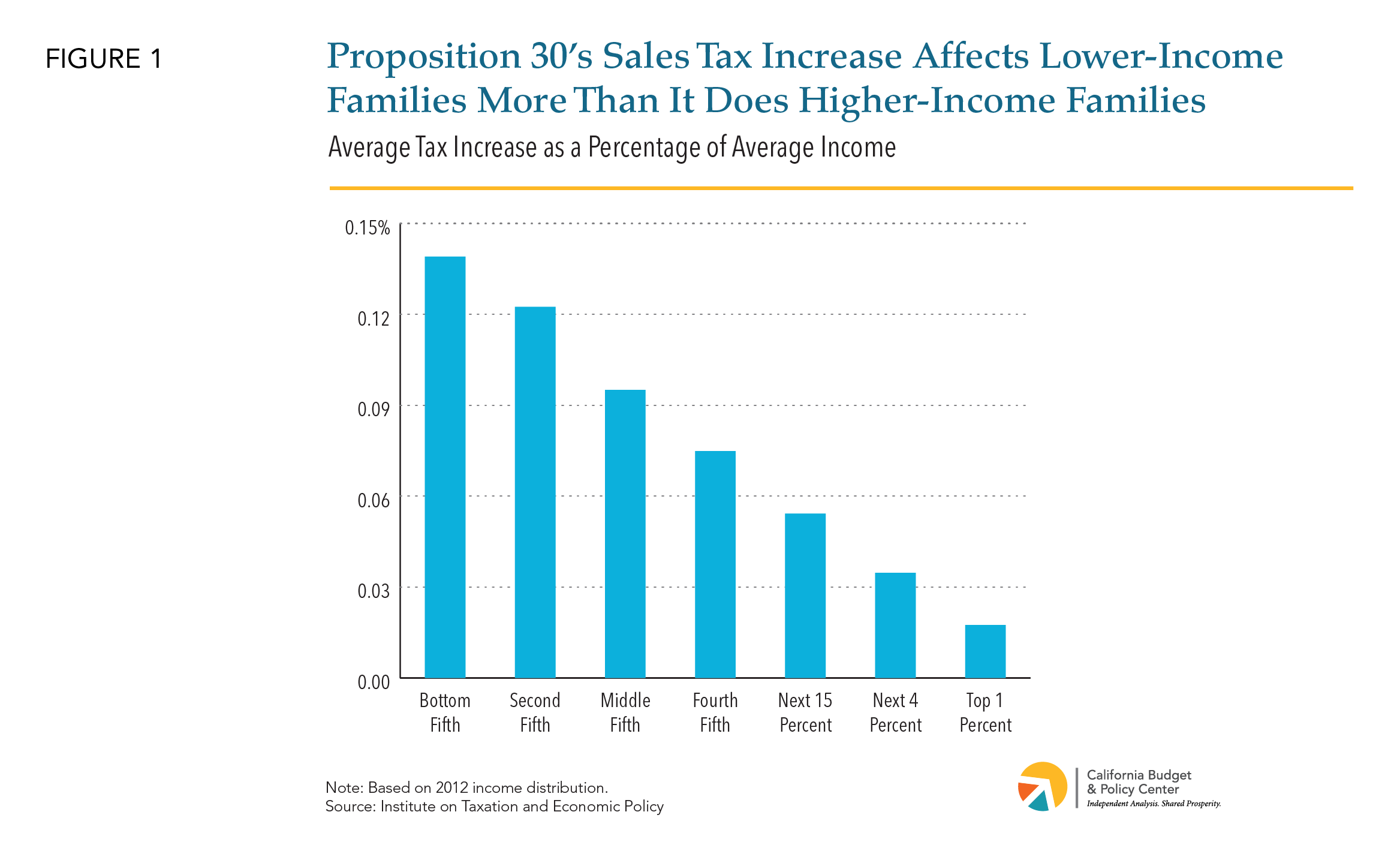
Prop. 30’s quarter-cent sales tax rate increase affects all consumers. However, as a share of income, this increase has a larger impact on lower-income households than it does on higher-income households (Figure 1). This makes the tax “regressive,” as opposed to a “progressive” tax, which does the opposite — ask more of higher-income households than of lower-income households.

Prop 30 Fig 1

The Income Tax Rate Increases Affect the Wealthiest 1.5 Percent of Households

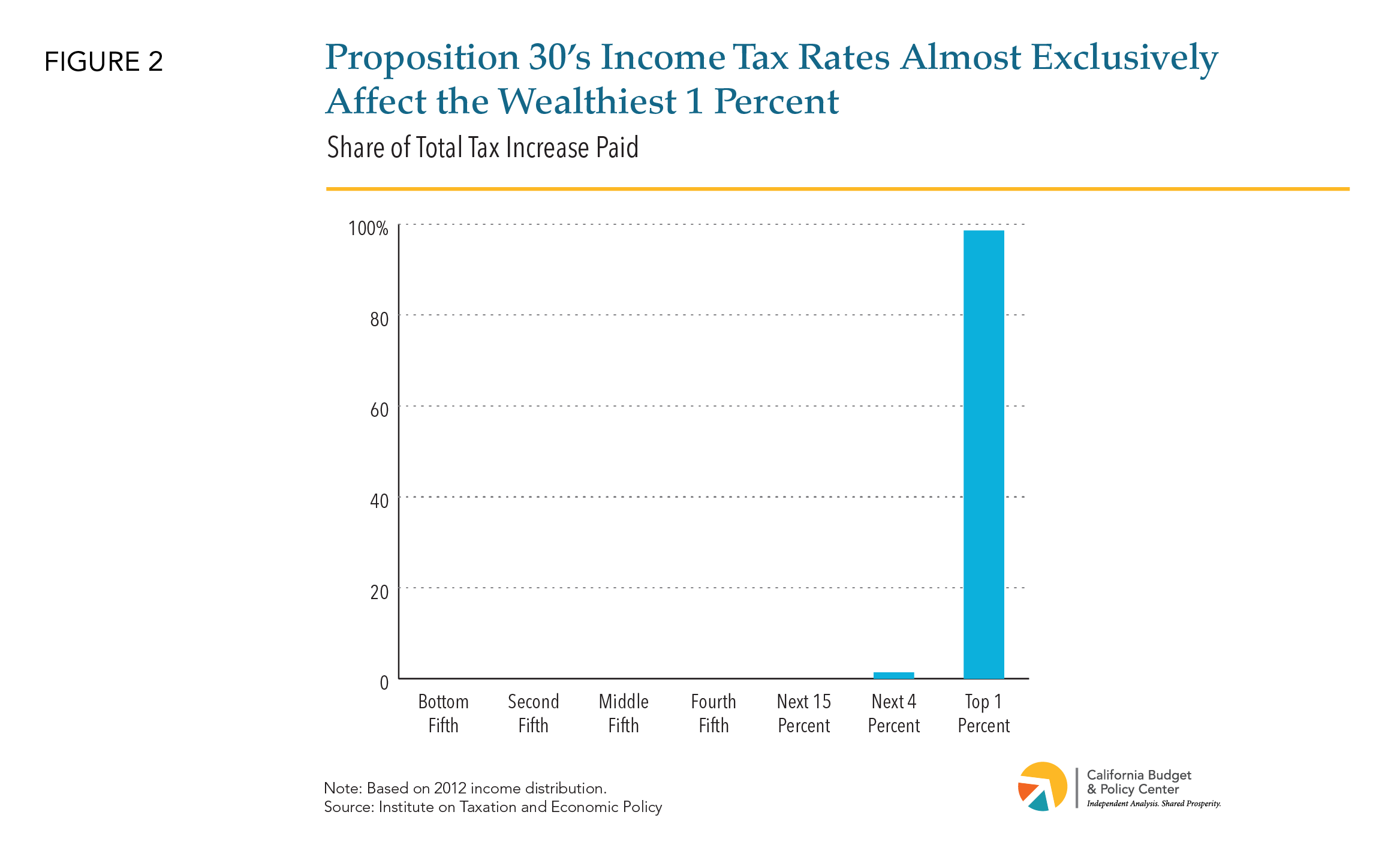
Prop. 30’s PIT rate increases are aimed at the highest-income households. Prop. 30’s PIT rates affect “roughly the 1.5 percent of taxpayers with the highest incomes,” according to the Legislative Analyst’s Office. Of the total annual dollar increase in income tax revenues raised by Prop. 30, the top 1 percent of households pay 98.6 percent, with the remainder paid by households in the next 4 percent, according to the Institute on Taxation and Economic Policy (ITEP) (Figure 2). Prop. 30’s PIT rate increases are very progressive.

Prop 30 Fig 2

Proposition 30 Overall Has a Progressive Effect

The revenues from Prop. 30’s higher PIT rates ($6.7 billion in 2015-16) are more than four times the revenues raised by the sales tax rate increase ($1.5 billion in 2015-16), according to the Department of Finance. This means that even though the sales tax component is regressive, Prop. 30 overall has a progressive effect on California’s tax system. Of the total revenue increase due to Prop. 30, the top 1 percent of families pay 77.2 percent, according to ITEP (Figure 3).

Prop 30 Fig 3

Asking the wealthiest Californians to contribute more follows the “equity” principle of taxation: that taxes should be levied fairly and based on ability to pay. Furthermore, the wealthiest Californians were the only ones to see growth in their average incomes over roughly the last quarter-century. The bottom 80 percent of Californians actually saw their average incomes decline between 1987 and 2014, after adjusting for inflation (Figure 4).

Prop 30 Fig 4

Proposition 30 Played a Critical Role in Stabilizing Public Investment Through California’s State Budget

Prop. 30 has had several notable budgetary impacts. It staved off substantial budget cuts in the 2012-13 fiscal year, as an additional $6 billion would have been cut from state support for programs in that year alone, had voters rejected the measure. Moreover, Prop. 30 has:

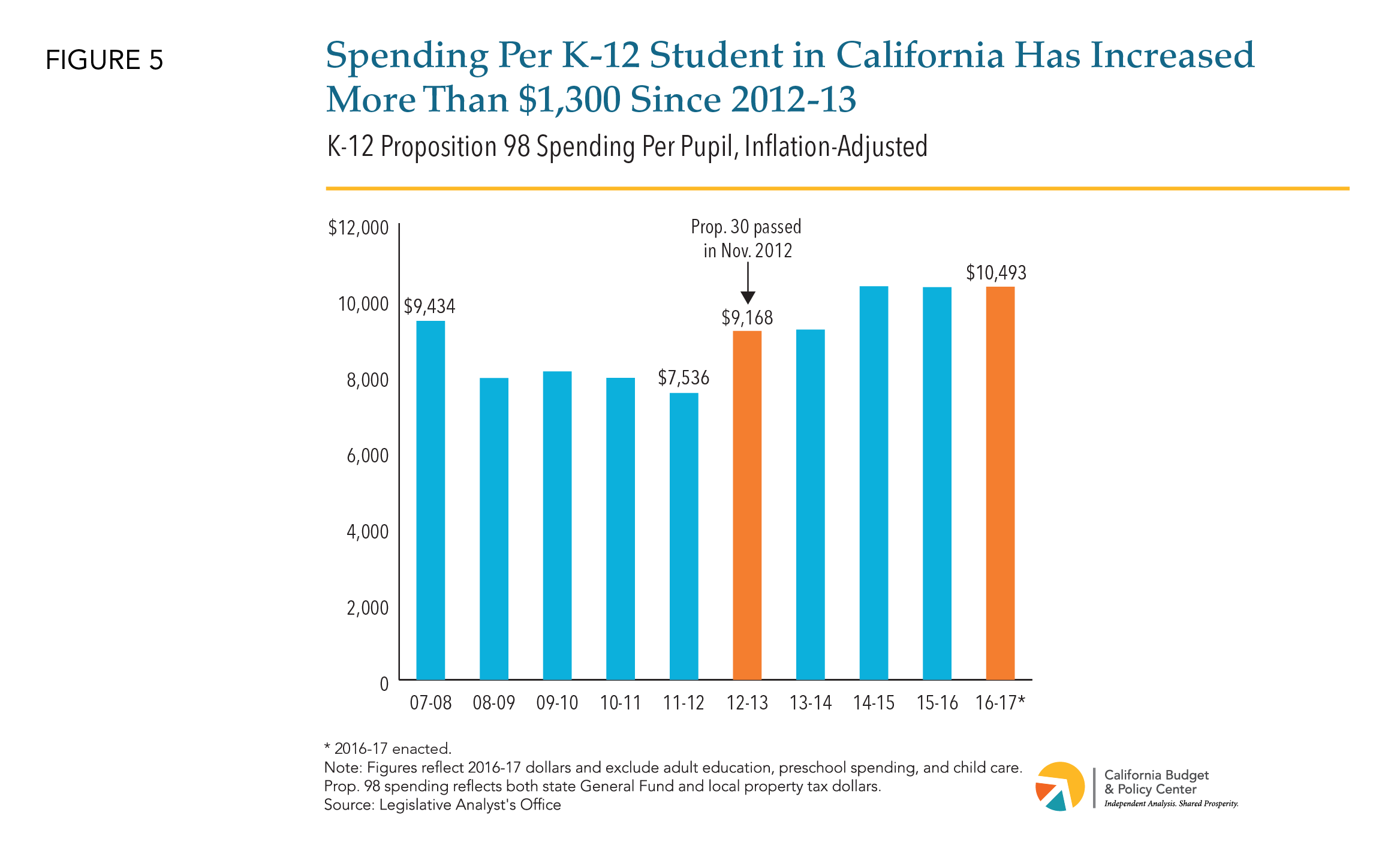
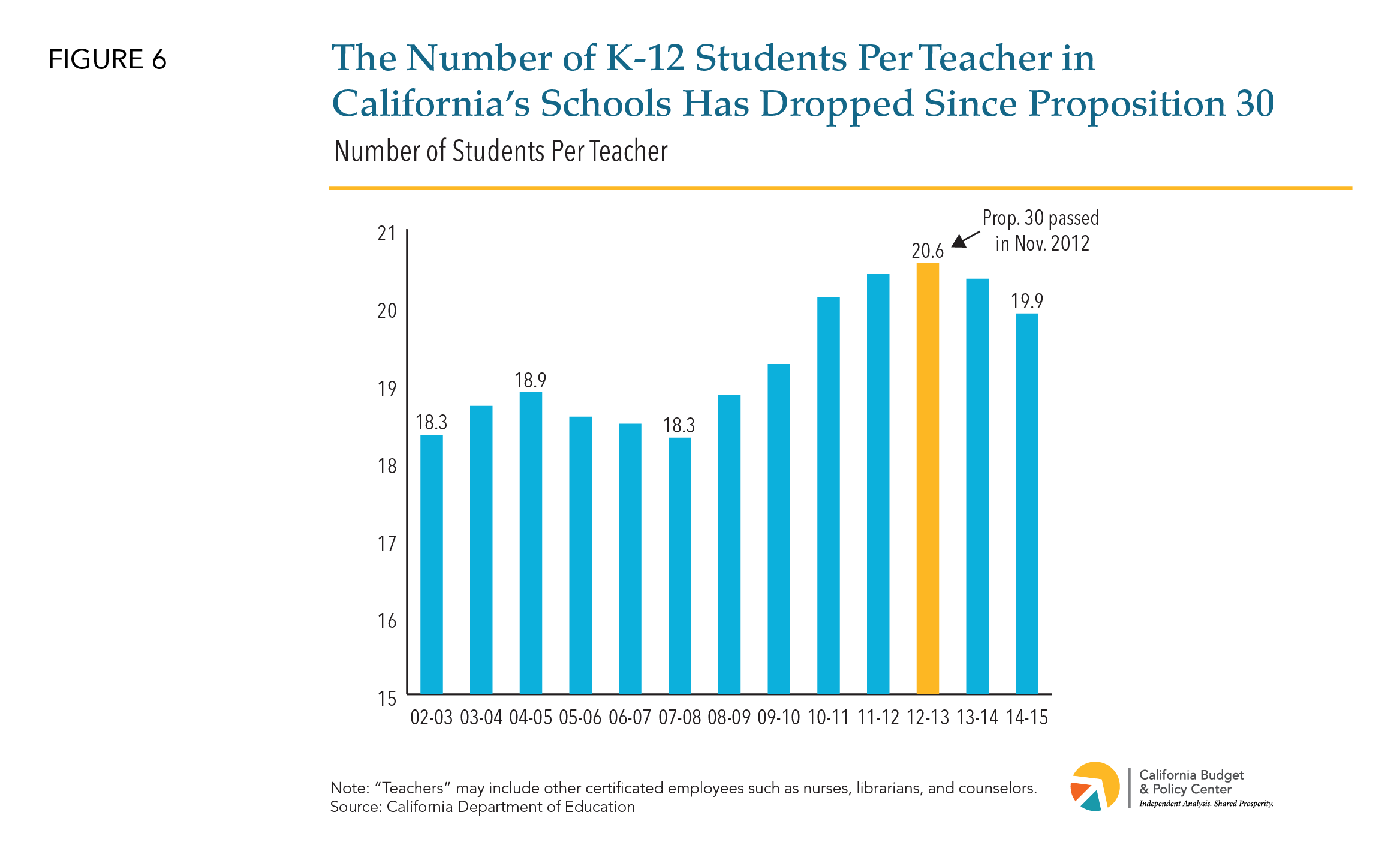
  • Helped the state to reinvest in preschool, K-12 schools, and community colleges. A growing economy and Prop. 30 worked together to boost Prop. 98 K-14 spending from $47.2 billion in 2011-12 to $71.9 billion in 2016-17. Since voters passed Prop. 30, Prop. 98 K-12 spending per student has increased by more than 14 percent — from $9,168 per student in 2012-13 to $10,493 in 2016-17, after adjusting for inflation (Figure 5). This increased support for California’s students followed a significant reduction in funding during and after the Great Recession. Furthermore, the average number of annual instructional days in California schools has increased and the number of K-12 students per teacher in California has decreased since voters approved Prop. 30 (Figure 6).
Prop 30 Fig 5
Prop 30 Fig 6
  • Allowed for some reinvestment in other public services after years of cuts. Prop. 30 provided space in the state budget to begin restoring funding to services outside of K-14 education. It did this by generating additional tax revenues that helped to fund the state’s share of the Prop. 98 guarantee, which in turn freed up General Fund dollars to support other services outside of K-14 education.
  • Boosted rainy day fund deposits and debt repayment. Prop. 2, approved by voters in 2014, requires the state to set aside at least 1.5 percent of General Fund revenues each year to both build up the state budget reserve and pay down budgetary debt. By increasing state revenues, Prop. 30 helped to boost deposits into the state’s rainy day fund and payments that reduce state debts. In 2016-17, for example, the state set aside $2.6 billion for Prop. 2 requirements and made an additional $2 billion deposit into the rainy day fund. These contributions would likely have been smaller in the absence of Prop. 30.

Proposition 30 Revenues Are Significant

Prop. 30 raises a significant amount of revenue. In 2016-17, Prop. 30 is projected to raise $7.7 billion — nearly equal to General Fund spending in the 2016-17 budget for the California State University (CSU), University of California (UC), and college financial aid combined ($7.9 billion) (Figure 7).

Prop 30 Fig 7

Alternatively, for more context on how much $7.7 billion represents, funding for key services and supports for seniors and people with disabilities is about $9.6 billion in the 2016-17 budget. This figure reflects combined General Fund support for the Supplemental Security Income/State Supplementary Payment (SSI/SSP) Program, which helps low-income seniors and people with disabilities to pay for rent, food, and other necessities; the In-Home Supportive Services (IHSS) Program, which helps low-income seniors and people with disabilities safely remain in their own homes rather than having to rely on more costly out-of-home care; and the Department of Developmental Services, which provides services and supports to people with developmental disabilities.

Conclusion

Prop. 30 helped California to begin reinvesting in its people and communities after the cuts made during and following the Great Recession. The looming loss of Prop. 30 revenues means California policymakers and voters must figure out how to fill the gap or face difficult choices about which public services and systems to prioritize and which to reduce or eliminate.

One initiative on the November 2016 ballot, Prop. 55, would maintain Prop. 30’s PIT rate increases beyond their scheduled expiration in 2018. In the forthcoming second part of this Budget Center series of briefs, we will discuss what Prop. 55 would do and what it would mean for the state.

Stay in the know.

Join our email list!