
key takeaway
Federal and state policy choices threaten to strip away full scope Medi-Cal from immigrants with humanitarian status, forcing many to delay or forgo critical health care and putting their ability to survive at risk.
Access to health care is essential for all Californians to be healthy and thrive. Yet federal and state policy choices threaten to strip away health coverage from hundreds of thousands of immigrants in the state.
State policymakers should protect access to comprehensive, full scope Medi-Cal coverage for immigrants with humanitarian status. Without full scope Medi-Cal, many will be forced to delay or forgo critical health care, threatening their ability to survive.
Who Is At Risk of Losing Health Coverage?
Immigrants are an integral part of California’s social fabric, pay billions of dollars in taxes every year, and contribute to its economic success. Over 1 in 4 Californians are immigrants, totaling almost 11 million people who are family members, neighbors, friends, and community members. This includes immigrants with humanitarian status, such as refugees, people granted asylum, and survivors of domestic abuse.
Immigrants with humanitarian status are some of the most vulnerable community members — they have endured and survived hardships of war, trafficking, or violence that often result in complex medical needs. Access to comprehensive health care is critical to ensure that they are able to get the treatment and care they need to survive in a new country as they recover from hardship.
What is the difference between full scope and restricted scope Medi-Cal?
- Full scope Medi-Cal provides free or low-cost health care to over one third of the state’s population. The program serves individuals with modest incomes, including children, seniors, people with disabilities, and pregnant individuals. It covers a wide range of services, including doctor’s appointments, emergency services, physical and occupational therapy, dentist appointments, and behavioral health services. Most Medi-Cal members do not pay copayments or copays, which are fixed out-of-pocket fees people must pay when they receive a health care service.
- Restricted scope Medi-Cal covers only emergency care and pregnancy-related services.
Federal and State Actions Threaten to Take Away Health Care Access
In 2025, Congressional Republicans and President Trump signed into law H.R. 1, the megabill, which enacted the deepest cuts to health care in US history. H.R. 1 is designed to restrict people’s access to health care and this is especially true for immigrants with humanitarian status, who will no longer be eligible for Medicaid and Children’s Health Insurance Program (CHIP) coverage starting in October of this year.
The governor’s 2026-27 budget proposal doubles down on the harm being imposed at the federal level. Instead of continuing decades of precedent of providing immigrants with humanitarian status with comprehensive health care, the governor’s proposal denies full scope Medi-Cal to immigrants set to lose their health insurance coverage because of H.R. 1. The California Department of Health Care Services estimates that this would leave up to 200,000 refugees, asylees, survivors of domestic violence, and other immigrants with just restricted scope Medi-Cal. However, the actual number of people affected may be lower, and the estimate could be revised in the future.
What Happens When Immigrants With Humanitarian Status Lose Full Scope Medi-Cal: Example Scenarios
Denying immigrant Californians full scope Medi-Cal will have harmful impacts on their physical, mental, and emotional health, as well as their overall lives. Those impacts will extend to their children, families, workplaces, and communities, as unmet health care needs do not disappear; they are displaced onto other systems and support networks. Ripple effects will be felt throughout the state’s economy as access to Medi-Cal is essential to building and sustaining a stable workforce and supporting worker productivity.
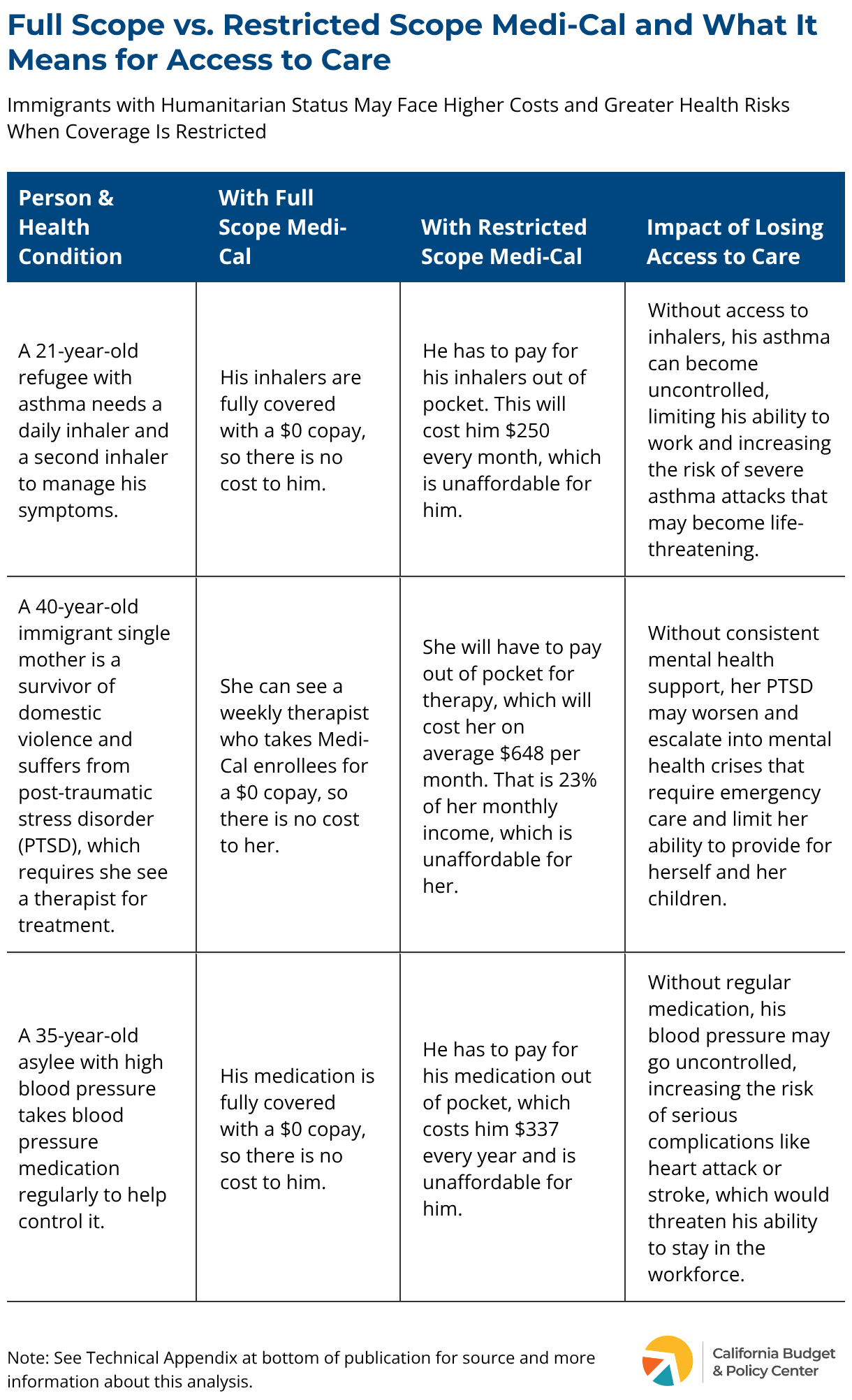
Consider the following scenarios: a 21-year-old refugee with moderate asthma, a 40-year-old single mom who is a survivor of domestic violence and has mental health problems as a result, and a 35-year-old asylee who has high blood pressure. As detailed below, when denied full scope Medi-Cal, people won’t have a choice; they will be unable to afford the care they need to survive.
When Policymakers Make Health Care Cuts, People Pay the Price
These impacts are not just hypothetical. A self-advocate with lived experience illustrated the profound impact that having and losing Medi-Cal coverage had on her family:
“When my mom was diagnosed with stage-four breast cancer, because of Medicaid, she was able to receive chemotherapy treatment and she survived her cancer. Because of that treatment, my mom was able to watch her grandchildren grow, continue working, support our family, and keep living her life.”
When their mother’s cancer returned, her immigration status restricted her care to limited, one-time treatment:
“I was the one sitting in the doctor’s office translating the information to her when the doctor said she had only three more years to live. Unfortunately, my mom passed away in 2016. To this day, I wish with all my heart that my mom could still be here to see everything I have accomplished. If Medi-Cal coverage is reduced for immigrant communities, many families could face devastating and unfair circumstances, just like the one my family experienced.”
This story was shared by the self-advocate, with support from Disability Rights California and illustrates the real-life impact of coverage gaps.
State Leaders Have the Tools to Protect Access to Health Care for All
Denying full scope Medi-Cal to many groups of immigrants could increase costs for some of the state’s most vulnerable community members, cut off critical health care for people, reduce their ability to remain in the workforce and financially support their families, and lead to increased costs for the state long-term. While H.R. 1 stripped Medicaid coverage from these groups of immigrants and the governor’s 2026-27 budget proposal follows the federal government’s lead, state policymakers can choose to chart a different path this year.
State leaders can champion policies that protect every Californian — like providing comprehensive health coverage to immigrants — by pursuing equitable revenue policies that ensure the most profitable corporations and wealthiest Californians are contributing their fair share in state taxes. This includes closing the “Water’s Edge” loophole, which costs the state $3-4 billion in state taxes every year as global corporations shift profits into offshore tax havens. State policymakers have options to mitigate the harm from federal cuts and it is critical that they take action to do so — people’s lives depend on it.