key takeaway
Prop. 40 would institute a one-time 5% tax on the wealth of billionaires to raise tens of billions in temporary revenue to address the loss of federal funding and other threats to health, nutrition, and education services, largely a result of H.R. 1 — the 2025 budget reconciliation law known as the “One Big Beautiful Bill Act.” Prop. 40 could potentially raise tens of billions in revenue in the short-term to preserve critical services, but may also lead to some income tax revenue losses in future years to the extent that billionaires leave the state to avoid the tax.
table of contents
- Background
- Who Would Be Subject to the Tax Under Prop. 40 and How Would It Be Calculated?
- What Is the Difference Between Income and Wealth?
- How Is Wealth Distributed Across California?
- How Much Revenue Will Prop. 40 Raise?
- What Would Prop. 40 Funds Pay For?
- How Would Prop. 40 Revenues Impact Californians?
- What Are the Concerns About Prop. 40?
- How Do Props. 41 and 42 Conflict With Prop. 40 on the November Ballot?
- The Bottom Line on Prop. 40
- Prop. 40 Supporters and Opponents
Background
California, like many other states, is facing a number of challenges to its ability to meet the needs of its residents, including the impending impacts of the deep federal cuts to public health care and nutrition assistance and the rising costs of providing services due to inflation, an aging population with more complex needs, and the state’s ongoing housing crisis. The federal cuts to Medi-Cal alone are expected to cost the state tens of billions of dollars in lost funding and could lead to around 1.3 million Californians losing health care access by 2029-30. Meaningfully addressing these challenges will require California to raise a substantial amount of revenue.
what is h.r. 1?
H.R. 1, the 2025 budget reconciliation law known as the “One Big Beautiful Bill Act,” signed by President Trump on July 4, 2025, will deeply harm Californians by cutting funding for essential health care and food assistance programs — while providing massive tax breaks to the wealthy and corporations. The spending cuts will disproportionately impact families with low incomes, immigrants, and communities of color, pushing more people into poverty and widening racial and economic inequities across the state.
Even prior to these more recent challenges, California was not generating enough revenue to meet the critical needs of all Californians through the state’s communities, evidenced by the state’s poverty rate remaining the highest in the nation. In addition to the human suffering caused by failing to ensure Californians can regularly access health care, put enough food on the table, and meet their other basic needs, such a failure dampens the state economy by preventing some individuals from fully participating in it and puts fiscal pressures on state and local governments as more households are forced to turn to costly emergency services and systems of last resort.
In the near term, Prop. 40 would likely generate tens of billions in revenue to prevent health coverage losses for Californians and stabilize the state’s health care system, and could provide additional support for nutrition assistance — which is also impacted by federal cuts — and for public education. Because the revenues would be one-time, the state would not be able to maintain these services in the future unless federal funding were fully restored or the state adopted alternative sources to raise this magnitude of revenue.
There is a strong rationale for taxing accumulated wealth — or taxing increases in wealth that currently go untaxed — given the profound wealth inequality and the vast unmet needs that exist in the state and across the country, as well as the ability of some ultrawealthy households to pay very little in income taxes as a share of their wealth.
At the same time, taxing wealth at the state level comes with some risks, particularly the potential for wealthy people to leave the state to avoid the tax, which would result in future state income tax losses if they did not return — putting at risk future funding for critical state services — and potential unknown impacts on the state economy. Prop. 40 attempts to counter that risk by applying the tax to billionaires who were California residents at the beginning of 2026, however it is likely this will be challenged in courts and the outcome is not certain.
In November, California voters will need to weigh the potential benefits of Prop. 40 against its potential tradeoffs.
Who Would Be Subject to the Tax Under Prop. 40 and How Would It Be Calculated?
Prop. 40 would institute a one-time tax on the worldwide wealth of billionaires. For the purposes of the measure, a billionaire subject to the tax could be an individual, a married couple, or a trust with net worth — as defined by the measure — above $1 billion. There are around 250 billionaires in California, with over $2 trillion in total wealth.1Forbes tracks the daily wealth of billionaires with its “Real-Time Billionaires” list, and the California-specific data was compiled in connection with Jasper Boll, Emmanuel Saez, and Gabriel Zucman, California Billionaires: Wealth, Taxes, and Wealth Tax Revenue Estimates (NBER Working Paper 35218, May 2026). Note: Saez is an author of Prop. 40.
The tax rate would be 5% for most billionaires, but the rate would be phased in for those with net worth between $1 billion and $1.1 billion.2Specifically, the 5% rate would be reduced by 0.1 percentage point for each $2 million that the household’s net worth falls below $1.1 billion. Taxpayers would have the option of paying the full amount of the tax with their 2026 tax returns or in installments across five years, with an annual deferral charge.
Net worth is typically calculated as the total value of assets held by an individual, couple, or family minus their total debts. However, Prop. 40 allows some exclusions from the net worth calculation, including:
- Real property holdings, which are subject to constitutional tax limitations due to Proposition 13, approved by California voters in 1978;
- Tangible personal property — such as vehicles, jewelry, appliances, or business equipment — held outside of California;3Tangible personal property is excluded from the net worth calculation if it is held outside of California for at least 270 days during 2026 unless it was temporarily relocated for the purpose of tax avoidance. and
- Certain pensions, retirement accounts, and deferred compensation arrangements.
The measure would apply the tax to billionaires who were California residents on January 1, 2026, and the amounts subject to the tax would be determined based on their net worth on December 31, 2026. There will likely be legal challenges to the application of the tax based on residency prior to the enactment of the tax. Federal and state tax measures often have retroactivity provisions to minimize tax avoidance and courts have upheld many of these laws, although it is unknown how courts would ultimately rule on this measure. The measure specifies that in the case the residency and valuation dates are invalidated by courts, these dates shall be construed to be the earliest dates consistent with law.
Prop. 40 establishes procedures for estimating the value of various types of assets that would be included in net worth for the purpose of the tax. Valuation is simple for some assets, such as holdings of publicly traded stock, which have a known market value at any given time. Other assets, such as shares of private businesses, intellectual property such as copyrights or trademarks, and artwork, are more difficult to value without a sale taking place. The measure has detailed valuation rules and formulas for different types of assets, and both the taxpayer and the state’s Franchise Tax Board — which would be responsible for administering the tax — could obtain certified appraisals in the case of valuation disputes. Additionally, the measure contains provisions intended to minimize the ability of taxpayers to avoid or evade their tax responsibility.4Tax avoidance reflects legal avenues to reducing tax liability, such as redirecting wealth holdings to exempted assets or relocating, whereas tax evasion encompasses illegal tactics to avoid taxes, such as hiding assets in tax havens, underreporting of asset values, or falsely claiming residency outside of the tax jurisdiction.
Example: Potential Impact of Prop. 40 on Mark Zuckerberg
Mark Zuckerberg, cofounder of Facebook, has a net worth of around $200 billion. Assuming he has approximately $200 billion in wealth subject to Prop. 40 on December 31, 2026, when net worth is to be determined for the purpose of the measure, he would owe around $10 billion in tax, which he could pay in five annual installments of $2 billion. His remaining wealth of around $190 billion would still be more than the entire economies of dozens of countries, roughly on par with the Gross Domestic Product of Morocco.
For comparison, Zuckerberg’s net worth increased 175% from 2023 to 2024 according to Forbes data, from $64.4 billion to $177 billion.
What Is the Difference Between Income and Wealth?
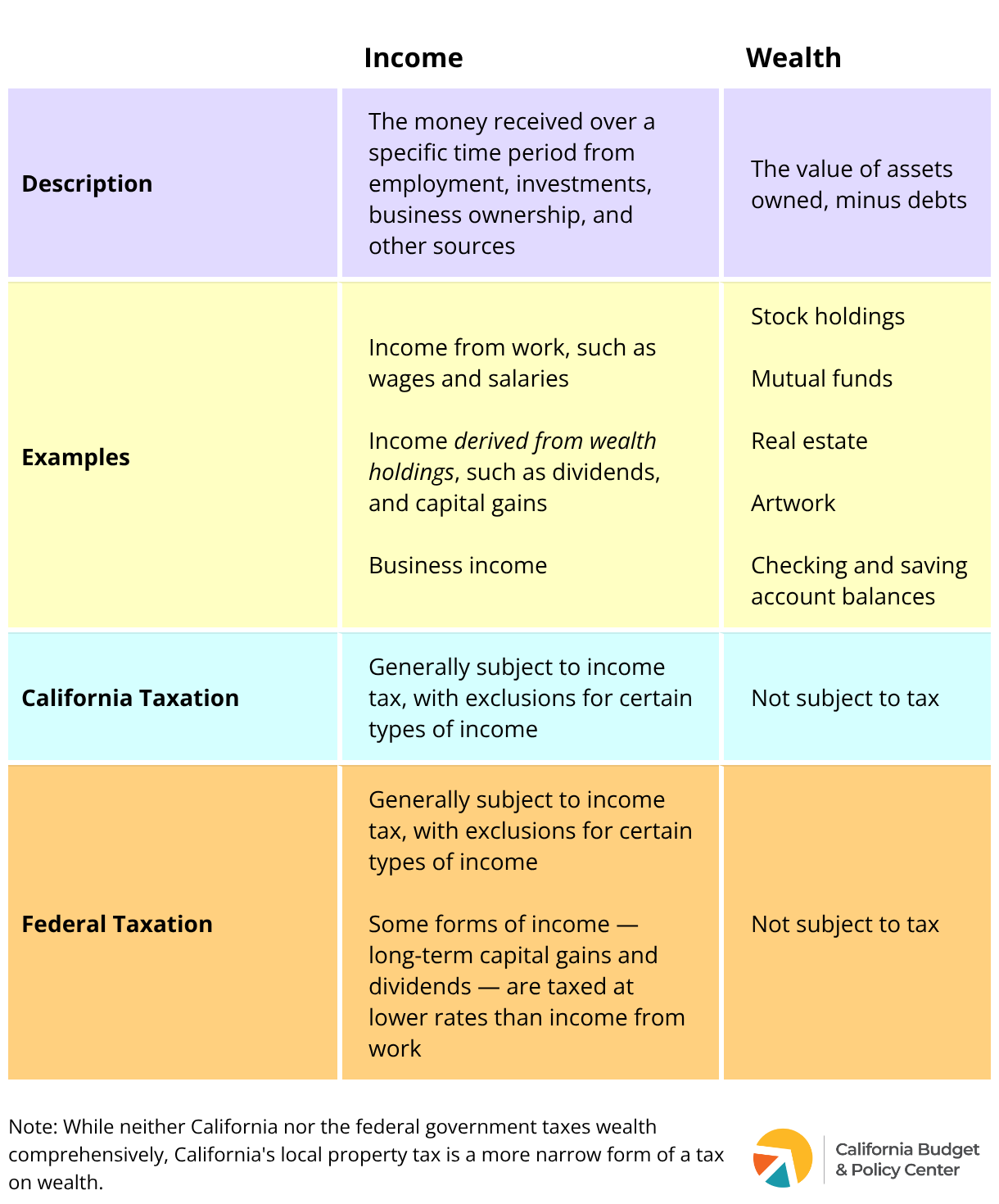
Capital Gains: Increases in Wealth
Households holding assets that have increased in value pay federal and state tax on those gains only when they sell those assets. This is known as a realized capital gain.
However, the value of an asset can grow exponentially and go untaxed as long as it is held onto — an unrealized capital gain. While the household doesn’t directly receive the proceeds from the gain until selling the asset, unrealized capital gains represent an increase in the household’s wealth and financial well-being.
For ultra-wealthy households, unrealized capital gains make up a large share of their total wealth.5For example, the Institute on Taxation and Economic Policy estimated that unrealized capital gains represent nearly 70% of total wealth for billionaires. In some cases, ultra-wealthy households — such as corporate founders — can avoid paying income taxes entirely in some years by not taking a salary, not selling any stocks or other assets, and simply borrowing against their wealth to pay their bills. There is evidence of some of the wealthiest Americans engaging in this behavior, detailed in analyses of leaked tax returns by investigative journalists, although recent research suggests that this is not a widespread phenomenon and that overall, wealthy households do have significant taxable income and their incomes allow them to cover their expenses while continuing to invest and grow their wealth.
Additionally, if someone holds onto assets until their death, their heirs do not have to pay any tax on the gain due to a provision in both federal and state law known as “stepped-up basis,” estimated to cost California around $5 billion each year.6Department of Finance, Tax Expenditure Report: 2025-26, p. 24. Note that the estimated annual cost of the provision is not equivalent to the revenue that could be generated from repealing it, and for this provision the revenue gains from repeal would start in the low hundreds of millions and increase with time, potentially reaching $5 billion annually in the future. Essentially, the combination of unrealized capital gains not being taxed and stepped-up basis results in some large wealth increases never being taxed.
How Is Wealth Distributed Across California?
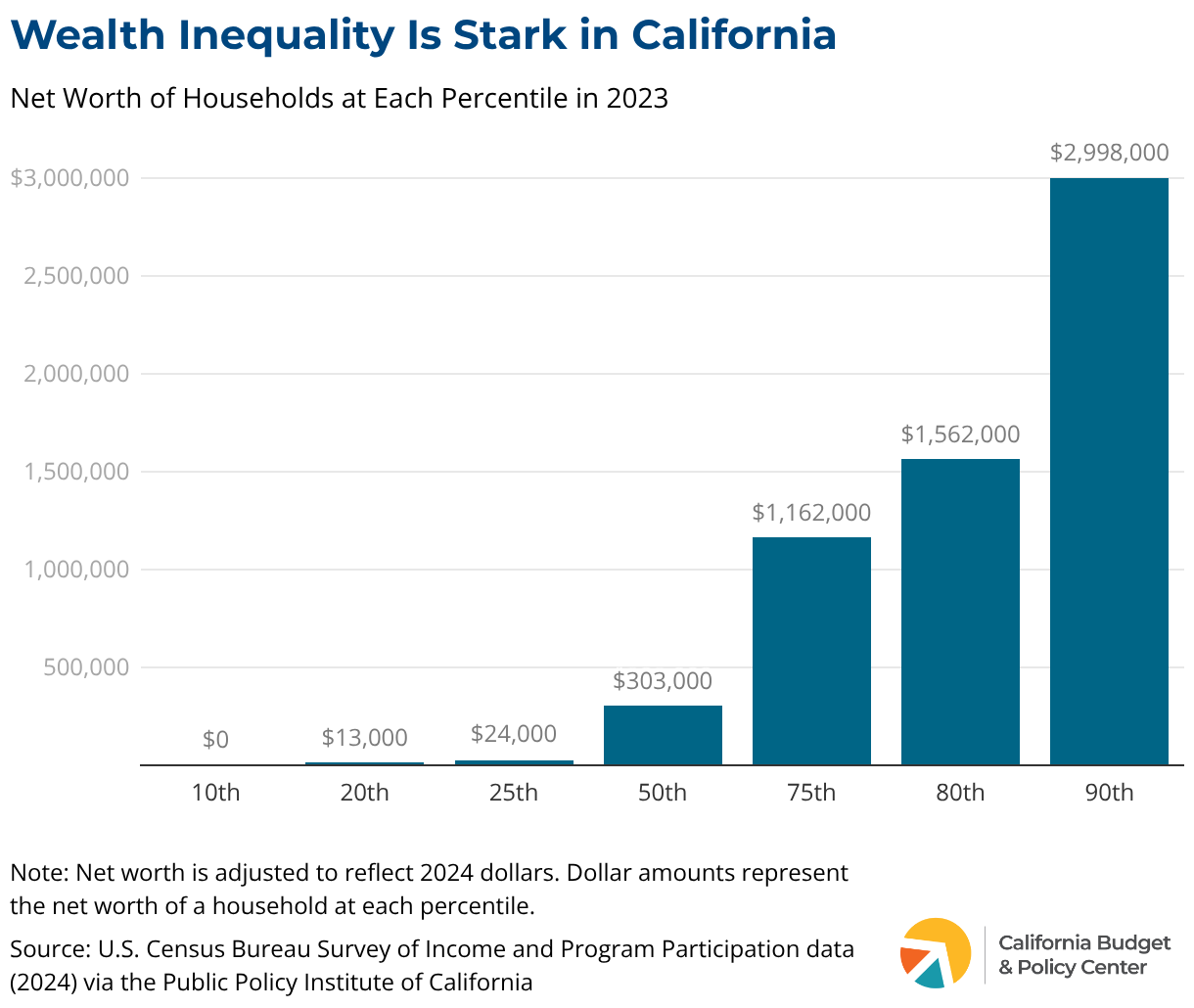
Across the country, the gaps in income and wealth have steadily grown with the top 10% of households seeing substantial growth in both income and wealth accumulation. Similarly, in California, only a tiny fraction of the population benefits from extreme income and wealth.
While both wealth and income inequality are prevalent in the state, wealth is even more unequally distributed than income in California. While the state has more wealth than the rest of the country, the disparities in wealth are also starkest in California.
When focusing on the wealth distribution in the state, the data show an alarming gap between households with high and low wealth. Specifically, the wealthiest 20% of households have a net worth of over $1.5 million, while the bottom 20% of households have a net worth of $13,000 or less. Those who would be subject to the Prop. 40 tax — those with a net worth above $1 billion — have a net worth of over 3,000 times the median household.
Wealth is also unequally distributed across racial and ethnic groups. For example, the median net worth of white households in 2023 was almost ten times the median net worth of Latinx households, reflecting the historical barriers to wealth accumulation these communities have faced. Black, Latinx, and other households of color often have less wealth due to many factors including a lower likelihood of owning stocks, occupational segregation pushing them into lower-payer jobs, and a lack of inherited generational wealth. These factors likely contribute to the large wealth disparities that have persisted throughout history.
How Much Revenue Will Prop. 40 Raise?
There is a high degree of uncertainty in estimating the potential revenue from this measure since it is impossible to accurately predict how billionaires and the courts will respond to the tax. It is likely there will be some avoidance and evasion of the tax, as billionaires may hide or underreport their assets, shift their asset holdings toward those that are exempt from the tax, attempt to sever their ties with California, or engage in other tactics to minimize or eliminate their tax liability.
After attempting to account for these factors, the Legislative Analyst’s Office estimates that the billionaire tax would likely raise “tens of billions” of dollars in the near term. It also suggests there could be some ongoing reductions in state income tax collections in the future — likely less than $1 billion per year — depending on the extent to which billionaires leave the state and no longer pay California tax on their income.
Authors of Prop. 40 estimate that the measure could raise around $100 billion over five years, after assuming that 10% of the potential tax base would be eroded due to avoidance and evasion. They assume a relatively low avoidance and evasion rate due to the one-time nature of the tax and its retroactive residency date as well as the inclusion of provisions in the measure intended to safeguard against the avoidance and evasion strategies seen with wealth taxes implemented in other countries, such as allowing fewer exemptions for certain asset types and applying the tax to trusts as well as individuals.
In contrast, researchers at the conservative-leaning Hoover Institution estimate the initial revenue gain might be closer to $40 billion, a still significant amount.
The large difference between estimates lies mainly in different assumptions about how many billionaires have or will successfully sever their residency ties with California to avoid the tax. The potential for migration and other avoidance efforts related to the measure and their implications are discussed below.
What Would Prop. 40 Funds Pay For?
All the revenue from the Billionaire Tax Act is intended to mitigate the harm from federal and state-level cuts to health care, food assistance, and K-14 public education programs. The measure would create a special fund — the 2026 Billionaire Tax Reserve Fund — to hold the revenue.
Revenues in the fund — after accounting for the costs incurred by the Franchise Tax Board to administer the tax — would be split between two subaccounts, with 90% of revenue going into the Billionaire Tax Health Account and 10% going into the Billionaire Tax Education and Food Assistance Account.
- Dollars in the Billionaire Tax Health Account would support health care funding, which could include but is not limited to:
- Dollars in the Billionaire Tax Education and Food Assistance Account would support funding for K-14 and food assistance programs, which could include but is not limited to:
Because the measure does not contain specific requirements as to how the dollars within each fund must be spent, beyond being used for “health care funding” and “education-related and food assistance expenditures,” policymakers would have fairly broad authority to determine the allocation of funding within those categories. However, the measure specifies that funds may not be used to replace existing state funds for health care, education, or food assistance.
Additionally, each subaccount has a limit for how much can be appropriated in a fiscal year. The health subaccount has an appropriation limit of $22.5 billion per fiscal year, and the education and food assistance account has a limit of $2.5 billion per fiscal year. The entire amount does not have to be allocated each year and funds can be retained if determined necessary.
Prop. 40 specifies that the revenue generated by the billionaire tax would be excluded from three spending requirements in the state Constitution:
- the minimum funding guarantee for TK-14 education (Prop. 98), which generally requires around 40% of General Fund revenues to support schools and community colleges;
- the required deposits into budget reserves and debt repayments, (Prop. 2), which requires at least 1.5% of General Fund revenues be split between budget reserves and repayments of state debts; and
- the state spending cap (Prop. 4, the “Gann Limit”), which restricts the usage of revenues above a certain level, based on spending in 1978-79 adjusted for changes in population and income.
How Would Prop. 40 Revenues Impact Californians?
The majority of the revenues from the Billionaire Tax Act would directly support Californians who are harmed by federal and state cuts to the Medi-Cal and CalFresh programs.
H.R.1 is estimated to result in around 1.3 million Californians losing Medi-Cal coverage by 2029-30 and tens of billions of dollars in lost federal funding every year. These provisions target a wide range of populations including, but not limited to, immigrant Californians and low-income adults without dependents. Policy changes impacting these populations include increasing eligibility checks for Medi-Cal, imposing ineffective work reporting requirements, and limiting retroactive coverage for adults. Federal policy changes, including provisions of H.R. 1 and the expiration of enhanced premium tax credits, could also result in around 400,000 to 500,000 fewer Californians receiving health coverage through Covered California — the state’s health insurance marketplace established through the Affordable Care Act. The revenue from Prop. 40 could help mitigate some of the harms of these federal policies, for instance by replacing some lost federal funding and providing counties with additional resources to administer Medi-Cal and help eligible Californians maintain coverage.
This measure could also allocate funding to counteract the harmful enacted provisions from recent state budget packages that further harm Medi-Cal recipients. In combination with the federal cuts, state policy changes like freezing Medi-Cal enrollment for certain undocumented adults, imposing burdensome monthly premiums, reinstating the Medi-Cal asset limit, and denying full-scope Medi-Cal to certain immigrants could nearly double the uninsured rate to 14.7% by 2030.
A smaller proportion of the revenue could also go towards offsetting H.R.1’s harmful cuts to CalFresh. H.R.1 puts more than 3 million households at risk of losing some or all of their food assistance and could cost California between $2.3 billion and $5.1 billion annually. The provisions include applying time limits to previously exempt populations like veterans, older adults, and former foster youth and eliminating CalFresh for tens of thousands of lawfully present immigrants.
The Prop. 40 revenues could also help sustain and support funding for public education which has been facing federal threats such as funding freezes, grant cancellations, and proposed budget cuts. Public education would receive less support under the measure than if the revenues were allocated to the General Fund — due to the Prop. 98 minimum funding guarantee — but that would also mean less funding available for health care and food assistance. Additionally, because the measure does not require any specific share of funding in the Billionaire Tax Education and Food Assistance Account to go to any of the specified allowable uses, it is possible that all of these funds would be used to support food assistance and none for education — or alternatively, all of the funds could go to education and none to food assistance. Again, policymakers would have significant flexibility in allocating the dollars in this fund to specific programs that align with the intended purposes of the fund.
What Are the Concerns About Prop. 40?
Prop. 40 Would Provide One-Time Revenues to Respond to Ongoing Federal Funding Losses
While the revenue that would be generated by Prop. 40 is mainly intended to address the harms of the federal cuts to health care and food assistance resulting from H.R. 1 and other federal threats, the revenue from this one-time tax would only be available for a few years. If the federal government does not reverse those deep cuts within the next several years, the state will again be presented with the choice of cutting services and letting Californians impacted by federal cuts fall through the cracks or finding new alternative revenue sources to help keep them afloat.
The Revenue from Prop. 40 Would Not Be Available to Support Other Core State Services
Because the revenue would be earmarked, state programs and services that help Californians — beyond health care, food assistance, and education — would not receive any of the one-time revenue under Prop. 40. For example, none of the revenue would be available to support other critical needs such as affordable housing and renter supports, homelessness response, subsidized child care, or other safety net programs. As noted above, because the measure does not specify how the funds in the Education and Food Assistance Account would be allocated, it is possible that the funds could be used only for food assistance or only for education, so there is no guarantee that funding is allocated for both of these purposes.
On one hand, there is a clear need for increased health care funding to respond to the dramatic federal cuts that could strip millions of Californians of their health insurance and put immense strain on health clinics and hospitals, particularly in rural areas. This need supports the rationale for dedicating the vast majority of the revenue to health care programs.
On the other hand, Californians facing barriers to economic security have many critical needs, and the state has long underinvested in meeting those needs. New revenues are essential to protect and expand vital state services — including services beyond what Prop. 40 revenues are allowed to fund. If the revenues from a new tax on wealth went into the state’s General Fund, policymakers would have the flexibility to deliberate and decide how to allocate funding to address the most pressing and changing needs of Californians.
There Are Uncertain Impacts of a State-Level Wealth Tax on the State’s Longer-Term Budget and Economy
Imposing a state tax on wealth for a small share of the population is a novel and untested approach in the United States, and novel approaches always come with some risks. Concerns have often been raised about the potential impacts of such a tax on the behavior of the ultra-wealthy: the extent to which they will engage in tax avoidance behaviors that have consequences for the state. The majority of these concerns focus on the risk that billionaires will leave the state to avoid the tax, which would lead to some loss of future income tax revenues from those households if they do not return later. A related concern often raised is how these potential migration impacts could affect the state’s economy if wealthy business founders/owners choose to relocate some of their business activities or if future company founders opt to start businesses in another state for fear of a future wealth tax.
While a significant outmigration of billionaires could reduce the one-time revenue yield from the billionaire tax, the bigger concern for the state is the potential impact on ongoing state income tax revenues, which could put a strain on the state budget in the future. The outcome here is also uncertain. The income taxes paid by billionaires are very small relative to their overall wealth, and some billionaires can essentially avoid income taxes entirely in some years by not selling any assets or receiving a salary. For example, researchers — including an author of Prop. 40 — examined public data reported to the US Securities and Exchange Commission and found that Google founders Larry Page and Sergey Brin did not sell stock, receive dividends, or take any compensation related to Alphabet (Google’s parent company) in 2019, 2020, or 2023, so they likely would not have paid any income taxes related to their Alphabet holdings or involvement. Additionally, it is not clear that migration and income tax losses would be permanent in response to a one-time tax.
Prop. 40 aims to address the potential concerns about migration by applying the wealth tax to billionaires who were California residents as of January 1, 2026. This retroactive residency date is likely to be challenged in court. However, if it is upheld, any billionaire leaving after this date would not be able to avoid the tax. Additionally, even billionaires who announced moves out of California before this date may not have sufficiently severed their residency with the state for tax purposes, as the state’s Franchise Tax Board considers many factors when verifying residency status beyond simply whether a filer claims to be resident of another state or has purchased property in another state.
There is no way to accurately predict how billionaires would respond to the tax — or the prospect of being subject to the tax, as there is uncertainty about whether the measure will be approved by voters and whether the retroactive residency date will be upheld. There is a body of research on how income and wealth tax policies may impact interstate and international mobility of taxpayers, but the findings vary widely depending on the geographical scope, the type and magnitude of the tax change, the population impacted, the data available, and the research methodology.7For a summary of research focused on the mobility of high-income and high-wealth households in response to income and wealth taxes, see Fernando Rodrigo Sauco, “Millionaires on the Run? Taxation of the Rich and Induced Mobility: A Literature Review,” Hacienda Pública Española/Review of Public Economics 253, no. 2 (June 2025): 91-127.
Research on the impacts of state-level income taxes on interstate migration has generally found very minor effects on the numbers of high-income people in a state relative to the state’s total population of high-income people.8While some studies have found statistically significant effects of taxes on migration rates among high-income tax filers, this translates to small changes in the stock of high-income people in a state. For example, Young et al. (2016) examined federal tax return data for all tax filers with incomes of at least $1 million across all states for 1999 to 2011 and estimated that a one percentage point increase in the income tax rates is associated with an 8% reduction in the net migration flows into the state — people moving in minus people moving out — but this only translates to only a 0.1% change in the population of millionaires. They also find that while millionaires are somewhat more sensitive to tax rates than the general population, they are also less likely to move between states overall. Rauh and Shyu (2024) examined the impacts of California’s income tax increases on high-income households enacted by Prop. 30 (2012) and estimated that the the tax increase was associated with a one-time increase in the outmigration rate of top-tax bracket filers of 0.8% — translating to around 535 out of the nearly 67,000 tax filers in the new top tax bracket. Notably, since the enactment of these top tax rates established by Prop. 30 and extended by Prop. 55 (2016), the numbers of tax filers with incomes placing them in these top tax brackets has grown significantly, along with the incomes of this group and the state revenue collections from the top rates. Additionally, there is evidence that state differences in tax rates have more significant effects on the choice of location among movers than on the probability of moving. For example, a study by Young and Lurie (2025) suggests millionaires in higher-tax states were no more likely to move than the general public in response to a 2017 federal tax change that impacted higher-income taxpayers in higher-tax states, but those that did move were more likely to move to lower-tax states. While taxes may be one factor in where people decide to live, they are one of many, and they may not outweigh other factors such as professional and family considerations, public amenities, weather, and lifestyle preferences. Indeed, survey data from the US Census Bureau show that the vast majority of people moving between states move for job or family reasons. Some research also finds that high-income people are generally less likely to move between states than the general population and are more embedded in their communities due to family, social, and business connections — they are more likely to be married, have children, and own businesses.9Young and Lurie (2025) did find an elevated migration of millionaires out of higher-tax states during the COVID pandemic when in-person social and business networks were disrupted, but this effect had generally subsided by the beginning of 2023.
However, the impact of a wealth tax on California billionaires may be different than the impact of income taxes on high-income households. There are no direct parallels to draw on, as no state has enacted this type of tax, and most wealth taxes in other countries have been imposed at the national level and applied to a broader segment of the population. These other wealth taxes have had substantial differences in design — including the tax rates, exemptions for specific types of assets, and the wealth thresholds above which the tax applies — as well as enforcement capacity. All of these factors can influence the impact of the tax, so the findings on migration and other avoidance behaviors are not uniform across studies of different wealth taxes and may not be directly relevant to the potential impact of a California billionaire tax.
Several countries, mainly in Europe, have levied taxes on their residents’ net worth in the past, but most have since repealed them. Among high-income countries — members of the Organization for Economic Cooperation and Development (OECD) — four currently impose taxes on wealth: Colombia, Norway, Spain, and Switzerland. This is down from 12 OECD countries with wealth taxes in 1990. A few other countries still have fairly comprehensive taxes on wealth — including Argentina (althougFor example, the Spain wealth tax study did find higher responses for people in higher wealth tax brackets, and a study on the impact of state-level estate taxes — essentially a one-time wealth tax levied when someone dies — on the state residence of US billionaires in the Forbes 400 found this population to be quite sensitive to the presence of an estate tax. However, this finding may not extend to a one-time wealth tax given that people are more likely to be mobile after retirement and may factor estate planning into their location decisions — and the estate tax study did find a stronger response for older billionaires.h this tax is being phased down), Bolivia, Uruguay — and additional countries including Belgium and Italy have taxes on the value of narrower categories of assets.10Washington State Department of Revenue, Wealth Tax Study Report (November 2024); PwC, Worldwide Tax Summaries: Net wealth/worth tax rates (Accessed July 6, 2026). Italy levies a 0.2% tax on foreign financial assets, and Belgium levies a 0.15% tax on securities accounts of at least 1 million euros.
Studies on wealth taxes in Spain and Switzerland — the only countries that have subnational wealth tax regimes instead of uniform national wealth taxes — found migration responses related to variation in tax rates between regions. The studies estimate that a one percentage point change in a wealth tax rate was associated with a change of around 8% to 10% in the population impacted by the tax. If billionaires in California had a similar response, a 5% wealth tax could result in substantial outmigration.
However, there are some caveats to extrapolating these findings — beyond the retroactive residency provision in Prop. 40 that may render billionaire outmigration after January 1, 2026 moot for the purpose of the tax. The subdivisions of Spain and Switzerland are much smaller than California, the taxes are ongoing instead of one-time, they are present across most or all regions of the countries, and they apply to a much broader population than billionaires — these factors could pull in opposite directions with regard to the applicability of these findings. It is also likely that some of the reported residence changes are fraudulent. Researchers found some suggestive evidence that false residency changes — such as a taxpayer claiming that a second home is their primary home — are responsible for some of the effect in Spain. The prevalence of this phenomenon could be limited with adequate enforcement.
There is a possibility that wealthier people are more likely to move in response to taxes, which would have implications for a tax specifically targeted to billionaires.
For example, the Spain wealth tax study did find higher responses for people in higher wealth tax brackets, and a study on the impact of state-level estate taxes — essentially a one-time wealth tax levied when someone dies — on the state residence of US billionaires in the Forbes 400 found this population to be quite sensitive to the presence of an estate tax.11Note that this finding is specific to the ultra-wealthy Forbes 400 group, so it cannot be generalized to a broader group of wealthy households. Previous research examining the effect of estate and inheritance taxes on state migration rates of older adults and the locations of wealthy older adults estimated insignificant or modest effects. However, this finding may not extend to a one-time wealth tax given that people are more likely to be mobile after retirement and may factor estate planning into their location decisions — and the estate tax study did find a stronger response for older billionaires.
There is limited research on the overall economic impacts of wealth taxes. One recent study on now-repealed national-level wealth taxes in Sweden and Denmark — looking at the effects of tax reductions and repeals — estimated that a one percentage point increase in top wealth tax rates decreases the number of wealthy taxpayers in the country by about 2%, and because the wealthy are disproportionately business owners, there are some broader economic impacts. However, the estimated effects were very modest, as a large portion of business activity lost due to the outmigration of business owners is absorbed by other remaining businesses. Again, the differences in geography, nature of the tax changes studied (tax cuts versus tax increases), and the fact that these were recurring rather than one-time taxes mean that these findings may not be generalizable to a one-time state-level tax.
Research on one-time or temporary wealth taxes is limited. Several countries in Europe enacted national-level, short-term wealth taxes in the wake of WWI and WWII, and some levied narrow temporary taxes targeting wealth holdings after the Great Recession, with varying levels of success depending on the circumstances. The vast differences in historical context, geographic focus, and design elements — such as tax rates, payment periods, exemption levels, and assets targeted — make these experiences not particularly relevant comparisons for the Prop. 40 proposal, and there has not been empirical research on the migration or general economic impacts of these temporary taxes.
In sum, although existing research can provide some insights into the potential impacts of a one-time California billionaire wealth tax, there are many unknowns given the unique nature of the proposal. Additionally, the findings from research on tax policy impacts may not always identify causality or precisely measure effects due to the many potential confounding factors. Finally, even if effects are precisely measured, the research attempts to isolate the effects of tax policies holding all else equal, when in the real world there are a variety of factors influencing location decisions beyond taxes. Ultimately, California voters will need to decide if the benefits of the revenue generated by a tax on billionaires outweigh the concerns about the uncertain future fiscal and economic effects.
How Do Props. 41 and 42 Conflict With Prop. 40 on the November Ballot?
Two other constitutional amendment measures appearing on the November ballot, Prop. 41 and Prop. 42, contain provisions that conflict with Prop. 40 and could invalidate it in part or in full if they receive more votes. These measures could also make it harder to raise state revenues in the future to invest in the well-being of Californians, which could result in cuts to essential services that Californians want and need.
What is Proposition 41?
Prop. 41 would:
- Require the State Auditor to conduct audits of programs that would receive revenue from new or higher special taxes, which are taxes that are dedicated to specific purposes rather than going into the state’s General Fund. This would include ongoing audits — every four years — of programs receiving funds from special taxes enacted on January 1, 2026 or later by either the Legislature or state voters. Additionally, pre-election audits would be required for programs that would receive revenues from a new or increased special tax that would appear on the statewide ballot. The pre-ballot and ongoing audits would be required to, among other things, contain recommendations on how the programs could reduce its costs by at least 10% annually. Policymakers would be under no obligation to implement these recommendations, but if they did, it could result in cuts to core services rather than simply “inefficient spending.”
- Prohibit revenues raised by special taxes enacted since January 1, 2026 from being excluded from the state’s spending cap, also known as the “Gann Limit.” The measure also specifies that if another measure on the same ballot imposes a tax and exempts its revenues from the Gann Limit, the entirety of the other measure would be invalidated if Prop. 41 receives more votes. However, this would not prevent voters from approving future amendments to the state Constitution that would exclude certain tax revenues from the Gann Limit.
Because Prop. 40 would exclude the revenue generated by the billionaire tax from the Gann Limit, this is in direct conflict with Prop. 41. If both measures are approved, but Prop. 41 receives more votes, Prop. 40 could be invalidated. Alternatively, if both measures pass but Prop. 40 receives more votes, the billionaire tax could be collected, but it is possible that audits would be required of Medi-Cal and other programs receiving Prop. 40 dollars. If both measures pass, there may be litigation regarding the application of conflicting provisions, and the final decision would be made by the courts.
What is Proposition 42?
Prop. 42 would:
- Prohibit the imposition of any new tax on the ownership of financial assets (such as bank accounts, stocks, bonds, or mutual funds), retirement accounts, interests in businesses, intellectual property, and other personal property (such as vehicles, jewelry, artwork, and other movable, physical property). Essentially, this would limit the taxation of assets to real estate assets, which are already subject to constitutional tax limitations under Prop. 13. However, if this measure is passed, it would not prevent voters from amending the state Constitution to tax any of these assets in the future, but state policymakers would not be able to enact taxes on any of the assets covered by Prop. 42 without voter approval.
- Prohibit the imposition of new retroactive taxes, and in particular taxes based on residency prior to the effective date of the new tax — except in cases where the revenues would be used to respond to a governor-declared emergency and the tax does not apply retroactively for more than one year before the effective date. Once again, the approval of Prop. 42 would not impact the ability of voters to approve retroactive taxes in the future, but would impact state policymakers’ ability to do so. As noted above, many tax laws do have limited retroactivity periods — such as dating back to the beginning of a tax year — for several reasons, including preventing tax avoidance.
Both of these provisions conflict with Prop. 40, as the billionaire tax would apply to financial assets, business interests, and other personal property, and it would be retroactively based on the taxpayer’s residence as of January 1, 2026. If both measures pass and Prop. 42 receives more votes, Prop. 40 could be invalidated. If Prop. 40 receives more votes, the wealth tax could be collected, but Prop. 42’s tax restrictions would likely apply to future legislative tax proposals. Again, conflicts may ultimately be decided in courts if both measures pass.
The Bottom Line on Prop. 40
Prop. 40 is a bold proposal that would create a first-in-the-nation tax on wealth, raising significant — temporary — revenue by taxing the fortunes of California’s more than 250 billionaires. Proponents argue this unprecedented measure is needed to help offset deep federal cuts and protect health care, food assistance, and education for all Californians. Because a wealth tax is untested at a state level in the United States, it carries real uncertainty: courts may strike down the measure or portions of it, conflicting measures could lead to years of litigation, and no one can say how the location decisions of billionaires might change and what that would mean for California’s long-term finances.
California voters will need to decide if the benefits of the revenue generated by a tax on billionaires outweigh the concerns about the uncertain future fiscal and economic effects of the billionaires tax.
Prop. 40 Supporters and Opponents
Prop. 40 is sponsored by Service Employees International Union — United Healthcare Workers West (SEIU-UHW), a local union representing health care workers. It has been endorsed by labor organizations including AFSCME California and Teamsters California, organizations including Our Revolution and California Democratic Socialists of America, and policymakers including US Senator Bernie Sanders, US Representative Ro Khanna, and State Superintendent of Public Instruction and former gubernatorial candidate Tony Thurmond.
Prop. 40 is opposed by labor organizations including the California Teachers Association and the State Building and Construction Trades Council of California, organizations including the California Business Roundtable, the California Medical Association, Planned Parenthood Affiliates of California, policymakers including Governor Gavin Newsom and US Representative Kevin Kiley, and gubernatorial candidates Xavier Becerra and Steve Hilton.
The California Budget & Policy Center is a nonpartisan research and analysis nonprofit and does not endorse or oppose ballot measures. This analysis reflects the institutional position of the Budget Center, developed and reviewed by our policy leadership team.
Kayla Kitson and Nishi Nair contributed to this publication.