Skip to content

Over many years, California lawmakers and voters adopted a series of harsh, one-size-fits-all sentencing laws that prioritized punishment over rehabilitation, led to severe overcrowding in state prisons, and disproportionately impacted Black and Latinx Californians – consequences that many families still feel today. California began reconsidering its “tough on crime” approach a little over a decade ago as prison overcrowding reached crisis proportions and the state faced lawsuits filed on behalf of incarcerated adults. Ultimately, a federal court in 2009 ordered California to reduce overcrowding to no more than 137.5% of the prison system’s capacity – an order that remains in effect today.1

State-level reforms – enacted into law through voter approval of ballot propositions as well as through legislative action – have focused on reducing incarceration, promoting more effective pathways to rehabilitation, and addressing the disparate impacts of criminal justice policies on people of color, particularly Black and Latinx communities.2 With these reforms, both the prison population and crime rates are down substantially, showing that California’s efforts to reduce mass incarceration, while far from complete, are working.

1. The Number of Adults Incarcerated by the State Has Declined Substantially

Adults who are incarcerated by the state fall under the jurisdiction of the California Department of Corrections and Rehabilitation (CDCR). Most of these adults – more than 9 in 10 – are held in 34 state-owned prisons. The remaining men and women are housed in other locations throughout California, including in public and private facilities under contract with CDCR. (Until recently, thousands of state prisoners were housed in out-of-state facilities.) The number of adults incarcerated by the state exceeded 173,000 in 2007, when state prisons were crowded to roughly double their capacity. By June 2020 – following years of criminal justice reforms and, more recently, new policies adopted in response to the COVID-19 pandemic – the number of adults incarcerated had dropped by more than one-third, to 113,403.3

2. With Declining Incarceration, California Ended the Use of Out-of-State Prisons and Has the Opportunity to Begin Closing State-Owned Prisons

In 2006, California began transferring incarcerated adults to facilities in other states to help reduce overcrowding in state prisons. State policymakers adopted this approach even though “out-of-state private prisons create significant barriers to rehabilitation and humane conditions of care.”4 The number of Californians moved out of state peaked at more than 10,000 in the early 2010s. However, as incarceration declined, California was able to gradually reduce its reliance on facilities in other states before finally terminating its last out-of-state contract in June 2019. Moreover, due to the ongoing decline in the prison population, California is on track to soon end the use of all in-state contract facilities for men, and the recently enacted 2020-21 budget package envisions closing two state-owned prisons in the coming years.5

3. California’s Incarceration Rate for Adults Has Fallen to a Level Last Seen in the Very Early 1990s

As California implemented criminal justice reforms, the incarceration rate – the number of adults incarcerated by the state for every 100,000 residents – has plummeted. California’s state-level incarceration rate dropped to 314 per 100,000 in June 2019, down by more than one-third (34%) from the recent peak of 476 per 100,000 in June 2006. Moreover, the June 2019 incarceration rate was slightly below the June 1990 level of 315. Still, incarceration of California men and women – disproportionately Black and Latinx Californians – remains high compared to earlier years. For example, in the late 1970s the state incarcerated fewer than 100 people for every 100,000 residents.

4. Meanwhile, California’s Property and Violent Crime Rates Remain at Historic Lows

California’s property crime rate – the number of property crimes per 100,000 residents – was 2,290 per 100,000 in 2019, far below the peak of 6,881 in 1980. The violent crime rate was 434 per 100,000 in 2019, less than half the peak of 1,104 in 1992. This latter rate is up modestly compared to the low of 393 per 100,000 in 2014, partly due to technical factors.6 Nonetheless, California’s violent crime rate resumed its decline after 2017 and is now below the 1969 rate (449 per 100,000).

5. California’s Incarceration Rate and Crime Rates Are All Down Substantially Since the Mid-2000s

Incarceration and crime rates are all down substantially compared to their levels in 2006 – shortly before state policymakers and the voters began enacting reforms to California’s criminal justice system. As noted above, the incarceration rate of adults dropped by more than one-third (34%) from June 2006 – the recent peak – to June 2019. During approximately the same period (2006 to 2019), California’s property crime rate fell by more than one-quarter (28%) and its violent crime rate declined by nearly one-fifth (19%). These statistics contradict the common, yet unsubstantiated, claim that reducing mass incarceration will cause crime rates to spike. In fact, California’s experience and a large body of research highlight the weak link between incarceration and crime.7

Conclusion

California’s experience with criminal justice reform provides further evidence that reducing mass incarceration of men and women can go hand-in-hand with lower crime rates. But California’s work is not done – policymakers can and should do more to decrease incarceration of Californians, particularly given the impact of the COVID-19 pandemic on incarcerated adults, prison staff, families, and surrounding communities. This is especially important for Black and Latinx men and women and their families, who are bearing the greatest burdens of COVID-19 in prisons and the broader community. In recent weeks, the state has been moving in the right direction: The prison population has fallen more rapidly than anticipated due to early releases and other policies advanced by Governor Newsom to slow the spread of the coronavirus behind prison walls. With these steps, the Governor has created an opportunity to plan for the closure of several state-owned prisons over the next several years – assuming, at a minimum, that current criminal justice reforms remain in place and that the state prison population does not again begin to rise. 

Downsizing California’s costly prison infrastructure would allow the state to reduce the size of the corrections footprint on the state budget. This, in turn, would free up resources that could be used for reentry assistance and other services that can help to promote rehabilitation, reduce poverty, and strengthen families and communities – particularly Black and Latinx communities, which have been disproportionately impacted by the pandemic and the deep recession that it triggered as well as by generations of discrimination at the hands of the criminal justice system.

1 The US Supreme Court upheld this order in 2011. California has been in compliance with this order since February 2015. See California Department of Corrections and Rehabilitation, Three-Judge Court Monthly Update (July 2020).

2 For an overview of key state-level reforms, see Scott Graves, State Corrections in the Wake of California’s Criminal Justice Reforms: Much Progress, More Work to Do (California Budget & Policy Center: October 2018), pp. 4-10.

3 CDCR’s in-custody population further declined to 103,169 as of August 12, 2020. This substantial ongoing decline reflects early releases and other policies adopted by the Newsom Administration that are intended to slow the spread of the coronavirus in state prisons. 

4 Randall G. Shelden and Selena Teji, Collateral Consequences of Interstate Transfer of Prisoners (Center on Criminal and Juvenile Justice: July 2012), p. 4.

5 Department of Finance, California State Budget 2020-21 (June 2020), p. 80.

6 Technical factors “related to crime classification and reporting” contributed to the slight yet temporary uptick in violent crime rates after 2014. Mia Bird, et al., The Impact of Proposition 47 on Crime and Recidivism (Public Policy Institute of California: June 2018).

7 Don Stemen, The Prison Paradox: More Incarceration Will Not Make Us Safer (Vera Institute of Justice: July 2017).

Stay in the know.

Join our email list!

Recent acts of police brutality against Black Americans and greater public outcry over the continued abuse and deaths of people across Black communities have amplified calls for defunding, abolishing, and reimagining local policing. This also comes with growing awareness that police violence has disproportionately fatal consequences for Black men and women, and Black transgender women in particular. The calls to action involve significantly transforming the mission and structure of local law enforcement, divesting from local law enforcement in its current forms, and reinvesting the freed-up funding into community-building capacities that would also seek to end racial profiling and police brutality against Black people and other people of color.

What’s more, over-policing of communities of color along with harsh state sentencing laws and local district attorneys’ power to inequitably and unjustly pursue criminal charges continue to drive California’s over-reliance on incarceration as well as the disparate treatment of people of color in the justice system. This leaves Black, Latinx, undocumented Californians, and many other families of color beholden to an overly harsh and unfair criminal justice system that has spanned generations and leaves these families unable to provide or build economic security for their households.

As calls for restructuring and reforming local policing and reducing incarceration intensify, what is at stake in terms of state and local spending in California? Data from the Department of Finance and the State Controller’s Office show that:

  • California’s 482 cities and 58 counties spent more than $20 billion from all revenue sources on city police and county sheriff’s departments as recently as 2017-18 (the most recent statewide data available). Cities spend nearly three times more on police than on housing and community development. Counties spend more of their general revenue on sheriff’s departments than on social services by a substantial margin.
  • The financial outlay goes beyond local law enforcement. The state of California and its cities and counties spend roughly $50 billion annually on local law enforcement, the criminal legal system, and incarceration in state prisons and county jails. In comparison, this spending is about three times what California spends from its General Fund on higher education (community colleges, CSU, and UC) and is roughly equivalent to state General Fund support for K-12 education.

The negative effects of prioritizing spending on systems of punishment and incarceration fall disproportionately on Black Californians and other people of color. For instance, Black and Latinx Californians are incarcerated at much higher rates than other Californians and are overrepresented in state prisons.

Budgets are about values. As state and local leaders craft their budgets for the upcoming fiscal year, they also can address recent and longstanding patterns of police brutality against Black people and other people of color. This should include asking whether spending approximately $50 billion per year on law enforcement, the criminal legal system, and incarceration accurately reflects our state’s values.

Stay in the know.

Join our email list!

Stay in the know.

Join our email list!

In the 1950s and 1960s, policymakers in California and elsewhere began reducing the use of state hospitals to treat people with mental illness – a policy known as “deinstitutionalization.” However, the lack of robust treatment alternatives led to a growing number of people with mental health conditions becoming homeless and, in many cases, incarcerated.1 As a result, prisons and jails have been turned into “America’s…new mental hospitals,” even though it is clear that correctional facilities are highly inappropriate places to house and treat people with mental illness.2

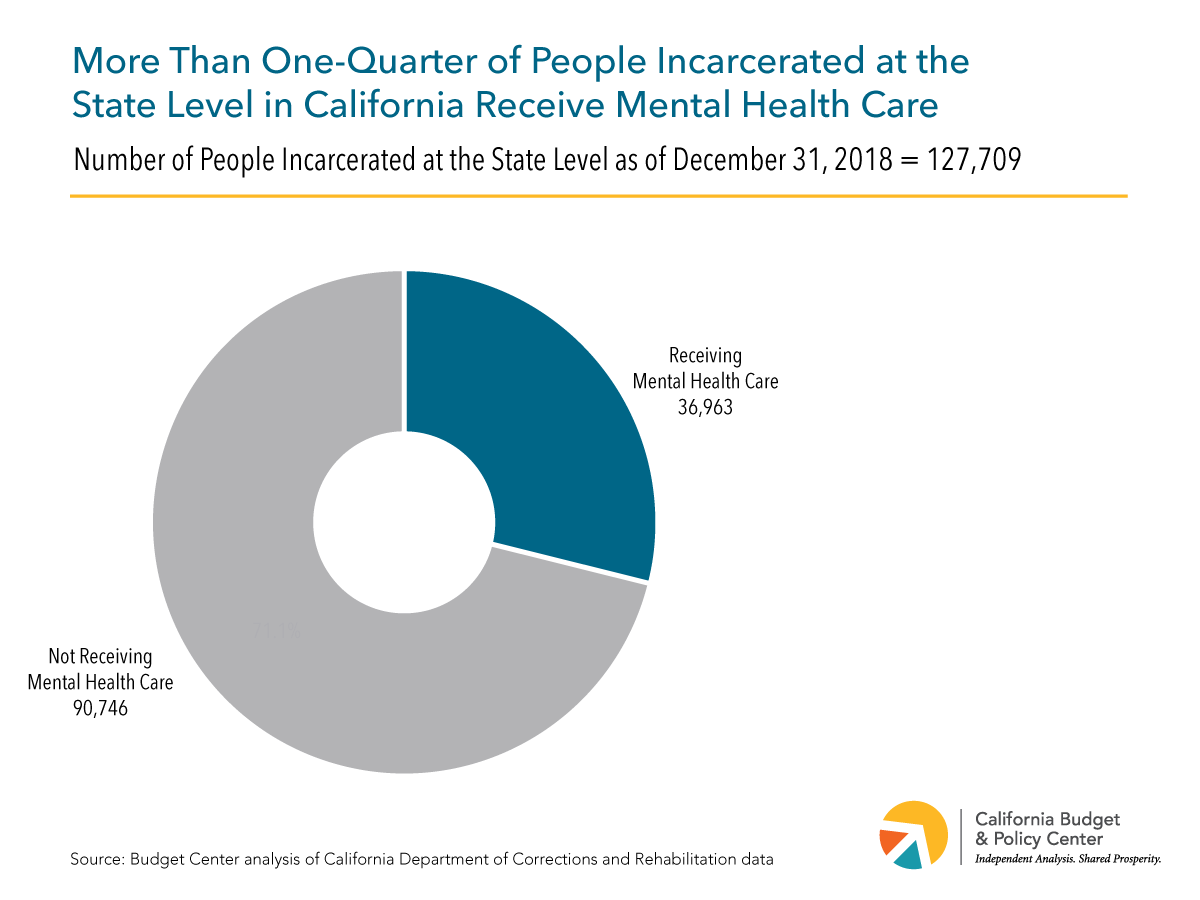
State prisons. Nearly 37,000 people incarcerated at the state level – almost 29% of the total – received mental health treatment in December 2018.3 This was up from about 32,500 – less than 25% of the total – in April 2013. California is projected to spend about $800 million on mental health care in state prisons under Governor Newsom’s proposed 2020-21 state budget. This is more than one-fifth (22%) of total projected health-related spending for state prisoners ($3.6 billion).

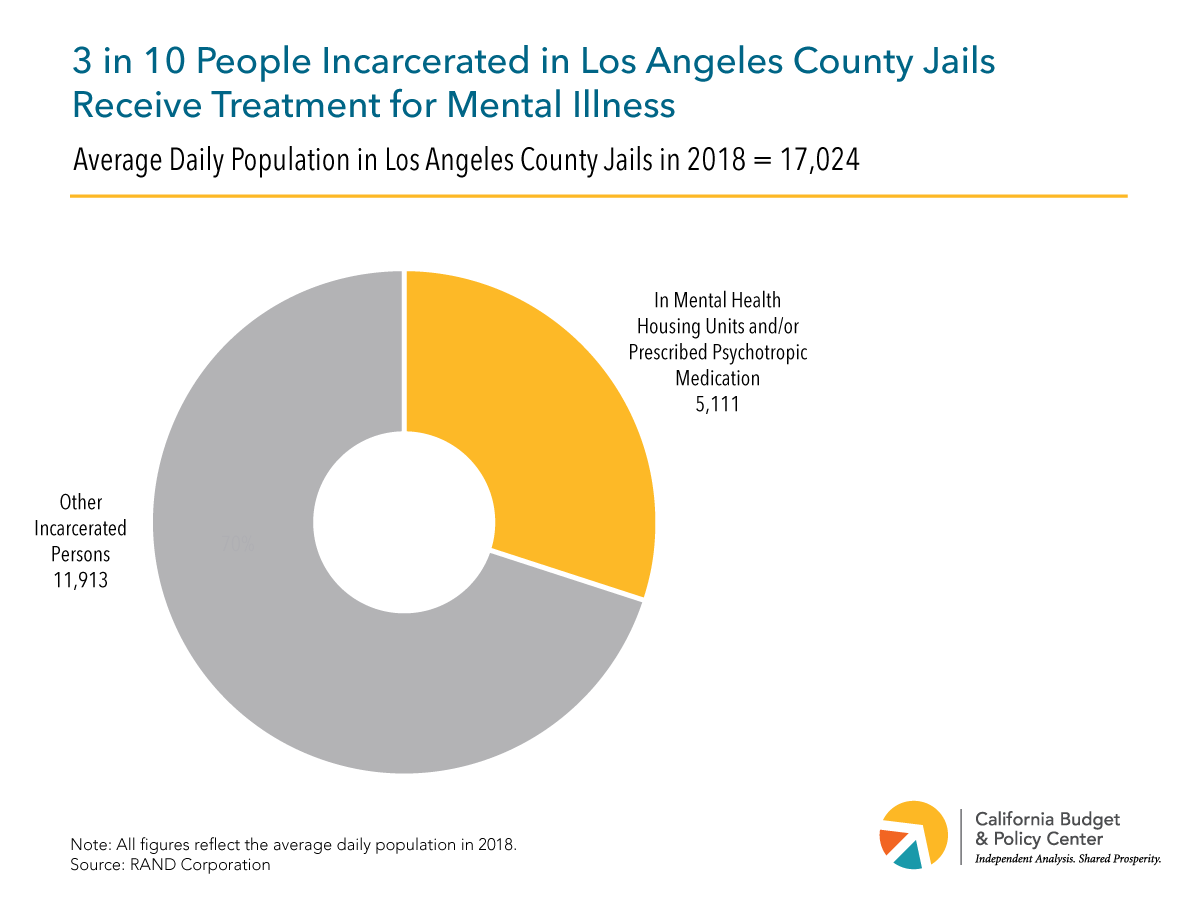
County jails. In September 2019, California’s county jails housed 72,806 people on any given day (average daily population).4 Many of these individuals need mental health care. Point-in-time statewide data for September 30, 2019 show that 20,023 people in jail had an open mental health case and 18,020 were receiving psychotropic medication.5 In Los Angeles County, which has the largest jail population in the state, an average of 30% of people in jail on any given day in 2018 — about 5,100 out of roughly 17,000 — “were in mental health housing units and/or prescribed psychotropic medications.”6

While California must continue to improve health care for people who are incarcerated, reforms are also needed to address the connections between mental health and the criminal justice system so that Californians who need mental health treatment receive the appropriate care in a timely manner rather than being confined in state prisons or county jails.


For more information on the state’s system, check out “Mental Health in California: Understanding Prevalence, System Connections, Service Delivery, and Funding”.

Support for the Budget Center’s work on behavioral health is provided by the California Health Care Foundation.

1 E. Fuller Torrey, et al., The Treatment of Persons With Mental Illness in Prisons and Jails: A State Survey (Treatment Advocacy Center and National Sheriffs’ Association: April 8, 2014), pp. 11-13; Jen Rushforth, “Guilty by Reason of Insanity: Unforeseen Consequences of California’s Deinstitutionalization Policy,” Themis: Research Journal of Justice Studies and Forensic Science 3 (Spring 2015), pp. 30-35;  Matt Vogel, Katherine D. Stephens, and Darby Siebels, “Mental Illness and the Criminal Justice System,” Sociology Compass 8 (June 2014), pp. 629-630.

2 The quotation is from E. Fuller Torrey, et al., More Mentally Ill Persons Are in Jails and Prisons Than Hospitals: A Survey of the States (Treatment Advocacy Center and National Sheriffs’ Association: May 2010), p. 1. See also Stanford Law School Three Strikes Project, When Did Prisons Become Acceptable Mental Healthcare Facilities? (February 2015).

3 Prison population and expenditure data cited in this paragraph are from the California Department of Corrections and Rehabilitation and the Department of Finance, respectively.

4 Statewide jail population data cited in this paragraph are from the Board of State and Community Corrections.

5 State data do not indicate how many people fall into both categories; the overlap may be substantial. Average daily population data are not directly comparable to point-in-time data. Point-in-time data for several counties were unavailable, so the reported numbers of open mental health cases and people receiving psychotropic medications are likely somewhat low.

6 Stephanie Brooks Holliday, et al., Estimating the Size of the Los Angeles County Jail Mental Health Population Appropriate for Release Into Community Services (RAND Corporation: January 2020).

Stay in the know.

Join our email list!

View the PDF version of this Fact Sheet.

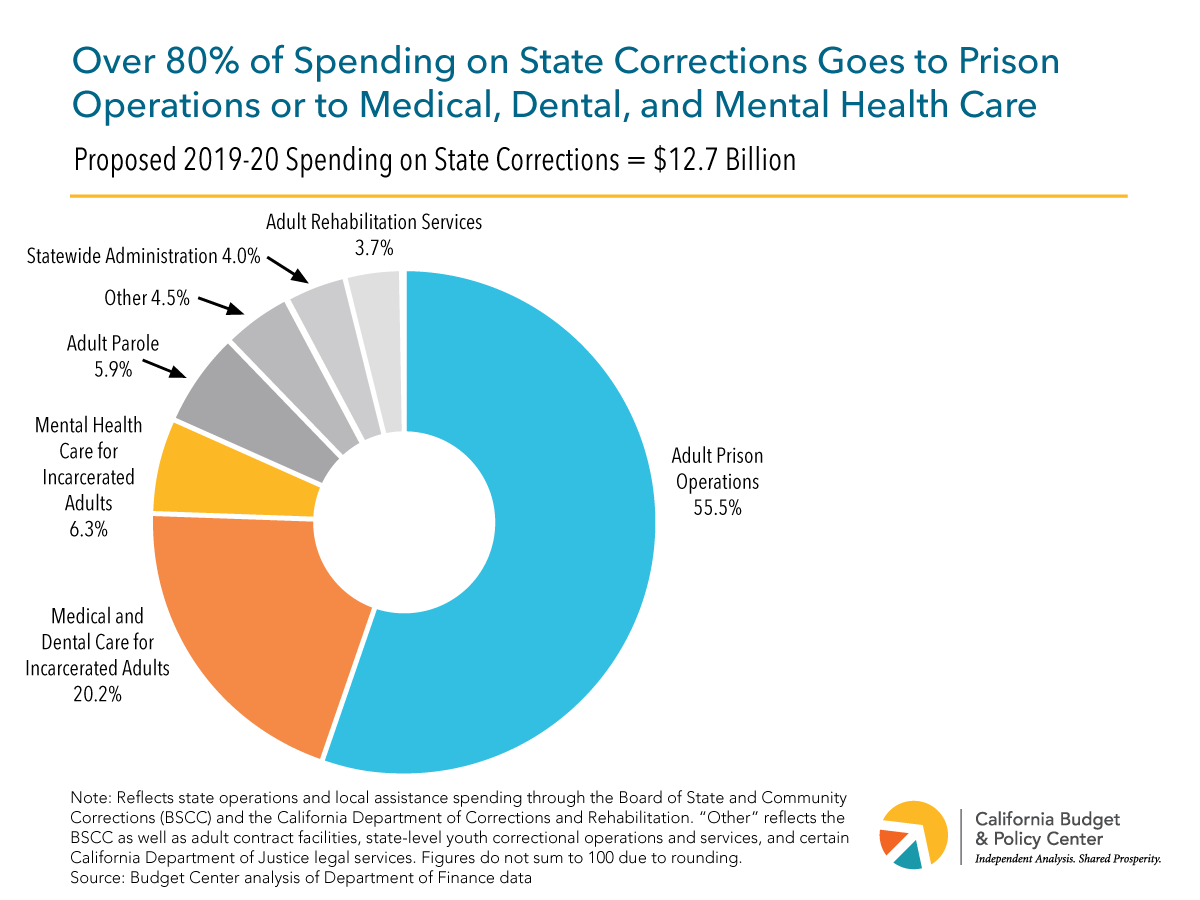
Governor Newsom’s proposed 2019-20 state budget includes $12.7 billion for state corrections.[1] The largest share of this proposed spending (55.5%, or $7.1 billion) goes to state prison operations. This includes the cost of salaries and benefits for correctional officers as well as the cost of various support services for incarcerated adults, such as meals and clothing.

The next-largest set of state corrections expenditures — totaling a proposed $3.4 billion in 2019-20 — pays for health-related services for incarcerated adults. Of this amount, $2.6 billion (20.2% of total spending on state corrections) is for medical and dental care and roughly $800 million (6.3% of the total) is for mental health care.

The fact that California spends hundreds of millions of dollars each year to provide mental health services in state prisons points to the prevalence of mental illness among incarcerated adults. Over 38,500 prisoners received mental health care in December 2017, the most recent month for which data are available.[2]

Moreover, the number of prisoners receiving mental health treatment has grown in recent years. In April 2013, these prisoners totaled 32,535 and accounted for less than 25% of all incarcerated adults.[3] By December 2017, this number had increased by more than 6,000 — to 38,561 — and was equal to nearly 30% of all incarcerated adults.[4] In contrast, during this same period the total number of adults incarcerated by the state declined by about 2,300, from 132,567 to 130,263.

Since the 1990s, a court-appointed officer has overseen mental health care delivery in California’s prisons to ensure that the state provides a constitutionally adequate level of care.[5] According to this officer, conditions are improving for prisoners who experience mental illness. “While more work remains to be done, [state officials] should take well-deserved encouragement from the progress they have made toward compliance.”[6]

Other observers note that prisons “are singularly ill-suited to house the mentally ill.”[7] People experiencing mental illness “are especially sensitive to the unique stresses and traumas of prison life, and their psychiatric conditions often deteriorate as a result.”[8] While California must continue to improve mental health care for incarcerated adults, reforms are also needed to address “the intersection between mental illness and criminal justice” so that Californians who need mental health treatment receive the appropriate care and do not end up in state prisons (or local jails).[9]

Support for this Fact Sheet was provided by the California Health Care Foundation.


[1] As used in this Fact Sheet, spending on “state corrections” reflects all funds budgeted through the California Department of Corrections and Rehabilitation (CDCR) and the Board of State and Community Corrections for state operations and local assistance. Several categories in the chart reflect the cost of both services and administration. In the case of dental and mental health care, the Department of Finance (DOF) combines the costs of administering these services into a single expenditure category. The Budget Center estimated the respective shares of administrative spending for dental care vs. mental health care in state prisons based on a methodology recommended by the DOF.

[2] California Department of Corrections and Rehabilitation, Offender Data Points: Offender Demographics for the 24-Month Period Ending December 2017 (no date), pp. 4 and 15.

[3] Matthew A. Lopes, Jr., Twenty-Sixth Round Monitoring Report of the Special Master on the Defendants’ Compliance With Provisionally Approved Plans, Policies, and Protocols (May 6, 2016), p. 3.

[4] The reasons for this increase are unclear. The CDCR suggests it may reflect the state’s improved ability “to assess, diagnose, and respond to [prisoners’] mental health treatment needs” as the prison population has declined and mental health-related staffing has increased. California Department of Corrections and Rehabilitation, An Update to the Future of California Corrections (January 2016), pp. 12-13.

[5] See Legislative Analyst’s Office, Overview of Inmate Mental Health Programs (March 16, 2017), p. 1, and California Department of Corrections and Rehabilitation, Notice: Decision in Mental Health Care Class Action (Coleman v. Brown) (no date).

[6] Matthew A. Lopes, Jr., Twenty-Sixth Round Monitoring Report of the Special Master on the Defendants’ Compliance With Provisionally Approved Plans, Policies, and Protocols (May 6, 2016), p. 123.

[7] Stanford Law School Three Strikes Project, When Did Prisons Become Acceptable Mental Healthcare Facilities? (February 2015), p. 7.

[8] Stanford Law School Three Strikes Project, When Did Prisons Become Acceptable Mental Healthcare Facilities? (February 2015), pp. 7-8.

[9] Stanford Justice Advocacy Project, The Prevalence and Severity of Mental Illness Among California Prisoners on the Rise (May 2017), p. 8.

Stay in the know.

Join our email list!

The Center on Budget and Policy Priorities’ annual conference, Impact 2018: Building Momentum for Equity and Opportunity, brought together members of the State Priorities Partnership (SPP), a network of independent, nonprofit research and policy organizations representing more than 40 states, and others interested in state policy. Executive Director Chris Hoene presented to the SPP Leadership Institute on the results of a strategic planning retreat he attended earlier this year and also introduced the conference’s closing plenary speaker, Professor Manuel Pastor of USC. Also, Steven Bliss, Director of Strategic Communications, presented “Using Digital Tools to Expand Reach and Engagement” for the workshop “Digital Advocacy 101.”

Stay in the know.

Join our email list!

In recent years, California has enacted various criminal justice reforms that have reduced the number of people incarcerated by the state and placed a greater emphasis on crime prevention and pathways to rehabilitation. Yet, even with this progress, state prisons remain overcrowded, spending on state corrections remains high, and racial and ethnic disparities persist.

This chartbook discusses the recent reforms, the key challenges still facing California’s corrections system, and the prospects for — and potential impacts of — further reforms.

Read the chartbook.

Stay in the know.

Join our email list!

In the fall of 2006, with California’s prisons bulging at the seams and the state facing lawsuits targeting prison overcrowding, Governor Arnold Schwarzenegger used his executive authority to “temporarily house” California prisoners in private correctional facilities in other states. (The Legislature endorsed this policy soon after it was implemented.) Initially, the numbers were small: Within a couple of months of the Governor’s emergency proclamation, just 80 Californians had been sent to prison beyond the state line (to Tennessee). However, California’s use of out-of-state “contract beds” expanded rapidly. By late 2010, more than 10,000 people were serving their California prison sentences outside of the state, including in Mississippi and Oklahoma.

Advocates for incarcerated adults criticized the state’s policy, arguing that “transferring prisoners out of state further disrupts ties to family and community.” Concerns were also raised about the conditions in private, for-profit facilities. Nonetheless, state policymakers saw the use of out-of-state facilities as a key strategy for addressing severe overcrowding in California’s prisons, at least temporarily. The apparent need for this strategy became all the more urgent when, in August 2009, a panel of federal judges ordered the state to cap its prison population at 137.5% of the prison system’s “design capacity.” At the time of this order — which was upheld by the US Supreme Court — California’s prison population far exceeded the cap. More than 150,000 adults were housed in state prisons that were designed to hold a total of about 80,000 people, putting the prison population at 188% of capacity.

Yet, thanks to a series of criminal justice reforms adopted by state policymakers and the voters — reforms that have significantly reduced incarceration — California has been able to comply with the court-ordered prison population cap while simultaneously scaling back its reliance on out-of-state facilities. Since peaking at over 10,000 in the early 2010s, the number of California prisoners housed outside of the state has declined to less than 3,000, as Governor Brown’s administration has pursued a policy (articulated in 2012 and again in 2016) that aims to end the use of contract beds in other states. Now, the culmination of this policy is just around the corner: California is expected to sever its ties with all out-of-state contract facilities by the end of January 2019, ending an era that began a dozen years ago during the depths of California’s prison overcrowding crisis.

Does ending the use of out-of-state facilities mean that California’s work is done when it comes to criminal justice reform? Not by a longshot. Although the state continues to comply with the court-ordered prison population cap, the prison system — which is overseen by the California Department of Corrections and Rehabilitation (CDCR) — remains severely overcrowded. Currently, approximately 115,700 adults are incarcerated in 34 state prisons designed to hold about 85,000 people — 136% of capacity. In addition, more than 11,000 adults are housed in other in-state facilities under the CDCR’s jurisdiction, including public and private contract facilities.

With incarceration projected to continue declining modestly over the next few years, California should soon be able to scale back the use of private in-state contract facilities — a goal explicitly spelled out in the 2018-19 state budget package — and could be in a position to close at least one state prison. However, downsizing California’s costly prison infrastructure in a bigger way would require additional criminal justice reforms, such as addressing the state’s harsh, one-size-fits-all sentencing laws. By more rapidly reducing incarceration, California could plan for the closure of multiple prisons and reinvest the savings in a range of public services and systems that can help to promote rehabilitation, reduce poverty, and strengthen families and communities. Watch for more Budget Center analysis and commentary on this topic in the coming months.

Stay in the know.

Join our email list!