The Department of Community Services and Development (CSD) joined the State Franchise Tax Board, CalEITC4Me, and United Ways of California in hosting a stakeholder event to promote awareness of the California Earned Income Tax Credit (CalEITC). As part of this event, California Budget & Policy Center Senior Policy Analyst Alissa Anderson presented on the importance of the CalEITC and the federal EITC.
There was a problem processing your signup. Please try again. Or contact us
Please check your email to confirm your signup.
Spending on K-12 schools is one of the most critical public investments we make. California voters’ approval of Proposition 30 in November 2012 has provided more dollars for the state to support schools and helped the state gain on the rest of the US in K-12 spending per student.
In 2012-13, the gap between California’s spending per student and the rest of the US had grown to its widest point. The drop in state revenue due to the Great Recession led to dramatic cuts to state spending on K-12 schools. As a result, the gap between California spending per K-12 student and the rest of the US grew to more than $2,600, the widest in at least 45 years, even after adjusting for inflation.
California’s spending per K-12 student has increased relative to the rest of the US since voters passed Prop. 30. California spent an estimated $2,000 more per K-12 student in 2015-16 than in 2012-13, inflation-adjusted. Largely as a result, the gap in spending per student between California and the rest of the US narrowed from more than $2,600 in 2012-13 to roughly $1,000 in 2015-16 (see chart).
Voter approval of Prop. 55 in November would extend a key component of Prop. 30 and provide significant funding for schools. Prop. 30 boosted state revenues by raising the state sales tax rate by one-quarter cent through 2016 and personal income tax rates for very high-income Californians through 2018. Prop. 30 revenues will decline starting in the current fiscal year (2016-17) as the measure’s tax rate increases begin to expire. Voter approval of Prop. 55, which appears on the November 8, 2016 statewide ballot, would extend Prop. 30’s personal income tax rates on the wealthiest Californians, thereby maintaining a revenue source that has helped narrow the gap between California spending per K-12 student and the rest of the US.
There was a problem processing your signup. Please try again. Or contact us
Please check your email to confirm your signup.
Endnotes are available in the PDFversion of this Issue Brief.
Proposition 30, approved by voters in 2012, provided critical revenues to California at a time when the state faced daunting budgetary challenges. Prop. 30’s tax rate increases are scheduled to fully expire at the end of 2018. Prop. 55, which will appear on the November 8, 2016 statewide ballot, would extend for 12 years the Prop. 30 tax rate increases that affect very-high-income Californians. Revenues generated by Prop. 55 – a projected $4 billion to $9 billion per year from 2019 through 2030 – would go to K-12 public schools, community colleges, health care for low-income Californians, the state’s rainy day fund, state debt payments, and other state services. This Issue Brief provides an overview of Prop. 55 and the policy issues it raises. The California Budget & Policy Center neither supports nor opposes Prop. 55.
What Would Proposition 55 Do?
Prop. 55, “The California Children’s Education and Health Care Protection Act of 2016,” would amend the California Constitution to (1) extend Prop. 30’s personal income tax provisions for 12 years beyond their scheduled expiration at the end of 2018 and (2) create a formula to provide additional funding for Medi-Cal from the revenues raised by the measure. Moreover, existing provisions of the state Constitution would require Prop. 55 revenues to go to K-12 public schools, community colleges, the state’s rainy day fund, and state debt payments. Specifically, Prop. 55 would:
Extend Prop. 30’s personal income tax rate increases on very-high-income Californians. Prop. 55 would extend – from 2019 through 2030 – personal income tax rates enacted by Prop. 30. Extending these rates would raise between $4 billion and $9 billion each year (in today’s dollars), according to the Legislative Analyst’s Office (LAO). Prop. 55 would allow Prop. 30’s one-quarter cent increase in the state sales tax rate to expire at the end of 2016 as scheduled.
Create a new constitutional formula to increase funding for Medi-Cal, which provides health care services to Californians with low incomes. For each fiscal year from 2018-19 through 2030-31, the Governor’s Department of Finance would be required to estimate the amount of General Fund revenues – including those raised by Prop. 55 – that are needed to:
Meet the annual Prop. 98 minimum funding guarantee for K-12 schools and community colleges.
Fund the cost of services that were authorized as of January 1, 2016 (excluding Prop. 98 spending), as adjusted for population changes, statutory cost-of-living increases, federal mandates, and other factors.
If any Prop. 55 revenues are estimated to remain after meeting these combined expenditures, Medi-Cal would receive 50 percent of the excess, up to a maximum of $2 billion in any fiscal year. Revenues allocated to Medi-Cal under this provision would have to add to – rather than replace – existing General Fund support for the program.
Increase funding for K-12 schools and community colleges as compared to current law. The vast majority of funding for California’s K-12 schools and community colleges is provided by the Prop. 98 minimum funding guarantee. This guarantee is based on varying economic and fiscal conditions, including state General Fund revenue collections. Other things being equal, General Fund revenues from 2018-19 to 2030-31 would be higher if voters approve Prop. 55 than if the measure is rejected. This is because Prop. 55 would extend income tax rate increases that otherwise would expire at the end of 2018 under the provisions of Prop. 30. By increasing General Fund revenues relative to current law – which assumes the expiration of Prop. 30’s income tax rates – Prop. 55 would boost the amount of Prop. 98 funding that K-12 schools and community colleges would otherwise be expected to receive during the period that Prop. 55 is in effect. About half of the revenue raised by Prop. 55 would go to K-14 education, according to the LAO.
Increase deposits into the state’s rainy day fund and repayments of state budgetary debt as compared to current law. Under Prop. 2, which voters approved in 2014, California is required to set aside a certain share of General Fund revenues each year in order to build the state’s rainy day fund (the Budget Stabilization Account) and pay down state budgetary debts, including unfunded state pension liabilities. Because Prop. 55 would increase General Fund revenues relative to current law – as explained above – the measure would result in larger debt payments and bigger deposits into the rainy day fund compared to what would be expected if voters rejected Prop 55. The LAO estimates that Prop. 55 would provide an additional $60 million to approximately $1.5 billion each year for Prop. 2 purposes.
Allow state policymakers to use any remaining revenues raised by Prop. 55 for any budget priorities. Prop. 55 revenues that remain after (1) meeting the constitutional spending obligations described above and (2) helping to maintain state services that were in place as of January 1, 2016 could be used for any public systems and services funded through the state budget. For example, these excess Prop. 55 revenues could be used to raise the number of subsidized child care slots, increase cash assistance for low-income seniors and people with disabilities, and boost state support for the California State University (CSU) and the University of California (UC).
Whose Taxes Would Proposition 55 Affect?
As noted above, Prop. 55 would extend the personal income tax rate increases of Prop. 30, but not the sales tax rate increase. Prop. 30’s income tax rate increases are aimed specifically at the highest-income households. Of the total dollar increase in income taxes brought about by Prop. 30, the top 1 percent of households pay 98.6 percent, and the next 4 percent of households pay the remaining 1.4 percent, according to the Institute on Taxation and Economic Policy (Figure 1). Prop. 55’s income tax rate increases could be expected to have a similar effect.
Compared to those of Prop. 30, Prop. 55’s overall tax-rate changes would be even more progressive. This is because Prop. 55 would not extend Prop. 30’s quarter-cent sales tax increase, which has a disproportionate impact on households with lower incomes. Prop. 55 follows the equity principle of taxation, by which taxes are levied fairly, based on the ability to pay.
Currently, California’s lowest-income families pay the largest share of their incomes in state and local taxes, while the wealthiest, who substantially benefit from public investments and have the greatest ability to contribute, pay much smaller portions of their incomes in state and local taxes. In other words, California’s tax system as a whole is regressive, even with Prop. 30’s income tax increases on the wealthiest households. If voters reject Prop. 55, California’s tax system would become even more regressive because the highest-income households would contribute a smaller share of their income in taxes than if Prop. 55 were approved (Figure 2).
Furthermore, the top 1 percent of California households – those who would be most affected by Prop. 55’s tax rate increases – have seen their average income more than double since the late 1980s, after adjusting for inflation (Figure 3). In contrast, average inflation-adjusted incomes for the bottom 80 percent of California households have declined.
What Would Rejection of Proposition 55 Mean for Public Services?
If California voters do not approve Prop. 55, the personal income tax rate increases on very-high-income Californians enacted by Prop. 30 will expire at the end of 2018. The expiration of Prop. 30’s income tax rates would:
Result in a significant loss of General Fund revenues. Fiscal year 2018-19 would lose half a year of higher personal income tax revenues and 2019-20 would lose a full year of higher revenues – a projected $4.5 billion in 2018-19 and $7.7 billion in 2019-20, with annual revenue losses continuing thereafter (Figure 4).
Create a multi-billion dollar budget deficit that would likely result in cuts to state services. With the expiration of Prop. 30’s income tax rates, the loss of billions of dollars in General Fund revenues would lead to annual multi-billion dollar state budget deficits. Under such a scenario, state policymakers would likely need to reduce spending for critical services in order to help to help balance the budget.
Reduce the Prop. 98 funding guarantee for schools and community colleges. Changes in annual General Fund revenues tend to affect the Prop. 98 guarantee. If Prop. 30’s income tax rates are allowed to expire, the projected decline in annual General Fund revenue growth would reduce Prop. 98 funding for K-14 education compared to the funding that would be required if Prop. 30’s tax rates were extended. Specifically, the Prop. 98 funding level could fall by roughly $2 billion in 2018-19 and by roughly $4 billion in 2019-20 if voters reject Prop. 55.
Restrict the state’s ability to boost investments in a broad range of critical services and systems. These include:
The state’s child care and development system, which continues to provide tens of thousands fewer subsidized “slots” than in 2007-08, the year the Great Recession began.
The state’s higher education system – the CSU and UC – for which direct state General Fund support per student is down substantially since the early 2000s, after adjusting for inflation.
The CalWORKs welfare-to-work program, which provides a level of support that leaves families, including 1 million children, unable to afford even low-cost housing.
SSI/SSP cash assistance for seniors and people with disabilities, which leaves individuals living below the poverty line and struggling to afford housing, food, and other necessities.
Result in smaller deposits into the state’s rainy day fund and lower debt payments, leaving the state less prepared for the next economic downturn. Building up reserves and paying down budgetary debt gives state policymakers additional options – beyond spending cuts – for balancing the budget and maintaining services during an economic downturn. However, the expiration of Prop. 30’s income tax rates would reduce the amount of revenues that are available for deposit into the Budget Stabilization Account and to pay down budgetary debt. As a result, critical services would likely face larger cuts if a recession significantly reduced state revenues.
In summary, allowing Prop. 30’s income tax rate increases on very-high-income Californians to expire would eliminate billions of dollars from California’s revenue system. This would leave the state with less funding to invest in schools, community colleges, and other vital public services and systems as well as reduce the state’s ability to pay down debts and save for a rainy day.
Policy Issues Raised by Proposition 55
Prop. 55 raises key policy issues, including whether to add a new funding formula for Medi-Cal to the state Constitution and whether to use temporary revenues to support ongoing services.
Adding a New Funding Formula for Medi-Cal to the State Constitution Reflects “Ballot-Box Budgeting”
By creating a new constitutional spending requirement for Medi-Cal, Prop. 55 is an example of what is commonly called “ballot-box budgeting.” On the one hand, critics of ballot-box budgeting argue that the initiative process limits voters to an up-or-down choice in isolation from other potential uses of funds. They argue that earmarking the proceeds from a certain revenue source constrains the ability of the Governor and lawmakers to use the same source for other spending priorities, to make programmatic changes, or to modify spending in response to economic, budget, and demographic shifts.
On the other hand, proponents of initiative-based spending argue that the two-thirds vote requirement for legislative approval of tax increases makes it difficult, if not impossible, to raise revenues through the legislative process to support public services and systems. As a result, they maintain that it is appropriate to offer voters the ability to raise taxes to fund specific state budget priorities.
Proposition 55 Provides Temporary Funds for Ongoing Spending
Prop. 55 extends Prop. 30’s personal income tax rate increases through 2030, but does not make those higher rates permanent. In other words, the revenues raised by Prop. 55 would eventually disappear. Given the temporary nature of these revenues, relying on them to fund permanent, ongoing services – such as K-14 education and Medi-Cal – would mean that state policymakers (and possibly the voters) would again face the question of whether to extend these tax rates, make them permanent, or find a different source of funding. If such efforts failed, state budget shortfalls would likely emerge, meaning that state policymakers would face the prospect of reducing spending on vital public services and systems.
What Do Proponents Argue?
Proponents of Prop. 55, including the California State PTA, the California Teachers Association, and State Superintendent of Public Instruction Tom Torlakson, argue that the measure will prevent “billions in budget cuts without raising taxes by ensuring the wealthiest Californians continue to pay their share.” They state that money from the measure “goes to local schools” with strict accountability requirements that “ensure funds designated for education go to classrooms,” and further that the measure “expands health care access for children.”
What Do Opponents Argue?
Opponents of Prop. 55, including the Howard Jarvis Taxpayers Association, the National Federation of Independent Business/California, and retired Superior Court Judge Quentin L. Kopp, argue that voters supported Prop. 30’s tax rate increases only “because we were promised they’d be temporary.” They assert that funding for schools and other requirements is adequate, and state that “we can’t trust the politicians and special interests.”
Conclusion
Prop. 55 would extend – from 2019 to 2030 – the personal income tax rate increases on very-high-income Californians that voters approved by passing Prop. 30 in 2012. Prop. 55 would not extend Prop. 30’s quarter-cent increase in the state sales tax rate, which would be allowed to expire at the end of 2016 as scheduled. Prop. 55 is projected to generate between $4 billion and $9 billion per year, a range that brackets the roughly $7 billion to $8 billion per year that Prop. 30 has raised to date. Prop. 55’s revenues would be used to meet various constitutional spending obligations, such as for K-14 education and for Medi-Cal, as well as to help maintain services that were in place as of January 1, 2016. After meeting these spending requirements, any Prop. 55 revenues that remained could be used for any budget priorities, including boosting working families’ access to subsidized child care, making higher education more affordable, and improving safety-net services for low-income families with children.
With Prop. 55, voters have a choice to maintain a level of funding that has allowed California to begin reinvesting in its schools and other public services after years of disinvestment during and following the Great Recession. Rejecting Prop. 55, and thus allowing Prop. 30’s income tax rate increases to expire at the end of 2018, would result in reduced state revenues, less funding for schools and community colleges, smaller deposits to the state’s rainy day fund, less repayment of budgetary debt, and – quite possibly – cuts to vital public services and systems. Moreover, California’s state and local tax system would become even more regressive because the wealthiest households – primarily the top 1 percent – would receive a substantial tax cut and thereby contribute less toward strengthening services that can promote economic security and opportunity for all Californians.
There was a problem processing your signup. Please try again. Or contact us
Please check your email to confirm your signup.
Endnotes are available in the PDFversion of this Issue Brief.
Proposition 30, approved by voters in 2012, provided critical revenues to California at a time when the state faced daunting fiscal challenges. These revenues increased school funding and allowed for reinvestment in other public services after years of cuts. Prop. 30’s tax rate increases are scheduled to expire over the next several years. Although the state is in a much stronger fiscal situation now than it was in 2012, the phasing out of Prop. 30’s revenue boost would mean fewer resources available in the coming years to fund California’s various priorities.
This Issue Brief is the first of a two-part series in which we discuss what Prop. 30 has meant for California, and what extending a key component of it, as proposed by Prop. 55 on the November 2016 ballot, would mean for the state.
What Did Proposition 30 Do?
Prop. 30 raised the state sales tax rate by one-quarter cent through 2016 and added three new personal income tax (PIT) rates for very-high-income Californians through 2018:
A 10.3 percent tax bracket for single filers’ taxable income between $250,001 and $300,000 and joint filers’ taxable income between $500,001 and $600,000;
An 11.3 percent tax bracket for single filers’ taxable income between $300,001 and $500,000 and joint filers’ taxable income between $600,001 and $1 million; and
A 12.3 percent tax bracket for single filers’ taxable income above $500,000 and joint filers’ taxable income above $1 million.
The PIT and sales tax rate changes enacted by Prop. 30 have increased state revenues by $7 billion to $8 billion annually, with somewhat smaller gains projected for later years due to the expirations of the sales tax rate increase in 2016 and of the PIT rate increases in 2018.
Whose Taxes Does Proposition 30 Affect?
Everyone Pays the Sales Tax Rate Increase
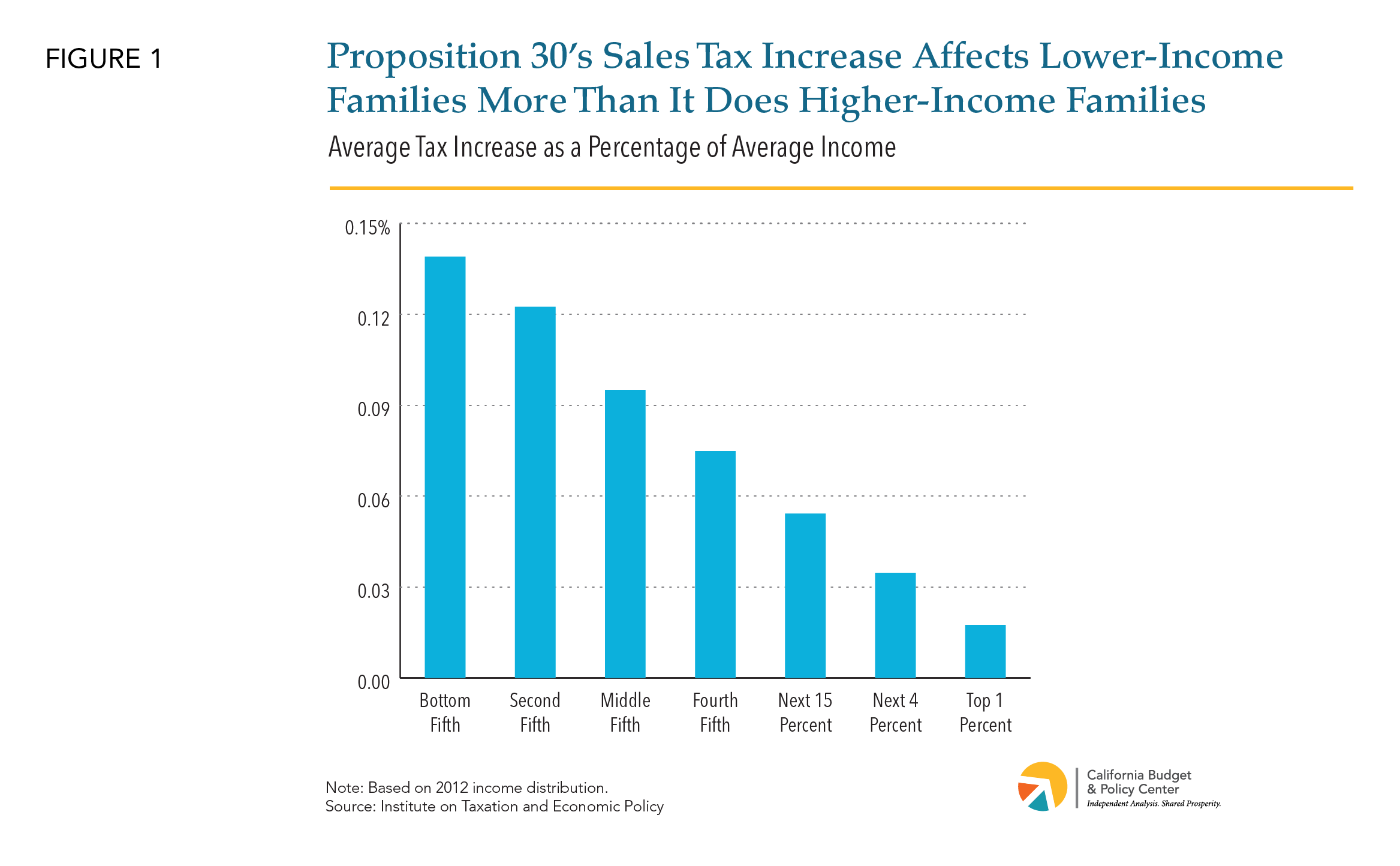
Prop. 30’s quarter-cent sales tax rate increase affects all consumers. However, as a share of income, this increase has a larger impact on lower-income households than it does on higher-income households (Figure 1). This makes the tax “regressive,” as opposed to a “progressive” tax, which does the opposite — ask more of higher-income households than of lower-income households.
The Income Tax Rate Increases Affect the Wealthiest 1.5 Percent of Households
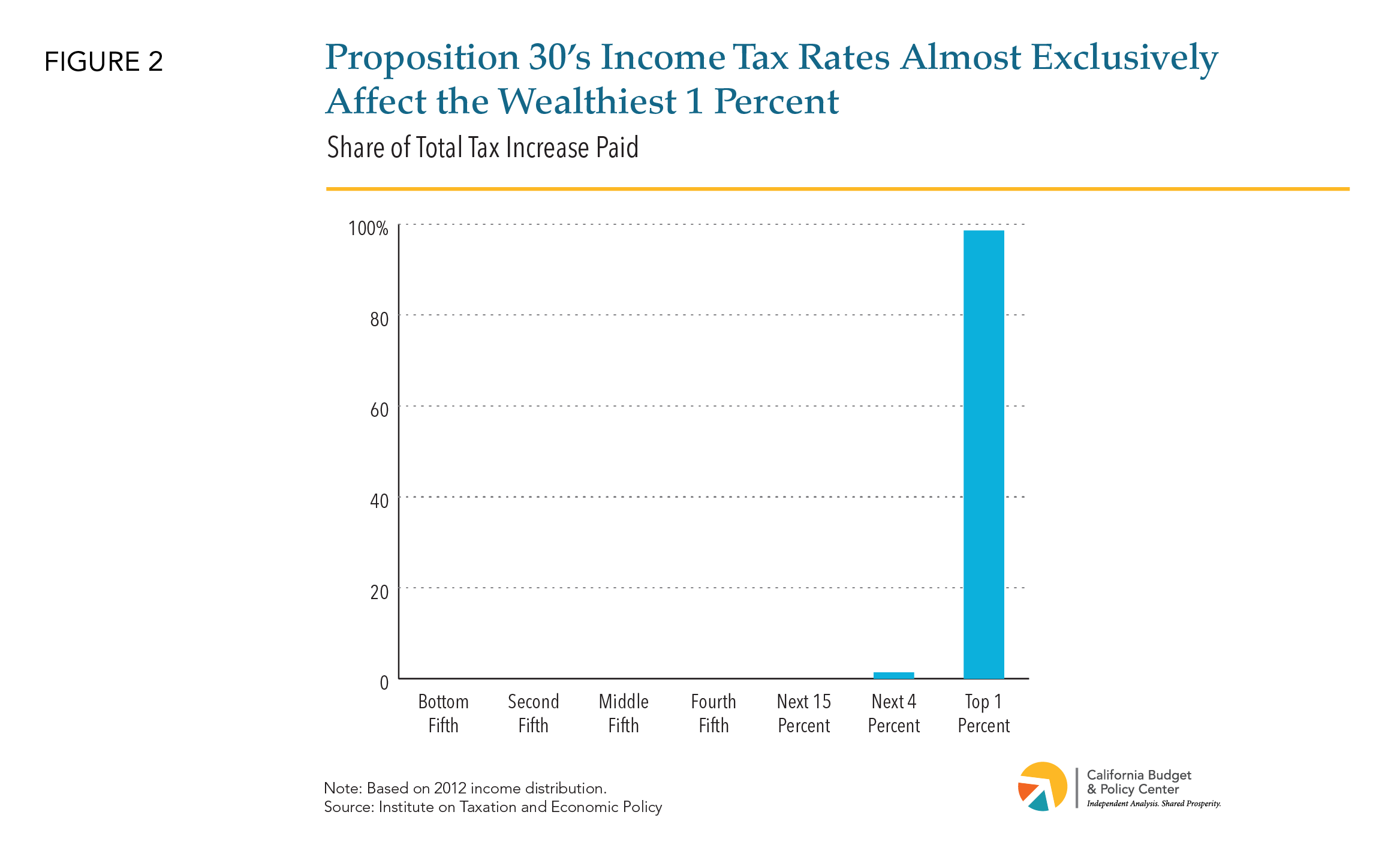
Prop. 30’s PIT rate increases are aimed at the highest-income households. Prop. 30’s PIT rates affect “roughly the 1.5 percent of taxpayers with the highest incomes,” according to the Legislative Analyst’s Office. Of the total annual dollar increase in income tax revenues raised by Prop. 30, the top 1 percent of households pay 98.6 percent, with the remainder paid by households in the next 4 percent, according to the Institute on Taxation and Economic Policy (ITEP) (Figure 2). Prop. 30’s PIT rate increases are very progressive.
Proposition 30 Overall Has a Progressive Effect
The revenues from Prop. 30’s higher PIT rates ($6.7 billion in 2015-16) are more than four times the revenues raised by the sales tax rate increase ($1.5 billion in 2015-16), according to the Department of Finance. This means that even though the sales tax component is regressive, Prop. 30 overall has a progressive effect on California’s tax system. Of the total revenue increase due to Prop. 30, the top 1 percent of families pay 77.2 percent, according to ITEP (Figure 3).
Asking the wealthiest Californians to contribute more follows the “equity” principle of taxation: that taxes should be levied fairly and based on ability to pay. Furthermore, the wealthiest Californians were the only ones to see growth in their average incomes over roughly the last quarter-century. The bottom 80 percent of Californians actually saw their average incomes decline between 1987 and 2014, after adjusting for inflation (Figure 4).
Proposition 30 Played a Critical Role in Stabilizing Public Investment Through California’s State Budget
Prop. 30 has had several notable budgetary impacts. It staved off substantial budget cuts in the 2012-13 fiscal year, as an additional $6 billion would have been cut from state support for programs in that year alone, had voters rejected the measure. Moreover, Prop. 30 has:
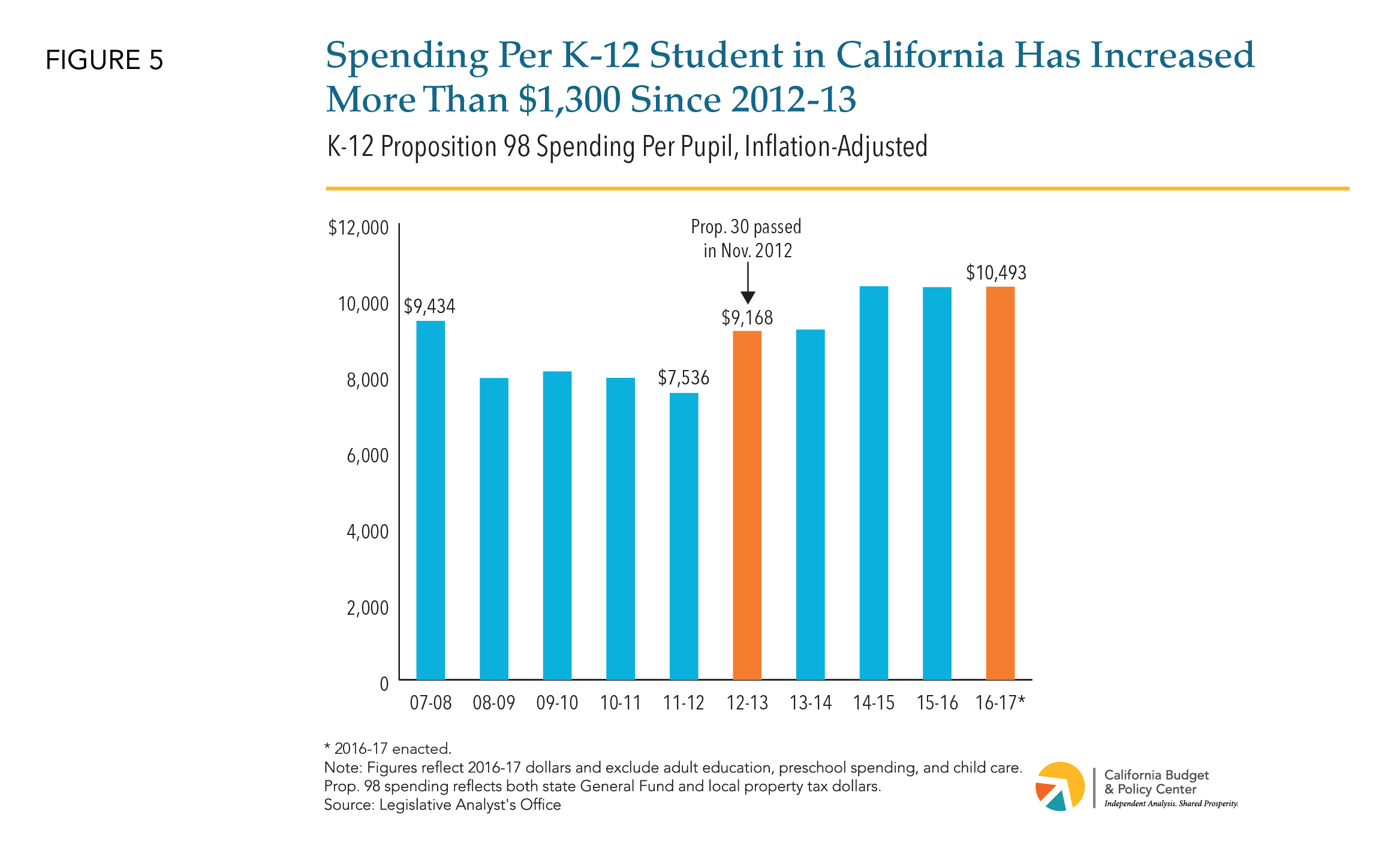
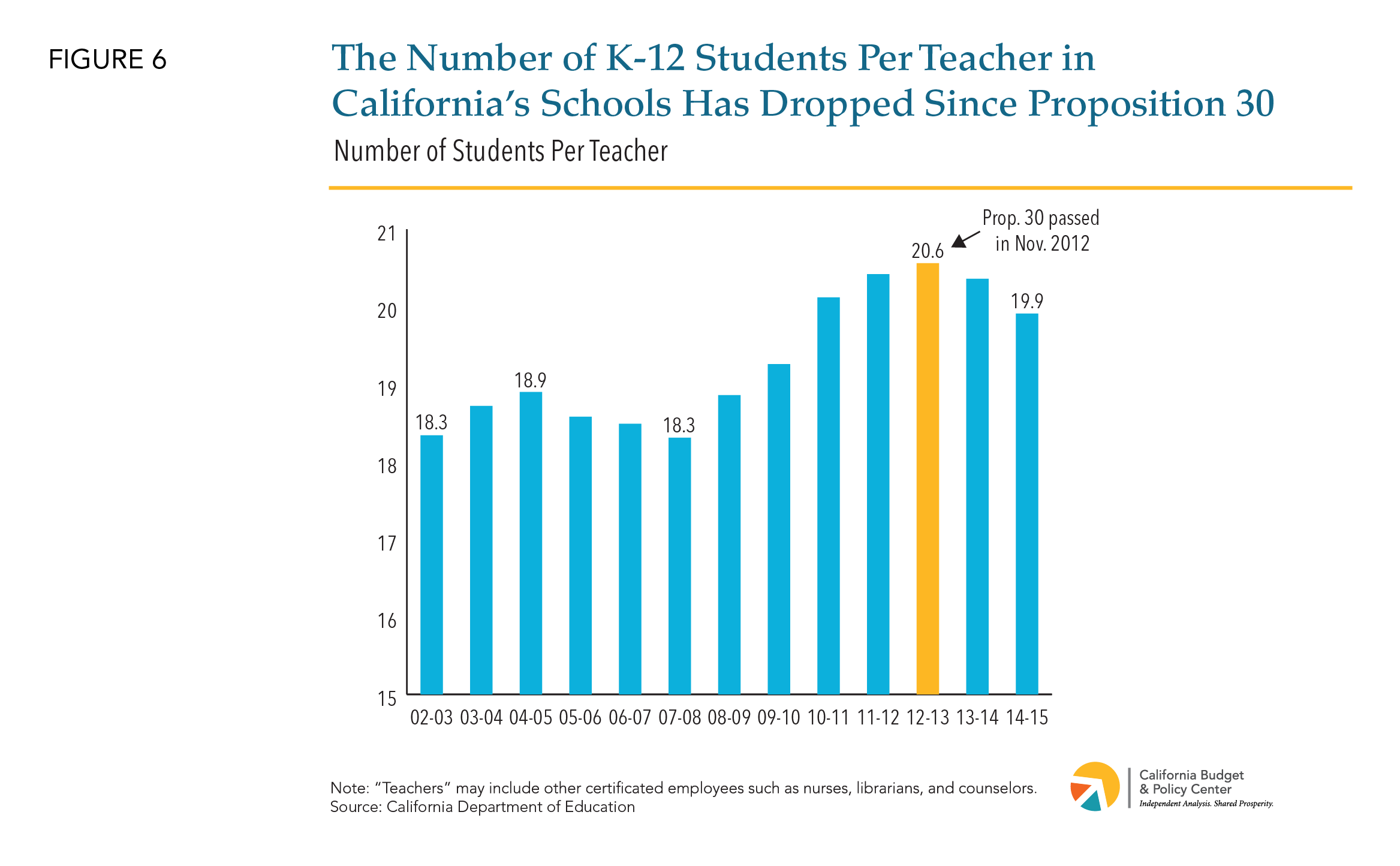
Helped the state to reinvest in preschool, K-12 schools, and community colleges. A growing economy and Prop. 30 worked together to boost Prop. 98 K-14 spending from $47.2 billion in 2011-12 to $71.9 billion in 2016-17. Since voters passed Prop. 30, Prop. 98 K-12 spending per student has increased by more than 14 percent — from $9,168 per student in 2012-13 to $10,493 in 2016-17, after adjusting for inflation (Figure 5). This increased support for California’s students followed a significant reduction in funding during and after the Great Recession. Furthermore, the average number of annual instructional days in California schools has increased and the number of K-12 students per teacher in California has decreased since voters approved Prop. 30 (Figure 6).
Allowed for some reinvestment in other public services after years of cuts. Prop. 30 provided space in the state budget to begin restoring funding to services outside of K-14 education. It did this by generating additional tax revenues that helped to fund the state’s share of the Prop. 98 guarantee, which in turn freed up General Fund dollars to support other services outside of K-14 education.
Boosted rainy day fund deposits and debt repayment. Prop. 2, approved by voters in 2014, requires the state to set aside at least 1.5 percent of General Fund revenues each year to both build up the state budget reserve and pay down budgetary debt. By increasing state revenues, Prop. 30 helped to boost deposits into the state’s rainy day fund and payments that reduce state debts. In 2016-17, for example, the state set aside $2.6 billion for Prop. 2 requirements and made an additional $2 billion deposit into the rainy day fund. These contributions would likely have been smaller in the absence of Prop. 30.
Proposition 30 Revenues Are Significant
Prop. 30 raises a significant amount of revenue. In 2016-17, Prop. 30 is projected to raise $7.7 billion — nearly equal to General Fund spending in the 2016-17 budget for the California State University (CSU), University of California (UC), and college financial aid combined ($7.9 billion) (Figure 7).
Alternatively, for more context on how much $7.7 billion represents, funding for key services and supports for seniors and people with disabilities is about $9.6 billion in the 2016-17 budget. This figure reflects combined General Fund support for the Supplemental Security Income/State Supplementary Payment (SSI/SSP) Program, which helps low-income seniors and people with disabilities to pay for rent, food, and other necessities; the In-Home Supportive Services (IHSS) Program, which helps low-income seniors and people with disabilities safely remain in their own homes rather than having to rely on more costly out-of-home care; and the Department of Developmental Services, which provides services and supports to people with developmental disabilities.
Conclusion
Prop. 30 helped California to begin reinvesting in its people and communities after the cuts made during and following the Great Recession. The looming loss of Prop. 30 revenues means California policymakers and voters must figure out how to fill the gap or face difficult choices about which public services and systems to prioritize and which to reduce or eliminate.
One initiative on the November 2016 ballot, Prop. 55, would maintain Prop. 30’s PIT rate increases beyond their scheduled expiration in 2018. In the forthcoming second part of this Budget Center series of briefs, we will discuss what Prop. 55 would do and what it would mean for the state.
There was a problem processing your signup. Please try again. Or contact us
Please check your email to confirm your signup.
This website uses cookies to analyze site traffic and to allow users to complete forms on the site. The California Budget & Policy Center does not share, trade, sell, or otherwise disclose personal information. By using our website you agree to our Privacy Policy.