Federal budget proposals threaten to cut funding for essential programs like Medi-Cal and CalFresh, trading away Californians’ health care and food security to fund massive tax breaks for the wealthy — with devastating consequences for millions of families across the state.
All Californians deserve access to resources that allow them the opportunity to thrive in their communities. Vital health, nutrition assistance, and other basic need programs are facing multiple federal threats, jeopardizing the existence and sustainability of these lifelines. These threats are being advanced through the federal budget reconciliation process, which is being championed by Republicans in Congress. These unprecedented cuts to vital health care and food access will inflict significant harm and fear on California’s most vulnerable communities.
The billions of dollars in cuts to Medicaid and SNAP will be used, in part, to pay for $4 trillion in tax cuts for the already wealthy and profitable corporations. If these proposed cuts are enacted, millions of Californians may delay treatment, go hungry, and face impossible tradeoffs as a result of basic support being pulled from under them.
Cuts to Medi-Cal Will Leave Millions with Impossible Choices
Medicaid — or Medi-Cal in California — is facing over $800 billion in cuts across the next 10 years, reversing much of the recent progress that helped more people across the United States access health care. Medi-Cal currently provides health coverage for over one-third of the state’s population, covering children, pregnant individuals, seniors, and people with disabilities. The reconciliation bill aims to deprive millions of health care by imposing ineffective work requirements and adding new barriers to the program. The following table presents the everyday choices individuals and families would be forced to make in order to afford vital medical services and medication.
Threats to CalFresh Will Deprive Millions of Californians of Food
Congressional House Republicans are poised to significantly cut the country’s anti-hunger program, SNAP — known as CalFresh in California — by $300 billion over the next 10 years which is equivalent to a 30% cut to the program. If the reconciliation bill is passed, this would be the largest cut in the program’s history and would force California to bear up to 25% of the cost of CalFresh benefits for the first time in the program’s history. For a family of three in California, a 30% cut to their benefits would mean a loss of $165 per month for groceries, on average. The following table displays the bundle of groceries that families in different localities across the state may no longer be able to afford due to this CalFresh reduction.
Proposed Federal Cuts Will Directly Harm California’s Most Vulnerable Communities
Programs like Medi-Cal and CalFresh help ensure millions of Californians have adequate resources to thrive. They ensure families can put food on the table and can readily access basic, but life-saving, health care. Republicans in Congress are pushing for cuts to these programs that will make it even harder than it already is for millions of Californians to make ends meet. Budgets reflect our collective values and priorities. Yet, recent proposals in Congress would take our country in the wrong direction — threatening access to essential health care and food assistance for millions, while advancing costly tax breaks that primarily benefit wealthy individuals and large corporations. These choices make clear whose interests are being prioritized — and it’s not everyday people.
In California, state leaders should present an opposing vision that prioritizes ensuring the economic security and well-being of all Californians by increasing revenues to mitigate the harm and increased inequality that federal leaders intend to cause.
There was a problem processing your signup. Please try again. Or contact us
Please check your email to confirm your signup.
key takeaway
State policymakers should invest in community-led efforts to improve the health and well-being of Californians. This includes raising rates for community health workers, promotoras, and community health representatives (CHW/P/Rs) and improving data reporting.
California’s health care system cannot meet the needs of its communities without the people who serve as trusted messengers and health navigators: community health workers, promotoras, and community health representatives (CHW/P/Rs). These frontline workers bring deep cultural knowledge and lived experience to their roles, helping them connect with patients and deliver critical care. Many are women of color who have supported their communities for decades. Yet despite their vital contributions, they remain underpaid, under-recognized, and under-supported.
In recent years, state leaders have taken steps to better integrate CHW/P/Rs into the health system. The most significant was the launch of a new Medi-Cal benefit in 2022, which allows CHW/P/Rs and service providers to be reimbursed for specific services delivered through Medi-Cal (Medi-Cal is California’s Medicaid program). This year, state policymakers have the opportunity to support the long-term sustainability of this essential workforce by increasing rates and improving data reporting.
Community Health Workers Bridge Gaps in Access
CHW/P/Rs are trusted members of the communities they serve. They help people navigate complex health and social service systems, often in ways that are culturally and linguistically responsive to their communities. Their work spans health education, chronic disease management, behavioral health navigation, enrollment in programs like Medi-Cal, and outreach during public health emergencies such as wildfires and the COVID-19 pandemic.
They are especially effective in communities of color, where medical mistrust, language barriers, and systemic discrimination often prevent individuals from accessing the care they need. CHW/P/Rs help close these gaps not just by providing services, but by building relationships grounded in trust, cultural understanding, and lived experience.
“
I used to be in their shoes — working the fields, overlooked and unheard. Now I bring farmworkers not just food and water, but trust, care, and a voice.
”
Arrely Caranza
Hijas Del Campo, Contra Costa/San Joaquin County
Community Health Workers Make a Difference: A Case Study
During the COVID-19 pandemic, El Sol Neighborhood Educational Center played a vital role in supporting communities across the Inland Empire — a story highlighted in a blog post by the California Health Care Foundation. El Sol mobilized quickly to assess community needs and provide timely support. Community health workers reached out to residents across San Bernardino and Riverside Counties, making more than 16,000 phone calls to check in with families and identify the assistance they needed most.
As part of their outreach efforts, community health workers distributed more than 1,360 hygiene kits, 50,000 face masks, and 12,450 food boxes. They also helped individuals who tested positive for COVID-19 connect with health care services and other essential supports. When dedicated funding became available, the organization expanded its team of community health workers and began training other community-based groups to launch similar campaigns.
In addition to direct outreach, the organization used creative approaches like comic books, community theater, and music videos to deliver accurate, culturally relevant health information. These efforts helped combat misinformation, promote vaccine confidence, and build stronger connections between public health systems and the communities they serve. This case shows how CHW/P/Rs can drive high-impact, community-led responses when they have the tools and resources to succeed.
“
I work with everyone from survivors of domestic violence and their children, to UC Santa Cruz students who are unhoused, to people leaving substance use treatment, doing whatever it takes to get them housing resources.
”
Corina Gitmed
Salud Para La Gente, Santa Cruz
State Leaders Have Taken Initial Steps to Integrate CHW/P/Rs
State leaders have taken initial steps to integrate community health workers and promotoras into the Medi-Cal workforce. In July 2022, the California Department of Health Care Services (DHCS) established a community health worker benefit within Medi-Cal, allowing community health workers, promotoras, and community representatives to be reimbursed for certain services. This benefit was intended to better integrate CHW/P/Rs into California’s health delivery system and support their work as trusted messengers. It allows CHW/P/Rs to be reimbursed for activities such as:
Preventing and managing chronic and infectious diseases.
Supporting behavioral health and mental well-being.
Providing perinatal, sexual, and reproductive health education and support.
Assisting with oral health care.
Addressing aging-related health needs.
Promoting safety and providing support related to domestic violence and community violence prevention.
Responding to environmental and climate-related health risks.
While this was an important first step, implementation can be improved. During an informational hearing in 2023, the California Department of Health Care Services reported that fewer than 6,000 Medi-Cal members had used the benefit and less than $1 million in reimbursements had been issued statewide. This limited uptake raises concerns about barriers to accessing the benefit, particularly for community-based organizations that may lack the administrative infrastructure to bill Medi-Cal.
Underinvestment in CHW/P/Rs Threatens the Workforce and Their Impact
Despite their central role in advancing health equity — the principle that everyone should have a fair and just opportunity to be healthy — CHW/P/Rs remain underpaid and undervalued. Many positions are funded through short-term grants, and the Medi-Cal reimbursement rates are not enough to support community-based organizations sustainably. This makes it difficult for organizations to recruit, retain, and fairly compensate CHW/P/Rs.
“
People don’t do this work for the money — they do it because helping their community is who they are. But a better wage would mean not having to have a second job to make ends meet. Higher reimbursement rates would mean we could support a bigger team to deliver high-quality care to more patients.
”
Diana Chung
Asian Youth Center, San Gabriel/Los Angeles
In recent years, health advocates successfully advanced a budget proposal to increase reimbursement rates for community health workers. The 2024 Budget Act included $5 million from the state’s General Fund Managed Care Organization (MCO) tax to fund a modest, regionally adjusted rate increase in the first year. However, the increase was ultimately eliminated after voters approved Proposition 35 in November 2024, which redirected MCO tax revenue toward other health care investments. As a result, any future rate increase would depend on General Fund support.
Without meaningful increases, many plans are now re-evaluating their own CHW/P/R compensation structures, and some community-based organizations are finding that the current reimbursement is not cost-effective due to high administrative overhead. A rate study is currently being requested by advocates to better understand how the state can sustain the CHW/P/R workforce and enhance uptake and utilization of the Medi-Cal benefit, but without immediate action, the benefit risks becoming symbolic rather than substantive.
Additional ongoing investments are needed to develop a strong pipeline of community health workers and also to ensure that workers are paid fair wages. Without reliable funding and workforce infrastructure, the state risks losing ground on efforts to improve community health and equity.
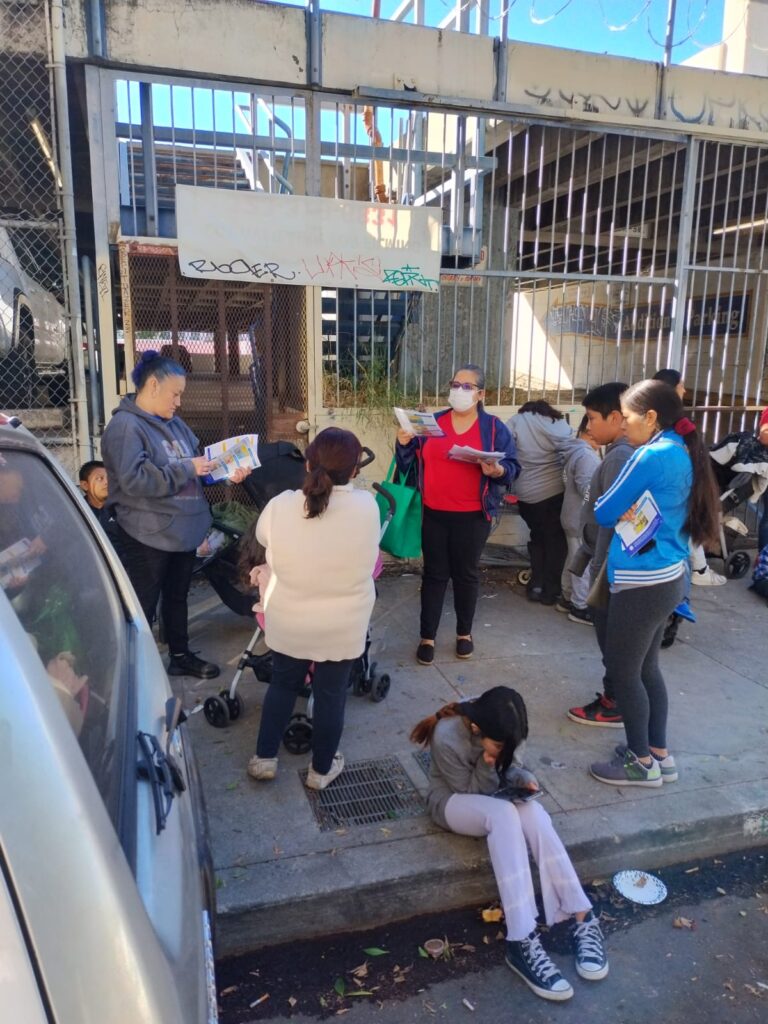
Latino Coalition for a Healthy California Promotora/CHW Fortina Hernández shares emergency preparedness resources while canvassing in the Los Angeles community.
Better Data Is Key to Expanding Access
A major challenge in evaluating and expanding the CHW/P/R workforce is the lack of reliable, centralized data. Policymakers and advocates don’t have access to key information, including how many CHW/P/Rs are delivering Medi-Cal services, who they’re reaching, and what outcomes they are achieving. While the federal Bureau of Labor Statistics collects limited data, it does not capture specific roles, pay sources, or population reach.
New proposed legislation aims to address some of these information gaps by requiring the California Department of Health Care Services (DHCS) to report on Medi-Cal benefit utilization. The bill aims to increase the Legislature’s understanding of the CHW/P/R benefit’s status through an annual report on the utilization data, which will enhance legislative oversight and inform any future legislation needed to strengthen and fund this vital program.
While this is an important step, the legislation alone is not enough. California lacks consistent, disaggregated workforce data across counties and managed care plans. DHCS has said it cannot collect some data, such as a health plan’s negotiated rate for CHW/P/R services, due to its contractual relationships with health plans, highlighting the need for greater transparency and accountability.
Without better data, the state cannot measure the benefit’s effectiveness or track whether the workforce is growing. Early signs suggest limited progress, and stakeholders are concerned that the benefit is not living up to its original promise of building and sustaining a robust CHW/P/R workforce.
Conclusion
Community health workers, promotoras, and community health representatives (CHW/P/Rs) are central to achieving health equity in California. They are trusted, experienced, and deeply embedded in the communities they serve. However, current policies and funding structures fall short of recognizing and sustaining their contributions to keeping communities healthy.
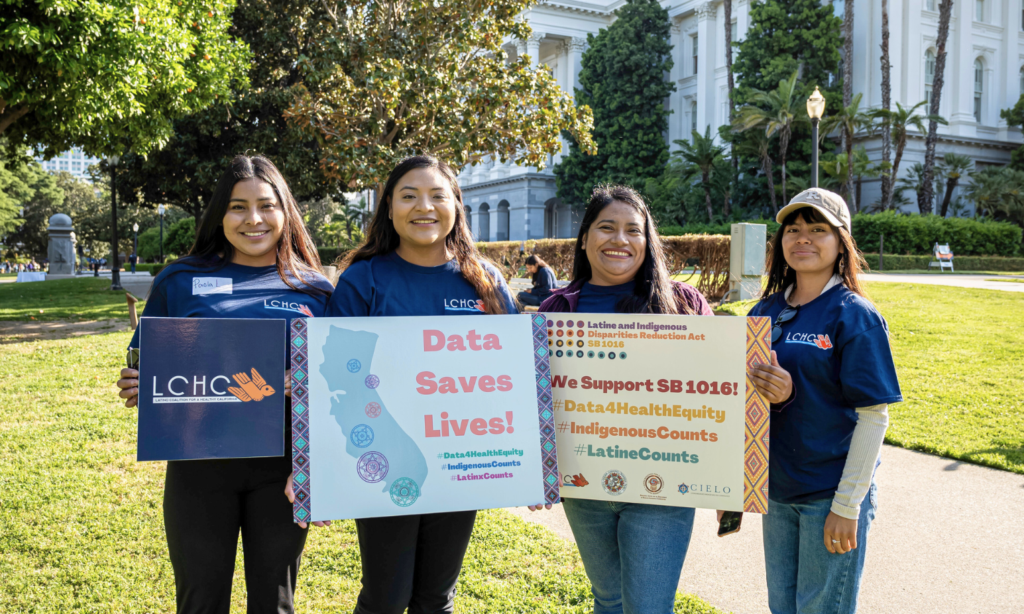
Promotoras and community health advocates at the State Capitol during Latino Coalition for a Healthy California’s 2024 Day at the Capitol.
To deliver on California’s commitment to health equity, state leaders should support better pay and career pathways for these essential health care workers. Policymakers can do this by raising reimbursement rates under Medi-Cal, implementing AB 403 with transparency, and investing in workforce data infrastructure. Policymakers should also support career pathways and certification processes that honor the lived experience and skills that CHW/P/Rs bring to the table.
CHW/P/Rs are not a new idea — they are a proven solution that supports access to health care, improves health outcomes, and builds trust in underserved communities. What they need now is real investment.
There was a problem processing your signup. Please try again. Or contact us
Please check your email to confirm your signup.
key takeaway
Protecting Medi-Cal’s funding and access to gender-affirming care is essential to safeguard the health, mental well-being, and dignity of California’s low-income transgender, gender-expansive, and intersex communities. However, this is currently threatened by federal budget cuts and policy proposals that would exacerbate existing disparities and costs.
Every Californian should be able to make decisions about their own medical care. This is especially important for transgender, gender expansive, and intersex (TGI) people who rely on gender-affirming care to ensure that they can access treatments that align with their gender identity without unnecessary restrictions or interference from others. For the 36,000 TGI Californians with low incomes who qualify for Medi-Cal, California’s Medicaid program serves as a lifeline that provides them with free or low-cost health coverage. Policymakers should protect Medi-Cal and access to gender-affirming care so that all Californians are able to access life saving care, have better mental health outcomes, and live with dignity.
What Are Current Threats to Medicaid and Gender-Affirming Care?
Congressional Republicans are actively pushing federal budget and policy proposals that threaten the ability of TGI people on Medicaid to access crucial gender-affirming care. Gender-affirming care improves mental and physical health outcomes, reduces disparities, and helps provide better health care access for TGI people. Denying access to this care can lead to untreated mental health issues, substance abuse, and other health issues that will only increase costs for the state and health care systems in the long run.
Federal budget proposals would cut funding for Medicaid in favor of tax breaks for the wealthy. Congressional Republicans are also pursuing policy proposals that would prevent Medicaid funding from being used for gender-affirming care. Such cuts and proposals would be harmful for all Californians, as gender-affirming care supports procedures like breast reduction surgery and IUDs. For TGI people, who are already facing significant health disparities due to historic and ongoing discrimination, these proposed cuts would be devastating.
For many, Medi-Cal is the only way to access vital health services, from gender-affirming care to mental health supports. Out-of-pocket costs for gender-affirming care can range from $72 to $3,792 per year, meaning that without Medi-Cal, many TGI Californians would be unable to afford out-of-pocket expenses for this critical care.
Cutting funding for Medi-Cal means taking critical care away from people who already face long-standing barriers to care, such as:
Lack of health coverage,
Limited access to treatments that align with gender identity,
Limited health care resources,
Lack of culturally competent and linguistically appropriate care, or
Other forms of discrimination.
These barriers to care are rooted in systemic transphobia and racism that TGI people face in health care and in society, which have systematically denied TGI people equitable access to quality care and resources. Cutting funding for Medicaid and enacting discriminatory policy proposals would reinforce systemic transphobia and put the health and well-being of our trans, non-binary, and intersex neighbors at risk.
Health inequities are avoidable differences in health that are rooted in social injustices that make some groups more vulnerable to poor health outcomes than others. For example, a health inequity is the increased rate of hospitalization for asthma in children living near busy roads.
TGI
TGI is an umbrella term that covers a range of gender identities including transgender, gender expansive, gender non-binary, and intersex.
Cisgender
Cisgender describes people whose gender identity matches their biological sex assigned at birth.
Gender-Affirming Care
Gender-affirming care is health care for TGI individuals that helps them live safe and healthy lives as their open and authentic selves. This includes mental health care, medical care, and social services.
Transphobia
Transphobia refers to deeply rooted negative attitudes, feelings, or actions towards transgender people. Examples include attempts to remove trans people’s rights, abuse towards trans people, and other forms of discrimination.
Transgender and Gender Expansive Californians Are Already Facing Increased Risks
Mental health is essential for overall health and well-being. Yet, half of TGI Californians experienced serious psychological distress in the past year. That is much higher than the rate for cisgender people (14%). Experiences with health care stigma, family or social rejection, and internalized oppression that many TGI people face contribute to worse mental health outcomes.
TGI people are not only facing disparities in mental health, they are also enduring worse health outcomes overall. A history of discrimination and stigma in health care faced by TGI people have resulted in inequitable health outcomes. Approximately 1 in 4 TGI people in California are in fair or poor health, which is significantly higher than cisgender Californians (16%).
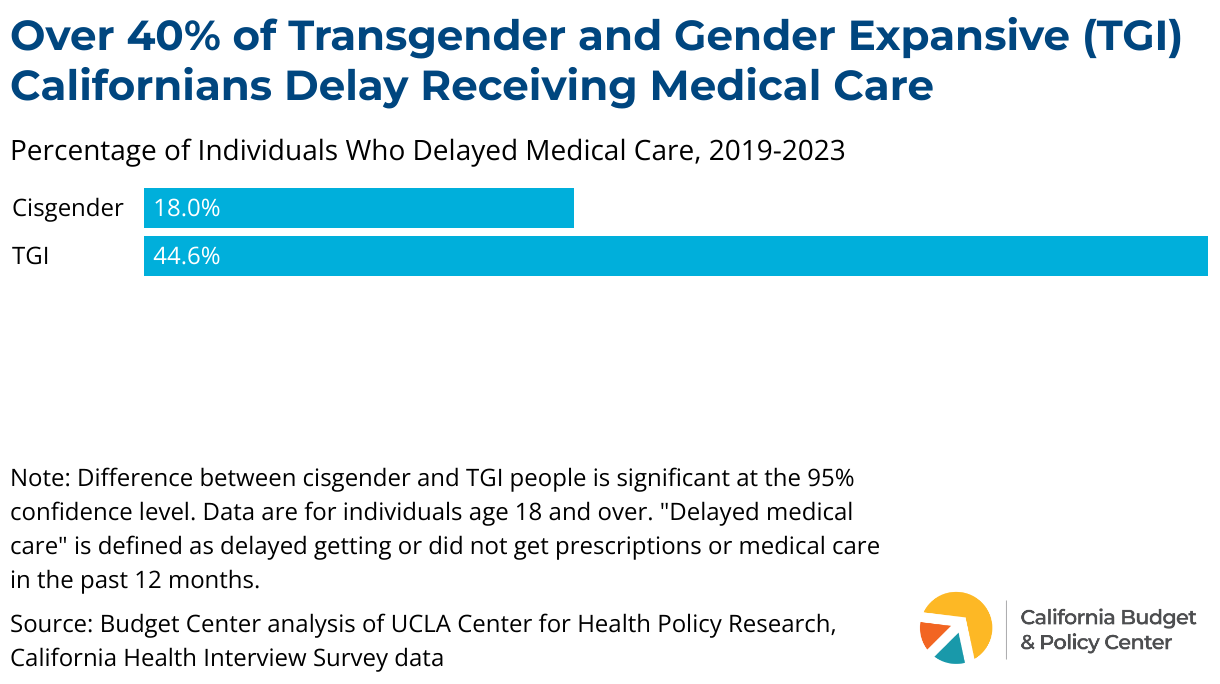
It is critical that everyone, especially TGI Californians, has access to timely and equitable health care that aligns with their gender identity without unnecessary restrictions. However, TGI people in California are delaying medical care or getting prescriptions at high rates. Over 40% of TGI people in the state delayed receiving medical care between 2019 and 2023, which is significantly higher than the average for cisgender people in the state (18%).
Forgoing preventive care or treatment for health conditions is harmful to health and well-being. Avoiding or delaying care also threatens the ability of people to thrive in the state. However, TGI people face unique barriers in accessing care, such as discrimination or fears of discrimination as well as a lack of competent providers and gender-affirming care. For example, providers may refuse to use the names and pronouns that correspond with an individual’s gender identity. Cutting funding for Medicaid and preventing Medicaid recipients from accessing gender-affirming care would increase the cost of health care for millions of Californians, and TGI people are already unable to afford out-of-pocket expenses due to employment discrimination and harassment or being unhoused. Increased costs would cause even more TGI people to delay receiving critical care.
Gender-affirming care saves lives. Policymakers should protect Medi-Cal to ensure all Californians — regardless of their income or gender identity — have access to affordable, quality, and affirming health care. Cutting Medi-Cal would take critical care away from some of our most vulnerable neighbors who rely on Medi-Cal to stay healthy and access care that allows them to survive.
Rather than cementing discriminatory policies and deepening inequities, state and federal policymakers should strengthen Medi-Cal to better meet the needs of TGI people and ensure that they can receive the care they need.
Federal Policy
The federal government plays a major role in shaping California’s budget, economy, and the well-being of its people.
Learn how federal policies shape California’s budget, economy, and vital programs — and how state leaders can respond to protect and support Californians.
There was a problem processing your signup. Please try again. Or contact us
Please check your email to confirm your signup.
key takeaway
Republican federal budget proposals threaten critical programs for California families — like Head Start and afterschool care — while offering tax breaks to the wealthiest 1%, putting children’s well-being and working parents’ economic security at risk.
The federal government funds critical programs and services for California’s families that benefit children across the state, such as early care and education, food assistance, after school programs, and much more. Republican federal budget proposals have threatened to cut or alter many of these programs, putting the well-being of California’s children and their parents/guardians at risk. At the same time, Republican leaders are proposing a series of tax cuts that will benefit the highest earners.
In order to fund these tax cuts for the wealthy, Republican proposals intend to cut critical programs that are lifelines for millions of Californians, putting funding for early care and education and afterschool programs at risk. If proposed cuts become a reality, California’s children and families may fall even deeper into poverty while the richest accumulate even more wealth.
A Tale of Two Families
Imagine two families living in San Bernardino County. The first is a single mother raising two young children — a three-year-old and a six-year-old. She works part-time at an Amazon warehouse and is also a part-time student, working toward an associate degree in Radiologic Technology to become an X-ray technician. The second family includes a Senior Vice President for Tesla and her spouse who works remotely as a managing director at an investment firm. This couple also has a three-year-old and a six-year-old.
The single mother is paid about $18,000 per year for her part-time work, which is below the poverty line. In contrast, the couple earns about $1.2 million annually — placing them in the top 1% of income earners in the U.S.
Each morning, the single mother drops off her three-year-old at a local Head Start program and her six-year-old at the neighborhood elementary school. After school, her six year-old child attends a 21st Century Community Learning Center program, allowing the mother to complete her shift and attend her classes. The Head Start and afterschool program let her pick both her children up between 5 p.m. and 5:30 p.m., allowing her to work and go to school to later boost her income.
In a different part of San Bernardino County, the wealthy couple have breakfast with their children each morning, then move on to their work day without having to consider drop-off, pick-up, or after care into their schedules because they employ a nanny to manage these and other household tasks. They also pay thousands of dollars to enroll their three-year-old in a part-day preschool for two days per week and the six-year-old in a private kindergarten.
“
This single mom may lose funds for nearly one month of rent, while the 1% family pays the mortgage on their vacation home for almost the entire year.
”
Programs like Head Start and 21st Century Community Learning Centers play no meaningful role in the wealthy family’s lives — they can afford private solutions for every need, from early education to afterschool care. But for families who are barely making ends meet, like our single mother, these programs aren’t luxuries — they are lifelines that allow working parents to stay employed and continue their education.
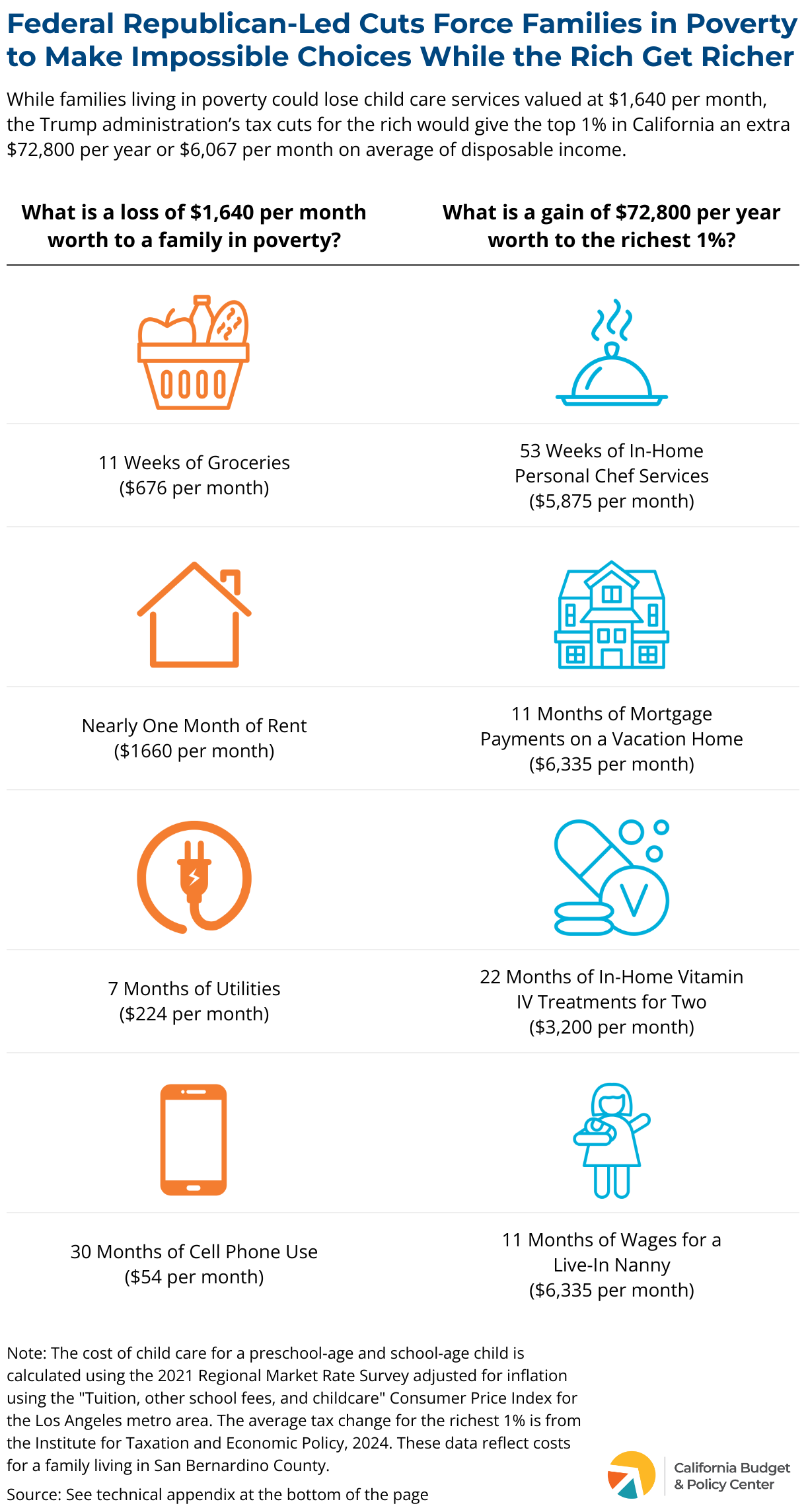
Under the proposed federal Republican budget cuts, these critical supports — Head Start and afterschool programs — are at risk. Without child care and afterschool programs, this mom would need to pay an average of $1,640 per month — or $19,680 per year — for care, which exceeds her annual income. Without these federal programs, she would be forced to make impossible decisions — choosing between groceries, rent, transportation, and the child care she needs to keep her job and finish school.
Federal Policy
The federal government plays a major role in shaping California’s budget, economy, and the well-being of its people.
Learn how federal policies shape California’s budget, economy, and vital programs — and how state leaders can respond to protect and support Californians.
Meanwhile, this wealthy family would receive an average tax break of $72,800 per year, funding additional luxuries: a vacation home, a personal chef, or health and wellness regimens. This would allow them even more flexibility and comfort without any additional work or sacrifice.
The following table quantifies the trade-offs that this single mom may have to make, juxtaposed with the additional luxuries the richest 1% can acquire.
Source: US Department of Agriculture, USDA Food Plans: Monthly Cost of Food Report for Low, Moderate, and Liberal Food Plans for January 2025
Note: Data reflect the monthly low-cost plan for a three-year-old, six-year-old, and a woman between the ages of 19 and 50.
Rent
Source: Apartment List
Note: Data reflect the average rent for a two-bedroom apartment in San Bernardino County in February 2025.
Utilities
Source: Budget Center analysis of US Census Bureau, 2023 American Community Survey
Note: Data reflect the median cost of electricity and gas in San Bernardino County in 2023. Data have been adjusted to reflect 2025 dollars using the Consumer Price Index for All Items in the Los Angeles metropolitan area.
Cellular Phone Service
Source: US Bureau of Labor Statistics, 2021-2022 Consumer Expenditure Survey
Note: Data reflect the average cost of cellular phone service for “consumer units” in California with the lowest 20% of income before taxes. Data have been adjusted to reflect 2025 dollars using the “Wireless telephone services in the U.S.” Consumer Price Index for All Urban Consumers.
Luxury Items
Personal Chef
Source: Morgan Stanley, 2022 Estate and Household Staff Compensation Report and the US Department of Agriculture, USDA Food Plans: Monthly Cost of Food Report for Low, Moderate, and Liberal Food Plans for January 2025
Note: Personal chef wages reflect 50% of the median reported wages, excluding bonuses. Data reflect the monthly liberal food plan for a three-year-old, six-year-old, and a woman and a man between the ages of 19 and 50.
Live-In Nanny
Source: Morgan Stanley, 2022 Estate and Household Staff Compensation Report
Note: Wages for a live-in nanny reflect the median reported hourly wage and a 40-hour work week.
Vitamin IV Treatments
Source: Drip Hydration
Note: Data reflect the cost of the monthly NAD premium membership plan.
Vacation Home
Source: Nerdwallet
Note: Data reflect a vacation home in Big Bear Lake, California with a purchase price of $900,000, a 20% down payment, and a 30-year fixed-rate mortgage with an interest rate of 6.875%. This analysis uses the online calculator’s default property tax rate (1.5%) and homeowner’s insurance rate (.64%).
California’s families with low incomes should not have their economic security threatened and their children’s enrichment and positive development endangered in order to help the nation’s richest households accumulate more wealth. Federal legislators representing California and state policymakers should push back against policies that put corporate profits and tax cuts for the wealthy ahead of the needs of California families and children. Republican-proposed cuts are not inevitable; state leaders can fight to prevent or mitigate harmful cuts to protect vital early care and education and afterschool programs for California’s children.
What are the benefits of Head Start and 21st Century Community Learning Centers?
The federal Head Start, Early Head Start, Migrant/Seasonal Head Start, and American Indian/Alaska Native Head Start (collectively, Head Start) programs provide critical early care and education for more than 73,000 children ages zero to 5 for families living in poverty in California, plus homeless, foster, and children with disabilities. Head Start has operated for six decades and has numerous benefits for California families and their children. Specifically, children participating in Head Start programs are:
More likely to complete high school;
More likely to enroll in and complete college;
Less likely to enter foster care; and
Less likely to experience poor health.
Overall, Head Start’s multi-generational benefits support families’ economic mobility and children’s well-being.
The federal government has been funding 21st Century Community Learning Centers for over 25 years. These programs provide after school and summer enrichment programs for more than 100,000 students in California and over a million more across the nation. Similar to Head Start, these afterschool programs have proven benefits for children, including:
Improved motivation in school;
Improved school-day attendance;
Improved scores on reading and math assessments; and
Gains in skills and competencies valued by employers.
Furthermore, parents and guardians of children in afterschool programs report having an increased ability to maintain their employment and increase hours at work.
Head Start and 21st Century Community Learning Centers are vital federal programs that improve the lives of California’s families and children.
Kristin Schumacher, a former analyst at the California Budget & Policy Center, now contributes to the organization as a consultant on various research projects.
There was a problem processing your signup. Please try again. Or contact us
Please check your email to confirm your signup.
key takeaway
Republican-proposed federal cuts to CalFresh would put millions of Californians at risk of hunger by shifting billions in food assistance costs to the state. These cost-shift proposals could force California to reduce already too-low CalFresh benefits or take assistance away from over a million participants, disproportionately harming children, seniors, veterans, and people with disabilities.
Over 5 million Californians rely on food assistance programs to ensure they can consistently put a meal on the table for themselves and their families. The Supplemental Nutrition Assistance Program (SNAP) — CalFresh in California — is a key tool for fighting hunger in the state. However, the Trump administration and congressional Republicans are pushing for severe cuts to CalFresh and other essential food assistance programs in order to fund huge tax giveaways for the wealthy.
Federal cuts to CalFresh would be especially devastating for California families with low incomes because benefits are completely funded by the federal government, with states covering a portion of the administrative and outreach costs.
House Republicans have proposed requiring the Agriculture Committee, which oversees SNAP, to cut at least $230 billion in federal spending over the next ten years. For comparison, the California General Fund is estimated to be $229 billion for the 2025-26 fiscal year. To make cuts of this magnitude possible, programs like CalFresh are likely to undergo major restructuring. CalFresh could face cuts to benefits and participation as a result of major cost-shifts to states, harsher time limits, and reversals of other key investments. Notably, significantly altering SNAP’s funding structure by offloading costs to states would have the greatest consequences for participants who rely on CalFresh for daily nutrition.
Cost-Shift Proposals Would Greatly Reduce Funding for CalFresh and Impose Massive Costs on California
If the federal government did decide to restructure how SNAP — and therefore CalFresh — is funded, this could shift major costs onto California.A cost-shift proposal would require the state to pay for a portion of CalFresh benefits for the first time in the program’s history, breaking a foundational agreement that food benefits are a federal responsibility as CalFresh is a federal entitlement program.
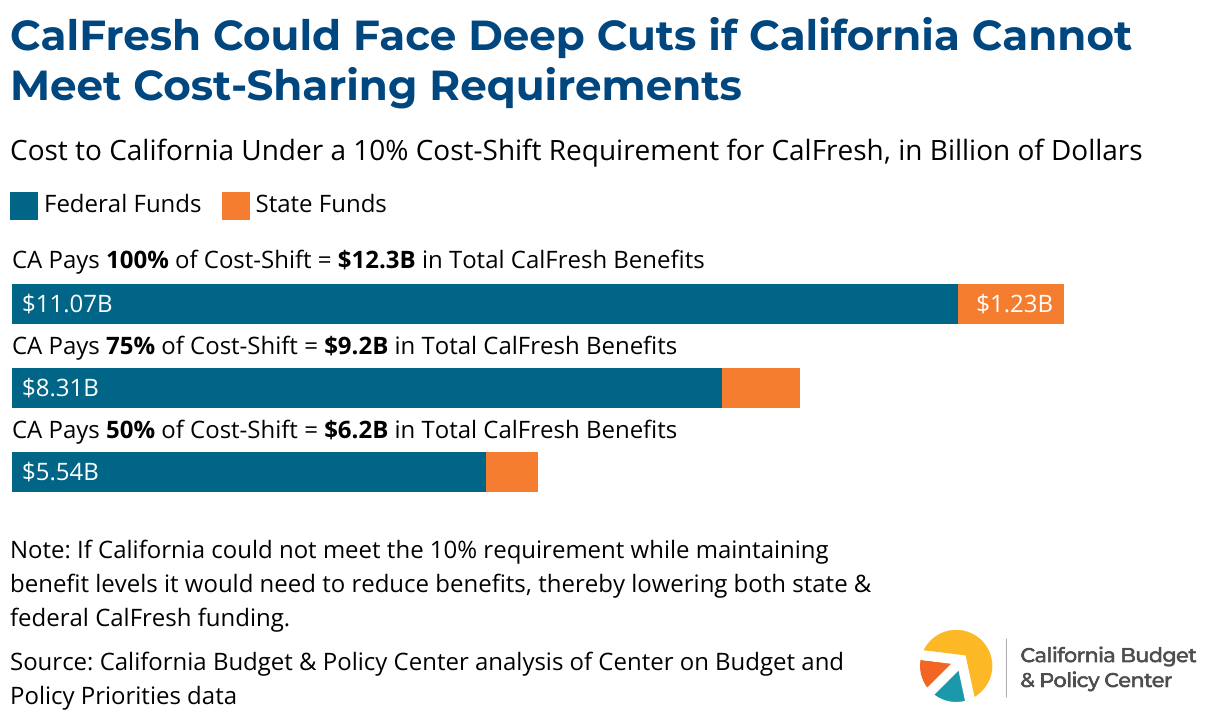
If California was required to cover 10% of the estimated cost of benefits issued in 2026, the state would be responsible for paying $1.23 billion to maintain CalFresh benefits. If California is required to fund $1.23 billion for CalFresh through this year’s budget or any future budget, but the state is only able to partially cover this cost, over a million people could lose benefits or receive significantly less assistance to buy groceries.
If California could only cover 75% of the $1.23 billion mandated by a hypothetical cost-shift proposal, the federal government’s contribution to CalFresh would decrease accordingly. Under this scenario,total CalFresh benefits would decrease from $12.3 billion to just $9.2 billion. In order to absorb this cut:
California would have to reduce daily CalFresh benefits, which are already too low, by 25% from $6.34 to $4.76, thereby increasing the daily food gap from $5.10 to $6.68.
Or, the state would have to take away benefits from 1 in 4 CalFresh recipients, or over 1.3 million participants.
Finding over $1 billion in California’s already strained budget fast enough to prevent families and individuals from losing benefits would be extremely difficult. Even if there weren’t any federal budget cuts, California is projected to face large budget shortfalls beginning in 2026-27 because state revenues are expected to fall far short of covering the cost of current services. Moreover, shifting a share of the cost of CalFresh benefits to California would likely make it impossible for the state to cover benefit costs during recessions when the need for food assistance rises, but state revenues decline.
Regardless of the magnitude of the cost-sharing proposal, Californians who rely on CalFresh to afford basic food needs are at risk of facing reduced benefits or exclusion from the program entirely, which could lead to increased food insecurity and poverty at a time when so many Californians are already struggling with the high costs of living.
Additional Federal Threats to SNAP Would Compound Harm
In addition to a severely damaging cost shift, other proposals to weaken SNAP could take aid away from children, veterans, seniors, working families, people struggling to find work, and people with disabilities. These proposals include:
Imposing time limits on exempted populations like veterans, people experiencing homelessness, youth who have aged out of foster care, and parents of school-aged children. SNAP has strict time limits on assistance for many able-bodied participants without dependents unless they meet certain work requirements, despite the extensive research that shows work requirements have no long-term impacts on employment and only result in people losing assistance. The overwhelming majority of CalFresh/SNAP recipients who can work already do. Therefore, imposing harsher time limits would cut benefits and increase hardship for people who face disproportionate challenges in the labor force, live in areas where there are insufficient jobs, and contribute significantly through their unpaid labor of caregiving.
Ending Broad-Based Categorical Eligibility (BBCE), which would impose significant administrative burdens and take food away from children receiving school meals.BBCE is an important tool to connect families who have difficulty affording basic expenses to different programs they are eligible for. One of the most important uses is to allow all children who receive CalFresh to automatically receive free school meals without additional paperwork. The proposal would also make it more difficult for children to access free school meals during the school year and over the summer, undermining efforts around School Meals for All in California. Overall, ending BBCE would further complicate the administrative process for agencies and families and reduce students’ access to free meals at school, putting additional pressure on family budgets.
Proposed Changes to Food Assistance Programs Will Harm Californians
Federal threats to food assistance programs will cause harm to already struggling families. Black, Latinx, and multiracial households disproportionately rely on these services, meaning any cuts would further exacerbate inequalities already present within these communities.
California’s leaders should take bold action to protect communities from the proposed devastating federal cuts. This starts with urging their federal counterparts to reject harmful budget cuts to food assistance programs like CalFresh in order to justify huge tax breaks for high-income households and corporations. At the same time, the state should prepare to mitigate the impact of potential cuts by exploring equitable revenue solutions to safeguard essential services.
Programs like CalFresh help families purchase food, aid the state in fighting poverty, and help stabilize the economy during recessions by supporting local businesses. Protecting and strengthening food assistance is necessary to ensure that no children, seniors, veterans, or Californians with disabilities go hungry in our state.
H.R. 1 and the Federal Budget
H.R. 1, the harmful Republican mega bill passed in July 2025, will deeply harm Californians by cutting funding for essential programs like health care, food assistance, and education.
See how California leaders can respond and protect vital supports.
There was a problem processing your signup. Please try again. Or contact us
Please check your email to confirm your signup.
key takeaway
Higher wages for early care and education workers in California are essential to expanding affordable child care, supporting families’ economic security, and addressing long-standing workforce inequities rooted in racial and gender disparities.
Access to affordable, nurturing early care and education (ECE) is critical for families’ economic security and positive child development. California’s ECE system helps families with low incomes find and pay for vital programs during a child’s early years. As part of this programming, the state also pays ECE providers who participate in subsidized ECE programs. State investments in ECE are critical for ensuring that families have adequate access to affordable early care options and that ECE providers are reimbursed at a fair rate. While the state has increased funding for subsidized ECE programs since the Great Recession, this funding has not gone far enough. Namely, the demand for subsidized ECE programs far exceeds the number of spaces. As of 2023, only 14% of children eligible for subsidized ECE programs were actually enrolled.1The ECE programs referenced in this statistic include the child care and development programs administered by the California Department of Social Services.
The need to expand access to affordable early learning options also means that California requires a workforce to meet that demand. The ECE profession has experienced high turnover due to low pay, a lack of benefits, and pandemic-related risks that drove many out of the field. In order to effectively address the unmet need for affordable care, the workforce must also expand. This remains a challenge under the current subsidized system’s payment rate structure. The ECE system will remain inequitable and affordable child care will remain scarce without higher wages for the workforce.
How are ECE providers paid and why are these professionals paid such low wages?
Those that accept state vouchers are paid based on the Regional Market Rate (RMR) survey; and
ECE professionals that have a direct contract with the state are paid using the Standard Reimbursement Rate (SRR). The current rates are frozen through the 2024-25 fiscal year as the state works to create an alternative methodology reflecting the true cost of care.
However, the 2023-24 budget established “cost of care” stipends to temporarily increase reimbursement rates above the RMR and SRR through the 2024-25 fiscal year.
Early care and education professionals working in these organizations — primarily women and disproportionately women of color — deserve fair and just wages for essential work that helps children learn and grow while parents are working or going to school to support their families. However, families are often unable to afford the true cost of care, including adequate wages for these professionals. The subsidy from the state could fill this gap, but the rate-setting methodologies that have been in place in California for decades assume and perpetuate a low-paid workforce. Paying this essential workforce low wages is a direct result of racist and sexist stereotypes that devalue caregiving work and exacerbate the gender wage gap. State leaders should instead prioritize treating these jobs as high-skill, high-value jobs. The current workforce of talented and dedicated providers who help care for and develop California’s children is misaligned with the low wages they receive.
How much has the reimbursement rate increased for ECE providers?
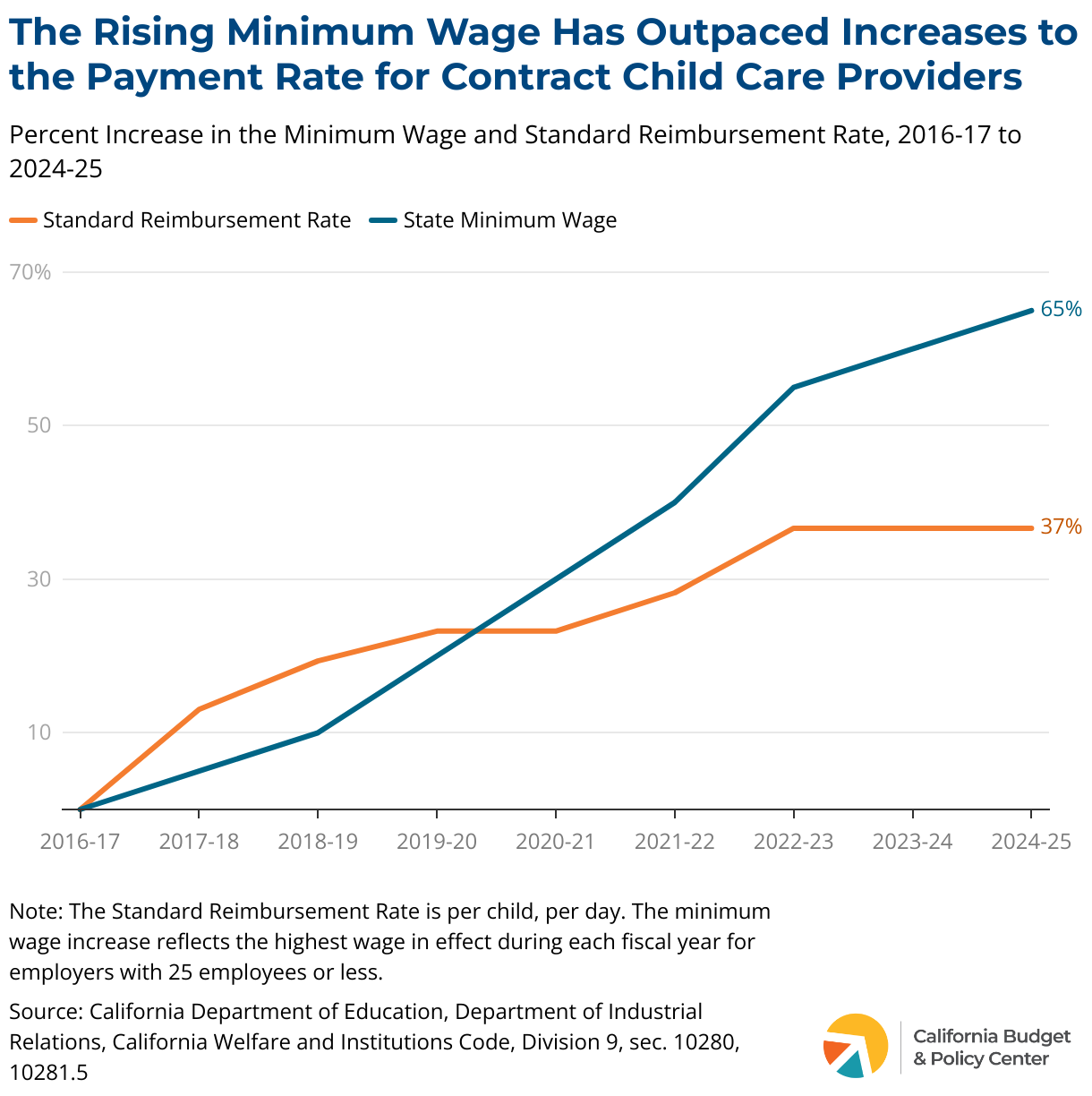
Over the past decade, ECE providers have experienced an increase in their reimbursement rates. Yet, these increases have been insufficient to keep pace with the rising costs of goods and services and the state’s minimum wage, which has been steadily increasing since 2016. The following chart highlights key points regarding increases to ECE providers’ rates:
Despite the cost of care supplement to the RMR, increases in rates remain far below the increase in the minimum wage. In 21 counties, home-based ECE providers participating in a voucher program had rates for infant care increase at less than half the rate of the minimum wage. In almost every county in the state, licensed family child care home providers and center-based providers struggled with low rate increases relative to the minimum wage (see table).
Aside from the cost of care supplement, state leaders have only updated voucher-based payment rates for child care providers three times in the past nine fiscal years. Specifically, rates were increased to the 75th percentile of the updated market surveys as part of the 2016-17, 2017-18, and 2021-22 spending plans. Without the cost of care supplement, rates in 2024 would still be at the 75th percentile of the 2018 market rate survey.
ECE payment rates have not kept pace with the increasing minimum wage. The state law requiring annual increases to the statewide minimum wage went into effect in 2016-17, raising the wage by 65% from 2016-17 to 2024-25. Because ECE professionals are paid very low wages, increases in the minimum wage increase costs for providers. State leaders have failed to increase payment rates to keep pace with the state minimum wage (see chart). This cuts into providers’ bottom line making it even harder to provide care to children and families.
Policymakers have not consistently updated the Standard Reimbursement Rate (SRR), either. From 2016-17 to 2024-25 the SRR increased by just 37%, falling far short of the 65% increase in the state minimum wage.
Policymakers’ failure to consistently update the payment rates for subsidized child care and preschool providers undermines their ability to offer care to children and families while covering the rising cost of business in California.
How Do ECE Professionals’ Wages Compare with the Broader Workforce?
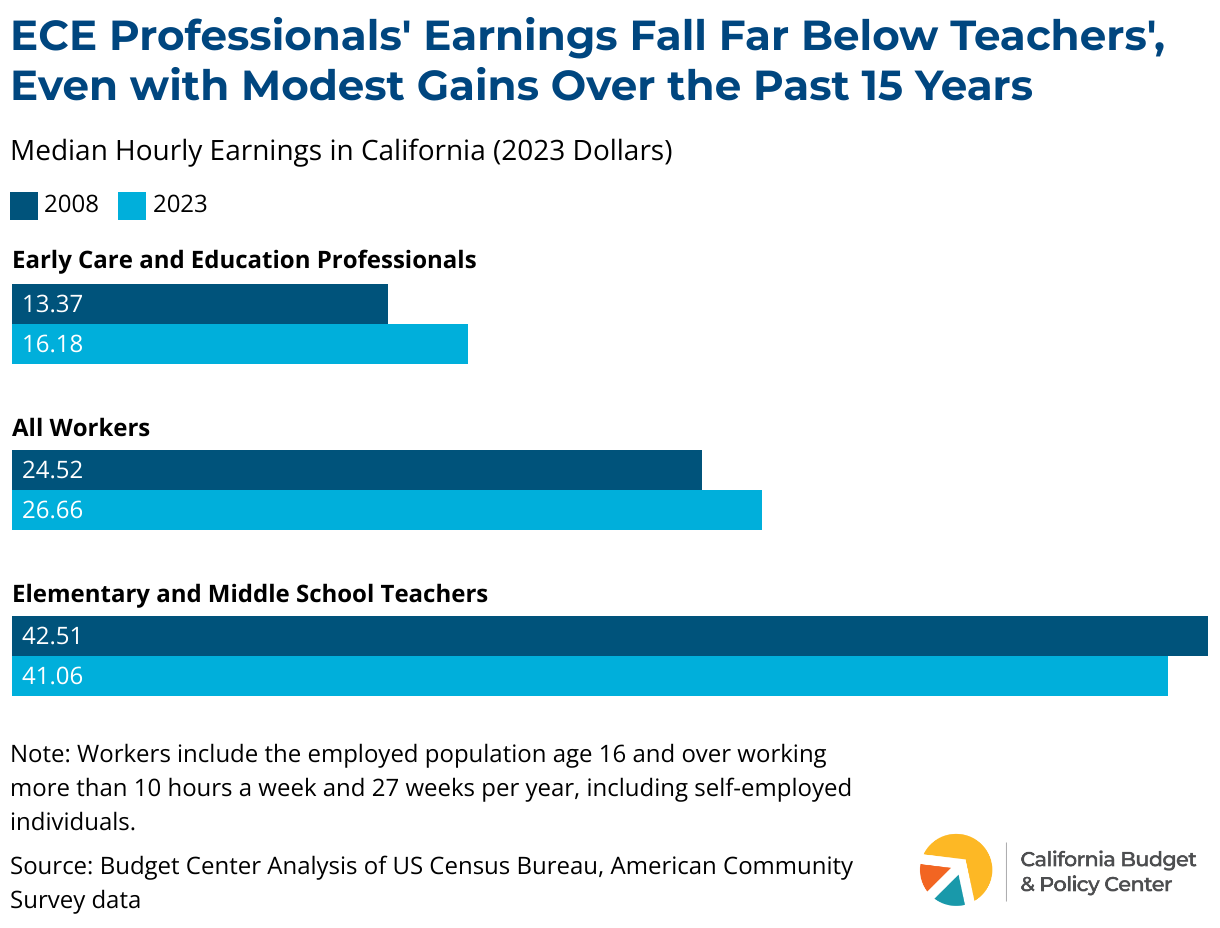
The relatively small percent increase in ECE professionals’ wages is further compounded by the low wages they face, as compared with other professions.This is particularly the case when compared to elementary and middle school teachers, an occupation with similar work and professional qualifications. The chart below compares median wages for ECE professionals, all workers, and K-8 teachers.2The methodology to define “Early Care and Education professionals” is based on the Center for the Study of Child Care Employment’s Early Childhood Workforce. These professionals include: 1) child care workers in the child day care services, private households, religious organizations, or elementary and secondary school industries; 2) education and child care administrators in the child day care services industry; 3) preschool and kindergarten teachers in the child day care services industry; and 4) other teachers and teaching assistants in the child day care services industry.
Overall, this chart shows that median ECE professionals’ wages fall behind the median for all workers and even further as compared with K-8 teachers. Other key points from this chart include the following:
Between 2008 and 2023, ECE professionals’ wages increased by only a few dollars. After adjusting for inflation, ECE professionals’ wages increased by $2.81 between 2008 and 2023. This small increase has meant that ECE professionals’ wages have remained alarmingly low over time, exacerbating issues such as high turnover and fewer workers willing to enter and stay in the field.
If trends continue, it will take nearly 60 years for ECE professionals’ wages to catch up to the median wage of all workers. Specifically, using the 10-year average rate of change for ECE professionals and all workers’ wages, ECE professionals will finally surpass the median wage of all workers in the year 2083.3The rate used to project median wages is the 10-year annual average of the change in median hourly earnings from 2012-2023. Therefore, the number of years before the wage gap closes reflects an estimate based on projected median hourly earnings. The data include the employed population age 16 and over working more than 10 hours a week and 27 weeks per year. Data for 2020 was unreliable and therefore omitted from the analysis. Source: Budget Center analysis of US Census Bureau, American Community Survey data.
ECE professionals make only 39% of the K-8 median hourly wage. ECE professionals’ hourly wage is less than half the median hourly wage of a middle school or elementary school teacher. ECE professionals often have the same qualifications and work with the same age groups as elementary and middle school teachers; yet, median wages are far from parity.
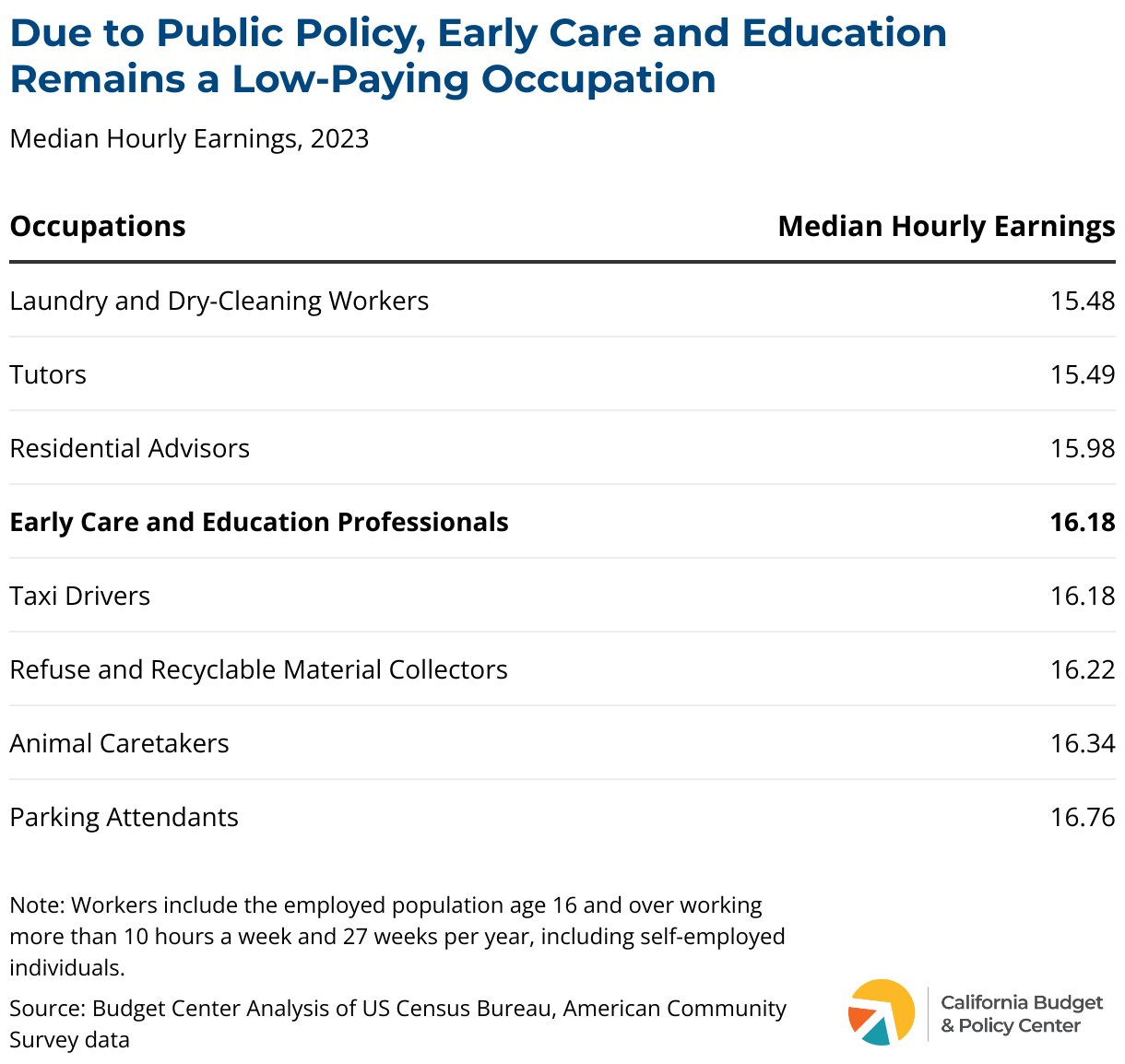
In addition to K-8 teachers, comparing ECE professionals’ hourly wages with other professions underscores that ECE professionals work in one of the lowest paid occupations despite the critical value of their work. The table below outlines ECE professionals’ median hourly earnings in the context of other low wage occupations. Thus, ECE professionals’ wages have not only grown at a slow rate, but they also started near the floor. ECE professionals have been stuck in low wage work, despite increases in state funding for ECE.
What is the consequence of low wages for ECE professionals?
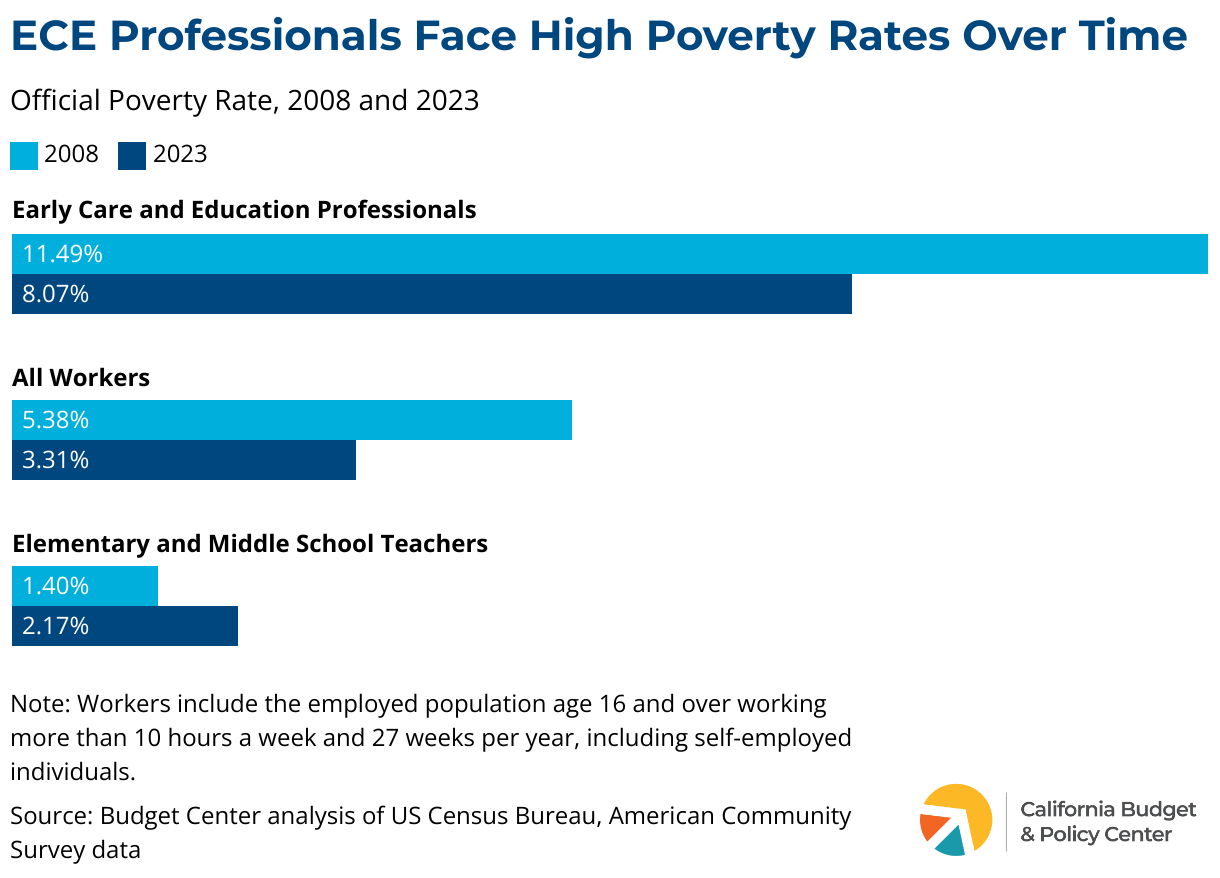
Poverty is on the rise for children and families across California. Thus, many of the families ECE professionals serve are struggling more now than in prior years to make ends meet; however, many professionals themselves are also in poverty. Specifically, compared with all workers and elementary and middle school teachers, a disproportionate percentage of ECE professionals are also in poverty. The chart below shows that while poverty rates have decreased for ECE professionals over time, they are still over twice that of all workers and nearly four times that of elementary and middle school teachers. These relatively high poverty rates are a consequence of ECE professionals’ historically low wages.
How can state leaders support ECE professionals?
Overall, California has undoubtedly seen an increased investment in its ECE system. However, the system is still falling short in several ways. While the number of slots has increased, thousands of families still do not have access to affordable ECE options. Increasing access to ECE programs also requires supporting ECE professionals, and wages are still too low to ensure ECE professionals have the resources they need to expand and thrive.
Inequities in the ECE system reflect centuries of historical racism and sexism. The ECE system and its workforce deserve better, and state leaders have the tools to ensure that ECE professionals are paid a living and just wage. Specifically, state leaders can advance the alternative methodology to develop payment rates and implement an improved rate structure. For far too long, ECE professionals have worked low wages and endured a system that undervalues their integral role in California. California has been a leader in many other policy areas, and is well-poised to continue leading by paying ECE professionals the true cost of care.
Kristin Schumacher, a former analyst at the California Budget & Policy Center, now contributes to the organization as a consultant on various research projects.
The ECE programs referenced in this statistic include the child care and development programs administered by the California Department of Social Services.
2
The methodology to define “Early Care and Education professionals” is based on the Center for the Study of Child Care Employment’s Early Childhood Workforce. These professionals include: 1) child care workers in the child day care services, private households, religious organizations, or elementary and secondary school industries; 2) education and child care administrators in the child day care services industry; 3) preschool and kindergarten teachers in the child day care services industry; and 4) other teachers and teaching assistants in the child day care services industry.
3
The rate used to project median wages is the 10-year annual average of the change in median hourly earnings from 2012-2023. Therefore, the number of years before the wage gap closes reflects an estimate based on projected median hourly earnings. The data include the employed population age 16 and over working more than 10 hours a week and 27 weeks per year. Data for 2020 was unreliable and therefore omitted from the analysis. Source: Budget Center analysis of US Census Bureau, American Community Survey data.
You may also be interested in the following resources:
There was a problem processing your signup. Please try again. Or contact us
Please check your email to confirm your signup.
key takeaway
California’s uninsured rate reached an all-time low in 2022, but the state must now work to maintain this progress. State leaders must ensure equitable access to health coverage as they process Medi-Cal renewals, which were temporarily suspended during the COVID-19 pandemic.
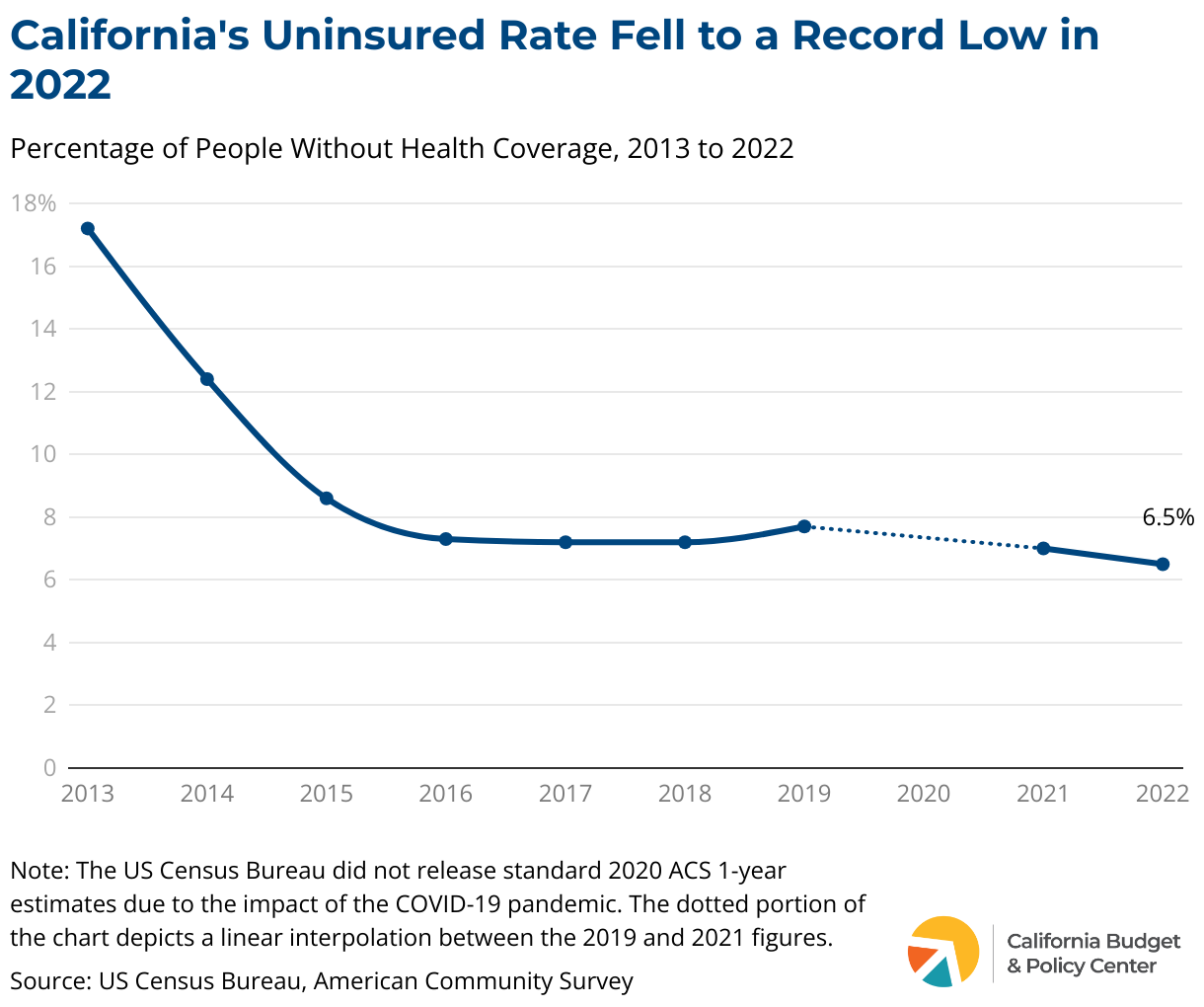
Consistent access to health care is necessary for everyone to be healthy and thrive. During the pandemic, millions of Californians with low incomes were able to stay continuously enrolled in Medi-Cal (California’s state Medicaid program) due to a federal pandemic-era policy.1A provision in the federal Families First Coronavirus Response Act passed in March 2020 required states to provide continuous coverage for Medicaid beneficiaries in exchange for enhanced federal funding during the federally declared Public Health Emergency (PHE). The Consolidated Appropriations Act of 2023, which federal policymakers passed in December 2022, delinked the continuous coverage provision from the PHE, thereby ending this provision on March 31, 2023. Partly as a result of this federal policy, Medi-Cal enrollment in California reached an all-time high — with over 15 million people enrolled — while the uninsured rate dropped to a historic low (6.5%).
Earlier this year, California began processing Medi-Cal renewals for the first time since the start of the pandemic. Recent data reveal an alarming trend: More than 500,000 Californians have lost Medi-Cal coverage during recent months. Although not everyone who loses Medi-Cal coverage becomes uninsured, the majority of people who lost coverage did so because of paperwork challenges. Certain groups, including immigrants, older adults, and people with disabilities, are at greater risk of losing Medi-Cal coverage during this continuous coverage “unwinding” period.
State leaders have implemented measures to reduce barriers to accessing and maintaining Medi-Cal coverage. Still, policymakers can take additional steps to prevent Californians who remain eligible for Medi-Cal from losing coverage. This includes pausing procedural terminations and investing in health navigators. By taking additional action, state leaders can strive to ensure that all Californians, regardless of race, age, disability, or immigration status, can access and maintain the critical health coverage they need to be healthy and thrive.
What is health equity?
When everyone has the opportunity to be as healthy as possible and no one is disadvantaged from achieving this because of their race, gender identity, sexual orientation, the neighborhood they live in, or any other socially defined circumstance.
California’s Health Coverage Landscape: Progress, Disparities, and the Path to Equitable Coverage
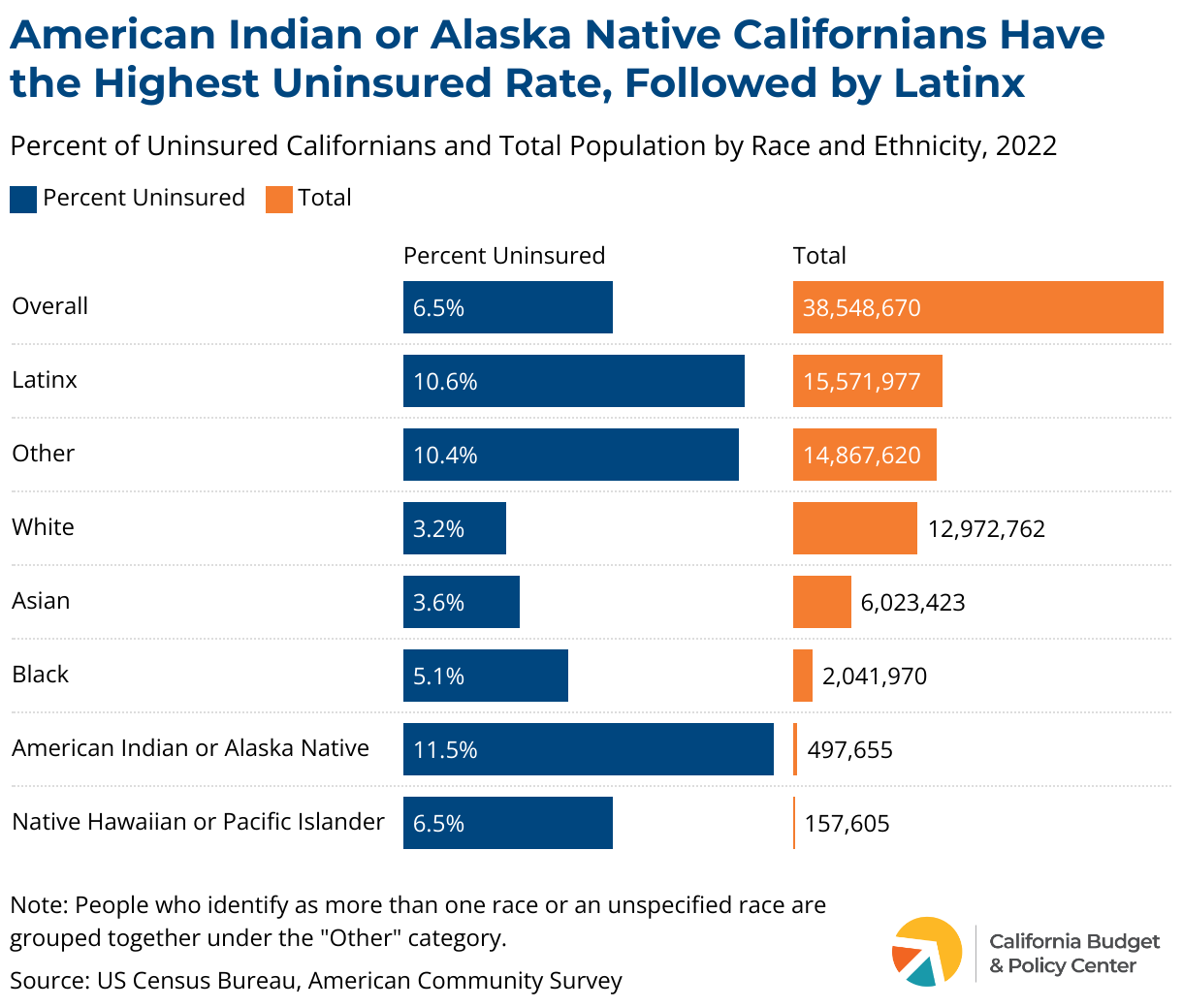
California has made significant strides in expanding access to health coverage. This progress is primarily due to the federal Affordable Care Act (ACA) and, more recently, the state’s efforts to expand comprehensive Medi-Cal coverage to income-eligible undocumented Californians. The percentage of Californians without health coverage decreased to 6.5% in 2022, down from the previous record low of 7% in 2021. These recent improvements in health coverage highlight the significant progress that California has made over the last decade when the uninsured rate was over 17%.
While access to health coverage has improved for all racial/ethnic groups in California over the last decade, racial disparities in coverage persist. Notably, gains in health coverage were significantly lower for Californians who identified as American Indian or Alaska Native (AI/AN), who had the highest uninsured rate. The uninsured rate of AI/AN Californians was nearly double that of the overall Californian population. Racial disparities were also evident for Latinx Californians, who had the second-highest uninsured rate. This is particularly concerning given that people identifying as Latinx account for over 40% of the state’s population.
The racial disparities in health coverage highlight the profound and enduring impact of racism, which blocks Californians of color from equal access to health care. For example, some people of color may hesitate to seek coverage because they distrust the government and health care systems that are responsible for past and ongoing mistreatment against them, their families, and their communities. Another instance of a racist policy is the exclusion of undocumented immigrants, driven by racial and xenophobic biases, from enrolling in federally funded Medicaid coverage or purchasing coverage through the ACA marketplaces.2Undocumented immigrants are not eligible to enroll in federally funded Medicaid coverage or purchase coverage through the ACA Marketplaces. In recent years, California has allocated state funding to expand eligibility for full-scope Medi-Cal to undocumented immigrants.
While California has made significant progress in increasing health coverage, there is much more work to be done to ensure equitable access to health coverage for all Californians. Addressing the racial disparities in health coverage requires targeted outreach and education efforts along with other antiracist policy actions to improve health and well-being for Californians of color.
Many Californians Are Losing Medi-Cal Coverage Due to Paperwork Challenges
On April 1, 2023, California began the process of redetermining eligibility for Medi-Cal enrollees for the first time since the onset of the COVID-19 pandemic. The California Department of Health Care Services (DHCS) publishes data showing the number of Californians who become disenrolled as a result of the redetermination process (i.e., undergo a procedural termination).3The California Department of Health Care Services (DHCS) publishes interactive Medi-Cal dashboards detailing statewide and county-level demographic data on Medi-Cal application processing, enrollments, redeterminations, and renewal outcomes. DHCS also provides valuable insight into the circumstances leading to the disenrollment of Medi-Cal beneficiaries, which are categorized as follows:
Procedural: an individual loses coverage due to issues with their renewal paperwork.4In this issue brief, the term "paperwork" is used in place of the term "procedural." This may be a result of a Medi-Cal enrollee not receiving or returning requested forms on time, or other issues with the application system.
Over Income: an individual's income exceeds the Medi-Cal eligibility threshold, potentially making them eligible for coverage through Covered California — the state’s health insurance marketplace.
Other Reasons: an individual moves out of the state, voluntarily disenrolls, or passes away.
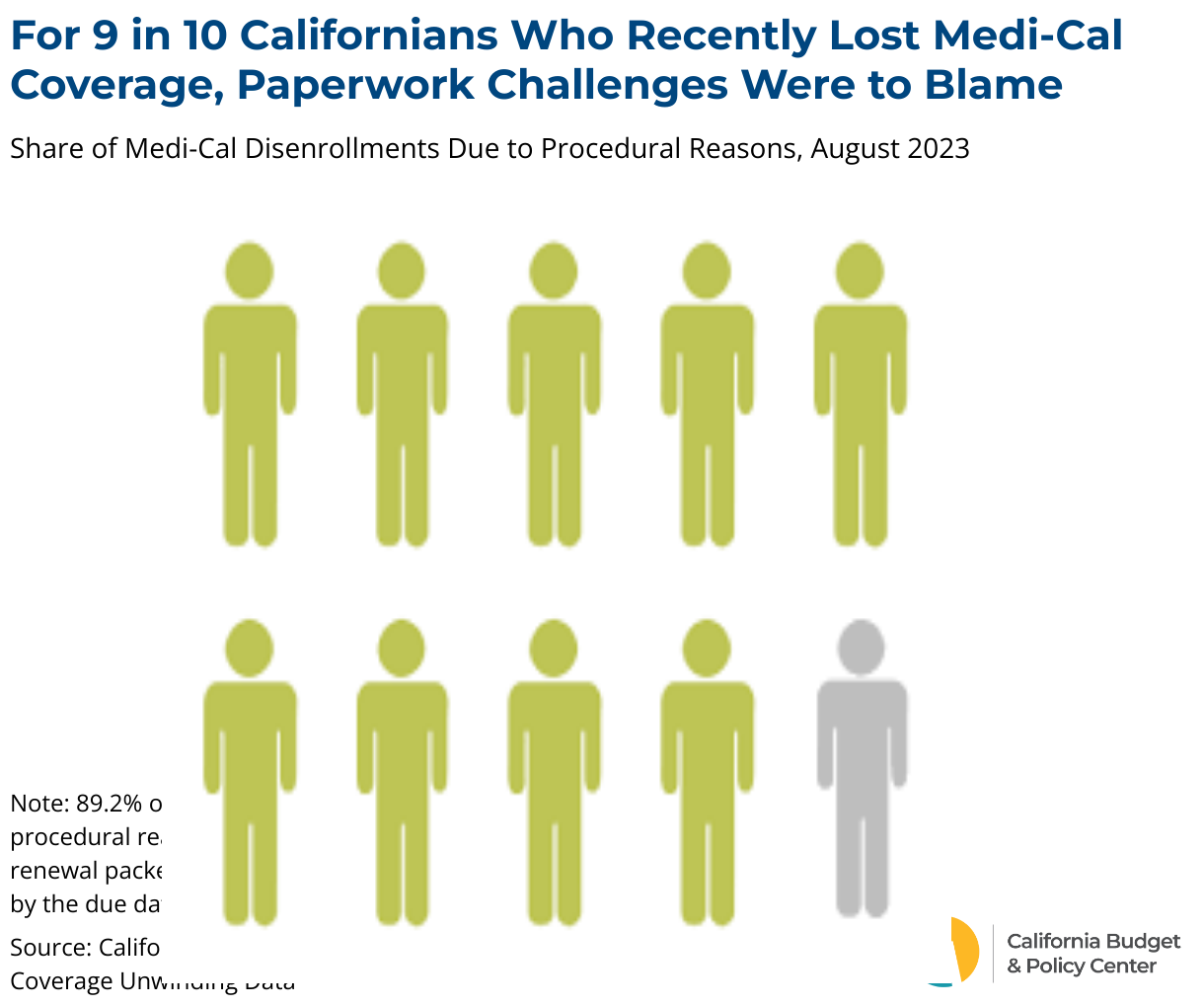
Nearly 9 in 10 Californians (89.2%) who lost Medi-Cal coverage in August 2023 did so because they did not complete the renewal paperwork or had incorrect or missing information in their forms. Although not everyone who loses Medi-Cal coverage becomes uninsured, the data reveal a troubling trend.5Medi-Cal members have 90 days after their disenrollment to provide the necessary outstanding information to their local Medi-Cal office to restore their coverage. After the 90 days, people can submit a new application. Historically, California has seen a reinstatement rate of about 4% over the 90-day period.
Completing the renewal process often involves complex paperwork and documentation requirements, which can be difficult to navigate. Additionally, some Californians have experienced extended call wait times when attempting to contact county Medi-Cal workers regarding their application.
Certain groups, including older adults and people with disabilities, are at greater risk of losing Medi-Cal coverage during the unwinding period.6Jennifer Tolbert and Meghana Ammula, 10 Things to Know About the Unwinding of the Medicaid Continuous Enrollment Provision (Kaiser Family Foundation, June 2023). Immigrants and their family members face unique obstacles to remaining covered, such as language barriers, privacy concerns, and fear of immigration consequences. As such, many Californians who are losing Medi-Cal coverage due to paperwork challenges may still meet the eligibility criteria.7Of the redeterminations that were received and processed in August 2023, about 20% were ineligible. See California Department of Health Care Services, Medi-Cal Continuous Coverage Unwinding Dashboard (August 2023), 14.
The high disenrollment rate due to paperwork challenges underscores the need to further streamline the renewal process and alleviate the paperwork burden on beneficiaries during the unwinding period and beyond. Addressing these challenges is essential to ensure that those who are eligible for Medi-Cal continue to receive vital health coverage.
Policy Recommendations to Support Equitable Access to Health Coverage Amidst the Unwinding Period
State leaders have taken steps to mitigate the impact of the continuous coverage unwinding period and better support access to health coverage. Earlier this year, the California Department of Health Care Services (DHCS) set forth a detailed plan with a guiding principle to maximize the continuity of coverage for Medi-Cal beneficiaries. These actions include:
Providing one-time funding support to local county offices, which are responsible for determining the initial and continuing Medi-Cal eligibility for an individual or a family.
Authorizing Covered California to enroll individuals in a qualified health plan when they lose Medi-Cal coverage.
Engaging community partners to serve as “Coverage Ambassadors” to share information with Medi-Cal beneficiaries about how to maintain Medi-Cal coverage.
State leaders can build on previous policy changes by taking action on the following recommendations:
Encouraging DHCS to suspend procedural Medi-Cal terminations given the high rate of such termination
This could help toprevent undue disruptions in health coverage. Additionally, the state can identify the reasons why these disenrollments are occurring and develop strategies to remedy this.
Recommending DHCS to increase the rate of ex parte renewals
Expanding investments in health navigators to ensure that Californians who are eligible for Medi-Cal do not lose coverage
Health navigators are trusted members of a community who play an important role in making sure that people who are eligible for Medi-Cal can access coverage. They help to inform community members about health coverage programs and services in a way that is linguistically and culturally responsive to the communities they serve.
Accelerating the implementation of continuous Medi-Cal coverage for children from birth to age 5
In 2022, policymakers passed legislation that would allow children enrolled in Medi-Cal to remain enrolled without administrative renewals. However, this policy is not slated to begin until January 2025.
Submitting a waiver to provide adults 12 months of continuous coverage
Several other states have done so. Extending continuous coverage for adults would promote consistent health care access, reduce administrative burdens, and increase economic stability for Californians.
By taking these steps, state leaders can work towards ensuring that all eligible individuals, regardless of age, disability, or immigration status, can access and maintain the critical health coverage they need in order to be healthy and thrive.
A provision in the federal Families First Coronavirus Response Act passed in March 2020 required states to provide continuous coverage for Medicaid beneficiaries in exchange for enhanced federal funding during the federally declared Public Health Emergency (PHE). The Consolidated Appropriations Act of 2023, which federal policymakers passed in December 2022, delinked the continuous coverage provision from the PHE, thereby ending this provision on March 31, 2023.
The California Department of Health Care Services (DHCS) publishes interactive Medi-Cal dashboards detailing statewide and county-level demographic data on Medi-Cal application processing, enrollments, redeterminations, and renewal outcomes.
4
In this issue brief, the term "paperwork" is used in place of the term "procedural."
5
Medi-Cal members have 90 days after their disenrollment to provide the necessary outstanding information to their local Medi-Cal office to restore their coverage. After the 90 days, people can submit a new application. Historically, California has seen a reinstatement rate of about 4% over the 90-day period.
Of the redeterminations that were received and processed in August 2023, about 20% were ineligible. See California Department of Health Care Services, Medi-Cal Continuous Coverage Unwinding Dashboard (August 2023), 14.
You may also be interested in the following resources:
El cuidado infantil asequible y enriquecedor es esencial para apoyar a las familias de California. Aunque la ayuda del gobierno federal proporcionó fondos para apoyar el sistema de cuidado infantil de California durante el COVID-19, estos fondos son temporales y muchas familias pronto enfrentarán la realidad de costos más altos para el cuidado infantil. Esto es particularmente importante para las mujeres de color que tenían muchas más probabilidades de sufrir los efectos económicos de la recesión del COVID-19.
Según datos recolectados en el año 2020, las mujeres latinas, afroamericanas y la mayoría de las demás mujeres de color tenían muchas más probabilidades de vivir en hogares atrasados con el pago de la renta o la hipoteca y en hogares con dificultad para poner suficientes alimentos en sus mesas. Durante este periodo de tiempo, el estado de California suspendió el requisito de que las familias que participan en el programa estatal de subsidios para el cuidado infantil paguen tarifas asociadas con el cuidado infantil, también conocidas como “tarifas familiares”. Esta suspensión vence el 30 de septiembre de 2023.
Sin embargo, con el liderazgo de Voces de Padres en movilización y defesa (como se detalla más abajo), a partir del 1 de octubre de 2023, las familias tendrán un programa de tarifas más equitativo que minimiza la necesidad de tener que escoger entre pagar por cuidado de niños y pagar otras necesidades básicas. Los líderes estatales ahora tienen la oportunidad de adoptar un programa de tarifas que realmente minimice los desafíos económicos que ya enfrentan muchas familias de California.
Acerca de esta publicación
Esta publicación fue escrita en colaboración con Voces de Padres. A través de la organización de base y el desarrollo de liderazgo, Voces de Padres activa y centra la sabiduría de los padres para transformar el cuidado infantil y garantizar que todos los sistemas que impactan a nuestras familias sean justos, equitativos e inclusivos.
Un agradecimiento especial a Marisol Rosales, una madre líder de Voces de Padres, por traducir este informe al español.
Acerca de las tarifas familiares para el cuidado infantil
Las tarifas familiares varían según los ingresos de la familia. Una familia que gana hasta el 85% del ingreso medio estatal califica para el programa de cuidado infantil subsidiado por el estado.1Las familias con ingresos hasta el 100% del ingreso medio estatal califican para el Programa Preescolar del Estado de California. El monto de una tarifa para el cuidado infantil de tiempo completo y de tiempo parcial está asociado con niveles de ingresos de hasta el 85 % del ingreso medio estatal. Estas familias deben pagar una tarifa basada en sus ingresos para acceder al cuidado infantil de tiempo completo o tiempo parcial subsidiado por el estado.
Cada año fiscal, el Departamento de Servicios Sociales de California establece los montos de tarifas para cada nivel de ingresos en un “programa de tarifas familiares”. Estas tarifas han sido inasequibles para las familias de California con ingresos bajos a moderados, lo que las ha obligado a muchas familias a decidir entre pagar el cuidado de niños y otras necesidades básicas, como alimentos y vivienda.
Sin embargo, la ley de presupuesto estatal de 2023-24 modificó permanentemente el programa de tarifas para que estos pagos sean más asequibles. Específicamente, a partir del 1 de octubre de 2023, las familias con ingresos por debajo del 75% del ingreso medio estatal ya no pagarán una tarifa, y las tarifas tendrán un límite del 1% de sus ingresos para aquellas familias al 75% o más del ingreso medio estatal. La siguiente tabla muestra los ingresos anuales de una familia al 75% del ingreso medio estatal.2Las estimaciones de ingreso medio estatal se basan en la encuesta American Community Survey del año 2021.
Ingresos al 75% del ingreso medio estatal
Número de miembros en la familia
Ingresos anuales
1-2
$64,884
3
$73,382
4
$84,969
Además, familias no tendrán que pagar tarifas pendientes de antes del 1 de octubre de 2023. La ley de presupuesto estatal de 2023-24 refleja los principales puntos de reforma de las tarifas familiares de Voces de Padres (como se detalla a continuación), pero el programa específico de tarifas que refleja estos puntos aún no se ha confirmado.
Hacia un programa de tarifas más equitativo
Desde 2019, padres líderes de Voces de Padres han expresado sus frustraciones y preocupaciones sobre el alto costo de las tarifas familiares. Señalaron el confuso formato del programa y cómo las altas tarifas limitan las posibilidades para sus familias. Los padres líderes se enteraron de que otros estados tienen programas de tarifas más asequibles y fáciles de entender.
Concretamente, los padres líderes se inspiraron en el programa de tarifas de Dakota del Sur, el cual limita los pagos al 1% de los ingresos de una familia, y también en el programa del estado de Washington que tiene un formato fácil de entender. Lo que surgió de esta investigación y conversaciones fue una visión clara para mejorar el programa de tarifas familiares en California, que incluye:
Eliminación de tarifas para todas las familias con ingresos hasta el 75% del ingreso medio estatal.
Tarifas en una escala móvil de pago equitativa con un límite del 1% de ingresos para familias al 75% o más del ingreso medio estatal.
Simplificar el programa de tarifas para que los principales niveles de ingresos se agrupen.
Suspender el cobro de tarifas atrasadas.3Muchas familias tenían planes de pago antes de la pandemia. Esos planes de pago han estado suspendidos, y sin medidas por parte de lideres estatales, los pagos reiniciarían el 1 de octubre de 2023.
Voces de Padres, con el apoyo del Child Care Resource Center y Every Child California, creó este sueño en un programa de tarifas familiares concreto que permitiría a las familias minimizar la necesidad de tener que escoger entre pagar por el cuidado infantil y pagar otras necesidades básicas. El programa de tarifas propuesto por Voces de Padres cuenta con el respaldo de sus padres líderes y refleja ahorros sustanciales comparado con el programa de tarifas original del Departamento de Servicios Sociales de California de 2023-24.
Expandiendo oportunidades con un nuevo programa de tarifas
La siguiente tabla muestra que porcentaje de los ingresos de una familia compuesta por una madre y su hijo debe gastarse en tarifas según el programa del Departamento de Servicios Sociales de California de 2023-24 comparado con el programa propuesto por Voces de Padres.
Porcentaje de ingresos pagados en tarifas para una familia de dos
Ingreso medio estatal
Ingresos anuales
Porcentaje de ingresos pagados en tarifas: programa del Departamento de Servicios Sociales 23-24
Porcentaje de ingresos pagados en tarifas: Programa de Voces de Padres
40% a 74%
$34,606 – $64,020
2.5% – 9.9%
0%
75%
$64,884
9.9%
0.2%
76%
$65,751
9.9%
0.2%
78%
$67,481
9.9%
0.2%
80%
$69,211
9.9%
0.2%
82%
$70,941
9.9%
0.4%
83%
$71,807
9.9%
0.4%
84%
$72,672
9.9%
0.4%
85%
$73,537
9.9%
0.4%
Con el programa de tarifas familiares de Voces de Padres, en algunos casos, las familias recuperarían casi el 10% de sus ingresos anuales. La siguiente gráfica muestra la cantidad de dinero que las familias de California de dos personas ahorrarían al usar el programa de tarifas de Voces de Padres. La tabla (después de la gráfica) muestra la cantidad de las tarifas para familias al 75% del ingreso medio estatal para varios tamaños de familias.
Cantidad anual en tarifas familiares para una familia al 75% del ingreso medio estatal
Número de miembros en la familia
Programa del Departamento de Servicios Sociales 23-24
Programa de Voces de Padres
1-2
$6,418
$133
3
$6,418
$151
4
$6,418
$174
Los padres líderes compartieron lo que estos ahorros podrían hacer posible para sus familias:
Karina del condado de Sonoma es madre de tres hijos. Actualmente está estudiando para obtener su licenciatura en sociología de la Universidad de Sonoma. Con el programa de tarifas del Departamento de Servicios Sociales, Karina tendría que pagar $600 por mes por el cuidado de niños. Compartió:
“Cuando me dijeron que tendría que pagar $600 al mes porque la tarifa familiar comenzaría nuevamente en octubre, estaba muy preocupada. Vi mis sueños educativos desvanecerse. Tendría que reducir mis clases y me tomaría más tiempo empezar a trabajar”.
Además, Karina compartió que el tener que pagar tarifas familiares significa tomar decisiones imposibles:
“Si tengo que pagar $600 dólares, voy a tener que elegir entre sacar a mi hija del programa que tanto la ayuda, o mantenerla en el programa y tomar el dinero de nuestro presupuesto para la comida. Alimentar a tres niños que están creciendo y a dos adultos no es barato. No quiero volver a abrir el refrigerador y ver los cajones vacíos”.
Con el programa de tarifas de Voces de Padres, Karina ahorraría $6,766 por año. Con este dinero, Karina puede comprar comida para casi diez meses, mantener a su hija en cuidado infantil y continuar con sus metas educativas.
Stevie del condado de Fresno
Stevie del condado de Fresno es madre de tres hijos. Actualmente está trabajando para obtener su certificación de Profesional en Recursos Humanos. Tener acceso al cuidado de niños fue fundamental para su capacidad de titularse de la escuela y perseguir sus metas profesionales. Con el programa de tarifas del Departamento de Servicios Sociales, Stevie tendría que pagar $500 por mes por el cuidado de niños. Compartió:
“Como madre soltera y compartiendo una habitación con un hijo, más del 50% de mis ingresos netos de cada cheque son para cubrir este gasto. Cuando vuelvan las cuotas familiares el 1 de octubre, tendré que pagar una cuota de más de $500 al mes. Esto sería un retroceso extremo para nosotros”.
Sin este gasto en una tarifa por el cuidado infantil, Stevie puede imaginar una vida en la que sus hijos puedan participar en actividades extracurriculares y ella pueda alcanzar su sueño de titularse de la universidad como estudiante de primera generación. La perspectiva de pagar una tarifa deja a Stevie con una serie de preguntas que le provocan ansiedad:
“¿Me faltará para la renta? ¿Tendré suficiente para cubrir el costo de la gasolina y la comida hasta mi próximo cheque? ¿Cómo voy a llegar a fin de mes cuando los gastos son solo lo básico para simplemente vivir?”
Con el programa de tarifas de Voces de Padres, Stevie ahorrará $6,000 por año. Con este dinero, Stevie puede pagar casi cinco meses de comida y dos meses de renta.
Elizabeth del condado de Riverside
Elizabeth del condado de Riverside es madre de tres hijos. Ella recibe un subsidio para el programa de cuidado infantil de su hijo de dos años. Con el programa de tarifas familiares de Departamento de Servicios Sociales, Elizabeth tendría que pagar $413 por mes, además de los $272 por mes que actualmente le paga a su proveedor de cuidado infantil. Los $413 adicionales por mes obligarán a Elizabeth a recortar gastos en otras áreas de su presupuesto de necesidades básicas e incluso a considerar dejar su trabajo:
“Lloro cuando pienso en lo que tendré que recortar de nuestro presupuesto para pagar la guardería. ¿Recortaré nuestro presupuesto para la comida, la gasolina, la ropa o los servicios públicos? A veces casi pienso en renunciar a mi trabajo debido a estas tarifas”.
Con el programa de tarifas familiares de Voces de Padres, Elizabeth ahorrará $4,968 por año. Con este dinero, Elizabeth no solo podrá mantener a su hijo con su proveedor de cuidado infantil, sino que también podrá pagar 14 semanas de comida y siete meses de facturas de gas y electricidad.
De acuerdo con los números de inscripción del año anterior y con el actual programa de tarifas del Departamento de Servicios Sociales de California, las familias pagarían colectivamente más de $100 millones de dólares en tarifas durante el transcurso del año. La ley de presupuesto estatal de 2023-24 reducirá significativamente el monto de las tarifas familiares, y en los próximos meses, líderes estatales consolidarán una escala actualizada de tarifas para confirmar exactamente cuánto será esta reducción.
A medida que los líderes estatales deciden sobre el nuevo programa de tarifas para 2023-24, el programa de tarifas familiares propuesto por Voces de Padres proporciona un modelo para garantizar que las familias, en particular aquellas encabezadas por mujeres de color como Elizabeth, Stevie y Karina, tengan los ingresos necesarios para pagar las necesidades básicas como la renta, servicios públicos y comida, para abrir posibilidades y lograr sus metas profesionales y educativas y también brindar una vida enriquecedora para sus hijos.
Las familias con ingresos hasta el 100% del ingreso medio estatal califican para el Programa Preescolar del Estado de California.
2
Las estimaciones de ingreso medio estatal se basan en la encuesta American Community Survey del año 2021.
3
Muchas familias tenían planes de pago antes de la pandemia. Esos planes de pago han estado suspendidos, y sin medidas por parte de lideres estatales, los pagos reiniciarían el 1 de octubre de 2023.
You may also be interested in the following resources:
There was a problem processing your signup. Please try again. Or contact us
Please check your email to confirm your signup.
This website uses cookies to analyze site traffic and to allow users to complete forms on the site. The California Budget & Policy Center does not share, trade, sell, or otherwise disclose personal information. By using our website you agree to our Privacy Policy.
California Budget & Policy Center
Secure Your Spot!
Join us in Sacramento on April 22, 2026 for engaging sessions, workshops, and networking opportunities with fellow changemakers, inspiring speakers, and much more.