Child care is critical for working parents, but the high cost of care can be a challenge for families. A very small share of California families with low and moderate incomes receive care through the state’s subsidized child care and development system. Many of these families pay monthly fees into this system — fees that can be unaffordable for families who are living paycheck to paycheck.
Working parents should not have to face impossible choices each month about whether to pay for food, rent, or child care. Learn more about family fees and why policymakers must use state and federal dollars to waive fees, ensure child care providers are supported, and boost families’ economic security.
There was a problem processing your signup. Please try again. Or contact us
Please check your email to confirm your signup.
More than 6 in 10 California children under the age of 12 live in families where all parents are working.1 For this reason, child care providers are a critical component of the state and nation’s economic infrastructure, ensuring that children have a safe space to learn and grow while parents work. Many providers in California have stepped up to the challenge of delivering care and distance learning support for families during the COVID-19 pandemic and recession — particularly for children with parents who are essential workers. But the state’s child care system is on the verge of collapse.
Already operating on thin financial margins, child care providers are struggling with a loss of income due to reduced enrollment, while facing dramatically increased costs necessary to keep children and staff safe and healthy. Many providers report losing money and turning to personal savings and credit cards in order to sustain operations.2 Since the pandemic began, many providers have closed their doors in California and thousands will not reopen.3 In addition, nearly 3 in 10 jobs in the child care industry have been lost during the crisis.4 These business owners and workers are primarily women and Black, Latinx, immigrant, and other workers of color. The loss of small businesses and jobs coupled with a decrease in child care supply for working families only exacerbates the economic toll of the pandemic on workers of color, women, and their communities.
“
Child care providers are struggling with a loss of income due to reduced enrollment, while facing dramatically increased costs necessary to keep children and staff safe and healthy.
”
Both the state and federal government have provided emergency funding to support child care providers and families this past year, but total support falls far short of the estimated level necessary to sustain this critical industry. The federal COVID relief package enacted in late 2020 included $10 billion in federal Child Care and Development Block Grant funds. California received $964 million of this funding. Policymakers and the administration must ensure that these one-time federal relief dollars are distributed equitably and without delay to avoid additional closures and layoffs as well as to support working families.
The state’s fiscal health is unexpectedly strong despite the current crisis. Policymakers should also invest one-time funds to help strengthen California’s child care infrastructure and dedicate ongoing funding to help families afford care and to pay providers fair rates. Even prior to the pandemic, 60% of Californians lived in a child care desert with limited access to child care providers.5 California’s economy cannot recover from the shocks of the COVID-19 pandemic until children have a safe place to learn and grow, working parents can return to their jobs, and providers are supported in sustaining the critical child care industry.
Support for this Fact Sheet was provided by First 5 California.
There was a problem processing your signup. Please try again. Or contact us
Please check your email to confirm your signup.
COVID-19 has changed jobs, schools, and child care settings for Californians, and this has been particularly disruptive for children, families, and the child care providers who are essential to California’s economy and communities. In this presentation learn what funding early care and education programs received in the 2020-21 state budget and from federal relief in 2020, and the additional support providers, workers, and families – particularly Californians of color and families in low-income households – still need from state and federal policymakers in the ongoing pandemic.
There was a problem processing your signup. Please try again. Or contact us
Please check your email to confirm your signup.
During this unprecedented health and economic crisis, many subsidized child care providers in California have stepped up to the challenge of providing early learning and care for families with low and moderate incomes – particularly for children with parents who are essential workers. While the state and federal government have both provided emergency funding to support subsidized child care providers, total support falls far short of the estimated level necessary to sustain child care providers. In addition, the Governor’s May Revision would cut provider payment rates by 10%. These rate cuts could be detrimental for child care providers who were already underpaid and operating on thin margins prior to the COVID-19 pandemic. Now, during this crisis, providers are faced with dramatically higher costs due to smaller class sizes, increased staffing per child, and the added expense of keeping facilities clean as they care for and educate children.
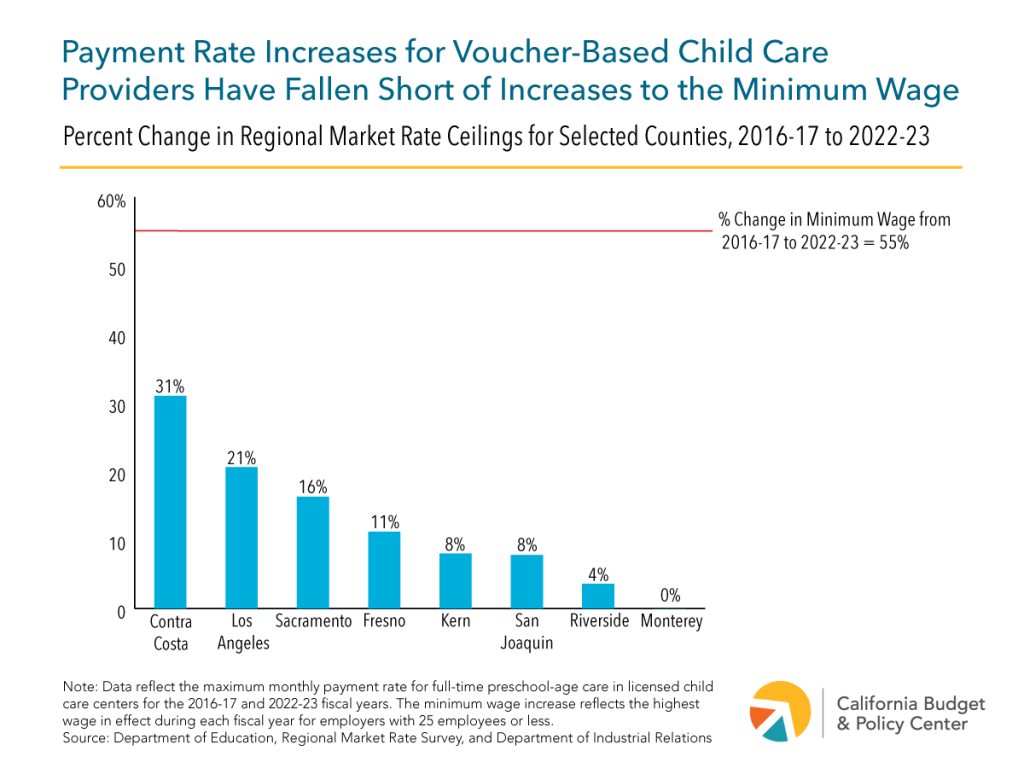
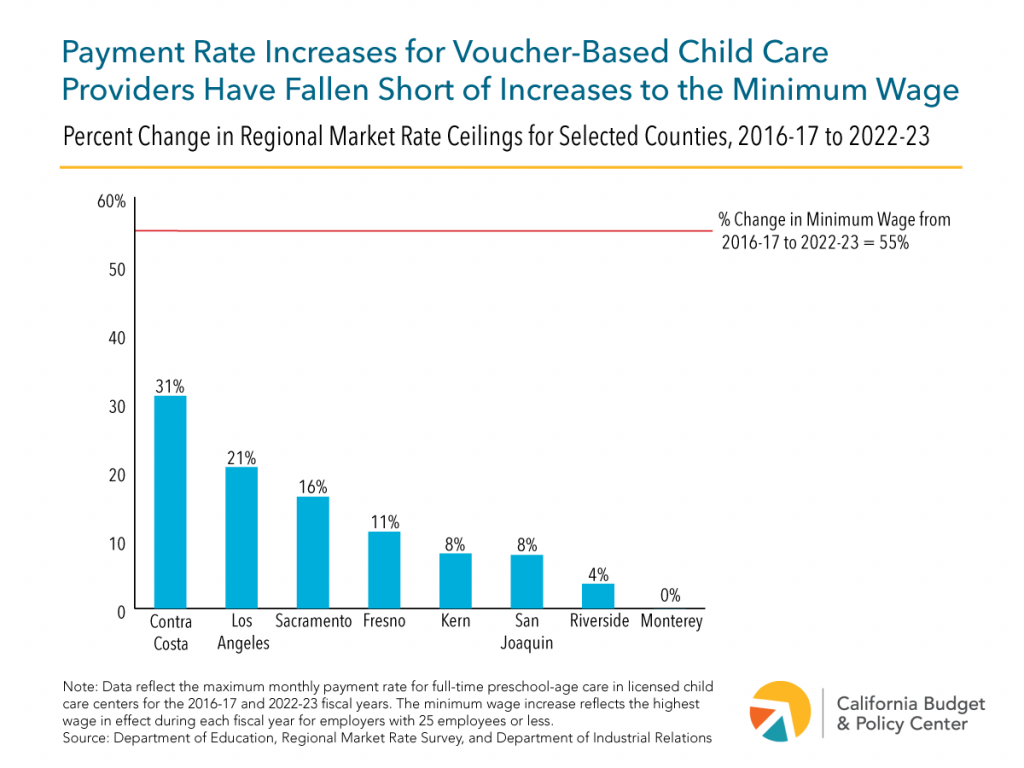
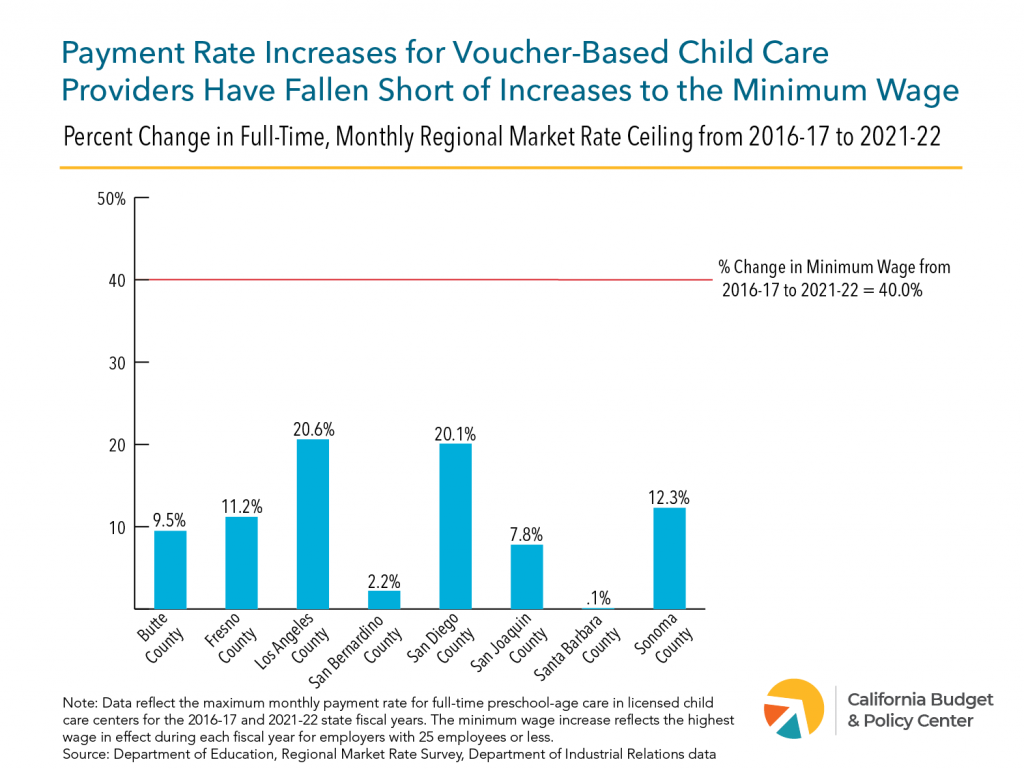
Subsidized child care providers are paid in one of two basic ways: by contracting directly with the state or by accepting vouchers from families. Providers who accept vouchers are reimbursed based on the Regional Market Rate (RMR) Survey, which provides “rate ceilings” for all 58 California counties by the type of care and the age of the child. The rate ceilings in use in the 2019-20 state fiscal year are based on the 75th percentile of the 2016 survey. In theory, this should allow families to access 75 out of every 100 providers in their county. However, because the state is currently using an outdated survey, families are able to access far fewer providers.
A 10% decrease to the current, outdated rate ceilings would further restrict families’ access to care. For example, in Los Angeles County where one-quarter of children eligible for subsidized child care live, the proposed rate ceiling for full-time, center-based care for an infant would be $1,435 per month, which means that families would have access to just 54% of providers in their community based on the most recent survey from 2018. Across California, the proposed rate ceilings for many counties would fall far short of the 75th percentile benchmark from the most recent survey.
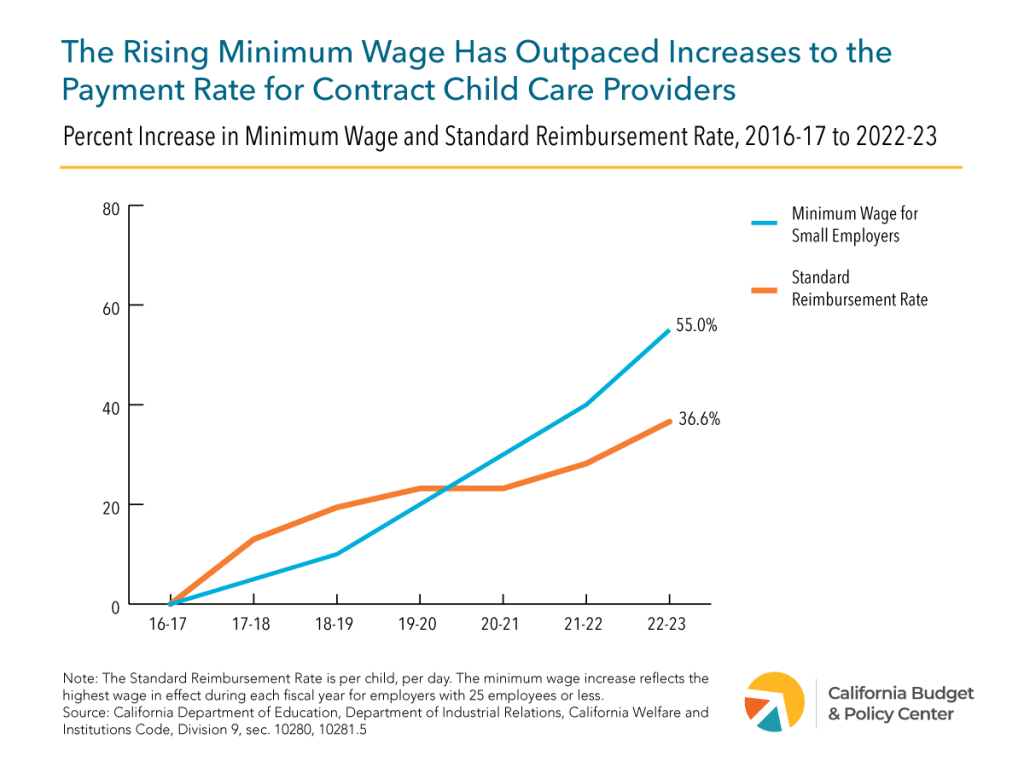
Providers that contract directly with the state are reimbursed with a statewide rate called the Standard Reimbursement Rate, which is adjusted based on different factors such as the age of the child. Contract-based providers have to meet quality standards, in addition to meeting the health and safety standards that voucher-based providers are held to. Given the additional standards required by the state, a higher rate should be provided for contract-based providers. However, in 14 counties contract-based centers caring for preschool-age children are paid at a monthly rate that is less than vouchers for center-based providers. One reason for this is because policymakers have not consistently increased the Standard Reimbursement Rate each year, and this key payment rate has lost value over time. A 10% cut would erase some of the gains made after the Great Recession in boosting the Standard Reimbursement Rate.
Child care providers’ ability to offer subsidized care depends, in part, on the state’s reimbursement rates. When providers are not paid at a level that allows them to operate their businesses, attract and retain qualified staff, and afford materials and supplies to educate children, they may be unable to offer care to families with low incomes. Some may be forced to permanently close their doors.
While the May Revision proposes to use $125 million in federal emergency funds to provide one-time stipends to subsidized providers, the value of these stipends will likely fall far short as compared to the long-term loss in income due to the Governor’s proposed 10% payment rate cut. In the meantime, California could lose an invaluable number of child care providers and diminish families’ access to care.
Child care providers are offering early learning and care for thousands of California children and are playing an outsized role as essential workers who ensure that other vital workers in our communities can go to work. Policymakers should use all available funds to stabilize subsidized child care providers by providing stipends for increased costs as proposed in the May Revision and maintaining provider payment rates. This is critical to helping providers survive the COVID-19 crisis, supporting families with low incomes who must leave their homes to work, and aiding the state’s economic recovery.
Support for this work is provided by First 5 California.
There was a problem processing your signup. Please try again. Or contact us
Please check your email to confirm your signup.
As California grapples with the COVID-19 pandemic, it’s been essential workers in hospitals, grocery stores, agricultural fields, and many other core services that have helped ensure the health and safety of our communities. But essential workers can’t go to work – no matter how vital their jobs – without a safe space for their children to learn and grow. This presentation by Senior Policy Analyst Kristin Schumacher covers research on the state’s essential workers, industries, and occupations – conducted in partnership with the UC Berkeley Labor Center. You’ll also learn how many children in California had parents who were considered essential workers and the number of children who were income-eligible for subsidized care with parents working in essential jobs.
The neighborhood a child grows up in can shape their long-term success, affecting their economic mobility as adults.[1] While Governor Newsom has pledged to create a “California for All,” currently opportunities for children are not evenly distributed across the state. Policymakers who aim to boost opportunity and improve children’s life-long prospects can strategically invest in subsidized child care and development programs that serve families with low and moderate incomes by targeting areas that have been left behind.
According to a Budget Center analysis of federal survey data, an estimated 2 million children from birth through age 12 were eligible for subsidized child care and development programs in California in 2017 — roughly 1 in 3 children across the state (32.2%).[2] The share of children eligible by county varied dramatically, with the highest shares of eligible children living in counties in the Central Valley — a region with some of the state’s highest poverty rates.[3] Kings County had the highest share, with more than half of all children in the county eligible for subsidized care (50.9%). (See Map below.) More than half of the children in the county group of Colusa, Glenn, Shasta, Tehama, and Trinity were also eligible (50.2%).[4] Conversely, the counties with the lowest share of eligible children were in and around the San Francisco Bay Area and Lake Tahoe, where the cost of living is significantly higher.[5] San Mateo County had the lowest share of eligible children, with 14.9% of children in the county eligible for subsidized care. [6] Because the cost of living is considerably higher in these counties, many families with incomes too high to qualify for subsidized care may still struggle to afford early care and education for their children.
The five counties with the largest number of eligible children were all located in Southern California: Los Angeles (539,900), San Bernardino (154,000), San Diego (149,600), Riverside (147,900), and Orange (136,900). (See Table below.) Collectively, these five counties accounted for more than half of all children birth through age 12 eligible for subsidized child care and development programs in the state. Los Angeles County alone accounted for more than 1 in 4 eligible children in California (26.6%).
Of the 2 million children eligible for subsidized care in California in 2017, just 1 in 9 children were enrolled in a program that could accommodate families for more than a couple hours per day and throughout the entire year (228,100).[7] The share of eligible children enrolled in a state program also varied across the state. (See Table below.) For example, in Orange County just 1 in 16 eligible children were enrolled in a subsidized program (6.1%). Riverside County also had a large number of eligible children but a very low share enrolled in a state program (7.3%). In contrast, due in part to a long history of prioritizing early care and education at the local level, nearly half of all eligible children were enrolled in a subsidized program in San Francisco (49.5%).[8]
Governor Newsom has signaled the intent to increase families’ access to the state’s subsidized child care and development system by proposing to boost funding for this system in the next fiscal year, including dollars for child care facilities, workforce development, and additional spaces for children. With a Governor focused on children and families, policymakers have an opportunity to invest new funding in the 2019-20 budget in an intentional fashion, targeting counties and even neighborhoods were the need is particularly acute. A child’s opportunity to escape poverty is often influenced by where they grow up. By strategically investing in areas throughout the state where children and families do not have as many opportunities, the Administration can ensure that “California for All” reaches those with the greatest need.
This analysis is the fourth part of a multiphase effort to analyze subsidized child care and development programs in California. Other phases of this work have examined the total unmet need for subsidized child care and unmet need across different age groups and by race and ethnicity. Support for this Fact Sheet was provided by First 5 California.
[2] Income eligibility is based on initial certification levels, which is 70% of state median income. Families are eligible for subsidized child care if the child who would receive care is under the age of 13; the family establishes an appropriate eligibility status, such as by having an income below the limit set by the state; and the family demonstrates a need for care, such as parental employment. Families generally must meet the same income guidelines applicable to child care to qualify for the California State Preschool Program (CSPP), which is funded solely with state dollars. State law, however, allows up to 10 percent of families in the state preschool program to have incomes up to 15 percent above the income eligibility limit, but only after all other eligible children have been enrolled. The CSPP is a part-day program offered for roughly nine months of the year. Some children receive “wraparound” services that provide subsidized child care for remainder of the day and throughout the entire year. To be eligible for the full-day CSPP, families generally must meet the same guidelines regarding eligibility status that are applicable to subsidized child care. See Kristin Schumacher, Millions of Children Are Eligible for Subsidized Child Care, but Only a Fraction Received Services in 2017 (California Budget & Policy Center: January 2019).
[4] Estimates for certain counties were deemed unreliable due to data limitations. The following counties have been grouped to improve the reliability of the data: 1) Alpine, Amador, Calaveras, Inyo, Madera, Mariposa, Mono, and Tuolumne; 2) Colusa, Glenn, Shasta, Tehama, and Trinity; 3) Del Norte, Humboldt, Lassen, Modoc, Nevada, Plumas, Sierra, and Siskiyou; 4) El Dorado and Placer; 5) Lake and Mendocino; 6) Marin, Napa, and Sonoma; 7) Monterey, San Benito, San Luis Obispo, and Santa Cruz; and 8) Sutter, Yolo, and Yuba.
[6] The income eligibility limit does not vary across the state, but a number of counties either have a pilot or are in the process of getting state approval for a county pilot to set income limits at a higher level. For example, San Mateo County and the City and County of San Francisco both have permanent pilots, which sets the income eligibility limit at 85% of state median income (SMI). Statewide the income eligibility limit is 70% of SMI, which is used for every county in this analysis.
[7] The 228,100 figure reflects children enrolled in the full-day CSPP or in one of the following subsidized child care programs: Alternative Payment Program; CalWORKs Stages 1, 2, or 3; Family Child Care Home Network; General Child Care; and the Migrant Child Care and Development Program. Enrollment is for children from birth through age 12 in October 2017. This analysis also includes the full-day CSPP, which consists of part-day preschool and “wraparound” child care, because it accommodates many — although not all — families’ work schedules throughout the year, and thus approximates the experience that a child would have in a subsidized child care program. In contrast, this analysis excludes roughly 97,000 children who were enrolled in the part-day CSPP, without access to wraparound child care, in October 2017. This is because most families with low and moderate incomes likely need wraparound care in order to supplement the CSPP’s part-day, part-year schedule. This analysis reports enrollment data for a single month — as opposed to a monthly average for 2017 — because the CDE does not typically separate part-day and full-day CSPP enrollment when reporting monthly averages for a single fiscal year. The CDE also states, “Caution should be used when interpreting monthly averages as some programs do not operate at full capacity throughout the entire year (e.g., State Preschool) while other programs have seasonal fluctuations in enrollment (e.g., Migrant Child Care).” Finally, the data are for October 2017 because the CDE’s point-in-time reports are only available for the month of October. See Kristin Schumacher, Millions of Children Are Eligible for Subsidized Child Care, but Only a Fraction Received Services in 2017 (California Budget & Policy Center: January 2019).
[8] San Francisco was the first city in the United States to pass a “Children’s Amendment.” Passed in 1991, this measure dedicated local funding to early care and education, among other programs and services for children. Voters in San Francisco also approved additional funding for a “Preschool for All” program in 2004. See San Francisco Office of Early Care & Education, San Francisco Citywide Plan for Early Care and Education (2016).
There was a problem processing your signup. Please try again. Or contact us
Please check your email to confirm your signup.
For EveryChild California’s Early Learning and Care Advocacy: A Day at the Capitol, Budget Center Senior Policy Analyst Kristin Schumacher presented on early learning programs in the May Revision of the 2019-20 state budget.
There was a problem processing your signup. Please try again. Or contact us
Please check your email to confirm your signup.
For First 5 Marin’s child care forum, Senior Policy Analyst Kristin Schumacher presented on the importance of affordable child care and preschool and basic policy approaches to address child poverty and boost child development.
There was a problem processing your signup. Please try again. Or contact us
Please check your email to confirm your signup.
This website uses cookies to analyze site traffic and to allow users to complete forms on the site. The California Budget & Policy Center does not share, trade, sell, or otherwise disclose personal information. By using our website you agree to our Privacy Policy.
California Budget & Policy Center
Secure Your Spot!
Join us in Sacramento on April 22, 2026 for engaging sessions, workshops, and networking opportunities with fellow changemakers, inspiring speakers, and much more.