Mental health is an essential part of overall health and well-being for Californians no matter one’s age, zip code, gender identity, or sexual orientation. Everyone should have the opportunity to be healthy and thrive, yet LGBTQ+ people disproportionately experience mental health challenges compared to non-LGBTQ+ people.1The acronym “LGBTQ+” is a collective acronym for lesbian, gay, bisexual, transgender, queer or questioning, and other sexual and gender identities. The addition of the “+” indicates inclusion of other identities not encompassed by “LGBTQ,” including but not limited to those who identify as intersex, nonbinary, and asexual. For more information about terminology used in this report, see GLAAD Media Reference Guide, https://www.glaad.org/reference/terms. This was true even before the pandemic, when many Californians experienced stress, grief, isolation, depression, and other hardships.
Many LGBTQ+ Californians Reported Poor Mental Health During the Pandemic
Over the past several months, LGBTQ+ Californians have experienced more mental health hardship than cisgender and straight Californians, according to data from the US Census Bureau Household Pulse Survey collected between July 2021 and March 2022.2A cisgender person is a person whose gender identity aligns with the sex they were assigned at birth. Data reflect the period between July 21, 2021 and March 14, 2022. While the US Census Bureau began administering the Household Pulse Survey in April 2020, it only began including questions about sexual orientation and gender identity in July 2021. Overall, about half of LGBTQ+ Californians reported poor mental health during the pandemic, which is defined as symptoms of depression, anxiety, or both. Mental health hardship was particularly pronounced among transgender Californians, with about two-thirds experiencing symptoms of poor mental health. In addition, about 6 in 10 bisexual Californians and more than 4 in 10 gay or lesbian Californians experienced poor mental health, compared to less than one-third of straight Californians.
The Household Pulse Survey includes relatively detailed information on gender identity and sexual orientation, which is significant because US Census Bureau surveys generally fail to capture this information, making it impossible to compare outcomes between LGBTQ+ and non-LGBTQ+ communities. However, the Household Pulse Survey data still do not fully reflect the complexity, nuance, and full spectrum of identities.
Many LGBTQ+ Californians Did Not Receive Mental Health Care When Needed
LGBTQ+ People Face Multiple Stressors That Are Harmful to Health
Even before the pandemic, Californians who reported their gender as transgender or gender nonconforming as well as those who identified as gay, lesbian, or bisexual were much more likely to report serious psychological distress compared to cisgender and straight Californians, respectively.5Serious psychological distress is an estimate of adults who have serious, diagnosable mental health disorders that warrant mental health treatment. See D. Imelda Padilla-Frausto et al., Serious Psychological Distress on the Rise Among Adults in California (UCLA Center for Health Policy Research, September 2020), 4-5, https://healthpolicy.ucla.edu/publications/Documents/PDF/2020/SPD-policybrief-sep2020.pdf. Experiences with discrimination, family or social rejection, and internalized oppression that many LGBTQ+ people face likely contribute to these higher rates of distress. For example, in a nationally representative sample of adults, including 489 adults identifying as LGBTQ, more than half of the LGBTQ respondents reported having experienced or having a LGBTQ friend or family member who had experienced personal discrimination such as slurs, harassment, violence, or threats of violence.6Harvard T.H. Chan School of Public Health, Robert Wood Johnson Foundation, and National Public Radio, Discrimination in America: Experiences and Views of LGBTQ Americans (November 2017), 1, https://cdn1.sph.harvard.edu/wp-content/uploads/sites/94/2017/11/NPR-RWJF-HSPH-Discrimination-LGBTQ-Final-Report.pdf. For more background on the factors that may contribute to higher rates of mental health challenges for specific LGBTQ+ populations, including LGBTQ+ people of color, see Pasha Mikalson Walker et al., Surveying the Road to Equity: The Annual State of LGBTQ Communities (#Out4MentalHealth Project, 2019), https://californialgbtqhealth.org/wp-content/uploads/2020/11/Surveying-the-Road-to-Equity-2019-State-of-LGBTQ-Communities-Report.pdf. About 1 in 5 reported having experienced discrimination in employment or housing.7Discrimination in America.
Economic Challenges May Worsen Mental Health for LGBTQ+ Communities
In addition to creating psychological distress, discrimination faced by LGBTQ+ individuals may lead to economic challenges such as poverty and homelessness, putting them at further risk of experiencing poor mental health outcomes. Between July 2021 and October 2021, people who identify as LGBT nationally were more likely to report difficulty paying for household expenses, such as food, rent, mortgage, and car payments than non-LGBT people, according to a report from the Williams Institute.8Kerith J. Conron et al., Food Insufficiency Among LGBT Adults During the COVID-19 Pandemic (The Williams Institute, April 2022), 4, https://williamsinstitute.law.ucla.edu/wp-content/uploads/LGBT-Food-Insufficiency-Apr-2022.pdf.
Californians who are LGBTQ+ and have low incomes have experienced an especially high rate of poor mental health during the pandemic. About 6 in 10 LGBTQ+ Californians in households with incomes less than $50,000 experienced poor mental health between July 2021 and March 2022, according to the Household Pulse Survey data. In contrast, about 4 in 10 non-LGBTQ+ Californians in households with incomes under $50,000 had poor mental health symptoms.
Income, cost of living, and socioeconomic status all impact people’s health. Research shows that low levels of household income and mental health conditions are related.9Jitender Sareen et al., “Relationship Between Household Income and Mental Disorders: Findings From a Population-Based Longitudinal Study,” Archives of General Psychiatry 68 (April 2011): 419–427, doi:10.1001/archgenpsychiatry.2011.15. Adults living in poverty are about three times more likely to report feeling nervous all or most of the time and four times more likely to report feeling sad all or most of the time compared to adults with higher incomes.10“Adults living in poverty” refers to adults who live in families with incomes below the poverty threshold. “Adults with higher incomes” refers to adults who live in families with incomes that are 200% of the poverty threshold or greater. “Interactive Summary Health Statistics for Adults,” National Center for Health Statistics (webpage), 2018 National Health Interview Survey, accessed April 18, 2022, https://www.cdc.gov/nchs/nhis/ADULTS/www/index.htm. Having a low income makes it difficult to afford health care, quality housing, and retirement savings — all of these stressors negatively impact both physical and mental health.
LGBTQ+ people with low incomes must navigate multiple and compounding stressors related to their economic situation as well as their gender identity and/or sexual orientation, which can be especially harmful to their mental health.
State Leaders Should Address the Mental Health Needs of LGBTQ+ Californians
State policymakers should address the unique needs of LGBTQ+ Californians as they work to increase access to mental health services and bolster the state’s mental health workforce. For instance, state leaders can promote LGBTQ+-affirming training for behavioral health providers to better serve Californians receiving health services through Medi-Cal, as some advocates have proposed. Policymakers can also invest in efforts to make sure that the behavioral health workforce better reflects the diversity of all Californians, including their gender identities and sexual orientations.
Information About the US Census Bureau Household Pulse Survey Data:
The US Census Bureau Household Pulse Survey measures how the COVID-19 pandemic has impacted households across the country from a social and economic perspective. In July 2021, the survey began collecting information on current gender identity, sex assigned at birth, and sexual orientation. For the gender identity dimension, the possible responses are 1) male, 2) female, 3) transgender, and 4) none of these. The possible responses for the sexual orientation question are 1) gay or lesbian, 2) straight, that is not gay or lesbian, 3) bisexual, 4) something else, and 5) I don’t know.
Because some transgender individuals select male or female as their primary gender identity, the data presented for transgender Californians in this report also include respondents identifying as male or female whose current gender identity is different than their sex assigned at birth.
Data Displayed in this Report:
This report does not display results for respondents who selected “none of these” on the gender identity question or those who selected “something else” or “I don’t know” to the sexual orientation question — unless the respondents were categorized as gay or lesbian, bisexual, or transgender based on other survey responses. Previous research suggests that people selecting these options may or may not identify as LGBTQ+.11Conron et al., Food Insufficiency, 17. Given the inconclusiveness of these data, it may not be appropriate to assume that people selecting these responses are LGBTQ+. However, excluding these responses means that the data do not fully represent the experiences of some groups of LGBTQ+ Californians. These groups include but are not limited to: those who identify as nonbinary, genderqueer, gender fluid, two-spirit, or another gender identity; those identifying as pansexual, asexual, or another sexual orientation; and those questioning their sexual orientation or gender identity.
Why Inclusive Information Matters for California Policy:
In order to better understand the experiences and needs of various LGBTQ+ populations, it is crucial that future federal, state, local, and nongovernmental surveys both include questions about gender identity and sexual orientation and also refine these questions to more accurately reflect the diversity of LGBTQ+ communities. Policymakers can advance health and economic equity for LGBTQ+ individuals by ensuring that publicly funded data efforts include comprehensive and inclusive information about gender identities and sexual orientations.
The acronym “LGBTQ+” is a collective acronym for lesbian, gay, bisexual, transgender, queer or questioning, and other sexual and gender identities. The addition of the “+” indicates inclusion of other identities not encompassed by “LGBTQ,” including but not limited to those who identify as intersex, nonbinary, and asexual. For more information about terminology used in this report, see GLAAD Media Reference Guide, https://www.glaad.org/reference/terms.
2
A cisgender person is a person whose gender identity aligns with the sex they were assigned at birth. Data reflect the period between July 21, 2021 and March 14, 2022. While the US Census Bureau began administering the Household Pulse Survey in April 2020, it only began including questions about sexual orientation and gender identity in July 2021.
Serious psychological distress is an estimate of adults who have serious, diagnosable mental health disorders that warrant mental health treatment. See D. Imelda Padilla-Frausto et al., Serious Psychological Distress on the Rise Among Adults in California (UCLA Center for Health Policy Research, September 2020), 4-5, https://healthpolicy.ucla.edu/publications/Documents/PDF/2020/SPD-policybrief-sep2020.pdf.
Jitender Sareen et al., “Relationship Between Household Income and Mental Disorders: Findings From a Population-Based Longitudinal Study,” Archives of General Psychiatry 68 (April 2011): 419–427, doi:10.1001/archgenpsychiatry.2011.15.
10
“Adults living in poverty” refers to adults who live in families with incomes below the poverty threshold. “Adults with higher incomes” refers to adults who live in families with incomes that are 200% of the poverty threshold or greater. “Interactive Summary Health Statistics for Adults,” National Center for Health Statistics (webpage), 2018 National Health Interview Survey, accessed April 18, 2022, https://www.cdc.gov/nchs/nhis/ADULTS/www/index.htm.
11
Conron et al., Food Insufficiency, 17.
You may also be interested in the following resources:
Governor Gavin Newsom released the May Revision to his proposed 2022-23 state budget on May 13, projecting $49 billion in discretionary revenues, a $227 billion General Fund spending plan, and total reserves of $37 billion.
The state’s fiscal health presents state leaders with an opportunity to provide targeted relief to the Californians most harmed by rising costs of living and an ongoing pandemic. While the governor’s proposal makes some strides, it fails to adequately provide direct, meaningful assistance to individuals and families struggling the most to pay for basic needs. Specifically, the administration proposes to move forward with a proposal to provide rebates to households based on vehicle registration — knowing it will exclude many Californians who need help and include wealthy Californians who do not need the aid — that only reinforces California’s widening income and wealth gap.
Progress in the May Revision
The governor’s budget proposal would make progress by investing in:
Public health infrastructure at the local and state levels.
Comprehensive Medi-Cal for Californians with low incomes who are undocumented and ages 26-49.
Health premium subsidies for Californians with low and middle incomes.
Emergency rental assistance that state leaders agreed to earlier this year.
Homekey to support housing to help people exit homelessness.
Children’s behavioral health.
Pandemic protections for subsidized child care providers and families to boost economic security.
K-12 and higher education systems.
Missed Opportunities in the May Revision
In addition to the ill-advised vehicle-based rebates plan, the governor’s proposals fail to:
Expand or strengthen the California Earned Income Tax Credit (CalEITC) that provides direct cash assistance to Californians earning low wages.
Increase payment rates for California workers who need paid time off.
Adequately invest in long-term housing and supportive services to address homelessness.
Provide new investments in the development, acquisition, or preservation of affordable housing.
Provide more public health support to address health equity.
Increase payment rates for subsidized child care providers.
Increase CalWORKs grants at a level that keeps all families out of deep poverty.
Significantly invest in addressing the needs of older adults and people with disabilities.
Expand food assistance to all Californians who are undocumented.
Allocate large one-time discretionary grants in the K-12 and California Community College systems using equity-based formulas.
Streamline and eliminate barriers that prevent students from low- and middle-income households and students of color from accessing state financial aid.
Tax Breaks for Wealthy Californians & Corporations
Too many of the governor’s proposals also potentially waste vital resources by providing aid and tax breaks to wealthy Californians and corporations. Most notably, the administration proposes to spend $3 billion over the next two years to unnecessarily pay down a federal unemployment insurance loan, which amounts to a tax break that primarily benefits larger businesses and corporations.
On the Gann Limit
The May Revision also outlines how the governor proposes to manage the state’s constitutional spending limit — or Gann Limit. The administration projects that the state will be under the limit for the two-year period ending on June 30, 2022 and will exceed the limit, pending other budget choices, in 2022-23. However, if state revenues continue to grow, state leaders may be confronted with making cuts to current services to meet the state’s rising constitutional spending obligations. As a result, the Gann Limit threatens to hold the state back from building a better and more equitable future for Californians and will need to be repealed or significantly reformed in future years.
Looking Ahead
This First Look report by the Budget Center team outlines key pieces of the May Revision to the governor’s 2022-23 budget proposal and examines how state leaders can expand upon the governor’s proposals to invest in the people who are most struggling to meet basic needs. Californians across the state have put their own health and well-being at risk to keep our communities running amid the ongoing pandemic, and the 2022-23 state budget agreed upon by the Legislature and governor should ensure kids, families, and individuals can be healthy and thrive.
what is the may revise?
Released on or before May 14, the May Revision (also known as the May Revise) updates the governor’s economic and revenue outlook; adjusts the governor’s proposed expenditures to reflect revised estimates and assumptions; revises, supplements, or withdraws policy initiatives that were included in the governor’s proposed budget in January; and outlines adjustments to the minimum funding guarantee for K-14 education required by Proposition 98 (1988).
The governor’s revised economic outlook expects US and California economic growth to continue in the coming years, but at a slower rate than projected in January. This reflects several factors including global supply chain bottlenecks, recent interest rate hikes by the Federal Reserve, and persistently high inflation. The administration also expects steady job growth to continue, helping to draw more people back to the labor force and reducing the state’s unemployment rate to around 4% by the end of the year. In addition, the revised budget projects inflation to fall to around pre-pandemic rates by the end of 2023, which should contribute to real average wage gains in the coming years. The administration also projects that inflation will exceed 7% in 2021-22, which will trigger an automatic increase in the state’s minimum wage, bringing it up to $15.50 for all employers beginning January 1, 2023.
Revised Budget Reflects Even Stronger Revenues than Anticipated in January
The governor’s January budget projected state revenues to come in significantly higher than assumed in the 2021 enacted budget. Despite a less positive economic outlook than expected in January, the revenue outlook for the three-year budget window spanning 2020-21 through 2022-23 has continued to improve. The governor now estimates that General Fund revenues across the budget window will be $55 billion higher than estimated in the January proposal, before accounting for transfers such as to the state’s rainy day fund.
The administration projects that total General Fund revenues before transfers will be $223 billion in the upcoming budget year — an increase of $25 billion over the January estimate. For the state’s three largest revenue sources, the revised budget projects 2022-23 General Fund revenues of:
$137 billion in personal income taxes,
$39 billion in corporation taxes, and
$34 billion in sales and use taxes.
Additionally, the administration now estimates that General Fund revenues for the current 2021-22 fiscal year will also total $223 billion — $29 billion higher than projected in the governor’s January proposal.
The estimated revenue growth over the three-year period reflects:
Increased personal income tax revenues due to strong wage growth and a booming stock market in 2021, prior to the 2022 market decline.
Increased corporation taxes due to higher corporate profits and more “pass-through” businesses choosing to participate in an elective tax payment program. The revenue from these elective payments will be largely offset through personal income tax credits for the owners and shareholders of these businesses.
Increased sales tax revenues due to inflation and some continuation of the trend of consumers spending more on taxable goods than on untaxed services during the pandemic.
The governor’s revised plan proposes several tax changes, including:
Modest improvements to the Young Child Tax Credit and a new tax credit for former foster youth, as proposed in January and covered in the CalEITC and Tax Credits section, at an estimated cost of $89 million in 2022-23.
A one-year suspension of the General Fund portion of the diesel sales tax (approximately 3.9%), estimated to cost $327 million in 2022-23 and $112 million in 2023-24. The governor proposes to use other General Fund revenues to backfill the lost revenues for transportation funding.
An extension of the California Competes tax credit program through 2027-28 at an annual cap of $180 million. This program awards tax credits to businesses that pledge to create jobs or make investments in the state and is currently set to expire after 2022-23. The governor also proposes $120 million to extend the California Competes grant program for one additional year. The grant program was created last year to provide awards to businesses that owe no taxes and do not benefit from tax credits. While California Competes is better structured than many other business tax incentives, the majority of these dollars go to large, profitable corporations.
An expansion of an existing sales tax exemption for business equipment purchases, focused on businesses that extract, process, or manufacture with lithium, at a cost of $15 million annually from 2022-23 through 2024-25. The governor also proposes an unspecified tax on lithium extraction.
A set of reforms to the state’s cannabis taxes, including the elimination of the tax on cannabis cultivation and mechanisms to ensure that cannabis tax-funded programs for youth, environmental restoration, and public safety continue to be funded at a baseline level of $670 million in each fiscal year through 2025-26. These mechanisms include providing up to $150 million one-time General Fund to backfill lost revenues as needed through 2025-26, and the option to increase the cannabis excise tax to make up the difference.
The revised budget also reflects tax changes proposed in January that have already been enacted through early action, including an early reversal of the temporary limitation on business tax credits and net operating losses as well as the exclusion of federal COVID-relief grants to restaurants and venue operators for state tax purposes. Finally, the revised budget now assumes that the two new business incentive programs the governor proposed in January to encourage climate change mitigation research and technologies will be administered as a grant program instead of tax credits.
Governor’s Car Rebate Proposal Steers Support in the Wrong Direction
The governor’s revised budget includes a proposal announced by the governor in March to provide rebates to car-owning Californians to address high gas prices. Under the proposal, Californians would be able to receive $400 each for up to two registered vehicles, at an estimated cost of $11.5 billion. This proposal appears to be one of the major ways the proposed budget would stay under the State Appropriations Limit (see the Gann Limit section). The governor indicated that the rebate would not be available for vehicles above a certain value, but did not specify what this value would be. Previous information released by the administration suggested that the rebates would be provided to eligible individuals by a third-party vendor based on information provided by the Department of Motor Vehicles (DMV).
This proposal falls short in several ways. Financial relief for Californians should be:
Targeted to Californians having the most difficulty making ends meet. Californians with low incomes and Black, Latinx, and other Californians of color are the most likely to be struggling to afford basic expenses. This reflects more than just gas prices. Low-income households have been hit hard by the rising costs of housing, food, and other necessities. And Californians in households without cars are more than twice as likely to be living in poverty. Additionally, some people with cars may not have valid registrations because they cannot afford to pay renewal fees or parking fines. Although the governor’s plan would provide needed assistance to non-vehicle owners by including $750 million for public transit agencies to provide free rides and by providing assistance with rent, utilities, health insurance, and child care costs, the scale of resources proposed for these purposes pales in comparison to the proposed payments for car owners. Policymakers should ensure that state resources are directed toward people that are in most need of help without providing windfalls to high-income and wealthy Californians who are not struggling to get by.
Meaningful to those who receive it. Better targeting would also allow for the state to provide more meaningful relief that would go further in meeting the needs of the most financially strapped families and individuals.
Delivered through efficient and proven pathways. Last year, state leaders were able to provide direct assistance to Californians with low and middle incomes through two Golden State Stimulus packages for people who file taxes and Golden State Grants for people receiving CalWORKs and Supplemental Security Income. Instead of creating a new and untested system to deliver relief specifically for vehicle owners based on DMV records — which could take additional time and resources to ramp up — policymakers should build on proven mechanisms and identify options to provide aid to those left out of previous rounds of payments.
Unanticipated Growth in Revenues Allows State to Build Reserves to $37 Billion
California has a number of state reserve accounts, some of which are established in the state’s Constitution to require deposits and restrict withdrawals, and some of which are at the discretion of state policymakers.
California voters approved Proposition 2 in November 2014, amending the California Constitution to revise the rules for the state’s Budget Stabilization Account (BSA), commonly referred to as the rainy day fund. Prop. 2 requires an annual set-aside equal to 1.5% of estimated General Fund revenues. An additional set-aside is required when capital gains revenues in a given year exceed 8% of General Fund tax revenues. For 15 years — from 2015-16 to 2029-30 — half of these funds must be deposited into the rainy day fund and the other half is to be used to reduce certain state liabilities (also known as “budgetary debt”).
Prop. 2 sets the maximum size of the BSA at 10% of General Fund Revenues and, if the limit is reached, any dollars that otherwise would have gone into the BSA would have to be spent on infrastructure, including spending related to deferred maintenance.
Prop. 2 also established a new state budget reserve for K-12 schools and community colleges called the Public School System Stabilization Account (PSSSA). The PSSSA requires that when certain conditions are met, the state must deposit a portion of General Fund revenues into this reserve as part of California’s Prop. 98 funding guarantee (see Prop 98. section).
The BSA is not California’s only reserve fund. Each year, the state deposits additional funds into a “Special Fund for Economic Uncertainties” (SFEU). Additionally, the 2018-19 budget agreement created the Safety Net Reserve Fund, which holds funds that can be used to maintain benefits and services for CalWORKs and Medi-Cal participants in the event of an economic downturn.
Stronger-than-expected revenue collections result in changes to the BSA, PSSSA, and SFEU projections for 2022-23. The administration projects 2022-23 balances of:
$23.3 billion in the BSA;
$9.5 billion in the PSSSA; and
$3.4 billion in the SFEU.
The administration’s proposal for 2022-23 leaves the Safety Net Reserve at its 2021-22 level of $900 million.
The governor’s proposal estimates that the BSA is now at its constitutional maximum (10% of General Fund revenue), resulting in a required $476 million in infrastructure investments in 2022-23.
Taking into account the BSA, PSSSA, Safety Net Reserve, and SFEU, the governor’s proposal would build state reserves to a total of $37.1 billion in 2022-23.
State Is Under the Gann Limit Through 2021-22, but Exceeds the Cap in 2022-23
In 1979, California voters approved Proposition 4, a constitutional amendment to limit state and local spending that became known as the “Gann Limit” after its primary sponsor, Paul Gann. The Gann Limit restricts policymakers’ ability to use revenues that exceed the spending cap. At the state level, this cap is tied to California’s 1978-79 spending level and is adjusted each year for changes in population and per capita personal income, as explained in the Budget Center’s Gann Limit Q&A. The Gann Limit was not a factor in state budgeting for several decades but recently has emerged as a constraint because state revenues are “growing faster than the limit,” according to the Legislative Analyst’s Office (LAO).
If the state exceeds the Gann Limit over a two-year period, the Legislature must spend the revenue over the limit in specific ways — providing half to taxpayers and the other half to K-12 schools and community colleges. State policymakers have limited options to structure budgets to avoid exceeding the spending cap. For example, they can spend more on things that are excluded from the limit, such as tax refunds, emergency response, and infrastructure projects, which can include housing. Reducing tax revenues, such as by expanding tax credits like the CalEITC, also helps the state to avoid exceeding the Gann Limit.
The budget and policy choices reflected in the May Revision keep the state under the Gann Limit by $2.6 billion (on net) across 2020-21 and 2021-22, the current fiscal year. These choices include massive outlays in 2021-22 for infrastructure, emergency response, and the governor’s ill-advised cash rebates for vehicle owners — all of which are excluded from the Gann Limit. (See the “Rebates” section for more on the governor’s vehicle-based rebate proposal.) Specifically, the revised budget excludes:
$36.7 billion for infrastructure projects in 2021-22, up from $3.5 billion in 2020-21;
$13.4 billion to address the COVID-19 and drought emergencies in 2021-22, up from $2.1 billion in 2020-21; and
$11.5 billion in tax refunds for vehicle owners in 2021-22, up from $0 in 2020-21.
In contrast, the administration projects the state will exceed the Gann Limit by $3.4 billion in 2022-23, the fiscal year that begins on July 1. This occurs largely because the May Revision excludes much less spending from the Gann Limit in 2022-23 compared to 2021-22. For example, the revised budget excludes:
$15.7 billion for infrastructure projects in 2022-23, down from $36.7 billion in 2021-22;
$4.3 billion to address the COVID-19 and drought emergencies in 2022-23, down from $13.4 billion in 2021-22; and
$0 in tax refunds for vehicle owners in 2022-23, down from $11.5 billion in 2021-22.
Notably, only a small share of Gann-exempt infrastructure spending that the May Revision budgets for 2022-23 would go toward housing — a clear missed opportunity in light of the state’s housing affordability crisis. (See the Housing & Homelessness section.)
As the governor and legislative leaders work toward finalizing the 2022-23 budget package, they will be able to craft a spending plan that satisfies Gann Limit requirements while also continuing to support baseline public services and systems. This is because the state’s large budget “surplus” provides policymakers with room to maneuver this year. Policymakers can meet the state’s constitutional obligations — including the Gann Limit and the Proposition 98 school funding guarantee — while also maintaining and in some cases expanding state services overall.
However, the state is likely to face large and growing Gann Limit requirements in the next few years if revenues keep growing substantially. For example, the LAO estimates that under the governor’s revenue assumptions and spending proposals, the state would face Gann Limit obligations exceeding $20 billion in 2023-24. In addition, the state will continue to be required to spend part of each General Fund dollar to satisfy its other constitutional obligations, including Prop. 98 (funding for K-14 education) and Prop. 2 (reserve deposits and debt payments). Under this scenario, for every dollar in revenue that is subject to Gann Limit requirements, the state would have to spend more than a dollar to meet its constitutionally required obligations. To keep the budget in balance while also satisfying all of these obligations, state leaders would have to cut spending on services and systems that lack constitutional protections, including child care, health care, the CSU and UC, college financial aid, and much more.
In short, while state leaders will be able to manage within the Gann Limit’s constraints this year, over the longer term the spending cap is a roadblock to creating a more equitable California. Since the Gann Limit is in the state Constitution, state leaders would need to ask voters to approve any changes to it. Repealing or meaningfully reforming the Gann Limit would allow the state to make the investments needed for all Californians to be healthy and thrive.
Health
May Revision Bolsters COVID-19 Response Efforts
COVID-19 continues to be an ongoing health threat for communities across the state. Recognizing the possibility of new variants of the virus as well as future surges in cases, the May Revision reflects an increase of $1.2 billion General Fund in 2021-22 and $760.8 million General Fund in 2022-23 to bolster COVID-19 response. Of this amount, $1.1 billion would fund the SMARTER Plan for the next phase of California’s pandemic response.
In order to implement the SMARTER Plan, the May Revision includes:
$530 million to increase COVID-19 testing, specifically to purchase additional antigen tests, support testing at schools, and continue rapid testing and treatment sites.
$468 million to support services for newly arrived migrants and border communities, such as temporary shelter, vaccinations, testing, and quarantine services.
$250 million for unanticipated COVID-19 emergency response needs.
$230 million for the Office of Community Partnerships and Strategic Communications to continue COVID-19 vaccine-related public education and outreach campaigns.
$183 million for COVID-19 operations support, including the COVID-19 call center, contractor support, and the Public Health Reserve Corps.
$158 million to implement a program for therapeutic treatment, which wouldspecifically target uninsured and underinsured Californians.
$100 million for medical surge staffing to support health care facilities during COVID-19 surges.
$93 million for vaccination efforts. This funding would sustain mobile vaccination sites and support uptake of boosters for eligible Californians.
$40 million to support staffing for vaccinations. This funding would help the stateprepare for the release of vaccines for children under five.
$16 million to continue tracking and monitoring of COVID-19 transmission, such as through wastewater surveillance, epidemiologic data analysis, modeling of future data trends, and research on the long-term impacts of COVID-19.
Public Health Support Maintained, More Needed to Promote Health Equity
The California Department of Public Health as well as local public health departments play a critical role in protecting and promoting Californians’ health and well-being. Yet despite this important responsibility, funding has not kept pace with the cost of responding to ongoing and emerging health threats. Many Californians suffered as a result of the COVID-19 pandemic due to the state’s lack of preparedness. Most notably, communities of color experienced higher rates of illness and death due to historic and ongoing structural racism that deny many communities the opportunity to be healthy and thrive. The intersection of the pandemic and structural racism continues to highlight the need to address the root cause of health disparities.
The governor’s revised budget maintains many public health investments that were proposed in January, including $300 million ongoing General Fund to improve public health infrastructure at the state and local level. Under this proposal, local health jurisdictions would receive a minimum base allocation to support workforce expansion, data collection and integration, and partnerships with health care delivery systems and community-based organizations. At the state level, this funding would establish a new Office of Policy and Planning to assess current and emerging public health threats as well as support other core functions, including emergency preparedness and public health communications.
This funding provides much-needed support for public health infrastructure, but state leaders can make additional investments to bolster the public health workforce at the local level. Doing so can help to ensure that counties and cities have the capacity to address ongoing and future public health threats. State leaders can also do more to advance health equity. Given that structural racism continues to have a profound impact on the health and well-being of many communities across the state, the governor’s administration and other state leaders can employ a variety of strategies to combat the effects of historical and ongoing racist policies and practices. Such strategies include declaring racism a public health crisis at the state level and establishing dedicated funding to support community-based organizations, clinics, and tribal organizations in their efforts to advance health equity.
Revised Budget Maintains Expansion of Medi-Cal to All Undocumented Immigrants
Building on the federal Affordable Care Act (ACA), California has substantially expanded access to health coverage in recent years. For example, more than 14 million Californians with modest incomes — nearly half of whom are Latinx — receive free or low-cost health care through Medi-Cal (California’s Medicaid program), several million more than before the ACA took effect. Another 1.5 million Californians receive subsidies to reduce the cost of coverage purchased through Covered California, our state’s health insurance marketplace. Nonetheless, many Californians — including many immigrants who are undocumented — remain uninsured while those with health coverage often face high monthly premiums and excessive out-of-pocket costs, such as copays and deductibles, when they seek health care services.
The May Revision:
Maintains the governor’s January proposal to expand Medi-Cal eligibility to undocumented immigrants ages 26 to 49, the last group of income-eligible undocumented immigrants in California who are excluded from comprehensive Medi-Cal coverage. The governor assumes that implementation would occur no sooner than January 2024. Health care and immigrant advocates have called for this expansion to take effect earlier.
Proposes $933 million in one-time payments to around 600,000 hospital and nursing facility workers. These payments are intended “to help retain this critical workforce,” according to the administration. The state would provide a baseline payment and would increase the payment “up to $1,500 if employers commit to fully matching the additional amount.”
Includes $304 million to reboot state premium subsidies for Californians with low- and middle-incomes who buy health coverage through Covered California, our state’s online health insurance marketplace. State premium subsidies were in effect in 2020 and 2021 but were suspended when the federal government began providing enhanced federal premium subsidies through the American Rescue Plan Act. With these enhanced federal subsidies expected to expire at the end of 2022, the governor proposes to restart the state’s own subsidy program, which reduces the cost of health insurance premiums for Californians with incomes up to 600% of the federal poverty line. However, these state subsidies would provide much less assistance than is currently available through the soon-to-expire enhanced federal subsidies ($1.7 billion per year).
Provides $100 million to help increase generic manufacturing of insulin and ultimately reduce the cost of this vital medication. The administration suggests that “CalRx biosimilar insulin products” would cost less than the current market price ($300 per vial) and would “disrupt market forces” that drive up the cost of insulin. The administration also notes that affordable insulin is an equity issue for people of color and Californians with low incomes, who are “much more likely to have diabetes-related complications, such as renal disease and amputations.”
Includes $57 million — on top of the $68 million proposed in January — to improve the availability and affordability of reproductive health care services. In response to the US Supreme Court’s likely decision to overturn Roe v. Wade as well as to growing restrictions on abortion access across the country, the May Revision includes proposals to bolster access to reproductive health care services and “prepare for the influx” of people from other states seeking reproductive health care services. This new package would provide $40 million to help reproductive health care providers offset the cost of providing abortion care services to people with low and moderate incomes who lack health coverage. Another $15 million would go to community-based organizations to provide medically and culturally competent outreach and education on sexual and reproductive health issues. The remaining $2 million would be used to develop and maintain a website focusing on reproductive rights as well as to conduct research on unmet needs for reproductive health care. These investments would come on top of the $68 million that the governor proposed in January to bolster reproductive health care in California.
Expands the governor’s January proposal to createEquity and Practice payments for Medi-Cal providers. The May Revision proposes $300 million ($150 million General Fund) for these payments, which would be on top of the $400 million ($200 million General Fund) the governor proposed in January. This funding would be available over five years, with the payments focused on “advancing equity, addressing COVID-19 driven health disparities, and improving quality measures in children’s preventive, maternity, and behavioral health care.”
Proposes to continue certain flexibilities in the Medi-Cal program that would otherwise expire when the federal COVID-19 public health emergency ends on July 15. The revised budget includes $176.5 million ($71.2 million General Fund) to extend several flexibilities, including separate payments to Federally Qualified Health Centers for COVID-19 vaccinations, “presumptive eligibility” for older adults and people with disabilities, and reimbursing at 100% of the federal Medicare rate for oxygen and respiratory durable medical equipment.
Includes several proposals aimed at helping eligible Medi-Cal beneficiaries maintain coverage as the state prepares to resume annual eligibility renewals. With the end of the federal COVID-19 public health emergency on July 15 (unless extended), California will once again be required to annually verify Medi-Cal beneficiaries’ eligibility — a requirement that was temporarily suspended by the federal government at the outset of the pandemic. The state will have 14 months to complete annual eligibility renewals for almost all 14 million-plus Californians enrolled in Medi-Cal, a process that will involve a number of entities including counties, Medi-Cal managed care plans, and community-based organizations. The May Revision continues to include $146 million ($73 million General Fund) over two fiscal years to address counties’ workload costs due to annual eligibility renewals. The May Revision also includes two new key proposals related to Medi-Cal eligibility. First, it proposes $60 million ($30 million General Fund), available over four years, to continue funding Health Enrollment Navigators, who help Californians connect with and maintain Medi-Cal coverage. Second, the May Revision includes $25 million ($12.5 million General Fund) to support a media and outreach campaign to 1) educate Medi-Cal enrollees about the soon-to-be-reinstated annual eligibility renewal process and 2) encourage them to update their contact information with their counties.
Revised Budget Increases Funding to Support Children’s Mental Health
The May Revision builds on the significant investments that state leaders have made to support Californians’ behavioral health needs (mental health conditions and/or substance use disorders), which have increased as a result of the ongoing pandemic. The administration acknowledges the toll on children and youth in particular and proposes additional funding to urgently address their behavioral health needs.
The revised budget includes the following changes for the Children and Youth Behavioral Health Initiative, which aims to transform California’s behavioral health system for all children and youth:
An additional $85 million General Fund to increase Children and Youth Behavioral Health Initiative grants to schools, cities, counties, tribes, and/or community-based organizations. These grants would support programs that teach wellness and mindfulness practices to teachers and students. Grants could also be used to expand parent support and training programs to help parents address their children’s behavioral health needs.
An additional $65 million ($32 million General Fund) to increase access to behavioral health services for students, bringing the total to $194 million ($97 million General Fund) for the Student Behavioral Health Incentive Program. This increase in 2022-23 reflects a change to the timing of payments in the Children and Youth Behavioral Health Initiative.
$100 million General Fund in the 2021-22 Budget Act for school behavioral health partnerships and capacity would shift to 2023-24.
About $3 million General Fund for the CalHOPE Student Support that was previously included in 2021-22 would shift to 2022-23.
The May Revision also includes proposals for suicide prevention efforts, highlighting the need to address youth suicide rates, particularly among transgender youth and Black youth. Specifically, the May Revision includes:
$40 million General Fund for the Youth Suicide Prevention Program. This funding would develop and implement a data-driven and community-based youth suicide prevention program for youth at an increased risk of suicide, including Black, Native American, Latnix, and foster youth.
$50 million to support school and community-based crisis response. This funding would allow schools to pilot a new approach of designating youth suicide and youth suicide attempts as a reportable public health event, which would trigger screening and resource connections to support youth.
The revised budget also includes $64.7 million General Fund in 2022-23 to administer the governor’s proposed Community Assistance, Recovery and Empowerment (CARE) Court plan that was unveiled in early March. See the Homelessness and Housing section for more information.
Building on the opioid response investments included in the governor’s January proposal, the May Revision includes an additional one-time $41.8 million Opioid Settlements Fund in 2022-23 and allocates the funding as follows:
$29.1 million for substance use disorder provider workforce training, bringing the total to $51.1 million for this program.
$10 million for the naloxone distribution project targeting unhoused populations, bringing the total to $15 million for this program.
$2.7 million for a public awareness campaign targeted towards youth opioid education and awareness and fentanyl risk education at the California Department of Public Health, which brings the total to $40.8 million for this program.
The Governor’s May Revision Explained
Save the date + register now!
Join us on May 20 as our Budget Center experts explore what the governor’s budget proposals mean for Californians with low incomes who we know are most struggling to make ends meet.
Governor’s New Homelessness Proposals Prioritize Interim Housing and Homekey
Having a place to call home is the most basic foundation for health and well-being no matter one’s age, gender, race, or zip code. But more than 161,000 Californians were experiencing homelessness and its destructive effects in early 2020, with Black, American Indian or Alaska Native, Pacific Islander, and LGBTQ+ Californians particularly affected by inequitable burdens of homelessness, and many older adults experiencing homelessness.
The May Revision maintains the governor’s January homelessness proposals, which emphasize clearing encampments and funding interim housing and treatment services for unhoused individuals with serious behavioral health issues. New proposals to address homelessness in the May Revision include:
An additional $150 million in the current year for the Homekey program, administered through the Department of Housing and Community Development, which provides funds for local entities to acquire, rehabilitate, convert, or build permanent or interim housing for people experiencing or at risk of homelessness. This brings the total proposed Homekey funding to $2.9 billion over two years.
A new allocation of $250 million General Fund each year in 2022-23 and 2023-24 for grants to local governments to create interim housing on state-owned land — for example “tiny homes” — intended as bridge housing for unsheltered individuals who could eventually transition to long-term housing that will be developed in upcoming years.
Some interim housing is needed within the homeless services system to meet urgent housing needs, but the most effective approaches to addressing homelessness — including for individuals with serious behavioral health needs — combine long-term housing with supportive services as needed. This housing can include leased units or tenant-based rental assistance as well as deed-restricted units. Besides the modest one-year increase in Homekey funding, the governor’s revised budget proposes no new investments to produce or acquire permanent affordable housing (see the Housing section) or to fund rental subsidies to enable individuals to exit homelessness.
Another significant proposal described in the revised budget is the Community Assistance, Recovery and Empowerment (CARE) Court, a plan to establish court-ordered treatment for people experiencing both homelessness and serious behavioral health challenges (see the CARE Court section).
The May Revision also maintains the $1 billion in flexible local funding in 2022-23 through the Homeless Housing, Assistance and Prevention (HHAP) Program that was provided through the 2021-22 budget as $1 billion annually for two years, with the intent to continue in future years “based upon performance and need.” In the May Revision, the governor proposes extending this annual funding beyond 2022-23 but requiring that local entities focus the spending on “highest priority needs, such as encampment resolution, Homekey operating sustainability, and CARE Court housing supports.” Continuing this funding commitment is important to sustain new projects and support existing effective local efforts, but requiring that the funding be spent on specific items would reduce flexibility to focus on identified local needs and gaps in services, which could reduce its effectiveness.
Governor Meets Emergency Rental Assistance Commitment, but Fails to Boost Investment in Affordable Housing
All Californians deserve a safe and stable place to call home, yet California’s serious housing affordability challenges continue to threaten the well-being of families and communities and the future growth of the state — with renters, those with low incomes, and Latinx, Black, and immigrant Californians most severely affected.
The Governor’s May Revision maintains the $1.5 billion one-time General Fund (to be spent across 2022-23 and 2023-24) proposed in January to boost funding in some programs that support affordable housing development and preservation. The annual $500 million boost for the state Low-Income Housing Tax Credit (LIHTC) and multi-year funding allocation for student housing are also maintained. For future years, the May Revision proposes an additional $500 million General Fund, over 2023-24 and 2024-25, to increase “downtown-oriented and affordable housing” developed through “adaptive reuse” of underutilized commercial and retail space.
Beyond the $150 million for Homekey, described in the Homelessness section, the Governor proposes no new investments for development, acquisition, or preservation of affordable housing for 2022-23 in the May Revision – despite record-breaking revenues above January projections and constitutional budget rules (including the Gann limit and Proposition 2, see Gann Limit and Reserves sections) that encourage or require substantial spending on infrastructure this year. This represents a key missed opportunity to invest in long-term solutions to the state’s housing affordability crisis at a time when about half of renters with low incomes are facing housing hardship and “shovel ready” affordable housing projects face a funding backlog.
In terms of direct assistance to Californians experiencing hardship, the May Revision includes support for both rent and utility assistance by:
Meeting the commitment state policymakers made through early budget action to fulfill all eligible requests for emergency rental assistance submitted by March 31, 2022 through the COVID-19 Emergency Rental Assistance Program (ERAP), allocating $2.7 billion one-time General Fund in the current year for that purpose.
Proposing one-time funding of $1.2 billion for past-due residential energy bill balances, through the California Arrearage Payment Program, and
Allocating one-time funding of $200 million for past-due residential water and wastewater charges, through the Low-Income Household Water Assistance Program.
Both utility assistance programs are administered by the Department of Community Services and Development.
Proposed CARE Court Framework Lacks Housing First Practices
Addressing the growing number of unhoused Californians has become one of the most serious issues facing the state and a top priority for policymakers. The current homelessness challenge is primarily due to the severe shortage of affordable housing — especially for people with the lowest incomes. However, for the minority of unhoused Californians with behavioral health conditions or substance use issues, inadequate investments in behavioral health services has also been a compounding factor, among others.
In an attempt to target the small number of unhoused individuals that lack decision-making capacity due to an untreated serious behavioral health condition, the May Revision includes the governor’s proposed Community, Assistance, Recovery, and Empowerment (CARE) Court plan that was unveiled in early March. The proposal creates a new framework to provide at-risk or unhoused Californians with untreated schizophrenia spectrum or other psychotic disorders, who may also have substance use disorders, with a court-ordered treatment plan. Individuals can be referred to CARE Court by behavioral health providers, community-based social services, family, first responders, or other specified parties.
As proposed, all counties would participate in the program, but it does not require courts to order housing or to require the county to provide housing. This structure does not prioritize effective “housing first” interventions that provide the housing and supportive services needed for individuals to maintain stable housing and live a healthy life. If individuals are deemed to have not successfully completed their mandated Care Plan, they may be referred to conservatorship.
To administer CARE Court, the May Revision proposes $64.7 million General Fund in 2022-23. This includes $39.5 million General Fund in 2022-23 and $37.7 million ongoing General Fund for the Judicial Branch, $10 million ongoing General Fund for the Department of Aging for the CARE Court Supporter Program, and $15.2 million General Fund in 2022-23, with smaller ongoing funds to the Department of Health Care Services for training and technical assistance, data collection, and evaluation. The administration estimates that CARE Court would serve 7,000-12,000 individuals. Given the limited scale of the proposed new program, and the lack of a “housing first” approach, the proposed funding could be better spent in investing in existing housing and behavioral health supports (see the Homelessness, Housing, and Behavioral Health sections).
Economic Security
May Revision Maintains Refundable Tax Credit Proposals
The governor’s revised budget maintains his January proposals to:
End the work requirement for the Young Child Tax Credit (YCTC) and annually adjust the credit for inflation so that it keeps up with rising prices, at a cost of $55 million and $14 million in 2022-23, respectively.
Establish a new refundable tax credit for former foster youth modeled after the Young Child Tax Credit, at a cost of roughly $20 million ongoing; and
Provide $10 million to support efforts to increase awareness of California’s Earned Income Tax Credit (CalEITC) and YCTC and connect tax filers with low incomes to free tax preparation services. This is $5 million less than the state provided in the 2021-22 budget. However, the administration indicated that they intend to build this $10 million into the Franchise Tax Board’s baseline budget so that this program is funded on an ongoing basis.
As in January, the revised budget does not include any proposals to strengthen or expand the CalEITC.
May Revision Maintains Medi-Cal Expansion, but Fails to Expand Food Assistance to All Undocumented Immigrants
California has the largest share of immigrant residents of any state and is home to an estimated 2 million to 3.1 million individuals who are undocumented. Half of all California workers are immigrants or children of immigrants. These Californians are deeply integrated into our communities, schools, and workplaces. Prioritizing the urgent needs of undocumented immigrants and their families is an important opportunity for California’s policymakers to make our support systems more equitably inclusive, to make our state’s economy more resilient, and to lead in this time where the state has the resources.
Specifically, the May Revision:
Maintains the governor’s proposal to expand comprehensive Medi-Cal coverage to all undocumented Californians starting no sooner than January 2024. In recent years, California has expanded eligibility for comprehensive Medi-Cal coverage to undocumented immigrants up to age 25 and adults age 50 and older who otherwise qualify for the program. The governor’s May Revision maintains his proposal from January to expand comprehensive Medi-Cal coverage to undocumented adults ages 26 to 49 starting no sooner than January 1, 2024 (See Coverage, Affordability, and Access section).
Maintains the govenor’s proposal to limit the expansion of the California Food Assistance Program (CFAP) to undocumented Californians who are age 55 or older. CFAP provides state-funded basic nutrition assistance for Californians who are blocked from CalFresh, California’s Supplemental Nutrition Assistance Program (SNAP), due to xenophobic and racist rules.
Provides funding to support newly arrived migrants and “border operations.” This includes $175 million one-time General Fund for the Department of Social Services to administer rapid response efforts to support migrant arrivals at the southern border; $468 million for the Department of Public Health for “border operations” and “humanitarian activities at the southern border,” including temporary shelter, testing, vaccines, and support services for newly arrived migrants; and an additional $9 million is allocated to the California Office of Emergency Services for “border response operations.”
The May Revision misses an opportunity to extend targeted economic support to undocumented families who have been excluded from thousands of dollars in federal aid and other support programs to help families meet their basic needs during the pandemic, including unemployment benefits. The administration’s proposal to expand food assistance to adults age 55 and older is an important step. But more than half of children in undocumented immigrant families live in poverty. Completing this expansion to include Californians of all ages, regardless of immigration status, is necessary to truly dismantle racist and xenophobic barriers and to address persistent gaps in federal aid.
Revised Proposal Yields Mixed Progress for CalWORKs Families
The California Work Opportunity and Responsibility to Kids (CalWORKs) is a critical support that provides modest cash assistance for families with low incomes, particularly families of color.Monthly CalWORKs grants are adjusted according to the number of people in the household who are eligible for CalWORKs. A family member may be excluded from grant calculations for reasons including having exceeded the time limit for assistance, not meeting work requirements, or due to their immigration status. These situations are not rare but rather represent almost two-thirds of CalWORKs cases.
In recent years state policymakers have raised the maximum CalWORKs grant above the deep poverty threshold (50% of the federal poverty line) for some CalWORKs families but not for those with an excluded family member, unfairly leaving them out of receiving sufficient assistance for basic needs. In the revised budget, the administration again misses the opportunity to raise CalWORKs grants above deep poverty for all families. The May Revision includes an 11% increase to CalWORKs grants (at an estimated $296.2 million in 2022-23). This increase is due to AB 85 of 2013, which provides a grant increase based on projected sales tax revenues. For example, under the governor’s proposal, while a family of three with no excluded members would receive a grant that is above deep poverty at 53% of the federal poverty line, a family with an excluded member would receive a grant that is below deep poverty at just 42% of the federal poverty line. To ensure grants are above deep poverty for all families, state legislators should also provide an additional 18% grant increase targeted to families with an excluded member.
The May Revision maintains the January proposal to allow former CalWORKs families to receive outstanding child support debt that currently goes to the state, county, and federal governments as “reimbursement” for the costs associated with the CalWORKs program. Under this change, these families would receive an estimated annual total pass through of $187 million. State leaders should build on this change to end racist policies that block Black, Latinx, and other families from economic security by also passing through 100% of child support payments to current CalWORKs and Medi-Cal recipients and ending the state’s collection of interest on child support debt.
May Revision Maintains Governor’s CalKIDS Proposal
The California Kids Investment and Development Savings (CalKIDS) program was created in 2019-20 to establish college savings accounts for all newborns and deposit at least $25 into those accounts. In 2021-22, the program was expanded to establish accounts for all public school students in grades 1-12 who live in families with low incomes and to deposit $500 into those accounts, with an additional $500 for foster youth and $500 for homeless students, up to a maximum of $1,500 per child. CalKIDS is expected to launch this summer.
The May Revision proposes to allocate $299,000 one-time General Fund and $1.5 million ongoing General Fund beginning in 2023-24 to support last year’s expansion of the CalKIDS program and to support outreach costs. This is a reduction in funding from the governor’s January budget which proposed allocating $170 million ongoing General Fund to support the expansion of CalKIDS as well as $5 million one-time and $5.2 million ongoing General Fund to support outreach and implementation costs.
Governor Fails to Increase Payment Rates for Subsidized Child Care Providers
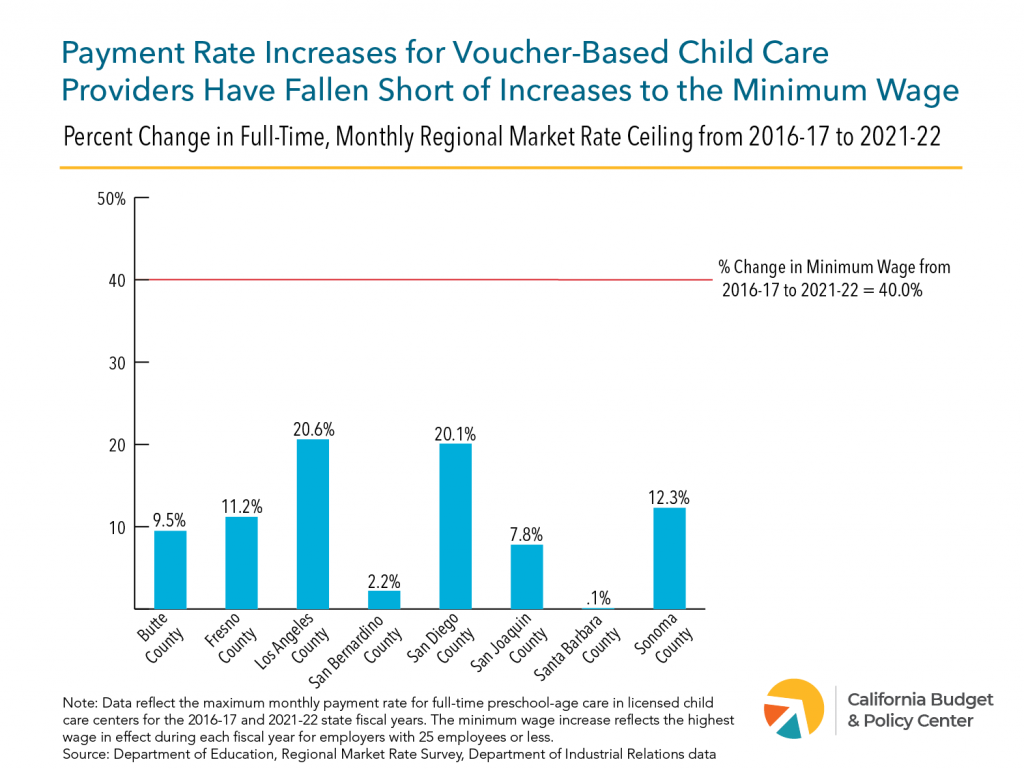
California’s subsidized child care and development system has long been critical to the state’s economic infrastructure, helping families struggling to make ends meet cover the high cost of early care and education for their children. The governor’s May Revision would maintain federal child care relief funding that was included in the January proposal to expand child care programs to serve an additional 36,000 children ($22.5 million for General Child Care and $247.3 million for the Alternative Payment Program). Yet, the May Revision would not increase provider payment rates for the 2022-23 state fiscal year, despite stagnant payment rates, the rising statewide minimum wage, and the increasing price of food and supplies.
Other child care investments in the May Revision include:
$200.5 million for child care infrastructure. This includes $100 million General Fund and $100.5 million federal funds for minor renovation and repairs to child care facilities in child care deserts and low-income communities.
$136 million to extend family fee waivers for one year. Under federal law, most families must pay a family fee for subsidized child care. California took advantage of flexibility offered by the federal government during the pandemic to waive these fees to boost family economic security. The May Revision provides $136 million in federal Coronavirus Response and Relief Supplementary Appropriation relief funds to continue this waiver until June 30, 2023.
$114 million to pay providers based on enrollment. Prior to the pandemic, the state paid subsidized child care and California State Preschool Program providers based on whether or not a child was in attendance. During the pandemic, state leaders opted to reimburse providers based on enrollment, similar to the private market, to stabilize providers’ budgets. The May Revision would continue this reimbursement policy through the 2022-2023 fiscal year, primarily using federal funds.
$20 million to boost administrative capacity in the Alternative Payment Program. The Alternative Payment Program provides subsidized child care vouchers to eligible families. The May Revision provides funding to enable these community-based programs to expand services and enroll additional children and families in the Alternative Payment Program.
Finally, the administration has not made any proposals to further boost the economic security of child care providers, such as by offering health care or retirement benefits. Nor have state leaders provided resources for workforce development training — funding that was rescinded in the 2021-22 budget agreement due to pandemic-related budget uncertainties.
May Revision Fails to Increase Payment Rates for California Workers Who Need Paid Time Off
California’s paid family leave and state disability insurance programs allow workers to take paid time off from work to attend to their own health or that of a family member. The Disability Insurance Fund — funded entirely by California workers’ contributions — provides benefits to workers when care needs arise. Policymakers temporarily increased payment rates for these programs in 2018 from 55% of earnings to 70% for workers with very low pay and 60% of earnings for all other workers, including full-time workers paid the minimum wage. Yet workers paid very low wages are far less likely to utilize the benefits they’ve paid for. Californians should be able to take paid time off to care for themselves or their family without risking their jobs or financial security. Governor Newsom’s paid family leave task force and Master Plan for Early Learning and Care both recommended that payment rates be increased to 90% for some workers to increase access for workers paid low wages, but the administration’s revised budget does not increase payment rates for these critical programs. And without action this year, payment rates will revert to just 55% of earnings at the end of 2022.
May Revision Does Not Accelerate a Pending Increase to State SSP Grants
Supplemental Security Income/State Supplementary Payment (SSI/SSP) grants help well over 1 million low-income seniors and people with disabilities to pay for housing and other necessities. Grants are provided to individuals and couples and are funded with both federal (SSI) and state (SSP) dollars. State policymakers made deep cuts to the SSP portion of these grants in 2009 and 2011 to help close budget shortfalls caused by the Great Recession. Except for a small increase provided in 2017, the recession-era cuts to SSP grants remained in effect for more than a decade.
State leaders changed course last year and adopted a substantial (24%) increase to SSP grants that took effect on January 1, 2022. The maximum monthly SSP grant for individuals jumped from $160.72 to $199.21. For couples, the maximum monthly SSP grant rose from $407.14 to $504.64.
Also as part of the 2021-22 budget package, state leaders committed to providing an additional substantial increase to SSP grants in January 2024, subject to funding being provided in the 2023-24 state budget. In the meantime, advocates for older adults and people with disabilities have called on state leaders to accelerate this increase to provide a permanent and more timely boost to the modest budgets of SSI/SSP recipients as the cost of housing, food, and other necessities continues to rise.
The May Revision:
Does not propose to accelerate the pending increase to the state’s SSP portion of SSI/SSP grants. As a result, the maximum SSI/SSP grant for individuals will remain below the federal poverty line for at least another year and a half.
Lacks significant new investments to address the needs of older adults and people with disabilities and advance the bold goals included in the Master Plan for Aging.
support the Budget Center
Want to support our work? Please consider donating to the Budget Center to help advance understanding and transparency in the state budget process and create a more inclusive California.
Administration Continues Push for Pre-Kindergarten Programs
The state currently funds two pre-kindergarten programs: transitional kindergarten (TK) and the California State Preschool Program. TK is a two-year kindergarten program offered at local educational agencies (LEAs) to children turning five between September 2 and December 2 of each year. The 2021-22 budget agreement included a multi-year plan to expand the state’s existing TK program to all four-year-olds in the state. The May Revision builds off of the transitional kindergarten proposals included in the January proposal, by eliminating credential requirements for TK teachers through June 30, 2026. The May revision also proposes two additional changes to the California State Preschool Program, including the substantial changes to this program included in the January proposal. The California State Preschool Program is an early learning program for children from low and moderate income families offered by community based organizations and LEAs. The May Revision proposals include two items: 1) $21.6 million to waive family fees for participating children ($10.8 million Proposition 98 and $10.8 million General Fund) and 2) paying California State Preschool Program providers based on enrollment, not attendance — a policy known to stabilize funding for subsidized early care and education providers (see Child Care section).
Increased Revenues Significantly Boost the Minimum Funding Level for K-14 Education
Approved by voters in 1988, Proposition 98 constitutionally guarantees a minimum level of funding for K-12 schools, community colleges, and the state preschool program. Changes in state General Fund revenues tend to affect the Prop. 98 guarantee, and the May Revision’s estimates of 2021-22 and 2022-23 revenues are significantly higher than those estimated in January’s budget proposal. As a result, the May Revision assumes a 2022-23 Prop. 98 funding level of $110.3 billion, $8.4 billion above the level assumed in the Governor’s proposed budget, and a 2021-22 Prop. 98 funding level of $110.2 billion, $11.1 billion above the level assumed in January. The revised budget assumes a 2020-21 Prop. 98 funding level of $96.1 billion, slightly above the $95.9 billion funding level assumed by the Governor in January.
Revenue projections in the Governor’s January budget proposal would have required total deposits of $9.7 billion into the Public School System Stabilization Account (PSSSA) — the state budget reserve for K-12 schools and community colleges. However, the May Revision projects a decrease in capital gains revenues as a share of total taxes that would reduce required PSSSA deposits and bring the total account balance to $9.5 billion in 2022-23. (See Reserves section.) Because the PSSSA balance is projected to exceed 3% of the total K-12 share of the Prop. 98 minimum funding level in 2021-22, current law would prevent K-12 school districts from maintaining more than 10% of their budgets in local reserves beginning in 2022-23.
May Revision Dramatically Increases Funding for Several K-12 Education Programs
The largest share of Prop. 98 spending goes to California’s school districts, charter schools, and county offices of education (COEs), which provide instruction to 5.9 million students in grades kindergarten through 12. The governor’s revised spending plan significantly increases funding for the state’s equity-based K-12 education funding formula, the Local Control Funding Formula (LCFF), but proposes a less equitable per-pupil formula to allocate a large discretionary block grant. Specifically, the May Revision:
Allocates $8 billion for a one-time “discretionary block grant.” The governor proposes to use a per-pupil formula to allocate the block grant to local educational agencies (LEAs), which could be used for a wide variety of purposes including maintaining staff levels and addressing student learning challenges. Under the governor’s proposal, funding received by LEAs would reduce outstanding state mandate debts, which reflect the cost of state-mandated services that LEAs provided in prior years but for which they have not yet been reimbursed. Allocating these one-time grant funds on a per-pupil basis arguably fails to meet the goal of equitable funding established by the LCFF.
Allocates $3.8 billion to modify the LCFF. The LCFF provides school districts, charter schools, and COEs a base grant per student, adjusted to reflect the number of students at various grade levels, as well as additional grants for the costs of educating English learners, students from low-income families, and foster youth. Because many school districts are experiencing reductions in average daily attendance (ADA) and LCFF base grants are calculated based on ADA, the governor’s January budget proposed changing the LCFF base grant calculation to allow LEAs to use the average of three prior years’ ADA. The May Revision maintains the proposed option for LEAs to use a three-year rolling average of ADA to calculate base grants, but would modify how 2021-22 ADA is calculated to allow classroom-based LEAs to “be funded at the greater of their current year average daily attendance or their current year enrollment adjusted for pre-COVID-19 absence rates.” The administration estimates a total cost of $3.3 billion ongoing and $463 million one-time to implement these changes to the LCFF.
Adds $2.2 billion in ongoing funding for LCFF base grants. The May Revision would boost LCFF base grant funding for K-12 school districts and charter schools by $2.1 billion and for COEs by $101.2 million.
Includes funding for a 6.56% LCFF cost of living adjustment (COLA). The May Revision notes that the 6.56% COLA would be the largest since the LCFF was implemented. The governor’s January budget proposal provided $2.1 billion to fund a 5.33% COLA for the LCFF.
Includes $1.8 billion in one-time Prop. 98 funding for deferred maintenance of school facilities. The May Revision would provide these funds to LEAs for a variety of purposes such as repairing and restoring classrooms. The revised budget proposal would allocate $100,000 to each COE and the remainder of funds to LEAs in an equal amount per their unduplicated number of English learners, foster youth, and students from low-income families.
Adjusts one-time non-Prop. 98 General Fund K-12 school facilities spending. The governor’s January budget proposed spending $1.3 billion in 2022-23 and $925 million in 2023-24 to support new construction and modernization projects through the School Facilities Program. Instead, the May Revision proposes to appropriate these dollars in the current fiscal year (2021-22).
Expands one-time funding for community schools by $1.5 billion. Community schools provide integrated educational, health, and mental health services to students. The 2021 budget agreement provided $3 billion for community school grants. Despite this level of funding, the May Revision states that demand for the grants exceeded expectations and that additional funding would expand access to the program.
Allocates more than $800 million in one-time funding to support educator workforce programs. The governor’s proposal includes $500 million to expand the Teacher Residency Grant Program for teachers and school counselors, $300 million to increase professional development resources available through the Educator Effectiveness Block Grant, and $15 million over three years to continue the work of the Educator Workforce Investment Grant Program in areas of special education and support for English learners.
Includes $611.8 million in ongoing funding for school nutrition programs. In January, the governor proposed $596 million to fund a requirement included in the 2021 budget agreement that all public schools provide two free meals per day to any student regardless of income eligibility in 2022-23. The May Revision would expand funding to increase the state meal reimbursement rate beginning in 2022-23. To the extent an increase in federal school meal reimbursement rates frees up state funds, the revised budget proposes to reallocate state funding for the Kitchen Infrastructure and Training Grant Program.
Adds $403 million in ongoing funding for the Expanded Learning Opportunities Program (ELOP). The revised spending plan increases the governor’s January budget proposal to provide $3.4 billion in ongoing funding for the ELOP to provide additional learning time for students before or after school, as well as outside of the traditional school year.
Allocates $100 million in one-time funding to expand the Community Engagement Initiative (CEI). The CEI’s goals include building the capacity of communities and school districts to facilitate conversations that focus on improving student outcomes. The May Revision proposes to expand the number of LEAs that have been reached by the initiative since it was established in 2018.
Allocates $62.1 million to increase the COLA for non-LCFF programs.The May Revision increases the COLA for several categorical programs that remain outside of the LCFF to 6.56% from the 5.33% provided in January.
The Revised Budget Includes Base Augmentations for the California Community Colleges
A portion of Proposition 98 funding provides support for California’s Community Colleges (CCCs), the largest postsecondary education system in the country, which serves high percentages of students of color and students with low incomes. CCCs prepare approximately 1.8 million students to transfer to four-year institutions or to obtain training and employment skills.
The 2022-23 revised budget proposes to increase funding for deferred maintenance projects at the CCCs, increase base funding for the Student Centered Funding Formula (SCFF), and provide a large one-time discretionary block grant using a less equitable allocation method than the SCFF. Specifically, the revised spending plan:
Provides $1.1 billion one-time Prop. 98 dollars for deferred maintenance projects. The funds are intended to support deferred maintenance and energy efficiency projects at the CCCs. These dollars are in addition to the $387.6 million proposed in January.
Includes $750 million one-time Prop. 98 dollars for discretionary block grants to CCC districts. Grants are intended to support districts in addressing pandemic-related issues and “reduce long-term obligations.” Grants would be allocated by the California Community College Chancellor’s Office based on the number of full-time equivalent students and can be used for any purpose determined by each community college district. Allocating these one-time dollars based on the number of full-time equivalent students arguably fails to meet the goal of equitable funding established by the SCFF.
Provides $375 million ongoing Prop. 98 dollars for base increases for the SCFF. These dollars include $250 million to increase funding rates for all components of the SCFF and an additional $125 million to boost the SCFF’s base allocation.
Allocates nearly $85 million ongoing Prop. 98 for a COLA for apportionments and enrollment growth. The revised budget includes an increase of $83.5 million to reflect a higher COLA (6.56%) for apportionments. The 6.56% COLA (up from 5.33% in the January budget) increases total funding to $492.9 million. The budget also includes an additional $1.3 million for a 0.5% enrollment growth for a total of $26.2 million for this item.
Includes nearly $62 million Prop. 98 dollars to support apprenticeships. The revised budget includes $45 million in one-time dollars for the California Healthy School Meals Pathways Program and $16.9 ongoing to make changes to the apprenticeship program Related and Supplemental Instruction rate.
Proposed Budget Provides Multi-Year Investments in the CSU and the UC
California supports two public four-year higher education institutions: the California State University (CSU) and the University of California (UC). The CSU provides undergraduate and graduate education to roughly462,000students on 23 campuses, and the UC provides undergraduate, graduate, and professional education to about290,000students on 10 campuses. For both institutions, the administration maintains the governor’s January proposal of a multi-year budget through 2026-27, focused on increasing enrollment, raising graduation rates and closing graduation gaps, increasing affordability of on-campus housing, and decreasing non-tuition costs.
For the CSU, the revised budget provides the following adjustments in addition to the $304.1 million ongoing General Fund proposed in January:
$147.5 million to invest in facilities to support the growth of a STEM workforce to meet the state’s goals on climate change.
An additional $25 million one-time General Fund to support CSU University Farms.
An increase of $1.5 million General Fund to support services for foster youth at CSU East Bay and CSU Northridge.
For the UC, the revised budget provides the following adjustments in addition to the $307.3 million ongoing General Fundproposed in January:
$514.1 million one-time General Fund to fund various programs, including research on the digital economy and biotechnology, graduate medical education, fire advisors for the California Department of Forestry and Fire Protection, and African American studies at UCLA. Of the $500 million allocated for biotechnology research, only $300 million is for 2022-23.
$13 million ongoing General Fund to support and expand UC Labor Centers.
$1.5 million General Fund ($650,000 ongoing) to integrate independent colleges and universities onto the ASSIST web platform that supports prospective transfer students.
May Revision Misses Opportunity to Provide Additional Financial Support for Students Pursuing Higher Education
Cal Grants are the foundation of California’s financial aid program for students with low and middle incomes pursuing higher education in the state. Cal Grants provide aid for tuition and living expenses that do not have to be paid back. The May Revision estimates that over 400,000 financial aid grants will be awarded to students in the 2022-23 academic year. Ensuring Californians have access and resources to attend and thrive in the state’s higher education institutions broadens opportunities for individuals and families and strengthens our state’s workforce to drive long-term economic growth.
The governor’s revised spending plan proposes no new changes to student financial aid from those included in the governor’s January proposal. The governor misses an opportunity to better support California students. High costs of higher education, exacerbated by the economic hardship of COVID-19 pandemic, have caused many students to cancel their education plans. Since the beginning of the 2021-22 academic year, students in low-income, Black and Latinx households were most likely to cancel all plans to take classes from postsecondary institutions. The governor can continue to support students with low and middle incomes and reduce racial inequities in higher education by pursuing reforms to Cal Grants that streamline and eliminate remaining barriers that prevent more students from accessing state financial aid. In addition, more investments are needed to adequately address non-tuition costs, such as housing, food, transportation, and other basic living expenses.
Justice Systems
Governor Does Not Propose to Close More State Prisons
More than 97,000 adults who have been convicted of a felony offense are serving their sentences at the state level, down from a peak of 173,600 in 2007. American Indian, Black, and Latinx Californians are disproportionately represented in state prisons — a racial disparity that reflects implicit bias in the justice system, structural disadvantages faced by these communities, and other factors. Among all incarcerated adults, most — 92,514 — are housed in state prisons designed to hold fewer than 82,000 people. This level of overcrowding is equal to 112.9% of the prison system’s “design capacity,” which is below the prison population cap — 137.5% of design capacity — established by a 2009 federal court order. California also houses more than 4,500 people in facilities that are not subject to the cap, including fire camps, in-state “contract beds,” and community-based facilities that provide rehabilitative services. The sizable drop in incarceration has resulted both from 1) a series of justice system reforms enacted by voters and state leaders and 2) changes adopted in 2020 to further reduce prison overcrowding in response to the COVID-19 pandemic, such as suspending intakes from county jails and implementing early releases.
The revised budget:
Does not call for the closure of additional state prisons. California recently closed the state prison in Tracy and was on track to shut down the Susanville prison by the end of June 2022 until litigation filed by the city of Susanville halted the process. In the meantime, the revised budget does not outline a plan to close more prisons even though the Legislative Analyst’s Office estimates that California could close as many as five prisons over the next few years. However, the administration says it is “committed to right-sizing California’s prison system” and suggests that “it may be possible to close three additional state prisons by 2024-25” (emphasis added). Closing more prisons, particularly those with costly, decaying infrastructure, would generate substantial savings as well as reduce overreliance on incarceration, which disproportionately impacts Californians of color and does not make neighborhoods and communities safer.
Projects that the prison population will temporarily rise before resuming its long-term decline by 2024-25. The prison population is estimated to increase by about 3,300 between 2021-22 and 2022-23, primarily because the state has been transferring people to prison who were temporarily being held in county jails to reduce the risk of COVID-19 transmissions in the prison system. However, current estimates also suggest that the prison population will soon resume its long-term decline, falling to roughly 95,700 by 2024-25.
Maintains the governor’s January proposal to keep providing emergency housing services to adults who are at risk of being unhoused when they leave prison. The Returning Home Well Program, which was created in response to the COVID-19 pandemic, would continue for another three years at a cost of $10.6 million General Fund annually.
Proposes $3 million in one-time funding to provide transitional housing for youth who are at risk of homelessness when they are discharged by the Board of Juvenile Hearings.
Proposal Maintains Inequitable Crime Reduction Plan, Modestly Invests in Additional Public Safety-Related Programs
California has adopted various justice system-related policy changes that reformed sentencing laws while still ensuring public safety. These reforms, passed through legislative action and voter approval, have led to sustained decreases in overall crime and prison population rates. Despite the relatively low and stable crime rates California has experienced since the mid-2000s, the May Revision maintains proposals that target retail theft and other crimes, and does not explicitly account for the potential racial discrimination that may arise in enforcement of those policies.
The May Revision also proposes a series of new investments to support law enforcement, probation services, and victim supports, including:
$50 million one-time General Fund for officer wellness grants for efforts that support peace officers’ physical and mental health and build community relations. The grants will be administered by the Board of State and Community Corrections to counties and cities to support eligible programs.
$20 million one-time General Fund for mobile probation center grants to increase access to probation services, especially for unhoused Californians. The mobile centers are intended to help individuals more easily access court appearances and pre-trial check-ins and complete various types of needs assessments.
$30 million one-time General Fund to establish innovative victim service pilot programs, including recovery centers in hard-to-reach and rural areas. These funds are intended to be spent over three years.
$12 million one-time General Fund over three years for a competitive grant program to support California tribes in locating and identify missing Indigenous persons.
$7.9 million General Fund in 2022-23 and $6.7 million ongoing for the Department of Justice to establish the Fentanyl Enforcement Program.
Workforce & Other Proposals
The Revised Budget Makes Additional Climate-Related Workforce Investments
To create pathways to jobs in industries related to the care economy and climate adaptation, the revised spending plan maintains workforce development proposals included in the January budget and adds additional investments.
The May Revision maintains investments in the care economy workforce and health-related fields. Those investments include major proposals such as $350 million for community health workers and $340 million for high road training partnerships in “family-sustaining” health care jobs.
The revised spending plan also maintains all the investments aimed at supporting the state’s efforts to combat the climate crisis and the ongoing transition to clean energies. Those include $265 million to support the transition from oil and gas to other industries and $235 million for training programs and grants across various climate-related industries.
The revised budget includes additional investments in workforce development opportunities related to climate adaptation, which include:
$41.5 million General Fund to support the state’s response to extreme heat. This includes $24.5 million to the Department of Industrial Relations to provide targeted outreach and education to communities in order to protect workers from heat-related illnesses and smoke from wildfires. It also includes $17 million over two years to the Workforce Development Board to expand high road training partnerships with industries that support the state’s response to extreme heat conditions. See Climate Change section for other climate-related investments.
Other proposals in the revised spending plan include additional investments in apprenticeships. This includes:
Nearly $62 million Prop. 98 dollars to support apprenticeship programs. As discussed in the California Community Colleges section, these funds include $45 million in one-time dollars for the California Healthy School Meals Pathways Program and $16.9 million ongoing to make changes to the apprenticeship program Related and Supplemental Instruction (RSI) rate.
The Revised Spending Plan Proposes $1.1 Billion to Bridge the Digital Divide
The pandemic has exposed the inequities in access to computers and high-speed internet, also known as the digital divide. Access to such technology is necessary to participate in education and other essential activities such as remote work, applying for jobs, virtual health appointments, and access to many other services. The digital divide disproportionately impacts low-income and Latinx households, as well as children and youth, seniors, and people with disabilities.
The governor’s revised spending plan proposes $1.1 billion one-time over two years for broadband infrastructure. The proposal would provide $600 million in 2023-24 and $500 million in 2024-25 to the California Department of Technology (CDT) to support broadband infrastructure projects currently underway across the state. These dollars are in addition to investment of $3.25 billion for the same purpose provided in the 2021-22 budget.
While broadband infrastructure is necessary to reach many households that are unconnected, especially in rural areas of the state, the proposal does not include support to address other aspects of the digital divide such as affordability barriers that keep many California households from connecting to the internet.
Governor Proposes Additional Relief for Small Businesses
In addition to the business tax proposals noted in the Revenue Outlook & Tax Proposals section — which are not specific to small businesses — the revised budget proposal includes some additional assistance targeted to small businesses, including:
$500 million one-time General Fund to provide grants of between $10,000 and $50,000 to small businesses and nonprofit organizations in industries hit hardest by the pandemic.
$75 million one-time General Fund to provide grants of between $30,000 and $50,000 for small agricultural businesses — those with 100 or fewer full-time employees in 2021 — that have lost revenue due to drought.
Both of these grant programs would be administered by the Office of the Small Business Advocate (CalOSBA).
Millions of California workers who lost their jobs during the depths of the COVID-19 pandemic used unemployment insurance benefits to pay for basic needs like food and rent. Although these benefits are supposed to be financed through employer payroll taxes, California businesses — for decades — haven’t been paying the true costs of the benefits workers need during recessions. Consequently, California’s unemployment fund has been chronically underfunded, and the state had to borrow billions of dollars from the federal government to help pay for unemployment benefits during the pandemic.
The governor’s revised budget continues to propose wasting $1 billion General Fund in 2022-23 and $2 billion in 2023-24 to pay down a portion of the state’s outstanding federal loans for these benefits. This proposal is unnecessary and amounts to a tax giveaway mostly benefiting large, profitable corporations, while wasting $3 billion that could be better spent supporting small businesses and California workers struggling to afford the high cost of living. Specifically, this proposal:
Is unnecessary because there is already a sensible process in place for paying off the state’s unemployment debt. Under federal law, California businesses will pay off this debt very gradually through small increases in the federal payroll tax rate. For example, in 2023, businesses will pay just $21 per worker more for the entire year. It makes sense for businesses to gradually pay off this debt since it largely resulted from decades of insufficient contributions by businesses to California’s unemployment fund prior to the pandemic.
Is a giveaway to large, profitable corporations that haven’t been paying the true cost of unemployment benefits for their workers for decades. The more employees a business has in California, the more a business would benefit under this proposal. One corporation that stands to benefit most is Chevron, which employs 10,000+ California workers and raked in $15.6 billion in profits last year as soaring gas prices strained the budgets of millions of Californians.
Businesses That Will Benefit Most Under Governor’s Unnecessary Unemployment Insurance Loan Payment
Company Examples of Private-Sector Businesses with At Least 5,000 California Employees
Most Recent Annual Profit (Billions)
Alphabet (parent company of Google)
$76.0
Intel
$19.9
Chevron
$15.6
eBay
$13.6
Sony Pictures
$11.0
Cisco
$10.6
Amgen
$5.9
Walt Disney Company
$2.5
Space Exploration Tech Corp (SpaceX)
*
*Not a publicly traded company so its profits are not reported publicly. However, SpaceX is estimated to be the second-highest-valued private company in the world. Source: Employment Development Department and US Securities and Exchange Commission
Would provide no immediate relief to small businesses that are still recovering from the pandemic. In January, the governor indicated that one rationale for this proposal is to reduce how much small businesses will pay in increased federal payroll taxes in future years. But the proposal would primarily benefit large corporations, and “provide no near-term economic relief to employers or workers,” according to the Legislative Analyst’s Office.
Administration Increases Spending to Respond to Climate Change
The revised budget provides additional funding for various proposals intended to help California and its residents adapt and respond to climate change. This includes:
An additional $8 billion to support the Clean Energy Investment Plan, of which $5.2 billion will support the Strategic Electricity Reliability Reserve to help the state’s energy grid withstand extreme climate events;
$970 million for the Public Utility Commission to provide residential solar and storage system incentives, of which $670 million would be for low-income households;
An additional $1.3 billion General Fund for a wide range of projects intended to help communities, fish, and wildlife avoid the negative impacts of extreme drought;
$250 million to leverage additional state financing tools to develop strategic clean energy projects;
$220 million over two years to support community cooling centers, as included in the state’s updated Extreme Heat Action Plan;
$150.2 million ($141.7 million General Fund) and 465 positions to increase CalFIRE’s ability to respond to wildfires due to climate change;
$100 million one-time General Fund for the Tribal Nature-Based Solutions program to support initiatives by California’s Native American tribes that use nature-based solutions to combat the climate crisis;
$100 million in match funding to support carbon removal projects;
An additional one-time $100 million from Cap and Trade auction proceeds to increase the number of satellites launched to measure methane emissions;
$24.5 million General Fund to the Department of Industrial Relations to help protect workers from heat-related illness and wildfire smoke hazards;
An additional one-time $20 million Greenhouse Gas Reduction Fund for the Community Air Protection Program, which aims to reduce emissions in communities with a disproportionate exposure to air pollution; and
$17 million General Fund over two years to the California Workforce Development Board to support training in industries that support the state’s response to extreme heat, as outlined in the Workforce Development section.
The revised budget also outlines a plan for how to spend $768 million included in the 2021-22 budget to implement California’s Natural and Working Lands Climate Smart Strategy to advance “climate-focused land management” and the Pathways to 30×30 Strategy to accelerate conservation of California’s lands and coastal waters. In addition, the administration proposes to accelerate its $10 billion zero-emission vehicle (ZEV) plan to increase clean transportation options. Finally, the revised budget proposes converting two tax credits included in the January budget into a single Climate Innovation Grant program administered by the California Energy Commission and provides a Sales and Use Tax exclusion to incentivize projects that manufacture, process, or recover lithium, as outlined in the Revenue Outlook & Tax Proposals section.
Each year, the Budget Center comes out with a First Look analysis of the governor’s May Revision, and we are proud to provide you with this timely breakdown. Want to support our work? Please consider donating to the Budget Center to help advance understanding and transparency in the state budget process and create a more inclusive California.
There was a problem processing your signup. Please try again. Or contact us
Please check your email to confirm your signup.
All California students pursuing higher education and career pathways should have access to an affordable education and the ability to achieve economic security. And California offers many postsecondary institutions for students to pursue their goals, including colleges, universities, community colleges, and trade schools. Yet, high costs of higher education and career training programs, along with economic hardship exacerbated by the COVID-19 pandemic has caused many students to cancel their education and career training plans. This is hitting students from households with low incomes the hardest. 1“Households with low incomes” are defined as households with annual income of less than $50,000. State policymakers can support students in building their education and careers by making education affordable and addressing costs of basic needs so California’s communities are home to thriving students, families, and workforces.
Since the beginning of the 2021-22 academic year, more than 1 in 5 households with low incomes included at least one prospective student who canceled all plans to take classes from a postsecondary institution due to impacts of the pandemic (23%).2The US Census Bureau, Household Pulse Survey defines postsecondary institutions as colleges, universities, community colleges, trade schools, or other occupational schools. Students living in households with low incomes were more likely to cancel their education plans than California households overall (18%) and compared to households with higher incomes (14%). Students in Black and Latinx households also canceled education plans at higher proportions than all households (24% and 19%, respectively).
There are various reasons why students canceled their postsecondary education plans, but financial stress is a key factor. Of those California households where at least one member canceled all plans for postsecondary education, 41% did so because they were unable to pay for educational expenses due to pandemic-related changes to income and 45% of households with low incomes canceled for the same reason.3Survey respondents were able to select various reasons why plans to take classes were canceled, including being unable to pay for educational expenses, having COVID-19 or having concerns about the virus, uncertainty about how classes or programs would change, among others. Respondents could choose more than one reason for canceling plans.
The high costs of postsecondary education are a major barrier for students with low incomes to stay enrolled and complete their coursework. At a time when California households with low incomes are much more likely to be struggling to meet basic needs, policymakers should ensure that Californians with low incomes seeking postsecondary degrees and certificates have the financial support necessary to complete their programs, provide for themselves and their households, and build their lives across the state’s diverse communities.
Support for this report was provided by the Conrad N. Hilton Foundation.
“Households with low incomes” are defined as households with annual income of less than $50,000.
2
The US Census Bureau, Household Pulse Survey defines postsecondary institutions as colleges, universities, community colleges, trade schools, or other occupational schools.
3
Survey respondents were able to select various reasons why plans to take classes were canceled, including being unable to pay for educational expenses, having COVID-19 or having concerns about the virus, uncertainty about how classes or programs would change, among others. Respondents could choose more than one reason for canceling plans.
You may also be interested in the following resources:
There was a problem processing your signup. Please try again. Or contact us
Please check your email to confirm your signup.
Introduction
All Californians deserve a safe and stable place to call home – a home that is affordable, located near their work and communities. Even before the COVID-19 pandemic, California’s serious housing affordability challenges threatened the well-being of families and communities and the future growth of the state. Throughout the pandemic, job losses have hit low-wage workers hardest, and hundreds of thousands of renters with low incomes have sought assistance as they are strained to pay rent.1Alissa Anderson, California Low-Paid Workers & Their Families Struggle as Jobs Decline Again (California Budget & Policy Center, February 2021), https://calbudgetcenter.org/resources/california-low-paid-workers-their-families-struggle-as-jobs-decline-again/. Enrique Lopezlira, et al., California’s Labor Market in the Time of COVID-19: 2021 Chartbook, February 2022 (UC Berkeley Labor Center, February 1, 2022), https://laborcenter.berkeley.edu/californias-labor-market-in-the-time-of-covid-19-2021-chartbook/. “California COVID-19 Rent Relief Program Dashboard,” State of California Business, Consumer Services, and Housing Agency, Housing Is Key Rental Assistance (webpage), accessed April 19, 2022, https://housing.ca.gov/covid_rr/dashboard.html. As the pandemic moves into a new stage and many emergency protections are lifted, millions of Californians continue to live in a state of emergency, struggling to keep a roof over their heads.
About 2.1 million California households were facing housing hardship in the first months of 2022, meaning people were already late on rent or mortgage payments and/or had low confidence in their ability to make their next payment.2Except where otherwise noted, results cited are from Budget Center analysis of US Census Bureau, Household Pulse Survey public-use microdata, representing multiweek averages for Week 41 (data collected December 29, 2021 to January 10, 2022), Week 42 (January 26 to February 7, 2022), Week 43 (March 2 to March 14, 2022), and Week 44 (March 30 to April 11, 2022). Without support, these households risk housing instability, evictions, and in the worst case, homelessness.
Who are the Californians currently struggling to afford their housing? Understanding who is experiencing housing hardship can help state leaders target policies and funding to ensure families and individuals receive the support they need to remain in stable housing and thrive.
1. Renters Are Much More Likely to Face Housing Hardship Than Homeowners
Access to an affordable home is the foundation for a healthy life, especially for the more than 40% of Californians who live in rented homes. Californians with low incomes, and Black, Pacific Islander, and Latinx Californians are especially likely to rent – reflecting racist and discriminatory policies and practices in housing, employment, and education that have blocked millions of Californians from homeownership.3Monica Davalos, Sara Kimberlin, and Aureo Mesquita, California’s 17 Million Renters Face Housing Instability and Inequity Before and After COVID-19 (California Budget & Policy Center, February 2021), https://calbudgetcenter.org/resources/renters-face-housing-instability-and-inequity-before-and-after-covid-19/.
Renters are especially likely to be struggling to afford their housing. From January to April 2022, California renters were twice as likely as homeowners with mortgages to report housing hardship. About 33% of renter households reported being late on housing payments or having low confidence in their ability to meet the next month’s payments, compared to 15% of homeowners with mortgages.
Even before the pandemic, 1 in 2 renter households paid more than 30% of income toward housing and 1 in 4 spent more than half their income on housing.4Davalos, Kimberlin, and Mesquita, California’s 17 Million Renters. Hundreds of thousands of applications for rental assistance during the pandemic show that renters continue to struggle with housing costs.5California COVID-19 Rent Relief Program Dashboard.”
2. About Half of Renters with Low Incomes Are Struggling to Afford Housing Costs
All Californians, regardless of income, deserve a safe and stable place to live. Yet many Californians particularly struggle to pay for housing when their incomes are low because their work is undervalued, they do not receive fair wages, they have lost jobs, or they depend on retirement or disability benefits that are set below the cost of living. All of these conditions reflect the effects of racist, sexist, xenophobic, and ableist policies and practices in workplaces and housing.
Californians with low incomes are especially likely to rent, and renters with low incomes report the most difficulty paying for housing. About half of renter households with incomes below $50,000 reported housing hardship from January to April 2022.
Californians with low incomes have been hit hardest by pandemic job losses.6Alissa Anderson, California Low-Paid Workers. Enrique Lopezlira, et al., California’s Labor Market. They have also suffered the most as inflation has pushed up prices for food, energy, and other necessities, as well as rent.7Michael Weber, Yuriy Gorodnichenko, and Olivier Coibion, “The Expected, Perceived, and Realized Inflation of US Households Before and During the COVID-19 Pandemic,”NBER Working Paper 29640, (January 2022), https://www.nber.org/papers/w29640.
3. Racial Disparities in Rent Hardship Are Severe
Race or ethnicity should not affect one’s access to stable and affordable housing. Yet racial inequities are severe in Californians’ housing experiences. Californians of color are most likely to live in renter households and were most likely to have unaffordable housing costs even before the COVID-19 pandemic.8Davalos, Kimberlin, and Mesquita, California’s 17 Million Renters. Black Californians disproportionately experience homelessness, as do American Indian or Alaska Native and Pacific Islander Californians.9Monica Davalos and Sara Kimberlin, Who is Experiencing Homelessness in California? Tailored Housing Interventions are Needed for California’s Diverse Unhoused Population (California Budget & Policy Center, February 2022), https://calbudgetcenter.org/resources/who-is-experiencing-homelessness-in-california/. These patterns reflect effects of racist housing, education, and employment policies and practices that have blocked Californians of color from opportunities to achieve housing security.
While housing hardship is being felt across renters of all races and ethnicities in California, Black and Latinx renters are especially likely to report being late or lacking confidence in their ability to make rent payments. About 4 in 10 Black or Latinx renter households reported housing hardship from January to April of 2022. About 3 in 10 Asian renters and about 2 in 10 white renters reported hardship.
These inequitable housing experiences reflect and add to racial inequities in other pandemic hardships. Black and Latinx workers have been most likely to lose employment and slowest to recover from high unemployment rates.10Alissa Anderson, Inequitable Job Gains: Unemployment Is Twice as High for Black Californians as for White Californians (California Budget & Policy Center, August 2021), https://calbudgetcenter.org/resources/inequitable-job-gains-covid19/. Pacific Islander, Latinx, and Black Californians have also experienced the highest age-adjusted rates of COVID-19 death.11Adriana Ramos-Yamamoto and Monica Davalos, Confronting Racism, Overcoming COVID-19, and Advancing Health Equity (California Budget & Policy Center, February 2021), https://calbudgetcenter.org/resources/confronting-racism-overcoming-covid19-advancing-health-equity/.
4. Housing Hardship Affects California Low-Income Renters in All Types of Families
Across all stages of life, families of all types need affordable and stable housing in order to thrive. Housing security is vital for children because housing instability and homelessness can severely negatively impact children’s health and development. For adults, a stable home is the basic foundation required to maintain health, work, and dignified living conditions throughout all ages of life.
Struggling California renters include both families with children and adult-only households. From January to April 2022, about half of renter households with incomes under $50,000 reporting housing hardship were families with children (51%). About half included only adults (49%), including senior households.
5. Even Before COVID-19, Undocumented and Mixed-Status Renters Had Unaffordable Rents
All Californians, regardless of where they are born, should be able to count on having safe and stable housing. Even before the pandemic, Californians who were undocumented immigrants or in mixed-status families faced higher rates of poverty due to discriminatory barriers to meeting basic needs, including worker exploitation and inequitable access to safety net supports.12Sara Kimberlin, Aureo Mesquita, and Kristin Schumachher, Undocumented & Mixed-Status Families Are Blocked From Food Support (California Budget & Policy Center, May 2022), https://calbudgetcenter.org/resources/undocumented-mixed-status-families-are-blocked-from-food-support/.
Among renter households that include undocumented Californians, an estimated 58% were paying unaffordable rents before the pandemic, and about an estimated one-third were severely housing cost-burdened, paying more than half of their income toward rent.13Budget Center analysis of US Census Bureau, American Community Survey public-use microdata for 2019, using undocumented status imputation developed for the California Poverty Measure. See Figure 5. These high rates of unaffordable housing put these households at risk of housing instability and eviction.
Estimates of current housing hardship among undocumented and mixed-status renters are not available, but the pandemic has likely increased hardship for these Californians. While millions of California workers who lost jobs during the pandemic turned to unemployment benefits for support, workers who are undocumented were blocked from accessing this aid. Undocumented and mixed-status households have also been excluded from other COVID-19 relief and from many ongoing supports that help families meet basic needs like housing.
Conclusion
Every California family and individual deserves a place to live, to thrive, to share moments with their loved ones – a place to call home. Despite much wealth in our state, driving strong growth in state revenues even during the pandemic, millions of Californians continue to live in a state of emergency, struggling to keep up with housing payments and at risk of losing their homes.
Yet policymakers can act on proven policies and invest in support especially for California’s renters, who are most likely to be facing housing hardship – particularly renters with low incomes and those who are Black and Latinx, as well as undocumented and mixed-status households. Strategies can include:
Direct resources to emergency rental assistance, legal aid, and eviction protections that have helped keep Californians housed during the pandemic. State leaders can build on these protections and supports to ensure California’s renters can stay in their homes.
Increase the supply of affordable rental housing to ensure that all Californians have access to an affordable home – and make sure thehousing is designed to meet the needs of diverse types of households, including older adults, single workers, households that include people with disabilities, and working families with children.
Expand and target additional financial support to Californians with low incomes through taxpayer rebates, refundable tax credits, and safety net supports like CalWORKs, Supplemental Security Income/State Supplementary Payment and General Assistance.
Design, implement, and evaluate housing policies with a racial equity lens, ensuring fair access and outcomes for communities historically excluded from housing security and opportunities.
Ensure emergency housing supports and affordable housing are accessible to all Californians in need regardless of immigration status so that undocumented individuals and mixed-status families have the security of a stable home.
As the COVID-19 pandemic moves onto a new stage, leaving many emergency measures behind, policymakers must ensure no Californian is left without a safe and stable home. Strong state revenues present opportunities to keep Californians housed now and to invest in the state’s long-term housing affordability challenges. California’s state of emergency only truly ends when all Californians have a safe, stable, and affordable place to call home.
Support for this report was provided by the Conrad N. Hilton Foundation.
Except where otherwise noted, results cited are from Budget Center analysis of US Census Bureau, Household Pulse Survey public-use microdata, representing multiweek averages for Week 41 (data collected December 29, 2021 to January 10, 2022), Week 42 (January 26 to February 7, 2022), Week 43 (March 2 to March 14, 2022), and Week 44 (March 30 to April 11, 2022).
Davalos, Kimberlin, and Mesquita, California’s 17 Million Renters.
5
California COVID-19 Rent Relief Program Dashboard.”
6
Alissa Anderson, California Low-Paid Workers. Enrique Lopezlira, et al., California’s Labor Market.
7
Michael Weber, Yuriy Gorodnichenko, and Olivier Coibion, “The Expected, Perceived, and Realized Inflation of US Households Before and During the COVID-19 Pandemic,”NBER Working Paper 29640, (January 2022), https://www.nber.org/papers/w29640.
8
Davalos, Kimberlin, and Mesquita, California’s 17 Million Renters.
Budget Center analysis of US Census Bureau, American Community Survey public-use microdata for 2019, using undocumented status imputation developed for the California Poverty Measure. See Figure 5.
You may also be interested in the following resources:
There was a problem processing your signup. Please try again. Or contact us
Please check your email to confirm your signup.
Introduction
California children need a safe space to learn and grow while parents are at work, and the COVID-19 pandemic underscored just how essential child care is for the livelihood of workers and communities. California’s subsidized child care and development system has long been critical to the state’s economic infrastructure, helping families struggling to make ends meet cover the high cost of early care and education for their children.1Families are eligible for subsidized child care if the child who would receive care is under the age of 13; the family establishes an appropriate eligibility status, such as by having an income below the limit set by the state; and the family demonstrates a need for care, such as parental employment. Families generally must meet the same income guidelines applicable to child care to qualify for the California State Preschool Program, which is funded solely with state dollars. State law, however, allows up to 10% of families in the state preschool program to have incomes up to 15% above the income eligibility limit, but only after all other eligible children have been enrolled. The California State Preschool Program is a part-day program offered for roughly nine months of the year. Some children receive “wraparound” services that provide subsidized child care for the remainder of the day and throughout the entire year. To be eligible for the full-day California State Preschool Program, families generally must meet the same eligibility guidelines that are applicable to subsidized child care. But policymakers have never provided enough funding to offer care for all eligible families or to ensure providers and early educators are paid fair and just wages.2Kristin Schumacher, Exploring the Unmet Need for Subsidized Child Care and Development Programs in California (California Budget & Policy Center, February 2019), https://calbudgetcenter.org/resources/exploring-the-unmet-need-for-subsidized-child-care-and-development-programs-in-california/; and Kristin Schumacher and Erik Saucedo, California’s Subsidized Child Care Providers Are Overdue for a Pay Raise (California Budget & Policy Center, April 2022), https://calbudgetcenter.org/resources/californias-subsidized-child-care-providers-are-overdue-for-pay-raise/
State and federal dollars fund the state’s subsidized child care and development system that includes both child care programs and the California State Preschool Program. Due to chronic underfunding at the state and federal level, cash-strapped families and under-paid providers engaged in the state’s subsidized child care and development system did not have the resources to withstand the economic shock of the pandemic. This 5 Facts provides key details on how state and federal funding mitigated some of the impacts of the pandemic on California’s subsidized child care and development system and explains why policymakers should continue to invest ongoing resources in California’s families and providers.
1. Federal Policymakers Provided Significant One-Time Support for Child Care Providers and Families During the Pandemic
California has received more than $5 billion in federal relief funds during the pandemic to support under-paid child care providers and cash-strapped families who were not in a position to weather a health and economic crisis.3Federal policymakers also provided pandemic relief funding for Head Start, a federal early care and education program. These relief dollars flowed directly to Head Start providers across California and were not appropriated in the state budget. See US Department of Health and Human Services, Office of Head Start, Program Instruction ACF-PI-HS-21-03 (May 4, 2021), https://eclkc.ohs.acf.hhs.gov/policy/pi/acf-pi-hs-21-03. These one-time relief dollars were on top of the state’s annual appropriation from the Child Care and Development Fund (CCDF) — the primary source of federal funding for subsidized child care.
The first round of federal pandemic relief for child care came from the Coronavirus, Aid, Relief, and Economic Security (CARES) Act, enacted in March 2020.4California Budget & Policy Center, Federal Fiscal Relief and COVID-19: Implications for Californians (April 2020), https://calbudgetcenter.org/resources/covid19-federal-fiscal-relief-california/. California received $350 million, increasing federal funding for child care in California by 51% in the 2020 federal fiscal year over pre-pandemic levels.5State policymakers supplemented the CARES Act funding for child care with an additional $110 million in flexible CARES Act dollars allocated to states from the Coronavirus Relief Fund. See Department of Finance, Notification letter Section 11.90 – Child Care and Food Bank Support (October 19, 2020), https://dof.ca.gov/wp-content/uploads/budget/covid-19/covid-19-allocations/10-19-20_section_11-90-federal_coronavirus_relief_funds-child_care_and_food_bank_support-cc.pdf.
Federal policymakers provided additional child care relief in the Coronavirus Response and Relief Supplemental Appropriations Act (CRRSA) in December 2020, of which California received an additional $964 million. Finally, the American Rescue Plan Act (ARPA) became law in March 2021, providing a total of $3.7 billion for child care relief efforts in California — 62% for provider stabilization and 38% to supplement CCDF funding.6California Budget & Policy Center, American Rescue Plan Provides Assistance to Millions of Californians (March 2021), https://calbudgetcenter.org/resources/american-rescue-plan-provides-assistance-to-millions-of-californians/. Combined, CRRSA and ARPA provided a total of $4.7 billion in child care relief funds to California in the 2021 federal fiscal year. This was a six-fold increase in federal child care dollars over pre-pandemic funding from the Child Care and Development Fund.
2. State Policymakers Have Utilized Roughly Half of Federal COVID-19 Child Care Relief Funds
Federal child care relief funding has been significant and essential to support child care providers and working parents. To date, state leaders have appropriated 48% — roughly $2.5 billion — of the federal funds to keep the underfunded subsidized child care and development system afloat.
More than one-third of the appropriated relief funds, or $891 million, has been used to support California families. Policymakers have utilized relief funding to provide emergency child care for essential workers and to expand subsidized child care spaces for families with low incomes. Policymakers also have waived family fees for subsidized care for a limited time to ease families’ financial burdens.7See Kristin Schumacher, Erik Saucedo, and Marcela Salvador, CaliforniaFamilies Pay High Price for Subsidized Child Care (California Budget & Policy Center, March 2021),https://calbudgetcenter.org/resources/california-families-pay-high-price-for-subsidized-child-care/.
Nearly two-thirds of the appropriated federal relief funds — $1.6 billion — has been allocated to support child care and preschool providers. Relief measures have included provider stipends for both subsidized and non-subsidized providers, rate increases and rate supplements to compensate for chronically low payment rates, pandemic supports to ease the cost of keeping doors open during the pandemic, and other investments in quality and support programs.
The administration has struggled to distribute the large amount of federal relief funds in a timely fashion, and some measures, such as waiving family fees for working parents and provider pandemic supports, will end on June 30, 2022, increasing economic hardship. More than half of the federal relief dollars remain unallocated.
3. Remaining One-Time Federal Relief Funds to Boost Provider Payment Rates and Provide Care for More Children
Roughly half of the $5.2 billion in one-time federal COVID-19 child care relief dollars remain unspent. The $2.7 billion in unspent funds includes both CRRSA and ARPA dollars — both of which can be used for a variety of purposes to supplement existing child care funding in California.8US Department of Health and Human Services, Office of Child Care, Information Memorandum CCDF-ACF-IM-2021-1 (April 14, 2021), https://www.acf.hhs.gov/occ/policy-guidance/ccdf-discretionary-funds-appropriated-crrsa-act-public-law-116-260-signed-law; US Department of Health and Human Services, Office of Child Care, Information Memorandum CCDF-ACF-IM-2021-2 (May 10, 2021), https://www.acf.hhs.gov/occ/policy-guidance/ccdf-acf-im-2021-02; and US Department of Health and Human Services, Office of Child Care, Information Memorandum CCDF-ACF-IM-2021-3 (June 10, 2021), https://www.acf.hhs.gov/occ/policy-guidance/ccdf-acf-im-2021-03.
The majority of unspent federal relief funding is ARPA dollars — both the stabilization funds and supplemental CCDF funds. Policymakers have signaled the intent to use these one-time ARPA dollars for provider payment rates through the 2023-24 state fiscal year and for subsidized child care spaces through the 2024-25 state fiscal year.9Assembly Bill 131 (Committee on Budget, Chapter 116, Statutes of 2021), https://leginfo.legislature.ca.gov/faces/billNavClient.xhtml?bill_id=202120220AB131; and Senate Bill 129 (Skinner, Chapter 69, Statutes of 2021), https://leginfo.legislature.ca.gov/faces/billNavClient.xhtml?bill_id=202120220SB129. State leaders have also indicated that the remaining $326 million in CRRSA will fund additional subsidized child care spaces in 2022-23 state fiscal year.10Assembly Bill 131 (Committee on Budget). The use of these federal child care relief funds in 2022-23 and beyond is not final until the governor signs the budget agreement for the fiscal year.
The federal administration signaled urgency in utilizing child care relief funds for temporary measures to support cash-strapped families and under-paid subsidized providers who have faced enormous challenges during the pandemic. The CRRSA dollars and ARPA Stabilization funds must be spent by September 30, 2023.11US Department of Health and Human Services, Office of Child Care, Information Memorandum CCDF-ACF-IM-2021-1 and Information Memorandum CCDF-ACF-IM-2021-2. ARPA supplemental CCDF funds must be spent by September 30, 2024.12US Department of Health and Human Services, Office of Child Care, Information Memorandum CCDF-ACF-IM-2021-3.
4. Policymakers Have Expanded the Subsidized Child Care and Development System With One-Time Funds
Funding for the state’s subsidized child care and development system increased dramatically in the 2021-22 state fiscal year due in large part to one-time federal relief funds. In 2021-22, total funding for subsidized child care programs and the California State Preschool Program was $6.9 billion, but $2 billion of this total was one-time funding — 29% of overall support.
These one-time dollars are both federal relief funds and state funds, and have been used to support children, families, and providers in a number of ways, including payment rate increases and additional child care and preschool spaces for children. Policymakers plan to use remaining one-time federal relief funds to maintain these program expansions in coming years.13Assembly Bill 131 (Committee on Budget). Eventually, the state will have to commit significant, ongoing state dollars to avoid cuts to these vital supports for families and providers, but this will be difficult if policymakers face budget challenges.
Using one-time dollars to boost funding for the subsidized child care and development system is not unique to the pandemic. Since Governor Newsom took office, the state has increasingly relied on one-time dollars to support child care and preschool program expansions. Using one-time funding for ongoing programs and services undermines the fiscal foundation of the state’s subsidized child care and development system.
5. The 2021-22 Budget Builds on Investments from Prior Years but Still Falls Short of Equitable Funding Levels
Policymakers have incrementally invested in the state’s subsidized child care and development system to restore the devastating cuts made to child care programs and the California State Preschool Program as a result of the Great Recession — the state’s last economic crisis.14Kristin Schumacher, One-time Funding Boosts Dollars for Child Care and Preschool (California Budget & Policy Center, September 2018), https://calbudgetcenter.org/resources/one-time-funding-boosts-dollars-for-child-care-and-preschool/. State leaders continued this investment trend in the 2021-22 budget by utilizing one-time federal relief dollars and one-time and ongoing state funds to dramatically increase support for the state’s subsidized child care and development system.
Total funding for subsidized child care and the California State Preschool Program increased by more than one-third in 2021-22 (after adjusting for inflation), bringing overall funding to $6.9 billion. This boost in funding was driven by roughly $1.7 billion in one-time federal relief dollars included in the 2021-22 state budget. State policymakers also increased General Fund support for the subsidized child care and development system by 31% and special fund support by 59%. However, even with increased funding, resources still fall far short of the billions in additional support necessary to provide fair and just wages to providers and to increase access to early learning and care for families with low and moderate incomes in California.15California Health & Human Services Agency, Master Plan for Early Learning and Care: Making California for All Kids (December 2020), 95-107, https://www.chhs.ca.gov/home/master-plan-for-early-learning-and-care/.
Conclusion
The COVID-19 pandemic has underscored just how vital child care is to children, families, communities, and the economy. In response to the crisis, California policymakers have invested state and federal dollars into the state’s chronically underfunded subsidized child care and development system to mitigate some of the devastating impacts of the pandemic. While total funding for subsidized child care and the California State Preschool Program increased dramatically, the use of one-time funds to expand these programs threatens the fiscal foundation of the system and California families’ and providers’ ability to sustain child care.
As the state and nation emerges from the pandemic, policymakers have the opportunity to use one-time federal pandemic relief funds as a down payment for a fiscally sound subsidized child care and development system. To do so, both the state and federal government must provide significant, ongoing resources. This will ensure that children have a safe place to learn and grow, working parents have access to affordable child care, and providers and early educators are paid fair and just rates.
Families are eligible for subsidized child care if the child who would receive care is under the age of 13; the family establishes an appropriate eligibility status, such as by having an income below the limit set by the state; and the family demonstrates a need for care, such as parental employment. Families generally must meet the same income guidelines applicable to child care to qualify for the California State Preschool Program, which is funded solely with state dollars. State law, however, allows up to 10% of families in the state preschool program to have incomes up to 15% above the income eligibility limit, but only after all other eligible children have been enrolled. The California State Preschool Program is a part-day program offered for roughly nine months of the year. Some children receive “wraparound” services that provide subsidized child care for the remainder of the day and throughout the entire year. To be eligible for the full-day California State Preschool Program, families generally must meet the same eligibility guidelines that are applicable to subsidized child care.
2
Kristin Schumacher, Exploring the Unmet Need for Subsidized Child Care and Development Programs in California (California Budget & Policy Center, February 2019), https://calbudgetcenter.org/resources/exploring-the-unmet-need-for-subsidized-child-care-and-development-programs-in-california/; and Kristin Schumacher and Erik Saucedo, California’s Subsidized Child Care Providers Are Overdue for a Pay Raise (California Budget & Policy Center, April 2022), https://calbudgetcenter.org/resources/californias-subsidized-child-care-providers-are-overdue-for-pay-raise/
3
Federal policymakers also provided pandemic relief funding for Head Start, a federal early care and education program. These relief dollars flowed directly to Head Start providers across California and were not appropriated in the state budget. See US Department of Health and Human Services, Office of Head Start, Program Instruction ACF-PI-HS-21-03 (May 4, 2021), https://eclkc.ohs.acf.hhs.gov/policy/pi/acf-pi-hs-21-03.
4
California Budget & Policy Center, Federal Fiscal Relief and COVID-19: Implications for Californians (April 2020), https://calbudgetcenter.org/resources/covid19-federal-fiscal-relief-california/.
US Department of Health and Human Services, Office of Child Care, Information Memorandum CCDF-ACF-IM-2021-1 (April 14, 2021), https://www.acf.hhs.gov/occ/policy-guidance/ccdf-discretionary-funds-appropriated-crrsa-act-public-law-116-260-signed-law; US Department of Health and Human Services, Office of Child Care, Information Memorandum CCDF-ACF-IM-2021-2 (May 10, 2021), https://www.acf.hhs.gov/occ/policy-guidance/ccdf-acf-im-2021-02; and US Department of Health and Human Services, Office of Child Care, Information Memorandum CCDF-ACF-IM-2021-3 (June 10, 2021), https://www.acf.hhs.gov/occ/policy-guidance/ccdf-acf-im-2021-03.
US Department of Health and Human Services, Office of Child Care, Information Memorandum CCDF-ACF-IM-2021-1 and Information Memorandum CCDF-ACF-IM-2021-2.
12
US Department of Health and Human Services, Office of Child Care, Information Memorandum CCDF-ACF-IM-2021-3.
California Health & Human Services Agency, Master Plan for Early Learning and Care: Making California for All Kids (December 2020), 95-107, https://www.chhs.ca.gov/home/master-plan-for-early-learning-and-care/.
You may also be interested in the following resources:
There was a problem processing your signup. Please try again. Or contact us
Please check your email to confirm your signup.
All Californians, regardless of their county, race, age, or immigration status should have the support they need to make ends meet and pay for basic necessities. State refundable tax credits — the CalEITC and Young Child Tax Credit — are a key way the state provides economic support to Californians with low incomes. Racism, sexism, socioeconomic discrimination, and inequitable policies have kept millions of Californians in poverty. But research shows refundable tax credits help families and individuals avoid poverty and food hardship, have better health, and experience improved educational achievement and economic security.
California’s refundable credits are specifically targeted to families and individuals with the lowest incomes and available to people who file taxes without regard to immigration status. These credits reach people with earnings from $1 to $30,000 — equivalent to a full-time, minimum-wage salary. Proposals by the governor and Legislature would make children and families without income from employment also eligible to benefit from the state’s child tax credit.
Leaders Can Ensure Tax Credits Deliver the Support Californians with Low Incomes Need
Across all regions of California, millions of children, parents, and working adults are eligible to claim the CalEITC and the Young Child Tax Credit by filing their taxes. State and local leaders can do several things to make sure tax credits deliver the support these Californians need to meet their basic needs and thrive:
Boosting the size of these credits. For families and for adults without children this is an effective and efficient way to direct flexible resources to Californians who most need support to make ends meet.
Piggybacking on the CalEITC and Young Child Tax Credit when targeting one-time taxpayer rebates or relief payments. By automatically issuing payments to filers who claim state credits, support can be directed to Californians with low incomes while leveraging existing administrative infrastructure and minimizing red tape for people receiving support.
Expanding the availability of free tax preparation and filing services. This can help ensure that the full benefit of credits goes to families and individuals, and is not reduced by for-profit tax preparation fees.
How many children, parents, and adult individuals are eligible to benefit from California’s refundable tax credits?
Estimates for each of California’s regions and counties are included in this report.1Estimates are based on simulation of income taxes in public-use microdata from the US Census Bureau, American Community Survey, downloaded from IPUMS USA (University of Minnesota, www.ipums.org), using a tax simulation model developed for the California Poverty Measure, a joint project of the Stanford Center on Poverty & Inequality and the Public Policy Institute of California. Population and income data reflect 2018 and 2019, with CalEITC and Young Child Tax Credit eligibility based on 2019 credit parameters (adjusted for inflation as needed), adding filers who use Individual Taxpayer Identification Numbers (ITINs) to reflect the eligibility expansion implemented in 2020. Note that credit parameters for tax year 2021 are identical to tax year 2019 other than adjustment for inflation for CalEITC. Filers with no earnings who would become eligible for the Young Child Tax Credit under the governor’s and Legislature’s proposals are not included in these estimates. By understanding how many Californians in every county can benefit from these important credits, policymakers and community leaders can invest in proven policies that build on tax credits as tools to help Californians make ends meet and thrive in their communities.
Download the full report above to find out how many Californians are eligible for tax credits in your region.
This project has been made possible in part by a grant from Silicon Valley Community Foundation.
Estimates are based on simulation of income taxes in public-use microdata from the US Census Bureau, American Community Survey, downloaded from IPUMS USA (University of Minnesota, www.ipums.org), using a tax simulation model developed for the California Poverty Measure, a joint project of the Stanford Center on Poverty & Inequality and the Public Policy Institute of California. Population and income data reflect 2018 and 2019, with CalEITC and Young Child Tax Credit eligibility based on 2019 credit parameters (adjusted for inflation as needed), adding filers who use Individual Taxpayer Identification Numbers (ITINs) to reflect the eligibility expansion implemented in 2020. Note that credit parameters for tax year 2021 are identical to tax year 2019 other than adjustment for inflation for CalEITC. Filers with no earnings who would become eligible for the Young Child Tax Credit under the governor’s and Legislature’s proposals are not included in these estimates.
You may also be interested in the following resources:
There was a problem processing your signup. Please try again. Or contact us
Please check your email to confirm your signup.
California’s subsidized child care providers offer vital early learning and care for families struggling to make ends meet. Even as the COVID-19 pandemic continues, many providers and their staff have risked their health and safety to offer care for children of working parents. These early educators — primarily women and disproportionately women of color — deserve to be paid professional wages for essential work that helps children learn and grow while parents are working to support their families.
Despite providers’ critical role in nurturing children and assisting families, state leaders have failed to consistently and adequately increase provider payment rates in recent years. Child care providers are unable to offer early educators adequate professional wages, struggle to keep pace with the rising statewide minimum wage, and can’t afford the increasing price of food and supplies if policymakers don’t provide routine and sufficient updates to payment rates. Ultimately, California providers and families suffer when subsidized child care is limited in their communities because of policymakers’ lack of investment.
Providers and families suffer when subsidized child care is limited in their communities because of policymakers’ lack of investment.
How Are Subsidized Child Care Providers Paid in California?
Subsidized child care providers are paid in one of two ways in California: 1) by accepting vouchers from families or 2) by contracting directly with the state. Providers who accept vouchers are reimbursed by the state based on the Regional Market Rate (RMR) Survey. The RMR survey — administered every two to three years — provides “rate ceilings” based on provider setting and the age of the child for all 58 California counties. The rate ceiling is the highest payment a provider can receive from the state for the care of a child. Providers that contract directly with the state are paid with a statewide rate called the Standard Reimbursement Rate, which has typically been adjusted for various factors such as the age of the child or disability status.
Payment Rates for Voucher-Based Child Care Providers Are Not Keeping Pace Across 58 Counties
California experienced strong revenue growth over the past five years, yet state leaders updated voucher-based payment rates for child care providers just twice since the 2016-17 state fiscal year. During this same period, the state law requiring annual increases to the statewide minimum wage went into effect, raising the wage by 40% from 2017 to 2022.1Calculations are based on the minimum wage for employers with 25 employees or less. Senate Bill 3 (Leno, Chapter 4, Statutes of 2016), https://leginfo.legislature.ca.gov/faces/billNavClient.xhtml?bill_id=201520160SB3
The rate ceilings for child care providers across all 58 counties generally have not kept pace with the rising minimum wage even after the most recent increase to payment rates included in the 2021-22 state budget agreement. In the state’s two most populous counties — Los Angeles and San Diego — payment rates for licensed centers caring for preschool-age children increased by half as much as the statewide minimum wage. Providers in some counties, such as Santa Barbara County, saw miniscule rate increases of less than 1%. And in 27 counties, due to weaknesses in the rate-setting methodology, licensed centers have not received a single rate increase for care for preschool-age children since the 2016-17 state fiscal year.2Market rate surveys collect data on the tuition and fees that families can afford to pay for child care in a geographic area. These rates typically do not cover the true cost of care, as many providers supplement tuition and fees with other sources of revenue, such as grants or donations. See Bipartisan Policy Center, The Limitations of Using Market Rates for Setting Child Care Subsidy Rates (May 2020), 4-6, https://bipartisanpolicy.org/report/the-limitations-of-using-market-rates-for-setting-child-care-subsidy-rates/.
State Rate for Contract Providers Doesn’t Match Rising Child Care Business Costs
Similar to voucher-based payment rates, policymakers also have not consistently updated the Standard Reimbursement Rate each year so that contract providers keep pace with rising staff costs and the increasing price of food and supplies. From 2016-17 to 2021-22, the Standard Reimbursement Rate has increased by just 28.2%, falling short of the 40% increase in the state minimum wage.3During this period, policymakers also increased the Standard Reimbursement Rate adjustment factors for a number of higher-cost groups of children, such as infants or children with disabilities. Many of these adjustment factors were eliminated in the 2021-22 budget agreement as part of the transition to a single reimbursement rate system for subsidized child care providers. See Assembly Bill 1808 (Committee on Budget, Chapter 32, Statutes of 2018), https://leginfo.legislature.ca.gov/faces/billTextClient.xhtml?bill_id=201720180AB1808; and Assembly Bill 131 (Committee on Budget, Chapter 116, Statutes of 2021), https://leginfo.legislature.ca.gov/faces/billNavClient.xhtml?bill_id=202120220AB131.
Even though contract-based providers are required to meet more program standards than voucher-based providers do, the payment rate is lower than the Regional Market Rate ceiling in many counties, illustrating a key problem with the state’s bifurcated rate system. To correct for this, policymakers included a provision in the 2021-22 budget agreement to reimburse contract-based providers with either the Standard Reimbursement Rate or the rate for voucher-based providers, whichever is higher.4Assembly Bill 131 (Committee on Budget).
Subsidized Child Care Providers Urgently Need a Pay Raise
Already operating on thin financial margins, child care providers have struggled during the pandemic with a loss of income and increased costs due to reduced enrollment, temporary closures, and enhanced health and safety requirements.5Kristin Schumacher, California’s Economic Recovery Starts with Child Care (California Budget & Policy Center, February 2021), https://calbudgetcenter.org/resources/california-economic-recovery-starts-with-child-care/. Policymakers’ recent efforts to boost subsidized child care providers’ payment rates and to provide other one-time rate supplements are just the first step to fair and just payment rates. In addition to increasing payment rates, the 2021-22 budget agreement also required the governor’s administration and providers, parents, and other early childhood experts to begin work on a plan to replace the state’s bifurcated rate system with a unified, equitable system.6AB 131 (Committee on Budget).
But subsidized child care providers and the families they serve can’t wait. While a permanent solution is in the works, state leaders should provide another payment rate increase in the 2022-23 budget agreement to ensure child care providers can keep up with rising costs while continuing to offer invaluable care to children and families.
Market rate surveys collect data on the tuition and fees that families can afford to pay for child care in a geographic area. These rates typically do not cover the true cost of care, as many providers supplement tuition and fees with other sources of revenue, such as grants or donations. See Bipartisan Policy Center, The Limitations of Using Market Rates for Setting Child Care Subsidy Rates (May 2020), 4-6, https://bipartisanpolicy.org/report/the-limitations-of-using-market-rates-for-setting-child-care-subsidy-rates/.
3
During this period, policymakers also increased the Standard Reimbursement Rate adjustment factors for a number of higher-cost groups of children, such as infants or children with disabilities. Many of these adjustment factors were eliminated in the 2021-22 budget agreement as part of the transition to a single reimbursement rate system for subsidized child care providers. See Assembly Bill 1808 (Committee on Budget, Chapter 32, Statutes of 2018), https://leginfo.legislature.ca.gov/faces/billTextClient.xhtml?bill_id=201720180AB1808; and Assembly Bill 131 (Committee on Budget, Chapter 116, Statutes of 2021), https://leginfo.legislature.ca.gov/faces/billNavClient.xhtml?bill_id=202120220AB131.
There was a problem processing your signup. Please try again. Or contact us
Please check your email to confirm your signup.
All California K-12 students deserve an engaging education that prepares them for college, career, and community life. However, many K-12 students are increasingly not enrolled and not attending schools. Students of color, students learning English, and students from families with low incomes have disproportionately experienced declines in enrollment and attendance. State policymakers should pursue policies that increase attendance rates and re-engage students who are not enrolled, many likely due to the health, economic, and learning challenges exacerbated by the COVID-19 pandemic.
While recent California student enrollment in K-12 public schools has fallen sharply overall, declines have been especially pronounced for socioeconomically disadvantaged students of color.1Socioeconomically disadvantaged students are either eligible for free or reduced priced meals or have parents or guardians who did not graduate high school. In 2021-22, enrollment for socioeconomically disadvantaged students fell by 3% from the prior year, following a drop of more than 3% between 2019-20 and 2020-21. Enrollment dropped for students in most racial and ethnic groups in 2021-22, but these drops were larger for most racial groups who were socioeconomically disadvantaged. These drops in enrollment were double the average statewide decline for Pacific Islander (6.4%) and Filipino (6.1%) students and nearly double for Black (5.8%) students.
Even for students enrolled in K-12 schools, many lost educational opportunities because they were chronically absent.2Students who are chronically absent are those who miss school for 10% of instructional days or more in a school year. Socioeconomically disadvantaged students disproportionately experience chronic absenteeism — with varied causes including limited transportation, adverse health conditions, and housing insecurity. The pandemic exacerbated these challenges causing chronic absenteeism to soar, especially for socioeconomically disadvantaged students of color and English learners. In 2020-21, nearly one-third of socioeconomically disadvantaged American Indian/Alaska Native (32.2%) and Black students (31.9%) were chronically absent, as were more than a quarter of Pacific Islander students (27.8%), and nearly one in five Latinx students (19.2%). The chronic absenteeism rate for socioeconomically disadvantaged English learners spiked to 18.8%, approaching the statewide average of 19.4%.
California students of color, students learning English, and students from families with low incomes not enrolled or attending K-12 schools are losing critical access to curriculum and social structures that schools, educators, and peers offer. While state policymakers weigh options to address the fiscal impacts on California school districts due to shifts in enrollment and attendance, they also hold responsibility for the educational and social well-being of students who have historically faced barriers to learning. To fulfill that responsibility, policymakers’ choices should prioritize the meaningful engagement of K-12 students and their families and help them rebuild educational opportunities.
Support for this reportwas provided by the Sobrato Family Foundation and the Stuart Foundation.
Socioeconomically disadvantaged students are either eligible for free or reduced priced meals or have parents or guardians who did not graduate high school.
2
Students who are chronically absent are those who miss school for 10% of instructional days or more in a school year.
You may also be interested in the following resources:
There was a problem processing your signup. Please try again. Or contact us
Please check your email to confirm your signup.
This website uses cookies to analyze site traffic and to allow users to complete forms on the site. The California Budget & Policy Center does not share, trade, sell, or otherwise disclose personal information. By using our website you agree to our Privacy Policy.