Introduction
Governor Gavin Newsom released his proposed 2026-27 California state budget on January 9, projecting a small and manageable deficit of $2.9 billion. The governor’s proposal projects $42.3 billion in additional revenue across the “budget window” (fiscal years 2024-25 to 2026-27) compared to projections made last June in the enacted budget. The $248.3 billion General Fund spending plan would protect most investments made in prior years, but does not propose any significant new investments or tax solutions to address federal cuts to health care and food assistance as well as affordability challenges affecting millions of Californians. The proposal also maintains previous state-level cuts to programs that expanded health care access and added child care slots, and allows prior years’ investments in combating homelessness to sunset without additional funding.
The administration’s revenue projections reflect an upgrade of the economic forecast, higher wage growth concentrated in technology sectors, particularly from artificial intelligence, and a strong stock market. However, the administration acknowledges that the current market trends may not be sustained, particularly as gains have been driven primarily by a handful of large tech companies due to enthusiasm about artificial intelligence, which may not last if investors do not realize expected returns.
The governor’s proposal would increase the state’s budget reserves, or “rainy day funds,” to $23 billion by the end of 2026-27, driven primarily by constitutionally required (Proposition 2) deposits as a result of increasing revenues.
The governor’s plan notably does not include any tax solutions to increase revenues — changes needed to help Californians who have not benefited from the state’s economic growth and are confronting lost benefits due to the cuts enacted in the federal Republican megabill, H.R. 1. Without new revenues, the proposal fails to secure the resources needed to counter the harm caused by the Trump administration and advance the governor’s goal of building a California for all. H.R. 1 also expanded tax cuts that primarily benefit the most profitable corporations and high-income households. In response, state leaders have an opportunity and responsibility to make our state’s tax system more equitable, protect California, and invest in the economic security and well-being of all Californians.
The governor’s spending plan protects and maintains some of the progress made in prior budget years to help improve economic security and opportunities for Californians with low incomes and Californians of color, including policy advances in behavioral health, cash assistance, food assistance, child care provider rate stipends, universal school meals, and expansion of before and after school programs. The proposal also boosts funding for TK-14 schools and community colleges through a combination of automatic adjustments in constitutionally required funding allocations, budget commitments made in recent years, and one-time spending.
Notably, however, the governor’s plan does not include new funding to address homelessness and abandons funding for housing programs for Californians with low incomes and affordable housing production. The plan also does not provide funding for 44,000 additional child care slots, a commitment the Governor made in 2021-22 and that has been unfulfilled since that time.
Even as the governor’s proposal limits investments to combat the high cost of living, it would commit the state to up to $180 million in spending annually from 28-29 through 2032-33 to extend the California Competes tax credit, which competitively allocates credits to businesses that make investments in California. While the credit is viewed as better designed than similar credits in other states that lack sufficient accountability mechanisms, state leaders should also consider the tradeoffs of committing to continued spending on business tax credits at a time when so many Californians confront affordability challenges made worse by federal cuts.
The administration projects that the state prison population will continue to decline despite the passage of Prop. 36 in 2024, which increased penalties for certain drug and theft offenses, including by reversing some of Prop. 47’s (2014) sentencing reforms. The ongoing decline of the prison population suggests that state policymakers should plan for additional state prison closures.
Overall, while the governor’s proposed spending plan protects some of the progress made in earlier years, failure to address harmful federal cuts from H.R. 1 and advance more equitable tax policies, while also promoting misguided priorities like expanded tax credits for businesses, would weaken the state’s capacity to better help Californians manage our state’s high cost of living. State leaders have an opportunity and a responsibility to champion policies that uplift and protect every Californian during a time of ongoing federal threats to our state.
This First Look report outlines key pieces of the 2026-27 California budget proposal, and explores how the governor prioritizes spending amid ongoing federal cuts and affordability challenges.
Table of Contents
Budget Overview
- Economic Outlook: Administration Projects Uneven Economic Gains for California and Ongoing Risks from Federal Policies
- Affordability Challenges: Everyday Californians Face Mounting Affordability Challenges, While a Select Few Enjoy Extreme Wealth
- Revenue Outlook: Proposed Budget Assumes a $42.3 Billion Improvement in the Revenue Outlook, But Stock Market Uncertainty Presents Risks to Forecast
- Tax Policy: Governor Proposes No Significant New Revenue Solutions to Support Investments, Despite Growing Needs Facing Californians on the Heels of Harmful Federal Cuts
- Reserves: Governor’s Budget Proposal Increases Reserve Funds Due to Increased Revenues
Health
- Coverage, Affordability & Access: Governor Proposes No Meaningful Action to Address Cuts to Health Care
- Behavioral Health: Proposed Budget Provides No New Major State Investments for Behavioral Health
- Medi-Cal Provider Taxes & Fees: Proposed Budget Highlights Challenges to State’s “MCO Tax” and Hospital Fee
Housing & Homelessness
- Housing: Proposed Budget Includes No New State Funding for Affordable Housing
- Homelessness: Proposed Budget Leaves Homelessness Funding Reduced as Federal Threats Loom
Economic Security
- Food Assistance: Governor’s Budget Fails To Plan for Historic Federal Food Assistance Cuts
- Refundable Tax Credits: Proposed Budget Maintains Refundable Tax Credits at Current Levels
- Family & Child Well-Being: Proposed Budget Makes No New Investments in Family Programs
- Californians with Disabilities & Older Adults: Proposed Budget Makes No New Investments in Californians with Disabilities and Older Adults
- Child Care: Governor Neglects Child Care Promises — Programs Remain Under-Resourced
- Immigrant Californians: Governor Provides No Support for Immigrant Californians
Education
- Overview: Increased Education Funding Enables More Resources for Schools
- Proposition 98: Updated Revenue Estimates Significantly Increase the Prop. 98 Guarantee
- Early Learning & Pre-K: Transitional Kindergarten and State Preschool Continue as Planned
- K-12 Education: Budget Proposal Includes Significant One-Time and Ongoing Investments for Education Programs
- Community Colleges: Proposed Budget Expands Support for the Community Colleges
Justice System
- State Corrections: Budget Projects Drop in Prison Population, Fails to Propose Prison Closures
- Proposition 36 Impact: Governor Includes Little Funding to Cover Proposition 36’s Unfunded Costs
- Proposition 47 Investments: Proposed Budget Projects Decline in Proposition 47 Savings in Coming Years
Budget Overview
Administration Projects Uneven Economic Gains for California and Ongoing Risks from Federal Policies
The administration’s economic outlook is an important aspect of the budget because aggregate changes in economic indicators, such as jobs and wages, affect how much revenue the state will generate. Although the new forecast expects slightly stronger national economic growth than anticipated last year, it projects California’s job market to be weaker, with essentially no net job gains in 2026 and only a marginal increase expected in 2027. Additionally, the state’s unemployment rate is projected to rise to 5.6% this year, up from an estimated 5.4% in 2025. Jobs in health care and private education are expected to continue to be the primary drivers of the state’s job growth. However, gains in these sectors are forecasted to be weaker than previously expected due to federal budget cuts. The administration also points to a significant divide in the quality of jobs projected in the near-term, with growth concentrated in lower-paying industries, while high-paying industries are projected to lose jobs.
The governor’s forecast significantly revised up estimates of average wage and personal income growth in 2025 — above 5% — driven largely by recent gains in high-wage, tech-related industries that are benefiting from the surge in AI investment. But the forecast expects wage and income gains to moderate to about 4% growth in 2026. The administration revised down inflation estimates and projections, but still expects the annual inflation rate to remain above 3% in California and above 2% nationwide throughout the forecast period.
Budget documents highlight several risks to the governor’s forecast that could produce weaker economic gains than expected. These include the potential for federal policies, particularly around trade, tariffs, and immigration, to weaken economic and job growth more than anticipated. In addition, the administration acknowledges that a financial market correction and significant stock market downturn, which could occur if returns on AI investments fall short of expectations, also poses a risk to the economic forecast.
Everyday Californians Face Mounting Affordability Challenges, While a Select Few Enjoy Extreme Wealth
The administration’s outlook is useful for understanding how economic conditions might impact budget revenues, but it’s also important to consider how economic conditions are affecting everyday Californians who count on services funded by the budget. Millions of Californians are facing mounting affordability pressures that will worsen as federal cuts to health care, food assistance, and other essentials take effect. The cost of food and rent is already up by 25% on average since 2020 and has been hitting households with lower incomes hardest. About 1 in 8 California households faced food insecurity in 2022-24, up from less than 1 in 10 in 2019-21. Furthermore, half of California renters face unaffordable housing costs, including 80% of renters with low incomes. The state’s high cost of living is a key reason why about 7 million state residents live in poverty. Centuries of structural racism as well as long-standing inequities in opportunity structured into budget policies, past and present, explain why Black, Latinx, and other Californians of color disproportionately face these economic challenges.
In stark contrast with the affordability challenges facing so many California residents, a tiny sliver of the population is enjoying extreme income and wealth. Collectively, the richest 0.1% of Californians — nearly 17,500 households — have more income than the roughly 3.5 million households in the middle fifth. That means a population roughly the size of the city of Los Angeles is out-earned by a group small enough to fit inside a sports arena. In addition corporate profits in California have skyrocketed over the past decade, but those gains have failed to trickle down to the workers who make those profits possible, as the typical worker’s earnings have hardly grown over the same period. The harmful federal Republican megabill enacted last year, H.R. 1, will exacerbate inequities in California and the nation, as deep cuts to health care and food assistance that millions of people count on were used to finance trillions of dollars in tax breaks for wealthy individuals and corporations.
Proposed Budget Assumes a $42.3 Billion Improvement in the Revenue Outlook, But Stock Market Uncertainty Presents Risks to Forecast
The governor’s budget proposal assumes that state General Fund revenues across the three-year budget window — covering fiscal years 2024-25 through 2026-27 — will be $42.3 billion higher than projected when the 2025-26 budget was enacted. The improved outlook is mainly driven by projected increases in personal income tax revenue. The higher revenue projections reflect higher-than-expected revenue collections since the enactment of the 2025 budget, an upgrade of the economic forecast, higher wage growth concentrated in technology sectors, and the strong stock market.
However, the administration acknowledges that the current stock market trends may not be sustained, particularly as stock market gains have been driven primarily by a handful of large tech companies due to enthusiasm about artificial intelligence, which may not last if stock market investors do not realize their expected returns. In other words, there is a possibility that the recent stock market growth reflects an “AI bubble” that could burst, which would negatively impact the state’s revenue forecast. The administration estimates that if a significant market downturn were to occur this year, General Fund revenues could end up being up to $30 billion lower than the current projection across the three-year budget window — even in the absence of an economic recession, which would depress revenues further.
The administration’s revenue projections are significantly higher than the Legislative Analyst’s Office’s (LAO) November estimate that General Fund revenues over the budget window could be about $11 billion higher than assumed in the 2025 budget. Because the governor’s administration and the LAO produce revenue estimates independently, they are built on differing assumptions. The difference between the administration’s and LAO’s projections largely reflects the fact that LAO’s forecast built in a higher risk of a stock market downturn during the budget window. However, if a significant stock market downturn were to occur, the LAO noted that actual revenues could end up being tens of billions of dollars below their forecast.
It’s important to keep in mind that both the governor’s and the LAO’s revenue estimates include projections of future revenues and are subject to change as additional information becomes available. There is always a high degree of uncertainty in forecasting future revenues, and the picture may very well look better or worse by the time the 2026-27 budget is being finalized, depending on changes in economic and stock market conditions and their impact on state tax collections.
Governor Proposes No Significant New Revenue Solutions to Support Investments, Despite Growing Needs Facing Californians on the Heels of Harmful Federal Cuts
Many Californians were already struggling to make ends meet before the federal government enacted its harmful megabill, H.R. 1, making deep cuts that will take health care and food assistance away from millions of Californians and make life harder for immigrant communities while gifting profitable corporations and wealthy households with more tax cuts.
Though these harmful policies come at the hand of the federal government, state leaders have a responsibility to do everything they can to reduce the damage that will be done to the lives of Californians impacted by federal cuts, as millions of state residents are at risk of losing health care coverage, facing increased health care costs, and losing some or all of their food assistance support. While these losses for Californians don’t have a direct impact on California’s budget — in contrast with other policies in H.R. 1 that directly shift costs to the state — California leaders must consider the human and economic costs of doing nothing to protect Californians targeted by federal cuts.
While the governor proposes a roughly balanced budget — under the assumption that revenue collections meet the administration’s forecast (see Revenue Outlook section) — the budget lacks any progressive tax solutions to generate additional revenue that would allow state leaders to backfill some of the federal cuts and protect Californians from the deep harms that will result from the lack of action.
Policymakers have options to increase revenues and make the state’s tax system more fair, which would allow the state to support the health and well-being of people impacted by federal cuts without slashing support for other critical state services. One logical place to start is eliminating or reducing existing tax breaks that largely benefit incredibly profitable corporations and cost the state billions of dollars each year. For instance, policymakers can end the “water’s edge” loophole that allows corporations operating internationally to avoid $3 billion or more in state taxes each year by stashing profits in offshore tax havens. Additionally, policymakers can place reasonable limits on corporate tax credits and deductions so that no profitable corporation pays next to nothing in taxes to the state in exchange for providing it with a skilled workforce, public infrastructure, and a large consumer base. Ensuring highly profitable corporations pay their fair share in state taxes can help to offset federal tax giveaways and generate the long-term revenue California needs to strengthen economic security for all.
Instead of considering policies to strengthen the tax contributions of wealthy corporations, the proposed budget would extend an existing tax credit program for corporations that would otherwise expire after 2027-28, the California Competes Tax Credit. The state competitively allocates California Competes credits to businesses that commit to making investments and creating jobs in the state. The maximum amount of tax credits that can be awarded in a fiscal year is currently $180 million, although the actual budgetary cost in a given year is generally lower due to differences in the timing of credit awards and credit claims, and the fact that the state can recapture credits if businesses fail to meet the job and investment targets in their credit agreements. The governor proposes to extend the current program for 5 years, from 2028-29 through 2032-33, maintaining the $180 million annual allocation cap (with no cost impact in the budget window).
The California Competes credit is better designed than other tax breaks that have no limits or accountability mechanisms, and some researchers have found evidence that the program is fairly effective in incentivizing job creation in the state — though disproportionately among residents with higher education levels. However, policymakers should consider the tradeoffs of committing to continued spending on the tax credit in the future when 1) the revenue loss due to the tax credit reduces the state’s capacity for other investments to meet the needs of Californians, including those who have been harmed by federal policies, 2) forecasters have projected significant budget deficits in the coming years under current policies, and 3) some of the investments made by businesses receiving the credits would likely have occurred even in the absence of the credit.
Governor’s Budget Proposal Increases Reserve Funds Due to Increased Revenues
California has several state reserve accounts that set aside funds for a “rainy day” when economic conditions worsen and state revenues decline. Some reserves are established in the state’s Constitution to require deposits and restrict withdrawals, and some are at the discretion of state policymakers.
California voters approved Proposition 2 in November 2014, amending the California Constitution to revise the rules for the state’s Budget Stabilization Account (BSA), commonly referred to as the “rainy day fund.” Prop. 2 requires an annual set-aside equal to 1.5% of estimated General Fund revenues. An additional set-aside is required when capital gains revenue in a given year exceeds 8% of General Fund tax revenue. For 15 years — from 2015-16 to 2029-30 — half of these funds must be deposited into the rainy day fund, and the other half is to be used to reduce certain state liabilities (also known as “budgetary debt”).
Prop. 2 also established a new state budget reserve for K-12 schools and community colleges called the Public School System Stabilization Account (PSSSA). The PSSSA requires that when certain conditions are met, the state must deposit a portion of General Fund revenues into this reserve as part of California’s Prop. 98 funding guarantee (see section on Prop. 98).
In order to access the funds in the BSA and PSSSA, the governor must declare a state budget emergency — an action that was taken in the enacted current-year (2025-26) budget in response to the state’s projected budget deficit.
The BSA and the PSSSA are not California’s only reserve funds. The 2018-19 budget agreement created the Safety Net Reserve Fund, which is intended to hold funds to be used to maintain benefits and services for CalWORKs and Medi-Cal participants in the event of an economic downturn, and which was completely spent down in response to recent years’ budget deficits. Additionally, the state has a Special Fund for Economic Uncertainties (SFEU) — a reserve fund that accounts for unallocated General Fund dollars and that gives state leaders total discretion as to when and how they can use the available funds.
The governor’s January proposal projects $23 billion in reserves at the end of 2026-27. Specifically, the proposal:
- Projects a BSA balance of $14.4 billion;
- Projects the PSSSA balance at $4.1 billion;
- Leaves the Safety Net Reserve with a zero balance; and
- Projects an SFEU balance of $4.5 billion.
In addition, as a result of the increase in state revenues in the current year (2025-26), the administration notes that an additional $2.8 billion deposit into the BSA would have been required under Prop. 2, but that they are suspending that requirement in their proposal, consistent with the budget emergency that was declared last June.

H.R. 1 and the Federal Budget
H.R. 1, the harmful Republican mega bill passed in July 2025, will deeply harm Californians by cutting funding for essential programs like health care, food assistance, and education.
See how California leaders can respond and protect vital supports.
Health
Governor Proposes No Meaningful Action to Address Cuts to Health Care
Access to health care is necessary for everyone to be healthy and thrive. Medi-Cal, California’s Medicaid program, provides free or low-cost health care to over one-third of the state’s population. This program covers a wide range of services to Californians with modest incomes, and many children, seniors, people with disabilities, and pregnant individuals rely on it.
In 2025, state leaders adopted sweeping cuts to Medi-Cal that reversed years of progress toward a more inclusive, equitable health system. These cuts included provisions that specifically harmed immigrant Californians, such as freezing new Medi-Cal enrollment for undocumented adults — a change that took effect this month. This marked a major shift away from the state’s commitment to expanding health care access and ensuring coverage for all Californians.
At the same time, Republicans in Congress and the Trump Administration enacted the deepest health care cuts in US history last year, slashing over $1 trillion from Medicaid over the next decade. These cuts, which included new burdensome red tape, put the health, financial security, and well-being of millions of Californians at risk.
Medi-Cal Budget Highlights
The governor’s 2026-27 budget proposal does not take action to address the threats to health insurance coverage, affordability, and access due to recent federal and state policy changes. Instead, the governor takes a wait and see approach, which is not a choice Californians can afford as harmful provisions from H.R. 1 and the 2025-26 Budget Act are already taking effect.
The proposed budget reflects the following spending in Medi-Cal:
- $196.7 billion ($46.4 billion General Fund) in 2025-26. This investment reflects an approximately $2 billion increase in General Fund spending compared to the 2025-26 Budget Act, which is mainly due to changes at the federal level and normal increased Medicare costs.
- $222.4 billion ($48.8 billion General Fund) in 2026-27. This represents a $2.4 billion increase compared to the 2025-26 Budget Act, which is mostly because of the end of the Medical Provider Interim Payment Loan and reduced tax revenue from the Managed Care Organization Tax (see Provider Taxes & Fees section).
While the governor’s budget proposal does not include major cuts to Medi-Cal, it does include other harmful provisions, such as:
- Applying federal work requirements to immigrants who receive state-funded Medi-Cal.
- Proposing no action to provide full-scope Medi-Cal to certain groups of immigrants who will soon lose their health insurance due to H.R.1.
Given the scale of both the federal and state budget cuts, California leaders should not let the cruelty of the federal government dictate how California acts. Instead, state leaders should take meaningful steps to minimize the harm to people’s access to health care and protect communities. Addressing this challenge will require bold leadership and new, ongoing state revenue, particularly from the most profitable corporations and wealthy individuals who benefit the most from H.R. 1’s federal tax breaks (see Tax Policy section).
New Health Investments
Although the proposed budget does not introduce bold new investments to reverse harmful state and federal actions, it does include smaller, but meaningful investments such as:
- $60 million to provide grants to reproductive health care providers. This one-time General Fund amount for the 2025-26 fiscal year will help reproductive health centers as they face critical funding shortages due to the federal government cutting off funding for health centers that also provide abortion services.
Covered California
For those who earn too much to qualify for Medi-Cal, Covered California — the state’s health insurance marketplace established through the Affordable Care Act (ACA) — serves as a vital resource. About 1.8 million Californians rely on the state’s health insurance marketplace for their health coverage.
The governor’s proposed budget does not include additional funding to enhance affordability or access through Covered California. Given the expiration of the enhanced premium tax credits (which continue to be debated in Congress), Californians who purchase health insurance through Covered California will see their premiums rise by an average of 97%. State leaders should consider options for increasing access to — and affordability of — health plans available through Covered California.
Proposed Budget Provides No New Major State Investments for Behavioral Health
Millions of Californians rely on services for mental health and substance use treatment, known as behavioral health care. Strengthening the state’s behavioral health system is essential to guaranteeing that every Californian can access the care they need regardless of race, age, gender identity, sexual orientation, or where they live. While state policymakers have launched and maintained largely one-time funding for various initiatives to transform California’s behavioral health system, the proposed 2026-27 budget includes no additional major state funds for behavioral health.
Notable Behavioral Health Proposals
The proposed budget includes limited, targeted behavioral health investments, largely supported by non–General Fund sources:
- Community-Based Behavioral Health Services: Provides $65 million in 2025–26 and $95.5 million in 2026–27 in MCO tax revenue to support mobile crisis response, transitional rent, and behavioral health rate increases.
- Health Care Workforce and Prevention Programming: Includes a $150 million placeholder from the Behavioral Health Services Fund, in lieu of General Fund, for workforce and prevention programming. Details will be updated at the May Revision.
- Community-Based Mobile Crisis Services: Proposes to move community-based mobile crisis from a statewide benefit to an optional Medi-Cal benefit beginning April 2027, following the expiration of enhanced federal funding in December 2026. The budget includes $431.5 million total funds ($50.7 million Proposition 35 funds, $347 million federal funds, $28.2 million 988 funds, and $5.6 million General Fund) to continue this benefit across 2025-26 and 2026-27.
Proposition 1 Implementation
Proposition 1 (Prop. 1), which voters approved in March 2024, is a two-part measure that amended California’s Mental Health Services Act and created a $6.38 billion general obligation bond to fund behavioral health treatment, residential facilities, and supportive housing for veterans and Californians with behavioral health needs. Counties will begin operating under the revised funding structure in July 2026.
In previous years, the state has provided limited, largely one-time funding to support Prop. 1 implementation, including $85 million ($50 million General Fund) in 2024–25 and $93.5 million total funds ($55 million General Fund) in 2025-26 for county support. However, county behavioral health departments caution that Prop. 1 relies on redirected mental health dollars rather than new investments, creating tradeoffs that reduce funding for existing treatment and prevention services (see Homelessness section). At the same time, rising costs and Medi-Cal coverage losses under H.R. 1 are likely to increase demand for county behavioral health services.
In 2026–27, counties are projected to receive more than $4 billion from the Behavioral Health Services Fund, but without additional ongoing investments, Prop. 1 alone will be insufficient to meet growing behavioral health needs or to end homelessness among Californians with significant behavioral health challenges.
Maintaining Previous Behavioral Health Initiatives
In recent years, the state has invested approximately $8.5 billion in total funds across multiple departments to expand behavioral health treatment capacity and infrastructure. These investments include $4.2 billion for the Children and Youth Behavioral Health Initiative, $2.9 billion for the Behavioral Health Bridge Housing and Behavioral Health Continuum Infrastructure programs, and $1.4 billion for Mobile Crisis Response.
Policymakers have also committed nearly $8 billion over five years to Behavioral Health Community-Based Organized Networks of Equitable Care and Treatment (BH-CONNECT), a multi-year initiative focused on improving access to behavioral health services for Medi-Cal members with significant needs, including children and youth involved in child welfare, people involved in the justice system, and individuals at risk of or experiencing homelessness.
Federal Threats to Behavioral Health
By cutting Medi-Cal financing and thus the behavioral health care services Medi-Cal provides, H.R.1, the harmful Republican megabill, severely threatens the progress California has made in connecting behavioral health care, housing, and recovery for all Californians. Medicaid is the largest payer of behavioral health services in the country and makes up a significant portion of counties’ mental health budgets, so cuts to this program at the federal level undermine the ability of state and local governments to provide behavioral health support in the long-term.
Additionally, programs like CalAIM and BH-CONNECT rely on federal waivers to use Medicaid funding for purposes such as housing navigation, and the federal government could choose to let the waivers expire or rescind them. The federal funding cuts will devastate the ability of hospitals, community centers, and other behavioral health providers to support Californians who desperately need help.
Proposed Budget Highlights Challenges to State’s “MCO Tax” and Hospital Fee
A key source of funding for California’s Medi-Cal program comes from taxes and fees assessed on health care providers, including private hospitals and health plans (also called managed care organizations, or MCOs). These taxes and fees are used to draw down additional federal funding for Medi-Cal. With these additional federal dollars, California is able to:
- Reimburse providers for much or all of the taxes or fees that they pay,
- Cover basic Medi-Cal costs that would otherwise be funded by California’s General Fund (freeing up these dollars for other purposes in the state budget), and
- Fund higher Medi-Cal payments to health care providers.
Provider taxes and fees need federal approval and must be periodically renewed. In California, most of the revenue raised by provider taxes/fees comes from two sources:
- The MCO tax generates over $7 billion per year in net revenue. MCO tax proceeds are used to boost Medi-Cal provider payment rates as well as to cover basic Medi-Cal costs, reducing California’s General Fund costs for the program.
- The Hospital Quality Assurance Fee raises over $5 billion per year. These revenues support supplemental payments to private hospitals and also cover basic Medi-Cal costs, reducing the state’s General Fund costs.
H.R. 1 — the harmful Republican megabill signed by President Trump last year — changed federal rules to limit states’ use of provider taxes and fees.
- The MCO tax will shrink substantially in the near term unless state policymakers act, but ultimately, revenue from the tax will decline over the long term due to H.R. 1.
- California’s hospital fee is in flux in the near term, but ultimately, revenue from the fee will decline over the long term due to H.R. 1.
The governor’s proposed 2026-27 spending plan:
- Points to the significant challenges that H.R. 1 and California’s Prop. 35 pose to the current MCO tax, but does not propose a plan for salvaging the tax.
- Assumes that California’s current MCO tax will remain in effect through December 2026, rather than being phased out in June 2026.
- Highlights the Trump administration’s rejection of California’s recent proposal to update the Hospital Quality Assurance Fee Program.
Housing
Proposed Budget Includes No New State Funding for Affordable Housing
Every Californian deserves a safe, affordable home, regardless of their income or background — an attainable reality in a state as resourceful as California. Over the past seven years, state policymakers have made notable progress in streamlining housing development and have invested modestly in affordable housing. Despite these efforts — and ongoing cost pressures that California renters are facing — state General Fund dollars have comprised only a small share of funding for supporting affordable housing development, and that funding has only declined in recent budget years. This harmful trend continues in the governor’s proposed 2026–27 budget, which does not include any new state funds for affordable housing.
Rather than making continued investments to expand affordable housing supply or address affordability, the administration emphasizes the continued implementation of the California Housing and Homelessness Agency (CHHA) and the Housing Development and Finance Committee (HDFC). Through this restructuring, the administration proposes statutory changes to better align affordable housing programs under HDFC with existing financing tools, such as Low-Income Housing Tax Credits (LIHTC) and private activity bonds. It also proposes to codify a long-term allocation of private activity bonds for affordable housing.
Following last year’s renegotiations of the state’s Cap-and-Invest program, the Affordable Housing and Sustainable Communities (AHSC) program is set to receive up to $560 million annually from Cap-and-Invest proceeds — which are not part of the General Fund — dedicated to affordable housing. Under the proposed changes, the affordable housing component of AHSC will be separated from the program’s other uses and be administered by the newly established HDFC to better leverage complementary subsidies, streamline administration, and accelerate project delivery.
While this restructuring is intended to improve coordination, streamline affordable housing financing, and increase affordable housing projects, it relies on existing funding sources outside of the General Fund and does not replace the need for sustained state investments to meet the scale of California’s housing shortage. Several key affordable housing programs are proposed to NOT receive any new state funding, including:
- State Low Income Housing Tax Credits (LIHTC) which are pivotal in developing and financing affordable housing. The state LIHTC program will only receive what is required by state statute; in 2024 the required allocation was roughly $120 million. While California is poised to receive an increase in federal LIHTC as a result of H.R. 1 (2025), this increase may only cover a small portion of the 2.5 million affordable homes the state needs. Moreover, any gains from expanded housing tax credits are undermined by H.R. 1’s deep cuts to essential supports such as health care and food assistance, which low-income families rely on to afford their housing and meet their basic needs.
- The Multifamily Housing Program is the state’s primary subsidy for affordable housing construction and preservation for some of the lowest income households. It is heavily oversubscribed and funding is expected to be fully depleted this year.
- The Portfolio Reinvestment Program preserves California Department of Housing and Community Development-funded affordable housing projects that are at-risk of conversion to market-rate housing. After the funding cuts in the 2024 Budget Act, this program currently has no funding.
- The Joe Serna, Jr. Farmworker Housing Grant Program funds housing for agricultural workers with a priority for lower-income households.
Separately, the proposed budget indicates that the administration is exploring creative financing mechanisms to address funding gaps for residential rebuilding following the Los Angeles wildfires early last year and signals its intent to bring forward a proposal for consideration in the May Revision. Lastly, the state continues the roll out of Proposition 1 (2024), which is providing roughly $2 billion in bond funds for permanent supportive housing projects for veterans and Californians with behavioral health conditions through the Homekey+ program, but these are not state General Fund dollars and are therefore inadequate for meeting the housing needs of all struggling Californians.
Proposed Budget Leaves Homelessness Funding Reduced as Federal Threats Loom
California has both the resources and the responsibility to ensure every resident has a stable, dignified place to call home. In 2024, homeless service providers served over 350,000 Californians experiencing homelessness — demonstrating both the scale of need and the increased capacity of the state’s response systems. This progress was driven largely by previous one-time state investments which funded critical homelessness prevention and resolution services and drove a 9% reduction of unsheltered homelessness in 2025.
Yet despite tangible results and the record numbers of Californians being served and housed, the Governor’s proposed 2026-27 budget includes no additional or ongoing state funding to address homelessness beyond what was committed last year. This decision puts hard-won progress at risk, especially as the Trump administration is actively defunding evidence-based homelessness solutions and working toward destabilizing safely housed Californians.
The only state investment in the proposed 2026-27 budget is the maintained $500 million for the Homeless Housing, Assistance and Prevention Grant program (HHAP), which is still effectively a 50 percent cut from what the program received in previous years. HHAP, which awards local flexible funds to address homelessness dependent on various coordination and accountability measures, will be contingent on even more accountability and performance requirements for applicants to receive this round of funding.
The administration has also pointed to the restructured Behavioral Health Services Act (BHSA) as an ongoing funding source to address homelessness among people with behavioral health needs. However, BHSA does not provide new General Fund resources; it reallocates existing dollars from a voter-approved surcharge on millionaires. County behavioral health departments have flagged that this restructuring may not significantly expand their ability to serve more people due to other costs they must absorb, such as ongoing operating costs for behavioral health or supportive housing projects recently built with one-time state or bond dollars (see Behavioral Health section).
The proposed budget also allows key homelessness programs that specifically serve vulnerable populations to sunset. This includes reduced funding for the Bringing Families Home, Home Safe, and Housing and Disability Advocacy programs. For these programs combined, the governor proposes $126.8 million Total Funds ($123.6 million General Fund) in FY 2026-27, which reflects a decrease of $221.0 million Total Funds ($209.1 million General Fund) from the Budget Act of 2025 (see Family and Child Well-Being section). There are also no additional funds in 2026-27 for the Encampment Resolution Grant Program.
Finally, while the administration acknowledges increasing uncertainty for service providers and Californians who can pay their rent due to federal housing programs, the proposed budget includes no funding to backfill or mitigate potential federal cuts or funding shortfalls to Continuums of Care, Emergency Housing Vouchers, or other housing assistance programs. These threats are compounded by H.R. 1’s SNAP changes, which place harmful requirements and time limits on adults experiencing homelessness without dependents, putting many at risk of losing food assistance this year. Together, these federal actions will disproportionately harm people receiving housing assistance, people of color, mixed-status families, older adults, and people with disabilities.
Without bold efforts to bring in revenue to support ongoing state investments, policymakers risk reversing progress and deepening a crisis that demands urgent and sustained action to continue supporting real and proven solutions for addressing homelessness.
Economic Security
Governor’s Budget Fails To Plan for Historic Federal Food Assistance Cuts
The Supplemental Nutrition Assistance Program (SNAP) — known as CalFresh in California — is the state’s most powerful tool in the fight against hunger. CalFresh provides modest monthly assistance to over 5.5 million Californians with low incomes to purchase food, bringing billions of federal dollars into the state each year that Californians spend in their communities, which helps boost local businesses and create jobs.
Last year, federal Republicans passed a budget bill, H.R. 1, that included the largest cuts to SNAP food assistance in the program’s history — cuts that will destabilize the state budget and harm millions of Californians, including children, older adults, and people with disabilities. In response, the governor’s proposed budget:
- Allocates an additional $382.9 million to pay for CalFresh administrative costs as mandated by H.R. 1.
- Does not commit additional resources to manage and mitigate the harm of H.R. 1.
Despite the minimal investments into the CalFresh program, the governor’s proposed budget maintains commitments to other food assistance programs:
- California Food Assistance Program (CFAP): The proposed budget maintains the commitment to expand CFAP to include undocumented adults age 55 and older beginning in October 2027. However, it does not include any expansion to other age groups or account for the immigrant exclusions in H.R. 1.
- SUN Bucks: The budget proposal allocates $73.4 million ($36.7 million General Fund) to support outreach efforts and administrative costs associated with the SUN Bucks program, which provides eligible students with a monthly benefit to purchase food over the summer months when they do not have access to daily school meals.
- Universal School Meals: The governor’s budget continues to fully fund the universal school meals program, which gives every student attending a public school in California access to two free meals during their school breakfast and lunch, regardless of income.
Given the scale of federal cuts to food assistance, California leaders should take meaningful steps to minimize the potential hunger spikes by making bold investments that help protect Californians in need.
Proposed Budget Maintains Refundable Tax Credits at Current Levels
California’s Earned Income Tax Credit, Young Child Tax Credit, and Foster Youth Tax Credit are refundable income tax credits that collectively help millions of families and individuals with low incomes pay for basic needs like food. These credits also help to promote racial and gender equity by directly boosting the incomes of Californians of color, immigrants, and women who are frequently blocked from economic opportunities and forced into low-paying jobs that fail to provide economic security.
The administration’s proposed budget preserves the credits at current levels, but does not propose to make any new investments to increase or expand them. While these credits already provide vital assistance to families across the state, the need for additional cash support among Californians with low incomes remains high. Sustained inflation in combination with other factors have created dire circumstances for families and individuals with low incomes, culminating in about 7 million residents lacking the resources to meet basic needs. These conditions are only further exacerbated by harmful federal actions that continue to prevent families from accessing federal tax credits, food assistance, and health care.
The budget proposal also includes just $10 million for refundable tax credit outreach, education, and free tax preparation assistance grants, which help community based organizations (CBOs) provide on-the-ground and online linguistically and culturally competent services to tax filers, including support applying for and renewing Individual Taxpayer Identification Numbers (ITINs), at no cost to eligible Californians. This funding is down significantly from prior years. Severely reduced funding will diminish the capacity of CBOs to provide essential outreach, ITIN, and tax-filing services in communities throughout the state and could increase the likelihood that tax filers turn to predatory and costly for-profit tax preparers.
Proposed Budget Makes No New Investments in Family Programs
The California Work Opportunity and Responsibility to Kids (CalWORKs) program is a critical support that provides modest cash assistance for families with low incomes, particularly families of color. While the 2025-26 budget package included significant programmatic changes to help streamline the program and make it more family-centered, the governor’s 2026-27 budget proposal does not include any new investments into the CalWORKs program and maintains levels from prior years, despite new and emerging threats.
The governor’s budget also maintains funding for the Emergency Child Care Bridge Program for Foster Children, which provides time-limited vouchers for child care and child care navigator services for foster care system families and parenting foster youth. Proposed program funding reflects the ongoing reduction of $30 million agreed to in the 2025-26 budget.
Additionally, the governor’s proposal includes a decrease of $221 million for housing support programs that help children and families served by the child welfare system, individuals involved in Adult Protective Services, older adults, and individuals with disabilities as a result of a lack of sustained investments in several homelessness programs (see Homelessness section).
Recent federal attacks, threatening to freeze key funding sources that support CalWORKs and other services for low-income families and vulnerable Californians, underscore the urgent need for state leaders to protect and strengthen core family and child well-being programs.
Proposed Budget Makes No New Investments in Californians with Disabilities and Older Adults
All Californians should be included, supported, and treated with dignity in their communities regardless of their age, ability, race, gender, or economic status. However, Californians with disabilities and older adults face significant barriers, with increased risks of not meeting their basic needs, experiencing poverty, and becoming homeless.
The governor’s proposed budget:
- Maintains the current investment in the Supplemental Security Income (SSI) and State Supplementary Payment (SSP) programs. SSI/SSP are the largest cash assistance programs serving low-income older adults and Californians with disabilities. However, the budget proposal does not include any additional funding or make commitments to closing the gap between grants and the federal poverty level.
In addition to SSI/SSP, federal health care and food assistance programs are vital to supporting the daily lives of these communities, with many SSI recipients also receiving CalFresh and Medi-Cal (see Food Assistance section and Coverage, Affordability & Access section). The threats to these programs from H.R.1 could be especially devastating to these communities and highlight the need for additional support to ensure the unique challenges of our aging population and people with disabilities are not exacerbated.
Governor Neglects Child Care Promises — Programs Remain Under-Resourced
California’s child care and development programs provide critical early care and education to hundreds of thousands of children in California, allowing families to go to work and school. These programs are available at low/no-cost, with family fees capped at 1% of a family’s income. Despite the integral role that state subsidized child care programs play in both the healthy development of young children and the economy, they remain under-resourced. While funding for child care programs has expanded since the Great Recession, demand far exceeds the supply, meaning that thousands of families face prohibitively high child care costs. Moreover, recent and ongoing federal threats to California’s child care funding raises the urgency for state leaders to provide needed resources to these essential programs. Regarding child care funding and subsidized spaces, the governor’s proposed budget:
- Maintains funding for child care and development programs at $7.5 billion in 2026-27.
- Does not fulfill promised 44,000 subsidized child care spaces.
- Includes modest funding for child care infrastructure.
In addition to funding for subsidized spaces, California needs a stable child care provider workforce to sustain and expand programs. However, California child care providers continue to receive low wages, exacerbating racial and gender inequities and threatening to destabilize the system. In an effort to improve child care provider pay, in April 2023 the state began the process of developing an alternative methodology to pay providers based on the “true cost of care.” This alternative methodology was completed during summer 2025, and the state has since moved on to a process for determining how the “true cost of care” estimates will result in a “single rate structure” for paying child care providers. Fundamental to this process is ensuring that this new “single rate structure” results in rates that pay child care providers a fair and just wage. Related to provider pay, the proposed budget:
- Maintains one-time cost of care plus payments and includes a cost-of-living adjustment (COLA).
- Advances prospective pay for providers.
- Lacks clarity on timeline for implementing rates based on a single rate structure.
Governor Provides No Support for Immigrant Californians
Immigrants and their families are deeply ingrained in the state’s social fabric. They are members of the state’s workforce, pay taxes, attend schools, own businesses, and raise families who invest in local communities. California has the largest share of immigrant residents of any state. Over one-half of all California workers are immigrants or children of immigrants, and more than 2 million Californians are undocumented, according to estimates. Undocumented immigrants in California make significant contributions to state and federal revenues, contributing $8.5 billion in state and local taxes in 2022, despite their exclusion from most public benefits.
In 2025, and so far in 2026, state and federal policies have targeted immigrants, limiting their access to health care, food assistance, and other critical services all while their lives have been severely under threat due to an unprecedented increase in immigration detention and deportation. While state leaders had made notable progress in recent years working towards a California for all where all people have access to economic opportunity and essential services, regardless of immigration status, this progress has been reversed.
At a time when the federal government is increasingly attacking immigrant communities, it is more critical than ever that California state leaders ensure the safety and well-being of all people, especially undocumented immigrants and maintain prior commitments to making an equitable state for everyone. Instead, the governor proposes no additional funding to protect and support the state’s immigrant communities and includes proposals that will impose additional harm. Specifically, the 2026-27 proposed budget:
- Includes no funding to bolster legal services programs that protect children, students, workers, and families.
- Introduces additional harmful provisions that will take away health care from many immigrants.
Although the governor does not provide support for immigrant Californians, the proposed budget does maintain previous commitments to food assistance for immigrants. Specifically, the proposed budget maintains the commitment to expand the California Food Assistance Program (CFAP) to include undocumented adults age 55 and older beginning in October 2027. However, it does not include any expansion to other age groups or account for the immigrant exclusions in H.R. 1 (see Food Assistance section).

Want to Better Understand
the State Budget?
The Budget Center’s essential resources for understanding and navigating the California state budget — all in one place.
Education
Increased Education Funding Enables More Resources for Schools
Education begins in their earliest years, preparing children and youth to transition into the K-12 and higher education systems. Publicly funded education programs play a critical role in the development, learning, and well-being of children and youth in California. Investing in them through these programs helps to ensure that children and youth are prepared for school and adulthood.
Overall, increased revenue estimates boost funding to schools and community colleges through the Proposition 98 Guarantee. The proposed budget includes significant new investments that address rising costs to schools and colleges and aims to strengthen prior initiatives focused on improving equity. Given the instability of federal funds as a result of recent legislation and other federal actions, these investments help ensure the state continues its commitment to addressing key challenges.
However, there are still major challenges ahead to ensure the state provides the resources to meet student needs, needs that also extend beyond education. Federal cuts to vital health care and safety net programs put students and families at greater risk of being able to make ends meet, thus putting their educational success at a greater risk. Helping Californians meet basic needs while adequately funding TK-14 education is especially challenging considering the context of the current federal climate and state budget landscape.
Updated Revenue Estimates Significantly Increase the Prop. 98 Guarantee
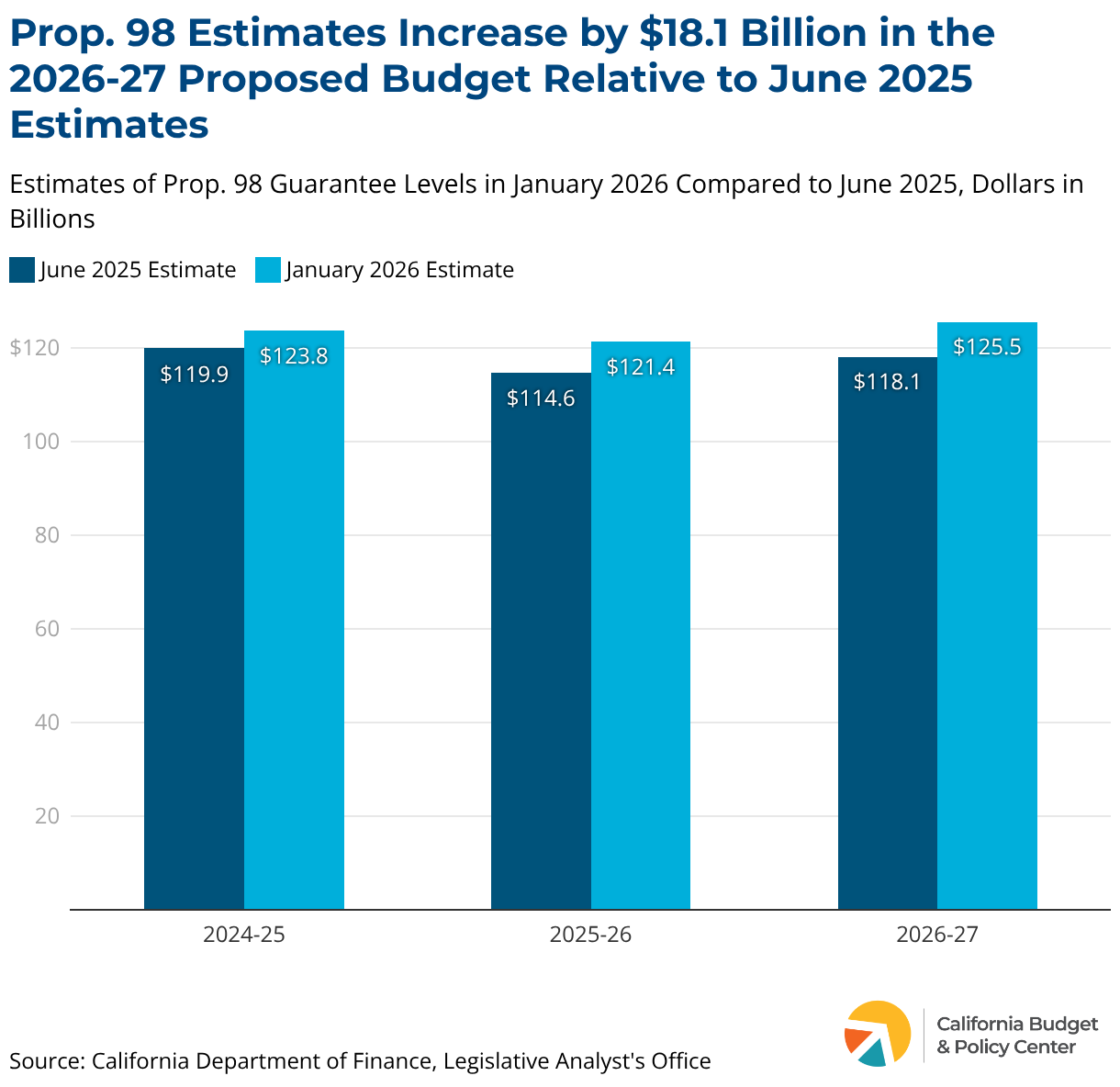
Approved by voters in 1988, Proposition 98 constitutionally guarantees a minimum level of annual funding for TK-12 schools, community colleges, and the state preschool program. The Prop. 98 guarantee tends to reflect changes in state General Fund revenues, so updates to revenue estimates change the minimum guarantee funding levels. For example, when the state revenues increase due to policy changes or overall economic growth, funding for TK-12 schools and the community colleges generally increases. Under the 2026-27 budget proposal, the Prop. 98 estimates increase by nearly $22 billion over the three-year budget window. The proposal details changes in required deposits and withdrawals across the budget window and adjusts the required maintenance factor payment.
The chart below shows updated estimates of the guarantee in the governor’s budget compared to estimates in the June 2025 enacted budget.
Prop. 98 revised estimates and proposed adjustments include the following:
- For 2024-25, the guarantee is revised up to $123.8 billion from $119.9 billion in June 2025. This level also reflects a settle-up payment created in the 2025 enacted budget and a higher maintenance factor payment — a required payment as a result of the suspension in 2023-24. Specifically, the maintenance factor payment is increased by $2.3 billion under revised revenue estimates, from $5.5 to $7.8 billion, leaving a balance of $585 million.
- For 2025-26, the guarantee is revised up to $121.4 billion from the previous estimate of $114.6. However, the governor proposes to fund the guarantee at $115.8 billion, $5.6 billion lower than what the Prop. 98 formulas require. This “settle-up,” according to the governor, is intended to mitigate the risk of revenues not fully materializing. This approach is similar to actions taken in the 2025 enacted budget for 2024-25, and it essentially moves $5.6 billion in costs to the future and the savings are used to support non-Prop.98 programs in 2025-26. No maintenance factor payment is required for 2025-26.
- For 2026-27 the Prop. 98 guarantee is calculated to be $125.5 billion, $7.4 billion higher compared to the prior estimate of $118.1 billion in June 2025. Similar to 2025-26, no maintenance factor payment is required in 2026-27 under the latest revenue assumptions included in the proposed budget.
The governor’s proposed budget also adjusts deposits and withdrawals for the Public School System Stabilization Account, also referred to as the Prop. 98 reserve, to reflect updated capital gains revenue estimates. In 2024-25, those adjustments increase the required deposit amount to $3.8 billion. In 2025-26, there’s a deposit of $664 million, which includes a mandatory deposit of $424 million and a discretionary one of $240 million. Lastly, for 2026-27 there’s a mandatory withdrawal of $407 million. After all of these adjustments, the revised balance in the Prop. 98 reserve is $4.1 billion at the end of the three-year budget window. See reserves section for more on budget reserves.
Transitional Kindergarten and State Preschool Continue as Planned
The California Department of Education (CDE) hosts two early learning and care programs: Transitional Kindergarten (TK) and the California State Preschool Program (CSPP). CSPP provides preschool to children ages 3 and 4 for families with low to moderate incomes (and temporarily to two-year-olds until July 2027). TK serves 4-year-olds, and eligibility is based on age alone in public schools and is not dependent on family income. Together, CSPP and TK are cornerstones of CDE’s Universal Preschool plan, which aims to expand early learning and care options for 3- and 4-year-olds in California. However, as California strives to create a mixed delivery system that centers the needs of families, the administration has the opportunity to utilize resources and implement policies in a way that integrates CSPP and TK with the broader early learning system to best support families with young children.
The governor’s proposed budget:
- Fully funds Transitional Kindergarten and maintains commitment to reduced ratios.
- Maintains CSPP program levels.
- Aligns with the California Department of Social Services (CDSS) on provider pay.
- Funds increased early intervention services for early education.
Budget Proposal Includes Significant One-Time and Ongoing Investments for Education Programs
The largest share of Proposition 98 funding goes to California’s school districts, charter schools, and county offices of education (COEs), which provide instruction to 5.9 million students. Education funding flows primarily through the Local Control Funding Formula (LCFF), which provides school districts, charter schools, and COEs a base grant per student, adjusted to reflect the number of students at various grade levels, as well as additional grants for the costs of educating English learners, students from low-income families, and foster youth. Other funds flow through a number of categorical programs such as the Expanded Learning Opportunities Program, special education, and other shorter-term investments.
The governor’s budget proposal provides the financial resources to expand existing programs and provides additional one-time funds to school districts, including a new discretionary block grant. Notable ongoing investments in the proposed budget include:
- $2.2 billion for a cost-of-living adjustment (COLA) for the LCFF and other non-LCFF categorical programs.
- $1 billion to sustain the California Community Schools Partnership Program.
- $509 million to increase special education base rates.
- $62.4 million to further strengthen the Expanded Learning Opportunities Program (ELOP).
The TK-12 education budget also includes significant one-time investments. Specifically, the spending plan proposes:
- $2.8 billion for a discretionary block grant.
- $250 million to continue supporting educator residency programs.
- $100 million intended to “increase access to college and career pathways for high school students.”
Proposed Budget Expands Support for the Community Colleges
A portion of Proposition 98 funding provides support for California’s Community Colleges (CCCs), the largest postsecondary education system in the country, which serves high percentages of students of color and students with low incomes. CCCs prepare more than 1.8 million students to transfer to four-year institutions or to obtain training and employment skills.
The 2026-27 proposed spending plan increases support to the community colleges through a cost-of-living adjustment, funds for increased costs, and a flexible block grant. The proposal also strengthens initiatives introduced in prior budgets. Specifically, the proposed spending plan:
- Allocates $271 million for a 2.41% COLA for the funding formula and other programs. This includes $241 million for the Student Centered Funding Formula and $31 million for other categorical programs.
- Provides $176 million for other formula adjustments and enrollment growth. The proposal includes a total of $87.2 million for enrollment growth, which includes $31.9 million for a 0.5 percent growth and an additional $55.3 million for a 1 percent growth in 2025-26. Additionally, the proposal provides a one-time increase of $88.7 million to support increased formula costs in addition to the COLA.
- Allocates $100 million one-time for a flexible block grant. The budget proposal does not provide any detail on how the “Student Support Block Grant” will be allocated to colleges or the intended use of those funds.
- Provides $78 million in one-time and ongoing funds to strengthen recent initiatives. This includes $41 million to further expand a common cloud data platform and $37 million to continue implementation of credit for prior learning efforts as part of the Master Plan for Career Education.
- Allocates $38.1 million to Calbright College, the online community college. The proposal states that these funds will provide more stable funding for the college as it “transitions out of its startup capacity.”

Where to Start? Our Essential Resources
Our resources on the California state budget can help us all ask: What kind of California do you want to live in? See our guides, videos, and more hosted on our Budget Academy!
Justice System
Budget Projects Drop in Prison Population, Fails to Propose Prison Closures
Roughly 90,360 adults convicted of a felony offense are serving their sentences at the state level, down from a peak of 173,600 in 2007. This sizable drop in incarceration is largely due to a series of justice system reforms adopted by state policymakers and the voters since the late 2000s, including Proposition 47, which California voters passed in 2014. (See Prop. 47 investments section.)
Despite this substantial progress in reducing incarceration, American Indian, Black, and Latinx Californians are disproportionately represented in state prisons — a disparity that reflects racist practices in the justice system as well as the social and economic disadvantages that communities of color continue to face due to historical and ongoing discrimination and exclusion.
Among all incarcerated adults, most — around 87,280 — are housed in state prisons designed to hold roughly 71,660 people. This overcrowding equals about 122% of the prison system’s “design capacity,” which is below the prison population cap — 137.5% of design capacity — established by a 2009 federal court order. California also houses around 3,080 people in facilities that are not subject to the cap, including fire camps, community-based facilities that provide rehabilitative services, and Department of State Hospitals facilities.
The governor’s proposed spending plan:
- Provides $13.8 billion General Fund for the California Department of Corrections and Rehabilitation (CDCR) in 2026-27, up by $525 million from the amount provided in the enacted 2025-26 budget ($13.2 billion).
- Projects the state will spend $138,019 per incarcerated adult in 2026-27, up from an estimated $135,921 in 2025-26.
- Projects that the prison population will decline in the coming years.
- Fails to advance a plan to continue downsizing the state prison system.
Governor Includes Little Funding to Cover Proposition 36’s Unfunded Costs
In 2024, voters approved Proposition 36, increasing penalties for certain drug and theft offenses. For example, Prop. 36 reversed some of the sentencing reforms put in place by Prop. 47 of 2014. In addition, Prop. 36 established a new process allowing prosecutors to charge people with a “treatment-mandated felony” for possessing illegal drugs. Yet, even with Prop. 36, most of the justice system reforms adopted by state policymakers and voters over the past couple of decades remain in effect.
By increasing punishment for drug and theft crimes, Prop. 36 has created new costs — including for incarceration, probation, and the courts — at the state and local levels.
However, Prop. 36 amounts to a huge unfunded mandate. The measure provided no new revenue to pay for these additional state and local costs — even though Californians were promised that Prop. 36 would provide evidence-based treatment, housing solutions, and programs to increase community health and safety. Instead, Prop. 36 assumes that state and local officials can accommodate the measure’s costs in their already strained budgets.
As a result, state and local leaders have to decide how to pay for the unfunded costs created by Prop. 36 even as they struggle to close budget deficits for the upcoming fiscal year and beyond.
The governor’s proposed 2026-27 state budget:
- Does not provide new funds to help address Prop. 36’s unfunded costs at the state or local levels. Instead, the governor suggests that some of the savings generated by Prop. 47 could be used to pay for Prop. 36 court-ordered treatment programs (see Prop. 47 investments section). This approach — shifting Prop. 47 dollars to pay for Prop. 36 programs — would displace important mental health and substance use services that otherwise would be funded through Prop. 47.
Proposed Budget Projects Decline in Proposition 47 Savings in Coming Years
Passed by voters in 2014, Proposition 47 reduced penalties for six nonviolent drug and property crimes from felonies to misdemeanors. As a result, state prison generally has not been a sentencing option for these crimes. Instead, people convicted of a Prop. 47 offense have served their sentence in county jail and/or received probation.
However, with the passage of Prop. 36 in November 2024, some of Prop. 47’s sentencing reforms have been reversed. Key changes enacted by Prop. 36 as well as their potential impact are described at the end of this section.
How Prop. 47 Savings Are Determined and Allocated
By decreasing state-level incarceration beginning in 2014, Prop. 47 reduced the cost of the prison system relative to the expected cost if Prop. 47 had not been approved by voters. The state Department of Finance is required to annually calculate these state savings, which are deposited into the Safe Neighborhoods and Schools Fund and used as follows:
- 65% for behavioral health services — which includes mental health services and substance use treatment — as well as diversion programs for individuals who have been arrested, charged, or convicted of crimes. These funds are distributed as competitive grants administered by the Board of State and Community Corrections.
- 25% for K-12 school programs to support vulnerable youth. These funds are distributed as competitive grants administered by the California Department of Education.
- 10% to trauma recovery services for crime victims. These funds are distributed as competitive grants administered by the California Victim Compensation Board.
California Has Allocated $908 Million in Prop. 47 Funds Through 2025-26
Since 2016, California has allocated $907.5 million in state prison savings attributable to Prop. 47. These funds have been invested in local programs that support healing and keep communities safe.
For example, research has found that people who received Prop. 47-funded behavioral health services and/or participated in diversion programs were much less likely to be convicted of a new crime. Individuals enrolled in these programs had a recidivism rate of just 15.3% — two to three times lower than is typical for people who serve prison sentences (recidivism rates range from 35% to 45% for these individuals).
Governor’s Proposed Budget Estimates $81 Million in Prop. 47 Savings to Invest in Local Communities in 2026-27
The budget estimates $81.3 million in Prop. 47 savings due to reduced state-level incarceration — dollars that will be invested in local communities starting in 2026-27. (These savings are attributable to the 2025-26 fiscal year, but will become available for expenditure in 2026-27.) With these additional funds, Prop. 47’s total investment in California’s communities will reach nearly $989 million, up from the current $908 million (through 2025-26).
Prop. 47 Savings Will Decline Due to Prop. 36
With the passage of Prop. 36 in November 2024, voters increased penalties for certain drug and theft offenses, including by reversing some of Prop. 47’s sentencing reforms (see Prop. 36 Impacts section). For example, Prop. 36 allows simple drug possession, petty theft, and shoplifting to be charged as felonies in certain circumstances. Under Prop. 47’s rules, these crimes were generally misdemeanors.
The administration estimates that the longer sentences allowed by Prop. 36 will increase the prison population by 562 in 2025-26 and by about 1,200 upon full implementation. (The overall prison population is projected to continue to decline due to the offsetting impact of justice system reforms that remain in effect.) As a result, the annual savings associated with Prop. 47 is expected to drop. For example, Prop. 47 allocations are anticipated to fall from $91.5 million in 2025-26 to $81.3 million in 2026-27 to $72.9 million in 2027-28 — a decline of 20% over this period. Prop. 36 is likely a key factor contributing to this substantial drop.
In short, because of Prop. 36, tens of millions of dollars that would otherwise have supported behavioral health treatment and other critical services over the coming years is expected to be shifted back to the state prison system.