Skip to content

Executive Summary

On January 10, Governor Jerry Brown released a proposed 2018-19 budget that prioritizes building up reserves amid deep uncertainty about looming federal budget proposals, the impacts of the recently enacted federal tax bill, and future economic conditions. The Governor forecasts revenues that are $4.2 billion higher (over a three-year “budget window” from 2016-17 to 2018-19) than previously projected in the 2017-18 budget enacted last June, driven largely by continued economic growth. The Governor’s budget assumes no changes to current federal policies and funding levels and is not yet able to account for the potential impacts of the Republican tax bill passed in late December.

The Governor’s proposed budget reflects some notable advances, such as providing funding to fully implement the Local Control Funding Formula for K-12 education (designed to direct additional resources to disadvantaged students), continuing to invest in early education and higher education, and creating a home visiting pilot program that would offer a range of supports for families participating in welfare-to-work (CalWORKs). In addition, the proposal maintains resources to address the impact of federal actions targeting the state’s immigrant residents. Yet, the Governor also places a heavy emphasis on building California’s reserves. He proposes making a one-time supplemental deposit of $3.5 billion to the state’s rainy day fund, in addition to the $1.5 billion required by Proposition 2 (2014). This proposed $5.0 billion deposit would raise the rainy day fund balance to the Prop. 2 maximum of 10 percent of General Fund tax revenues.

While the prospect of major changes in federal policy is a reason for caution, this budget could strike a better balance between putting away funds for a rainy day and boosting investments now that would help more Californians make ends meet and advance economically. Opportunities include increasing basic income support provided by the California Earned Income Tax Credit (CalEITC), boosting cash assistance for low-income seniors and people with disabilities (SSI/SSP), raising CalWORKs grant levels, and advancing new proposals to address our state’s affordable housing crisis.

The 2018-19 state budget debate will move forward amid many unknowns at the federal level, making it critical that California’s congressional delegation and state lawmakers seek to advance smart policy choices that broaden economic opportunity and push back against federal proposals that would harm people and communities across the state.

The following sections summarize key provisions of the Governor’s proposed 2018-19 budget.

Download full report (PDF) or use the links below to browse individual sections of this report:

Administration Expects Modest Economic Growth, but Notes Potential Risks

Within the past year, both the US and California have seen their lowest unemployment rates since 2000. The Administration expects the state’s unemployment rate to remain low over the next few years, at around 5 percent. The Governor’s proposed budget assumes that California’s economy will grow modestly over the next five years, but with jobs added at a slower pace than during the past five years. This expected slowdown is due in part to the state’s high housing costs, which limit the ability of employers to recruit workers to move into or within the state to access jobs. As inflation has begun to rise nationally, California’s high housing costs are also expected to contribute to continuing higher inflation within the state compared to the US.

While projecting modest economic growth, the Administration points to the risk of a national recession, noting that this current period of growth has lasted more than eight years and that unemployment rates nationally and in California are at “levels only seen near the end of an expansion.” While this risk is worth keeping in mind, a recession in the next few years is not inevitable. The Legislative Analyst’s Office (LAO) and other experts have pointed out that the recent long period of expansion does not in and of itself mean that another recession is likely soon. Other potential economic risks noted by the Administration include a stock market correction and geopolitical events that disrupt global trade. It is important to note that the Governor’s budget does not incorporate projected economic impacts from the recently passed federal tax bill, with assessment of those effects postponed to the May Revision.

Back to Top

Governor’s Proposed Budget Reflects Improved Revenue Forecast

The Governor’s proposed budget projects higher-than-expected revenues due to an improved economic forecast. However, the Administration cautions that its revised revenue projections are subject to uncertainty. Most notably, the estimates do not take into account the impact of the recently enacted federal tax legislation, which will have significant implications for California. Budget documents note that the Administration’s revised forecast in May will include preliminary estimates of the impact of the new tax law.

The proposed budget projects that total General Fund revenues (before transfers) over the three-year “budget window,” from 2016-17 to 2018-19, will be about $4.2 billion higher than the projections included in the 2017-18 budget agreement. The stronger revenue forecast is largely driven by higher personal income tax (PIT) and sales and use tax (SUT) revenue projections. Specifically, the Governor expects PIT revenues during this three-year period to be nearly $2.9 billion higher, SUT revenues to be $1.5 billion higher, and corporation tax (CT) revenues to be $358 million lower than expected when the budget for the current fiscal year was signed into law. Higher PIT projections largely reflect stronger wage gains, particularly among higher-income taxpayers, while higher SUT projections are due to stronger-than-expected consumer spending and capital equipment spending by businesses. Lower CT revenues result from weaker-than-anticipated corporate tax receipts in spite of strong corporate profits.

Back to Top

The Governor’s Proposal Opts to Maximize the State’s Rainy Day Fund and Build Up State Reserves

California voters approved Proposition 2 in November 2014, amending the California Constitution to revise the rules for the state’s Budget Stabilization Account (BSA), commonly referred to as the rainy day fund. Prop. 2 requires an annual set-aside equal to 1.5 percent of estimated General Fund revenues. An additional set-aside is required when capital gains revenues in a given year exceed 8 percent of General Fund tax revenues. For 15 years — from 2015-16 to 2029-30 — half of these funds will be deposited into the rainy day fund, and the other half will be used to reduce certain state liabilities (also known as “budgetary debt”).

Based on the Governor’s revenue projections for 2018-19, Prop. 2 would constitutionally require the state to deposit $1.5 billion into the BSA (and to use an additional $1.5 billion to repay budgetary debt). In addition, the Governor proposes to make an optional, one-time supplemental transfer of $3.5 billion from the General Fund to the BSA. (The total transfer to the BSA would be $5.0 billion: $1.5 billion as required by the state Constitution, plus the $3.5 billion supplemental transfer.) As a result, the BSA would total $13.5 billion by the end of the 2018-19 fiscal year.

Under the scenario outlined by the Governor, the BSA would reach its constitutional maximum of 10 percent of General Fund tax revenues in 2018-19. When this limit is reached, Prop. 2 requires that any additional dollars that would otherwise go into the BSA be spent on infrastructure, including spending on deferred maintenance. In other words, Prop. 2 prohibits these additional dollars from being allocated to ongoing programs and services.

The BSA is not California’s only reserve fund. Each year, the state deposits additional funds into a “Special Fund for Economic Uncertainties” (SFEU). The Governor’s proposed budget calls for an SFEU balance of $2.3 billion. Including this fund, the Governor’s proposal would build state reserves to a total of $15.8 billion in 2018-19.

One additional implication of the Governor’s proposal is that the $3.5 billion supplemental transfer to the BSA may not be readily available to help the state meet needs created by future developments, such as federal budget cuts. In order to access the BSA funds, the Governor would need to declare a “budget emergency,” defined by Prop. 2 as a disaster or extreme peril, or insufficient resources to maintain General Fund expenditures at the highest level of spending in the three most recent fiscal years, adjusted for state population growth and the change in the cost of living. In contrast, an additional transfer to the SFEU would leave the funds more readily available to help the state address uncertainties. This is because funds in the SFEU can be accessed without the need to declare a budget emergency.

Back to Top

Governor Proposes No Changes to the CalEITC

The California Earned Income Tax Credit (CalEITC) is a refundable state tax credit designed to boost the incomes of low-earning workers and their families and help them afford basic expenses. The credit was established by the 2015-16 budget agreement and was subsequently expanded as part of the 2017-18 budget deal.

Prior to this expansion, the CalEITC provided an average credit of more than $500 to around 370,000 families and individuals across the state. (Those with dependents received an average of more than $800, while those without dependents received an average of just over $100.) Many more Californians will likely benefit from the CalEITC this year due to the credit expansion.

The Governor’s proposed budget makes no changes to the CalEITC. Consistent with prior years, the Governor proposes maintaining the CalEITC “adjustment factor” at 85 percent for tax year 2018. (California policymakers must specify the CalEITC adjustment factor in each year’s state budget. This factor sets the state EITC at a percentage of the federal EITC, thereby determining the size of the state credit available in the following year.) Additionally, the Administration projects that the CalEITC will reduce state General Fund revenues by $343 million in 2017-18 and by $353 million in 2018-19.

The proposed budget also does not appear to include any funding to maintain community-based efforts to promote the CalEITC in order to boost credit claims. The 2016-17 and 2017-18 budget agreements each included $2 million for grants to community-based organizations and other local entities to support efforts to raise awareness of the CalEITC. Education and outreach efforts are important because evidence suggests that many families who were eligible for the credit missed out on it in recent years.

Back to Top

Increased Revenues Boost the Minimum Funding Level for Schools and Community Colleges

Approved by voters in 1988, Proposition 98 constitutionally guarantees a minimum level of funding for K-12 schools, community colleges, and the state preschool program. The Governor’s proposed budget assumes a 2018-19 Prop. 98 funding level of $78.3 billion for K-14 education, $3.1 billion above the revised 2017-18 minimum funding level. The Prop. 98 guarantee tends to reflect changes in state General Fund revenues and growth in the economy, and estimates of 2017-18 General Fund revenue in the proposed budget are higher than those in the 2017-18 budget agreement. As a result, the Governor’s proposed 2018-19 budget reflects a $75.2 billion Prop. 98 funding level for 2017-18, $688 million more than the level assumed in the 2017-18 budget agreement.

California’s school districts, charter schools, and county offices of education (COEs) provide instruction to approximately 6.2 million students in grades kindergarten through 12. The Governor’s proposed budget increases funding for the state’s K-12 education funding formula — the Local Control Funding Formula (LCFF) — providing sufficient dollars to reach the LCFF’s target funding level in 2018-19. The proposed budget also pays off outstanding state obligations to school districts. Specifically, the Governor’s proposed budget:

  • Increases funding by $2.9 billion to fully implement the LCFF. The LCFF provides school districts, charter schools, and COEs a base grant per student, adjusted to reflect the number of students at various grade levels, as well as additional grants for the costs of educating English learners, students from low-income families, and foster youth. The Governor’s proposal to increase LCFF funding is sufficient for all K-12 school districts to reach a target base grant in 2018-19 (all COEs reached their LCFF funding targets in 2014-15). As a result, all K-12 districts would reach their LCFF targets two years earlier than the Governor initially estimated when the Legislature enacted the LCFF.
  • Allocates $1.8 billion in one-time funding to reduce mandate debt the state owes to schools. Mandate debt reflects the cost of state-mandated services that school districts, charter schools, and COEs provided in prior years, but for which they have not yet been reimbursed.
  • Provides $212 million to support the Strong Workforce Program. The Governor’s proposed budget provides $200 million to establish a K-12-specific component of the Strong Workforce Program, which was established as part of the 2016-17 budget for the purpose of expanding the availability of community college career technical education (CTE) and workforce development programs. The Governor’s proposal also provides $12 million to fund local industry experts to provide technical support to K-12 districts that operate CTE programs.
  • Provides $133.5 million to fund cost-of-living adjustments (COLAs) for non-LCFF programs. The Governor’s proposed budget funds a 2.51 percent COLA for several categorical programs that remain outside of the LCFF, including special education, child nutrition, and American Indian Education Centers. The Governor proposes to use the increases in LCFF grants proposed for school districts and charter schools to fund the COLA for non-LCFF programs. The Governor’s budget also provides $6.2 million to fund a 2.51 percent COLA for COEs.
  • Allocates $100 million in one-time funding to increase and retain special education teachers. The Governor’s proposed budget includes $50 million for one-year, locally sponsored programs to prepare and retain special education teachers and $50 million for one-time competitive grants for K-12 school districts that create new, or expand existing, programs to address the need for special education teachers.
  • Provides $65.7 million in ongoing funding to implement a statewide system of support for K-12 school districts. To help address low student achievement in school districts identified by the state’s new accountability system, the Governor’s proposed budget includes $59.2 million for COEs and $6.5 million for the California Collaborative for Educational Excellence.

Back to Top

Governor Proposes New Funding Formula for California Community Colleges

A portion of Proposition 98 funding supports California’s community colleges (CCCs), which help prepare approximately 2.4 million full-time students to transfer to four-year institutions as well as obtain training and skills for immediate employment. The Governor’s budget proposes a new funding formula for CCC general-purpose apportionments and also calls for establishing a fully online community college. Specifically, the proposed budget:

  • Provides $175 million for a new general-purpose apportionment funding formula. The Governor’s proposal would allocate apportionments through three grants: a base grant, a supplemental grant, and a student success incentive grant. Each CCC district would receive a base grant based on a per-Full-Time Equivalent Student (FTES) funding rate that, similar to the current funding formula, would be applied to all districts. Each CCC district would also receive a supplemental grant based on the number of low-income students it enrolls as determined by two factors: students who receive a College Promise Grant fee waiver (formerly known as the Board of Governors Waiver) and students who receive a Pell grant. Each CCC district would also receive a student success incentive grant based on the number of students who “meet the following metrics: 1) the number of degrees and certificates granted and 2) the number of students who complete a degree or certificate in 3 years or less.” The student success incentive grant would also include additional funds for each Associate Degree for Transfer granted by the college. Under the new formula, funding for all CCC districts during the first year of implementation would be held harmless to the level of funding that the district received in 2017-18. The Governor’s proposal also assumes that approximately 50 percent of apportionment funding would be allocated initially as the base grant, 25 percent as part of the supplemental grant, and 25 percent as part of the student success incentive grant.
  • Includes $161.2 million to provide a 2.51 percent cost-of-living adjustment (COLA) for apportionments.
  • Allocates $120 million to establish a fully online community college. The proposed budget would allocate $100 million in one-time funding to set up the new online college and provide $20 million in ongoing funding. The Governor’s Budget Summary asserts that the online college “will not impact traditional community colleges’ enrollment because its enrollment base will be working adults that are not currently accessing higher education.”
  • Provides $46 million to support implementation of the California College Promise. Under the proposed spending plan, CCCs could use this funding to support last year’s enactment of Assembly Bill 19 — the California College Promise — which allows CCCs to waive some or all of the $46 per unit fee for all first-time California resident CCC students enrolled in 12 units or more per semester during their first year. The Governor’s budget proposal would also allow funding to be used for other purposes to “advance specific student success goals.”
  • Reduces enrollment growth funding by $13.7 million over the three-year budget window. The proposed budget increases funding available for enrollment growth by $60 million in 2018-19, but reduces funding by $73.7 million to reflect unused enrollment growth funding in 2016-17.

The Governor’s proposed budget also provides CCCs with $264.3 million in one-time funding for deferred maintenance and an additional $32.9 million to fund a new Student Success Completion Grant, consolidating funding for the Full-Time Student Success Grant and the Community College Completion Grant and basing the new grant on the number of units a qualifying student takes each semester or each year.

Back to Top

Budget Proposal Includes Modest Funding Increases for CSU and UC

California supports two public four-year higher education institutions: the California State University (CSU) and the University of California (UC). The CSU provides undergraduate and graduate education to roughly 479,000 students on 23 campuses, and the UC provides undergraduate, graduate, and professional education to about 273,000 students on 10 campuses.

The Governor’s proposed 2018-19 budget includes modest increases in General Fund spending for the CSU and the UC, with the expectation that these institutions will implement certain improvements. Specifically, the proposed spending plan:

  • Increases funding for the CSU by $92.1 million. The Administration expects the CSU to use these funds to improve the graduation rates of two-year transfer students and four-year graduation rates, as outlined in the CSU Graduation Initiative 2025.
  • Increases funding for the UC by $92.1 million. The Administration’s proposal increases funding for “base growth” by 3 percent. In addition, $50 million in funding from the 2017-18 budget package is contingent on the University providing evidence of meeting several budget and enrollment expectations by May 1, 2018.
  • Provides $7.9 million to reverse a scheduled decrease in Cal Grant tuition awards for private nonprofit institutions. The spending plan proposes to maintain the maximum award for new students attending private nonprofits accredited by the Western Association of Schools and Colleges at $9,084. The Governor’s proposal requires these institutions to admit at least 2,500 students in 2019-20 who have earned an Associate Degree for Transfer from the California community colleges and are guaranteed junior status, and 3,000 such students in 2020-21.
  • Does not reflect funding to cover increased Cal Grant costs that would result from potential tuition increases at the CSU and the UC. The Governor’s budget summary notes that both the CSU and the UC have indicated that they may present tuition increases to their governing bodies, which would require increased funding for Cal Grants. For 2018-19, the CSU is considering a 4 percent tuition increase, and the UC is considering a 2.5 percent tuition increase.

Back to Top

Administration Proposes “Inclusive” Competitive Grant Program for Child Care and Preschool Providers

California’s child care and development system allows parents with low and moderate incomes to find jobs and remain employed while caring for and preparing children for school. State policymakers dramatically cut funding for these programs during and after the Great Recession, which hampered families’ access to safe and reliable early care and education. Even as the state’s economy continues to grow and revenues increase faster than earlier forecasted, funding for the child care and development system in the current 2017-18 fiscal year remains more than $500 million below the pre-recession level, after adjusting for inflation.

The 2018-19 budget proposal creates a new competitive grant program with one-time funding of $167.2 million ($125 million Proposition 98, $42.2 million federal TANF funds). The stated goal of the Inclusive Early Education Expansion Program is to “increase the availability of inclusive early education and care for children aged 0 to 5 years old” in order to boost school readiness and improve academic outcomes for children from low-income families and children with exceptional needs. The grants are to be targeted to areas with low incomes and low access to care. In addition, the budget proposal:

  • Provides $47.7 million to increase the Standard Reimbursement Rate by 2.8 percent. For providers that contract directly with the state, the proposal increases rates effective July 1, 2018 ($31.6 million Prop. 98 General Fund, $16.1 million non-Prop. 98 General Fund).
  • Provides $13.3 million General Fund to make permanent a hold harmless provision for voucher-based child care providers. Families can access subsidized care by using a voucher to select a child care provider of their choice. The value of these vouchers is based on the state’s Regional Market Rate Survey, which is conducted on a periodic basis. The 2017-18 budget package updated the payment rate for these child care providers using the most recent survey and included a hold harmless provision to ensure that providers would not see a decrease in payment rates. The hold harmless provision in the 2017-18 budget was temporary, and the proposed 2018-19 budget makes this hold harmless provision permanent.
  • Provides $8.5 million Prop. 98 General Fund to increase the number of slots in the state preschool program. The proposed budget adds 2,959 full-day state preschool slots for Local Education Agencies beginning on April 1, 2018, as stipulated in a multiyear plan included in the 2016-17 budget agreement.

Back to Top

Proposed Budget Emphasizes the Uncertainty Over the Fate of Medicaid and the Federal Affordable Care Act

Last year, congressional leaders made multiple attempts to repeal the Affordable Care Act (ACA) and substantially reduce federal funding for Medicaid, which provides health coverage to tens of millions of Americans with low incomes, including more than 13 million in California. (Medi-Cal is California’s Medicaid program.) While these efforts failed, the federal government has pursued other changes that threaten to destabilize insurance markets and reduce the number of people with health coverage. For example, the Republican-backed tax bill – which President Trump signed into law last month – repealed the financial penalty (effective in 2019) for people who fail to opt in for health coverage. This change is expected to both reduce the number of people with health insurance and drive up premiums for those who continue to purchase coverage on the individual market. In addition, President Trump has used his executive authority to advance a number of policies designed to weaken the ACA.

The Governor’s budget summary acknowledges the uncertainty surrounding these potential federal policy changes, including whether they would “ultimately be approved or when they would take effect.” As a result, the Governor’s proposals assumes that current federal and state health policies will remain in place.

In addition, the Governor’s proposed budget:

  • Projects total Medi-Cal enrollment of 13.5 million in 2018-19. This is up from 7.9 million in 2012-13, an increase that is due primarily to California’s full implementation of federal health care reform.
  • Projects total Medi-Cal spending of $101.5 billion in 2018-19, which is comprised primarily of federal dollars. Federal support for Medi-Cal is projected to be $67.1 billion in 2018-19, roughly two-thirds of total funding for the program. State General Fund support for Medi-Cal is projected to be $21.6 billion in the upcoming fiscal year, with other non-federal funds providing the remaining $12.8 billion.
  • Estimates that the state’s share of cost for the “optional” Medi-Cal expansion will be $1.6 billion in 2018-19, substantially lower than the projected federal share ($21.3 billion). In January 2014, California – as allowed by the ACA – expanded Medi-Cal eligibility to certain low-income adults who previously did not qualify for the program. For the first three years, the federal government paid 100 percent of the costs for these new Medi-Cal enrollees, who are projected to number 3.9 million in 2018-19. California began to pay a small portion of the cost in 2017, with the state’s share set to gradually increase to 10 percent in 2020 and beyond under current federal law.
  • Estimates that Proposition 56 (2016) will raise $1.3 billion in tobacco tax revenues during 2018-19, with most of these funds allocated to Medi-Cal. Approved by voters in 2016, Prop. 56 increased the state’s excise tax on cigarettes by $2 per pack effective April 1, 2017. The measure also triggered an equivalent increase in the excise tax on other tobacco products and – for the first time – applied the state excise tax to electronic cigarettes that contain nicotine. Prop. 56 requires that the majority of the revenues raised by the measure go to Medi-Cal. The Administration projects that Medi-Cal will receive $850.9 billion from this new funding source in 2018-19, with these dollars proposed to be allocated as follows:
      • $649.9 million for supplemental payments and rate increases for Medi-Cal providers;
      • $169.4 million “to support new growth in Medi-Cal compared to the 2016 Budget Act”; and
      • $31.6 million to boost funding for certain home health providers.

Back to Top

Governor Highlights Uncertainty of Federal Funding for the Children’s Health Insurance Program (CHIP)

CHIP is a joint federal-state program that supports health insurance for almost 9 million children throughout the US during the course of a year, including over 2 million in California. In California, CHIP-eligible children from families with incomes up to 266 percent of the federal poverty line (FPL) —$65,436 for a family of four — receive health care services through Medi-Cal. (These children previously would have been enrolled in the Healthy Families Program, which was eliminated in 2013). Through separate, smaller programs, CHIP also supports health care services for certain children whose families earn up to 322 percent of the FPL in San Francisco, San Mateo, and Santa Clara counties, as well as for pregnant women in families with incomes up to the same level.

Since late 2015, the federal government has paid 88 percent of CHIP costs in California, with the state covering the remaining 12 percent. Previously, the federal share was set at 65 percent. Last year, with the program authorized only through September 2017, the Governor assumed that Congress would reauthorize CHIP at the 65 percent level effective October 1, 2017. However, Congress failed to allocate long-term federal funding for CHIP and has only managed to approve temporary funding that expires in March 2018. The short-term extension funded CHIP at 88 percent, and the Governor expects about $150 million General Fund savings to be reflected in the May Revision. These savings are not reflected in the January proposal because the funding extension occurred after the budget was finalized.

The Governor’s proposed 2018-19 budget still assumes that Congress will eventually renew CHIP funding, at the lower 65 percent level. If Congress does not reauthorize CHIP, however, the Affordable Care Act requires California to continue coverage for those children receiving care through Medi-Cal, with a 50 percent federal share. On a conference call with stakeholders, Administration officials did not confirm that the state would continue to cover the 32,000 children and pregnant women who do not qualify for federally funded Medi-Cal.

Back to Top

Governor Proposes One-Time Increase to CalWORKs Single Allocation, Provides Funds to New Home Visiting Pilot Program

The California Work Opportunity and Responsibility to Kids (CalWORKs) program provides modest cash assistance for 860,000 low-income children while helping parents overcome barriers to employment and find jobs. CalWORKs is the state’s version of the federal Temporary Assistance for Needy Families (TANF) program. Counties receive most of their funding to support CalWORKs activities (including employment services and certain child care services) through the “CalWORKs single allocation,” which has historically been budgeted based on projected caseload.

Last year, in response to the continued decline in the CalWORKs caseload, the 2017-18 budget agreement reduced the single allocation by about $140 million and required the Administration and the counties to devise a new budgeting methodology to “address the cyclical nature of the caseload changes and impacts to county services.” The Governor’s 2018-19 proposed budget includes a one-time increase in the single allocation of $187 million until the revised methodology is adopted; this is an 11 percent increase relative to the 2017-18 allocation of $1.7 billion. Additionally, with the state minimum wage scheduled to increase from $11 to $12 on January 1, 2019 for large businesses, CalWORKs spending is expected to decrease by $1.2 million General Fund as more families earn an income that is above the eligibility limit (but still far below the level needed to make ends meet).

At their current levels, CalWORKs grants fail to lift most families out of “deep poverty,” which is defined as having an income that is below half of the federal poverty line ($10,210 for a family of three in 2017). The Governor does not propose any increase to CalWORKs grant levels or time limits, even though this would be necessary to fully restore cuts that state policymakers made to the program during and after the Great Recession.

The Governor’s proposal does allocate a total of $158.5 million in one-time TANF funds through 2021 for a new voluntary home visiting pilot program, with $26.7 million in the first year. Evidence-based home visiting programs offer resources and parenting skills development to new and expecting parents, particularly those who are at-risk. The proposed initiative would apply existing models currently in place in the state to serve first-time CalWORKs parents with the aim of encouraging healthy development of low-income children, promoting healthy parenting, and preparing parents for work. On a conference call with stakeholders, Administration officials indicated an implementation target date of January 2019 for the pilot program.

Back to Top

Governor Projects a Federal Increase for SSI/SSP Grants in 2018-19, but Does Not Provide a State Increase

Supplemental Security Income/State Supplementary Payment (SSI/SSP) grants help well over 1 million low-income seniors and people with disabilities to pay for housing, food, and other basic necessities. Grants are funded with both federal (SSI) and state (SSP) dollars. State policymakers made deep cuts to the SSP portion of these grants in order to help close budget shortfalls that emerged following the onset of the Great Recession in 2007. The SSP portions for couples and for individuals were reduced to federal minimums in 2009 and 2011, respectively. Moreover, the annual statutory state cost-of-living adjustment (COLA) for SSI/SSP grants was eliminated beginning in 2010-11, after having been suspended for several years.

California took a modest step toward reinvesting in SSI/SSP by funding a 2.76 percent COLA for the SSP portion of the grant in the 2016-17 fiscal year. This boosted the monthly SSP grant to $160.72 for individuals (an increase of $4.32) and to $407.14 for couples (an increase of $10.94). However, SSP grants were not further increased in 2017-18, and these grants would continue to remain frozen at the current levels under the Governor’s proposed 2018-19 budget.

The Administration does project that the federal government will increase the SSI portion of the grant by 2.6 percent effective January 1, 2019. As a result of this projected federal increase:

  • The maximum monthly combined SSI/SSP grant for individuals who live independently would increase from the current level of $910.72 to $930.72 on January 1, 2019. This projected 2019 grant level equals 92.6 percent of the current federal poverty guideline for an individual ($1,005 per month).
  • The maximum monthly combined SSI/SSP grant for couples who live independently would increase from the current level of $1,532.14 to $1,562.14 on January 1, 2019. This projected 2019 grant level equals 115.5 percent of the current poverty guideline for a couple ($1,353 per month).

Back to Top

Proposed Budget Highlights Impact of Proposition 57, Which Provides New Tools for Reducing Incarceration

Currently, about 130,000 people who have been convicted of a felony offense are serving their sentences at the state level — down from a peak of around 173,600 in 2007. Most of the individuals who are currently incarcerated — nearly 114,300 — are housed in state prisons designed to hold slightly more than 85,000 people. This level of overcrowding is equal to 134.3 percent of the prison system’s “design capacity,” which is below the prison population cap — 137.5 percent of design capacity — established by a 2009 federal court order. (In other words, the state is in compliance with the court order.) In addition, California houses nearly 15,700 individuals in facilities that are not subject to the court-ordered cap, including fire camps, in-state “contract beds,” out-of-state prisons, and community-based facilities that provide rehabilitative services.

The sizeable drop in incarceration has resulted largely from a series of policy changes adopted by state policymakers and the voters in the wake of the federal court order. The most recent reform was Proposition 57, a 2016 ballot measure that provided state officials with new tools to address ongoing overcrowding in state prisons. Prop. 57:

  • Gave the California Department of Corrections and Rehabilitation (CDCR) broad authority to award sentencing credits to reduce the amount of time that people spend in prison.
  • Requires parole consideration hearings for state prisoners who have been convicted of a nonviolent felony and have completed the full term for their primary offense.
  • Requires juvenile court judges to decide whether a youth accused of a crime should be tried in adult court.

With the implementation of Prop. 57, the average daily number of incarcerated adults is projected to drop from just over 130,300 in 2017-18 to about 127,400 in 2018-19 (a 2.2 percent decline), according to Administration estimates. Moreover, the Administration anticipates that by freeing up space in state prisons, Prop. 57 — along with other recent criminal justice reforms — will allow the state to end the use of one of two remaining out-of-state prison facilities by the end of the current fiscal year (June 30), and to end the use of the other facility by the fall of 2019. Currently, more than 4,200 Californians are housed in facilities in Arizona and Mississippi because there is no room for them in state prisons given the court-imposed prison population cap.

In addition, the Governor’s proposed 2018-19 budget includes:

  • Overall General Fund support of $11.7 billion for the CDCR, up slightly from $11.5 billion in the current fiscal year (2017-18). Spending on state corrections now makes up roughly 9 percent of total General Fund expenditures, down from 11.4 percent of total General Fund spending in 2011-12.
  • $131.1 million General Fund to address failing roofs and mold in various facilities, aging communications equipment, and outdated medical transport vehicles.
  • $26.6 million General Fund to establish a firefighter training program for formerly incarcerated adults.
  • $20.1 million General Fund to “address mental health treatment bed capacity issues” as well as to “monitor health care data reporting and patient referrals.”
  • $9.2 million General Fund to expand rehabilitative programming activities for incarcerated adults, including both career technical education and self-improvement programs.
  • $3.8 million General Fund for certain changes related to juvenile justice, including increasing to age 25 both the “ward age” for juvenile court commitments (up from age 23) and the “age of confinement” for superior court commitments (up from age 21). These changes are intended to allow youth involved with the juvenile justice system to benefit from rehabilitative activities designed for their age group as well as to “be more successful upon release,” according to the Governor’s budget summary.

Finally, the Administration estimates that Prop. 47 will generate net state savings of $64.4 million in 2017-18, with ongoing annual savings expected to be approximately $69 million. Approved by California voters in 2014, Prop. 47 reduced penalties for certain nonviolent drug and property crimes from felonies to misdemeanors and generally allowed people who were serving a felony sentence for these crimes at the time of Prop. 47’s passage to petition the court to have their sentence reduced to a misdemeanor term. The annual state savings from Prop. 47 are required to be allocated as follows: 65 percent to mental health and drug treatment programs, 25 percent to K-12 public school programs for at-risk youth, and 10 percent to trauma recovery services for crime victims.

Back to Top

Governor’s Budget Maintains Additional Resources to Address Impact of Federal Actions on Immigration

The Administration notes that more than half of all children born in California have at least one foreign-born parent and that immigrants have been critical to California’s labor force and economic growth throughout the state’s history. Given the prominence of immigrants in California’s population and the state’s economy, recent and ongoing federal actions to limit immigration and aggressively enforce immigration laws particularly impact California. These issues have been an area of particular tension between the Trump Administration and California’s state and local governments.

The Governor’s proposed budget continues an expansion of state resources included in last year’s budget to address federal actions that affect California’s immigrant residents. The proposed 2018-19 budget includes $45 million General Fund dedicated to legal services for people seeking help with securing legal immigration status, defense against deportation, and other immigration services, as well as $3 million to assist undocumented immigrants who are unaccompanied minors, both through the Department of Social Services. The Governor’s budget also maintains increased funding for the Attorney General’s office to address federal actions and proposes to make this increased funding permanent.

Back to Top

Budget Proposal Reflects New Funding For Transportation Approved in 2017

Last year, the Governor and Legislature passed the Road Repair and Accountability Act of 2017 (Senate Bill 1), a 10-year, $55 billion transportation package. SB 1 funds improvements in state and local transportation infrastructure by increasing the state gas tax for the first time since 1994 (raising it to its inflation-adjusted level relative to 1994) and through a series of other fuel taxes, vehicle fees, and other transportation-related fees. The Governor’s proposed 2018-19 budget includes $4.6 billion in funding provided by SB 1, split evenly between state and local transportation projects.

Back to Top

Administration’s Housing Proposals Implement the 2017 Legislative Housing Package

The Governor’s proposed budget includes several references to California’s high housing costs and their implications for families and individuals as well as the economy. The Governor notes the large percentage of Californians paying more than half of their incomes toward housing, the negative impact of high housing costs on job growth and inflation, and the significant gap between housing production and demand. To begin to address California’s housing affordability crisis, last year the Legislature passed, and the Governor signed, a comprehensive package of housing legislation. These bills included multiple strategies to improve housing affordability, including directly financing affordable housing production, facilitating private-market housing production, and increasing local accountability for accommodating a fair share of new housing development.

The housing proposals in the Governor’s budget reflect implementation of components of the legislative housing package. Specifically, the Governor’s proposed budget:

  • Allocates $245 million from the real estate transaction fee established by Senate Bill 2 for affordable housing and homelessness programs. Funds from this new fee, which are expected to total $258 million annually, must be primarily targeted to homelessness services and local government capacity building for housing planning in this first year of implementation (with funds in future years largely dedicated to affordable housing development).
  • Provides $3 million General Fund to the Department of Housing and Community Development to implement various changes included in the housing package.
  • Anticipates voter approval of the $4 billion housing bond that will be placed on the November 2018 ballot as another component of the legislative housing package, while allocating $277 million of new housing bond funds toward the Multifamily Housing Program. This program supports development, rehabilitation, and preservation of rental housing affordable to lower-income households.

These proposals, combined with continuation of existing programs, loans, and tax credits administered through various state departments and agencies, bring the total proposed state funding for affordable housing and homelessness to $4.37 billion.

Back to Top

Governor Proposes Extending and Expanding the California Competes Tax Credit Program

California Competes provides income tax credits to certain businesses in order to encourage companies to move to, stay in, or expand in California. The program was established in 2013, together with two other economic development programs, as a replacement for the state’s Enterprise Zone programs. Under current law, California Competes will expire in 2017-18.

The Administration proposes extending California Competes for five years and making $180 million in credits available to qualifying businesses in each of those years. The proposed budget also provides $20 million annually to assist small businesses and “reconstitutes” $50 million per year to encourage businesses to hire people facing barriers to work, such as parolees, CalWORKs parents, and veterans.

A recent Legislative Analyst’s Office (LAO) report recommended that the Legislature end California Competes based on a preliminary evaluation of the program. Specifically, the LAO found that while the “executive branch has made a good faith effort to implement California Competes,” the program produced “windfall benefits” to businesses in some cases without any increase in overall state economic activity. Additionally, the LAO noted that it is difficult to assess the effectiveness of targeted tax incentives and suggested that “broad-based tax relief” for all businesses would be preferable.

Back to Top

Stay in the know.

Join our email list!

For the Budget Center’s annual budget preview, “The State Budget Process and Key Issues to Watch for in 2018,” Director of Research Scott Graves provided an overview of the state budget process and highlighted opportunities for public engagement.

Stay in the know.

Join our email list!

This post is the first in a California Budget & Policy Center series that will discuss the tax cuts proposed by President Trump and Republican congressional leaders and explore the implications for Californians and the nation.

Now that Republican leaders in Washington, DC, have moved on from their latest failed effort to repeal the Affordable Care Act, they have quickly turned their attention to a combination of tax cuts and deep spending reductions that together would have dire implications for many low- and middle-income people in California and across the nation. In September, the Trump Administration and leaders in the US House of Representatives and Senate unveiled their unified tax framework, which would provide significant tax cuts that predominantly benefit the wealthy.

Republican leaders are developing the full details of their tax plan in parallel with efforts to enact a budget for fiscal year 2018, and in order to offset the costs of tax cuts they are also seeking draconian cuts in spending on an array of critical programs and services. Congressional rules allow for a “fast track” process to pass tax cuts and certain spending reductions with a simple majority in the Senate (without needing any Democratic votes) — a process known as “reconciliation.” If GOP leaders pursue their proposed tax cuts, they will enact a massive redistribution of wealth that would be, in part, paid for through budget cuts to programs that help low- and middle-income families make ends meet and access greater economic opportunity.

Latest GOP Tax Plan Skews Benefits to the Wealthy

Despite their stated goal of providing a tax cut for middle-class families, the latest GOP framework would provide the vast majority of its benefits to wealthier Americans and corporations. For instance, the current tax framework is most specific about repealing the estate tax;  ending the Alternative Minimum Tax (AMT); cutting corporate tax rates; potentially lowering the highest income tax rates; and preserving tax preferences for mortgage interest — in short, a range of benefits that accrue disproportionately to wealthier households.

In contrast, the tax proposal’s benefits for working families are less explicit — and apparently far less substantial. Based on information released so far, the clearest proposals benefiting middle-class households are a doubling of the standard deduction and an unspecified increase in the Child Tax Credit, though the tax framework also includes some vague language about future “additional measures.” However, accounting for changes like the elimination of personal exemptions and an increase in the bottom marginal income tax rate for some filers, many low- and middle-income families could see little benefit, if any.

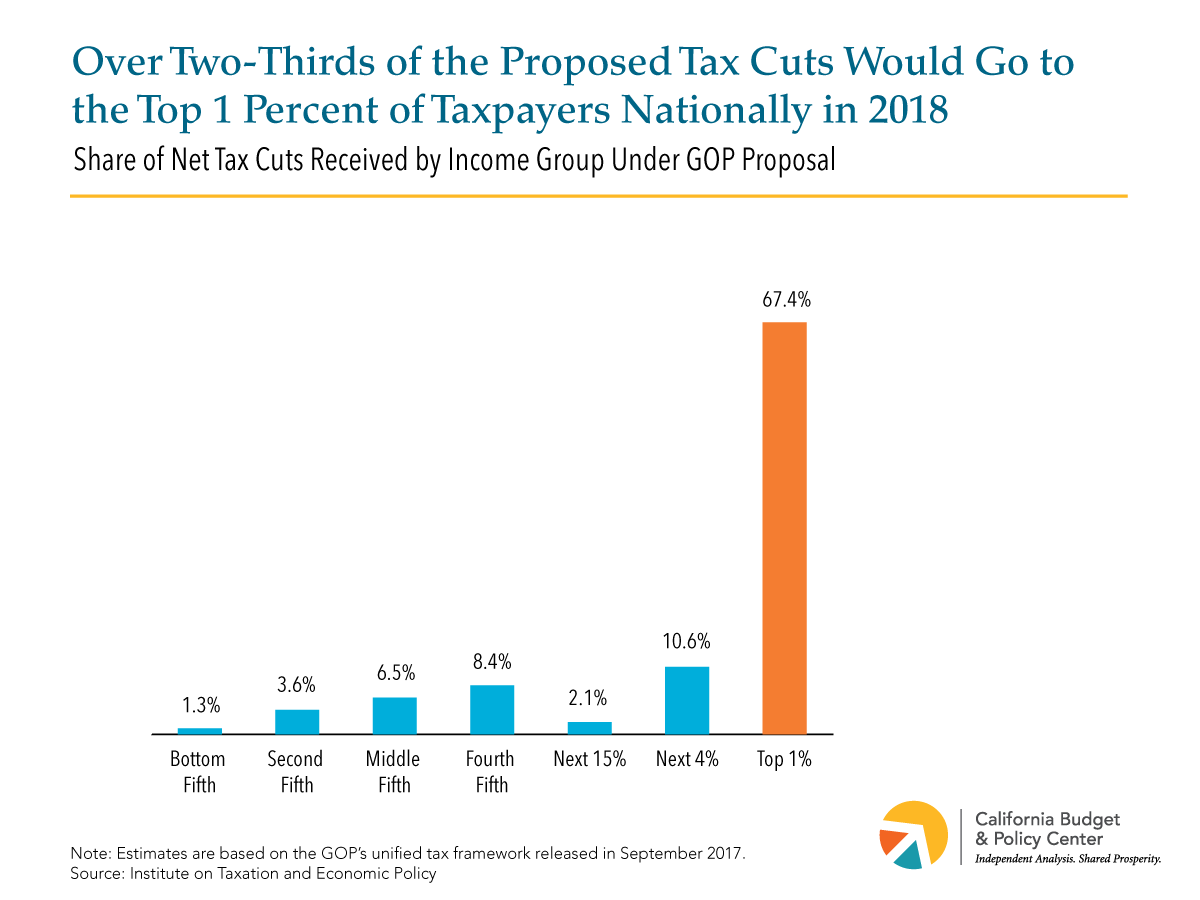
Though the President had promised that the rich “will not be gaining at all with this plan,” the numbers tell a different story. In fact, a recent analysis of the GOP tax package points to a vastly unfair distribution of its benefits. According to the nonpartisan Institute on Taxation and Economic Policy, the top 1 percent of households — a group whose annual incomes are at least $615,800 and average over $2 million — would receive over two-thirds of the tax cuts in 2018 (see chart below), an amount equivalent to 4.3 percent of this group’s pre-tax income. The bottom 60 percent of Americans, however, would receive 11.4 percent of the tax cuts, equal to a meager 0.7 percent of this group’s total income. What’s more, these Americans would be most likely to be affected by corresponding federal spending cuts that GOP leaders are proposing to offset the overall cost of the tax cuts.

In other words, the latest GOP tax plan is heavily skewed to benefiting the wealthiest households in the US, likely at the expense of many low- and middle-income households.

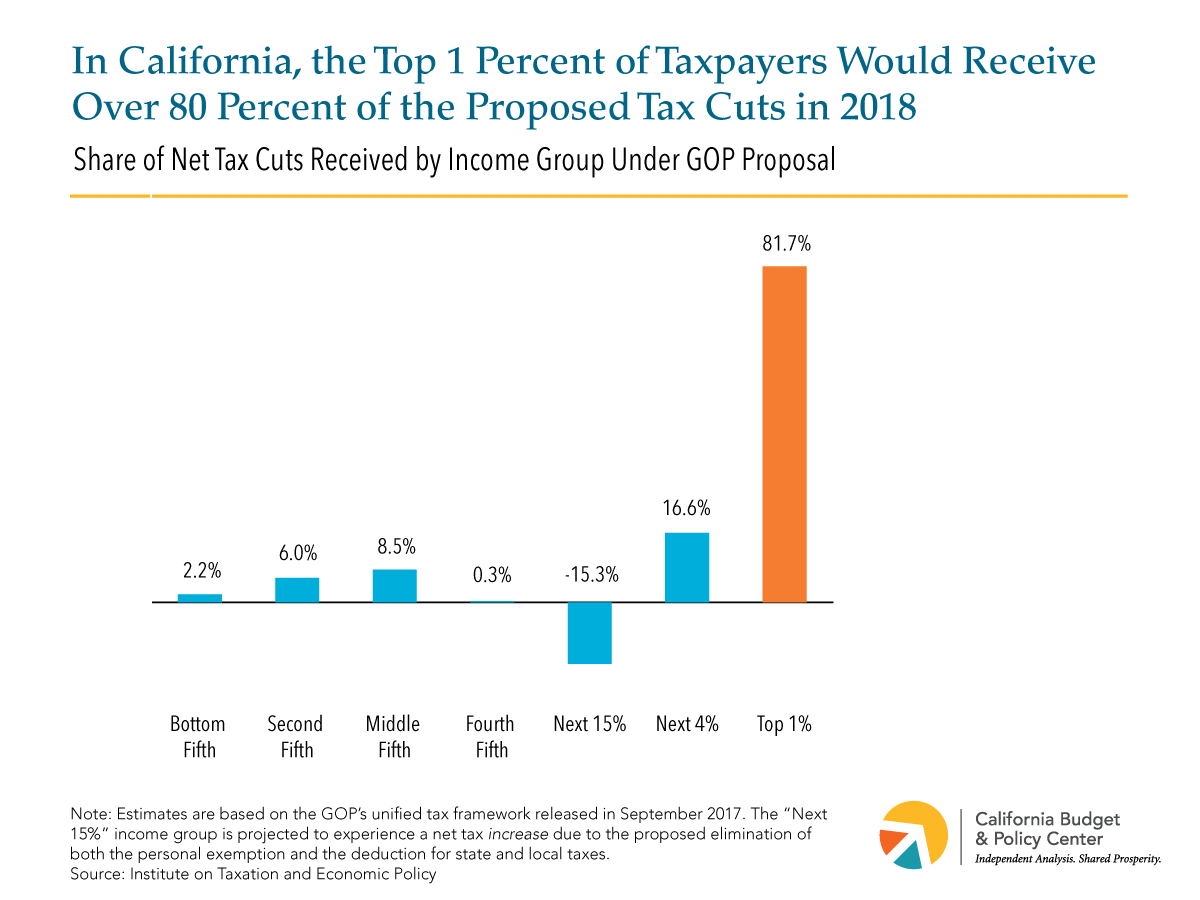
The regressive impacts of this tax framework may be even greater in some states. Here in California, an even larger share of the tax cuts — almost 82 percent — would go to just the top 1 percent of earners in 2018, with another 16.6 percent going to the next 4 percent, and the rest of the benefits spread across the remaining income levels (see chart below). The richest 1 percent of California earners — those making more than $864,900 a year — would receive an average tax cut of $90,160. In contrast, middle-income households — making between $47,200 and $75,500 a year — would receive a much smaller average tax cut of $470, and the lowest income households — those making less than $27,300 a year — would receive a tax cut of $120. For many of these low- and middle-income households the benefits of these marginal tax cuts would likely be offset by significant cuts to federal programs and services including health care, housing, food assistance, and job training assistance, among others.  

Revenue Losses Would Hurt the Economy and Struggling Households

The latest GOP plan would also come at a huge cost in lost revenues. Estimates of the resulting revenue loss vary from $2.2 trillion to $2.4 trillion over the next decade. While the plan purports to add $1.5 trillion to the federal debt over the next decade, yet-to-emerge details about the plan and likely compromises on some of the plan’s more controversial proposals (such as the elimination of the federal deduction for state and local taxes, widely known as the “SALT” deduction) could result in a much larger increase in federal debt.

The Trump Administration insists that the tax cuts will boost economic growth and pay for themselves, but analysts agree that this scenario is highly unlikely. Rather, in order to minimize the costs of the tax plan, the GOP would likely respond by attempting to further slash entitlement programs like the Supplemental Nutrition Assistance Program (SNAP), Medicaid, Medicare, and other parts of the federal budget that include funding for housing, job training, and other assistance. These cuts would likely have negative impacts on the economy by destabilizing economic conditions of millions of households who rely upon those programs to help make ends meet and to access greater economic opportunity.

Tax Plan Is Particularly Bad for California

The combination of GOP tax and budget proposals would be particularly harmful for many Californians and for the state of California.

In terms of budget cuts, the significant cuts to Medicaid and SNAP (Medi-Cal and CalFresh in California) would likely result in reduced or eliminated benefits for millions of Californians with low incomes — over 13 million (34.2 percent) who are enrolled in Medi-Cal and over 4 million (10.8 percent) who receive food assistance through CalFresh.

These cuts would also likely undermine California’s fiscal health, forcing state leaders to choose between destabilizing the state budget by trying to fill fiscal holes as a result of federal tax and budget cuts or, on the other hand, destabilizing vulnerable individuals and communities across the state by reducing benefits.

Some California taxpayers would also see significant increases in their tax bills. For instance, the majority of Californians earning $129,500 to $303,200 annually — which can actually be considered a “middle class” income in the many parts of California where costs of living are significantly higher than much of the country — would see a nearly $4,000 increase in their annual federal tax bills. This increase is largely the result of the repeal of the SALT deduction, mentioned earlier.

In short, the GOP tax and budget plans would increase the tax bills of some Californians, providing minimal tax cuts for many others, while reducing vital public assistance, all in pursuit of providing large tax cuts to the very wealthiest households and corporations.

A Better Path

Congress can still choose a more fiscally and economically responsible path. Instead of providing tax cuts that overwhelmingly go to the wealthiest households and corporations, cutting vital public programs and services, losing trillions of dollars in revenues, and adding significantly to the federal debt, Congress could seek to enact policies that move our nation in the right direction. Federal tax and budget policies should focus on making investments that enable our communities to thrive, help the most vulnerable, and broaden economic prosperity. Any federal tax cuts should be weighted toward those who need them most, and should be revenue-neutral, with lost revenues from tax cuts offset by other revenue increases (new taxes or closed loopholes) that are fairly distributed across the income spectrum.

It will be important to pay attention to which path our elected officials in Washington choose in the coming weeks and months. Their actions may mean that Californians would face the prospect of holding their congressional representatives accountable for decisions that would disproportionately — and negatively — impact our state.

Stay in the know.

Join our email list!

Whether renting an apartment or seeking to purchase a home, Californians face very high housing costs in many parts of the state.

High Rents Are Unaffordable to Households with Low and Moderate Incomes

Typical rents for a modest two-bedroom apartment in the areas where nearly two-thirds of Californians live are $1,500 or more per month — a level that is unaffordable for residents with low and moderate incomes.[1]  Affordable housing costs are defined by the US Department of Housing and Urban Development (HUD) as costing 30 percent or less of household income. By HUD’s standard, a family would need at least $60,000 in annual income to afford a monthly rent of $1,500 — an income that would require 110 hours of work per week at the current state minimum wage of $10.50 per hour.[2]

However, rents vary substantially across California. Rents are highest in coastal urban areas, while rents in the Central Valley and in northern inland areas are significantly less expensive, in many cases less than $1,000 per month for a modest two-bedroom apartment. Nonetheless, even these more affordable rents are beyond the reach of many Californians. Rent that is affordable for a full-time minimum-wage worker can be no more than $546 per month — which is lower than HUD’s two-bedroom Fair Market Rent in every part of California.[3]  This means that a single parent working full-time at minimum wage cannot expect to afford a modest two-bedroom apartment for her family anywhere in California.

High Home Prices Put Ownership Out of Reach for Californians With Moderate Incomes

For many middle-income Californians, buying a home is an important goal and part of achieving the “American dream” — but home purchase prices are out of reach for many households with moderate incomes.

Two-thirds of Californians live in areas where the median sales price for a single-family home is $500,000 or more. To purchase a half-million-dollar home while keeping housing expenses to no more than 30 percent of income requires an annual income of roughly $145,000, well over twice the state median household income. In addition to the high annual income required to afford monthly ownership expenses, making a 20 percent down-payment on a home that costs half a million dollars requires $100,000 in savings. Furthermore, nearly 1 in 10 Californians live in a county where the median sales price for a single-family home is $1 million or more — only affordable to households with annual incomes of roughly $244,000 or more, with $200,000 in savings required for a 20 percent down-payment.

Like rents, home sales prices vary greatly throughout the state. In many inland areas of the state, typical home prices are less than $250,000. However, these less expensive areas tend to have substantially lower household incomes than the more expensive parts of the state. In fact, even in the county with the least-expensive median home price (Lassen County), the income required to afford the median-priced home is more than 150 percent of the local median income.

Policies That Slow the Growth in Housing Costs Can Help Families and the State Economy

California’s high housing costs create serious burdens for families and individuals with low incomes, who are likely to struggle to afford typical rents even when working full-time. Those with moderate incomes are affected by the state’s high housing costs as well, as high home sale prices put the dream of homeownership out of reach for many. High housing costs can also restrict the ability of families to relocate to access jobs or move close to family, and can push families to live farther from their jobs, leading to longer commutes, which cause increased pollution and reduced time with family. High housing costs also negatively affect the state economy by making it more difficult for employers to recruit workers and deterring individuals from moving to or remaining in California, thus limiting the available labor force and dampening economic growth.

Policy solutions are urgently needed to prevent housing costs from further escalating and to make more housing available that is affordable to lower-income households. Strategies such as subsidizing the development of affordable housing and facilitating more private housing production can help increase the supply of housing, including units affordable to residents with low incomes, thus reducing pressure on costs. These and other policy approaches need to be seriously considered in order to address the negative impacts of California’s high housing costs.


Endnotes

[1] Rents reflect Fair Market Rents (FMR) for 2017, published annually by the US Department of Housing and Urban Development. FMRs are based on the 40th percentile (in a few cases 50th percentile) of gross rents, or rent including utilities, paid by renters within a specific metropolitan area or rural county who moved into their housing units within the past 15 months. FMRs are broadly representative of typical rents paid within a metropolitan area, and are adjusted by HUD to account for expected inflation in housing costs, but they may be lower than the current asking rents for vacant apartments in particularly high-demand cities or neighborhoods within a larger metropolitan area, or in areas where asking rents have been increasing very rapidly.

[2] Minimum wage as of January 1, 2017 for employers with at least 26 employees. See https://www.dir.ca.gov/dlse/faq_minimumwage.htm.

[3] Assumes 40 hours of work per week at the $10.50 minimum wage for employees of large firms as of January 1, 2017. See https://www.dir.ca.gov/dlse/faq_minimumwage.htm.

Stay in the know.

Join our email list!

A number of current proposals at the federal level, put forth by the Trump Administration and congressional leaders, call for deep spending cuts to many important public services and systems that improve the lives of individuals and families across California. These cuts are proposed at a time when both President Trump and leaders in the House of Representatives have signaled support for major tax cuts that would largely benefit the wealthy and large corporations.

Although federal spending deliberations occur far from California, their outcomes have deep potential impacts right here at home, in every part of our state. In order to shed light on the local importance of federal budget choices, as well as underscore what’s at stake in the votes cast by members of California’s congressional delegation, we are pleased to provide these House district Fact Sheets. They provide district-by-district figures on public services and supports across four areas — food and shelter, health care, income support, and education — along with local information on social and economic conditions.

Click below to get the Fact Sheet for your district. (Find your representative)

District 1 – Rep. Doug LaMalfa (R)District 28 – Rep. Adam Schiff (D)
District 2 – Rep. Jared Huffman (D)District 29 – Rep. Tony Cárdenas (D)
District 3 – Rep. John Garamendi (D)District 30 – Rep. Brad Sherman (D)
District 4 – Rep. Tom McClintock (R)District 31 – Rep. Pete Aguilar (D)
District 5 – Rep. Mike Thompson (D)District 32 – Rep. Grace Napolitano (D)
District 6 – Rep. Doris O. Matsui (D)District 33 – Rep. Ted Lieu (D)
District 7 – Rep. Ami Bera (D)District 34 – Rep. Jimmy Gomez (D)
District 8 – Rep. Paul Cook (R)District 35 – Rep. Norma Torres (D)
District 9 – Rep. Jerry McNerney (D)District 36 – Rep. Raul Ruiz (D)
District 10 – Rep. Jeff Denham (R)District 37 – Rep. Karen Bass (D)
District 11 – Rep. Mark DeSaulnier (D)District 38 – Rep. Linda Sánchez (D)
District 12 – Rep. Nancy Pelosi (D)District 39 – Rep. Ed Royce (R)
District 13 – Rep. Barbara Lee (D)District 40 – Rep. Lucille Roybal-Allard (D)
District 14 – Rep. Jackie Speier (D)District 41 – Rep. Mark Takano (D)
District 15 – Rep. Eric Swalwell (D)District 42 – Rep. Ken Calvert (R)
District 16 – Rep. Jim Costa (D)District 43 – Rep. Maxine Waters (D)
District 17 – Rep. Ro Khanna (D)District 44 – Rep. Nanette Barragán (D)
District 18 – Rep. Anna G. Eshoo (D)District 45 – Rep. Mimi Walters (R)
District 19 – Rep. Zoe Lofgren (D)District 46 – Rep. J. Louis Correa (D)
District 20 – Rep. Jimmy Panetta (D)District 47 – Rep. Alan Lowenthal (D)
District 21 – Rep. David Valadao (R)District 48 – Rep. Dana Rohrabacher (R)
District 22 – Rep. Devin Nunes (R)District 49 – Rep. Darrell Issa (R)
District 23 – Rep. Kevin McCarthy (R)District 50 – Rep. Duncan D. Hunter (R)
District 24 – Rep. Salud Carbajal (D)District 51 – Rep. Juan Vargas (D)
District 25 – Rep. Steve Knight (R)District 52 – Rep. Scott Peters (D)
District 26 – Rep. Julia Brownley (D)District 53 – Rep. Susan Davis (D)
District 27 – Rep. Judy Chu (D)

Stay in the know.

Join our email list!

California’s 2017-18 budget agreement included a major advance for working families who struggle to get by on low incomes. A “trailer bill” included in the budget package significantly expands eligibility for California’s Earned Income Tax Credit, the CalEITC — a refundable state tax credit that helps people who earn little from their jobs to pay for basic necessities.[1] Specifically, this bill 1) allows previously ineligible self-employed workers to qualify for the CalEITC and 2) raises the credit’s income eligibility limits so that workers higher up the income scale can qualify for it. These changes could extend the credit to well over 1 million additional low-income working families beginning in tax year 2017.[2] This represents a significant expansion of the CalEITC given that around half a million families might have been eligible for it prior to the expansion and that roughly 360,000 have annually claimed the credit since it was established in 2015.[3]

This report provides an in-depth look at what the expanded CalEITC means for low-earning Californians. It finds that the higher income limits will allow many more workers living in or near poverty, including single parents working full-time minimum wage jobs, to become eligible for the credit. However, these newly eligible workers will qualify for very modest credits — less than roughly $230 for those with children and under about $84 for those without children. Thus, while the budget agreement makes an important advance for working families by greatly expanding access to the CalEITC, state policymakers could further strengthen this critical tax credit by increasing the benefit these newly eligible workers can receive in future years.

More Low-Earning Self-Employed Workers Will Gain Access to the CalEITC

Prior to the expansion, the CalEITC was the only EITC in the nation that excluded many self-employed workers, such as small-business owners and independent contractors.[4] This exclusion undermined a fundamental purpose of the EITC: to encourage and reward work. The 2017-18 budget agreement ends this exclusion beginning in tax year 2017. As a result, all self-employed workers who meet all other requirements for the CalEITC will be able to benefit from the credit. This change better aligns California’s EITC with the federal EITC and ensures that the state credit incentivizes all types of paid work.

The Income Limits to Qualify for the CalEITC Will Increase Significantly

Prior to the expansion, many workers who struggled to get by were not eligible for the CalEITC because the income limits to qualify for the credit were extremely low. The budget agreement raises these limits in order to allow additional low-earning workers to qualify for the credit. For workers with qualifying children, the new income limit will be $22,300 beginning in tax year 2017 (Table 1). This is more than double the previous income limit for parents with one child and more than one-and-a-half times the previous limit for parents with two or more children. The budget agreement also more than doubles the income limit for workers without qualifying children, from about $6,700 in tax year 2016 to roughly $15,000 in tax year 2017.

Table 1

Higher Income Limit Means More Minimum Wage Workers Will Qualify for the CalEITC

The higher CalEITC income limits will allow more minimum wage workers to benefit from the credit. Prior to the expansion, many minimum wage workers earned too much to qualify for the credit, even though they earned too little to make ends meet given California’s high cost of living. For example, in tax year 2016, families with one child were not eligible for the CalEITC unless they earned less than about $10,000 a year, a salary that translates into working just 19 hours per week at the state minimum wage (Table 2).[5] Families with two or more children did not qualify for the credit unless they earned less than about $14,000 annually, equivalent to working 27 hours per week at the minimum wage. The CalEITC expansion will allow families to work up to 41 hours per week at the state minimum wage to benefit from the credit.[6] This means, for example, that the CalEITC will become available to single parents working full-time at the minimum wage (Figure 1).

Table 2

Figure 1

For workers without qualifying children, the new CalEITC income limit will increase to $15,010. Since this is less than a full-time minimum wage salary, the credit will not be available to full-time minimum wage workers without qualifying children. Nevertheless, this higher threshold means that these workers will be able to work up to 27 hours per week at the minimum wage and still qualify for the credit, up from just 13 hours per week to qualify previously.[7]

Higher CalEITC Income Limit Means More Working Families in Poverty Will Qualify for the CalEITC

Raising the income limits to qualify for the CalEITC will not only allow more minimum wage workers to benefit from the credit, but will also make the credit available to more workers living in or near poverty. Prior to the expansion, the CalEITC’s income limits fell well below the official federal poverty line. As a result, many workers living in poverty were not eligible for the credit. For example, single parents with one child had to earn less than about 62 percent of the poverty line to qualify for the credit. Beginning in tax year 2017, these parents can have incomes up to about 135 percent of the poverty line and still be eligible for the credit (Figure 2). Raising the income limits closer to or above the poverty line is important because many families with incomes this low struggle to afford basic expenses, particularly in high-cost areas of the state.

Figure 2

CalEITC Will “Phase Out” More Gradually, Allowing Workers Higher Up the Income Scale to Qualify

The size of the CalEITC for a particular family or individual depends on how much they earn and how many children they support. Specifically, the credit “phases in” (increases) for higher levels of earnings up to a certain maximum point, after which the credit “phases out” (decreases) for higher levels of earnings until it reaches $0. The budget agreement extends the CalEITC to workers higher up the income scale by phasing out the credit more slowly beginning at an income of $13,794 for workers with two qualifying children (Figure 3).[8] This is the income level at which these parents are estimated to qualify for a CalEITC of $250 in tax year 2017. For workers without qualifying children, the budget package phases out the CalEITC more gradually beginning at an income of $5,354 — the point at which these workers are estimated to qualify for a CalEITC of $100 in tax year 2017.

Figure 3

Most workers who previously qualified for the CalEITC will see no change in the size of the credit, while some will receive slightly larger credits. For example, there will be no change in the credit for parents with two qualifying children and earnings of up to $13,794 (Table 3). Those with incomes between $13,794 and $14,529 will qualify for slightly larger credits. For instance, a parent with two children and earnings of $14,000 will qualify for an estimated $244 from the CalEITC under the expansion, up from an estimated $180 if the credit had not been expanded. Workers with two children and incomes between $14,529 and about $22,300 will newly qualify for the CalEITC.

Table 3

Newly Eligible Workers Will Qualify for Very Modest Credits

Workers who become eligible for the CalEITC because of the higher income limits will qualify for very modest credits. Those with qualifying children will be eligible for roughly $230 or less, depending on their earnings. For example, a worker with two children could qualify for about $214 if she earns $15,000 or $126 if she earns $18,000 (Figure 4). Workers without qualifying children who become eligible for the CalEITC under the expansion will be able to receive about $84 or less, depending on their earnings. For instance, these workers would be eligible for about $84 if they earn $7,000 annually or $52 if they earn $10,000 annually.

Viewed another way, families working a total of 30 hours per week in 2017 at the state minimum wage (earning an annual salary of $16,380) will be eligible for an estimated $115 from the CalEITC if they have one qualifying child, $174 if they have two qualifying children, or $176 if they have three or more qualifying children (Table 4).[9] If the CalEITC had not been expanded in this year’s budget agreement, these workers would not have qualified for the credit at all.

Figure 4

Table 4

Conclusion

Creating the CalEITC was an important advance in how our state helps workers with low incomes to better afford basic necessities and move toward financial security. The 2017-18 budget agreement greatly strengthens this vital tax credit by extending it to well over 1 million additional low-income working families. Although many of the newly eligible workers will qualify for very modest credits, the budget deal lays the foundation for further strengthening the CalEITC, as state policymakers can build on these changes in coming years by increasing the size of the credit that newly eligible workers can receive.


Endnotes

[1] Senate Bill 106 (Committee on Budget and Fiscal Review, Chapter 96 of 2017).

[2] Institute on Taxation and Economic Policy (ITEP). ITEP’s estimate is subject to some uncertainty. This estimate is largely based on Internal Revenue Service (IRS) data on California tax filers who claim the federal EITC. However, only around 75 percent of Californians who are eligible for the federal EITC are estimated to actually claim the credit each year. This means that California’s federal EITC participation rate is implicitly assumed in ITEP’s estimate. In other words, this estimate may be understated to the extent that expanding the CalEITC encourages workers who qualify for the federal EITC, but who do not typically file their taxes, to file in order to benefit from the state credit. On the other hand, ITEP’s estimate could be overstated  given that the CalEITC appears to be undersubscribed. ITEP estimates that 553,000 tax units could have claimed the CalEITC in 2016, but actual claims were around 360,000. This suggests that ITEP’s estimate of the number of families who could benefit from the expanded CalEITC could be too high if many workers who are eligible for the credit continue to miss out on it in coming years.

[3] It is not known exactly how many families are eligible for the CalEITC. Estimates prior to the expansion ranged from around 400,000 to 600,000. Soon after the credit was signed into law, the Franchise Tax Board estimated that roughly 600,000 families would likely be eligible for it. (Personal communication with the Franchise Tax Board on September 22, 2015.) Similarly, a Stanford University analysis of US Census Bureau data estimated that approximately 600,000 families would have been eligible for the CalEITC if it had been in place in tax year 2013. (Christopher Wimer, et al., Using Tax Policy to Address Economic Need: An Assessment of California’s New State EITC (The Stanford Center on Poverty and Inequality: December 2016).) A more recent Budget Center analysis of US Census Bureau data estimated that around 416,000 families might have been eligible for the credit in tax year 2015. Additionally, ITEP’s analysis of IRS data suggests that about 550,000 families were likely eligible in tax year 2016. (Personal communication with the Institute on Taxation and Economic Policy on May 6, 2016.)

[4] Prior to the expansion, families and individuals who had self-employment income in addition to “earned income” qualified for the CalEITC if their federal adjusted gross income (AGI) was below the income limit. (“Earned income” was defined as annual wages, salaries, tips, and other employee compensation subject to wage withholding pursuant to the state Unemployment Insurance Code. Federal AGI includes both earned income and self-employment income, as well as several other types of income.) For these tax filers, the size of the CalEITC was based on their “earned income” if their federal AGI was below the income level needed to qualify for the maximum CalEITC. In contrast, if their federal AGI was at or above this threshold, then the size of the CalEITC was based on either their “earned income” or their federal AGI, whichever resulted in a smaller credit. Prior to the expansion, self-employed workers who had no “earned income” were not eligible for the CalEITC. These workers will qualify for the CalEITC beginning in tax year 2017, as long as they meet all other requirements for the credit.

[5] Earnings refer to annual earnings for the entire family.

[6] This means that in a family with one working parent, that parent can work up to 41 hours per week and still qualify for the credit. Families with two married working parents who file joint tax returns  could work a combined total of up to 41 hours per week at the minimum wage and still qualify for the credit.

[7] This means that single workers without qualifying children can work up to 27 hours per week at the minimum wage and still qualify for the credit, while married workers without qualifying children can work a combined total of up to 27 hours per week and still qualify for the credit. Most state EITCs base their credits on the same eligibility rules as the federal EITC, which means that all workers who qualify for the federal credit also qualify for the state credit. In contrast, prior to the expansion, the CalEITC was available to just a fraction of those who qualified for the federal EITC because the income limits to qualify for the state credit were extremely low. Beginning in tax year 2017, the new CalEITC income limit for workers without children will match the federal EITC threshold that applies to these workers (Table 1). As a result, all Californians without qualifying children who are eligible for the federal EITC will also be eligible for the CalEITC. The new CalEITC income limits for parents will also be closer to the federal EITC thresholds, which range from about $39,600 to about $48,300 for single parents, depending on the number of children they are supporting.

[8] For workers with three or more qualifying children, the credit begins to phase out more slowly at an income of $13,875 and for workers with one qualifying child, the credit begins to phase out more slowly at an income of $9,484. These income levels do not reflect the income levels specified in SB 106 due to errors in the bill. These income levels will be corrected in a subsequent bill later this fall. (Personal communication with the Department of Finance (DOF) on July 24, 2017.)

[9] Eligibility for the CalEITC is based on annual earnings for the tax filer (for unmarried workers) or the combined annual earnings of the tax filer and his or her spouse (for married couples filing taxes jointly). In other words, families will be eligible for an estimated CalEITC of $115 if they have one working parent who earns $16,380 or two married working parents who earn a combined total of $16,380.

Stay in the know.

Join our email list!

Executive Summary

On June 27, Governor Brown signed the 2017-18 state budget bill. This year’s budget agreement includes a number of improvements over earlier proposals, though the overall scope of state investments remains constrained by uncertainty about potential federal policy changes. The 2017-18 budget package:

  • Expands the California Earned Income Tax Credit (CalEITC) to well over 1 million additional families by expanding the credit to the self-employed and increasing the income eligibility limits.
  • Reflects an agreement between the Governor and legislative leaders over how to spend Proposition 56 tobacco tax revenues for Medi-Cal, with this funding going to supplemental payments for Medi-Cal providers and also to covering ordinary spending growth in the program.
  • Continues a multiyear reinvestment in subsidized child care and preschool that the Governor had proposed to delay in January. This includes increasing reimbursement rates for providers and adding full-day preschool slots. The enacted budget also increases access to subsidized care by raising income eligibility limits and establishing a 12-month eligibility period.
  • Requires counties to pay a larger share of In-Home Supportive Services (IHSS) costs, but includes temporary funding and other provisions to mitigate the impact of this cost-shift.
  • Mitigates a reduction in core funding for counties’ delivery of CalWORKs welfare-to-work services based on an expected decline in caseload and makes other small additional investments in welfare-to-work services.
  • Continues to increase funding for K-14 education as required by the Prop. 98 guarantee.
  • Includes dedicated resources to respond to federal action on immigration, including support for people seeking help with naturalization, deportation defense, and securing legal immigration status.

The budget package sets aside $3.6 billion as constitutionally required by Prop. 2 (2014), with half deposited in the state’s rainy day fund and half used to pay down state budgetary debt. The budget package also includes a supplemental $6 billion payment for the California Public Employees’ Retirement System (CalPERS), using funds borrowed from a state short-term investments account. Other notable elements include a significant restructuring of the state Board of Equalization as well as a transportation package agreed to by state leaders earlier this year, which will invest more than $50 billion over 10 years in state and local infrastructure through increases in fuel and vehicle-related taxes and fees.

The budget package makes no increases in basic income support for low-income seniors and people with disabilities (SSI/SSP) and lacks any proposals to address California’s affordable housing crisis.

Download full report (PDF) or use the links below to browse individual sections of this report:

Budget Package Projects Increase in Revenues, Continues to Boost State Reserves

The budget package projects General Fund revenues of $127.7 billion for 2017-18. This represents an increase of $6.1 billion over the current fiscal year (2016-17) and also reflects a modestly improved revenue picture compared to the Governor’s January projection of $125.2 billion for 2017-18 (an increase of $2.5 billion).

Of the $127.7 billion in projected General Fund revenues, $1.8 billion is taken “off the top” and transferred to the Budget Stabilization Account (BSA), the state’s constitutional “rainy day fund.” California voters revised the rules that apply to the BSA by passing Proposition 2 in November 2014. Prop. 2 requires an annual set-aside equal to 1.5 percent of estimated General Fund revenues. An additional set-aside is required when capital gains revenues in a given year exceed 8 percent of General Fund tax revenues. For 15 years — from 2015-16 to 2029-30 — half of these funds will be deposited into the rainy day fund, and the other half will be used to reduce certain state liabilities (also known as “budgetary debt”).

The enacted budget projects that the BSA will total $6.7 billion by the end of the current fiscal year (2016-17). Based on projected revenues for 2017-18, Prop. 2 constitutionally requires the state to deposit an additional $1.8 billion into the BSA (as well as set aside $1.8 billion for repaying budgetary debt), bringing the total amount in the BSA to $8.5 billion by the end of 2017-18.

The BSA is not California’s only reserve fund. Each year, the state deposits additional General Fund revenues into a “Special Fund for Economic Uncertainties” (SFEU). The enacted budget includes $1.4 billion for this fund, bringing state reserves to a total of $9.9 billion (BSA + SFEU) by the end of 2017-18.

Back to Top

Budget Agreement Expands the CalEITC

The California Earned Income Tax Credit (CalEITC) is a refundable state tax credit that state policymakers established in June 2015. This credit, modeled after the federal EITC, helps working families who earn very little from their jobs to better afford basic necessities. Around 350,000 families benefited from the CalEITC in tax year 2016 — the second year that the credit was available. Single parents with multiple qualifying children received an average of roughly $1,000 from the CalEITC, while workers without qualifying children received an average of about $100.

The 2017-18 budget agreement significantly expands the CalEITC so that well over 1 million additional families could benefit from the credit beginning in tax year 2017. Specifically, the budget agreement:

  • Allows low-earning self-employed workers to be eligible for the credit. Currently, the CalEITC is the only EITC in the nation that excludes many low-earning, self-employed workers. This exclusion undermines a fundamental purpose of the EITC: to encourage and reward work. The budget deal ends this exclusion, bringing the state credit into better alignment with the federal credit. This change means that independent contractors and small business owners who meet all other eligibility criteria will be able to benefit from the CalEITC beginning in tax year 2017.
  • Raises the income limits to qualify for the credit. Many workers who struggle to get by are not eligible for the CalEITC because the income limits to qualify for the credit are extremely low. Parents are not eligible for the credit unless their annual earnings are less than around $10,000 to $14,000, depending on the number of children they are supporting. Workers without qualifying children are not eligible unless they earn under about $6,700 annually. These income limits are so low that full-time minimum wage workers earn too much to qualify for the credit, even though they typically earn too little to make ends meet. The 2017-18 budget agreement raises the income limits to qualify for the CalEITC beginning in tax year 2017, thereby allowing many more low-earning workers to benefit from the credit. For parents with qualifying children, the limit will increase to just over $22,000 — roughly equivalent to a full-time, year-round minimum wage worker’s annual earnings. The new limit for parents will also be closer to the threshold to qualify for the federal EITC, which ranges from about $39,600 to about $48,300 for single parents, depending on the number of children they are supporting. For workers without qualifying children, the CalEITC limit will increase to about $15,000 — roughly equal to the threshold for these workers to qualify for the federal EITC.
  • Maintains support for CalEITC promotion. Awareness of the CalEITC appears to be low, and many people who were eligible for the credit during its first two years appear to have missed out on it. Lower-than-expected take-up of the CalEITC likely reflects the fact that the majority of workers who are eligible for the credit are not required to file state income taxes due to their very low incomes. In other words, many eligible workers may not realize that they can receive a tax refund even if they do not owe state income taxes. For this reason, promoting the CalEITC is critical to maximizing the credit’s success. The 2017-18 budget includes $2 million to maintain a grant program created last year that is designed to help communities expand their efforts to promote the CalEITC. The budget also provides about $5.8 million to the Franchise Tax Board to administer the CalEITC, including the processing and auditing of tax returns that claim the credit.

Back to Top

Budget Package Updates Eligibility Guidelines and Continues Multiyear Investment in Early Care and Education

The 2017-18 budget package continues implementation of the multiyear investment in California’s subsidized child care and development system, as included in the 2016-17 budget agreement. The budget package also takes an important step forward in updating income eligibility guidelines for subsidized programs, which have not been updated in a decade. Specifically, the budget package:

  • Provides $160.3 million to increase the reimbursement rate for providers that contract directly with the state. The budget increases by 5 percent the Standard Reimbursement Rate (SRR), the payment rate for providers contracting with the state ($43.7 million Proposition 98, $23.9 million non-Prop. 98 General Fund). This increase takes effect July 1, 2017, and reflects the second half of a 10 percent increase included in the 2016-17 budget agreement. In addition, the 2017-18 budget increases the SRR by an additional 6 percent, also effective July 1, 2017 ($60.7 million Prop. 98, $32 million non-Prop. 98 General Fund).
  • Provides $40.6 million General Fund to update the payment rate for voucher-based providers. Families can access subsidized care by using a voucher to select a child care provider of their choice. The value of these vouchers is based on the state’s Regional Market Rate (RMR) Survey, which is conducted on a periodic basis. The budget package increases the value of vouchers by updating rates to the 75th percentile of the 2016 RMR Survey, effective January 1, 2018.
  • Provides $25 million General Fund to update income eligibility limits and implement a 12-month eligibility period. The budget agreement updates income eligibility limits using the most current state data on family incomes. The budget also establishes a 12-month eligibility period, where families remain eligible regardless of changes in income or need, as long as family income does not exceed 85 percent of state median income. These changes bring California into compliance with the federal Child Care and Development Block Grant rules and take effect July 1, 2018.
  • Provides $15.5 million General Fund to create a “child care bridge” for children in foster care. In participating counties, the Emergency Child Care Bridge Program for Foster Children will help foster care families find and pay for short-term child care services, effective January 1, 2018.
  • Provides $7.9 million Prop. 98 General Fund to increase the number of slots in the state preschool program. The budget package adds 2,959 full-day state preschool slots beginning March 1, 2018, as stipulated in the original multiyear plan in the 2016-17 budget agreement.

Back to Top

Budget Package Boosts the Minimum Funding Level for Schools and Community Colleges

Approved by voters in 1988, Proposition 98 constitutionally guarantees a minimum level of funding for K-12 schools, community colleges, and the state preschool program. The 2017-18 budget agreement assumes the same Prop. 98 funding levels for 2015-16 ($69.1 billion) and 2016-17 ($71.4 billion) as the May Revision, and a 2017-18 Prop. 98 funding level of $74.5 billion, slightly lower ($77 million) than the May Revision. The Prop. 98 guarantee tends to reflect changes in state General Fund revenues, and while the May Revision’s estimates of 2015-16 revenues were up relative to assumptions in January’s budget proposal, the May Revision’s 2015-16 Prop. 98 funding level was actually greater than the minimum funding guarantee based on the May revenue estimates. Because calculations of the Prop. 98 guarantee are usually based on prior-year funding levels, the 2015-16 Prop. 98 funding level in the budget agreement leads to higher Prop. 98 funding levels in 2016-17 and 2017-18 than the minimum funding guarantee otherwise would have required.

The budget agreement also includes two provisions that affect the Prop. 98 guarantee for 2016-17. The first provision suspends an additional payment that is statutorily required in years when the Prop. 98 guarantee would grow less quickly than the rest of the state budget; this reduces the 2016-17 Prop. 98 guarantee by $405 million from $71.3 billion to $70.9 billion. The second provision allocates up to $514 million in 2016-17 Prop. 98 spending as a settle-up payment for prior-year obligations if Prop. 98 spending exceeds the minimum guarantee in that year. Because actual 2016-17 Prop. 98 spending is $71.9 billion, $993 million above the minimum funding guarantee, the new budget agreement allocates the full $514 million as a settle-up payment, resulting in a 2016-17 Prop. 98 funding level of $71.4 billion.

Back to Top

Budget Increases Support for the Local Control Funding Formula (LCFF) and Other K-12 Spending

California’s school districts, charter schools, and county offices of education (COEs) provide instruction to approximately 6.2 million students in grades kindergarten through 12. Consistent with proposals made in the January budget and the May Revision, the budget agreement increases funding for the LCFF — the state’s K-12 education funding formula — and pays off outstanding obligations to school districts. Specifically, the budget agreement:

  • Provides $1.4 billion to continue implementation of the LCFF. The LCFF provides school districts, charter schools, and COEs a base grant per student, adjusted to reflect the number of students at various grade levels, as well as additional grants for the costs of educating English learners, students from low-income families, and foster youth. The increase in LCFF funding may reduce the amount of time it takes for its full implementation, which depends on funding sufficient for all districts to reach a target base grant. (All COEs reached their LCFF funding targets in 2014-15.) According to the Administration, the 2017-18 LCFF funding level in the budget agreement would bring the LCFF formula “to 97 percent of full implementation.”
  • Provides $877 million in one-time funding to reduce mandate debt the state owes to schools. Mandate debt reflects the cost of state-mandated services that school districts, charter schools, and COEs provided in prior years, but for which they have not yet been reimbursed.
  • Provides an additional $50 million, for a total of $600 million, in ongoing funding for the After School Education and Safety (ASES) Program. The boost in ASES’ funding will help cover costs for implementing new minimum wage obligations.
  • Provides $30 million in one-time funding for teacher workforce programs. The budget agreement provides $25 million, to be available through 2021-22, for a second cohort of school employees to obtain their teaching credential through the Classified School Employee Teacher Credentialing Program. The budget agreement also provides $5 million in competitive grants, to be available through 2019-20, for a newly established Bilingual Teacher Professional Development Program to help California meet the demand for bilingual teachers needed to implement programs authorized by voter approval of Proposition 58 last November.
  • Provides $10 million in one-time funding to support refugee students. The budget agreement requires the Department of Social Services to allocate these dollars between 2017-18 and 2019-20 to school districts that are impacted by significant numbers of refugee students.
  • Maintains cost-of-living adjustments (COLAs) for non-LCFF programs. Consistent with the May Revision, the budget agreement provides an additional $3.2 million to fund a 1.56 percent COLA, up from the 1.48 percent COLA proposed in the January budget, for several categorical programs that remain outside of the LCFF. These include special education, child nutrition, and American Indian Education Centers.
  • Includes provisions to increase accountability for general obligation (GO) school facilities bond funds approved by voters last November. Proposition 51 authorized $7 billion in state GO bonds for K-12 school facilities. However, the Governor’s May Revision stated that the Administration would only support the expenditure of Prop. 51 dollars once measures were taken “to ensure that taxpayers’ dollars are spent appropriately.” The budget agreement includes trailer bill language (AB 99), proposed by the Governor, which requires audits of financial reports that school districts will be required to submit for school facilities projects that began after April 1, 2017.

Back to Top

Budget Agreement Increases Funding for California Community College Operations and Other Purposes

A portion of Proposition 98 funding supports California’s community colleges (CCCs), which help prepare approximately 2.4 million full-time students to transfer to four-year institutions as well as obtain training and skills for immediate employment. The 2017-18 budget agreement increases funding for CCC operating expenses and general-purpose apportionments. Specifically, the budget:

  • Boosts funding for CCC operating expenses by $183.6 million, $23.6 million above the May Revision. The budget agreement provides funding for the CCCs to pay for increased expenses in areas such as employee benefits, facilities, and professional development.
  • Maintains cost-of-living adjustment (COLA) for apportionments. Consistent with the May Revision, the budget agreement provides $97.6 million to fund a 1.56 percent COLA for apportionments, up from 1.48 percent as proposed in the Governor’s January budget.
  • Provides $76.9 million in one-time funding for deferred maintenance and other CCC expenses. The budget agreement provides funding for CCCs to pay for facilities and other items including deferred maintenance, instructional equipment, and certain water conservation projects.
  • Increases enrollment growth funding. The budget agreement maintains the May Revision proposal to provide $57.8 million in 2017-18 to fund a projected 1 percent increase in enrollment growth. The budget agreement also reduces funding by $33 million to reflect unused dollars allocated for 2015-16 enrollment growth.
  • Increases financial aid funding for CCC students by $50 million. The budget agreement provides $25 million for a newly established Community College Completion Grant Program and an additional $25 million for the Full-Time Student Success Grant program. Completion grants of up to $2,000 will be awarded to students who fulfill a set of requirements, including having received a Full-Time Student Success Grant and maintaining at least a 2.0 grade point average.

Consistent with the May Revision, the budget agreement provides CCCs with $150 million in one-time funding for grants to develop and implement the Guided Pathways Grant Program, an institution-wide approach to supporting student success.

Back to Top

Budget Agreement Increases Higher Education Funding and Requires Increased Transparency From the UC

The 2017-18 budget agreement increases funding for the California State University (CSU) and University of California (UC), but makes a piece of funding for the UC contingent on certain requirements. Specifically, the new spending plan:

  • Increases funding for the CSU by $182.2 million. In addition to the $162.2 million in increased ongoing funding included in the Governor’s January budget proposal, the enacted budget includes $20 million to support an additional 2,487 full-time California resident students compared to the 2016-17 academic year. The budget agreement also provides $20 million in one-time funding to support several CSU programs: $12.5 million for the Graduation Initiative, $3 million for the San Bernardino Palm Desert Campus, $2.5 million to support “hunger free” campuses, and $2 million for equal employment opportunity programs.
  • Increases funding for the UC by $136.5 million, but conditions more than one-third of this boost on the University demonstrating effort to satisfy several expectations. In addition to $131.2 million in increased funding in the Governor’s January budget proposal, the spending plan includes $5 million to support an additional 500 graduate students in 2017-18 compared to the 2016-17 academic year. However, the budget agreement withholds $50 million of this funding, which will be released only if the UC demonstrates — by May 1, 2018 — that it has made a good faith effort to implement: 1) recommendations made by the State Auditor, who identified a number of concerns with UC budgeting practices, 2) a more transparent budgeting process, and 3) a transfer policy at all of its campuses, except for UC-San Francisco and UC-Merced, which aims to ensure that at least one out of every two entering freshman is a transfer student beginning in the 2018-19 academic year.

The budget agreement increases funding for the California Student Aid Commission (CSAC). This includes shifting an additional $117.7 million in federal Temporary Assistance for Needy Families (TANF) funds to support Cal Grants, which offsets General Fund costs for Cal Grants by the same amount. In addition, the budget package:

  • Provides $96 million to maintain the Middle Class Scholarship Program (MCSP). The Governor proposed to phase out the MCSP in both his January budget proposal and the May Revision. The budget package rejects the Governor’s proposal, but reduces funding for the MCSP by $21 million.
  • Provides $48.9 million for the CSAC to pay for higher Cal Grant costs due to recently adopted tuition increases at the CSU and the UC. The budget package boosts funding to cover increased Cal Grant costs — $28 million for CSU students and $20.9 million for UC students.
  • Provides an additional $8 million to maintain Cal Grant funding for new students attending private institutions accredited by the Western Association of Schools and Colleges. The budget agreement maintains the maximum $9,084 Cal Grant award for new students at private nonprofit and for-profit accredited institutions.

Back to Top

Budget Package Uses $546 Million in Proposition 56 Tobacco Tax Revenues to Boost Medi-Cal Provider Rates

The 2017-18 state budget package resolves a months-long disagreement between the Governor and legislators over how to spend new Prop. 56 tobacco-tax revenues that go to Medi-Cal, which provides health coverage for more than 13 million Californians. Approved by voters last November, Prop. 56 raised the state’s excise tax on cigarettes by $2 per pack and triggered an equivalent increase in the state excise tax on other tobacco products. These increases, which took effect on April 1, will generate nearly $1.3 billion in new funding for Medi-Cal in 2017-18, according to state projections.

The Prop. 56 compromise, which is contained in Assembly Bill 120, includes the following elements:

  • Of the $1.3 billion in Prop. 56 funds that are projected to flow to Medi-Cal in 2017-18, up to $546 million could go to doctors, dentists, and certain other Medi-Cal providers as “supplemental payments.” These payments will be divided among five groups of providers: Up to $325 million for physicians; up to $140 million for dentists; up to $50 million for women’s health providers; up to $27 million for providers serving people with developmental disabilities; and up to $4 million for providers caring for people with HIV/AIDS. This use of Prop. 56 funds — which state lawmakers promoted, but the Governor initially resisted — reflects the measure’s requirement that the tobacco tax dollars directed to Medi-Cal be used “to increase funding for the existing [program]…by providing improved payments for all healthcare, treatment, and services.” According to Prop. 56, these “improved payments” must be allocated based on criteria that include 1) ensuring timely access to care, 2) bolstering the quality of care, and 3) addressing provider shortages in various parts of the state.
  • The state Department of Health Care Services (DHCS) will determine the rules for allocating these supplemental payments. These rules must be posted on the DHCS website by July 31, 2017. AB 120 does not require DHCS to solicit public input in developing these rules. However, it seems likely that the Department will reach out to key stakeholders in order to help ensure that the supplemental payments are structured in a way that will achieve the goals established by Prop. 56.
  • Prop. 56-funded supplemental payments will be disbursed only if:
    • California receives “all necessary federal approvals” in order to ensure that federal Medicaid matching funds will be available to the state. Supplemental payments will be independently allocated by provider type as federal approval is received for that category of providers. At a Senate Budget and Fiscal Review Committee hearing on June 13, Senator Holly Mitchell — the committee chair — indicated that the intent is to provide supplemental payments retroactive to July 1, 2017, even if federal approval were received much later in the fiscal year. If the Trump Administration does not approve the state’s proposed supplemental payments, then the Prop. 56 revenues that would have funded these payments would have to be used for other purposes in Medi-Cal, although AB 120 does not provide specifics on this point.
    • The federal government does not cut funding for Medi-Cal. Supplemental payments will not go into effect (or will be suspended) if federal support for Medi-Cal is reduced below the level projected in the state budget. (The Governor’s Department of Finance will make this determination.) While President Trump and Republicans in Congress are attempting to make deep cuts to Medicaid, it’s unclear whether any such reductions will be approved and, if they are, how soon they would take effect. If federal Medicaid cuts do take effect in the coming fiscal year, then any Prop. 56 revenues that would have funded supplemental payments would have to be used for other purposes in Medi-Cal, although AB 120 does not provide specifics on this point.
  • If California allocates the full $546 million in Prop. 56-funded supplemental payments in 2017-18, the state would receive a projected $613 million in federal Medicaid matching funds. With these federal funds, a total of up to $1.2 billion in supplemental payments would be available to Medi-Cal providers in 2017-18.
  • The remaining Prop. 56 funds that flow to Medi-Cal will be used to pay for ordinary spending growth in the program. For example, if the state allocates the full $546 million in supplemental payments in 2017-18, the remaining $711 million in Prop. 56 revenues for that year will go toward routine year-over-year cost increases in Medi-Cal, costs that typically would be paid for with state General Fund dollars. This part of the compromise reflects the Governor’s interpretation of Prop. 56 — one that is at odds with how many state lawmakers and Medi-Cal providers interpret the measure.
  • The compromise sets an expectation that the Governor could disburse up to $800 million in Prop. 56 funds as supplemental payments to Medi-Cal providers in 2018-19, which begins on July 1, 2018. However, the amount of supplemental payments provided in 2018-19 will ultimately be determined based on negotiations between the Governor and legislative leaders as part of the typical state budget deliberations in 2018.

Back to Top

Budget Package Restores Full Dental Services in 2018, Vision Services in 2020, for Adults Enrolled in Medi-Cal

In order to help close a substantial budget gap in 2009, state policymakers eliminated several Medi-Cal benefits for adults that are optional under federal law. (Medi-Cal is California’s Medicaid program.) These cuts included optional dental services as well as optometric and optician services. The 2013-14 state budget package restored some optional dental services for adults effective May 1, 2014. These restored services included fluoride treatments, certain crowns, and full dentures, but excluded certain other dental services, such as implants. The 2017-18 budget agreement (Senate Bill 97):

  • Restores, as soon as January 1, 2018, the full array of dental services for adults in Medi-Cal. This change is estimated to increase General Fund spending by $34.7 million in 2017-18, with estimated full-year costs of $72.9 million beginning in 2018-19. Implementation is contingent on federal approval.
  • Restores, as soon as January 1, 2020, optometric and optician services as a Medi-Cal benefit for adults. Implementation is contingent on federal approval as well as on funding being provided in the state budget.

Back to Top

Budget Package Shifts In-Home Supportive Services (IHSS) Costs to Counties, but Reduces the Impact

Under the Coordinated Care Initiative (CCI), California integrates health care and other services — including IHSS — for certain seniors and people with disabilities. In January, the Administration indicated that because the CCI is not cost-effective, it will be discontinued in 2017-18, pursuant to current law. Because of how the CCI is structured, one key outcome of discontinuing this initiative is that counties’ share of the nonfederal costs for IHSS will go up substantially beginning in July 2017, while the state’s share of the costs will drop. (IHSS costs are funded with federal, state, and county dollars.) This past spring, the Administration worked with counties to develop a multifaceted plan to mitigate the impact of this roughly $600 million cost-shift on county budgets. As enacted in Senate Bill 90, this plan includes the following elements:

  • Maintains a “maintenance-of-effort” (MOE) structure for sharing nonfederal IHSS costs between the state and counties. This county MOE structure was implemented in 2012 as part of the CCI. The state General Fund will continue to pay the difference between counties’ MOE contribution each year and the total nonfederal share of IHSS costs in each county.
  • Calculates a new MOE base for county IHSS costs in 2017-18 and applies an annual inflation factor to that base beginning in 2018-19. The MOE base will include the cost of IHSS services along with a limited amount of costs related to IHSS administration. The inflation factor is set at 5 percent for 2018-19 and will rise to 7 percent in 2019-20 and each year thereafter. However, the inflation factor could be lower in any given year depending on the performance of sales and use tax revenues that counties receive as part of their “1991 realignment” funding.
  • Provides counties with General Fund dollars to offset a portion of their increased costs for IHSS. The state will provide counties with $400 million in 2017-18; $330 million in 2018-19; $200 million in 2019-20; and $150 million in 2020-21 and each year thereafter.
  • Redirects, for five years, certain 1991 realignment “growth” funds in order to offset a portion of counties’ increased costs for IHSS. For the first three years, SB 90 redirects all Vehicle License Fee growth funds from various 1991 realignment subaccounts, including one that provides funding for mental health services. In the fourth and fifth years, the amount of redirected revenues would be cut in half.
  • Allows counties to avoid repaying revenues that they received in error due to miscalculations by the state Board of Equalization. This amount ranges from $100 million to $300 million, according to the California State Association of Counties (CSAC).
  • Allows counties that are “experiencing significant financial hardship” due to higher IHSS costs to seek a low-interest loan from the state. This loan option would be available through 2019-20. Loans would have to be paid back within three years.

With this mitigation plan in place, counties’ additional costs for IHSS are expected to be relatively manageable in 2017-18 and 2018-19. However, CSAC warns that the potential for a 7 percent jump in counties’ IHSS contribution in 2019-20 “is problematic…and will lead to growing county general fund impacts.” Any remaining county concerns could be addressed relatively soon: SB 90 requires the Governor’s Department of Finance — in developing the 2019-20 budget — to meet with CSAC and other organizations to examine various issues related to the 1991 realignment, including IHSS costs.

Back to Top

Budget Package Mitigates Cut to Key CalWORKs Funding Source and Calls for Change in Allocation Methodology

The California Work Opportunity and Responsibility to Kids (CalWORKs) Program provides modest cash assistance for 875,000 low-income children while helping parents overcome barriers to employment and find jobs. Counties receive most of their funding to support CalWORKs activities (including employment services, some child care and case management, and eligibility and other administration services) through the “CalWORKs single allocation,” which has historically been budgeted based on projected caseload. Because the CalWORKs caseload is expected to decline next year, the Governor proposed reducing the single allocation by roughly $250 million, about a 13 percent cut relative to the 2016-17 allocation. Counties objected to this cut, citing their limited ability to quickly reduce spending in response to changes in caseload, as well as the need to maintain a baseline level of infrastructure and service capacity in order to be able to respond to future caseload increases. In response to these concerns, the 2017-18 budget agreement reduces the proposed cut to the single allocation with a one-time $108.9 million augmentation, resulting in an overall net reduction to the single allocation of about $140 million compared to the 2016-17 fiscal year. The budget agreement also requires the Administration to work with counties to revise the methodology for developing the single allocation.

The budget agreement does not propose new increases to CalWORKs basic grants or time limits, though this would be necessary to restore cuts made to the program during and after the Great Recession. However, the budget does include some new investments in welfare-to-work services and infrastructure, including financial incentives for participants engaged in education, expansion of substance abuse services to children of CalWORKs participants, and investments in data and evaluation systems.

Back to Top

Budget Agreement Provides Increased Resources to Address Federal Actions on Immigration and Other Issues

California was home to more than 10.7 million foreign-born residents as of 2015. This includes a significant number of undocumented immigrants and their children, who are often US citizens. Aggressive federal enforcement of immigration laws has been an area of particular tension between the Trump administration and California’s state and local governments, and the 2017-18 budget package adopts three new proposals that aim to address this issue. Specifically, the budget agreement:

  • Prohibits local law enforcement agencies from establishing new contracts or expanding existing contracts with federal authorities to provide space to detain noncitizens facing federal immigration charges. This provision applies to contracts for detaining both noncitizen adults and accompanied or unaccompanied minors.
  • Requires the Attorney General to review conditions and policies in California detention facilities that hold individuals facing federal immigration charges. The budget provides $1 million to support these activities.
  • Dedicates $45 million General Fund to the Department of Social Services to increase the availability of legal services for people seeking help with naturalization, deportation defense, and securing legal immigration status. These funds represent an increase over the $30 million for this purpose previously proposed by the Governor.

The enacted budget also maintains the $6.5 million General Fund and 31 positions in the Department of Justice proposed by the Governor for “new legal workload related to various actions taken at the federal level.” These funds are intended to address federal actions broadly in the areas of public safety, health care, the environment, consumer affairs, and general constitutional issues, including actions that may affect the California Secure Choice Retirement Savings Program.

Back to Top

Supplemental Payment for State Employee Pensions Included in Budget Package

The budget package includes higher levels of contributions to state-run retirement systems: the California Public Employees’ Retirement System (CalPERS) and the California State Teachers’ Retirement System (CalSTRS). CalPERS and CalSTRS, like many retirement systems, are not funded at levels that will keep up with future benefits, resulting in the state needing to make annual contributions in order to pay down unfunded liabilities. The state’s unfunded liabilities in the two retirement systems have grown recently as a result of lower-than-expected investment returns and changes to the assumptions the systems make about future investment returns. Greater unfunded liabilities from lower investment returns, in turn, mean that state General Fund contributions to the two systems must increase.

The enacted budget includes additional General Fund contributions as a result of CalPERS and CalSTRS reducing the “discount rate” from 7.5 percent to 7.0 percent over the next several years. The discount rate is the assumed future rate of return on investments that is used to estimate the level of contributions from the state and employers.

In addition, the budget includes a supplemental payment to CalPERS of $6 billion, using revenues borrowed from the Surplus Money Investment Fund, a state cash-flow and short-term investments account that is used to pool and invest state funds until they are needed. The purpose of this loan is to help offset increases in state contributions in future years — essentially refinancing a liability to CalPERS. The loan will allow the funds to be invested at CalPERS’ assumed investment return rate (discount rate) of 7 percent, as opposed to the less than 1 percent currently earned by the funds. The Administration estimates that over two decades this will generate an additional $11 billion (after paying for the costs of the loan), helping to reduce state contributions to CalPERS. The General Fund’s share of the repayment of the loan will be covered by funds set aside by Prop. 2 (2014) for repayment of budgetary debt. The rest of the loan repayment will come from a series of state special funds. In other words, the intention is that repaying the loan will not come from money that could otherwise be used to increase spending for other General Fund programs.

Back to Top

Budget Provides More Than $11 Billion for the California Department of Corrections and Rehabilitation

The California Department of Corrections and Rehabilitation (CDCR) operates the state’s prison and parole systems. Funding for the CDCR supports the cost of housing men and women in state prisons and other correctional facilities, providing health care and rehabilitation services, and supervising people who have been released back to their communities after completing their prison terms. CDCR’s budget also pays for youth correctional operations and services that are provided at the state level.

The 2017-18 budget provides $11.1 billion in General Fund support for CDCR operations. Overall General Fund spending for CDCR, including support for capital outlay, is equal to 8.9 percent of total enacted 2017-18 General Fund expenditures. In a significant change, the CDCR’s budget includes — effective July 1, 2017 — $254.4 million that was previously budgeted through the Department of State Hospitals (DSH). These dollars pay for the operation of 1,156 inpatient mental health treatment beds at three state prisons — beds that are part of the broader system of mental health care that is provided to incarcerated adults. Transferring responsibility for these psychiatric services from the DSH to the CDCR is intended to “streamline processes and improve timelines for inmate referrals for psychiatric inpatient treatment,” according to the Administration’s summary of the budget package.

Back to Top

Budget Package Highlights Anticipated Reduction in Prison Population Due to Proposition 57

Currently, more than 131,100 people are serving sentences at the state level in the custody of the California Department of Corrections and Rehabilitation (CDCR). Most of these individuals — over 115,100 — are housed in state prisons designed to hold slightly more than 85,000 people. This level of overcrowding is equal to 135.3 percent of the prison system’s “design capacity,” which is below the prison population cap — 137.5 percent of design capacity — established by a federal court order. In addition, California houses approximately 16,000 individuals in facilities that are not subject to the court-ordered population cap, including fire camps, in-state contract beds, out-of-state prisons, and community-based facilities that provide rehabilitative services.

The total number of people incarcerated by the state has declined by roughly one-quarter since peaking at 173,600 in 2007. This substantial reduction resulted largely from a series of policy changes adopted by state policymakers and the voters in the wake of the 2009 federal court order requiring the state to reduce overcrowding in state prisons.

California voters added a new reform last year by approving Prop. 57, which gives state officials new policy tools to address ongoing overcrowding in state prisons. Prop. 57 requires parole consideration hearings for state prisoners who have been convicted of a nonviolent felony and have completed the full term for their primary offense. The measure also gives the CDCR — which is part of the Governor’s administration — broad new authority to award sentencing credits to reduce the amount of time that people spend in prison. Prop. 57 requires the CDCR to adopt regulations implementing both of these provisions. Finally, Prop. 57 requires juvenile court judges to decide whether a youth should be tried in adult court.

Earlier this year, the Administration drafted emergency regulations to implement Prop. 57, which were approved by the Office of Administrative Law in April. Based on these emergency rules (as published):

  • The new parole consideration process for nonviolent offenders was scheduled to take effect on July 1, 2017.
  • New and enhanced sentencing credits for completion of education and rehabilitation programs are scheduled to be implemented on August 1, 2017. (Enhanced sentencing credits for good conduct took effect on May 1.)

The 2017-18 budget package estimates that in 2017-18, Prop. 57 will reduce the number of inmates by 2,675 below the level that was otherwise projected (130,368). This annual drop in the inmate population is projected to grow to about 11,500 in 2020-21. A declining inmate population will allow the CDCR “to remove all inmates from one of two remaining out-of-state facilities in 2017-18, and begin removing inmates from the second facility as early as January 2018,” according to the Administration’s summary of the budget package. The budget agreement assumes that Prop. 57 will result in net state savings of $38.8 million in 2017-18, rising to about $186 million by 2020-21.

Back to Top

Budget Agreement Reorganizes State Tax Administration and Limits Board of Equalization’s Duties

The California Board of Equalization (BOE) currently operates over 30 tax and fee programs and has a quasi-judicial role in ruling on tax appeals. In addition, an elected five-member board governs the BOE, and BOE board members often view themselves in a quasi-legislative role.

There has been longstanding concern regarding the BOE’s conflicting roles and responsibilities, and a recent audit by the Department of Finance showed recent misuse of BOE resources, board member interference in routine operations, and an inability to report accurate and reliable information to the Legislature or the Administration.

In response, the 2017-18 budget agreement reorganizes the BOE’s roles and responsibilities and in doing so creates two new state entities: the California Department of Tax and Fee Administration (CDTFA) and the Office of Tax Appeals (OTA). Under the reorganization, the BOE will retain the core duties specified in the state Constitution, including equalizing county property tax rates, assessing certain intercounty and business property, assessing taxes on insurers, and assessing and collecting alcohol excise taxes. The CDTFA and the OTA will have responsibility for other BOE operations that are defined by state statute. The CDTFA will have responsibility for administering other BOE tax and fee operations, and the OTA will have responsibility for ruling on tax appeals. The reorganization of state tax administration will be effective on July 1, 2017.

Back to Top

Budget Agreement Reflects Recently Approved Transportation Funding Package

California’s expansive transportation infrastructure includes 50,000 lane-miles of state and federal highways, 304,000 miles of locally owned roads, Amtrak intercity rail services, and numerous local transit systems, all of which facilitate the movement of people and goods across the state. The state’s largest category of deferred maintenance is for its existing transportation facilities.

The final 2017-18 budget includes an agreement with the Legislature on a 10-year, $54 billion transportation funding package. This includes $2.8 billion for 2017-18.

The funding will be split equally between state and local transportation programs over the next 10 years. Major state-level allocations include:

  • $15 billion for highway repairs.
  • $4 billion in bridge repairs.
  • $3 billion to improve trade corridors.
  • $2.5 billion to reduce congestion on major commute corridors.

Major local-level allocations include:

  • $15 billion for local road repairs.
  • $8 billion for public transit and intercity rail.
  • $2 billion for local “self-help” communities that are making their own investments in transportation improvements.
  • $1 billion for active transportation projects to better link travelers to transit facilities.

The funding package relies on new revenues generated from a series of tax and fee increases:

  • $24.4 billion from a 12-cent increase in the base gas excise tax starting on November 1, 2017.
  • $10.8 billion from a 20-cent increase in the diesel fuel base excise tax and a 5.75-cent increase in the diesel fuel sales tax starting on November 1, 2017.
  • $16.3 billion from a new annual transportation improvement fee that will take effect on January 1, 2018. This fee will range from $25 to $175 per vehicle based on the value of the vehicle. (For instance, a vehicle valued at less than $5,000 would incur a fee of $25, while a vehicle valued at $60,000 or more would incur a $175 fee.)
  • $200 million from a new annual fee of $100 on all zero-emission vehicles starting on July 1, 2020.

In addition, the base gas and diesel fuel excise taxes, the new transportation improvement fee, and the new zero emissions vehicle fee will be annually adjusted for inflation starting in 2020-21.

Back to Top

Budget Makes No New Investments in SSI/SSP or Housing, Leaves Cap-and-Trade Allocation Unresolved

The 2017-18 budget agreement includes no new investments in some services and supports that help Californians who have low incomes. In addition, the current budget package leaves unsettled the issue of how to allocate “cap and trade” revenues in 2017-18. Specifically, the budget package:

  • Does not provide a cost-of-living adjustment (COLA) for SSI/SSP grants. Supplemental Security Income/State Supplementary Payment (SSI/SSP) grants help well over 1 million low-income seniors and people with disabilities to pay for housing, food, and other basic necessities. Grants are funded with both federal (SSI) and state (SSP) dollars. Last year, the state approved a state COLA for the SSP portion of the grant, which took effect in January 2017, but no new state COLA was approved for 2017-18.
  • Does not propose any new funding to address California’s affordable housing crisis. No major new state funds are allocated to support affordable housing in the budget agreement, though multiple proposals to invest in housing are still pending in the Legislature. The budget does include $43.5 million for the Housing and Disability Advocacy Program, which was created as part of the budget package that was signed into law last year, but which was never implemented. This program is intended to help people who are homeless or at risk of homelessness and who have a disability to access appropriate benefits. The $43.5 million in funding provided for 2017-18 is carried forward from the 2016-17 budget.
  • Does not resolve the question of allocating cap-and-trade revenues. California’s cap-and-trade program sets a statewide limit on the emission of greenhouse gases (GHGs) and authorizes the Air Resources Board (ARB) to auction off emission allowances, with proceeds invested in activities that seek to reduce GHG emissions. In January, the Governor proposed allocating cap-and-trade funds contingent on the Legislature confirming — with a two-thirds vote in each house — the ARB’s authority to administer the cap-and-trade program beyond 2020. This legislative action has not yet occurred, though negotiations on this vote continue.

Back to Top

Stay in the know.

Join our email list!


This analysis is the second part of a multiphase effort to analyze subsidized child care and development programs in California. (Read the first part.) Future phases of this work will examine the unmet need for subsidized child care for children from birth through age five.


Abstract

California’s child care and development system allows parents with low and moderate incomes to find and maintain employment while providing care and education for their children. On average, from 2013 to 2015, more than 1.5 million children were eligible for subsidized programs, but only 13 percent were served in a program that could accommodate families for a full day and throughout the year. While the share of eligible children participating in these programs was low across all racial and ethnic groups, Asian and Latino children had the smallest share of eligible children enrolled in subsidized care. There are a number of reasons why Asian and Latino children could have lower rates of participation, including the rapid population growth of these two groups over the past decade; immigration- and language-related barriers to accessing subsidized care; and difficulties in utilizing subsidized care while working in low-wage jobs. Policymakers should substantially boost funding for the subsidized child care and development system to allow for greater participation for all children, in addition to addressing burdensome eligibility and reporting rules and increasing subsidized child care provider payment rates, which could improve access for many families in California.


Ensuring that children receive a strong education is one of the keys to shared economic prosperity. Learning begins even before birth, so it is imperative that all children get a solid start in early childhood in order to be prepared to learn when they enter kindergarten.[i] Unfortunately, poverty has a powerful, negative impact on children in their early years, and substantial disparities exist at the intersection of race, ethnicity, and family income.[ii] Latino and black children are significantly more likely to live in poverty than their white and Asian peers, and these disparities result in developmental gaps that can emerge very early and with lifelong consequences. [iii]

Ensuring that families have access to high-quality child development programs can mitigate the effects of poverty and close gaps in learning and development. However, largely due to inadequate state and federal funding, only a small fraction of families who are eligible for California’s subsidized child care and development programs receive care. On average, from 2013 to 2015, more than 1.5 million children from birth through age 12 were eligible for subsidized care in California, according to a California Budget & Policy Center analysis of federal survey data.[iv] Yet, on average, just 210,000 children (13.2 percent) were enrolled in a program that could accommodate families for an entire day and throughout the year.[v]

In addition, enrollment in California’s subsidized child care and development programs varies by race and ethnicity (see chart below).[vi] During the three-year period from 2013 to 2015:

  • The share of eligible children enrolled in a subsidized child care and development program was low across all racial and ethnic groups, ranging from 7.8 percent of the eligible population for Asian children to 31.8 percent for black children. Even for black children — the demographic group with the highest share of eligible children enrolled in a full-day, full-year program — roughly 2 out of 3 eligible children did not receive subsidized care.
  • Nearly 1.1 million Latino children were eligible for subsidized care, but only 119,000 (11.0 percent) were enrolled in a state program. Latino children are the largest child demographic group in California, accounting for slightly more than half of the state’s children.[vii]
  • Only about 1 in 13 eligible Asian children were enrolled in a subsidized program — just under 9,000 out of an estimated 112,000 eligible children (7.8 percent, as noted above).
  • An estimated 128,000 black children were eligible for subsidized care, but only 41,000 (31.8 percent, as noted above) were enrolled in a state program.
  • Fewer than 1 in 5 eligible white children received subsidized care (18.2 percent). An estimated 207,000 white children were eligible, but only 38,000 were enrolled in a full-day, full-year program.

There are various reasons why enrollment in subsidized programs could vary by race and ethnicity in our state. [viii] These include:

  • Population Growth. In part, demographic groups experiencing rapid population growth are less likely to be enrolled in subsidized care because the number of child care and development “slots” has not kept up with this growth.[ix] For example, over the last decade the Asian child population in California (from birth through age 12) increased by 14.3 percent and the Latino child population grew by 7.8 percent.[x] At the same time, funding for subsidized care decreased and the number of slots shrank as state policymakers made dramatic cuts during and after the Great Recession. As noted above, Asians and Latinos have a markedly lower share of eligible children enrolled in subsidized care, as compared to white and black children.
  • Immigration- and Language-Related Barriers. Navigating California’s subsidized child care and development system can be complicated, and families with low incomes may encounter barriers to accessing subsidized care. This is especially true for low-income families with immigrant parents or with parents who have limited English proficiency.[xi] In California, more than half (57.8 percent) of low-income children from birth through age 12 have at least one immigrant parent, and more than one-third (38.2 percent) of low-income children have parents who speak English less than “very well.” The majority of these children are Latino.[xii] Research shows that for these families a lack of understanding of subsidized programs, complicated eligibility and enrollment processes, and a fear of interacting with government agencies all may contribute to lower-than-expected enrollment in subsidized programs.[xiii]
  • The Nature of Low-Wage Employment. Many families in California rely on low-wage jobs that include night and/or weekend shifts, unpredictable schedules, and hours that fluctuate from month to month or even from week to week.[xiv] Working parents who have nontraditional hours or irregular schedules may use vouchers to select care from a subsidized child care provider of their choice. Many of these families rely on “license-exempt” providers — typically friends or relatives — to watch their children on short notice or during evenings or weekends. However, amid budget shortfalls due to the Great Recession, state policymakers reduced the payment rates for license-exempt providers, lowering them from 90 percent of the licensed rate to just 60 percent. For providers who watch children on a part-time basis, the payment rate is even lower — roughly one-third of the licensed rate. While the 2016-17 state budget increased the license-exempt rate, it remains much lower as a share of the licensed rate than prior to the recession and, in some cases, fails to pay even the equivalent of the minimum wage. If providers are unwilling to accept vouchers due to low reimbursement rates, this could limit low-income families’ access to care, with a disparate impact for Latinos. In California, 28.1 percent of employed Latinas work in low-wage jobs, compared to 13.2 percent of white women and 15.4 percent and 15.2 percent of Asian and black women, respectively.[xv]

Governor Brown and lawmakers can take steps to improve eligible families’ access to subsidized child care and development programs. For example, state policymakers should:

  • Substantially increase funding for subsidized child care and development programs. State policymakers could improve access to subsidized care across racial and ethnic groups in part by ending years of underinvestment. Funding for California’s subsidized child care and development programs was cut by about 40 percent (inflation-adjusted) during and after the Great Recession. While state policymakers have made reinvestments in recent years, far fewer children overall are being served in the current fiscal year than in 2007-08, at the onset of the Great Recession. Significantly boosting funding for subsidized care would help to address the lack of access among every racial and ethnic group.
  • Address eligibility reporting rules that are especially burdensome for families that face barriers to accessing subsidized care. Current rules for subsidized care require parents to resubmit eligibility information in a wide variety of situations — such as changes in income or to a work or class schedule — often resulting in frequent re-reporting by families within a given 12-month period. These reporting rules are burdensome for all families, but especially for families with variable work schedules, immigrant families, and for families that have limited English proficiency.[xvi] Further, these arduous reporting requirements can cause disruption in caregiving for children, undermine parents’ employment, and even lead to the premature loss of subsidized care.[xvii] A proposal in the state Legislature — Assembly Bill 60 (Santiago & Gonzalez Fletcher) — would bring California into compliance with federal regulations by creating a 12-month window of eligibility for subsidized care once families have secured a child care slot. A 12-month window of eligibility would reduce barriers to care; allow more children to benefit from stable, positive relationships with caregivers, thus enhancing child development; and also help parents maintain employment and increase earnings.[xviii]
  • Continue to increase payment rates for subsidized child care providers, including license-exempt providers. Families access child care and preschool programs via licensed child care providers that contract directly with the state or by using vouchers to select the child care provider (licensed or license-exempt) of their choice. During and after the Great Recession, policymakers failed to update the payment rates for these providers, and even cut the payment rate for license-exempt providers. Lack of funding for payment rates means that the providers may not be able to reimburse employees at a level that is commensurate with their experience and education or cover other operational costs. Recent years’ investments in provider payment rates have resulted in modest gains, but policymakers have much further to go. As California’s minimum wage increases to $15 per hour in coming years, many child care workers will receive a much-needed raise.[xix] If reimbursement rates are not increased annually to keep pace with the minimum wage, this will continue to place a strain on providers that offer subsidized care. Moreover, as mentioned previously, policymakers cut license-exempt provider payment rates from 90 percent to 60 percent of the licensed rate for family child care homes. While the 2016-17 budget agreement increased the payment rates to 70 percent of the licensed rate, policymakers should increase the payment rates even further to ensure that license-exempt providers are paid at least the equivalent of the minimum wage.

Children are the engine that will drive California forward in years to come. Investing in our state’s child care and development system can increase families’ economic security and, in turn, boost children’s health and well-being. These are some of the first steps necessary to improving school readiness and closing achievement gaps that affect low-income children and children of color. Making greater investments in our state’s subsidized child care and development system, and improving access for eligible children, will not only change children’s lives, but will also maximize California’s future potential.


Endnotes

[i] Center on the Developing Child, Harvard University, Five Numbers to Remember About Early Childhood Development (2009) and Christine Moon, Hugo Lagercrantz, and Patricia K. Kuhl, “Language Experience In Utero Affects Vowel Perception After Birth: A Two-County Study,” Acta Paediatrica 102 (2013), pp. 156-160.

[ii] Emma García, Inequalities at the Starting Gate: Cognitive and Noncognitive Skills Gaps Between 2010-2011 Kindergarten Classmates (Economic Policy Institute: June 2015) and Nicole L. Hair, et al., “Association of Child Poverty, Brain Development, and Academic Achievement,” JAMA Pediatrics 169 (2015), pp. 822-829.

[iii] For data on child poverty rates by race and ethnicity see Alissa Anderson, A Better Measure of Poverty Shows How Widespread Economic Hardship Is in California (California Budget & Policy Center: October 2016), p. 2. For research on disparities by race and ethnicity, see Tamara Halle, et al., Disparities in Early Learning and Development: Lessons From the Early Childhood Longitudinal Study — Birth Cohort (ECLS-B) (The Council of Chief State School Officers and Child Trends: June 2009) and James J. Heckman, “Schools, Skills, and Synapses,” Economic Inquiry 46 (2008), pp. 289-324.

[iv] Budget Center analysis of US Census Bureau, Current Population Survey data. Data limitations likely result in a conservative estimate of the number of children in California who are eligible for subsidized child care and development programs. For more information about the methodology used to calculate this estimate, see the Technical Appendix from Kristin Schumacher, Over 1.2 Million California Children Eligible for Subsidized Child Care Did Not Receive Services From State Programs in 2015 (California Budget & Policy Center: December 2016).

[v] The 210,000 figure reflects children enrolled in the full-day California State Preschool Program (CSPP) or in one of the following subsidized child care programs: Alternative Payment Program; CalWORKs Stages One, Two, or Three; Family Child Care Home Network; General Child Care; and the Migrant Child Care and Development Program. Data are not available for California Community Colleges’ CalWORKs Stage 2. Enrollment is a three-year average for October 2013, October 2014, and October 2015. This analysis includes the full-day CSPP, which consists of part-day preschool and “wraparound” child care, because it accommodates many — although not all — families’ work schedules throughout the year, and thus approximates the experience that a child would have in a high-quality subsidized child care program. In contrast, this analysis excludes an average of roughly 94,000 children who were enrolled in the part-day CSPP, without access to wraparound child care, in October 2013, October 2014, and October 2015. This is because most families with low and moderate incomes likely need wraparound care in order to supplement the CSPP’s part-day, part-year schedule. This analysis reports enrollment data for a single month — as opposed to a monthly average for a calendar year or fiscal year — because the California Department of Education (CDE) does not typically separate part-day and full-day CSPP enrollment when reporting monthly averages. The CDE also states, “Caution should be used when interpreting monthly averages as some programs do not operate at full capacity throughout the entire year (e.g., State Preschool) while other programs have seasonal fluctuations in enrollment (e.g., Migrant Child Care).” Finally, the data are for October 2013, October 2014, and October 2015 because the CDE’s point-in-time reports are only available for the month of October.

[vi] Racial and ethnic groups included in this analysis are Latino, non-Latino Asian, non-Latino black, and non-Latino white. Native American children, Pacific Islander children, or children identified as more than one race were not included due to small sample sizes.

[vii] US Census Bureau, Current Population Survey, 2013-2015 3-Year Estimates. On average, from 2013 to 2015, Latino children made up 51.5 percent of the child population from birth through age 12.

[viii] Other reasons why enrollment in subsidized child care and development programs could vary by race and ethnicity include: 1) parents’ preferences regarding care for their children and 2) having an immigration status that precludes enrollment in these programs. First, with respect to parents’ child care preferences, existing research has produced mixed results. Some studies show that child care preferences vary by the race and ethnicity of the parents, while other research suggests that child care preferences are not related to race and ethnicity. See Nicole Forry, et al., Child Care Decision-Making Literature Review (Office of Planning, Research and Evaluation, US Department of Health and Human Services: December 2013), p.18. With that said, newly published research using more recent data demonstrates that, among low-income families, Latinos’ perceptions regarding child care settings generally do not differ from those of white and black parents, nor are Latino families more likely to have family members nearby to care for their children while at work or in school. (Cited research did not explore data for the Asian population.) Researchers hypothesize that Latinos’ underutilization of formal child care arrangements, such as center-based care, may be due to specific barriers such as access to certain child care providers or language barriers. See Danielle Crosby, et al., Hispanic Children’s Participation in Early Care and Education: Type of Care by Household Nativity Status, Race/Ethnicity, and Child Age (National Research Center on Hispanic Children & Families: November 2016); and Lina Guzman, et al., Hispanic Children’s Participation in Early Care and Education: Parents’ Perceptions of Care Arrangements, and Relatives’ Availability to Provide Care (National Research Center on Hispanic Children & Families: November 2016). Second, with respect to immigration status, Budget Center estimates take this eligibility-related factor into account. Certain demographic groups’ underutilization of subsidized care is not related to children’s or parents’ eligibility based on their immigration status.

[ix] Christina Walker and Stephanie Schmit, A Closer Look at Latino Access to Child Care Subsidies (Center for Law and Social Policy: December 2016), p. 4.

[x] Overall in California, the child population from birth through age 12 decreased by about 3 percent in the past decade. The white and black child population also decreased by 21.3 percent and 26.0 percent, respectively, during this same period. (Budget Center analysis of US Census Bureau, Current Population Survey. Data based on three-year averages: 2003 to 2005 and 2013 to 2015.)

[xi] Erica Greenberg, Gina Adams, and Molly Michie, Barriers to Preschool Participation for Low-Income Children of Immigrants in Silicon Valley: Part II (Urban Institute: January 2016) and Lynn A. Karoly and Gabriella C. Gonzalez, “Early Care and Education for Children in Immigrant Families,” The Future of Children 21(1) (2011), pp. 71-101.

[xii] Of the number of low-income children in California with at least one immigrant parent, 82.6 percent are Latino and 9.4 percent are Asian. Low-income children with parents with limited English proficiency are also overwhelmingly Latino (87.4 percent). The next largest share are Asian children (8.2 percent). Budget Center analysis of US Census Bureau, American Community Survey, 2011-2015 5-Year Estimates. “Low-income” is defined as less than 200 percent of the federal poverty line. English proficiency is self-reported in the American Community Survey.

[xiii] See Julia Gelatt, Gina Adams, and Sandra Huerta, Supporting Immigrant Families’ Access to Prekindergarten (Urban Institute: March 2014); Erica Greenberg, Gina Adams, and Molly Michie, Barriers to Preschool Participation for Low-Income Children of Immigrants in Silicon Valley: Part II (Urban Institute: January 2016); Lynn A. Karoly and Gabriella C. Gonzalez, “Early Care and Education for Children in Immigrant Families,” The Future of Children 21(1) (2011), pp. 71-101; and Christina Walker and Stephanie Schmit, A Closer Look at Latino Access to Child Care Subsidies (Center for Law and Social Policy: December 2016).

[xiv] Liz Watson, Lauren Frohlich, and Elizabeth Johnston, Collateral Damage: Scheduling Challenges for Workers in Low-Wage Jobs and Their Consequences (National Women’s Law Center: April 2014).

[xv] Data are for the female civilian population age 16 and over. Racial and ethnic groups are mutually exclusive. Asian, black, and white exclude people who also identify as Latina. Low-wage occupations are defined as those that have a median hourly wage that is less than two-thirds of the overall median hourly wage. In California, this includes food preparation and serving; building and grounds cleaning and maintenance; personal care and service; and farming, fishing and forestry occupations. Budget Center analysis of California Employment Development Department, Occupational Employment & Wage Data, 2015 and US Census Bureau, American Community Survey, 2015 One-Year Estimates.

[xvi] Erica Greenberg, Gina Adams, and Molly Michie, Barriers to Preschool Participation for Low-Income Children of Immigrants in Silicon Valley: Part II (Urban Institute: January 2016) and Christina Walker and Stephanie Schmit, A Closer Look at Latino Access to Child Care Subsidies (Center for Law and Social Policy: December 2016).

[xvii] Gina Adams and Jessica Compton, Client-Friendly Strategies: What Can CCDF Learn From Research on Other Systems? (Urban Institute and Office of Planning, Research and Evaluation, Administration for Children and Families: December 2011); Gina Adams and Monica Rohacek, Child Care Instability: Definitions, Context, and Policy Implications (Urban Institute: October 2010); and Danielle Ewen and Hannah Matthews, Adopting 12-Month Subsidy Eligibility (Center for Law and Social Policy: October 2010).

[xviii] Nicole D. Forry and Sandra L. Hofferth, “Maintaining Work: The Influence of Child Care Subsidies on Child Care-Related Work Disruptions,” Journal of Family Issues 32 (2011), pp. 346-368; Yoonsook Ha, “Stability of Child-Care Subsidy Use and Earnings of Low-Income Families,” Social Service Review 83 (2009), pp. 495-523; Hannah Matthews, et al., Implementing the Child Care and Development Block Grant Reauthorization: A Guide for States (Center for Law and Social Policy and National Women’s Law Center: 2015), pp.35-37; and Judith Reidt-Parker and Mary Jane Chainski, The Importance of Continuity of Care: Policies and Practices in Early Childhood Systems and Programs (The Ounce: November 2015).

[xix] Senate Bill 3 (Leno, Chapter 4 of 2016) gradually raises the state minimum wage to $15 per hour by 2023, or potentially later depending on the condition of the economy and the state budget. After the state minimum wage reaches $15 per hour, it will be indexed annually for inflation. For an in-depth discussion of the minimum-wage increase, see Alissa Anderson and Chris Hoene, California’s $15 Minimum Wage: What We Know and Don’t Know (California Budget & Policy Center: April 13, 2016).

Stay in the know.

Join our email list!