Introduction
Governor Gavin Newsom released the May Revision to his proposed 2023-24 California state budget on May 12, projecting a $31.5 billion shortfall, up from a projected $22.5 billion shortfall in January. The administration proposes to resolve the shortfall through a series of spending reductions, trigger cuts, and delays or deferrals of spending authorized in earlier years as well as through internal borrowing and fund shifts. The $224 billion General Fund spending plan would protect many ongoing investments made in prior years, mostly maintains state reserves that are projected to total $37.2 billion, and rejects raising revenues to continue to invest in Californians.
Despite the growing shortfall, the governor’s revised budget manages to protect and maintain much of the progress made in prior years to help improve economic security and opportunities for Californians with low incomes, including investments in health care and behavioral health, safety net and cash assistance programs, homelessness and housing, and cradle-to-career education.
Each year the state budget provides state leaders with an opportunity to fund the vision of California they aspire to create. As Californians continue to experience the rising costs of basic needs like food, child care, and housing, our state’s leaders face increasing demands for essential services to meet the needs of our communities. This is especially important for Black, Latinx, and other Californians of color as well as for Californians with low incomes, who repeatedly bear the brunt of economic downturns, rising cost of living, and austerity policies.
Yet, the governor’s proposal misses an opportunity to consider additional revenues and ensure large and highly profitable corporations pay their fair share, as proposed in the state Senate’s budget plan. The Senate’s proposal proves that state policymakers can take steps to make critical investments to improve economic security, address homelessness and unaffordable housing costs, and support child care providers.
Budget shortfalls should not be addressed solely through spending solutions. State leaders should consider other tools, like raising revenues and redirecting spending that supports the wealthy and corporations, to further protect essential services and continue to make progress toward a more equitable California.
This First Look report outlines key pieces of the May Revision and explores how the governor prioritizes spending amid the first budget shortfall of his tenure.
WHat is the May Revision?
Released on or before May 14, the May Revision updates the governor’s economic and revenue outlook; adjusts the governor’s proposed expenditures to reflect revised estimates and assumptions; revises, supplements, or withdraws policy initiatives that were included in the governor’s proposed budget in January; and outlines adjustments to the minimum funding guarantee for K-14 education required by Proposition 98 (1988).
Contents
Budget Overview
- Economic Outlook: Governor’s Updated Economic Forecast Assumes Slow Growth but No Recession
- Revenue: Revised Budget Downgrades Revenue Estimates, Includes No New Tax Proposals
- Reserves: May Revision Mostly Maintains State’s Reserves, but Draws Down Safety Net Reserve
Health
- Coverage, Affordability & Access: Governor Maintains Commitment to Expand Medi-Cal to All Undocumented Californians
- Behavioral Health: Revised Budget Sustains Major Behavioral Health Initiatives
- Public Health: May Revision Maintains Public Health Infrastructure Investment, Restores Funding to Rebuild Workforce
Homelessness & Housing
- Homelessness: Proposal Keeps Previous Homelessness Commitments but Lacks Ongoing Funding
- Housing: May Revise Proposes No New Investments for Affordable Housing Production
Economic Security
- Refundable Tax Credits: May Revision Makes No New Investments in Tax Credits for Low-Income Californians
- CalWORKs: No Significant Investments in CalWORKs Despite Safety Net Reserve Withdrawal
- Food Assistance: Governor Proposes Investments in Anti-Hunger Programs, but More Is Needed
- SSI/SSP: Governor Maintains Increase to SSP, but Falls Short of Prior Commitments
- Child Care: Governor Extends the Family Fee Waiver but Does Not Boost Provider Rates
- Paid Sick Leave: May Revision Fails to Expand Paid Sick Leave
- Immigrant Californians: May Revision Boosts State’s Commitment to Addressing Needs of Migrants
Education
- Early Learning & Pre-K: Governor Continues to Focus Investments in Transitional Kindergarten
- Proposition 98: K-14 Education’s Minimum Funding Level Drops Due to Lower Revenue Estimates
- K-12 Education: Revised Budget Funds a Large Cost-of-Living Adjustment for K-12 Education
- Community Colleges: The Revised Spending Plan Reduces Several One-Time Investments for Community Colleges
- CSU/UC: May Revision Maintains Multiyear Funding Investments for the CSU and UC Systems
Workforce & Other Proposals
- Workforce Development: Governor Reverses Some Workforce Cuts Proposed in January
- CalKIDS: May Revise Makes Modest Adjustments to CalKids Proposal
- Broadband & Digital Divide: Revised Spending Plan Maintains Delays for Broadband Infrastructure Projects
- State Corrections: May Revision Does Not Propose or Plan for Additional Prison Closures
- Local Safety: Revised Budget Doubles Funding to Address Missing Indigenous Persons
Budget Overview
Governor’s Updated Economic Forecast Assumes Slow Growth but No Recession
The governor’s May Revision highlights several risks to the economic outlook — including the federal debt ceiling standoff, high interest rates, bank failures, and tech sector layoffs — but does not anticipate a recession. The forecast assumes nationwide economic growth to be slow but positive through most of 2023, then to recover to more normal rates (1.5% – 2%) beginning later in the year as inflation continues to moderate and monetary policy eases, continuing through the forecast period ending in 2026.
The administration notes several reasons for cautious optimism: inflation has been slowing, consumer spending is still strong, and the state is continuing to add jobs, albeit at a slower rate than during the recovery from the dramatic losses early in the pandemic. The revised budget also maintains that despite some high-profile tech layoffs, employment in the information sector is still above pre-pandemic level, many of the layoffs have occurred outside of California, and they likely represent a “correction to apparent over-hiring at some firms during the pandemic.” The forecast does not anticipate any major banking or tech sector crises that would disrupt the economy.
The forecast assumes that job growth will continue to slow throughout 2023 and 2024 and revert to its historical trend, and that the state’s unemployment rate will increase through 2025 to a peak of 5.2% due to the effects of higher interest rates and more cautious lending activity on business investment and the labor market.
Average wage growth in the state fell to almost zero in 2022 after strong growth in previous years, largely reflecting declines in the highest-paying sectors that have seen reductions in bonuses and stock options. The forecast anticipates that wage growth will recover to around 3% in 2023 and 2024 and 4% in 2025. Taking into account inflation, real average wage growth was negative in 2022 and the forecast doesn’t project positive real wage growth until 2025.
Revised Budget Downgrades Revenue Estimates, Includes No New Tax Proposals
The governor’s January budget proposal projected a $29.5 billion shortfall in state General Fund revenue relative to the estimates in the enacted 2022 budget. Since then, revenue collections have come in even lower than anticipated, reflecting weaker stock market performance and inflation-adjusted wage growth. Due to the weaker revenue collections and the risks to the economic outlook, the revised budget assumes General Fund revenues for the three-year budget window ending with the 2023-24 fiscal year will be $8.4 billion lower than expected in January.
Relative to the January projections, the revised budget anticipates revenues for the state’s “Big Three” revenue sources to be:
- $14.3 billion lower for the personal income tax ($3.2 billion lower excluding the impact of the pass-through entity elective tax, which shifts some revenue from the personal income tax system into the corporate tax system),
- $6.2 billion higher for the corporation tax ($4.3 billion lower excluding the impact of the pass-through entity tax), and
- $100 million higher for the sales and use tax.
These estimates are based on the assumption that the economy does not go into recession. The administration notes that in the case of a mild to moderate recession, General Fund revenues could fall below these estimates by $20 billion to $40 billion. Also notable, updated estimates of the state’s “Big Three” tax revenues across the budget window from the Legislative Analyst’s Office are $11 billion lower than the governor’s May Revision estimates, suggesting that the actual budget problem could be substantially larger than the governor is projecting.
The updated revenue estimate is subject to additional uncertainty this year as a result of the extension of tax payment deadlines for most Californians into October, giving estimators less complete information about the state’s revenue situation than they usually have at this point in the year. The May Revision assumes that these extensions will result in about $42 billion of personal and corporation income tax revenues being delayed until October. This uncertainty increases the likelihood that the 2023-24 budget will be subject to more substantial adjustments after being signed into law than in most years.
The governor does not propose any substantial revenue increases to protect or strengthen services and supports for Californians, nor does he propose any additional tax policy changes beyond his January proposals. These proposals included closing a tax loophole related to income from certain trusts, exempting forgiven student loan debt from state taxation, extending and making refundable the state’s film and television tax credit, and changing the rules for the state’s existing New Employment Credit.
In stark contrast to the governor’s proposal, the state’s Senate Budget Plan released on April 26 includes a proposal to move from a single tax rate on general corporations to a graduated tax rate where the first $1.5 million of a corporation’s state profits would be taxed at 6.63% while profits above that level would be taxed at 10.99%. This change is estimated to raise several billion dollars in state revenue and would support proposals to increase tax credits for Californians with low- and middle-incomes (see the refundable tax credits section), ongoing funding to address homelessness, child care provider rate increases, K-14 education funding, and shoring up the state’s Safety Net Reserve.
May Revision Mostly Maintains State’s Reserves, but Draws Down Safety Net Reserve
California has a number of state reserve accounts that set aside funds intended to be used for a “rainy day,” when economic conditions worsen and state revenues decline. Some reserves are established in the state’s Constitution to require deposits and restrict withdrawals, and some are at the discretion of state policymakers.
California voters approved Proposition 2 in November 2014, amending the California Constitution to revise the rules for the state’s Budget Stabilization Account (BSA), commonly referred to as the rainy day fund. Prop. 2 requires an annual set-aside equal to 1.5% of estimated General Fund revenues. An additional set-aside is required when capital gains revenues in a given year exceed 8% of General Fund tax revenues. For 15 years — from 2015-16 to 2029-30 — half of these funds must be deposited into the rainy day fund and the other half is to be used to reduce certain state liabilities (also known as “budgetary debt”). Prop. 2 also established a new state budget reserve for K-12 schools and community colleges called the Public School System Stabilization Account (PSSSA). The PSSSA requires that when certain conditions are met, the state must deposit a portion of General Fund revenues into this reserve as part of California’s Prop. 98 funding guarantee (see section on Prop. 98).
In addition, Prop. 2 increased the maximum size of the BSA to approximately 10% of estimated General Fund revenues. If this limit is reached, any dollars that otherwise would have gone into the BSA would have to be spent on infrastructure, including spending related to deferred maintenance. Similarly, Prop. 2 caps the size of the PSSSA at 10% of the estimated Prop. 98 minimum funding guarantee for schools and community colleges. If this limit is reached, state policymakers are required to use the dollars that would otherwise have been deposited into the PSSSA to instead support schools and community colleges.
The BSA is not California’s only reserve fund. The 2018-19 budget agreement created the Safety Net Reserve, which holds funds intended to be used to maintain benefits and services for CalWORKs and Medi-Cal participants in the event of an economic downturn. Additionally, each year, the state deposits additional funds into a “Special Fund for Economic Uncertainties” (SFEU) — a reserve fund where state leaders have a lot of flexibility and discretion as to when and how they can use the available funds.
The governor’s May Revision does not draw down the BSA to cover the projected state revenue shortfall and projects an increase in the PSSSA balance. For 2023-24, the proposal projects a BSA balance of $22.3 billion — the same as the 2022-23 level — and a PSSSA balance of $10.7 billion — up from $9.9 billion in 2022-23. The administration estimates the BSA in 2023-24 will continue to top out at 10% of estimated General Fund revenues, requiring that $2.3 billion that would exceed that level be spent on infrastructure projects. In addition, the PSSSA is expected to reach 10% of the Prop. 98 minimum funding guarantee.
The May Revision does propose to draw down $450 million from the Safety Net Reserve, leaving $450 million in that account. In contrast, the state’s Senate Budget Plan released in late April would increase the Safety Net Reserve to $1.9 billion.
The SFEU is projected to be $3.8 billion in 2023-24, down significantly from its current year (2022-23) projected total of $18.8 billion.
Taking into account the BSA, PSSSA, Safety Net Reserve, and SFEU, the governor’s proposal would include total reserves of $37.2 billion in 2023-24.
Health
Governor Maintains Commitment to Expand Medi-Cal to All Undocumented Californians
California has expanded access to health coverage in recent years, building on the federal Affordable Care Act (ACA). More than 15 million Californians with modest incomes — nearly half of whom are Latinx — are projected to receive free or low-cost health care through Medi-Cal (California’s Medicaid program) in 2022-23. Another 1.7 million Californians purchase health coverage through Covered California, our state’s health insurance marketplace. Nonetheless, many Californians — including immigrants who are undocumented — remain uninsured, while those with health coverage often face high monthly premiums and excessive out-of-pocket costs, such as copays and deductibles, when they seek health care services.
The governor’s revised budget protects major health care investments that were enacted in the 2022 Budget Act. Most notably, the budget maintains the commitment to expand full-scope Medi-Cal eligibility to undocumented immigrants ages 26 to 49 starting January 1, 2024. In recent years, California has expanded eligibility for comprehensive Medi-Cal coverage to certain immigrants who qualify for the program except for their immigration status, including children and young adults up to age 25 as well as adults age 50 and older. However, undocumented adults ages 26 to 49 continue to be excluded. The enacted 2022-23 budget began the process of closing this eligibility gap by extending full-scope coverage to these adults no sooner than January 1, 2024. The May Revision includes additional funding for the two most recent Medi-Cal expansions: $1.6 billion General Fund in 2023-24 and an estimated $2.4 billion General Fund annually. These figures include the cost of providing In-Home Supportive Services to newly eligible adults who are anticipated to enroll in the program.
In addition, the governor’s revised budget maintains the proposal to renew California’s Managed Care Organization (MCO) tax, effective April 1, 2023 through December 31, 2026. The May Revision advances the effective date nine months earlier than planned in the governor’s proposed budget. The MCO tax essentially reduces — or “offsets” — state General Fund spending on Medi-Cal by well over $1 billion per year. The renewal of the MCO tax, which requires federal approval, would result in $19.4 billion to maintain Medi-Cal funding. Of this amount, $10.3 billion, including $922.7 million in 2023-24, would be set aside for future use and $8.3 billion over the proposed MCO tax period would support the Medi-Cal program, offsetting General Fund spending. The remaining funding would be allocated as follows: $237 million ($98 million General Fund) in 2023-24 and $580 million ($240 million General Fund) annually thereafter to increase provider rates for primary care, obstetric care (including doulas), and non-specialty mental health services.
While the revised budget proposal would improve health care access and affordability for many Californians, it fails to use dollars raised from the state’s individual mandate penalty as intended when the penalty was established: to help people afford health insurance through Covered California. Penalizing Californians with low-to-moderate incomes for not obtaining health coverage and then failing to use the penalty revenue to address the high cost of coverage and care is an injustice. As outlined in the state Senate’s budget plan, the governor should provide greater financial assistance to Californians who are uninsured and struggling to purchase coverage given that premiums, deductibles, and other out-of-pocket costs are on the rise. Access to timely, quality, and comprehensive health care services is critical because it promotes overall physical and mental health. When people do not have access to health coverage, they are less likely to receive preventive care, less likely to receive treatment for chronic health conditions, and more likely to report a poor health status.
Revised Budget Sustains Major Behavioral Health Initiatives
Behavioral health services — mental health care and/or treatment for substance use — are primarily provided by California’s 58 counties, with funding from the state and federal governments. These services support millions of Californians who cope with mental illness or substance use disorders. Unfortunately, many Californians experience barriers to accessing the behavioral health care services they need in order to thrive, particularly individuals experiencing or at risk of homelessness. In addition, LGBTQ+ people and people of color disproportionately experience barriers to care due to the legacies of discrimination.
In recent years, the administration launched various behavioral health initiatives to transform California’s behavioral health system. This summer, the administration will seek approval of a new federal waiver called the Behavioral Health Community-Based Organized Networks of Equitable Care and Treatment (BH-CONNECT) Demonstration — previously known as California’s Behavioral Health Community-Based Continuum (CalBH-CBC) Demonstration. This initiative would complement the administration’s ongoing efforts to expand access to Medi-Cal behavioral health services with a focus on children and youth, individuals experiencing or at risk of homelessness, and justice-involved individuals. The waiver is estimated to cost $6.1 billion ($306.2 million General Fund) over five years and is expected to be implemented no sooner than January 2024. Major reforms to the Medi-Cal program as well as the level of federal funding that will be provided must be negotiated with the federal government through the Medicaid waiver process. As such, implementation of BH-CONNECT will depend on the availability of funding and federal approval.
The administration’s revised budget also includes the following:
- $500 million from the Mental Health Services Fund to support the Behavioral Health Bridge Housing Program, which aims to address the immediate housing and treatment needs of people with serious behavioral health conditions who are also experiencing unsheltered homelessness. In January, the governor’s administration proposed to postpone $250 million for this program to 2024-25. The revised budget eliminates this delay by using Mental Health Service Fund dollars in lieu of General Fund support. (See the homelessness section for more information about supports for Californians who are experiencing or at risk of homelessness.)
- $250.3 million Opioid Settlements Fund for opioid and fentanyl response. Of this amount, $220.3 million would be allocated over four years to support the Naloxone Distribution Project. Naloxone is a life-saving medicine that reverses an opioid overdose, which is urgently needed. Over 7,000 Californians died due to opioid overdose and nearly 6,000 Californians died due to a fentanyl overdose in 2021. The remaining $30 million would be available in 2023-24 to support the development of a generic naloxone nasal spray product.
- $50.5 million Mental Health Services Fund to support the CalHOPE program, which provides crisis support for communities impacted by a national disaster.
- $50 million General Fund over three years to support behavioral health for older adults. Specifically, the revised budget allocates $20 million General Fund in 2023-24, $20 million General Fund in 2024-25, and $10 million General Fund in 2025-26 to support a targeted media campaign for older adults as well as competitive grants to local governments to identify and address the unique behavioral health needs of older adults.
- $40 million ($20 million General Fund) to support the governor’s proposal to modernize the state’s behavioral health system. This allocation reflects initial funding to support the governor’s proposed 2024 ballot initiative, which would authorize a general obligation bond to build mental health treatment residential settings for Californians with behavioral health conditions. It would also reform the Mental Health Services Act (Prop. 63 of 2004) by overhauling the funding structure, leading to at least $1 billion annually in local assistance for housing and residential services for people experiencing behavioral health conditions.
- $15 million one-time 988 State Suicide and Behavioral Health Crisis Services Fund in 2023-24 to support the 988 Suicide & Crisis Lifeline, which helps connect Californians to trained crisis counselors who can help people experiencing a mental health crisis or emotional distress. This funding would support 988 call centers for a total of $19 million in 2023-24 and $12.5 million in 2024-25 and ongoing.
Investments in our behavioral health system are critical. The governor’s commitment to improving access to behavioral health services can support Californians who are coping with mental health conditions or substance use disorders. These investments can also reduce hospitalization or even incarceration due to behavioral health conditions.
May Revision Maintains Public Health Infrastructure Investment, Restores Funding to Rebuild Workforce
Everyone should have the opportunity to be healthy and thrive, regardless of their race, gender identity, sexual orientation, income, or zip code. The California Department of Public Health as well as local public health departments play a critical role in protecting and promoting Californians’ health and well-being. Their responsibilities include infectious disease control, chronic disease prevention, health promotion, and more.
The May Revision maintains $300 million ongoing General Fund to strengthen public health infrastructure at the state and local level. The governor’s revised budget also restores $49.8 million over four years for various public health workforce training and development programs. This is critical because public health funding has historically not kept pace with the cost of responding to ongoing and emerging health threats.
The governor’s revised budget scales back resources for COVID-19 response by $50 million General Fund due to the end of the state of emergencies at the federal and state level. It is important to note that reducing funding for COVID-19 response may have potential implications for managing the virus in the future. State leaders should continue to monitor COVID-19 and make funding adjustments as needed. This includes ongoing funding for state and local public health needs to ensure that California is better prepared to address current and future public health emergencies.
State leaders can do more to make sure all Califorrnians have the opportunity to be healthy and thrive. Given that structural racism continues to have a profound impact on the health and well-being of many communities across the state, the governor’s administration and other state leaders can employ a variety of strategies to combat the effects of historical and ongoing racist policies and practices. Such strategies include declaring racism a public health crisis at the state level and establishing dedicated funding to support community-based organizations, clinics, and tribal organizations in their efforts to advance health equity.
Homelessness & Housing
Proposal Keeps Previous Homelessness Commitments but Lacks Ongoing Funding
Having a safe and stable place to call home is core to living a dignified and healthy life. Yet, over 171,000 Californians were counted as experiencing homelessness at a point-in-time in early 2022. Over the same year, local homeless service providers made contact with more than 315,000 Californians needing to find a home or search for other life-sustaining services. While people of all ages and backgrounds are pushed into homelessness for varying reasons, deeply rooted inequities have placed Black, American Indian or Alaska Native, and Pacific Islander Californians, adults without children, older adults, and LGBTQ+ individuals at higher risk of facing homelessness and its destructive effects. Still, the May Revision does not build on the governor’s earlier commitments to address homelessness. The administration instead continues to focus on establishing stronger local accountability measures around homeless services and regional coordination.
Most notably, the administration sustains $1 billion one-time General Fund for the Homeless Housing, Assistance and Prevention (HHAP) Grant Program in 2023-24, which provides local jurisdictions with flexible funds to address homelessness. In conjunction, the administration will propose trailer bill language so these funds prioritize high need populations —specifically unsheltered individuals — through permanent housing supports and programs like Homekey and the Community Assistance, Recovery, and Empowerment (CARE) Act. This is in contrast to the state Senate budget plan that proposes $1 billion ongoing for HHAP which is needed as effectively addressing homelessness requires adequate capacity and services at a scale that meets the need as well as reliable ongoing funding so that efforts can be sustained.
Other maintained homelessness-related allocations in 2023-24 include:
- $500 million one-time Mental Health Services Fund for the Behavioral Health Bridge Program, which supports people experiencing homelessness with serious behavioral health conditions through short-term bridge housing and services. This amount reflects a $250 million restoration that was not reflected in the January proposed budget but was included in the 2022 Budget Act. These funds were previously proposed through General Fund dollars (see Behavioral Health section).
- $400 million General Fund for encampments resolution grants for local jurisdictions.
The May Revise also moves forward with the CARE Act that is set to start in select counties in October 2023 and expand statewide by 2024. The proposed budget augments funding for the Department of Health Care Services and the Judicial Branch for implementation. This includes $128.9 million General Fund in 2023-24, $234 million General Fund in 2024-25, $290.6 million General Fund in 2025-26, and $290.8 million General Fund in 2026-27 and annually ongoing after.
Lastly, the administration upholds proposals that leverage potential federal and state Medicaid funds for homelessness prevention and rehousing assistance for select populations if waivers are approved by the federal government. This includes various initiatives within California Advancing and Innovating Medi-Cal (CalAIM) , such as the Transitional Rent Waiver Amendment and the Behavioral Health Community-Based Organized Networks of Equitable Care and Treatment (BH-CONNECT) Demonstration (see Behavioral Health section).
Housing
May Revise Proposes No New Investments for Affordable Housing Production
Safe and stable housing is a basic need for all individuals, but many Californians are unable to maintain stable housing because of unaffordable housing costs. Renters, people with low incomes, Black and Latinx Californians, and Californians who are undocumented are especially likely to struggle to keep up with housing costs. Despite noting California’s serious housing affordability challenges, the governor proposes no additional or expanded investments to increase the supply of affordable housing.
The May Revision maintains the funding for affordable housing development that was included in the 2022-23 budget agreement for use in 2023-24. This includes $225 million for multifamily housing, $410 million over two years for adaptive reuse of underutilized commercial space, and $225 million infrastructure for infill housing. It also continues the $500 million boost to the state Low-Income Housing Tax Credit program, as in recent previous years, but no further increase is proposed. The governor also does not augment other state funding that directly supports the development of affordable housing.
The administration continues to propose a $350 million reduction in 2023-24 for homeownership programs and accessory dwelling units that were included in the 2022-23 state budget agreement. These reductions would be restored if sufficient General Fund is available in January 2024. One-time funds for the Foreclosure Intervention Housing Prevention Program are also newly impacted. The governor proposes deferring $345 million — of the $500 million included in the 2021 Budget Act — over four fiscal years for a revised allocation of $50 million in 2023-24, $100 million in 2024-25, $100 million in 2025-26, and $95 million in 2026-27. Additionally, the administration shifts and restructures funds included in the 2022-23 budget agreement that support affordable housing for public college students (see CSU/UC section).
In contrast, the Senate budget plan proposes allocating an additional $500 million towards the state Low-Income Housing Tax Credit Program as well as an additional $300 million flexible funding for affordable housing production programs. Additionally, the Senate budget plan proposes restoring or augmenting homeownership programs delayed by the governor. It also allocates $700 million to expand the Renters Tax Credit and makes it refundable, so that it would benefit renters with the lowest incomes (see Refundable Tax Credits section).

making sense of the governor’s may revision
Join us on May 18th as out Budget Center experts explore how the governor’s budget proposals adapt to the challenges facing the state and support the well-being of all Californians.
Economic Security
May Revision Makes No New Investments in Tax Credits for Low-Income Californians
California’s Earned Income Tax Credit (CalEITC), Young Child Tax Credit, and Foster Youth Tax Credit are refundable income tax credits that collectively help millions of families and individuals with low incomes pay for basic needs like food each year. These credits also promote racial and gender equity by targeting cash to Californians of color, immigrants, and women who face racism, sexism, and other structural barriers to advancement in the labor market.
The administration does not propose to make any new investments in these tax credits even though Californians’ need for cash support remains high. About 2 in 3 households with incomes under $35,000 reported difficulty affording basic needs like groceries last fall and the economic challenges facing millions of Californians have worsened since then with the expiration of federal supports, such as emergency SNAP/CalFresh food assistance. The end of this and other federal policies are key factors expected to push more Californians into poverty this year.
In contrast with the governor’s May Revision, the Senate’s budget proposal would invest $1.9 billion ($1.5 billion ongoing) in tax credits that would boost the incomes of millions of Californians with low and moderate incomes. This includes:
- A $700 million expansion of the state’s renters credit that would help 3.25 million households better afford rent;
- A $400 million increase in the amount of money provided through the CalEITC that would help more than 3 million low-paid workers pay for basic needs; and
- A $400 million investment to begin providing California’s new Workers Tax Fairness Credit, which was signed into law last year and would extend a tax benefit to as many as 2.5 million union workers who are not eligible for an existing tax deduction that largely benefits high-income union workers.
No Significant Investments in CalWORKs Despite Safety Net Reserve Withdrawal
The California Work Opportunity and Responsibility to Kids program (CalWORKs) is a critical support that provides modest cash assistance for families with low incomes, particularly families of color.
The May Revision:
- Includes a slight increase of 3.6% to CalWORKs grants (at an estimated $111.2 million cost in 2023-24), up from 2.9% in January, as is required by AB 85 of 2013, which links CalWORKs grant increases to projected sales tax revenues.
- Proposes pulling back approximately $280 million in unspent funds from the 2021-22 CalWORKs Single Allocation, which funds employment services, eligibility determination, and administrative costs.
- Delays the start of a previous proposal, which would redirect collected child support payments from the state back to former CalWORKs parents. Implementation is expected to begin April 2024. This delay results in approximately $70 million General Fund revenue — dollars that otherwise would have gone to families.
- Withdraws $450 million from the Safety Net Reserve designed to maintain existing CalWORKs and Medi-Cal benefits and services during an economic downturn (see Reserves section for more).
The governor’s proposal falls short in meeting the minimal needs of CalWORKs families. In recent years, state policymakers have raised the maximum CalWORKs grant above the deep poverty threshold (50% of the federal poverty line) for some CalWORKs families, but not for many of those with an excluded family member, unfairly leaving these children and families behind with less assistance to meet basic needs. The governor’s revised budget again fails to raise CalWORKs grants above the deep poverty threshold for all families.
The initial proposal to redirect collected child support payments to formerly assisted families was a step forward from a policy that routed outstanding child support debt to the state, county, and federal governments as “reimbursement” for the costs associated with the CalWORKs program. The delay in redirecting collected child support to former CalWORKs families, however, perpetuates a racist policy that blocks Black, Latinx, and other families from economic security.
The governor’s proposal also misses an opportunity to provide funding to end the CalWORKs work participation rate penalty for counties, a racist and sexist policy that works against recent CalWORKs program reforms and hinders the CalWORKs program from helping parents address barriers.
Governor Proposes Investments in Anti-Hunger Programs, but More Is Needed
No Californian should have to worry about whether they’ll be able to put food on the table. But about 1 in 10 California households sometimes or often do not have enough to eat, according to a recent Census Bureau survey. The recent end of several federal programs that provided additional food assistance since the beginning of the COVID-19 pandemic has left many Californians on the brink of a hunger cliff.
The revised budget proposes several changes from the January proposal to improve food assistance programs, including:
- Additional support for the Universal School Meals Program (see K-12 section).
- $47 million ($23.5 million General Fund) to phase in a new federal Summer EBT program for children who qualify for free or reduced lunch. The program would begin in the summer of 2024.
- An updated timeline for the expansion of the California Food Assistance Program (CFAP), which would extend benefits to undocumented adults over the age of 55, to begin in October 2025. This includes a $40 million investment for automation and outreach efforts.
While the May Revision makes some improvements to the January budget proposal, which proposed no new food assistance funding, it does not include any new commitments to further expand CFAP and fully end the exclusion of undocumented households from vital food supports. It also misses an opportunity to increase CalFresh monthly benefits. This is particularly important given the recent end of pandemic emergency allotment support, which had increased a household’s benefits to the maximum allotment for its family size. The recent end of this program means some households participating in CalFresh have seen their food assistance benefits plummet, from $281 to just $23 in some cases. The governor’s proposal does not include any additional food assistance to help support families during this transition.
Governor Maintains Increase to SSP, but Falls Short of Prior Commitments
Supplemental Security Income/State Supplementary Payment (SSI/SSP) grants help well over 1 million low-income seniors and people with disabilities to pay for housing and other necessities. Grants are provided to individuals and couples and are funded with both federal (SSI) and state (SSP) dollars. State policymakers made deep cuts to the SSP portion of these grants in 2009 and 2011 to help close budget shortfalls caused by the Great Recession. Except for a small increase provided in 2017, the recession-era cuts to SSP grants remained in effect for more than a decade.
State leaders changed course in 2021 and adopted a substantial (24%) increase to SSP grants that took effect on January 1, 2022. Also in 2021, state leaders committed to providing an additional increase to SSP grants in January 2024, subject to funding being provided in the 2023-24 state budget. Part of this increase has already taken effect, with state leaders raising the maximum monthly SSP grants for individuals from $160.72 in 2021 to $219.73 in 2023. For couples, the maximum monthly SSP grant rose from $407.14 in 2021 to $556.62 in 2023.
In line with the governor’s January proposal, the May Revision:
- Increases the state’s portion of SSI/SSP grants in 2024, but not as much as previously committed. As noted above, an increase to the maximum monthly SSP grants took effect on January 1. The governor calls for an additional increase to take effect on January 1, 2024, raising the maximum SSP grants for individuals from $219.73 in 2023 to $238.62 in 2024. For couples, the maximum monthly SSP grant would increase from $556.62 in 2023 to $604.49 in 2024. These new maximum SSP grant levels would fall somewhat short of the 24% increase originally anticipated by state lawmakers. For example, assuming the January 2022 grant levels were raised by 24%, the maximum grant for individuals should rise to roughly $247 and the maximum grant for couples should go up to nearly $626 as of January 2024.
- Does not commit to future increases that would allow grants to keep up with the cost of living and fully make up for prior grant reductions. Even with an increase in SSP grants in 2022, 2023, and 2024, the maximum SSP payment for individuals in 2024 — $238.62 — falls far short of the level it would have reached — more than $400 — if state leaders had consistently adjusted this grant for annual changes in the cost of living since 2008, according to Budget Center calculations. In other words, grants have not kept pace with the cost of living in California due to state policy choices, leaving many low-income seniors and people with disabilities less able to make ends meet.
Governor Extends the Family Fee Waiver but Does Not Boost Provider Rates
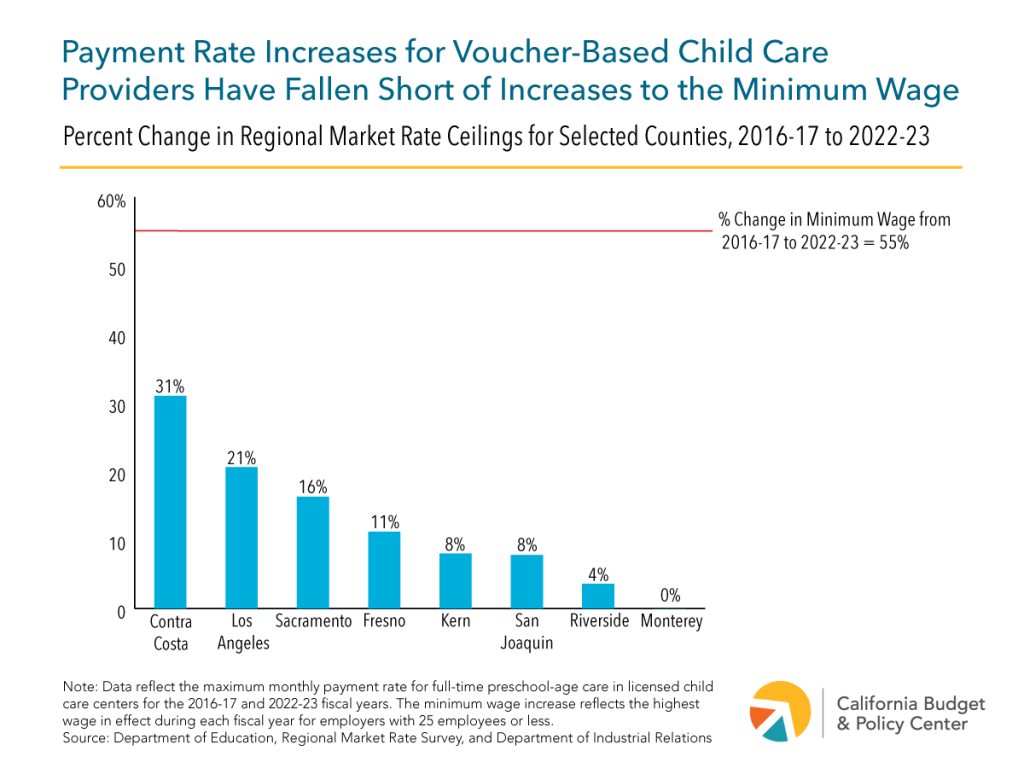
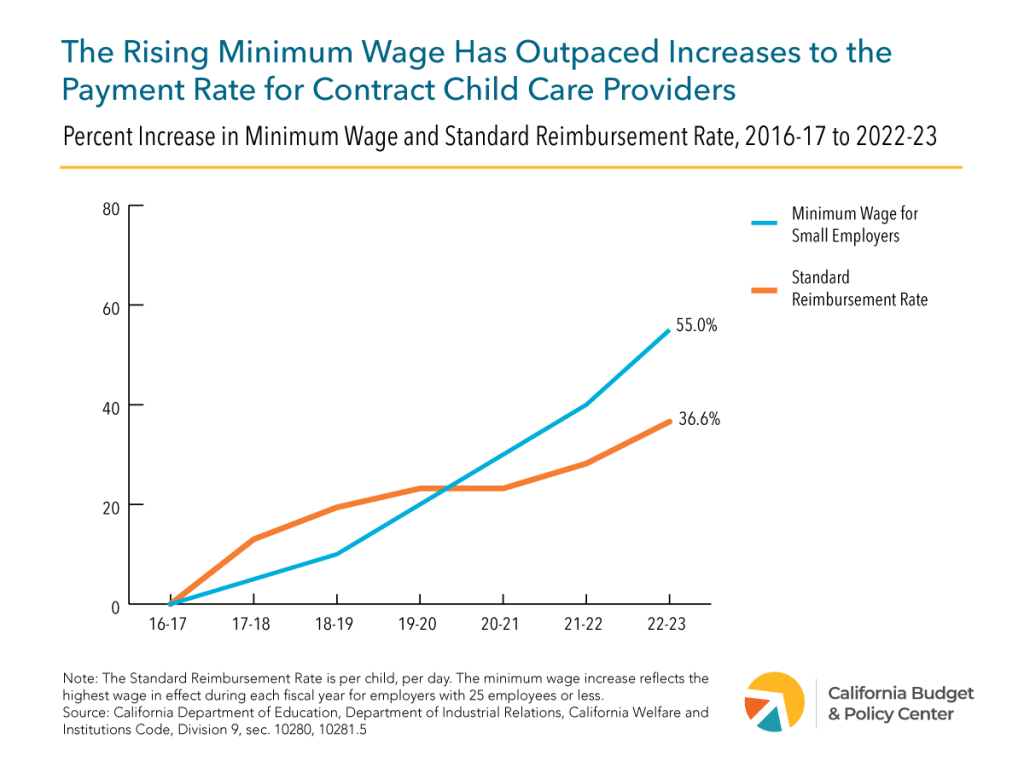
California’s subsidized child care and development system is a critical resource for families with low to moderate incomes seeking to access affordable, nurturing early care and education. Despite child care’s critical role for California families, too few families can access affordable child care options and many are unable to pay high family fees, prompting families to make sacrifices in other areas of need (i.e., housing and food). Furthermore, provider reimbursement rates have not kept pace with the rising minimum wage, resulting in many providers struggling to make ends meet. Child care providers are integral to supporting the development of California’s children and the economic well-being of families. Current provider rates do not reflect their vital profession.
The governor’s proposed budget:
- Waives family fees for child care and development programs. The governor proposes to extend the 2022-23 policy to waive family fees using $29.4 million of one-time federal funds. The current fee waiver was set to expire on June 30, 2023, and the proposal extends the waiver until September 30, 2023. In fact, two bills recently passed by the Legislature — Assembly Bill 100 and Assembly Bill 110 — will waive family fees until September 30, 2023. The governor signed both bills into law on May 15, thereby implementing the policy change assumed in the May Revision.
- Includes temporary stipends to state-subsidized child care providers. The governor will authorize the California Department of Social Services (CDSS) to use around $169 million in federal funds to provide stipends for state-subsidized providers. The 2023-24 stipends follow previous years of similar funding, allocated on a per child-basis. Specifically, state-subsidized child care provider stipends were also provided in 2022-23 ($1,442 per child) and 2021-22 ($600 per child). Assembly Bill 100 and Assembly Bill 110, referenced above, include the temporary stipends. With the governor’s May 15th signature, this funding will officially be implemented as planned.
- Does not add any new child care slots for 2023-24. The governor indicated in January that the slots created during the past two cycles (over 100,000) will be maintained. The January budget proposed that 20,000 additional slots be added for 2024-25.
- Does not increase child care provider rates for 2023-24. The Senate Budget Plan proposes over $1 billion to increase child care rates “to support and stabilize child care providers.” The Assembly’s Child Care Funding Budget Plan (“Care COLA”) proposes a $1 billion cost of living adjustment, increasing child care funding by 25.44%. This effort is intended to move providers away from poverty wages. Despite the Senate and Assembly’s plans, the governor’s proposed budget does not incorporate increases to provider rates. The Assembly described the Care COLA proposal as a “first step in a multi-year effort currently being collectively bargained by the Governor and Child Care Providers United.” The state plans to continue to work with Child Care Providers United (CCPU) to negotiate a successor agreement to the current contract, which expires on June 30, 2023. Rate increases could be considered as a part of these negotiations.
- Includes over $184 million from the General Fund to support an estimated 8.22% statutory cost-of-living adjustment (COLA). This increase would be provided to child care and development programs ($183.3 million) as well as the Child and Adult Care Food Program ($840,000).
While the proposed budget includes a 8.22% COLA, this increase only applies to the rates received by providers that contract directly with the state. Providers that are a part of the state subsidy system will not see an increase in rates in the proposed budget, despite the roughly $1 billion for rate increases named in the Senate budget plan and the Assembly’s “Care COLA.”
May Revision Fails to Expand Paid Sick Leave
Most California workers are entitled to at least 24 hours of paid sick leave per year. State policymakers temporarily expanded the amount of paid sick leave available to California workers during the COVID-19 pandemic, providing up to 80 hours of annual leave for COVID-related reasons. However, this supplemental paid sick leave expired at the end of 2022, leaving many workers with just three days of paid sick leave to care for themselves or a family member.
The May Revision does not propose to expand paid sick leave. As a result, under the governor’s plan many workers would continue to have just three days of paid sick leave per year. In contrast, a bill moving through the Legislature would expand sick leave from three days to seven. California lags behind every other state that has paid sick leave — leaving workers with the impossible choice of going to work while sick or losing their paycheck. State leaders should require employers to provide additional paid sick days for workers so that all Californians are able to care for themselves or their loved ones when they are ill.
May Revision Boosts State’s Commitment to Addressing Needs of Migrants
California has the largest share of immigrant residents of any state, and over half of California workers are immigrants or children of immigrants. More than 2 million Californians are undocumented, according to estimates.
The May Revision boosts California’s commitment to addressing the needs of migrants along the border. Specifically, the governor proposes to spend $150 million from the General Fund in 2023-24 to provide respite sheltering for migrants and “support their safe passage through border regions.” This initiative will prioritize vulnerable groups, including families with young children and LGBTQ+ individuals.
The revised budget also maintains some recent key commitments to immigrant Californians. Specifically, the May Revision:
- Continues to fund full inclusion in Medi-Cal for otherwise eligible Californians regardless of immigration status. This expansion is set to take effect beginning in January 2024 (see the Coverage, Affordability & Access section).
- Moves up the start date for expanding food assistance to otherwise eligible undocumented Californians age 55+. These Californians are now anticipated to begin receiving benefits through the California Food Assistance Program in October 2025 rather than the initial date of January 2027 (see the Food Assistance section).
The May Revision does leave some urgent needs of immigrant Californians unmet, however. There is no funding to provide a basic safety net for California workers who lose their jobs and are undocumented, who continue to be excluded from unemployment insurance (UI) benefits despite their critical contributions to the state’s economy and our communities. In contrast, the Senate budget plan envisions extending UI benefits to these excluded workers.
Education
Governor Continues to Focus Investments in Transitional Kindergarten
The governor’s 2021-22 budget included a plan to implement universal transitional kindergarten (TK) for all 4-year-olds over a four-year period. The 2023-24 proposed budget aligns with year two of TK implementation (2021-22 was considered a planning year). TK eligibility is based on age alone in public schools and is not dependent on family income. In addition to TK, the state also funds the California State Preschool Program (CSPP). CSPP provides preschool to children ages 3 and 4 for families with low to moderate incomes. While CSPP and TK reflect the two state-funded pre-kindergarten programs, they are among several early learning options available to California families with low to moderate incomes (see section on Child Care).
The governor’s revised budget:
- Continues to fund the implementation of TK expansion. The initial year one expansion took effect during the current fiscal year — 2022-23 — and covered children whose fifth birthdays fell between September 2 and February 2 (the previous cut-off was December 2). The year two 2023-34 expansion will provide eligibility to children who turn 5 between September 2 and April 2 (about 42,000 children). The governor proposes approximately $762 million for 2023-24 costs to expand TK access. Of this total, roughly $597 million will support expanded eligibility and $165 million will support one additional certificated or classified staff person in TK classrooms. The $597 million to support expanded eligibility is a reduction from the $690 million proposed in the January budget. This difference is due to reduced TK enrollment projections at the time of the May Revision (roughly 4,000 children).
- Includes roughly $95 million to support an 8.22% statutory cost-of-living adjustment for the state preschool program. This increase reflects $60 million Proposition 98 General Fund and $35.3 million General Fund. The total funding amount is an $80 million reduction from the January 2023 estimates. The May Revision states that this reduction is due to a lower number of state preschool program contractors being reimbursed at the State Reimbursement Rate than originally expected.
- Includes $9.7 million to waive family fees for the state preschool program. In addition to the proposal to waive family fees for child care and development programs (see Child Care section), the May Revision proposes to continue to waive family fees for CSPP from July 1, 2023 through September 30, 2023. The governor proposes that a total of $4.4 million non-Proposition 98 General Fund and $5.3 million Proposition 98 General Fund from the 2022 Budget Act be used to waive CSPP family fees.
- Includes temporary stipends to state preschool program providers. The governor authorizes the California Department of Education (CDE) to use around $112 million in federal funds to provide stipends for CSPP providers. As mentioned in the Child Care section, Assembly Bill 100 and Assembly Bill 110 were recently signed by the governor, confirming temporary stipend funding for both state preschool and child care and development providers.
- Continues to implement a multiyear plan to ensure CSPP serves a greater diversity of children. The 2022-23 budget package increased payment rates for certain children enrolled in state preschool, including children with disabilities, dual language learners, and 3-year-olds. In exchange, preschool providers have begun enrolling more children with disabilities and providing enhanced services to dual language learners. In January, the governor proposed to continue implementing this plan in 2023-24, at a cost of $64.5 million Proposition 98 General Fund and $51.8 million General Fund.
- Delays a planned $550 million investment in preschool, TK, and full-day kindergarten facilities from 2023-24 to 2024-25. This delay was included in the governor’s January budget. Facilities investments are intended to help build new school facilities or retrofit existing buildings in order to provide appropriate spaces for preschool, TK, and full-day kindergarten.
- Does not include funding for educator (including early educator) recruitment needs. The Senate budget plan includes $1.1 billion one-time Proposition 98 General Fund for resources such as incentives and staff training to support educators with earning units at institutions of higher education. The Senate budget plan states that this funding may support developing micro-credential programs for transitional kindergarten. The governor’s plan does not include funds for the Senate’s outlined educator recruitment needs.
K-14 Education’s Minimum Funding Level Drops Due to Lower Revenue Estimates
Approved by voters in 1988, Proposition 98 constitutionally guarantees a minimum level of funding for K-12 schools, community colleges, and the state preschool program. Changes in state General Fund revenues tend to affect the Prop. 98 guarantee, and the May Revision’s estimates of 2022-23 and 2023-24 revenues are lower than those estimated in January’s budget proposal. As a result, the May Revision assumes a 2023-24 Prop. 98 funding level of $106.8 billion, approximately $2 billion below the level assumed in the governor’s January budget proposal, and a 2022-23 Prop. 98 funding level of $106.8 billion, slightly lower than the $107 billion funding level assumed in January. The revised budget assumes a 2021-22 Prop. 98 funding level of $110.6 billion, slightly above the $110.4 billion funding level assumed by the governor in January.
Revenue projections in the governor’s January budget proposal would have required a deposit into the Public School System Stabilization Account (PSSSA) — the state budget reserve for K-12 schools and community colleges — raising the account balance to $8.5 billion. However, the May Revision projects an increase in capital gains revenues as a share of General Fund revenues. This increase would boost the required PSSSA deposit and bring the total account balance to approximately $10.7 billion in 2023-24, which would reflect its constitutional limit. (See Reserves section.) Moreover, because the PSSSA balance is projected to exceed 3% of the total K-12 share of the Prop. 98 minimum funding level in 2022-23, current law would prevent K-12 school districts from maintaining more than 10% of their budgets in local reserves beginning in 2023-24.
Revised Budget Funds a Large Cost-of-Living Adjustment for K-12 Education
The largest share of Prop. 98 funding goes to California’s school districts, charter schools, and county offices of education (COEs), which provide instruction to 5.9 million students in grades kindergarten through 12. The governor’s revised spending plan uses one-time dollars to help fund a large cost-of-living adjustment (COLA) to the state’s K-12 education funding formula — the Local Control Funding Formula (LCFF). Specifically, the May Revision:
- Provides a $3.4 billion year-over-year increase for the LCFF. The LCFF provides school districts, charter schools, and COEs a base grant per student, adjusted to reflect the number of students at various grade levels, as well as additional grants for the costs of educating English learners, students from low-income families, and foster youth. The May Revision would fund an 8.22% COLA for the LCFF in 2023-24, up from the 8.13% COLA estimated in the January budget proposal. The revised spending plan proposes to use $2.7 billion in one-time dollars to help pay for the large increase in ongoing support for the LCFF. According to the Assembly Budget Committee, the May Revision would provide an estimated $79.8 billion in funding for the LCFF in 2023-24.
- Cuts approximately $2.5 billion from the Learning Recovery Emergency Block Grant. The 2022-23 budget agreement provided $7.9 billion for a one-time block grant to K-12 school districts, COEs, and charter schools allocated based on the percentage of enrolled students who are English learners, students from low-income families, or foster youth. The May Revision proposes to reduce this funding to approximately $5.4 billion.
- Cuts the Arts, Music, and Instructional Materials Discretionary Block Grant by approximately $600 million more than proposed in January. The governor’s January budget proposed reducing, from nearly $3.6 billion to approximately $2.3 billion, one-time funding for a per pupil discretionary block grant provided to local educational agencies (LEAs) in the 2022-23 budget agreement. The May Revision proposes to reduce funding for the block grant to approximately $1.8 billion.
- Increases funding by approximately $300 million for school nutrition programs. For the 2022-23 school year, California established a Universal Meals Program that provides two free meals per day to any public K-12 student regardless of income eligibility. The revised spending plan includes an additional $110 million in one-time dollars and approximately $191 million in ongoing dollars to fully fund increased demand for the program in 2022-23 and 2023-24.
- Provides $80 million in ongoing funding for COEs serving students in juvenile court. The revised spending plan states these additional resources would be used to support staffing and programming requirements for students in alternative school settings. The May Revision also proposes to increase COEs’ LCFF base grants by 50% for the additional year of assistance they would provide, based on a proposal in the governor’s January budget, to school districts with performance issues.
- Provides $20 million for the Bilingual Teacher Professional Development Program (BTPDP). The BTPDP was established in 2018, but it expired in June 2021. The May Revision would reinstitute the program and make funding available through 2028-29.
- Funds an increase in the COLA for non-LCFF programs. The May Revision increases the COLA for several categorical programs that remain outside of the LCFF to 8.22% from the 8.13% COLA provided in January.
- Maintains $300 million for a proposed “equity multiplier” add-on to the LCFF. The revised spending plan would continue to provide ongoing funding proposed in January for LEAs with large shares of students from families with low incomes. Additionally, the May Revision states that it reflects changes to the state’s K-12 accountability system to clarify those proposed in January “including additional assurances that all LEAs with low student performance address disparities in the preparation of their educators.”
- Proposes to screen students in kindergarten through 2nd grade for risk of reading difficulties. The May Revision proposes to make these screenings mandatory by the 2025-26 school year and would require LEAs to provide services to identified students, including those at risk of dyslexia.
- Extends the deadline for spending Expanded Learning Opportunities Program (ELOP) funds. The 2022-23 budget agreement provided $4 billion for the ELOP. The May Revision extends the June 30, 2023 deadline for spending ELOP funds received in 2021-22 and 2022-23 to June 30, 2024.
The Revised Spending Plan Reduces Several One-Time Investments for Community Colleges
A portion of Proposition 98 funding provides support for California’s Community Colleges (CCCs), the largest postsecondary education system in the country, which serves high percentages of students of color and students with low incomes. CCCs prepare approximately 1.8 million students to transfer to four-year institutions or to obtain training and employment skills.
The 2023-24 May Revision proposes reductions to several one-time investments and also provides additional funds for a cost-of-living adjustment (COLA) for apportionments. Specifically, the revised spending plan:
- Reduces the COVID-19 Recovery Block Grant by more than half in 2022-23. The 2022 Budget Act included $650 million one-time Prop. 98 for a flexible block grant for community college districts to address the impacts of COVID-19 on students. The revised plan reduces funding for this grant by $345 million in the current fiscal year.
- Reduces proposed funding to support student enrollment and retention. The revised budget includes a reduction of $100 million of the proposed $200 million one-time Prop. 98 that would support colleges in increasing enrollment and retention rates. While recent CCC enrollment rates have shown modest increases, the CCC system experienced significant drops in enrollment as a result of the COVID-19 pandemic.
- Proposes additional reductions for deferred maintenance projects. The May Revision decreases funding for these projects by $239 million one-time Prop. 98 dollars, for a total reduction of $452 million.
- Includes approximately $28 million for an 8.22% COLA for apportionments and other programs. These funds reflect an increase of $25.4 million ongoing Prop. 98 dollars for the Student Centered Funding Formula (SCFF) for a total of $678 million. The proposal also provides the same percentage COLA to other CCC categorical programs and the Adult Education Program, and allocates an additional $3 million ongoing Prop. 98 dollars for that purpose.
- Allocates one-time dollars for apportionments in 2023-24. The spending plan also includes an increase of about $503 million one-time Prop. 98 dollars for the Student Centered Funding Formula in 2023-24.
The May Revision also includes details on proposed spending flexibilities for CCC districts. The revised spending plan proposes statutory changes that would allow CCC districts to spend flexibly among the Student Equity and Achievement Program, Student Financial Aid Administration, and Student Mental Health Resources. This expanded flexibility would begin in 2023-24. Districts not making “sufficient” progress toward the CCC roadmap goals that were established in the 2022 Budget Act would have that flexibility revoked.
May Revision Maintains Multiyear Funding Investments for the CSU and UC Systems
California supports two public four-year higher education institutions: the California State University (CSU) and the University of California (UC). The CSU provides undergraduate and graduate education to roughly 462,000 students on 23 campuses, and the UC provides undergraduate, graduate, and professional education to about 290,000 students on 10 campuses.
The revised spending plan maintains the 5% base increases to both the CSU and the UC, $227 million and $216 million, respectively. This increase is part of the multiyear funding investments established through the compacts between the administration and the CSU and UC systems. The compacts outline major goals, including increasing access; improving student success and advancing equity; increasing affordability; improving collaboration among systems of higher education; and supporting workforce preparedness.
To address the budget shortfall, both the CSU and UC budgets include funding shifts totaling approximately $1.8 billion. Specifically, the funding shifts include:
- Approximately $856 million General Fund support to CSU-issued bonds for infrastructure projects and affordable student housing grants. The spending plan includes $61 million ongoing General Fund for debt service on those bonds.
- Approximately $935 million General Fund support to UC-issued bonds for capital outlay projects and affordable student housing grants. The spending plan also includes $63.3 million ongoing General Fund for debt service on those bonds.
Other higher education proposals in the revised spending plan include:
- $545 million for affordable student housing projects at the California Community Colleges (CCCs). This includes $450 million one-time General Fund in 2023-24 and $95.4 million one-time General Fund in 2024-25. The 2022-23 budget agreement allocated these funds to support all three segments of higher education for the construction of, or renovation of commercial properties into, affordable student housing. See CCCs section for other CCC proposals.
- Maintains a delay — to 2025-26 — of $900 million in 2023-24 and $250 million in 2024-25 for the student housing revolving loan program that was established in the 2022 Budget Act to support all three systems of higher education.
- A decrease of $480 million one-time General Fund in the current fiscal year to the Golden State Education and Training Program. This program supports Californians who lost their jobs as a result of the pandemic to reskill, upskill, or access educational or training programs.
- Maintains an increase of $227 million one-time General Fund for the Middle Class Scholarship that the administration committed to in the 2022 Budget Act.
Workforce & Other Proposals
Governor Reverses Some Workforce Cuts Proposed in January
The May Revision proposes to restore funding to two programs the Administration proposed cutting in January. The first is a reversal of a proposed $49.8 million General Fund cut over four years to various public health workforce training and development programs. The second is a reversal of a proposed $30 million General Fund cut ($15 million in each of 2023-24 and 2024-25) to the Department of Industrial Relations’ Women in Construction Unit, which promotes and supports women and non-binary individuals in skilled trade careers.
See additional workforce proposals in the early learning and Pre-K section.
May Revise Makes Modest Adjustments to CalKids Proposal
The California Kids Investment and Development Savings Program (CalKIDS) establishes college savings accounts for California children with an initial seed deposit provided by the state. All newborns receive a seed deposit of at least $25, while first graders living in low income families receive $500 seed deposits. First graders who are foster youth get an additional $500, and those who are homeless get an additional $500 for a maximum deposit of $1,500.
In January, the governor proposed increasing the seed deposit for all newborns from $25 to $100, funded by redirecting $30 million ongoing General Fund beginning in 2023-24 that was intended for seed deposits for first graders. The administration projected that there would be fewer eligible first graders than originally expected and that less money would be needed to provide seed deposits to them.
The May Revision includes a new adjustment that further revises down the number of eligible students, resulting in a decrease of $30 million in the General Fund in 2022-23. The administration does not propose a particular use of this savings.
Revised Spending Plan Maintains Delays for Broadband Infrastructure Projects
The pandemic exposed the inequities in access to computers and high-speed internet, also known as the digital divide. Access to such technology is necessary to participate in education and other essential activities, such as remote work, applying for jobs, virtual health appointments, and access to many other services. The digital divide disproportionately impacts low-income and Latinx households, as well as children and youth, seniors, and people with disabilities.
The 2023-24 revised spending plan maintains funding delays of more than $1.1 billion in funding to future years for last-mile infrastructure grants and the Loan Loss Reserve Fund. Both programs support the expansion of broadband infrastructure at the local level and are overseen by the California Public Utilities Commission (CPUC).
Last-mile infrastructure (wires, poles, cables, and other components) refers to the final section of a network that connects to middle-mile infrastructure (fiber-optic cables laid over hundreds of miles) and provides high-speed internet access to individual communities and households. The Loan Loss Reserve Fund supports local governments, tribes, and nonprofits in financing local broadband infrastructure development.
In contrast to the May Revision, the Senate budget plan proposed additional funding for infrastructure, including more than $1.1 billion for last-mile broadband projects and the Loan Loss Reserve Fund.
May Revision Does Not Propose or Plan for Additional Prison Closures
More than 96,200 adults who have been convicted of a felony offense are serving their sentences at the state level, down from a peak of 173,600 in 2007. American Indian, Black, and Latinx Californians are disproportionately represented in state prisons — a racial disparity that reflects implicit bias in the justice system, structural disadvantages faced by these communities, and other factors.
Among all incarcerated adults, most — 91,980 — are housed in state prisons designed to hold fewer than 80,000 people. This level of overcrowding equals 115.2% of the prison system’s “design capacity,” which is below the prison population cap — 137.5% of design capacity — established by a 2009 federal court order. California also houses more than 4,300 people in facilities that are not subject to the cap, including fire camps, in-state “contract beds,” and community-based facilities that provide rehabilitative services. The sizable drop in incarceration has resulted from both 1) a series of justice system reforms enacted by voters and state leaders and 2) changes adopted in 2020 to further reduce prison overcrowding in response to the COVID-19 pandemic, such as suspending intakes from county jails and implementing early releases.
The governor’s May Revision includes a previously announced plan to reduce prison capacity in the following ways:
- By the end of 2023, the state will complete the deactivation of certain facilities within six state-owned prisons, generating ongoing annual General Fund savings of roughly $170 million.
- By March 2024, the state will end its contract for the use of the California City Correctional Facility. California City is the last of several private prisons that the state began leasing to help alleviate overcrowding in state-owned prisons, generating ongoing General Fund savings of roughly $156 million.
- By March 2025, the state will shut down the Chuckawalla Valley State Prison in Blythe.
Adults who are housed in these various facilities will be moved to “appropriate level” state-owned prisons.
This planned downsizing of the prison system follows the closure of one state prison in September 2021 — Deuel Vocational Institution in Tracy — and the anticipated shutdown of another state prison — California Correctional Center in Susanville.
But California can do more. The state can safely close up to five additional state prisons, according to a recent report by the Legislative Analyst’s Office. The ongoing savings from closing five additional prisons — around $1 billion per year — could be redirected to help people make the transition back to their communities more successfully and boost services to support survivors of crime, reduce poverty, increase housing stability, address substance use and mental health issues, and enhance the safety and well-being of our communities.
Revised Budget Doubles Funding to Address Missing Indigenous Persons
California is home to more people of American Indian/Alaska Native heritage than any other state in the country. There are currently 109 federally recognized Indian tribes in California, including several tribes with lands that cross state boundaries. There are also about 45 tribal communities of formerly recognized tribes that were terminated as part of the United States’ termination policy in the 1950s, as well as tribal communities that were never recognized by the federal government. The diverse array of tribal nations in California currently have nearly 100 separate reservations or rancherias and a number of individual Indian trust allotments. These lands constitute Indian Country.
American Indian/Alaska Native communities experience crime and victimization at higher rates than other populations. In particular, community members and researchers have long identified a crisis of missing and murdered Indigenous peoples, particularly among women. Community advocates describe this crisis “as a legacy of generations of government policies of forced removal, land seizures, and violence inflicted on Native peoples.”
In order to help address this crisis among tribal nations in California, the state recently provided $12 million from the General Fund over three years to help tribal police and prosecutors collect data and investigate cases of missing Indigenous persons. These funds may also be used for counseling services and other activities. The May Revision proposes an additional $12 million General Fund for these purposes — doubling the total allocation to $24 million.
In terms of other local public safety measures, the governor’s revised budget:
- Proposes to restructure a new gun buyback program to get firearms out of circulation more quickly. In 2022, the state provided $25 million General Fund to buy back guns using a competitive grant model overseen by the Board of State and Community Corrections. However, citing recent mass shootings and the need for faster action, the governor proposes to shift these funds to the Office of Emergency Services to “work directly with local law enforcement agencies to expedite targeted, coordinated gun buybacks.”
- Provides $10 million one-time General Fund to enhance security among nonprofits that are at risk of hate-motivated violence. This includes organizations that represent Asian American and Pacific Islander, Black, Jewish, Latinx, and LGBTQ+ communities. The funds could be used for reinforced doors, alarms, and other security improvements.
- Projects state savings of nearly $113 million in 2023-24 due to reduced incarceration stemming from Proposition 47, with these dollars required to be invested in a broad array of services. Approved by voters in 2014, Prop. 47 reduced penalties for six nonviolent drug and property crimes from felonies to misdemeanors. Consequently, state prison generally is no longer a sentencing option for these crimes. Instead, individuals convicted of a Prop. 47 offense serve their sentence in county jail and/or receive probation. By decreasing state-level incarceration, Prop. 47 reduced the General Fund cost of the state prison system (relative to the expected cost if Prop. 47 had not been approved). The state Department of Finance is required to annually calculate these savings, which are then deposited into the Safe Neighborhoods and Schools Fund and allocated as follows: 65% to mental health and drug treatment programs, 25% to K-12 public school programs for at-risk youth, and 10% to trauma recovery services for crime victims.