Every year, California’s 58 counties — under state oversight — deliver essential public services that support Californians’ well-being, keep communities healthy and safe, and protect vulnerable populations, including children, older adults, and people with disabilities. These programs are funded with a broad range of revenues, including federal dollars, local county taxes, and funding provided by the state.
Counties’ responsibility for these services grew substantially beginning in the 1990s. The state restructured — or “realigned” — the state-county relationship in 1991 and again in 2011 by increasing counties’ fiscal and programmatic obligations for a number of services, while also providing counties with dedicated, ongoing revenues to help support their new costs.
These state-to-county “realignments” encompass vital programs that:
aim to protect vulnerable children and adults,
address health inequities,
support people facing mental health and/or substance use challenges,
keep people from cycling through carceral systems, and
improve Californians’ quality of life, particularly residents with low incomes.
Yet, while counties receive billions of dollars each year to deliver these critical public services, the concept of realignment is not well understood. Moreover, the framework and funding structures that underpin realignment are complex and can be challenging to grasp.
This report cuts through the complexity by explaining what realignment is, how it is structured, and key ways in which it has changed over time. This report does not describe every detail of these complex funding structures. It also does not evaluate realignment or assess how realigned services have been implemented. Instead, it provides a high-level overview that explains the basics, outlines the 1991 and 2011 realignment frameworks, and describes how realignment has evolved in recent decades.
Part 1: Realignment — The Basics
What Is Realignment?
California’s state government and the state’s 58 counties have long shared responsibility for financing and delivering a broad array of services, including public health, mental health care, and support for families with children with low incomes.
However, state and county roles are not static. Instead, they vary across programs and have shifted over time as state policymakers have redefined the state-county relationship. These periodic shifts in responsibility between the state and counties for the financing and implementation of public services are known as “realignment.”
Types of Realignment
The transfer of fiscal and programmatic responsibility for public services between the state and counties typically happens in one of two ways:
Realignment can modify how the state and counties share the cost of public services.
Historically, the state and counties have shared the cost of many public programs operated by counties. Often, these services are also supported with federal funding, in which case the state and counties split the nonfederal share of costs (although not usually 50/50).
Realignment can modify these state/county “cost-sharing ratios” so that one level of government pays more of the cost of a service and the other pays less. For example, counties’ share of costs for a program could be increased from 30% to 60%, with the state’s share reduced from 70% to 40%.
Realignment can transfer the full cost of a program to one level of government or the other.
Historically, the most common transfer scenario has been for state policymakers to eliminate General Fund support for a program that counties already operate and shift 100% of the cost of the program to counties.
The state may also require counties to take on new responsibility for a program or function that is operated at the state level, shifting 100% of the cost from the state General Fund to counties.
However, the most far-reaching realignments were adopted in 1991 and 2011 when counties took on additional responsibility for a broad range of services. These realignments — 20 years apart — expanded counties’ fiscal and programmatic responsibilities in several policy areas.
The 1991 and 2011 realignments encompass the following policy areas:
Social services for children, families, older adults, and people with disabilities
These include Child Welfare Services, Adult Protective Services, In-Home Supportive Services, and more.
Behavioral health services
These include community-based mental health services, substance use disorder treatment services, and more. Applying a different lens, these services include both 1) Medi-Cal specialty mental health and substance use disorder treatment services and 2) non-Medi-Cal services.
Health services
These include public health as well as health care for adults with low incomes who otherwise lack access to health coverage (this is known as indigent health care).
Public safety functions
These include — but are not limited to — trial court security, youth justice, and counties’ new role (as of 2011) in “community corrections” — managing, supervising, and rehabilitating adults convicted of certain low-level offenses.
See Part 2 and Part 3 for key facts about the 1991 and 2011 realignments, respectively, and the Appendix for a description of the programs included in each realignment.
Rationale for Realignment
The goals of realignment typically fall into three categories:
Realignment can help to address state budget deficits.
For example, Governor Pete Wilson and Governor Jerry Brown proposed major state-to-county realignments — in 1991 and 2011, respectively — in response to multibillion dollar state budget deficits.
Realigning responsibilities to the counties helped to address these shortfalls by shifting costs from the General Fund to the newly created realignment revenues that flowed directly to counties.
Realignment can help to improve funding stability.
Providing dedicated revenues to support realigned programs helps to insulate these programs from reductions when the state faces a budget shortfall.
For example, the health and mental health services included in the 1991 realignment were previously funded with state General Fund dollars. Due to state budget shortfalls, these programs were cut in previous budgets, according to the Department of Finance. Moreover, these health and mental health services “would have been subject to additional major reductions” in 1991 to help close the budget deficit if state policymakers had not adopted realignment that year.
Realignment can — but does not always — promote greater efficiency and effectiveness in service delivery.
A primary rationale for the 2011 realignment was that transferring funding and responsibilities to local governments would “allow governments at all levels to focus on becoming more efficient and effective,” helping to ensure that services are “delivered to the public for less money.” Similar claims were made for the 1991 realignment.
Two evaluations of the 1991 realignment — in 2001 and 2018 — found some evidence of progress in terms of efficiency and effectiveness. However, these evaluations also found that counties’ flexibility over these programs and their ability to control costs had diminished substantially since 1991 due to state law changes and other factors.
Funding to Support Realigned Services
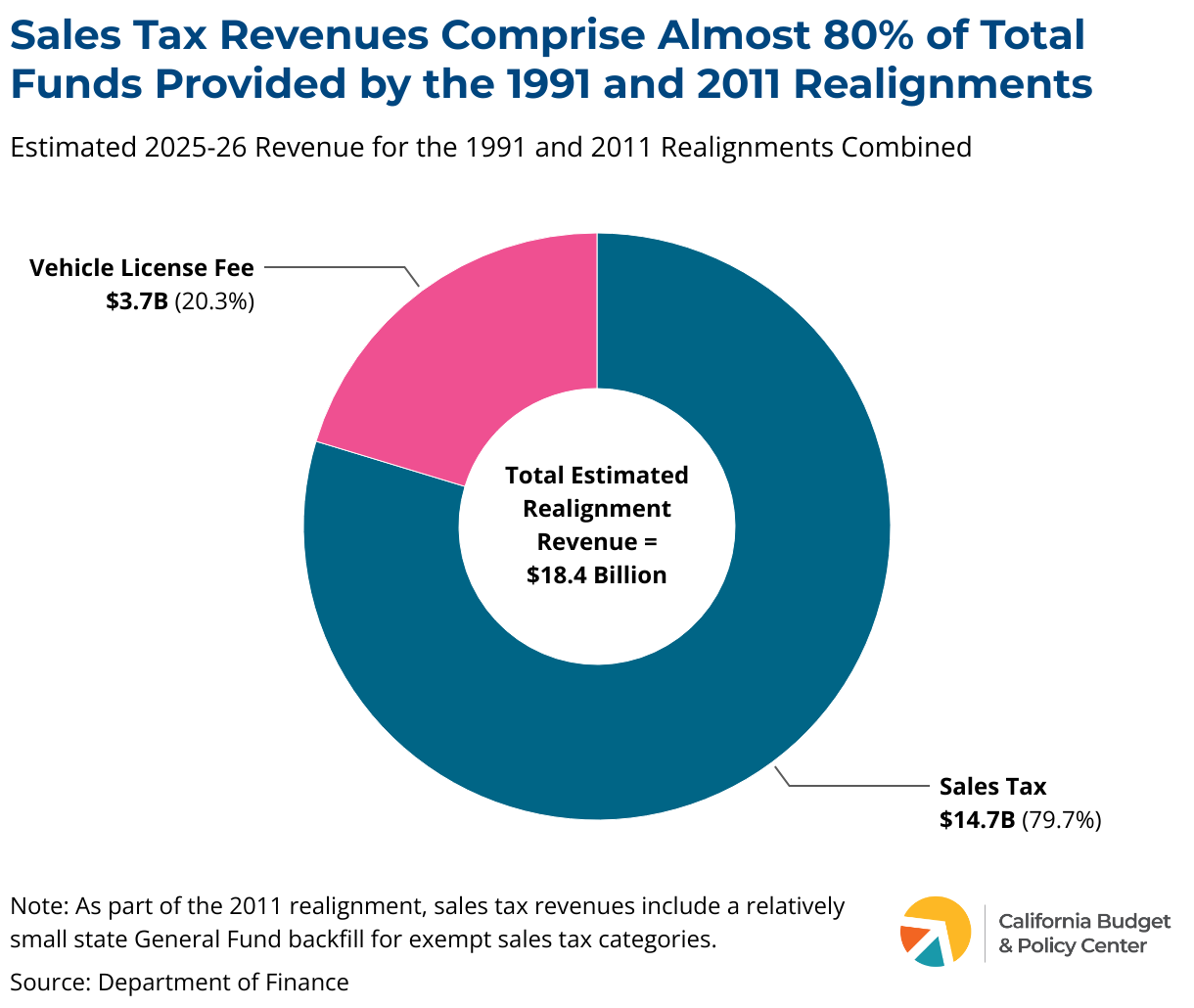
When state policymakers shift responsibilities to counties, they provide dedicated annual funding to help counties pay for their additional costs. Annual funding to support counties’ 1991 and 2011 realignment responsibilities comes from two sources — the sales tax and the Vehicle License Fee (VLF). Specifically:
To fund the 1991 realignment, state policymakers increased the state sales tax rate by one-half cent and raised the state’s VLF. Counties continue to receive these dedicated funds each year to support the programs that were realigned to them in 1991.
To fund the 2011 realignment, state policymakers redirected a portion of the state’s existing sales tax and VLF revenues to counties, without raising taxes. In other words, these dollars were carved out of existing state revenue streams. Counties continue to receive these dedicated funds each year to support the programs that were realigned to them in 2011.
What is the sales tax?
The sales tax — formally, the “sales and use tax” — is a tax on the purchase of tangible goods in California (the “sales tax”) or the use of tangible goods in California that were purchased elsewhere (the “use tax”).
Services are excluded from the sales and use tax, as are other items exempted by law, including groceries, menstrual hygiene products, and medications.
The sales and use tax is a regressive tax because households with lower incomes generally spend a larger share of their incomes on necessities than households with higher incomes, so a larger share of their income goes to sales taxes.
What is the vehicle license fee?
The VLF is an annual state fee that is based on the purchase price or value of a vehicle.
In 2011, state leaders shifted to counties part of the base 0.65% VLF rate in order to help fund counties’ increased responsibilities under the 2011 realignment.
The sales tax provides most of the revenue that counties receive to support their responsibilities under the 1991 and 2011 realignments. While sales tax revenues generally grow over time, they can decline from year to year, such as during recessions. When sales tax revenues fall, counties receive less realignment funding than they received the year before. When the economy improves, realignment revenues begin to grow again, providing counties with more resources to carry out their responsibilities.
However, under the 1991 realignment, the revenue shortfalls created during economic downturns are not filled. Even when revenues begin to grow again — providing additional funding for realigned programs — this growth comes on top of a permanently lowered funding base. This leaves counties with less revenue to carry out their 1991 realignment responsibilities over the long term. In contrast, under the 2011 realignment, counties’ funding base is restored when revenues begin to recover following a recession.
Moreover, counties are not reimbursed for their actual costs for realigned programs. Instead, counties receive dedicated revenue that is intended to cover their costs over time. However, this revenue often falls short of meeting the need for and growing cost of services, including counties’ health, public health, and behavioral health responsibilities under both realignments.
Realignment revenue comes closer to covering counties’ actual costs for social services programs, such as Child Welfare Services and In-Home Supportive Services. Under the 1991 realignment, these “entitlement” or “caseload” programs are first in line for sales tax revenue growth, with these growth revenues supporting counties’ rising costs for these services.
Part 2: Key Facts About the 1991 Realignment
What Did the 1991 Realignment Do?
In 1991, counties took on increased responsibility for a number of health, mental health, and social services programs. (See the Appendix for descriptions of these programs.) This “realignment” changed the state-county relationship in two major ways:
The state transferred responsibility for certain health and mental health programs to counties.
Specifically, counties took full responsibility for key health and mental health programs and also absorbed larger costs as the state eliminated General Fund support for those programs (although the state still maintained an oversight role).
The transferred services included community-based mental health, public health, and health care provided to uninsured adults with low incomes (commonly known as indigent health care).
The state generally increased counties’ share of the nonfederal costs for multiple social services programs as well as for one health program.
Prior to realignment, the state paid most or all of the nonfederal costs of major health and social services programs using General Fund dollars.
Realignment generally shifted more of these nonfederal costs to counties, which lowered the state’s share of costs, freeing up state General Fund dollars for other purposes.
Child Welfare Services and In-Home Supportive Services (IHSS) were among several social services programs for which counties’ share of cost increased under the 1991 realignment. (IHSS is generally considered a social services program but may be referred to as a health program.)
Counties also took on a larger share of the cost for California Children’s Services (CCS), a health program for children with certain diseases or health problems. (CCS was grouped with social services programs for the purpose of the 1991 realignment.)
In some cases, the state reduced counties’ share of cost — and increased the state’s share — to reflect counties’ relatively limited control over spending. The state began to pay a larger share of the cost for:
Cash assistance for low-income families with children, which was integrated into the new CalWORKs program in the mid-1990s.
County administration, which reflects counties’ operational costs for key social services programs.
How Is the 1991 Realignment Funded?
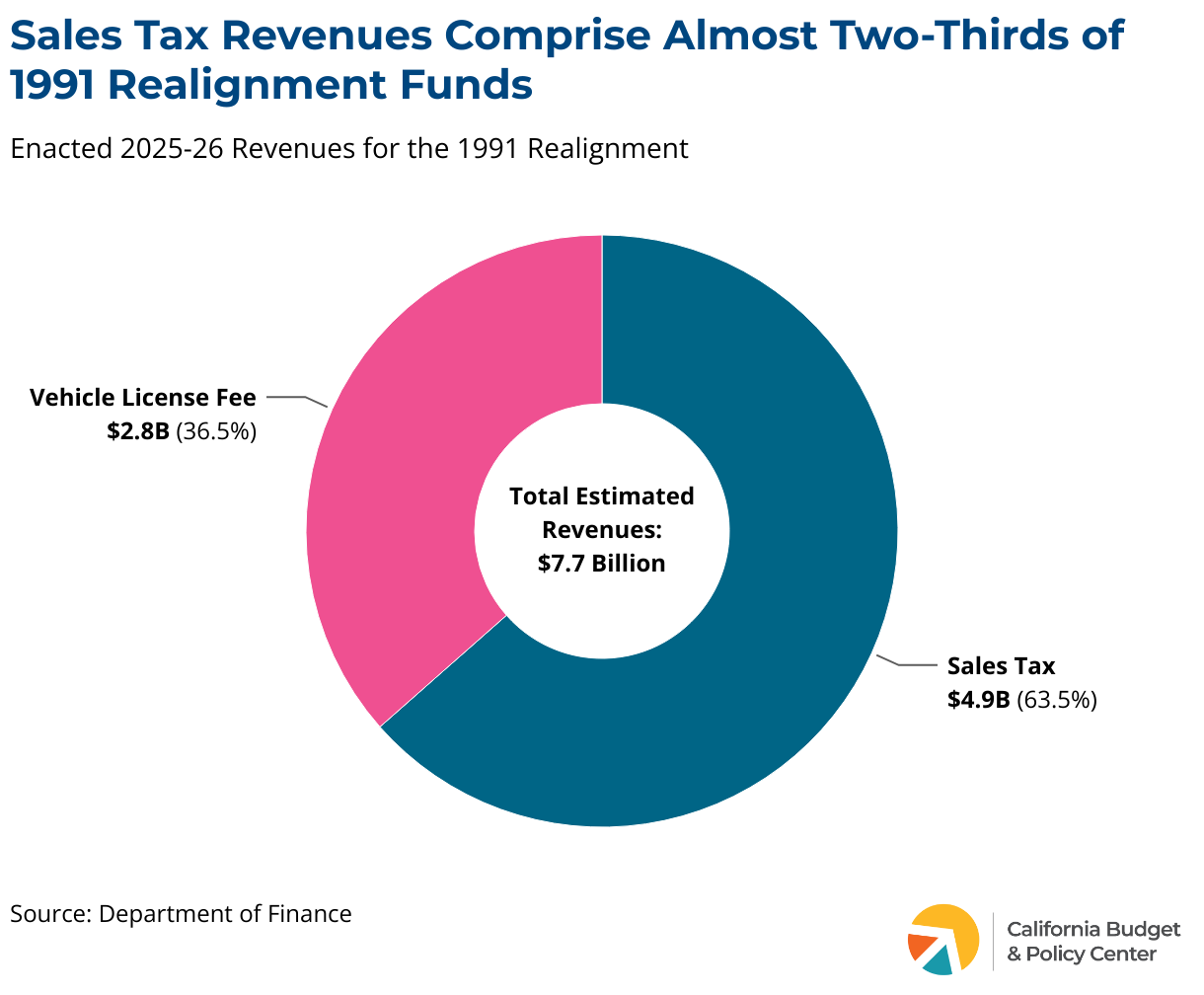
In order to support the programs included in the 1991 realignment, the state Legislature increased taxes and dedicated the revenues to the realigned programs. In 2025-26, these taxes are estimated to raise $7.7 billion. Specifically:
The Legislature raised the state sales tax rate by one-half cent and increased the state’s Vehicle License Fee (VLF), allocating all of the revenue to counties to support the realigned programs.
The half-cent sales tax rate provides almost two-thirds of annual 1991 realignment revenues, totaling an estimated $4.9 billion in 2025-26.
The VLF increase generates about one-third of annual realignment revenues, totaling an estimated $2.8 billion in 2025-26.
What is the sales tax?
The sales tax — formally, the “sales and use tax” — is a tax on the purchase of tangible goods in California (the “sales tax”) or the use of tangible goods in California that were purchased elsewhere (the “use tax”).
Services are excluded from the sales and use tax, as are other items exempted by law, including groceries, menstrual hygiene products, and medications.
The sales and use tax is a regressive tax because households with lower incomes generally spend a larger share of their incomes on necessities than households with higher incomes, so a larger share of their income goes to sales taxes.
What is the vehicle license fee?
The VLF is an annual state fee that is based on the purchase price or value of a vehicle.
In 2011, state leaders shifted to counties part of the base 0.65% VLF rate in order to help fund counties’ increased responsibilities under the 2011 realignment.
How Is the 1991 Realignment Structured?
The 1991 realignment revenues flow through a series of accounts that grew increasingly complex as the Legislature modified the original framework in the decades after the 1991 realignment took effect. (See Part 4 for details on this point.)
Revenue
Annual revenues generated by the higher sales tax rate and the VLF increase first flow into “base funding” accounts.
Realignment “base” revenue is allocated through the Sales Tax Account or the Vehicle License Fee Account, with these funds supporting the various services included in the 1991 realignment.
Realignment revenues sometimes fail to reach the base level of funding, such as when sales tax revenues decline during a recession. When this happens, counties’ funding base is reduced for a fiscal year to match the (lower) available revenues. In other words, counties receive less realignment funding than they received the year before.
Under this scenario, funding for the realigned programs increases only when realignment revenues grow again in future years. However, counties’ realignment base is permanently lowered — that is, the revenue that counties lose during tough budget years when revenues fall short is not made up in future years.
What is realignment “Base” revenue?
“Base” revenue for a fiscal year = the amount of realignment revenue allocated to counties in the prior fiscal year. In other words, the total amount of realignment revenue that counties receive in one year becomes the base level of funding for the next fiscal year.
If available, annual revenues generated by the higher sales tax rate and the VLF increase next flow into “growth funding” accounts.
Growth revenue — if available — is allocated through the Sales Tax Growth Account or the Vehicle License Fee Growth Account, with these funds supporting 1991 realignment services based on a complex set of funding priorities.
Sales tax growth revenues go first to social services programs, including but not limited to Child Welfare Services and In-Home Supportive Services. (Social services are called “caseload” programs in the 1991 realignment framework).
Any remaining sales tax growth revenues go to the health and mental health accounts as well as to support certain increases to CalWORKs grants. As discussed in Part 4, the state began using sales tax growth revenues to fund periodic CalWORKs grant increases in 2013.
Vehicle License Fee Growth Account
VLF growth revenues go first to the County Medical Services Program to support counties’ role in providing health care to low-income, uninsured adults (known as indigent health care).
Any remaining VLF growth revenues go to health and mental health programs as well as to support certain increases to CalWORKs grants. As discussed in Part 4, the state began using VLF growth revenues to fund periodic CalWORKs grant increases in 2013.
what is realignment “growth” revenue?
“Growth” revenue = the amount of realignment revenue left over (if any) after the base level of revenue for a fiscal year has been reached.
In other words, sales tax and VLF revenue that exceeds the base level of funding for a fiscal year flows to counties on top of their base allocations.
Allocations: Big Picture
Originally, revenue raised by the 1991 realignment solely supported the realigned health, mental health, and social services programs. However, in the early 2010s, state leaders redirected a portion of 1991 realignment revenue to offset some state costs for CalWORKs. To implement these shifts, state leaders added three CalWORKs-focused accounts to the 1991 realignment framework. (See Part 4 for details.)
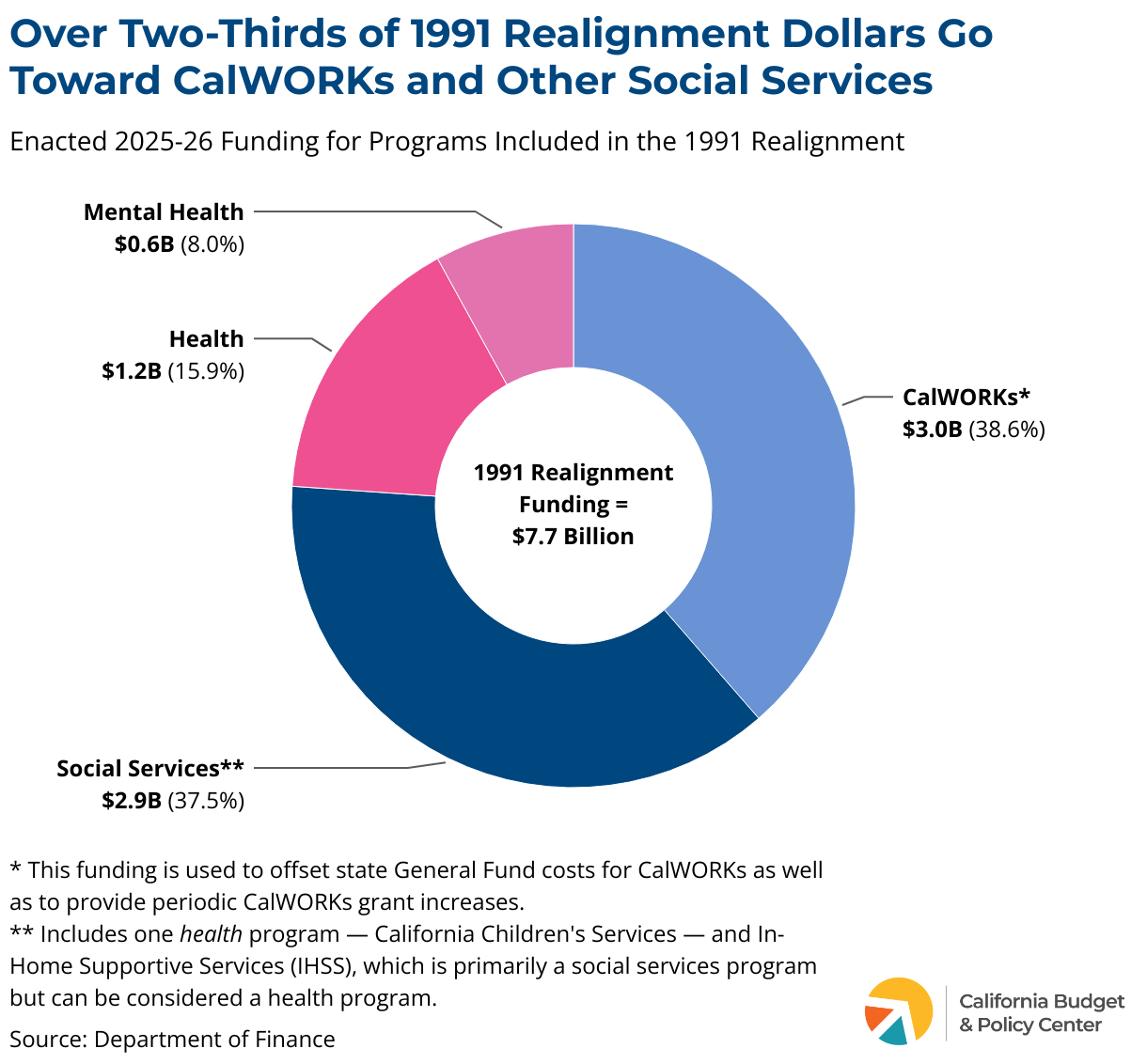
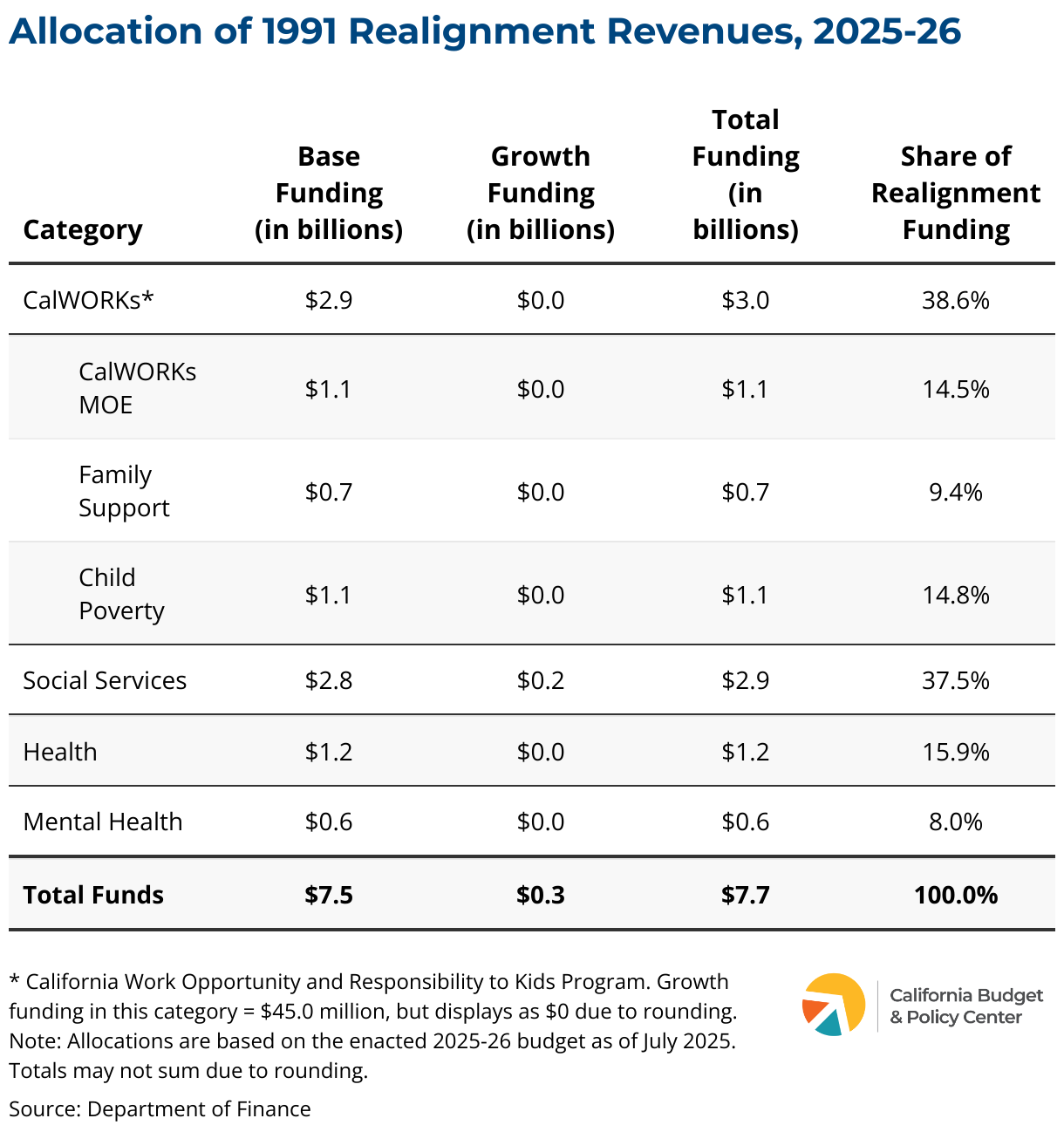
With the addition of these new CalWORKs accounts, 1991 realignment revenue — which is estimated to total $7.7 billion in 2025-26 — is divided among four spending categories:
CalWORKs,
Social Services,
Health, and
Mental Health.
CalWORKs Allocation
Nearly 40% of realignment funding — an estimated $3.0 billion in 2025-26 — is used to achieve state savings by offsetting the state’s cost for CalWORKs.
These funds flow into three accounts created in the early 2010s: the CalWORKs MOE [Maintenance of Effort] Subaccount, the Family Support Subaccount, and the Child Poverty and Family Supplemental Support Subaccount. (See Part 4 for details.)
Using 1991 realignment dollars to offset a portion of the state’s General Fund cost for CalWORKs frees up state dollars for other purposes and reduces pressure on the state budget.
Social Services Allocation
More than one-third of realignment funding — an estimated $2.9 billion in 2025-26 — supports multiple social services programs as well as one health program.
These funds flow into the Social Services Subaccount, supporting programs like Child Welfare Services, Foster Care, and In-Home Supportive Services. (IHSS is generally considered a social services program but may be referred to as a health program.)
These revenues also support California Children’s Services (CCS), which assists children with certain diseases or health problems and is the only health program included in the Social Services Subaccount.
All of the programs in the Social Services Subaccount are known as “caseload” programs in the 1991 realignment framework.
Health Allocation
About 16% of realignment funding — an estimated $1.2 billion in 2025-26 — supports counties’ role in delivering health services.
The Health Subaccount includes funding for public health activities as well as for indigent health care (care provided to low-income, uninsured adults).
Counties’ role in indigent health care diminished substantially starting in 2014 when California adopted the Medi-Cal eligibility expansion as allowed by the Affordable Care Act. With this expansion, millions of uninsured adults who previously accessed health care through county programs became newly eligible for Medi-Cal. With fewer adults turning to counties for health care, the state redirected some indigent health care dollars away from counties, as described in Part 4.
Mental Health Allocation
Less than 10% of realignment funding — an estimated $618 million in 2025-26 — supports counties’ role in delivering mental health services.
The Mental Health Subaccount includes funding for community-based mental health services, state hospital services for civil commitments, and Institutions for Mental Disease (IMDs) — facilities with 16 or more beds where people reside to receive treatment for mental illness as well as medical and nursing care services.
Looking at it through a different lens, these services include both 1) Medi-Cal specialty mental health services and 2) non-Medi-Cal services.
What Else Changed with Realignment in 1991?
In addition to establishing dedicated revenue streams and allocation formulas, the 1991 realignment legislation included other significant elements. Specifically:
Counties may transfer a limited amount of their annual revenue from one realignment account to another.
Counties are allowed to transfer funds among the Health, Mental Health, and Social Services subaccounts.
Specifically, up to 10% of one account’s annual allocation may be shifted to the other two subaccounts.
In addition, under certain circumstances, counties may transfer:
An additional 10% of funds from the Health account to the Social Services subaccount.
An additional 10% of funds from the Social Services subaccount to the Health or Mental Health subaccounts.
Realignment legislation included “poison pill” provisions — one of which remains in effect today.
When the realignment legislation was advancing, state leaders were uncertain whether any of its provisions would be challenged through a lawsuit or a “mandate” claim filed by a county seeking reimbursement from the state.
As a result, state leaders added several “poison pills” to the legislation that were intended to nullify key components of realignment if a challenge was successful.
Some of the hurdles created by these poison pills were ultimately overcome — specifically, provisions that would have rolled back the half-cent sales tax increase or the Vehicle License Fee increase, either of which would have reduced the revenue available to support the realigned programs.
However, one of the poison pills remains active: If any county makes a mandate claim that results in state costs of more than $1 million, the 1991 realignment would come to an end.
Part 3: Key Facts About the 2011 Realignment
What Did the 2011 Realignment Do?
In 2011, the Legislature built on the 1991 realignment by further increasing counties’ responsibility for several health and social services programs while also realigning certain public safety functions. (See the Appendix for descriptions of these programs.) This new realignment in 2011 revised the state-county relationship in two key ways:
Counties became fully responsible for funding — supported with realignment revenue — certain behavioral health, social services, and public safety programs that they were already administering.
Prior to 2011, counties, the state, and the federal government shared the cost of operating the child welfare system and key behavioral health services. With the 2011 realignment, the state stopped using its own General Fund dollars to help pay for the nonfederal costs of these programs. Instead, counties started paying 100% of the nonfederal costs using realignment funds to help pay for those costs. This change applied to:
Nearly the entire child welfare system, including Child Welfare Services, Foster Care, Adoptions Administration, Adoption Assistance, and Child Abuse Prevention, Intervention, and Treatment.
Major behavioral health programs, including Drug Medi-Cal services, Medi-Cal Specialty Mental Health Managed Care, and the Early and Periodic Screening, Diagnosis, and Treatment (EPSDT) program.
The state also eliminated General Fund support for several other programs that counties were administering in 2011. Instead, counties began to use the revenue provided by the 2011 realignment to fund these programs. This change applied to:
The Adult Protective Services program.
Key substance use treatment programs, such as drug courts and the Women and Children’s Residential Treatment Services Program.
Certain local public safety programs and functions, including trial court security, counties’ youth justice responsibilities, and local grants focused on law enforcement and county probation.
Counties took on new responsibility — supported with realignment revenue — for certain public safety functions that previously had been carried out by the state.
In order to help reduce overcrowding in state prisons, the 2011 realignment included a new role for counties in managing, supervising, and rehabilitating adults convicted of certain low-level offenses — a change commonly called “community corrections.” Previously, people convicted of low-level offenses served their sentences in state prison and were supervised by state parole agents upon their release.
The Legislature also created new roles for county district attorneys and public defenders in parole revocation hearings. These proceedings determine whether people who violate the terms and conditions of their local supervision should be punished with county jail time.
How Is the 2011 Realignment Funded?
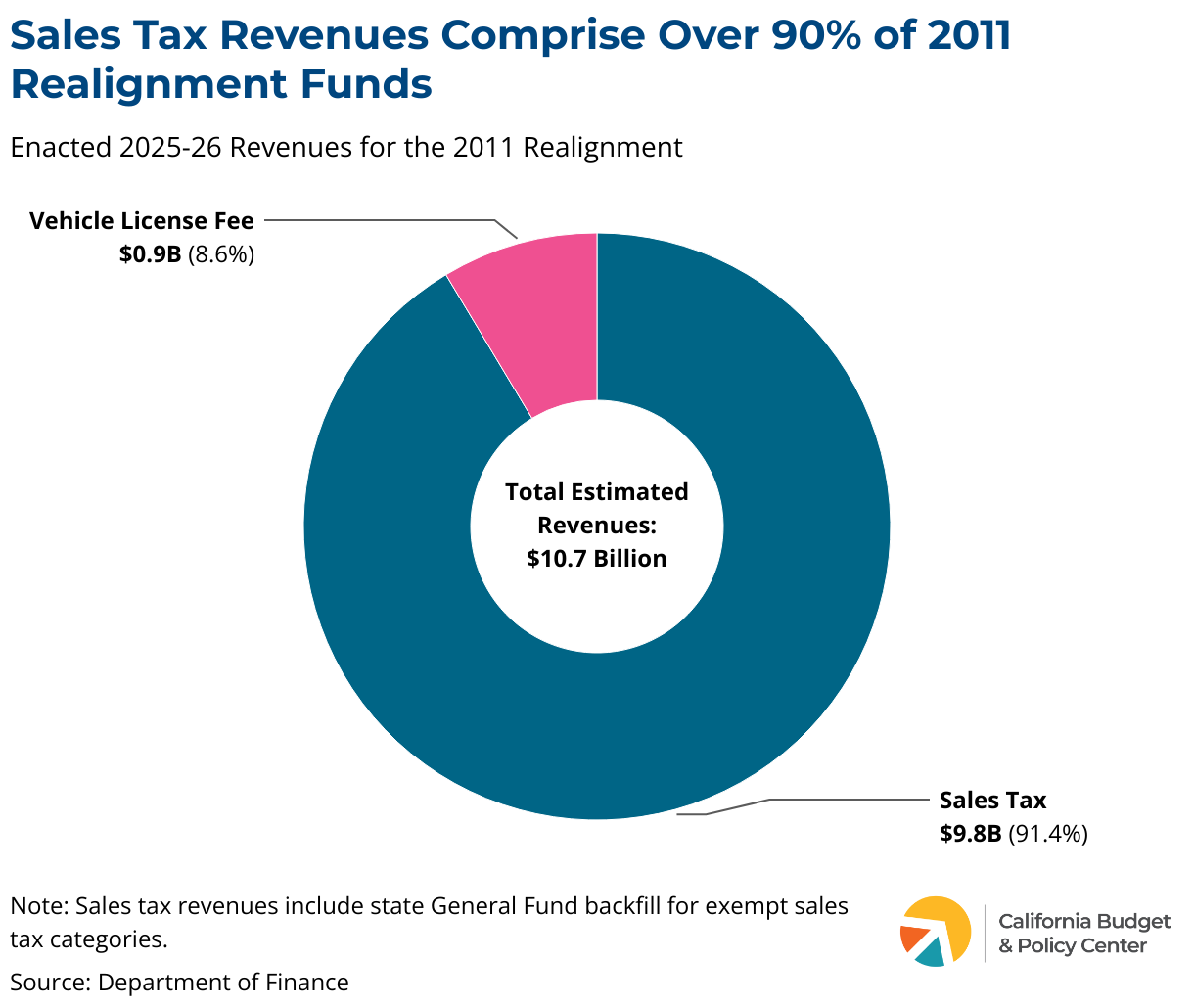
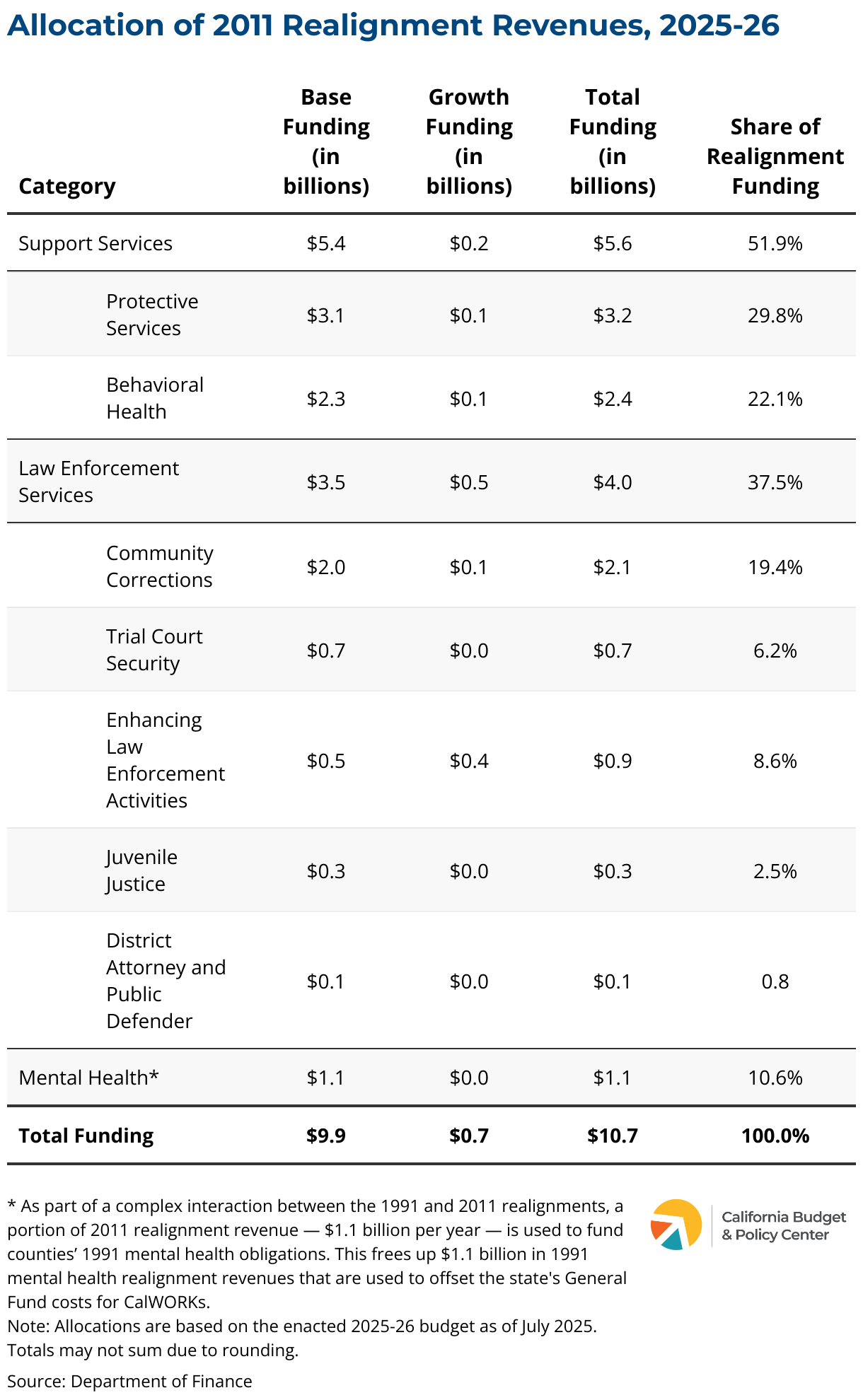
To fund the 2011 realignment, state leaders carved out portions of two existing revenue streams and dedicated those revenues to counties. These revenues are estimated to total $10.7 billion in 2025-26.
The Legislature redirected to counties a portion of state sales taxes as well as a portion of Vehicle License Fee (VLF) revenue in order to fund the realigned programs.
The Legislature shifted revenues equal to 1.0625 cents of the state sales tax rate to counties. In other words, slightly more than 1 cent of the sales tax rate on each $1 in taxable purchases bypasses the state treasury and goes directly to counties. In 2025-26, these diverted sales tax dollars are estimated to total $9.8 billion — more than 90% of all revenues that counties receive through the 2011 realignment.
In addition, the state uses General Fund dollars to backfill for certain exempt sales tax categories. This provides a relatively small amount of additional revenue to support counties’ 2011 realignment responsibilities. This General Fund backfill is estimated to total $44.2 million in 2025-26.
The Legislature also redirected a portion of VLF revenues to counties. In 2025-26, the VLF revenues shifted to counties are estimated to total $919.3 million — about 9% of all revenues that counties receive through the 2011 realignment.
What is the sales tax?
The sales tax — formally, the “sales and use tax” — is a tax on the purchase of tangible goods in California (the “sales tax”) or the use of tangible goods in California that were purchased elsewhere (the “use tax”).
Services are excluded from the sales and use tax, as are other items exempted by law, including groceries, menstrual hygiene products, and medications.
The sales and use tax is a regressive tax because households with lower incomes generally spend a larger share of their incomes on necessities than households with higher incomes, so a larger share of their income goes to sales taxes.
What is the vehicle license fee?
The VLF is an annual state fee that is based on the purchase price or value of a vehicle.
In 2011, state leaders shifted to counties part of the base 0.65% VLF rate in order to help fund counties’ increased responsibilities under the 2011 realignment.
How Is the 2011 Realignment Structured?
The 2011 realignment revenues move through a complicated set of accounts that the Legislature last modified in 2012, the year after this realignment was adopted.
Revenue
The state sales tax and Vehicle License Fee (VLF) revenues that fund the 2011 realignment flow into an account called the “Local Revenue Fund 2011” until this fund reaches its “base” level for a fiscal year.
These base funds support counties’ role in providing the services included in the 2011 realignment.
Realignment revenues sometimes fail to reach the base level of funding, such as when sales tax revenues decline during a recession. When this happens, counties receive less funding, but the gap is tracked and the base is gradually restored when revenues begin to grow again.
In other words, under the 2011 realignment, counties’ base funding is temporarily lowered when revenues decline. In contrast, when 1991 realignment revenues fail to reach the base level, counties’ base funding is permanently lowered because there is no requirement for base restoration in the 1991 realignment.
What is realignment “Base” revenue?
“Base” revenue for a fiscal year = the amount of realignment revenue allocated to counties in the prior fiscal year. In other words, the total amount of realignment revenue that counties receive in one year becomes the base level of funding for the next fiscal year.
Any sales tax and VLF revenue that exceeds the base funding level for a fiscal year becomes “growth” revenue.
Growth revenue — if available — is allocated to the programs included in the 2011 realignment based on complex rules that set funding priorities.
For example, if sales tax revenue grows year-over-year, about two-thirds of that growth is divided among the behavioral health and social services programs, while the remaining one-third of those growth dollars go to the public safety programs.
what is realignment “growth” revenue?
“Growth” revenue = the amount of realignment revenue left over (if any) after the base level of revenue for a fiscal year has been reached.
In other words, sales tax and VLF revenue that exceeds the base level of funding for a fiscal year flows to counties on top of their base allocations.
Allocations: Big Picture
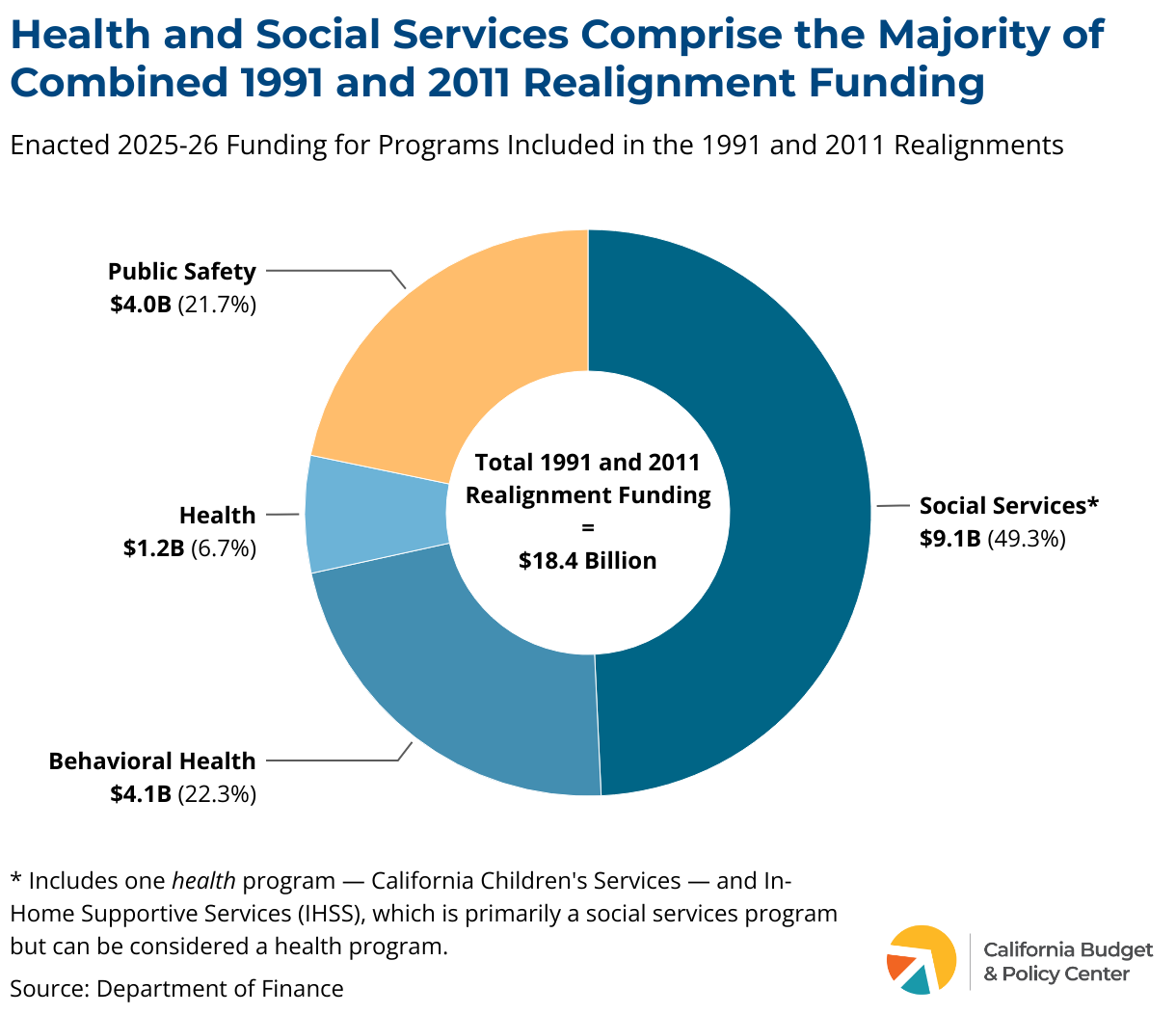
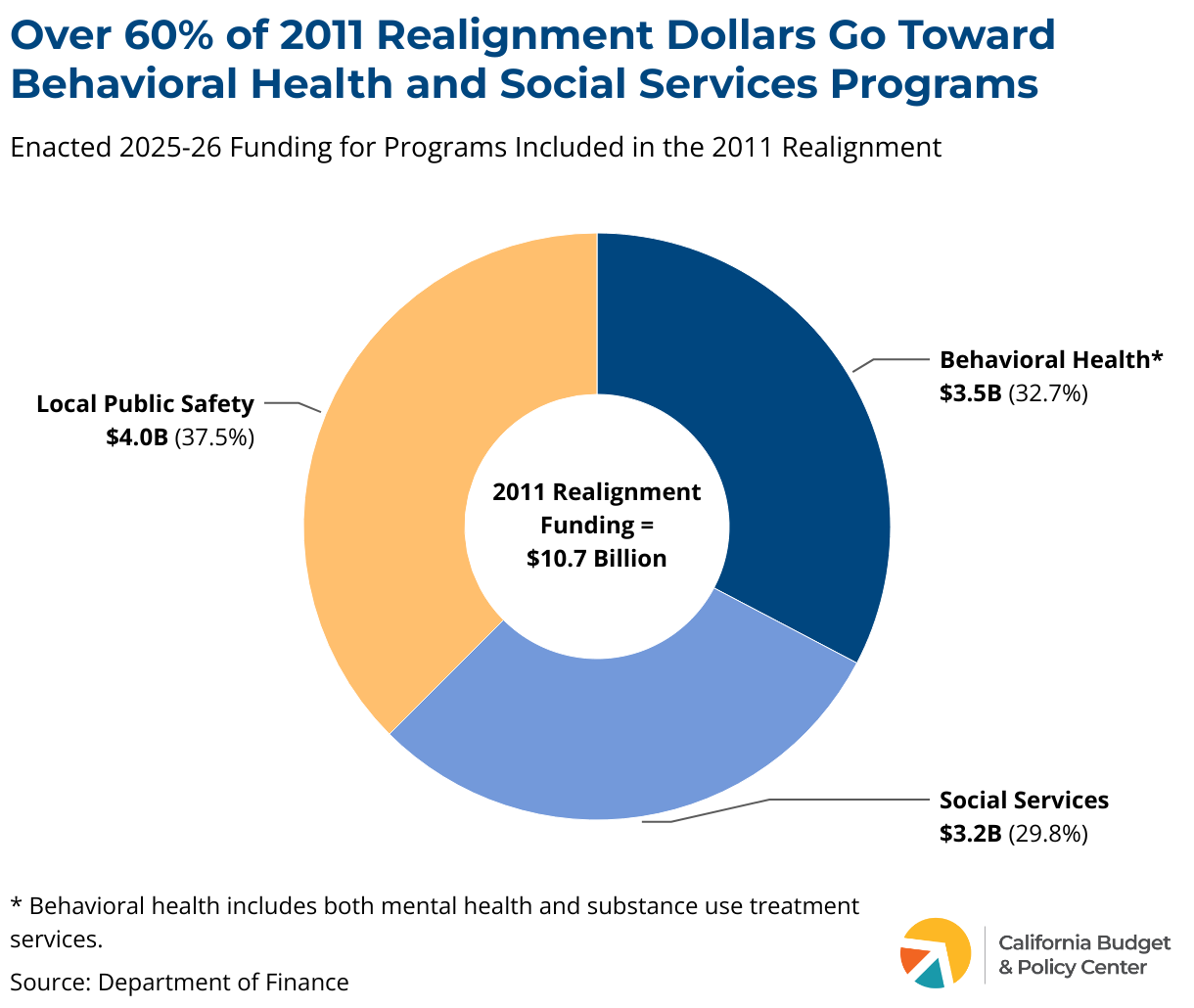
More than 60% of revenues provided through the 2011 realignment — an estimated $6.7 billion in 2025-26 — support counties’ role in delivering behavioral health and social services. The remaining funds — an estimated $4.0 billion — go to public safety programs that were realigned to counties in 2011.
Behavioral Health Allocation
Nearly one-third of 2011 realignment funding — an estimated $3.5 billion in 2025-26 — supports behavioral health services. This includes funding for both 1) the mental health and substance use disorder treatment services that counties took increased responsibility for starting in 2011 and 2) the mental health services that were shifted to counties as part of the earlier realignment in 1991.
$2.4 billion of these funds flow into the Behavioral Health Subaccount, which was created as part of the 2011 realignment.
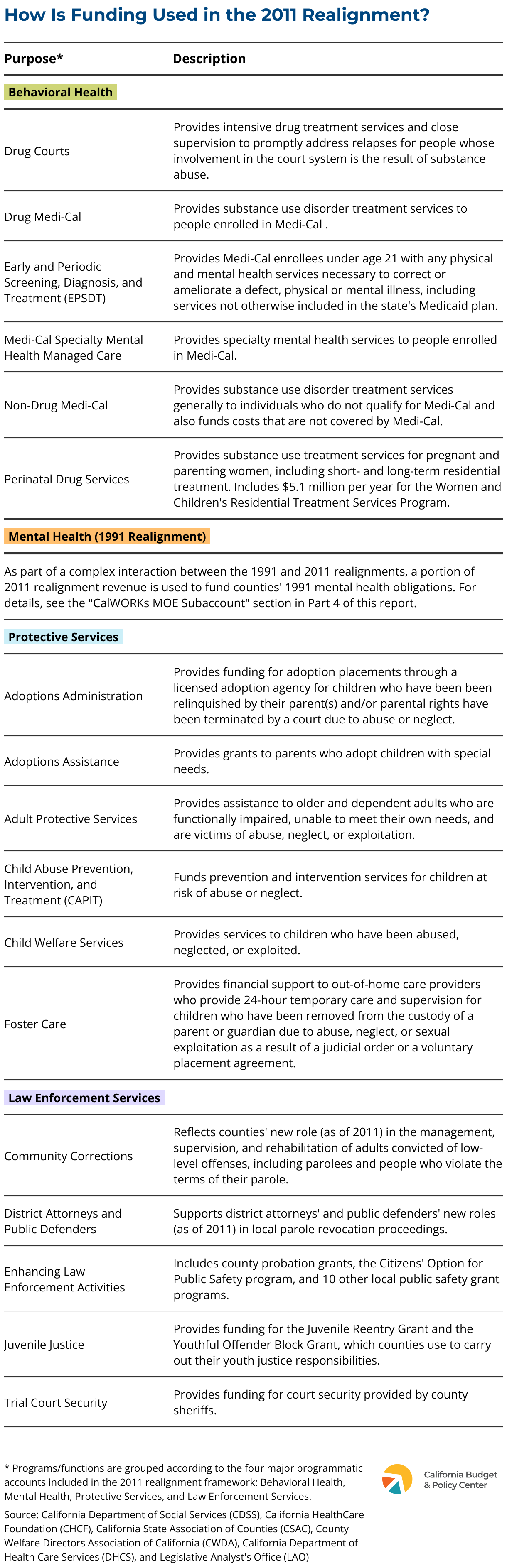
This subaccount supports both 1) Medi-Cal specialty mental health and substance use disorder treatment services and 2) non-Medi-Cal services, including:
Early and Periodic Screening, Diagnosis, and Treatment (EPSDT) services for children and youth,
Medi-Cal Specialty Mental Health Managed Care (MHMC), and
Substance use treatment services, including perinatal drug services and drug courts.
In 2011, counties were already administering these programs. The primary impact of the 2011 realignment was to increase counties’ costs — and eliminate the state’s costs — for these programs, with the new realignment revenue intended to help counties meet their larger financial obligations.
For example, since 2011 counties have been fully responsible for the nonfederal share of costs for EPSDT and MHMC.
The remaining $1.1 billion of these 2011 realignment funds flow into the Mental Health Subaccount, which was created as part of the 1991 realignment.
These funds — which are capped at $1.1 billion per year — support the mental health responsibilities that counties took on in 1991 as part of the first major state-to-county realignment.
In other words, counties’ 1991 mental health responsibilities are largely funded with revenues provided by the 2011 realignment rather than with 1991 realignment dollars — a fund switch that benefited the state’s General Fund. See Part 4 for details about this switch.
Social Services Allocation
Around 30% of 2011 realignment funding — an estimated $3.2 billion in 2025-26 — supports counties’ role in providing social services for children, youth, and older and dependent adults.
These funds flow into the Protective Services Subaccount, supporting Child Welfare Services, Foster Care, Adoption Assistance, and related programs for children and youth as well as Adult Protective Services.
In 2011, counties were already administering these programs, most of which were also included in the 1991 realignment. The primary impact of the 2011 realignment was to increase counties’ costs — and eliminate the state’s costs — for these programs, with the new realignment revenue intended to help counties meet their larger financial obligations.
For example, since 2011 counties have been fully responsible for the nonfederal share of costs for the child welfare system.
Public Safety Allocation
Over one-third of 2011 realignment funding — an estimated $4.0 billion in 2025-26 — supports public safety programs.
These funds flow into the Law Enforcement Services Account and primarily support counties’ role in “community corrections” — the management, supervision, and rehabilitation of people convicted of certain low-level offenses who, prior to 2011, served their sentences in state prison and were supervised by state parole agents upon release.
What Else Changed with Realignment in 2011?
In addition to establishing dedicated revenue streams and allocation formulas, the 2011 realignment legislation included other significant elements. Specifically:
Counties may transfer a limited amount of revenue between the Behavioral Health and Protective Services subaccounts, both of which are part of the Support Services Account.
Specifically, counties may shift — in either direction — an amount of funding that does not exceed 10% of the funds in the smaller account, based on the prior fiscal year’s funding level. (Certain counties are not subject to the 10% cap.)
Any transfer applies only for the fiscal year in which it is made, meaning that transfers do not create a permanent funding shift.
Counties are not allowed to transfer funds between the Support Services Account and the Law Enforcement Services Account.
This means that funding for behavioral health programs and social services cannot be used for law enforcement purposes (or vice versa) — even on a temporary basis.
The 2011 realignment includes constitutional protections approved by California voters.
In 2012, California voters strengthened the 2011 realignment by approving Proposition 30, which enshrined significant protections for the state and counties in the state Constitution. Specifically, Prop. 30:
Constitutionally protects the state revenue that was shifted to counties to fund their responsibilities under the 2011 realignment. This means the state cannot reduce or eliminate these revenues without voter approval.
Requires the state to provide counties with alternative funding if current realignment revenues are eliminated.
Allows counties to disregard state policy changes that increase realignment program costs if the state does not provide funding to offset those costs.
Requires the state to pay at least half of any 2011 realignment program cost increases that stem from federal court or administrative decisions or federal law or regulations.
Constrains the state’s ability to submit federal plans or waivers that would increase counties’ costs for realigned programs.
Protects the state from mandate claims related to the 2011 realignment.
Part 4: How State Leaders Reshaped Realignment to Benefit the State Budget
In the early 2010s, as California struggled to emerge from the Great Recession, state leaders made three major changes to the 1991 realignment framework to reduce cost pressures on the state’s General Fund. Notably, one of these changes involved shifting funds between the 1991 and 2011 realignments.
Taken together, these changes today provide a roughly $3 billion annual benefit to the state budget. These adjustments to the 1991 realignment funding structure — and the new accounts that were created to implement them — are described below.
CalWORKS MOE Subaccount
In 2011, state leaders approved a complex funding shift between county-run mental health programs and CalWORKs, creating over $1 billion in annual state General Fund savings.
In 2011, as state leaders were developing California’s second major state-to-county realignment, they decided to use a portion of the revenue from this new realignment — capped at $1.1 billion per year — to pay for counties’ mental health obligations, which were shifted to counties as part of the first major realignment in 1991.
This fund shift freed up $1.1 billion of 1991 realignment revenue that otherwise would have remained in the Mental Health Subaccount and supported counties’ mental health responsibilities. In other words, counties no longer needed those 1991 realignment dollars for mental health because those funds were replaced with revenue from the 2011 realignment.
These freed-up revenues were redirected to a CalWORKs MOE Subaccount that was added to the 1991 realignment framework (MOE = “maintenance of effort”). These dollars replaced, or offset, the state’s cost for CalWORKs grants, resulting in ongoing annual state General Fund savings of $1.1 billion.
Because this policy change implemented a funding shift rather than a funding cut, there was no detrimental impact on county-run mental health programs or on the CalWORKs program.
Family Support Subaccount
In 2013, state leaders shifted some 1991 realignment revenue from county-run indigent health care programs to CalWORKs, generating hundreds of millions of dollars in ongoing state General Fund savings.
Prior to 2014, Californians with low incomes who were ineligible for Medi-Cal (Medicaid) received care through county indigent health care programs, which were part of the 1991 realignment and funded with realignment revenues.
With the passage of the federal Affordable Care Act (ACA) in 2010, states were allowed to expand — starting in 2014 — their Medicaid programs to millions of adults who previously were excluded due to Medicaid’s stringent rules. California implemented this expansion in 2014. This change shifted primary responsibility for providing health care to these adults — along with the cost — from counties to the state and federal governments.
Given counties’ diminished role — and the state’s significantly expanded role — in indigent health care, state leaders created a complex set of formulas to capture county savings. In other words, a portion of counties’ 1991 realignment revenue for indigent health care was shifted to the state. These changes were included in Assembly Bill 85 (Committee on Budget, Statutes of 2013), as modified by Senate Bill 98 (Chapter 358, Statutes of 2013).
These redirected 1991 realignment revenues:
Are deposited into the Family Support Subaccount, which was added to the 1991 realignment framework by AB 85.
Replace, or offset, the state’s cost for CalWORKs grants and county administration of the program, resulting in annual state General Fund savings.
The amount of 1991 health realignment funds redirected to the state varies from year to year. This fund shift is estimated to exceed $700 million in 2025-26.
Child Poverty and Family Supplemental Support Subaccount
In 2013, state leaders redirected a portion of 1991 realignment “growth” revenue to support periodic increases to CalWORKs cash assistance for families, precluding the need for the state General Fund to pay for these increases.
In the early 2010s, the state adjusted counties’ share of cost for the In-Home Supportive Services (IHSS) program, which counties fund largely with revenues provided by the 1991 realignment.
With this adjustment, counties’ costs for IHSS grew more slowly than under the previous cost-sharing formula. As a result, counties needed less 1991 realignment revenue to cover their annual IHSS cost growth. Under the longstanding rules of the 1991 realignment, these freed-up revenues became available for other programs, such as public health and mental health services.
However, state leaders changed the rules for distributing certain 1991 realignment growth revenue (“general growth”) in order to provide periodic CalWORKs grant increases with these growth dollars. These changes were included in Assembly Bill 85 (Committee on Budget, Statutes of 2013), as modified by Senate Bill 98 (Chapter 358, Statutes of 2013).
As a result, in addition to supporting counties’ long-standing health and mental health obligations, a portion of “general growth” dollars were shifted into a Child Poverty and Family Supplemental Support Subaccount — often called the “Child Poverty” account — that was added to the 1991 realignment framework by AB 85 in 2013.
Child Poverty funds provide automatic CalWORKs grant increases if there is enough funding to support 1) the ongoing cost of prior grant increases and 2) the ongoing cost of a new grant increase. Funds in the Child Poverty account have grown from $0 in 2013-14 to an estimated $1.1 billion in 2025-26.
Using a portion of 1991 realignment revenue to fund periodic CalWORKs grant increases means that less money from the state’s General Fund is needed for this purpose, improving the state budget’s bottom line. Nonetheless, state leaders have continued to use General Fund dollars to provide some discretionary grant increases over the past decade. These discretionary increases — which are on top of the automatic increases provided with realignment funds — have aimed to reduce the number of CalWORKs families living in extreme poverty.
Appendix
1991 Realignment Details: Funding and Programs
This table displays estimated funding for each 1991 realignment account as of the enacted 2025-26 state budget (signed into law in June 2025):
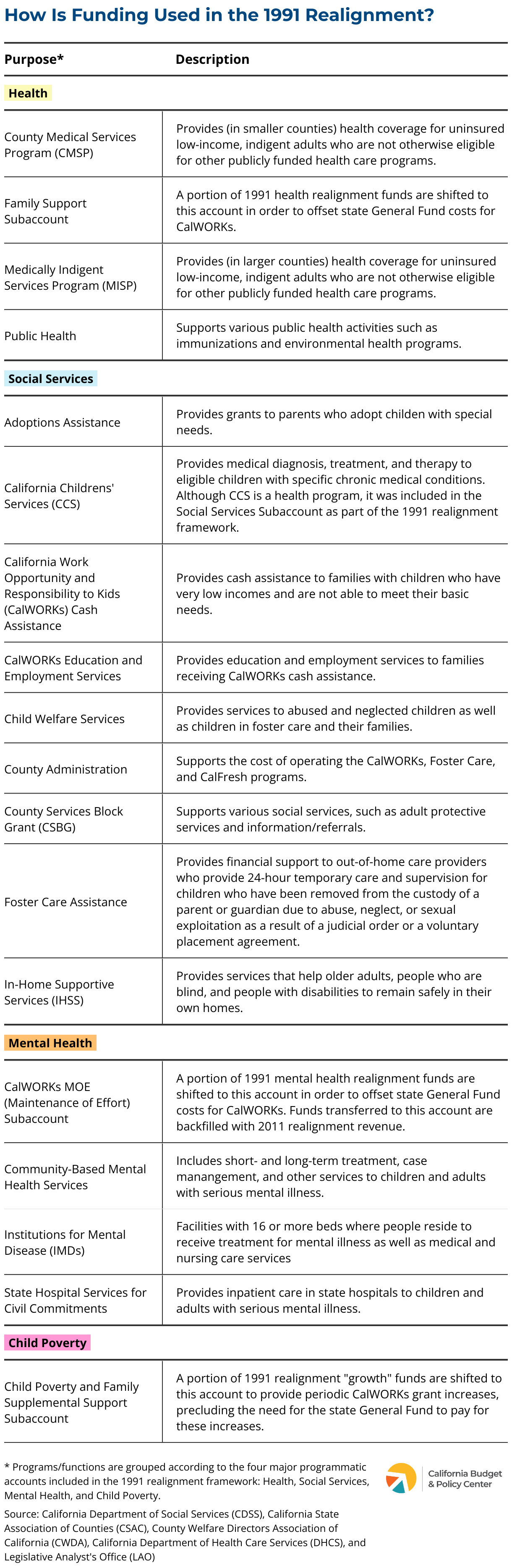
This table describes the programs and functions included in the 1991 realignment:
2011 Realignment Details: Funding and Programs
This table displays estimated funding for each 2011 realignment account as of the enacted 2025-26 state budget (signed into law in June 2025):
This table describes the programs and functions included in the 2011 realignment:
The amount of realignment revenue that counties receive in one fiscal year becomes the base level of funding for the next fiscal year. Therefore, counties’ base allocation for a fiscal year equals the amount of revenue allocated in the prior fiscal year, with growth revenue (if any) provided on top of the base.
Base Restoration
When 2011 realignment revenues fall short of meeting the base level of funding for all subaccounts, this shortfall is tracked and repaid in later fiscal years when revenues are higher. The 1991 realignment does not include a base restoration provision.
Growth Allocation
The amount of realignment revenue left over (if any) after the base allocation for a fiscal year has been reached. Sales tax and VLF revenue that exceeds the base level of funding for a fiscal year flows to counties on top of their base allocations.
Maintenance-of-Effort (MOE)
A requirement for one level of government to maintain a set level of spending for a program in order to receive additional funding for that program from another level of government.
Poison Pill
Legislation that was intended to nullify key components of the 1991 realignment if any county filed a successful challenge. Only one poison pill provision is still in effect today: If any county makes a mandate claim that results in state costs of more than $1 million, the 1991 realignment would come to an end.
Realignment
Periodic shifts in responsibility between the state and counties for the financing and implementation of public services.
Sales Tax
A tax on the purchase of tangible goods in California (the “sales tax”) or the use of tangible goods in California that were purchased elsewhere (the “use tax”).
Subaccount
Accounts to which dedicated revenues are transferred to fund a program or groups of programs. Includes, for example, the Social Services Subaccount (1991 realignment) and the Behavioral Health Subaccount (2011 realignment).
Unmet Need
Occurs when revenue growth for a fiscal year is less than the increase in costs for social services programs included in the 1991 realignment. As revenues increase in later years, additional funds are provided to social services programs through the Caseload Subaccount to make up the difference — which reduces the revenue growth available to support other programs funded through the 1991 realignment.
Vehicle License Fee
An annual state fee that is based on the purchase price or value of a vehicle.
guide to the county budget process
Check out our Guide to the County Budget Process — a resource designed to help Californians understand how county budgets work and how you can engage with local leaders to advocate for fair and just policy choices.
Supported by California Health Care Foundation (CHCF), which works to ensure that people have access to the care they need, when they need it, at a price they can afford. Visit www.chcf.org to learn more.
SACRAMENTO, CA — A new publication from the California Budget & Policy Center (Budget Center) outlines the severe and far-reaching harm that President Trump’s recently signed federal budget will inflict on Californians with low and moderate incomes. The Budget Center urges state leaders to take bold and immediate action to protect communities, mitigate harm, and … Continued
H.R. 1, the harmful Republican “Big Beautiful Bill Act” passed in July 2025, will deeply harm Californians by cutting funding for essential programs like health care, food assistance, and education — while providing massive tax breaks to the wealthy and corporations. The spending cuts will disproportionately impact families with low incomes, immigrants, and communities of color, pushing more people into poverty and widening racial and economic inequities across the state.
Meanwhile, the 2025-26 state budget, which Governor Newsom signed into law in June, fails to advance a bold vision and invest in California’s future. Confronting the harm of the Trump agenda requires bolder action from state leaders to protect vulnerable Californians and ensure access to basic supports, such as health care and food assistance.
Introduction
On July 4, President Trump signed into law the so-called “Big Beautiful Bill Act.” The budget bill strips away health care, food assistance, and other basic supports from tens of millions of Americans — including Californians in every congressional district across the state — while exploding funding for his immigration enforcement agenda and doubling down on costly tax cuts for corporations and the wealthy.
Trump’s budget “reconciliation” bill was opposed by every Democrat and supported by every Republican in California’s congressional delegation, including Reps. David Valadao (CA-22), Young Kim (CA-40), and Ken Calvert (CA-41), whose constituents are especially vulnerable to cuts in health care and food assistance.
The federal budget bill sets in motion massive reductions to federal funding for Medicaid health coverage (Medi-Cal in California) and SNAP food assistance (CalFresh in California) — cuts that will destabilize the state budget and harm millions of Californians, including children, older adults, and people with disabilities.
Trump’s bill also includes an unprecedented expansion of funding for detention and deportation, which will escalate the fear and intimidation that many Californians have already experienced in Los Angeles, the Central Valley, and other parts of the state — and that threatens local economies.
Just weeks after passing the reconciliation bill, congressional Republicans approved the president’s request to cancel more than $9 billion in spending for foreign aid and public broadcasting that Congress had previously authorized. The president is expected to send additional “rescissions” (cancellation) requests to Congress, building on the administration’s broader effort to unlawfully delay or block billions of dollars in appropriations from being spent.
Trump and congressional Republicans will ultimately bear responsibility for the harm caused by their massive spending cuts, detention and deportation agenda, and inequitable tax policies. However, California’s state leaders cannot stand idly by as the pain of these cruel federal policy choices radiates out across the state. State policymakers must commit to doing all they can to protect vulnerable Californians and ensure access to basic supports like health care and food assistance.
Unfortunately, the 2025-26 state budget signed by Governor Newsom in June fails to advance a bold vision to protect Californians and invest in the future of our state. In closing a roughly $7 billion budget deficit, state leaders avoided some of the harmful cuts that the governor proposed in his May Revision. However, the budget still includes major reductions that will harm the same populations targeted by federal policies.
Confronting the harm of Trump’s agenda requires bolder state action, including adopting major tax policy changes to raise the revenue needed to protect Californians from deepening hardship. As corporations reap billions in federal tax giveaways, California has a responsibility to claw back a share of that revenue through its own tax policies to reduce the suffering that Californians will experience due to harmful federal policies.
And addressing the harm to California’s communities can’t wait. The California Budget & Policy Center urges state leaders to reopen the state budget — in August or during a special session — to start making the necessary investments and raising the revenues needed to prepare for the devastating federal cuts that will roll out over the next several months and beyond.
With Californians and the state under increasing federal attacks on various fronts, Californians should be asking:
“Where are our state leaders and why aren’t their budget policies presenting a bolder vision to protect and invest in Californians and the future of our state?”
At the California Budget & Policy Center, we are committed to working with state leaders to ensure that California can offer the alternative vision — a government of care and inclusion — that Californians deserve.
Implementation Dates
TIMELINE OF FUNDING CUTS TO MEDI-CAL AND CALFRESH IN CALIFORNIA
More than 1 in 3 Californians rely on Medi-Cal, the state’s Medicaid program that provides free or low-cost health coverage to people with low incomes. That’s nearly 15 million people in the state, including children, pregnant individuals, seniors, and people with disabilities. For those who don’t qualify for Medi-Cal but still need help affording coverage, Covered California offers private insurance plans with financial assistance from federal and state subsidies. About 1.8 million Californians get their coverage through Covered California.
Alongside Medi-Cal and Covered California, Medicare is a critical pillar of California’s health care system. Medicare is a federal program that provides health insurance to people age 65 and older and to younger individuals with long-term disabilities. About 6.6 million Californians are enrolled in Medicare, including 1.6 million people who are dually eligible for both Medicare and Medi-Cal due to their age and income.
Cuts to any of these health care programs can cause serious and lasting harm. Without health insurance, people are more likely to skip routine checkups, delay treatment, or avoid health care altogether. This increases the risk of preventable illnesses becoming more serious, drives up emergency room visits, and pushes more people into medical debt. Over time, losing access to coverage not only harms individual health but leads to overcrowded clinics, longer wait times for appointments, and fewer resources for providers to serve their communities.
How Does the Federal Budget Bill Affect Health Care in California?
Republicans in Congress and the Trump Administration recently enacted the deepest health care cuts in US history, slashing over $1 trillion from Medicaid over the next decade. These cuts, along with new burdensome red tape, put the health, financial security, and well-being of millions of Californians at risk. While some of the provisions in the federal bill won’t take effect right away, the long-term impacts amount to a partial repeal of the Affordable Care Act (ACA).
A major part of California’s progress to expand health coverage over the last decade was due to the ACA’s expansion of Medi-Cal, which California fully implemented in 2014. A key reform was extending Medi-Cal eligibility to low-income adults under age 65 without dependents, a group that was previously excluded from Medicaid in most states. Today, about 5 million Californians are part of this “ACA expansion population.” That coverage is now at risk, as the federal bill imposes harsh work requirements and stricter eligibility checks that could push many off Medi-Cal due to red tape.
As people lose health coverage, clinics and hospitals — especially in rural areas — will face additional financial strain. Health care providers will struggle to meet the growing demand for health care services with fewer resources. The result will be overcrowded clinics, fewer options for care in local communities, and rising health care costs that make it harder for people to get the care they need when they need it.
The federal budget bill includes a number of harmful changes that would weaken Medicaid (Medi-Cal) and put health coverage at risk for millions of Californians. Specifically, the bill:
Takes Medicaid and CHIP (Children’s Health Insurance Program) coverage away from many immigrants starting October 2026. Under this change, only US citizens, US nationals, and a narrow group of immigrants would remain eligible: green card holders (excluding those in the US temporarily), certain Cuban and Haitian immigrants, Compact of Free Association (COFA) migrants, and immigrant children and pregnant adults who meet specific federal residency criteria. Refugees, asylees, humanitarian parolees, trafficking survivors, and other immigrants previously eligible under humanitarian protections would lose access to care — cutting off coverage for some of the most vulnerable people.
Imposes new burdensome work reporting requirements for adults in the ACA expansion population, which could result in 3 million adults in California losing Medi-Cal coverage. Work requirements are essentially cuts that would cause significant health coverage losses. The exact timing for when California will implement work requirements has not been decided. Implementation is set to begin in January 2027, but states can start earlier with federal approval, or delay until January 2029 if they get an extension. This policy change requires certain adults (ages 19-64) to prove they are working, looking for work, or participating in job training programs for at least 80 hours per month in order to keep their Medi-Cal coverage. Some groups would be exempt, such as pregnant people, adults caring for someone with a disability, adults caring for a dependent child age 13 or younger, tribal members, foster and former foster youth under age 26, adults released from incarceration within the past 90 days, and veterans with a disability. However, it remains to be seen how these exemptions would be applied in practice, given limitations in the data used to determine who falls into these categories. The state Department of Health Care Services estimates that work requirements will result in up to 3 million adults losing coverage as well as a loss of $22.3 billion in federal funding for Medi-Cal.
Makes it more challenging for adults in the ACA expansion population to maintain their Medi-Cal coverage due to increased eligibility checks — yet another tactic to push people from coverage. This change requires California to check Medi-Cal eligibility twice a year instead of once a year starting January 2027. Paperwork and documentation requirements can be burdensome for people to navigate. In addition, many Californians already experience long wait times when trying to contact county Medi-Cal workers to address eligibility questions or submit necessary information. The state Department of Health Care Services estimates that this policy change will result in 400,000 adults losing coverage, which will drive up the uninsured rate and raise costs for hospitals and clinics treating uninsured patients.
Makes it more expensive for many adults to access health care by imposing new costs of up to $35 per service for certain adults beginning October 2028. This applies to adults in the ACA expansion population with incomes greater than 100% of the federal poverty level ($15,560 per year). In this context, these new costs refer specifically to copayments: the fixed out-of-pocket fees people must pay when they receive a health care service. Even modest costs can lead people to delay or skip needed care, putting their health at risk. Currently, most Medi-Cal enrollees do not pay copayments, and some services (e.g., emergency care, pregnancy-related care, and family planning) are fully exempt. Under this policy change, primary care and behavioral health services would be newly added to the list of exemptions, but states will now be required to charge copayments for most other services. Providers will also be allowed to turn people away if they can’t pay the new fee, creating yet another barrier for low-income adults trying to get care.
Shortens Medi-Cal retroactive coverage for adults starting January 2027, leaving many people with less help paying for medical care they received before applying. Currently, Medi-Cal covers up to 3 months of past care, which is important for people who delay applying due to illness, paperwork, or other barriers. This policy change cuts that to just 1 month for ACA expansion adults and 2 months for all other applicants. This bill does allow states to provide up to 2 months of retroactive coverage for children in CHIP (Children’s Health Insurance Coverage). An estimated 86,000 Medi-Cal members per year would be affected by this policy and receive 1 month of retroactive coverage instead of 3 months.
Severely reduces access to preventive care, primary care, and reproductive and sexual health care by defunding providers that offer abortion services. Specifically, the federal budget act prohibits Medicaid funding to be used to pay for services provided by Planned Parenthood for one year. More than 80% of Californians who seek care at Planned Parenthood health centers rely on Medi-Cal for their health coverage, meaning the large majority of Californians receiving critical care from Planned Parenthood will be severely restricted in their access to preventive care, primary care, and reproductive and sexual health care. Federal law already prohibits Medicaid from covering abortion services, except in certain circumstances. While this was set to take effect immediately, a federal judge has blocked this provision, which should allow — for the time being — approximately $300 million in federal funding to Planned Parenthood clinics in California to be restored.
Keeps harmful policies in place that make it harder for people to access and maintain Medi-Cal health coverage. Specifically, the bill blocks implementation of a federal rule that would have made it easier for children, seniors, and people with disabilities to enroll and maintain health coverage. This rule was designed to reduce administrative barriers, prevent unnecessary coverage losses, and improve continuity of care.
Reduces federal funding for emergency care for immigrants. Starting October 2026, California will no longer receive a 90% federal funding match for emergency services provided to individuals who would qualify for the ACA expansion group if not for their immigration status. This change means the state will either have to spend more from the General Fund to maintain current services or cut back on the emergency care covered through Medi-Cal. As a result, some immigrants may be denied life-saving care, and the financial burden on California’s safety net hospitals and clinics could grow.
Restricts how California funds its Medi-Cal program by banning new provider taxes, imposing new uniformity rules, and capping existing tax rates. The ban on new provider taxes and the requirement that Medicaid plans and providers be taxed at the same rate as non-Medicaid entities take effect immediately, unless the US Health and Human Services Secretary grants a three-year transition period. Starting in October 2027, the law also begins phasing down the allowable provider tax rate from 6% to 3.5% of net patient revenue by 2032. Overall, these provisions directly threaten the Managed Care Organization (MCO) tax and Hospital Quality Assurance Fee — key tools California relies on to draw down federal funds and sustain Medi-Cal and other important health care investments. While the direction of these cuts is clear, the full impact will depend on how federal agencies implement the law and whether California can adjust its provider tax structures to comply with the new rules. If revenue from provider taxes are reduced or lost altogether, California could face major budget shortfalls that will likely put Medi-Cal coverage at risk, especially in communities that have long faced barriers to care.
Caps how California can pay Medi-Cal providers through State-Directed Payments (SDPs), which are extra payments the state uses to help providers cover the cost of caring for Medi-Cal patients. The bill caps these payments at 100% of Medicare rates, which is below what California currently pays. While this is not a direct funding cut, this policy change limits how much federal Medicaid funding California can draw down. Some existing SDP arrangements may be temporarily protected, but those protections begin phasing out in January 2028. Due to these changes, California hospitals could lose billions in federal funding, which would strain safety-net providers and make it harder for Medi-Cal patients to get care.
The federal budget bill also undermines Medicare, the federal program that provides health coverage for older adults and people with disabilities, putting the care of millions of Californians at risk. The bill:
Takes Medicare away from certain immigrants who currently qualify. Medicare is an earned benefit. People become eligible if they or their spouse have worked in the US for at least 10 years. Today, immigrants with legal permission to live and work in the US can qualify for Medicare if they meet the work criteria. This bill restricts access to Medicare to only US citizens, green card holders, Cuban-Haitian entrants, and individuals from COFA nations (Compacts of Free Association). As a result, many immigrants who have spent years contributing to Medicare would be permanently denied the benefits they’ve earned — an exclusion that is both unfair and deeply unjust. For those already receiving Medicare but who are no longer eligible under these new rules, the bill terminates their benefits no later than January 4, 2027.
Keeps harmful policies in place that make it harder for low-income seniors and people with disabilities to afford health care and prescription drugs. Specifically, the bill delays the full implementation of a federal rule that would have allowed more low-income Medicare beneficiaries to enroll in the Medicare Savings Program, which covers Medicare premiums and often other out-of-pocket costs through Medicaid. The rule would have simplified the enrollment process and required states to automatically enroll people who receive Supplemental Security Income (SSI). While some provisions of the rule have already taken effect, the bill delays full implementation of the rule until October 1, 2034. This means many low-income older adults and people with disabilities will continue to face barriers to getting the financial help for which they qualify.
Keeps unsafe nursing home conditions in place, putting seniors and people with disabilities at risk. The bill delays implementation of a federal rule, finalized in May 2024, that requires nursing homes to increase staffing levels and report more information about worker pay. These long-overdue reforms were designed to address dangerously low staffing levels that put patients at risk. Under new law, the Secretary of Health and Human Services is prohibited from implementing, administering, or enforcing the staffing requirements until October 1, 2034. This delay means many older adults and people with disabilities who rely on nursing homes for daily care will continue to face unsafe and understaffed conditions for the next decade.
The federal budget bill makes sweeping changes that will reduce access to Covered California and increase health care costs for many Californians, especially immigrants and people with unstable incomes. Losing health insurance isn’t just harmful for those who directly lose coverage — it also threatens the broader health care system. By pushing people, particularly younger and healthier individuals, out of coverage, the bill weakens the health insurance market and could lead to higher premiums for those who remain insured. Specifically, the bill:
Takes Covered California support away from certain immigrants who currently qualify. The federal budget bill eliminates premium tax credits for lawfully present immigrants with incomes under the poverty line starting January 2026, and further restricts eligibility beginning January 2027 to only US citizens, green card holders, COFA migrants, and Cuban and Haitian entrants. As a result, refugees, asylees, DACA recipients, TPS holders, and others will lose access to subsidies. This exclusion targets people who have fled violence or instability and undermines their ability to stay healthy, support their families, and fully participate in their communities.
Fails to extend enhanced premium tax credits, making Covered California coverage much more expensive. Without action, about 1.8 million Californians would face higher premiums and up to 400,000 people may lose coverage altogether when the credits expire at the end of 2025. Monthly premium costs would rise by an average of 63%, with even steeper increases for communities of color — up to 76% for Latinx enrollees and 71% for Asian enrollees.
Raises health care costs and penalizes people with fluctuating incomes. Under current law, people who receive premium tax credits through Covered California have to repay only a portion if their income ends up higher than expected, but the bill removes those protections and requires full repayment, no matter their income level. It also ends cost-sharing assistance for people who enroll outside of the standard open enrollment window. These harmful changes will take effect for taxable years beginning January 1, 2026, making coverage more expensive and less stable for many Californians, particularly seasonal workers, gig workers, and others with incomes that vary from month to month.
How Does California’s 2025-26 State Budget Impact Health Care?
As Republicans in Congress were advancing a harmful federal budget bill, California policymakers approved state-level budget cuts that more immediately reduce access to health care, including budget decisions that restrict coverage for immigrants. While the state-level cuts are smaller in scale than those at the federal level, these state-level decisions still pose serious risks. Taken together, federal and state cuts threaten to reverse more than a decade of progress that brought California’s uninsured rate to a historic low.
The enacted 2025-26 state budget includes targeted cuts that roll back coverage for undocumented Californians, primarily adults ages 19 and older. It also affects some immigrants who are federally ineligible for Medicaid, such as lawful permanent residents subject to a five-year federal waiting period. Specifically, the state budget:
Freezes new Medi-Cal enrollment for undocumented adults ages 19 and older starting in January 2026. Under this change, income-eligible undocumented adults who are not enrolled by that date would be barred from entering the program. There is a 90-day re-enrollment period if someone otherwise eligible loses coverage, but after that, this change blocks re-enrollment for those who lose coverage — even temporarily — due to changes in income, paperwork issues, or life circumstances. This change reduces General Fund spending by $77.9 million in 2025-26, increasing to $3.3 billion by 2028-29.
Imposes a burdensome $30 monthly Medi-Cal premium for certain immigrants ages 19-59 starting in July 2027. Undocumented adults and certain other groups of immigrants will be required to pay $30 per month to keep their Medi-Cal coverage — a cost that will not apply to other Medi-Cal members. For many low-income Californians, this will make coverage unaffordable and lead to disenrollment. This change will reduce General Fund spending by $695.7 million in 2027-28 and $675 million in 2028-29 and ongoing.
Eliminates Medi-Cal dental benefitsfor certain immigrants starting July 2026. This change ends full-scope dental coverage for undocumented adults and certain other groups of immigrants, but allows them to continue to have access to restricted-scope emergency dental coverage. This reduces access to basic health services and could lead to serious, untreated dental conditions. This change will reduce General Fund spending by $308 million in 2026-27 and $336 million in 2028-29 and ongoing.
The budget agreement also includes broader cuts that would affect all Medi-Cal enrollees, including seniors, people with disabilities, and individuals managing chronic health conditions. Specifically, the enacted budget:
Reinstates Medi-Cal asset limits, which were eliminated in January 2024 and would return in January 2026. This policy change would require seniors and people with disabilities to limit their assets to $130,000 for individuals and $195,000 for couples. The asset test weakens a household’s financial stability and discourages savings as people may be compelled to spend down in order to qualify for Medi-Cal. This change reduces General Fund spending by $61.3 million in 2025-26, $562.9 million in 2026-27, and $827.4 million ongoing, inclusive of In-Home Supportive Services impacts.
Ends coverage for GLP-1 drugs (e.g., Ozempic and Wegovy) for weight loss starting January 2026. This cut reduces General Fund spending by $85 million in 2025-26, growing to $790 million by 2028-29. In making this cut, state leaders overlook the potential long-term health and economic benefits of reducing obesity rates, such as lower rates of heart disease and other chronic conditions.
Eliminates over-the-counter drug coverage. Specifically, the budget ends pharmacy coverage of certain drug classes including COVID-19 antigen tests, vitamins, and certain antihistamines including dry eye products. This could burden low-income individuals with additional out-of-pocket costs for managing everyday health needs. This change would reduce General Fund spending by $3 million in 2025-26 and $6 million in 2026-27 and ongoing.
Adds new step therapy protocols and prior authorization for certain drugs starting January 2026. These changes would require Medi-Cal members to first try lower-cost medications (step therapy) and obtain approval before accessing some treatments (prior authorization), potentially delaying timely, clinically appropriate care and disrupting stable treatment for people with chronic conditions. State officials project these changes will reduce General Fund spending by $175 million in 2025–26 and $350 million in 2026–27 and ongoing.
The enacted budget also includes provider payment reductions and cuts to health care infrastructure that could destabilize the health care system, which already faces a health care workforce shortage. Specifically, the budget agreement:
Cuts funding for Federally Qualified Health Centers (FQHCs) and rural health clinics. Specifically, the budget eliminates Prospective Payment System rates to clinics for services provided to undocumented adults and certain other groups of immigrants. Clinics serving undocumented populations would no longer receive enhanced reimbursement for care, straining the financial viability of safety-net providers. This change would reduce General Fund spending by $1 billion in 2026-27 and $1.1 billion ongoing.
Cuts Proposition 56 supplemental payments for dental care. Eliminating this funding — $362 million in 2026-27 and ongoing — will likely result in fewer dental providers accepting Medi-Cal patients and lead to more patients not having dental care.
Suspends the Proposition 56 loan repayment program. This program has been critical for recruiting and retaining health care professionals in underserved areas by helping repay student loans for providers who commit to serving Medi-Cal populations. Suspending the final cohort reduces the state’s ability to build a diverse and culturally competent workforce, particularly in rural and low-income communities. Without this incentive, fewer providers may choose to work in Medi-Cal, deepening workforce shortages. This change reduces General Fund spending by $26 million in 2025-26.
Reduces support for skilled nursing facilities, jeopardizing the safety and well-being of medically vulnerable people. The budget agreement eliminates the Workforce and Quality Incentive Program, which incentivizes improvements in staffing, training, and patient care outcomes. It also suspends the requirement for facilities to maintain backup power systems capable of lasting at least 96 hours — a critical safeguard during wildfires, power outages, and heatwaves. These changes reduce General Fund spending by $168.2 million in 2025-26, $280 million in 2026-27, and $140 million ongoing.
Establishes new prior authorization for hospice care, which could limit timely access to pain relief and supportive services. This policy change, effective July 1, 2026, requires providers to obtain prior authorization before delivering hospice services. Such administrative barriers could limit timely access to pain relief and supportive services. These changes are expected to reduce General Fund spending by $50 million in 2026-27 and ongoing.
Caps payments to PACE (Program of All-Inclusive Care of the Elderly) providers, which care for seniors with complex health needs. PACE providers deliver care to seniors with complex health and social needs. This funding cap, effective January 1, 2027, may make it more difficult for providers to meet individualized care needs or expand services. This change will reduce General Fund spending by $13 million in 2026-27 and $30 million ongoing.
What Should State Policymakers Do Next?
Given the scale of both the federal and state budget cuts, California leaders need to take meaningful steps to minimize the harm to people’s access to health care, especially in how they implement harmful policies like work requirements and more frequent eligibility checks. For example, state leaders should invest in Medi-Cal eligibility and enrollment systems to help counties identify who qualifies for work requirement exemptions and make it easier for people to enroll in and keep their coverage. This is essential to ensure people don’t lose Medi-Cal coverage due to paperwork issues.
But more importantly, state leaders must do everything they can to preserve and, where possible, restore health coverage in the face of unprecedented loss of federal funding.
California stands to lose between $112 billion and $187 billion in federal health care funding over the next decade, according to the Kaiser Family Foundation. This represents an existential threat to all of the progress California has made in expanding health coverage over the past decade. A budget shortfall of this magnitude will have ripple effects throughout the health care system — from reduced access to care for low-income families, to financial strain on hospitals, to higher premiums and cost-sharing for people who purchase coverage through Covered California.
Addressing this challenge will require bold leadership and new, ongoing state revenue, particularly from corporations and wealthy individuals who will benefit the most from federal tax breaks (see Tax Policy section). Without additional revenue, the state will be forced to make even deeper, more painful cuts to Medi-Cal, such as by reducing benefits, limiting provider payments, or restricting eligibility. These should all be a last resort rather than a first response.
In the near term, state leaders should preserve, and where possible, restore access to health care. This means avoiding additional cuts to Medi-Cal eligibility and prioritizing support for safety-net providers like community clinics and public hospitals that serve a large number of Medi-Cal enrollees and uninsured patients. As more people lose health coverage, these providers will face growing demand with fewer resources. Without targeted support, they could be forced to scale back services or shut down entirely, leaving entire communities without access to essential health care. While these steps won’t fully offset the damage of federal cuts, they are critical to preventing a severe health care crisis.
federal policy
The federal government plays a major role in shaping California’s budget, economy, and the well-being of its people.
Learn how federal policies shape California’s budget, economy, and vital programs — and how state leaders can respond boldly to protect and support Californians.
The Supplemental Nutrition Assistance Program (SNAP) — known as CalFresh in California — is the state’s most powerful tool in the fight against hunger. CalFresh provides modest monthly assistance to over 5.5 million Californians with low incomes to purchase food, bringing billions of federal dollars into the state each year that Californians spend in their communities, which helps boost local businesses and create jobs. In early 2023, CalFresh kept 1.1 million state residents out of poverty, reducing California’s poverty rate by 3 percentage points, according to the Public Policy Institute of California.
How Does the Federal Budget Bill Affect Food Assistance in California?
The federal budget package will dramatically raise costs and reduce food assistance benefits for millions of Californians by cutting federal funding for SNAP by nearly $200 billion — about 20% — across 10 years, the largest cut in the program’s history. These cuts will likely lead to increased poverty, food insecurity, and hunger among children, older adults, people with disabilities, and many others, as over 3 million California families are poised to lose some or all of their benefits. In total, cuts to SNAP are estimated to cost the state between $1.7 billion and $3.7 billion annually in lost federal funding. Here are some of the major direct impacts in California.
Severely limits food assistance for older adults, caregivers, veterans, former foster youth, and people experiencing homelessness by restricting CalFresh benefits to three months across three years for these groups unless they can prove they are working 20 hours per week or qualify for an exemption, such as having a disability. The new federal law requires, for the first time, that parents and caregivers of school-age children as young as 14 meet burdensome and ineffective work reporting requirements, putting 125,000 Californians at risk of losing some or all of their food assistance. Additionally, 243,000 Californians in households with non-disabled older adults ages 55-64 would also be at risk of losing some or all of their food assistance as a result of the expanded time limits. The budget bill also rescinds previous exemptions to the time limits for veterans, former foster youth, and people experiencing homelessness. As a result, the Department of Social Services estimates a loss of nearly $500 million in federal funding per year. Additionally, thousands more could be impacted as the law also restricts the state’s ability to request a waiver of these provisions in the case of weak labor market conditions. This change could limit California’s current statewide waiver to just three counties.
Puts the state on the hook for additional costs totaling billions of dollars annually. This cut to the SNAP program involves a fundamental change to the funding structure that will require states to pay a portion of SNAP benefits for the first time starting in federal fiscal year (FFY) 2028. In California, based on recent trends, the state will be responsible up to $1.84 billion annually to maintain current benefit levels unless it’s able to significantly decrease its payment error rate. Shifting a share of the cost of CalFresh benefits to California would likely make it impossible for the state to cover benefit costs during recessions when the need for food assistance rises but state revenues decline. Additionally, states will be required to pay for 75% of their program administrative costs starting FFY 2027 rather than the current 50%. In California, the state will have to pay an additional $685 million per year, based on current spending.
Effectively cuts CalFresh benefits for all 5.5 million program participants. The budget package permanently freezes the cost of the Thrifty Food Plan (TFP) outside of inflation adjustments. Prior to a 2021 expansion, the TFP had not been updated since the 1970s to reflect current science-based dietary recommendations or the economic realities of buying and preparing food. The new law will prevent future revisions to the TFP that would require additional investments, effectively decreasing already limited benefits and making it significantly harder for families to afford groceries. Additionally, other provisions of the law increase the paperwork burden required to receive utility deductions and remove internet costs as a deductible expense, which will decrease the amount of assistance most households receive.
Takes away food assistance from many lawfully present immigrants, including asylees, refugees, parolees, battered noncitizens, and trafficking victims. Most immigrants with humanitarian protections will immediately lose CalFresh eligibility, abandoning the federal government’s long-standing commitment to people fleeing danger. According to the Department of Social Services, this restriction will take benefits away from nearly 74,000 Californians and result in a loss of $133 million in federal funding per year. This change will also cut total federal monthly benefits for households with mixed immigration statuses that include US citizens.
What Are the Additional Federal Threats to Food Assistance in California?
Republicans may try to make additional spending cuts to non-defense “discretionary” programs that are funded through the annual appropriations process. Unlike with budget reconciliation, Democrats have leverage in the appropriations process because they are able to use the filibuster to block action in the Senate, which requires 60 votes to end. This means that decisions on discretionary spending require bipartisan support.
The appropriations process will:
Determine the funding for the Special Supplemental Nutrition Program for Women, Infants, and Children, or WIC. Both the White House and the House appropriations bills propose cuts to funding for WIC, even as uptake of the program has increased each year. In contrast, the Senate appropriations bill commits to fully funding WIC for the upcoming federal fiscal year. WIC is critical in supporting the health of pregnant and postpartum individuals, infants, and young children via food assistance and health and nutrition education.
In addition, other food assistance programs are facing potential cuts through agency guidance. Namely a recent notice sent out by USDA:
Gives the state the option toreclassify programs in a way that would restrict immigrant eligibility for multiple food assistance programs in California (see Immigrants section). Some of the programs subject to this state option include The Emergency Food Assistance Program (TEFAP), Summer EBT/Sun Bucks, and WIC, which are essential in ensuring children have enough to eat and helps food banks reach those in need. It is highly unlikely that California leaders would choose to reclassify these programs as it would create more red tape for people trying to access food assistance and increase the administrative burden on food banks and county offices.
How Does California’s 2025-26 State Budget Impact Food Assistance?
The state budget maintains previous commitments to food assistance programs, but does not make new ongoing investments to directly mitigate the harm caused by the federal cuts. Specifically, the state budget:
Maintains the implementation timeline to expand the California Food Assistance Program (CFAP) to eligible adults ages 55 and older, regardless of immigration status, starting October 2027.
Provides a total one-time investment of $60 million to the CalFood program, which helps food banks purchase California-grown food.
What Should State Policymakers Do Next?
State leaders can take bold and proactive steps to ensure Californians in need can receive food assistance and mitigate harm caused by federal cuts. Recommended actions include:
Investing in systems that reduce the SNAP/CalFresh payment error rate. There is a small window of time before the state will need to pay for a portion of CalFresh benefits. In order to minimize and even eliminate its liability, the state would need to reduce its FFY 2024 payment error rate of 10.98% to below 6% for either FFY 2025 or FFY 2026. The state can take swift action by investing in processes that streamline eligibility and benefit determinations to minimize overpayments and underpayments. If these investments are made before FFY 2027, the state could take advantage of the current 50% federal match for administrative funding to partly cover the costs. Administrative funds used after the start of FFY 2027 will only receive a 25% federal reimbursement.
Ensuring a seamless transition of newly SNAP-excluded immigrants to CFAP. The California Food Assistance Program (CFAP) has been a key instrument in providing food assistance to certain noncitizens in California who are ineligible for SNAP. Given the new expanded immigrant restrictions, state leaders should ensure people do not lose their benefits by facilitating their transition to CFAP assistance.
Preserving current commitments to food assistance. The recently enacted state budget preserves the commitment to expand CFAP. However, the implementation timeline has already been delayed before and was further at risk in earlier budget proposals. Ensuring the CFAP expansion moves forward as planned will help many Californians avoid hunger. Additionally, other essential programs like universal school meals, SUN Bucks, and CalFood, while not a replacement for CalFresh, can help fill gaps for families. Continuing to invest in these programs can help mitigate food insecurity.
Immigrants
California is home to the largest share of immigrants in the US and immigrants are an integral part of California’s social fabric, pay taxes, and contribute to its economic success. Over half of all California workers are immigrants or children of immigrants, and the more than 2 million Californians who are undocumented make significant contributions to state and federal revenues, contributing $8.5 billion in state and local taxes in 2022 in addition to a significant amount of federal taxes, despite their exclusion from most public benefits.
How Does the Federal Budget Bill Affect Immigrants in California?
Federal cuts and other harmful policies targeting immigrants will have severely harmful effects on families, communities, and the state’s entire economy. The federal budget act deprives children and families of nutrition and health care, while supercharging an immigration enforcement agenda that threatens constitutional protections. It provides billions in largely unrestricted funds for the Trump Administration’s immigration enforcement agenda and presents a generational threat to democratic rule of law, community safety, and local economies across the country. Here are some of the major impacts in California.
Takes away Medicare, Medicaid, and Children’s Health Insurance Program (CHIP) from certain groups of immigrants, including refugees, asylees, and some survivors of domestic violence and sex trafficking. Since workers contribute to Medicare through taxes from their paychecks, this means the federal budget act will take away health care from people who have paid for and earned this benefit, effective January 2027 (see Health Care section). The elimination of Medicaid and CHIP eligibility for many groups of immigrants is effective October 1, 2026.
Bars certain groups of immigrants from qualifying for subsidies that help people afford health insurance in Covered California, effective January 1, 2026 (see Health Care section).
Takes away SNAP food assistance — CalFresh in California — from immigrants who are not naturalized citizens or do not hold a green card. This means most refugees as well as immigrants who are trafficking survivors or survivors of domestic violence will be excluded from federal nutrition assistance. CalFresh benefits are completely funded by the federal government, so without state action to ensure access to state-funded benefits, this provision cuts off immigrants from a key tool to put food on the table for themselves and their families. There is no date specified for this provision so no action will be taken until implementation guidance is provided.
Creates harsh and inequitable tax rules for immigrant filers and their US citizen family members. The federal budget act could exclude around 650,000 children children in California from the Child Tax Credit if neither of their parents has a valid Social Security Number, even though these parents collectively pay billions in taxes every year (see Tax Policy section). This is in addition to the over 200,000 children who were already excluded from the credit under the 2017 tax cuts because they lack Social Security Numbers — an exclusion made permanent by the new law. This provision is effective starting in the 2025 tax year. It also prohibits immigrants without SSNs from receiving tax credits for college students, effective beginning in tax year 2026. And the law takes away Premium Tax Credits — which help people afford health coverage — from immigrants with certain legal statuses, including but not limited to refugees, asylees, and survivors of domestic violence and trafficking, effective January 1, 2027. The new law also imposes a 1% tax on remittances that US residents send abroad, increasing the costs for people sending support to family in other countries or encouraging them to send money through less secure means. While the tax applies to people sending remittances regardless of immigration status, it is a policy that is clearly aimed at discouraging immigration and making life more difficult for immigrants and their families. The new tax will be applied to transfers beginning in 2026.
What Are the Additional Federal Threats to Immigrants in California?
Since President Trump took office, he and his administration have taken additional actions outside of the federal budget act that threaten the safety of immigrants and their ability to survive. The legality of these actions continues to be challenged. Specifically, the Trump administration has:
Reclassified programs as federal public benefits, which restricts these programs to “qualified immigrants.” Recent notices by the Department of Health and Human Services (HHS), Department of Education (ED), and the Department of Labor (DOL) reclassify several programs as federal public benefits, restricting eligibility to certain “qualified” immigrants, thus rescinding access to programs that many immigrant populations rely on to support themselves and their families. Another notice by the Department of Agriculture (USDA) gives states the option to reclassify programs in this way (see Food Assistance section). These notices threaten the ability of immigrants to access programs like food banks, Head Start, and Career and Technical Education (CTE) programs, and impact many groups of immigrants that were not previously subject to restrictions, such as individuals with temporary protected status and survivors of trafficking or domestic violence. Although these changes have all now taken effect immediately, they will all also require additional federal guidance to be effective. An additional order from the Department of Justice (DOJ) — effective August 15, 2025 — could also restrict many groups of immigrants from accessing services that are “necessary to protect life or safety.” Previously, these services were exempt from eligibility restrictions for immigrants, but that exemption has now been withdrawn. While it is not yet clear which services will remain available regardless of immigration status, it is clear that the Trump administration is continuing to take steps that threaten the ability of many groups of immigrants to access services such as those for survivors of violence and abuse and those needing mental health and substance use treatment.
Agreed to share personal data of Medicaid enrollees with Immigration and Customs Enforcement (ICE) officials. This agreement between the Centers for Medicare and Medicaid Services and the Department of Homeland Security means that the US Department of Health and Human Services has now begun sharing private personal medical data of the 79 million Americans enrolled in Medicaid — which includes nearly 15 million Californians enrolled in Medi-Cal — with ICE. This includes sensitive personal information such as home addresses and racial and ethnic information. The purpose of this data sharing agreement is explicitly to track down immigrants who may be undocumented. This unprecedented breach of medical privacy threatens the ability of immigrant Californians, especially those who are undocumented, from seeking care for fear of deportation. Immigrant Californians will now be put in impossible positions where they may delay emergency medical care because they fear for their own safety, which will lead to worse health outcomes and jeopardize the lives and health of communities.
How Does California’s 2025-26 State Budget Impact Immigrants?
Unfortunately, at a time when the federal government is actively working to dismantle the rights and protections for immigrants, California is also cutting funding for key programs serving immigrants. Specifically, the 2025-26 state budget:
Halts access to health programs for undocumented immigrants. The state budget implements an enrollment freeze for full-scope Medi-Cal expansion for undocumented immigrants ages 19 and over starting January 1, 2026, eliminates dental benefits for undocumented and certain other groups of immigrants beginning July 1, 2026, and implements a $30 monthly premium for undocumented immigrants and certain other groups of immigrants already enrolled in Medi-Cal starting on January 1, 2027.
Does not include funding to bolster the safety net for California workers who lose their jobs and are undocumented, such as ensuring these workers can access unemployment insurance benefits.
Includes only modest increases to legal services programs. The governor and legislators approved $25 million to defend immigrants against deportation, detention, and wage theft in a special session earlier this year, and the enacted state budget included $10 million increases each for two immigration legal services programs. However, given the threats immigrant communities are already facing and the large increase in funding for immigration detention and deportation, additional funding for immigration legal services is urgently needed.
What Should State Policymakers Do Next?
State leaders can take additional action to ensure the safety of immigrants in California and maintain prior commitments to making an equitable state for everyone, regardless of immigration status. Recommended actions include:
Increase funding for legal services to protect and support immigrants at risk of deportation. Advocates and state policymakers called for an additional $60 million in funding for legal services programs to protect the safety and rights of the state’s immigrant communities, and this was before the large increase in federal funding for immigration enforcement.
Continue to take legal action against the federal government to protect immigrant Californians from federal overreach and actions that threaten the lives, rights, and freedoms of immigrants. In a special session earlier this year, legislators and the governor approved $25 million in funding for legal resources to protect Californians against federal threats, and the state should continue to draw on this funding to protect against federal threats.
Uphold previous commitments to health care for all. The state budget reverses years of progress towards health care for all regardless of immigration status. This harmful decision threatens the health and lives of immigrants in the state. It is critical now more than ever that California ensures the safety and well-being of all people, especially undocumented immigrants who are under attack by this hostile federal administration. State leaders should reverse their cuts and barriers to health care for undocumented Californians and other groups of immigrants.
Ensure a seamless transition of newly SNAP-excluded immigrants to the California Food Assistance Program (CFAP). Given the new expanded immigrant restrictions in SNAP, state leaders should ensure people do not lose their benefits by facilitating their transition to CFAP assistance.
Want to Better Understand the State Budget?
The Budget Center’s essential resources for understanding and navigating the California state budget — all in one place.
Explore tools, videos, and expert insights designed to strengthen your advocacy and guide informed decision-making.
Having sufficient tax revenues is critical for the federal and state governments’ ability to adequately fund programs and services benefiting households who are struggling financially and lack access to affordable health care, housing, food, and other necessities. One of the key motivations for the newly enacted federal budget package was to extend and expand the massive tax cuts provided in the 2017 Trump tax law, as most of the provisions impacting individuals and families were slated to expire at the end of 2025. With the newly enacted budget bill, federal leaders not only made permanent many costly provisions of the 2017 tax cuts that mostly benefit high-income people and provided additional tax cuts for corporations, they also used the high costs of the tax cuts to justify cruel cuts to health care, food assistance, and other benefits.
How Does the Federal Budget Bill Affect Taxes in California?
In total, the tax provisions of the new law will cost the federal government nearly $4.5 trillion in lost revenue over 10 years. The largest portion of those cuts will go to the richest Americans as well as large corporations. Additionally, the new law continues to leave out millions of low-income families from fully benefiting from the Child Tax Credit, strips the credit away from additional children in mixed-status families, and excludes immigrants from additional tax benefits.
Taking all the tax provisions together, the richest 5% of Americans will receive more than 40% of the total tax cuts. Meanwhile, the bottom 20% of Americans will receive less than 1% of the tax cuts, and the meager tax benefits received by low-income families will be wiped out by the impacts of tariffs and cuts to health and food assistance programs.
In California, the richest 1% (about 200,000 households with incomes above about $1 million) will receive an average tax cut of more than $35,000 in 2026, while the lowest-income 20% of Californians (nearly 4 million households with incomes below $31,000) will get just $100 on average. Again, this small benefit for low-income families is not nearly enough to offset the cost of price increases related to President Trump’s tariff policies or the cuts to basic needs programs that will harm many of these families.
Among its many tax provisions, the reconciliation bill will:
Continue to exclude at least 2 million children with low incomes in California from receiving the maximum Child Tax Credit — a proven tool for improving economic security — simply because their families’ income is too low. The law permanently increases the maximum credit to $2,200, but this increase will only benefit moderate-to-higher income families, while leaving out families who are most in need.
Take the Child Tax Credit away from mixed-status families where at least one parent doesn’t have a valid Social Security Number beginning with the 2025 tax year, which will increase child poverty. In California, this could result in around 650,000 children losing access to this income-boosting credit. This is in addition to the over 200,000 children who were already excluded from the credit under the 2017 tax cuts because they lack Social Security Numbers — an exclusion made permanent by the new law.
Bar some immigrants and mixed status families from other tax benefits, including taking away tax credits that help students and their families afford higher education — the American Opportunity Credit and Lifetime Learning Credit — from tax filers who don’t have Social Security Numbers beginning with the 2026 tax year, and taking away Premium Tax Credits — which help people afford health coverage — from immigrants with certain legal statuses including but not limited to refugees, asylees, and survivors of domestic violence and trafficking beginning in 2027.
Take a step toward dismantling the IRS Direct File program, a free tax filing option that was piloted in states including California in 2024 before being expanded. California has taken steps to integrate its existing free state filing system, CalFile, with Direct File in 2026 to make federal and state tax filing easier for Californians. While the final federal law does not eliminate the program entirely, it will create a task force on replacing Direct File.
Permanently gut the federal estate tax, allowing wealthy families to pass up to $30 million to their heirs tax-free, perpetuating wealth inequality and the racial wealth gap. Only 743 very large California estates were subject to the tax in 2022, and with the passage of this bill, a similarly small share of extremely wealthy families will be responsible for paying the tax.
Permanently extend and make more generous a tax break for business income that disproportionately benefits rich households, who are most likely to have this kind of income. More than half of the tax benefits from this so-called “Qualified Business Income (QBI) deduction” or “pass-through deduction” go to millionaires. White families are also most likely to benefit from this deduction — a US Treasury department study estimated that 90% of the tax benefits go to white families. In California, the deduction was claimed by 70% of tax filers with incomes of at least $1 million in 2022, compared to just 11% of filers with incomes below $100,000.
Make the 2017 bill’s “Opportunity Zone” program permanent, with modifications. The program provides tax breaks for individuals and businesses that make investments in low-income areas. The direct tax benefits go mostly to the wealthy, while there is little indication that the program has resulted in benefits for members of the affected communities. Most of the investment that has occurred has been in real estate developments such as market-rate housing and commercial developments in communities that were already showing signs of economic improvement — and there is no evidence that the investments have resulted in new job opportunities, more affordable housing options, or other benefits for low-income residents of Opportunity Zone communities. The new law changes the definition of eligible communities to focus more on lower-income neighborhoods, while newly including rural communities and offering more generous incentives for investments in rural communities. However, the law doesn’t include any provisions that would increase the likelihood of investments in the types of projects that would actually improve the lives of low-income residents of the targeted communities.
Phase out tax credits for electric vehicles and renewable energy created by the Inflation Reduction Act, which will slow progress on combating climate change, reduce clean energy jobs, and increase household energy costs.
Create temporary tax deductions for tips, overtime pay, and auto loan interest — populist-sounding policies proposed by President Trump to distract from how much the overall tax and budget package is skewed to the rich. These policies may provide some modest benefits to some workers and families, but are poorly targeted tools to help lower-income families. Tax deductions by definition leave out people who don’t owe any federal income tax because their incomes are too low, and the deductions for tips and overtime pay leave out low-paid workers who don’t have income from tips or overtime pay while encouraging exploitation of workers by employers. These deductions will expire after the 2028 tax year if not renewed by Congress.
How Does California’s 2025-26 State Budget Impact Taxes and State Revenues?
Despite the significant damage that the federal budget and tax package will do to California’s budget and California residents and the massive tax cuts that it will give to wealthy people and corporations, the enacted 2025-26 state budget package does not take steps to significantly increase state revenues to mitigate the harms that will be felt acutely by many Californians.
A more than doubling of the total allocation of tax credits for the film industry, from $330 million annually to $750 million annually for fiscal years 2025-26 through 2029-30. This expansion is estimated to cost $15 million in 2025-26, increasing to $209 million in 2028-29 and peaking after that.
A change in the way banks are taxed, which is estimated to increase state revenues by $330 million in 2025-26 and by around $250 million or more in future years.
A partial exclusion of military retirement income from taxable income, expected to reduce state revenues by $130 million in 2025-26 and by around $80 million in future years.
An exclusion of settlement payments related to wildfires from taxable income for settlements received anytime from 2021 through 2029, estimated to reduce state revenues by $28 million in 2024-25, by $15 million in 2025-26, and by about $17 million across the rest of the exclusion period.
What Should State Policymakers Do Next?
Given the immense harms that will be done as a result of the recently enacted federal budget bill, state leaders must develop plans to significantly raise state revenues — particularly from the corporations and wealthy individuals that stand to gain the most from the federal tax cuts — in order to balance the state budget and protect California residents that are vulnerable to serious harms from the federal cuts to health care, food assistance, and other federal policies. State leaders can start by:
Closing the “water’s edge” loophole that allows large multinational corporations to avoid billions in state taxes by shifting their domestic profits abroad into tax havens.
Increasing the tax rate on the most profitable corporations, which represent a small share of corporate tax filers but reap the vast majority of profits and are subject to the same tax rate as smaller, less profitable corporations.
Tightening and making permanent limitations on corporate tax credits so that corporations cannot use stockpiled tax credits to wipe out their taxes, including the additional taxes they would owe from other corporate tax reforms.
Exploring options to recapture a share of the federal tax cuts that high-income and high-wealth households are receiving at the federal level, such as increasing top income tax rates and pursuing reforms to better tax the wealth these households have accumulated.
Early Childhood & Education
Children’s education begins in their earliest years, creating a pipeline into K-12 and onto higher education. All educational programs play a critical role in the development, learning, and well-being of children in California. Investing in youth from cradle-to-career helps to ensure that young children are prepared for school and life, promoting academic success for children through higher education. Multiple federal actions are already harming cradle-to-career programs, jeopardizing the existence and sustainability of these important programs.
How Does the Federal Budget Bill Affect Early Childhood and Education in California?
The federal budget bill will harm California students and the systems that serve those students. As detailed in the Health and Food Assistance sections, millions of Californians, including students across the educational pipeline, will potentially lose access to food and essential services that allow them to attend school and learn. The main direct threat to TK-12 education is a national school voucher program to expand private schools and weaken public education in states across the country. The final version of the bill, however, largely limits the reach of a national school voucher program by making it optional for states to participate in it. It is highly unlikely that California leaders would choose to participate, but there’s likely to be ongoing pressure from supporters of school vouchers for California to sign on to this damaging policy change.
The federal budget bill will mostly impact higher education by making it harder for students to finance their degrees and repay their loans, including:
Drastically overhauling the federal student loan repayment system. For new loans issued after July 1, 2026, borrowers will have just two repayment options: a new fixed-payment option called the “standard” plan and a new income-based plan called “Repayment Assistance Plan” (RAP). Current borrowers may remain in existing plans or opt into RAP. Limits to repayment options will likely cause financial hardship for the nearly 4 million Californians who carry student debt.
What Are the Additional Federal Threats to Early Childhood & Education in California?
Republicans may also try to make additional spending cuts to non-defense “discretionary” programs that are funded through the annual appropriations process. Unlike with budget reconciliation, Democrats have leverage in the appropriations process because they can use the filibuster to block action in the Senate, which requires 60 votes to end. This means that decisions on discretionary spending require bipartisan support in order to be approved by Congress. Additionally, since President Trump took office, he has withheld funding from key programs. The legality of these actions continues to be challenged. Key federal threats to early childhood and education programs outside of the reconciliation process are as follows:
The president’s administration continues to unlawfully withhold more than $5 billion for TK-12 programs. On June 30, 2025, the US Department of Education sent letters to states that the funding they were expecting on July 1 would not be disbursed due an internal review. These funds had already been approved by Congress in March for 2025. The harm of the freeze has been immediate, forcing school districts to make adjustments to their budgets for the upcoming school year. Impacted programs support English learners, migrant students, and teacher professional development — funding for afterschool programs was initially frozen and released to states as of July 18. The withholding of these funds created a funding gap of nearly $1 billion for California, impacting school districts’ budgets and the nearly 6 million students across all regions of the state.
The administration is looking to reduce federal education funding by 15%. The president’s budget proposal would impact roughly $6 billion in funding to states as it would eliminate a number of programs, including funding supporting English language learners, migrant education, teacher preparation and professional development, community schools, among others. This budget proposal also includes cuts to higher education, particularly for programs that help students pay for college. It proposes eliminating the Federal Supplemental Educational Opportunity Grant (FSEOG) and significantly reducing the Federal Work-Study (FWS) program. The proposal would also reduce the maximum Pell Grant award by nearly $1,700 from the current fiscal year. In California, Pell Grant awards support 818,000 students across California’s higher education institutions.
The president’s budget request proposes to eliminate the Child Care Access Means Parents in Schools (CCAMPIS) program. CCAMPIS provides funding to several institutions of higher education to help student parents with low incomes afford child care. In federal fiscal year (FFY) 2023, CCAMPIS awarded grants to 44 institutions of higher education in California, totalling $16.6 million to support California’s student parents afford child care.
Additionally, the president’s budget request puts funding at risk for preschoolers with disabilities. Specifically, the budget request proposes to consolidate the Individuals with Disabilities Education Act (IDEA) Part B for Preschool into IDEA Part B School Age. In FFY 2024, $420 million was appropriated for IDEA Part B for preschool-age children. In FFY 2026, this appropriation would be zeroed out for preschool-age children and instead moved into the school-age group. As a result, there would be no guarantee that preschool-age children with special needs would receive IDEA resources if the president’s proposal becomes law.
The notice from Health and Human Services (HHS) regarding the interpretation of “federal public benefit” (see Immigrants section) undermines access to Head Start/Early Head Start. Specifically, this notice impacts certain immigrants’ ability to access these effective early learning programs as well as promotes a chilling effect that may result in qualified immigrants choosing not to enroll in Head Start/Early Head Start. The implementation of this notice may be delayed by challenges in court.
How Does California’s 2025-26 State Budget Impact Early Childhood & Education?
The 2025-26 state budget provides additional context for understanding how California’s early childhood and education programs are impacted by federal actions. Key state budget actions are outlined as follows:
The 2025 enacted budget maintains TK-12 education programs. Estimates of Proposition 98, which funds TK-12 education and the community colleges, set the minimum funding guarantee at $114.6 billion for 2025-26. This funding guarantee and budgetary actions allows the state to fulfill existing commitments, including fully funding a 2.3% cost-of-living adjustment for the Local Control Funding Formula and other programs and carrying out program expansion such as Universal Transitional Kindergarten and expanded learning. Additionally, the budget provides a significant amount of one-time funds to schools, including $1.7 billion for a new discretionary block grant that will go out to school districts based on a per-pupil calculation.
The state budget defers additional funding commitments for the state’s university systems to future years. The final agreement includes deferrals of 3% of base funding for the California State University (CSU) and University of California (UC). The 3% in deferrals translates to $144 million for the CSU and $130 million for the UC. These deferrals are in addition to the deferred funding commitment the state was not able to meet as part of the compacts with the two university systems. While these budgeting strategies help close overall budget shortfalls, it adds pressure to future budgets starting in 2026-27. Additionally, deferrals create uncertainty for the two systems which further complicates their budgets given ongoing attacks from the federal government.
Funding increases and other budget actions allow the state to meet financial aid caseloads. The enacted budget provides more than $323 million in ongoing and one-time funds across the budget window to meet an increased number of students eligible for Cal Grant awards. The budget also makes the Middle Class Scholarship more predictable for students by setting fixed award levels and ensuring colleges get the funds they need on time.
The state continues to delay the process of finalizing and implementing a child care provider payment system based on the true cost of care. While the 2025-26 budget agreement includes a $59.4 million increase (ongoing) for a child care provider cost-of-living adjustment, no contract agreement was reached with Child Care Providers United (CCPU). CCPU represents family child care and family, friend, and neighbor providers (i.e., home-based providers), and their contract expired on July 1, 2025. Without a new contract, the same contract terms from the expired contract remain in place. Therefore, until a new agreement is reached, home-based providers will not see an increase in their rates, despite what is in the budget agreement. This stalemate puts additional strain on an already fragile early childhood system and perpetuates historical inequities rooted in racism and sexism.
What Should State Policymakers Do Next?
Given federal actions, the state has an opportunity to mitigate harm to early childhood and education programs. Recommended state actions are as follows:
Continue to maintain a commitment to resource equity in the education budget. The state has made progress in establishing programs that increase educational opportunity for students in California for those that need it the most. Given ongoing federal attacks on California’s TK-12 funding, state solutions should not involve cuts to programs to backfill lost federal funds, and that involves continuing to pressure the federal government to fulfill their commitments.
Accelerate efforts to make college more affordable for Californians. Thelimits on student loans and fewer options to loan repayment will reduce opportunities to finance a postsecondary education. While the state budget maintains current financial aid caseload levels, it does not address longstanding affordability issues, which may worsen as a result of federal actions. State leaders could revisit Cal Grant reform as they plan for future budgets to mitigate the harm coming for the federal government on college affordability and access.
Maintain health care and retirement benefits for home-based providers and resume CCPU negotiations. Given the harms to health care and exacerbation of income inequality resulting from the recently enacted federal bill, maintaining these benefits for home-based providers participating in the state child care subsidy system is paramount to ensuring that providers can meet their own basic needs.
Fulfill commitment to add 44,000 new subsidized child care spaces in the 2026-27 budget agreement. The 2024-25 budget committed to a timeline for fulfilling the promised 200,000 new subsidized child care spaces promised in 2021. Subsidized space expansion has been on pause for the last three years, with expansion expected to resume in 2026 with 44,000 slots. Given the threats to child care in recent federal actions, it is critical for the state to fulfill this commitment.
Housing & Homelessness
Over half of California’s 6 million renter households face unaffordable housing costs. This reality is especially true for low-income families with children, older adults on fixed incomes, and workers whose wages haven’t kept up with rising expenses. When rent takes up most of a paycheck, essentials like food, child care, gas, and medical care fall out of reach. These pressures contribute to the scale of homelessness in the state, with more than 350,000 Californians experiencing homelessness receiving support from service providers last year. Yet despite great need, state and federal leaders prioritized cuts to housing, food, and medical benefits — leaving many with even fewer resources to stay healthy and housed.
How Does the Federal Budget Bill Affect Affordable Housing in California?
The federal budget act makes key changes to the federal Low-Income Housing Tax Credit (LIHTC) program starting in 2026. LIHTC is a core tool for financing affordable housing in California, and while the changes will support more development, they fall short of meeting the state’s overall housing needs. They also come alongside cuts to essential safety net programs that will harm families and leave them struggling to afford other basic necessities, including housing.
Key federal LIHTC changes include:
A permanent 12% increase in the 9% LIHTC allocations, which are typically used for new construction and cover about 70% of eligible project costs.
A permanent reduction in the bond financing threshold from 50% to 25% for the 4% LIHTC, which is commonly used for acquiring and rehabilitating buildings.
In practical terms, California will have more tax credits to allocate, which will help fund more affordable housing, but this increase will only cover a very small portion of the 2.5 million affordable homes the state needs. Plus, these gains can be undermined if they come at the expense of the very basic necessities that the same low-income families rely on to survive. Even if Californians may have a chance to access affordable housing, higher out-of-pocket costs for essentials like health care and food will leave them worse off.
The federal budget act also modifies and extends the Opportunity Zones program which provides federal tax breaks for long-term investments in designated low-income neighborhoods through projects such as housing and small businesses. While the program was intended to bring investment into these communities, the results have been mixed. Much of the housing built in these zones has been market-rate since there are no housing affordability requirements tied to the tax benefits (see Tax Policy section).
What Are the Additional Federal Threats to Housing and Homelessness in California?
Republicans may also try to make additional spending cuts to non-defense “discretionary” programs that are funded through the annual appropriations process — which include key affordable housing, rental assistance, and homelessness programs. Unlike budget reconciliation, Senate Democrats have leverage in the appropriations process because they are able to use the filibuster to block action in the Senate, which requires 60 votes to end. This means that decisions on discretionary spending require bipartisan support in order to be approved by Congress. Additionally, since taking office, President Trump has withheld funding from key programs, and the legality of those actions is being challenged in court.
However, federal threats to key affordable housing and homelessness programs outside of the reconciliation process remain. The House Appropriations Committee approved its FFY 2026 Transportation, Housing, and Urban Development (THUD) spending bill on July 16. The House bill allocates $67.8 billion to HUD, a $939 million decrease from FFY 2025. This could mean cuts to already underfunded programs for rental assistance, affordable housing, and community development. In some cases, maintaining the funding level from the previous year is proposed, which amounts to a cut in real terms due to rising housing and maintenance costs. Key concerns in the House proposal include:
A small funding increase to Homeless Assistance Grants — which fund the Continuum of Care program and Emergency Solutions Grants that support homeless services in California — falls short of meeting the scale of homelessness or investing in permanent solutions.
A proposal to give the US Department of Housing and Urban Development (HUD) broad authority to allow local housing agencies to increase rents and impose time limits and work requirements on families and individuals receiving assistance.
On July 24, the Senate Appropriations Committee then released their proposed FFY 2026 THUD spending bill. The Senate proposal includes $73.3 billion for HUD, which is $5.5 billion more than the House bill and about $3.3 billion more than what was provided in the FFY 2025 continuing resolution. It also does not include the harmful policy that would allow public housing authorities to impose time limits or work requirements. Still, even with the funding increase, many HUD programs like Tenant-Based Rental Assistance would not receive enough funding to support all current recipients. In California, an estimated 31,600 people comprising 14,400 households, could lose housing vouchers under this proposal.
Both the Senate and House proposals reject the most extreme parts of President Trump’s proposed HUD budget, which included deep cuts, combining key programs into block grants, and a strict two-year limit on rental or homelessness assistance. However, neither the House or Senate proposal includes the funding needed to fully transition Emergency Housing Voucher recipients into the Housing Choice Voucher program, which currently serves 15,000 people in California and nearly 60,000 nationwide.
How Does California’s 2025-26 State Budget Impact Housing and Homelessness?
The 2025-26 state budget provides limited, one-time allocations for affordable housing and homelessness — signaling that lawmakers continue to sideline core issues at the heart of California’s affordability challenges. This year, policymakers focused on reforms to increase housing production through reducing construction time, streamlining, and state administrative coordination. This is primarily through reforms to reduce construction timelines by making the California Environmental Quality Act (CEQA) optional for many urban projects and establishing a new California Homelessness and Housing Agency, effective July 2026. In addition to these legislative reforms, the 2025-26 budget includes the following:
The 2025-26 budget states that $500 million one-time for Round 7 of the Homeless Housing Assistance and Prevention (HHAP) program will be appropriated in 2026–27. This means big cities, counties, and Continuums of Care which receive HHAP dollars will receive half the funding they received in previous rounds and have to account for a lag in funding due to the delayed appropriation time. These funds are subject to even stricter accountability measures, some of which are out of the jurisdiction of service providers, limiting their ability to receive these critical dollars.
$209 million one-time for homelessness and housing programs for specific populations, including people with disabilities and families involved in the child welfare system.
$100 million one-time for Encampment Resolution Grants, an allocation first included in the 2024 Budget Act. However, these efforts often displace unhoused individuals without guaranteeing access to permanent housing or services.
Affordable Housing & Supporting Renters
$500 million one-time for the state’s Low Income Housing Tax Credits, a key tool that has supported affordable housing development annually since 2019.
$120 million one-time for the Multifamily Housing Program, which plays a vital role in creating homes for people with the lowest incomes. However, the program is significantly oversubscribed, so while this funding is impactful, it will only cover a fraction of the needed projects.
$300 million one-time for the California Dream for All program which supports downpayment assistance for first-generation, first-time homebuyers.
Increases the California Renter’s Tax Credit, contingent on funding next year. The credit would go from $60 for single filers and $120 for joint filers to $250 for renters without dependents and $500 for those with at least one dependent. A key shortcoming is that the credit is not refundable, which limits its benefit to the lowest-income renters.
What Should State Policymakers Do Next?
California must lead with strong, sustained state investments to protect progress and meet urgent housing needs of communities across the state — especially at a time when local governments, service providers, and affordable housing developers face growing uncertainty due to depleting state funds and proposed federal cuts.
California has the resources to ensure ongoing funding for homelessness services and affordable housing development so that all Californians have a safe, stable place to call home. Focus should remain on funding and promoting real, compassionate solutions that aren’t rooted in criminalization, discrimination, or further displacement of unhoused Californians. Proactive efforts can also ensure renters have the protections and resources they need to stay housed, especially during economic hardship or when federal supports are at risk.
Resource Roundup
The Budget Center and our partners have produced a number of key resources that provide additional analyses and details on the impacts of the federal budget bill. Select resources are listed below. Please see our Federal Policy page for all federally focused publications. Key partner resources summarizing and highlighting the impact of the recently passed budget bill are listed below.
General information about the recently passed federal budget bill
SACRAMENTO, CA — Following the July 4 signing of a sweeping federal budget reconciliation bill by President Trump, the California Budget & Policy Center (Budget Center), a nonpartisan research and analysis nonprofit, issued the following statement from its executive director, Chris Hoene: “President Trump’s nearly 1,000-page reconciliation bill strips away health care, food assistance, and … Continued
SACRAMENTO, CA — Following the June 9 announcement of a joint legislative budget plan by leaders in the California State Senate and Assembly, the California Budget & Policy Center (Budget Center), a nonpartisan research and analysis nonprofit, responded with the following statement from its executive director, Chris Hoene: “Californians face an onslaught of threats — … Continued
Watch to learn more
Ever wondered where California gets the money to fund schools, healthcare, and public services? This quick explainer breaks down the key components of the state budget — from the General Fund to federal dollars — and shows how these funds work together to power the state’s economy and serve its communities.
Want to Better Understand the State Budget?
The Budget Center’s essential resources for understanding and navigating the California state budget — all in one place.
Explore tools, videos, and expert insights designed to strengthen your advocacy and guide informed decision-making.
Governor Newsom’s 2025-26 revised budget proposes significant, harmful cuts on California’s immigrant and low-income communities to address the budget shortfall, but it doesn’t have to be that way. Policymakers can raise revenues to avoid harming vulnerable Californians, who are also the target of federal leaders. They can, and should: Californians expect and deserve a bold … Continued
Governor Gavin Newsom released a summary of the May Revision to his proposed 2025-26 California state budget on May 14, proposing nearly $12 billion in budget actions to close an estimated 2025-26 deficit ($7.5 billion) and build up the state’s discretionary reserve ($4.5 billion). In contrast, the governor’s January proposal projected a small positive balance after two years of state deficits. The governor’s proposal reflects increased uncertainty as a result of federal policy changes and proposals that are destabilizing economic conditions, resulting in a more negative fiscal outlook for the state.
The $226.4 billion General Fund spending plan would protect some investments made in prior years, but notably proposes $5 billion in harmful cuts, primarily to Medi-Cal, the state’s Medicaid program that provides health care coverage to over 14 million Californians. Those cuts include a series of proposals targeting adult Californians who are undocumented, such as freezing access to Medi-Cal, instituting $100 per month premiums for those currently enrolled, and removing access to long-term care and dental benefits, among other proposals. Other proposed cuts target older adults, people with disabilities, and foster youth — communities, like Californians who are undocumented, that are among the most vulnerable in our state.
The governor’s revised budget also fails to propose any major tax policy changes to increase state revenues to address the shortfall, avoid cuts, and buffer against emerging federal threats, even while federal leaders are preparing to give away more than $4 trillion in tax cuts to high-income households and corporations.
While many of the details are forthcoming, the governor also proposes to partially close the budget gap through borrowing and fund transfers. The governor also proposes future cuts for programs supporting vulnerable Californians including food assistance and support for foster care in 2026-27 if revenues are not adequate.
The governor’s proposal continues to call for drawing down just $7.1 billion in reserves and projects total state reserves at $15.7 billion by the close of 2025-26 to guard against future revenue decline or threats to the state’s fiscal condition.
The governor also maintains his proposed changes to the state’s reserve policies to exempt rainy day fund deposits from the state’s spending cap, commonly known as the Gann Limit, and allow the rainy day fund to grow to 20% of General Fund revenues (up from the current 10% cap). These changes, which would need voter approval, would allow the state to set aside a larger portion of state revenues in the rainy day fund during periods of strong revenue growth.
Even as the governor’s proposal would cut access to health care, it would commit the state to new spending to expand the film tax credit for film studios, growing the credit from $330 million to $750 million annually.
WHat is the May Revision?
The May Revision is an update to the governor’s proposed state budget, released by May 14 each year. It includes new estimates for the state’s economy and revenues, updates proposed spending based on the latest information, and may revise, add, or remove policy proposals from the January budget.
The governor’s spending plan protects and maintains some of the progress made in prior budget years to help improve economic security and opportunities for Californians with low incomes and Californians of color, including policy advances in behavioral health, cash assistance (refundable tax credits, CalWORKs, and SSI/SSP), and universal school meals. The proposal also maintains prior commitments to child care, but delays making additional commitments to expanding the system. The governor’s plan leaves out funding to address homelessness and abandons funding for housing programs for Californians with low incomes and affordable housing production as the state faces a growing housing crisis.
Changes to the state’s revenue outlook result in slightly lower estimates for the Prop. 98 minimum funding guarantee for K-12 schools and community colleges compared to January. The governor’s proposal continues to fully fund the completed rollout of universal transitional kindergarten (T-K). In a notable shift from January, the May Revision reduces proposed cuts to CSU and UC from 8% to 3%.
The administration projects that the state prison population will moderately increase in the near term due to the passage of Prop. 36 in November 2024, which increased penalties for certain drug and theft offenses, including by reversing some of Prop. 47’s (2014) sentencing reforms. However, the administration projects that the prison population will resume its long-term decline due to other justice system reforms that remain in effect. As a result, the governor proposes to close one additional state prison by late 2026.
Overall, while the governor’s proposed spending plan protects some of the progress made in earlier years, cutting access to health care and other supports for adult Californians who are undocumented, seniors, and people with disabilities, failing to advance more equitable tax policies, and misguided expansion of tax credits for film studios would weaken the state’s capacity to better help Californians manage our state’s high cost of living and meet basic needs.
With federal leaders poised to extend and expand tax cuts that primarily benefit big corporations and high-income households, offset in part by unprecedented cuts to health care, food assistance, and other vital public supports, state leaders have a responsibility to make our state’s tax system more equitable, protect the economic security and well-being of all Californians, and present a starkly different vision than federal leaders.
This First Look report outlines key pieces of the May Revision and outlines the governor’s priorities in balancing the budget to address a projected shortfall.
Budget Center experts unpack key insights from the May Revision, including the governor’s broken promise to undocumented Californians, revenue options, and continued federal threats.
Join us for this free, virtual event on May 22 at 1 p.m.
Economic Outlook Deteriorates, Reflecting Federal Policies and Uncertainty
The administration’s economic outlook projects trends in major economic indicators that affect state tax collections and revenues in the budget. The administration downgrades the state’s economic outlook in the revised budget based on recent federal policies, most notably, the imposition of significant tariffs, including on California’s major trading partners. The administration estimates that California’s average tariff rate has increased from 2.4% last year to 27% as of mid-April and notes that this will have “immediate and broad-reaching impacts affecting nearly all the state’s $500 billion worth of imported goods as of 2024, nearly 12% of its economic output.” As a result, the revised budget:
Significantly downgrades its projections of US economic growth, particularly in 2025 when real Gross Domestic Product is expected to increase by just 1.3% — well below the pre-pandemic average growth rate of 2.6%.
Significantly revises up its projection of inflation in the US and California, as the cost of tariffs is largely expected to be passed on to consumers in the form of higher prices. The administration expects the California Consumer Price Index to increase by 3.8% in 2025, followed by another 3.5% increase in 2026.
Revises down its projection for job growth, now expecting the state to add just 6,000 jobs per month in 2025 and 3,000 per month in 2026 — substantially below the pre-pandemic average of around 30,000 jobs added per month.
Expects the state’s unemployment rate to increase by 0.1 percentage point to 5.4% in 2025 and then to 5.5% in 2026 and 2027.
Downgrades its forecast for inflation-adjusted wage and personal income growth in the state.
The revised budget notes that this forecast is based on policies in place as of mid-April and that federal policy uncertainty remains the biggest downside risk to the forecast. In other words, if federal policy choices over the coming weeks and months further weaken the economy, the state’s economic outlook will further deteriorate.
Weakened Outlook and Federal Policies Threaten Californians’ Well-Being
While the administration’s outlook is useful for understanding how economic conditions might impact budget revenues, it’s also important to consider how economic conditions are affecting Californians, who count on programs and services funded by federal and state budgets. Although California is now the fourth largest economy in the world, millions of Californians aren’t sharing in our state’s prosperity. More than 7 million state residents lack the resources to meet basic needs, over half of renters have unaffordable housing costs, and more than 1 in 5 households experience food hardship. Black, Latinx, and other Californians of color disproportionately face these challenges due to centuries of structural racism and long-standing inequities in opportunity that have been structured into budget policies, past and present.
Compounding these challenges, policies being pursued by the Trump Administration and Republicans in Congress will further drive up costs, making it even harder for families and individuals to make ends meet. For example, the Trump Administration’s sweeping tariff policy will add to the economic challenges facing people with lower incomes because tariffs are essentially regressive taxes. Plus, economists have warned that the drastic and chaotic nature of these tariffs could plunge the economy into a recession, exacerbating the economic challenges facing families, workers, and businesses. On top of this, the budget package currently advancing through Congress would slash federal funding for health care, food assistance, and other vital services, jeopardizing the health and well-being of millions of Californians. This includes:
Massive cuts to funding for Medi-Cal and efforts to repeal or undermine the Affordable Care Act that would cause Californians to lose health coverage, have fewer benefits, face higher health care costs, and experience more difficulty getting care;
The largest cut to SNAP food assistance (CalFresh in California) in history that would put low-income families and individuals at greater risk of hunger by taking away some or all of their food benefits; and
Terminating many immigrants’ access to vital programs, including denying Medicare to lawful permanent residents who have worked and paid taxes to support the program, denying SNAP to refugees, asylees, and other humanitarian immigrants, and denying the Child Tax Credit to US citizen children in mixed status families.
Revised Revenue Estimates Downgraded by $5.2 Billion for Three-Year Budget Window
While actual revenue collections for the current (2024-25) and previous (2023-24) fiscal years have been stronger than expected since the January budget proposal, the administration now projects revenues for the upcoming 2025-26 budget year to be $10.5 billion lower relative to the January projections, primarily due to economic and stock market uncertainty stemming from federal actions including President Trump’s tariff policies. This includes downgrades in the projected revenues across all three of the state’s “Big Three” revenue sources — personal income taxes, corporate taxes, and sales taxes.
Across the three-year budget window, state General Fund revenues are now projected to be $5.2 billion lower than the January budget projection, as the improved collections for 2023-24 and 2024-25 offset some of the downgrade in the 2025-26 forecast. This estimate is of a similar magnitude as recent revenue projections from the Legislative Analyst’s Office. Because this estimate only takes into account state-level General Fund revenues, it does not factor in any potential impacts of proposed reductions in funding from the federal government currently being considered in Congress.
The continuing uncertainty in the economic outlook — related to inconsistent tariff policies, deep cuts to the federal workforce, and threats of mass deportations — poses additional risks to the revenue forecast. While the May Revision does not assume an economic recession during the budget window, the administration estimates that if a mild recession were to occur, the “Big Three” revenue sources could end up being around $14 billion lower across the three-year budget window than the primary estimate.
Governor Maintains January Tax Policy Proposals and Proposes No New Revenue
The Governor’s proposal comes at a time when millions of Californians could be harmed by proposed deep federal cuts to health care, food assistance, and other critical basic needs in order to pay for tax cuts that primarily benefit high-income households and corporations. State leaders have the responsibility to maintain core state services and protect vulnerable Californians who will be most impacted by federal cuts. Policymakers can achieve this by significantly increasing state revenues and ending or reforming inequitable tax breaks that benefit profitable corporations and wealthy people.
The administration continues to estimate that the governor’s tax proposals as a whole will increase state General Fund revenues by $186 million in 2025-26. This revenue increase is related to a proposed change to the way banks and other financial institutions are taxed. However, this modest increase may be offset in upcoming years by revenue decreases due to the film credit expansion.
As the details of the harmful federal funding and service cuts become more clear, Californians will be looking to state leaders to protect community members who will be deeply impacted by those policies. Closely scrutinizing state tax breaks and equitably raising state revenue should be part of the solution to mitigate the suffering caused by destructive federal actions without reversing commitments already made to promote health and well-being for Californians.
Governor’s May Revision Maintains Proposal to Withdraw Reserve Funds and Change Reserves Policies
California has a number of state reserve accounts that set aside funds intended to be used for a “rainy day” when economic conditions worsen and state revenues decline. Some reserves are established in the state’s Constitution to require deposits and restrict withdrawals, and some are at the discretion of state policymakers.
California voters approved Proposition 2 in November 2014, amending the California Constitution to revise the rules for the state’s Budget Stabilization Account (BSA), commonly referred to as the rainy day fund. Prop. 2 requires an annual set-aside equal to 1.5% of estimated General Fund revenues. An additional set-aside is required when capital gains revenues in a given year exceed 8% of General Fund tax revenues. For 15 years — from 2015-16 to 2029-30 — half of these funds must be deposited into the rainy day fund, and the other half is to be used to reduce certain state liabilities (also known as “budgetary debt”).
Prop. 2 also established a new state budget reserve for K-12 schools and community colleges called the Public School System Stabilization Account (PSSSA). The PSSSA requires that when certain conditions are met, the state must deposit a portion of General Fund revenues into this reserve as part of California’s Prop. 98 funding guarantee (see section on Prop. 98).
In order to access the funds in the BSA and PSSSA, the governor must declare a budget emergency — an action that was taken in the enacted current-year (2024-25) budget in response to the state’s projected budget deficit.
The BSA and the PSSSA are not California’s only reserve funds. The 2018-19 budget agreement created the Safety Net Reserve Fund, which is intended to hold funds to be used to maintain benefits and services for CalWORKs and Medi-Cal participants in the event of an economic downturn. Additionally, the state has a Special Fund for Economic Uncertainties (SFEU) — a reserve fund that accounts for unallocated General Fund dollars and that gives state leaders total discretion as to when and how they can use the available funds.
The governor’s May Revision projects $15.7 billion in reserves at the end of 2025-26. Specifically, the proposal:
Includes a $7.1 billion withdrawal from the BSA and, due to other required adjustments, leaves the remaining BSA balance at $11.2 billion. (This withdrawal was assumed as part of the 2024-25 state budget package.)
Projects the PSSSA will have a zero balance, down from an estimated $1.5 billion in the governor’s January proposal due to a reduction in required deposits and a mandatory withdrawal.
Leaves the Safety Net Reserve with a zero balance. (The 2024-25 state budget drained all funds from this reserve.)
Projects an SFEU balance of $4.5 billion.
Administration maintains January plan to change reserve policies
The administration also maintains its January proposal to revise the state’s reserve policies under Prop. 2 (2014) and Prop. 4 (1979), which created an arbitrary spending cap known as the Gann Limit. The administration contends that these changes are needed in order to ensure the state can adequately build up reserves during periods of strong revenue growth to offset years of revenue decline.
Under Prop. 2, deposits into any reserve, including the BSA, are counted as expenditures under the spending cap. This means that savings for future budget needs are treated as spending in the year the deposit is made. As a result, in years when revenues are strong, the required deposit into the BSA could put the state at risk of exceeding the spending cap since the deposit is counted as part of the state’s overall expenditures. In order to address this situation, the governor proposes to exempt annual BSA deposits from the spending cap so that they no longer count as spending.
Proposition 2 also set a maximum size of the BSA at 10% of state General Fund revenue. The governor proposes to increase the maximum BSA deposit from 10% to 20% of General Fund revenues to allow state leaders to grow reserves to higher levels during periods when revenues are strong.
State Budget Reserves Explained
See our report, California’s State Budget Reserves Explained, to learn more about the savings accounts policymakers can use to support Californians in times of budget shortfalls.
Health
May Revision Harms Californians’ Health and Access to Care
Access to health care is necessary for everyone to be healthy and thrive. Medi-Cal, California’s Medicaid program, provides free or low-cost health care to over one-third of the state’s population. This program covers a wide range of services to Californians with modest incomes, and many children, seniors, people with disabilities, and pregnant individuals rely on it.
Cuts to Medi-Cal
The governor’s revised spending plan proposes sweeping cuts to Medi-Cal that reverse years of progress toward a more inclusive, equitable health system. These cuts particularly harm undocumented Californians, but also impact low-income individuals across the state, reducing access to essential services, prescription drugs, and health care providers. This marks a major shift away from the state’s commitment to expanding health care access, especially for immigrant communities, seniors, and people with disabilities.
The revised budget includes harmful cuts specifically targeting undocumented Californians, mostly adults ages 19 and older. Some of these cuts may also affect all individuals who are federally ineligible for Medicaid, such as lawful permanent residents during a federal five-year waiting period. Despite the serious consequences of these proposals, the administration failed to clearly define who is included in these categories. When people’s health care is on the line, vague language and ambiguity are not just irresponsible. They are harmful.
The May Revision proposes the following cuts that would primarily impact undocumented Californians ages 19 and older:
Freeze Medi-Cal enrollment beginning January 2026.
Under this policy change, income-eligible undocumented adults who are not enrolled by that date would be barred from entering the program. It would also block re-enrollment for those who lose coverage — even temporarily — due to changes in income, paperwork issues, or life circumstances. As a result, individuals who are otherwise eligible could permanently lose coverage. This change would reduce General Fund spending by $86.5 million in 2025-26, increasing to $3.3 billion by 2028-29.
Impose a $100 monthly Medi-Cal premium.
Effective January 2027, undocumented adults would be required to pay $100 per month to keep their Medi-Cal coverage — a cost that would not apply to other Medi-Cal members. For many low-income Californians, this would make coverage unaffordable and lead to disenrollment. This change would reduce General Fund spending by $1.1 billion in 2026-27 and $2.1 billion by 2028-29.
Eliminate long-term care benefits.
The revised budget ends long-term care coverage for undocumented adults, effective January 1, 2026. This would strip access to services that allow people with serious medical needs to live safely and with dignity. This change would reduce General Fund spending by $333 million in 2025-26 and $800 million in 2026-27 and ongoing.
Eliminate dental benefits.
The May Revise eliminates full-scope dental coverage for undocumented adults effective July 1, 2026. These adults will continue to have access to restricted-scope emergency dental coverage. This reduces access to basic health services and could lead to serious, untreated dental conditions. This change would reduce General Fund spending by $308 million in 2026-27 and $336 million in 2028-29 and ongoing.
Eliminate In-Home Supportive Services (IHSS) for undocumented adults beginning January 2026.
These services help Californians with low incomes who are over the age of 65, blind, and/or disabled live with dignity in their own homes. This proposal is both harmful and xenophobic, potentially pushing immigrant families deeper into poverty. These cuts could also lead to increased state spending on nursing home care in the long run. This change would reduce General Fund spending by $158.8 million and ongoing.
Reduce funding for Federally Qualified Health Centers (FQHCs) and rural health clinics.
Specifically, the May Revise eliminates Prospective Payment System rates to clinics for services provided to undocumented Californians. Clinics serving undocumented populations would no longer receive enhanced reimbursement for care, straining the financial viability of safety-net providers. This change would reduce General Fund spending by $452.5 million in 2025-26 and $1.1 billion in 2026-27 and ongoing.
Implement a pharmacy rebate aggregator.
Implement a pharmacy rebate aggregator, a system that helps the state collect money back from drug companies after medications are provided to Medi-Cal patients. Estimated General Fund savings are $300 million in 2025-26 and $362 million ongoing. In addition, the May Revision reflects new savings from establishing a minimum rebate for certain high-cost drugs used to treat HIV/AIDS and cancer. These additional changes are estimated to save the General Fund $75 million in 2025-26 and $150 million ongoing. However, a rebate-driven system may unintentionally restrict access to certain medications or prioritize savings over clinical value for immigrants who are impacted.
The governor’s revised budget also includes broader cuts that would affect all Medi-Cal enrollees, including seniors, people with disabilities, and individuals managing chronic health conditions. Specifically, the May Revision proposes to:
Reinstate Medi-Cal asset limits, which were eliminated in January 2024 and would return in January 2026. This policy change would require seniors and people with disabilities to limit their assets to $2,000 for individuals and $3,000 for couples. The asset test weakens a household’s financial stability and discourages savings as people may be compelled to spend down in order to qualify for Medi-Cal. This change would reduce General Fund spending by $94 million in 2025-26, $540 million in 2026-27, and $791 million ongoing, inclusive of In-Home Supportive Services impacts.
Make multiple cuts to In-Home Supportive Services (IHSS).
Make multiple cuts to In-Home Supportive Services (IHSS), a program that helps Californians with low incomes who are over the age of 65, blind, and/or disabled live with dignity in their own homes. These include capping provider overtime and travel hours at 50 hours per week beginning July 2025, aligning IHSS Residual Program coverage with the timing of Medi-Cal eligibility, and cutting funding for county costs related to Community First Choice Option late reassessment penalties. These changes would reduce support for both IHSS recipients and the workers who provide essential in-home care. Combined, these proposals would reduce General Fund spending by about $900 million in 2025-26 and $707.5 million ongoing.
Eliminate acupuncture as a Medi-Cal benefit
Eliminate acupuncture as a Medi-Cal benefit, a service that many enrollees rely on to manage pain and other chronic conditions. This cut limits patient choice and may increase reliance on less effective or more expensive treatments, such as prescription medications or emergency care. This change would reduce General Fund spending by $5.4 million in 2025-26 and $13.1 million ongoing.
The revised budget also includes provider payment reductions and cuts to health care infrastructure that could destabilize the health care system, which already faced a provider shortage. Specifically, the May Revision proposes to:
These payments help sustain providers delivering dental care, family planning, and women’s health services — often in communities with limited provider options. Eliminating this funding will likely result in fewer clinics accepting Medi-Cal patients and exacerbate existing disparities in access to reproductive and preventive care. It also undermines state goals to improve maternal health outcomes and oral health equity. This change would reduce General Fund spending by $504 million in 2025-26 and $550 million ongoing.
Suspend the Proposition 56 loan repayment program.
Suspend the Proposition 56 loan repayment program, which has been critical for recruiting and retaining health care professionals in underserved areas by helping repay student loans for providers who commit to serving Medi-Cal populations. Suspending the final cohort reduces the state’s ability to build a diverse and culturally competent workforce, particularly in rural and low-income communities. Without this incentive, fewer providers may choose to work in Medi-Cal, deepening workforce shortages. This change would reduce General Fund spending by $26 million in 2025-26.
Cut support for skilled nursing facilities.
The revised budget would eliminate the Workforce and Quality Incentive Program (WQIP), which incentivizes improvements in staffing, training, and patient care outcomes. It would also suspend the requirement for facilities to maintain backup power systems capable of lasting at least 96 hours — a critical safeguard during wildfires, power outages, and heatwaves. These cuts jeopardize the safety and well-being of some of the state’s most medically vulnerable residents. This change would reduce General Fund spending by $168.2 million in 2025-26 and $140 million ongoing.
Impose prior authorization for hospice care.
This policy change would require providers to obtain prior authorization before delivering hospice services. These administrative barriers could limit timely access to pain relief and supportive services. This change would reduce General Fund spending by $25 million in 2025-26 and $50 million ongoing.
Cap payments to PACE providers (Program of All-Inclusive Care of the Elderly)
Cap payments to PACE providers (Program of All-Inclusive Care of the Elderly), which provides comprehensive, community-based care to seniors with complex health and social needs. This may make it more difficult for providers to meet individualized care needs or expand services. This change would reduce General Fund spending by $13 million in 2025-26 and $30 million ongoing.
The revised budget also proposes a series of changes to Medi-Cal’s pharmacy benefits that would affect millions of enrollees. These proposals would undermine access to timely, effective, and affordable treatment. Specifically, the May Revision proposes to:
End coverage for GLP-1 drugs (e.g., Ozempic and Wegovy).
End coverage for GLP-1 drugs (e.g., Ozempic and Wegovy) effective January 2026. Originally developed to treat diabetes, GLP-1 medications have also proven effective for weight loss and the management of obesity-related conditions. Under this proposal, Medi-Cal would no longer cover these drugs, resulting in reduced General Fund spending of $85 million in 2025-26, with the reduction growing to $680 million by 2028-29 and ongoing. This proposal overlooks the potential long-term health and economic benefits of reducing obesity rates, such as lower rates of heart disease and other chronic conditions.
Imposes step therapy protocols.
Imposes step therapy protocols, which would require Medi-Cal members to try less expensive medications before accessing more costly or preferred treatments. While this can reduce short-term costs, it may interfere with timely, clinically appropriate care. This change would reduce General Fund spending by $87.5 million in 2025-26 and $175 million ongoing.
Imposes prior authorization for continuation of drug therapy.
Imposes prior authorization for continuation of drug therapy effective January 2026. Medi-Cal currently allows beneficiaries to continue receiving certain drugs even after they’re removed from the contracted drug list if they had previously been approved. The proposed policy would eliminate this “continuing care” status and instead require members to seek new prior authorizations. This could disrupt treatment for people with chronic conditions who rely on medication stability. This change would reduce General Fund spending by $62.5 million in 2025-26 and $125 million in 2026-27 and ongoing.
Imposes prescription drug utilization management.
Under this proposal, the state would expand prior authorization protocols across more drug classes. These changes are intended to manage costs but may delay treatment access and increase administrative burden for providers and patients. This change would reduce General Fund spending by $25 million in 2025-26 and $50 million in 2026-27 and ongoing.
Eliminate over-the-counter drug coverage.
The May Revise ends pharmacy coverage of certain drug classes including COVID-19 antigen tests, vitamins, and certain antihistamines including dry eye products. This could burden low-income individuals with additional out-of-pocket costs for managing everyday health needs. This change would reduce General Fund spending by $3 million in 2025-26 and $6 million in 2026-27 and ongoing.
Federal Threats to Health Care Access
The harmful cuts proposed in the May Revision come at a time when California’s health care system faces serious threats from the federal level. Congressional Republicans are advancing a federal budget proposal that prioritizes tax breaks for corporations and the wealthy while slashing investments in health care. This includes deep cuts to Medicaid and efforts to undermine the Affordable Care Act (ACA), both of which could severely jeopardize access to care for millions of Californians.
Medi-Cal, which provides health coverage to nearly 15 million people and accounts for almost two-thirds (64.4%) of all federal funding flowing through California’s state budget, is particularly at risk. Reduced federal funding would lead to a significant budget shortfall, leaving state leaders with critical decisions about how to protect Medi-Cal and the Californians who depend on it.
In the face of these threats, California leaders should pursue policy solutions that protect and strengthen health care access. This includes reforming the state’s tax system to ensure profitable corporations pay their fair share and eliminating tax breaks that overwhelmingly benefit the wealthiest Californians. These steps would raise the revenue to help support vital health care programs (see tax policy section) and allow California to protect its progress — and its people — from harmful federal actions.
Federal Policy
The federal government plays a major role in shaping California’s budget, economy, and the well-being of its people.
Learn how federal policies shape California’s budget, economy, and vital programs — and how state leaders can respond to protect and support Californians.
Proposition 35, which voters approved in November 2024, significantly changed how state policymakers can use revenue from the Managed Care Organization (MCO) tax. State leaders have historically relied on much of this revenue to reduce or offset General Fund spending on Medi-Cal. While Prop. 35 allows policymakers to continue using a portion of this funding for that purpose, the amount has been reduced and will decrease further starting in 2027.
The revised budget reflects the following MCO tax revenue to offset General Fund spending to support existing Medi-Cal services:
$9 billion in 2024-25
$4.2 billion in 2025-26
$2.8 billion in 2026-27
Compared to the Governor’s January proposal, this is an increase of $1.1 billion in 2024-25 and decreases of $200 million in 2025-26 and $400 million in 2026-27.
The May Revision reflects $804 million in 2024-25, $2.8 billion in 2025-26, and $2.4 billion in 2026-27 for the MCO Tax and Proposition 35 expenditure plan. This includes $1.6 billion across 2025-26 and 2026-27 to support increases in managed care base rates relative to calendar year 2024 for primary care, specialty care, ground emergency medical transportation, and hospital outpatient procedures.
Federal Threats to MCO Tax Revenue
The long-term stability of the MCO tax remains uncertain. Its structure must be periodically approved by the federal government to comply with Medicaid financing rules, and proposed federal changes could severely limit how states use provider taxes to draw down federal funds.
Congressional Republicans are advancing a federal budget proposal that includes deep health care cuts and new limits on provider taxes. These changes could cost California billions in federal funding each year. In addition, the Centers for Medicare & Medicaid Services recently issued a proposed rule that would restrict how states structure provider taxes by targeting a financing mechanism currently used to generate federal Medicaid funds. If finalized, this rule would significantly limit California’s ability to rely on the MCO tax to support Medi-Cal.
These federal policy changes could significantly disrupt California’s ability to generate and allocate MCO tax revenue. These growing risks underscore the need for state leaders to identify more stable, long-term funding sources to protect Medi-Cal and maintain critical health care investments.
Governor’s Revised Budget Sustains Behavioral Health Initiatives
Millions of Californians rely on county services for mental health and substance use treatment, known as behavioral health care. Many of these individuals face housing insecurity, justice system involvement, or child welfare placement. Strengthening the state’s behavioral health system is essential to guaranteeing that every Californian can access the care they need regardless of race, age, gender identity, sexual orientation, or where they live. In recent years, state policymakers have launched various initiatives to transform California’s behavioral health system with the goal of improving access.
Continuing BH-Connect
The governor’s May Revise maintains funding for the launch of California’s Behavioral Health Community-Based Organized Networks of Equitable Care and Treatment (BH-CONNECT), which was announced in his January budget proposal.This multiyear initiative aims to improve access to behavioral health services for Medi-Cal members with significant needs, focusing on children and youth involved in child welfare, people involved in the justice system, and individuals at risk of or experiencing homelessness.
Funding for BH-CONNECT includes $8 billion in state and federal resources over four years. Major components of BH-CONNECT include workforce investments, transitional rent assistance, and support for children and youth in child welfare, among others.
Sustaining Proposition 1 Implementation
Proposition 1, which voters approved in March 2024, is a two-part measure that amended California’s Mental Health Services Act and created a $6.38 billion general obligation bond to fund behavioral health treatment, residential facilities, and supportive housing for veterans and Californians with behavioral health needs.
In 2024, state leaders allocated funding to begin Prop. 1 implementation, including $85 million($50 million General Fund) for 2024-25 for county behavioral health departments, which provide mental health and substance use disorder services to Californians through Medi-Cal and other programs. The administration maintains their January proposal of an additional $93.5 million total funds ($55 million General Fund) for 2025-26 for Prop. 1 implementation at the county level.
Other Behavioral Health Initiatives Sustained
The governor’s revised budget also continues other behavioral health initiatives that were launched in previous budget agreements, including:
California Advancing and Innovating Medi-Cal (CalAIM)
A multiyear initiative to transform the Medi-Cal program with the goal of improving health outcomes, particularly for individuals experiencing homelessness, foster youth, and justice-involved individuals. It brings together physical health, mental health, and social services to make care simpler and more focused on patients, while improving support through new ways of paying for and delivering care.
The Children and Youth Behavioral Health Initiative
A multiyear, multi-department package of investments to improve mental health and wellness supports for children, youth, and families. It focuses on prevention and early intervention, and making services more accessible in schools and community settings.
Community Assistance, Recovery, and Empowerment (CARE) Court
A plan to establish court-ordered treatment for people experiencing both homelessness and serious behavioral health challenges.
New Behavioral Health Investments
The revised budget also introduces two smaller actions:
CalHOPE Warm Line: $5 million from the Behavioral Health Services Fund (BHSF) to support the continuation of the CalHOPE Warm Line — a 24/7 phone line program that offers free, confidential support to Californians — through 2025-26 and beyond.
Trainings for ACEs Providers: $2.9 million in total funds (with $1.46 million from the BHSF and $1.46 million from federal funds) to support trainings for Adverse Childhood Experiences (ACEs) providers.
Federal Threats to Behavioral Health
Congressional Republicans are actively pursuing budget cuts that would severely threaten California’s behavioral health services. Medicaid is the largest payer of behavioral health services in the country and makes up a significant portion of counties’ mental health budgets, so cuts to this program at the federal level undermine the ability of state and local governments to provide behavioral health support. Additionally, programs like CalAIM and BH-CONNECT rely on federal waivers to use Medicaid funding for purposes such as housing navigation, and the federal government could choose to let the waivers expire or rescind them. Any funding cuts at the federal level would devastate the ability of hospitals, community centers, and other behavioral health providers in supporting Californians who desperately need help.
Housing & Homelessness
May Revision Continues to Withhold New Funding for Housing Affordability
California is home to over 6 million renter households, more than half of whom face unaffordable housing costs. This burden falls hardest on low-income families with children, older adults on fixed incomes, and working Californians whose wages don’t keep pace with the cost of living. For these Californians, already stretched thin, the high cost of housing makes other basic needs — like food, child care, gas, and medical care — unreachable. Yet these same Californians are once again being left behind in the name of austerity.
The May Revision upholds the administration’s decision to withhold any new or ongoing state investments in affordable housing. Worse, it proposes deeper state funding cuts to already gutted affordable housing programs, including reverting $31.7 million of unexpended General Fund for the Infill Infrastructure Grant Catalytic Program, the Commercial Property Pilot Program, and the 2021 Infill Infrastructure Grant Program that was appropriated in previous years. The revised budget also calls to restructure the Greenhouse Gas Reduction Fund (GGRF), putting at risk the Affordable Housing and Sustainable Communities Program (AHSC) which it currently supports. This program has funded over 20,000 affordable homes near transit, advancing both housing and climate goals.
The Governor did state his support for two housing development-related bills that would create building exemptions to the California Environmental Quality Act which may encourage housing production in certain instances. He also stated his support for a housing and infrastructure bond. However, even if California voters pass the bond in the upcoming election, funding wouldn’t be available until 2027 — while most affordable housing programs will run out of funds by the end of this year.
Efforts to increase housing production through streamlining and coordination are important, but not enough. Policymakers must pair them with ongoing investments in deeply affordable housing and strong tenant protections — such as anti-price gouging laws and rental assistance—to prevent more people from losing their homes.
This is especially urgent now, as federal housing programs could face deep cuts under the Trump Administration. In California, federal housing programs support over 920,000 people but fall far short of meeting demand, and nearly 15,000 California emergency housing choice vouchers will be lost soon without additional funding. While the May Revision does include an increase of $416.6 million one-time Federal Trust Fund to support recovery from natural disasters in 2023 and 2024, these dollars do not holistically address the state’s ongoing affordable housing crisis (see Climate Change section). As the state pulls back its own investments, this will only cause more Californians to face housing instability and homelessness without intentional, sustained action.
May Revision Abandons Funding to End Homelessness in California
California has both the resources and the responsibility to ensure every resident has a stable, dignified place to call home. Last year alone, homeless service providers served over 350,000 Californians experiencing homelessness — demonstrating both the scale of need and the increased capacity of the state’s response systems. This expanded reach was made possible in part by previous one-time state investments that funded critical homelessness prevention and resolution services. However, most of these funds were temporary and are now approaching critical funding cliffs.
Yet despite record numbers of people being served and housed, the Governor’s revised 2025–26 budget includes no new or ongoing state funds to address homelessness, putting hard-won progress at risk and abandoning the state’s most vulnerable residents and the permanent solutions that will solve homelessness.
Instead, the May Revision proposes $4.2 million ($4 million General Fund) in 2025-26, $6.4 million ($6.2 million General Fund) in 2026-27, and $6.2 million ($6.1 million General Fund) in 2027-28 and ongoing to support the reorganization of the Business, Consumer Services, and Housing Agency, which is set to be dissolved by July 2026. This restructuring will establish a new California Housing and Homelessness Agency aimed at improving alignment across housing and homelessness programs.
The Administration also proposes $200 million in Proposition 35 funds over two years to establish Flexible Housing Pools to support Behavioral Health Services Act reforms and Medi-Cal transitional rent benefits (see Proposition 35 Implementation and Behavioral Health sections). While these funds could help unhoused individuals with serious behavioral health conditions secure housing, they fall far short in addressing the broader statewide housing and homelessness needs. Plus, the additional proposed deep cuts to Medi-Cal and eligibility limitations could harm the same Californians these investments are attempting to serve (see Coverage, Affordability & Access section).
Meanwhile, local governments and service providers are bracing for the possibility of severe federal cuts proposed by the Trump Administration, including a 43% reduction in rental assistance, the elimination of key homelessness grants, and the possible loss of more than 15,000 California emergency housing choice vouchers — threatening to push thousands back into homelessness. Without bold, ongoing state investment, policymakers risk reversing progress and deepening a crisis that demands urgent and sustained action to continue supporting the real solutions needed.
Economic Security
Revised Budget Proposes No Changes to Refundable Tax Credits
California’s three refundable income tax credits — the California Earned Income Tax Credit (CalEITC), Young Child Tax Credit, and Foster Youth Tax Credit — provide financial support to low-income Californians, including undocumented workers who file taxes with an Individual Taxpayer Identification Number (ITIN), helping them pay for essentials like housing and food. These state credits are especially vital because they benefit many Californians who are excluded or receive minimal support from the federal EITC and Child Tax Credit (CTC).
California’s credits may become an even more important source of support for families and individuals if legislation that Congressional Republicans are currently advancing is enacted. This legislation would create onerous new processes that will make it harder for families to claim the federal EITC, likely causing eligible families to lose access to the credit. It also would strip the federal CTC from millions of US citizen and legal resident children living in mixed-status families, including an estimated 910,000 children in California. And while this legislation would increase the CTC for children in families with high incomes, it would provide nothing to children in families with low incomes, including about 2 million children in California. In addition to these threats, a recent unprecedented federal threat to taxpayer privacy protections risks making taxpayers afraid to file their taxes, causing them to lose access to vital state and federal tax credit support.
The Governor’s revised budget proposes no changes to California’s refundable state tax credits and maintains the Administration’s January proposal to provide just $10 million for tax credit outreach, education, and free tax preparation grants. These grants help community based organizations provide on-the-ground and online linguistically and culturally competent services to tax filers. This proposed level of funding is down by half from $20 million provided in 2023-24 and $12 million in 2024-25.
Revised Budget Includes Wins for CalWORKs but Cuts to Multiple Foster Youth Programs
Millions of families across the state struggle to afford basic necessities. The California Work Opportunity and Responsibility to Kids (CalWORKs) and foster youth programs help parents feel supported and ensure children are given the opportunity to succeed. Amidst this budget shortfall, this administration’s revised spending plan includes some wins for CalWORKs, while simultaneously proposing millions of dollars in cuts to programs that support foster youth in California.
The CalWORKs program is a critical component of California’s safety net for families with low incomes that helps over 650,000 children and their families with modest cash grants, employment assistance, and critical supportive services. The proposed budget would strengthen CalWORKs by:
Granting more flexibility in allowable welfare-to-work activities. The proposal would add goal-oriented activities to help better support the needs of individual parents and would also make Job Club, which provides support for resume writing, interviewing, and other job search activities, optional to align with the needs and various trajectories of individuals.
Reducing the administrative burden on counties by replacing county welfare-to-work reporting requirements with administrative data extracts.
Simplifying the process for families to regain assistance after being sanctioned. Currently, families that are sanctioned can face significant and ongoing penalties that affect their ability to meet their basic needs. Reducing the red tape around sanctions can help more families regain access to their full CalWORKs grant.
However, the May Revision proposes cuts to several programs that support foster youth. The revised budget:
Cuts $50 million one-time funding in 2025-26 for the Hope, Opportunity, Perseverance, and Empowerment (HOPE) for Children Trust Account Program.
The HOPE Program, designed on the model of baby bonds, creates trust accounts for children from low-wealth families, including long-term foster youth and children bereaved by COVID-19, that they can access when they become adults. The program gives these children the opportunity to grow their wealth and gain financial autonomy and would help address the racial wealth gap in California.
Reduces funding for The Emergency Child Care Bridge Program for Foster Children (Bridge Program).
The Bridge Program is administered through CDSS and provides time limited vouchers for child care and child care navigator services for foster care system families and parenting foster youth. The revised budget proposes a reduction of $42.7 million, reflecting roughly $30.6 million in cuts for FY 2024-25 and $12 million in cuts for 2025-26 and ongoing. Funding for the Bridge Program remains at $51 million.
Cuts $13.1 million in funding for the Family Urgency Response System (FURS) in 2025-26.
FURS is a hotline for current or former foster youth and their caregivers to call and get immediate help for any issue they may be experiencing.
Fails to immediately implement the Tiered Rate Structure for foster youth.
Under this proposal, the plan will only be implemented if there are available funds in the General Fund in spring 2027. The Tiered Rate Structure plan alters the way foster youth receive funding so the amount is based on each child’s assessed level of needs. This system is designed to better help break the cycle of poverty and trauma often faced by foster youth.
Governor Invests in Fighting Child Hunger, Leaves Out Older Adults
California has led the nation in fighting child hunger as the first state to adopt universal school meals in 2022. The governor’s revision builds on this by investing an additional:
$90.7 million ongoing Proposition 98 to fully fund the universal school meals program and guarantee each child can access breakfast and lunch at school regardless of their family’s income.
$21.9 million ongoing Proposition 98 and $57.5 million General Fund to expand state-match dollars and outreach for the Summer Electronic Benefits Transfer (SUN Bucks) program. This program provides families with low incomes $120 for food for each school-aged child over the summer while they cannot access school meals.
However, the governor does not propose any additional funding for other core food assistance programs. Instead, the May Revision:
Walks back commitment to expanding the California Food Assistance Program (CFAP) to undocumented older adults age 55 and over. The revised budget adds language that would make the expansion contingent on available funding in 2027. Furthermore, the administration also has not put forth any plans to end this exclusion for undocumented Californians under age 55, even while 64% of undocumented Californians are living in or near poverty.
Fails to invest in CalFood, allowing the funding expansion to expire, which will take the average annual funding California food banks receive down to $8 million from $60 million. The additional funding to food banks has been key in helping them meet more diverse needs and serve more people in need with California-grown food.
Food assistance benefits are already too low and facing significant threats at the federal level. SNAP — known as CalFresh in California — is set to face up to $300 billion in federal cuts with the possible implementation of harmful proposals like shifting costs onto California and expanding time limits for participants. These cuts could impose billions of dollars worth of costs onto the state not accounted for in the May Revision and reduce benefits for the over 5 million Californians who rely on CalFresh.
Revised Budget Fails to Invest in Older Adults and Californians with Disabilities
All Californians deserve to feel included, supported, and treated with dignity in their communities regardless of their age, ability, race, gender, or economic status. However, Californians with disabilities and older adults face significant barriers, with increasing risks of not meeting their basic needs. The May Revision fails to invest in these communities.
Proposes over $1 billion in mostly ongoing cuts to the In-Home Supportive Services (IHSS) Program.
These services help Californians with low incomes who are over the age of 65, blind, and/or disabled live with dignity in their own homes. The revised spending plan proposes limiting the pay and hours of home care providers resulting in a reduction of $707.5 million. Additional cuts would come from the many participants who would lose access with the reinstatement of the Medi-Cal asset limit test and the coverage exclusion for adults 19 and older who are undocumented (see Health Coverage section). While the governor’s initial estimates of the cuts totaled over $1 billion, at a recent legislative hearing, the Department of Social Services provided updated estimates totaling approximately $800 million due to anticipated delays in implementing the proposed changes.
Proposes over $120 million in 2025-26 and over $300 million in 2026-27 in cuts to the Department of Developmental Services (DDS).
This department provides individuals with intellectual and developmental disabilities a variety of services that allow them to achieve their goals. However, these cuts reduce, and in some cases eliminate, funding for organizational trainings and other capacity-building services. Additionally, the proposal would end the rate reform hold harmless policy in February 2026 instead of June 2026. This policy would mean that some providers would be subject to a rate reduction, thereby limiting the reach of programs around the state that serve Californians with developmental disabilities.
Does not reinstate the cost of living adjustment (COLA) for the State Supplementary Payment (SSP) program.
In recent years, state policymakers have made significant investments to increase SSP grants; however, the total grant levels remain below federal poverty levels. After deep cuts to the program during the Great Recession, grants have not kept up with rising housing costs, making it difficult for low-income people with disabilities to make ends meet.
These cuts and lack of investments coupled with the uncertainty around the California Food Assistance Program (CFAP) expansion to older adults regardless of immigration status (see Food Assistance section) and the devastating cuts to the Medi-Cal program would compound the harm people with disabilities and older adults in California are already experiencing.
Governor’s Revised Budget Fails to Make Clear Progress Toward Rate Reform
California’s child care and development programs administered by the California Department of Social Services (CDSS) are integral for supporting California’s families and child care providers. Despite recent progress (such as increased overall funding, reduced family fees, and new child care provider health and retirement benefits), the child care system is still falling short for both families and child care providers. The number of subsidized child care spaces does not meet demand, meaning that thousands of families face prohibitively high child care costs. Specifically, without access to a child care subsidy, a single mother of an infant and a school-age child in California will spend, on average, 61% of her income on child care. Moreover, California child care provider wages have not kept up with the living wage, pointing to the urgent need for child care provider rate reform. Overall, the May Revision maintains previous commitments but fails to make advancements on provider pay that are needed for an equitable and stable child care system.
Includes $7 billion to support current child care and development program commitments.
Compared to 2024-25, spending is roughly similar. The state reports higher than anticipated caseloads for CalWORKs Stage 2 child care and increased costs associated with prospective pay for providers and the recent redefinition of full-time care to 25 hours. These increases are partially offset by lower than projected caseloads for CalWORKs Stage 3 child care and eliminating the cost-of-living adjustment (COLA). The COLA elimination only applies to providers still paid through the standard reimbursement rate (SRR), equating to a $60.7 million reduction. The majority of providers are paid through the regional market rate (RMR) and do not receive a COLA.
Maintains plan to add approximately 200,000 new child care slots.
In 2021-22, the governor committed to adding approximately 200,000 new child care slots by 2026-27. Expansion was delayed and paused in 2023-24 and 2024-25; however, the 2024-25 budget did solidify a plan for rolling out the remaining slots. Per this plan, slot expansion remains paused during 2025-26, and costs to maintain slots are reflected in the aforementioned $7 billion. Thus, the 2025-26 revised budget does not include appropriations for slot expansion; the administration remains committed to adding 44,000 slots in 2026-27, 33,000 slots in 2027-28, and any remaining unawarded slots in 2028-29 and ongoing. However, the revised budget does include cuts to the Emergency Child Care Bridge Program (see Family and Child Well-Being section).
Does not include a new rate structure to pay providers the true cost of care.
The 2024-25 budget included trailer bill language requiring the state to set new reimbursement rates under the alternative methodology by no later than July 1, 2025. The state’s report detailing these new rates also must include estimated costs and timelines associated with the implementation components of the alternative methodology. Child Care Providers United (CCPU) — representing family child care and family, friend, and neighbor providers — is currently in the process of negotiating the new rate structure with the administration as part of the new union contract. In parallel, the state has been working on a new rate structure for center-based providers. While the revised budget acknowledges that the state continues to work toward an alternative methodology, it only includes $91.8 million to support rate reform-related administrative and start-up costs. Key decisions related to the rate structure, funding, and implementation still need to be made. The legislature requested that the state provide a transition plan for implementing a new rate structure by May 14; however, this was not included in the revised budget. This has left child care provider fair pay in a precarious place in advance of the July 1, 2025 federal deadline to finalize a new rate structure.
Maintains 2024-25 child care provider temporary rate increases.
In light of the limited progress on implementing a new rate structure, it is important to note that 2024-25 trailer bill language prohibited the new reimbursement rates or any temporary reimbursement established by the state as part of a transition timeline from being reduced below their current levels. Thus, the 2025-26 proposed budget includes $699 million to maintain the Cost of Care Plus Rate for child care providers. This is up from the approximately $659 million estimated for 2024-25. CCPU’s current contract expires June 30, 2025.
In light of federal threats, California faces many uncertainties that impact available funding for rate reform. Yet, child care providers face constant worry about their economic stability. Additionally, CCPU shared that in their recent contract negotiations, the state proposed to eliminate their health benefits and cut their retirement plan. Proposed federal cuts to Medi-Cal and CalFresh only exacerbate this proposed cut from the state, underscoring the need to maintain provider benefits and implement a rate structure that pays providers the true cost of care.
Governor Cuts Support for Immigrant Californians
Immigrants and their families are deeply ingrained in the state’s social fabric. They are members of the state’s workforce, pay taxes, attend schools, own businesses, and raise families who invest in local communities. California has the largest share of immigrant residents of any state. Over half of all California workers are immigrants or children of immigrants, and more than 2 million Californians are undocumented, according to estimates. Undocumented immigrants in California make significant contributions to state and federal revenues, contributing $8.5 billion in state and local taxes in 2022, despite their exclusion from most public benefits.
State leaders have made notable progress in recent years working towards a California for all where all people have access to economic opportunity and essential services, regardless of immigration status. In a special session called for by the governor earlier this year, legislators and the governor approved $25 million in funding for legal resources for potential fights with the incoming federal administration plus an additional $25 million to defend immigrants against deportation, detention, and wage theft.
However, the governor’s revised budget marks a significant reversal in working towards a California for all. At a time when the federal government is actively working to dismantle rights and protections for immigrants, it is critical now more than ever that California ensures the safety and well-being of all people, especially undocumented immigrants. Federal deportation policies and restrictions on immigration are not only tearing apart California families, but also threatening the state’s economic vitality, workforce stability, and access to essential services like food, housing, and care.
Instead of providing support to immigrants, the governor’s revised budget does not include any additional funding to protect and support the state’s immigrant communities and instead cuts funding for key programs serving immigrants. Specifically, the 2025-26 revised budget:
Halts access to health programs for undocumented immigrants.
The May Revise implements an enrollment freeze for full-scope Medi-Cal expansion for undocumented immigrants ages 19 and over, eliminates long-term care benefits and In Home Supportive Services (IHSS) for undocumented adults, and eliminates dental benefits for undocumented immigrants ages 19 and over. Additionally, the revised budget also implements a $100 monthly premium for undocumented immigrants already enrolled in Medi-Cal (see Health Coverage section).
Pauses expansion to a nutrition assistance program.
Pauses expansion to a nutrition assistance program for undocumented older adults. The governor’s previous commitment to expand the California Food Assistance Program (CFAP) to undocumented older adults age 55 and over is now contingent on available funding in 2027(see Food Assistance section).
Does not include additional funding to bolster legal services programs.
Does not include additional funding to bolster legal services programs that protect children, students, workers, and families. This is especially critical as federal policymakers dismantle immigrants’ access to justice. Advocates and state policymakers have called for an additional $60 million in funding for legal services programs in order to protect the safety and rights of the state’s immigrant communities as they face unprecedented threats, but the governor’s revised budget does not include any additional funding.
Does not include funding to bolster the safety net for California workers who lose their jobs and are undocumented.
Does not include funding to bolster the safety net for California workers who lose their jobs and are undocumented, such as ensuring these workers can access unemployment insurance benefits.
Given the actions the federal government has already taken against immigrant communities in California, state leaders should be taking bold action and making investments — not cuts — that ensure all Californians, regardless of immigration status, feel safe and have the resources they need to thrive.
Governor Does Not Provide Needed Support to Domestic and Sexual Violence Survivors
Every Californian deserves to live in a world where they feel safe. However, millions of Californians experience domestic and sexual violence every year — women, transgender, non-binary Californians, and some women of color are most likely to experience this type of violence.
The state receives federal funding through the Victims of Crime Act (VOCA) to help provide essential services to survivors of crime, including survivors of domestic and sexual violence. These funds help provide survivors with critical services like emergency shelter, counseling, and financial assistance.
However, anticipated cuts to VOCA at the federal level would result in a roughly 45% cut to state grants for organizations that support survivors of crime, decimating the funding of many of these organizations who rely entirely on VOCA funding to provide these critical services. Additionally, the US Justice Department has already cut $811 million in grants, which includes cutting funding to programs providing services to domestic violence survivors.
Does not provide funding to fill the gap in crime victim services funding.
In 2024, the state stepped in and provided $103 million in one-time funding to backfill federal VOCA funding gaps. However, even with federal cuts to VOCA anticipated again this year, there is no funding provided in the 2025-26 proposed budget to fill those gaps. Since 2019, funding has fallen far short of levels needed to maintain the services local organizations provide to more than 816,000 victims of crime.At the current funding levels, programs will have experienced a 67% cut in funding since 2019.
Eliminates all funding for the cash assistance program for survivors.
In 2022-23, the state appropriated $50 million to establish the Flexible Assistance for Survivors (FAS) grant program. These dollars were meant to provide grants to community-based organizations to provide flexible assistance such as relocation, care costs, or other basic needs to survivors of crime. However, the May Revision calls for a reversion of $49.7 million of this funding, meaning all funding appropriated for this program will be returned to the General Fund, eliminating the program and support for survivors of crime when other programs like VOCA are already facing large funding cuts.
Want to Better Understand the State Budget?
The Budget Center’s essential resources for understanding and navigating the California state budget — all in one place.
Explore tools, videos, and expert insights designed to strengthen your advocacy and guide informed decision-making.
The California Department of Education (CDE) hosts two early learning and care programs: Transitional Kindergarten (TK) and the California State Preschool Program (CSPP). CSPP provides preschool to children ages 3 and 4 for families with low to moderate incomes and temporarily to 2-year-olds until 2027 in both school and community-based settings. TK serves 4-year-olds, and eligibility is based on age alone in public schools and is not dependent on family income. Together, CSPP and TK are cornerstones of CDE’s Universal Preschool plan intended to bring more early learning and care options to 3-and 4-year-olds in California. Moreover, TK and school-based CSPP are funded through the state’s Proposition 98 guarantee (see Proposition 98 section). However, as California strives to create a mixed delivery system that centers the needs of families, the administration has the opportunity to spend resources and implement policies in a way that integrates CSPP and TK with the broader early learning system to best support families with young children.
The initial year one expansion took effect during the 2022-23 school year and covered children whose fifth birthdays fell between September 2 and February 2 (the previous cut-off was December 2). The year two 2023-24 expansion provided eligibility to children who turn 5 between September 2 and April 2. The year three 2024-25 expansion extended eligibility to children who turn 5 from April 2 to June 2. As a final step, the 2025-26 school year will allow all children who turn 4 by September 1 to enroll in TK. The 2025-26 budget proposal includes $2.1 billion ongoing Proposition 98 dollars for this full implementation. The 2025-26 expansion is estimated to provide TK access to 51,000 additional children (down from the 60,000 estimate provided in January). These amounts are a reduction from the $2.4 billion proposed in January, given revised average daily attendance estimates and a lower cost-of-living adjustment (see K-12 Education section).
Implements new TK ratio guidelines.
As Universal TK completes expansion in 2025-26, reduced teacher-to-child ratios will take effect. Specifically, TK classroom ratios will reduce from 1:12 to 1:10 in 2025-26. This new ratio was originally planned for 2023-24 but was delayed. The 2025-26 proposed budget includes $1.2 billion ongoing Proposition 98 dollars to support this ratio reduction in every TK classroom. This is a decrease from the $1.5 billion proposed in January, driven by lowered average daily attendance estimates.
Funds English language proficiency screeners and supplementary funding for multilingual learners in TK.
In 2024-25, the governor signed Assembly Bill 2268 to exempt TK students from the English Language Proficiency Assessment for California (ELPAC) to determine whether new students will be designated English learners, because the ELPAC was considered inadequate for accurately screening multilingual 4-year-olds. This bill went into effect for the 2024-25 school year, meaning that TK students currently do not have an English language proficiency screener. Thus, the January proposed budget included $10 million Proposition 98 dollars for TK classrooms to use new English language proficiency screeners. This proposed appropriation is maintained in the revised budget and may help address the current lack of an English language proficiency screener in TK. Relatedly, the revised budget includes $7.5 million Proposition 98 dollars to address reductions in supplemental and concentration grant funds to local education agencies (LEAs) resulting from the recent exemption of TK students from the ELPAC.
Maintains CSPP program levels but suspends cost of living adjustment (COLA).
The 2024-25 budget authorized (but did not require) both part-day and full-day CSPP to enroll eligible 2-year-old children until July 1, 2027. The 2025-26 budget for CSPP includes this temporary expansion. Proposed spending for CSPP largely reflects the January proposal, reflecting an increase in funding as compared with 2024-25. However, the revised budget suspends the COLA for CSPP providers, equating to a reduction of $19.3 million ongoing Proposition 98 General Fund and $10.2 million ongoing General Fund. While rate reform is currently being negotiated by Child Care Providers United — representing home-based providers — a new rate structure will also be confirmed and implemented for CSPP. Confirming and implementing this new rate structure has faced the same challenges detailed in the Child Care section and is subject to the July 1, 2025 federal deadline.
Revised Budget Adjusts the Prop. 98 Guarantee Downward
Approved by voters in 1988, Proposition 98 constitutionally guarantees a minimum level of annual funding for K-12 schools, community colleges, and the state preschool program. The Prop. 98 guarantee tends to reflect changes in state General Fund revenues, and revenue estimates consequently update the minimum guarantee funding levels. The 2025-26 revised spending plan reflects downward adjustments in the minimum guarantee estimates and, given changes in revenue, it adjusts required deposits and withdrawals from the Prop. 98 reserve — the state budget reserve for K-12 schools and community colleges. The revised budget also makes changes to the Prop. 98 split between TK-12 and community colleges.
The chart below shows updated projections of the guarantee in the May Revision compared to projections in the January budget proposal and the 2024-25 enacted budget.
Prop. 98 revised estimates and proposed adjustments include the following:
The January proposal projected the 2025-26 Prop. 98 guarantee to be $118.9 billion. However, with declining revenue projections, the May Revision now estimates the 2025-26 minimum guarantee at $114.6 billion. This figure reflects a $4.3 billion decrease from the January estimate and is also $1.1 billion lower than the $115.7 billion estimate in the 2024-25 enacted budget.
While revenue projections grew for 2024-25, the Prop. 98 minimum guarantee estimate of $118.9 in the May Revision is slightly lower than the January projection. However, this $118.9 billion still represents an increase of $3.6 over the estimate in the June budget. Along with these updates, the maintenance factor obligation — a required payment as a result of the suspension in 2023-24 — is also likely to be adjusted. Despite this constitutionally required amount, the governor’s revised spending plan maintains a proposal to fund the guarantee at $117.6 billion in 2024-25, $1.3 billion lower. This approach aims to mitigate potential risks associated with revenue volatility by delaying the required amount until the guarantee’s final calculation for that year.
For the 2023-24 fiscal year, the guarantee’s level is maintained at $98.5. Since the guarantee was suspended with the 2024-25 budget, the 2023-24 level does not change.
The revised spending plan also makes an adjustment to a required deposit into the Public School System Stabilization Account (PSSSA) — also referred to as the Prop. 98 reserve. In 2024-25, the required deposit is $540 million, down from an estimated $1.1 billion deposit in January. Also, given the decline in Prop. 98, there’s now a mandatory withdrawal in 2025-26 of $540 million, fully drawing down this reserve (see Reserves section).
The revised budget also proposes changes to the share of Prop. 98 funds that go to TK-12 schools or the California Community Colleges. This proposal would shift the growth in Prop. 98 for Transitional Kindergarten expansion specifically to TK-12, essentially reducing the Community College’s portion by $492 million.
Revised Spending Plan Largely Maintains TK-12 Programs
The largest share of Proposition 98 funds goes to California’s school districts, charter schools, and county offices of education (COEs), which provide instruction to 5.9 million students in grades kindergarten through 12. Funding flows primarily through the Local Control Funding Formula (LCFF), which provides school districts, charter schools, and COEs a base grant per student, adjusted to reflect the number of students at various grade levels, as well as additional grants for the costs of educating English learners, students from low-income families, and foster youth. Other funds flow through a number of categorical programs such as the Expanded Learning Opportunities Program, special education, and others.
The revised spending plan largely maintains proposals included in the January budget and includes additional one-time and ongoing investments. Specifically, the revised budget:
Provides a 2.3% cost-of-living adjustment (COLA) for the LCFF and other non-LCFF programs.
This revised COLA is slightly lower than the proposed January calculation of 2.43%. To fully fund the costs of the LCFF, particularly the COLA, the budget includes a withdrawal of $481 million from the Prop. 98 reserve in 2025-26. The revised budget also includes $174 million to maintain the same COLA (2.3%) for other programs, including the LCFF Equity Multiplier, Special Education, and Child Nutrition, among others. Notably, and as described in the Early Learning and Pre-K section, the State Preschool Program would not receive a COLA.
Maintains proposal to fully expand Transitional Kindergarten (TK).
Under the revised spending plan, the budget would provide $2.1 billion for this purpose. Additionally, the revised proposal maintains a plan to reduce ratios in TK for 2025-26. (See the Early Learning and Pre-K for additional details).
Maintains a proposal for a new discretionary block grant.
However, due to the drop in the Proposition 98 guarantee, this block grant has been reduced to $1.7 billion from the original $1.8 billion back in January. The Student Support and Professional Development Discretionary Block Grant would provide districts, charter schools, and county offices of education with additional funding to support:
Professional development for teachers, including literacy support for multilingual students and math
Teacher recruitment and retention efforts
Career pathways and dual enrollment expansion efforts
Maintains proposal to expand access to the Expanded Learning Opportunities Program (ELOP) for students in grades TK-6.
The May Revision provides $525.5 million, or $90.5 million more for the program than proposed in January. The overall increase would expand eligibility to more schools, support higher attendance estimates, and raise the minimum grant for districts from $50,000 to $100,000.
Maintains and increases support for the state’s comprehensive literacy and educator development strategy.
The revised budget maintains $545.3 million for various initiatives that support evidence-based literacy and math instruction. Additionally, it includes an increase of $210 million in one-time Prop. 98 funds to support professional learning for elementary educators and expand access to early literacy screening tools for young students.
Makes adjustments to teacher preparation and recruitment proposals.
The revised budget includes $100 million one-time Prop. 98 funds to provide stipends for student teachers. Back in January, these dollars were originally proposed to support the Teacher Recruitment and Incentive Grant Program for a similar purpose. The revised budget also mentions additional flexibilities to teacher candidates to complete credentialing requirements. Lastly, the May Revision maintains a proposal of $100 million to extend the timeline for the current National Board Certification Incentive Program.
Increases funding for school nutrition programs.
The largest increase includes $90.7 million ongoing Prop. 98 funds to fully fund the universal school meals program in 2025-26. Additionally, the revised budget includes an ongoing increase of $21.9 million in Prop. 98 funds to support the SUN Bucks program, which provides eligible students with access to food during the summer months.
Provides additional funds to support multilingual students.
In addition to literacy and professional development investments that also support multilingual students, the revised budget includes other investments that specifically target the needs of students from diverse language backgrounds. Specifically, it includes $7.5 million in one-time Prop. 98 funds to provide supplemental funding to districts that would otherwise lose LCFF funding as result of not identifying TK students as English Learners (see Early Learning and Pre-K for additional details). Additionally, it includes a smaller proposal of $2 million ongoing Prop. 98 funds to support regional lead agencies that can assist schools in meeting the needs of English language learners.
Revised Budget Scales Back Previously Proposed Initiatives at the Community Colleges
A portion of Proposition 98 funding provides support to the California Community Colleges (CCCs), the largest postsecondary education system in the country, which serves high percentages of students of color and students with low incomes. CCCs prepare more than 1.8 million students to transfer to four-year institutions or to obtain training and employment skills.
The 2025-26 revised spending plan proposes to support a 2.3% cost-of-living adjustment (COLA) and funding for a higher level of enrollment growth; however, it eliminates and reduces funding previously proposed for other CCC initiatives.
Allocates $217.5 million for a 2.3% COLA for CCC apportionments.
This amount reflects a reduction of $12.9 million from January due to the adjustment in the COLA from 2.43% to 2.3%. In addition to that decrease, the revised budget includes $27.7 million for the same COLA percentage and other adjustments to certain categorical programs and the Adult Education Program.
Funds a 2.35% enrollment growth.
The budget provides $109.5 million for a 2.35% growth in enrollment, which reflects a significant increase from the 0.5% that was previously proposed.
Defers support for the Student Centered Funding Formula (SCFF).
The revised budget proposes to defer $531.6 million from 2025-26 to 2026-27. Additionally, it uses $59 million from the Prop. 98 reserve withdrawal in 2025-26 (see Prop. 98 and Reserves sections) to cover SCFF costs.
Reduces one-time funding for several initiatives proposed in January.
This includes a reduction of $150.5 million for the Common Cloud Platform, which adjusts this proposal down to $12 million. Additionally, the revised budget proposes to reduce the Credit for Prior Learning Proposal from $50 million to $15 million — a related ongoing proposal of $7 million would be reduced to $5 million.
Revised Budget Maintains Deferrals for the CSU and UC, Reduces Previously Proposed Cuts
California supports two public four-year higher education institutions: the California State University (CSU) and the University of California (UC). The CSU provides undergraduate and graduate education to nearly 454,000students at 23 campuses, and the UC provides undergraduate, graduate, and professional education to more than 294,000students across 10 campuses.
The 2025-26 May Revision maintains the planned deferral of funding increases to the UC ($240 million) and CSU ($252 million) systems from 2025-26 to 2027-28. This funding was supposed to be part of multi-year investments established through agreements between the administration and the CSU and UC systems in 2022. These agreements (also known as compacts) outlined major goals, including increasing access, improving student success and advancing equity, increasing affordability, improving collaboration among systems of higher education, and supporting workforce preparedness.
The revised spending plan also decreases previously proposed ongoing reductions for both systems. The January budget proposal included a 7.95% cut — $375 million for CSU and $397 million for UC — in ongoing General Fund support for UC & CSU systems beginning in the 2025-26 fiscal year. The May Revision reduces this cut down to $144 million for the CSU and $130 million for the UC, reflecting about a 3% reduction to each of the systems.
Additionally, for the UC system, the revised budget maintains a planned deferral of $31 million General Fund dollars from 2025-26 to 2027-28 that would have supported the UC in increasing the number of resident undergraduate students.
Revised State Budget Adjusts Student Aid as Federal Threats Emerge
Increases support for the Cal Grant program, the state’s financial aid program for low-income students.
To fund growth in the number of students eligible for Cal Grants, the revised budget provides a Cal Grant increase of $94.7 million one-time in 2024-25 and $228.7 million ongoing funds in 2025-26, both General Fund dollars. These grants, as opposed to loans, do not need to be paid back and help students afford housing, food, transportation, and child care.
Increases support for the Middle Class Scholarship (MCS).
The revised budget includes an one-time increase of $77 million General Fund in 2024-25 to address an increase in caseloads for this program. The MCS provides awards to students to help them cover the total cost of attendance at the University of California and California State University systems.
Adjusts funding for the Golden State Teacher Grant Program.
Under the May Revision, total one-time funding increases to $64.2 million, an increase of $14.2 million from the January budget proposal, reflecting a carryover of unused funds from 2024-25. This program provides awards to students in professional preparation programs and those who are working toward a teaching credential.
While these proposed adjustments will certainly provide needed funds to maintain aid to students, they come at a time of growing federal threats to Pell Grants and student loans. House Republicans outlined a plan to limit Pell Grants — which support low- and middle-income students attending public institutions, including the California Community Colleges, UC, and CSU campuses — and to impose drastic changes to the student loan system, including restricting repayment options and making it more complicated to apply. These proposals could significantly impact students across all segments of California’s public higher education system.
Justice System
May Revision Calls for Closing an Additional State Prison by October 2026
Nearly 90,800 adults convicted of a felony offense are serving their sentences at the state level, down from a peak of 173,600 in 2007. This sizable drop in incarceration is largely due to a series of justice system reforms adopted by state policymakers and the voters since the late 2000s, including Proposition 47, which California voters passed in 2014 (see Prop. 47 investments section).
Despite this substantial progress in reducing incarceration, American Indian, Black, and Latinx Californians are disproportionately represented in state prisons — a disparity that reflects racist practices in the justice system as well as the social and economic disadvantages that communities of color continue to face due to historical and ongoing discrimination and exclusion.
Among all incarcerated adults, most — around 87,600 — are housed in state prisons designed to hold roughly 71,700 people. This overcrowding equals 122% of the prison system’s “design capacity,” which is below the prison population cap — 137.5% of design capacity — established by a 2009 federal court order. California also houses around 3,200 people in facilities that are not subject to the cap, including fire camps, in-state “contract beds,” and community-based facilities that provide rehabilitative services.
Calls for closing an additional state prison by October 2026, for ongoing state General Fund savings of around $150 million per year.
This proposal reflects California’s challenging fiscal situation as well as the projected long-term decline in the prison population. Closing an additional prison would advance a long-term state objective of downsizing the prison system. In recent years, California has closed three state prisons, deactivated 42 housing units across 11 prisons, and eliminated in-state and out-of-state contracted prison capacity, generating hundreds of millions of dollars in ongoing state General Fund savings. Further scaling back the state prison system would free up additional state revenue that could help incarcerated individuals successfully transition back to their communities as well as support crime survivors, reduce poverty, increase housing stability, and address substance use and mental health issues.
Projects that the state prison population will temporarily rise due to Proposition 36 before resuming its long-term decline.
The number of adults incarcerated in state prison is projected to rise to about 92,200 by 2027-28 due to the impact of Prop. 36, which voters passed in November. (See Prop. 36 section.) However, the administration also projects that the prison population will resume its long-term decline in subsequent years due to the offsetting impact of other justice system reforms that remain in effect.
Provides $13.4 billion General Fund for the California Department of Corrections and Rehabilitation (CDCR) in 2025-26, down from an estimated $14 billion for the current fiscal year (2024-25).
Under the May Revision, CDCR’s share of overall state General Fund spending would drop below 6% in 2025-26. By comparison, CDCR’s budget comprised more than 9% of General Fund spending in 2013-14, the fiscal year before voters passed Prop. 47.
Withdraws or modifies various CDCR proposals advanced by the governor in January in order to help close the state budget shortfall.
This includes:
A reduction of $23.1 million one-time General Fund in 2025-26 due to delaying various Americans with Disabilities Act facilities improvements.
A reduction of $19.8 million ongoing General Fund related to maintaining and replacing CDCR’s public safety radio and communications equipment.
A reduction of $7.8 million one-time General Fund in 2025-26 related to COVID-19 mitigation costs, leaving $5 million available to continue necessary COVID-19 prevention and mitigation activities.
A reduction of $6 million General Fund in 2025-26 and $25.4 million General Fund in 2026-27 related to the air cooling pilot program. The remaining funds — $17.6 million in 2025-26 and $20 million in 2026-27 — will be used to evaluate the effectiveness of various air cooling alternatives at three state prisons.
Assumes additional, but unspecified, reductions to CDCR’s budget totaling $125 million in 2025-26 and growing to over $600 million in 2027-28.
CDCR plans to identify and achieve these savings “through additional operational improvements related to headquarters, contract management, overtime management, and modifying various aspects of health care programs,” according to the May Revision.
Revised Budget Includes Little Funding to Implement Proposition 36
Last November voters approved Proposition 36, increasing penalties for certain drug and theft offenses. For example, Prop. 36 reversed some of the sentencing reforms put in place by Prop. 47 of 2014 (see Prop. 47 Investments section). In addition, Prop. 36 established a new process allowing prosecutors to charge people with a “treatment-mandated felony” for possession of illegal drugs. Yet, even with the passage of Prop. 36, most of the justice system reforms adopted by state policymakers and voters over the past couple of decades remain in effect.
By increasing punishment for drug and theft crimes, Prop. 36 is creating new costs — including for incarceration, probation, and the courts — at the state and local levels. However, Prop. 36 amounts to a massive unfunded mandate. The measure provides no new revenue to pay for these additional state and local costs — even though Californians were promised that Prop. 36 would provide evidence-based treatment, housing solutions, and programs to increase community health and safety. Instead, Prop. 36 assumes that state and local officials will be able to accommodate the measure’s substantial costs in their already strained budgets.
As a result, state and local leaders face difficult choices about how to pay for the unfunded costs created by Prop. 36 even as they are struggling to close substantial budget deficits for the upcoming fiscal year and beyond.
The May Revision does not include any new state funding to implement Prop. 36 beyond the funds needed to support higher state prison costs. The revised budget increases prison spending by about $29 million in 2025-26 to reflect a larger state prison population due to Prop. 36, according to Department of Finance testimony provided to Senate Budget and Fiscal Review Subcommittee #5 on May 15. However, the May Revision does not propose any new additional state funding to support the service needs and other unfunded costs imposed by Prop. 36 — costs that could easily reach to the low hundreds of millions of dollars each year.
May Revision Projects Steep Drop in Proposition 47 Savings in Coming Years
Passed by voters in 2014, Proposition 47 reduced penalties for six nonviolent drug and property crimes from felonies to misdemeanors. As a result, state prison generally has not been a sentencing option for these crimes. Instead, people convicted of a Prop. 47 offense have served their sentence in county jail and/or received probation.
However, with the passage of Prop. 36 last November, some of Prop. 47’s sentencing reforms have been reversed. Key changes enacted by Prop. 36 as well as their potential impact are described at the end of this section.
How Prop. 47 Savings Are Determined and Allocated
By decreasing state-level incarceration over the past decade, Prop. 47 reduced the cost of the prison system relative to the expected cost if Prop. 47 had not been approved by voters. The Department of Finance is required to annually calculate these state savings, which are deposited into the Safe Neighborhoods and Schools Fund and used as follows:
65% for behavioral health services — which includes mental health services and substance use treatment — as well as diversion programs for individuals who have been arrested, charged, or convicted of crimes. These funds are distributed as competitive grants administered by the Board of State and Community Corrections.
25% for K-12 school programs to support vulnerable youth. These funds are distributed as competitive grants administered by the California Department of Education.
10% to trauma recovery services for crime victims. These funds are distributed as competitive grants administered by the California Victim Compensation Board.
California Has Allocated $816 Million in Prop. 47 Savings to Date
Since 2016, California has allocated $816 million in state prison savings attributable to Prop. 47. These funds have been invested in local programs that support healing and keep communities safe. For example, research shows that people who received Prop. 47-funded behavioral health services and/or participated in diversion programs were much less likely to be convicted of a new crime. Individuals enrolled in these programs had a recidivism rate of just 15.3% — two to three times lowerthan is typical for people who serve prison sentences (recidivism rates range from 35% to 45% for these individuals).
May Revision Estimates That $91.5 Million in Prop. 47 Savings Will Be Available to Invest in Local Communities in 2025-26
The May Revision estimates that Prop. 47 will generate an additional $91.5 million in savings due to reduced state-level incarceration — dollars that will be invested in local communities starting in the 2025-26 fiscal year. (These savings are attributable to the 2024-25 fiscal year, but are available for expenditure in 2025-26.) With these additional funds, Prop. 47’s total investment in California’s communities will exceed $900 million, up from the current $816 million.
Prop. 47 Savings Are Projected to Decline Substantially Due to Prop. 36
With the recent passage of Prop. 36, voters increased penalties for certain drug and theft offenses, including by reversing some of Prop. 47’s sentencing reforms (see Prop. 36 section). For example, Prop. 36 allows simple drug possession, petty theft, and shoplifting to be charged as felonies in certain circumstances. Under Prop. 47’s rules, these crimes were generally misdemeanors.
The state prison population is expected to rise in the near term due to the longer sentences allowed by Prop. 36 (see State Corrections section). As a result, the annual savings attributable to Prop. 47 is projected to substantially decline. Budget documents project that annual Prop. 47 savings will decrease from $91.5 million in 2024-25 to $27.1 million in 2026-27 — a drop of $64.4 million (70%) over this two-year period.
In other words, because of Prop. 36, more than $64 million in state funding that would otherwise have supported behavioral health treatment and other critical services over the next two years is expected to be shifted back to the state prison system.
state budget terms defined
What’s the difference between a trailer bill and policy bill? A deficit and an operating deficit? And what exactly is a “Budget Bill Jr.?” Our Glossary of State Budget Terms answers that and more.
Budget Maintains Funding for Wildfire Relief and Recovery
As demonstrated by the devastating wildfires that swept through Los Angeles County earlier this year, as well as other disasters in recent years, Californians are deeply impacted by the effects of climate change. While the climate crisis affects all Californians, communities of color and low-income communities are often hit hardest due to historical and ongoing displacement and underinvestment.
In January, the governor signed legislation to provide over $2.5 billion in wildfire relief to Los Angeles County to help communities hit hard by the disastrous wildfires in the region. This funding included:
$2.5 billion for response and recovery efforts,including support for emergency protective measures, evacuations, and sheltering for survivors;
$4 million to expedite rebuilding homes in local communities; and
$1 million to rebuild local schools damaged by the wildfire.
In April, the governor signed into law “early action” legislation to use some of the funding approved in January as well as funding approved by voters in November through Proposition 4 for wildfire relief and prevention. This included:
Appropriating $181 million in Prop. 4 bond funds for wildfire prevention and resilience, including $170 million to conservancies for forest vegetation and management and $10 million to the Department of Forestry and Fire Protection to fund a tribal fire resiliency center.
Authorizing the Department of Finance to use funds approved in January to increase funding for unmet response and recovery needs from damage caused by the wildfires.
The governor’s May Revise maintains previously appropriated funding for relief to Los Angeles County from the wildfires suffered earlier this year. Additionally, the May Revise:
Includes an increase of $416.6 million to support recovery from natural disasters. These funds will be available to the Department of Housing and Community Development and reflect available federal dollars for recovery efforts from natural disasters in 2023 and 2024 (see Housing section).
There was a problem processing your signup. Please try again. Or contact us
Please check your email to confirm your signup.
This website uses cookies to analyze site traffic and to allow users to complete forms on the site. The California Budget & Policy Center does not share, trade, sell, or otherwise disclose personal information. By using our website you agree to our Privacy Policy.